




Abstract
Large-scale production of 32P for its clinical use in palliative care of painful bone metastasis in the form of Na3[32P]PO4 (32P-sodium orthophosphate) has been practiced for six decades. The classical route of production of 32P by (n,p) reaction on high purity elemental sulfur yields no-carrier-added (NCA) 32P. Since high specific activity 32P is not essential for the formulation of Na3[32P]PO4 for bone pain palliation, an alternate route of production of 32P by direct neutron capture using elemental phosphorus target [31P(n,γ)32P] was envisaged and its suitability for use in bone pain palliation was evaluated. Toward this, irradiation of elemental red phosphorus target was carried out at a neutron flux of 8×10¹³ n/cm2.s for 60 days and this yielded 32P with a specific activity of 230±15 MBq/mg (6.2±0.4 mCi/mg) having >99.9% radionuclidic purity. About 370–555 MBq (10–15 mCi) doses of Na3[32P]PO4 were formulated in sterile saline (pH 7.4) using the 32P produced. The radiochemical purity of the formulation was found to be ∼99% with respect to PO4 3−. The formulation exhibited good in vitro stability in saline and in human serum. Biodistribution studies carried out in normal Wistar rats revealed comparable pharmacokinetic properties of the formulation prepared using (n,γ) produced 32P with that of NCA 32P produced by (n,p) route. Besides having the advantages of simplicity in radiochemical processing and minimum radioactive waste generation, use of the proposed production route in place of the traditional 32S(n,p)32P route would result in better utilization of irradiation volume of research reactors.
Introduction
Phosphorus-32 [T1/2=14.26 days, Eβ(max)=1.71 MeV, no γ] as Na3[32P]PO4 has been widely used for palliation of pain arising from osseous metastases and also in the treatment of myeloproliferative diseases for the last six decades. 1 –7 Routinely, 32P is produced in large scale (74–740 GBq, 2–20 Ci in a batch) in research reactors by use of 32S(n,p)32P reaction. This route of production yields 32P in no-carrier-added (NCA) form. However, poor yield 32P obtained in 32S(n,p)32P process is one of the major drawbacks of this production route, since the nuclear reaction has a cross section of only 69.55 mb for fast neutrons, which usually is a small fraction of the thermal neutron flux. As a result, a large amount of elemental sulfur needs to be irradiated to get 32P activity in adequate quantity, which eventually occupies a large irradiation volume in research reactors. Apart from this, the tedious and time-consuming radiochemical procedure required to separate a small quantity of 32P from the bulk of irradiated sulfur target is another major drawback. Moreover, irradiation of natural elemental sulfur also leads to the coproduction of 33P [T1/2=25.3 days, Eβ(max)=249 keV, no γ] through 33S(n,p)33P route (σ=57.18 mb) as a radionuclidic impurity.
The production of 32P in research reactor could also be carried out by thermal neutron activation of natural elemental phosphorus target material. However, this route of production yields low specific activity 32P, since the 31P(n,γ)32P process has a poor thermal neutron capture cross section of 172 mb. It is worth mentioning that unlike natural sulfur, natural phosphorus is mononuclidic in 31P, which rules out the formation of any other activation products as radionuclidic impurities. Theoretically, there is a possibility of formation of 33P from (n,γ) activation of 32P. However, due to the negligibly small thermal neutron capture cross section of 32P, the formation of 33P activity by double neutron capture during the irradiation of 31P target could be almost ruled out. Hence, thermal neutron activation of red phosphorus target is expected to yield radionuclidically pure 32P, which may only contain negligibly small quantities of radionuclidic impurities formed from the activation of chemical impurities present in the target. Elemental phosphorus exists in several forms (allotropes) that exhibit different properties. The two most common forms are white phosphorus and red phosphorus. White phosphorus is the most reactive volatile (melting point 44.2°C), and toxic compared to the other allotropes. On the other hand, red phosphorus is the more inert form of phosphorus that is formed by heating white phosphorus to 250°C or by exposing it to the sunlight. Hence, high purity red phosphorus was the natural choice as the target material for the production of 32P using direct neutron capture route.
Theoretical calculation shows that 1 mg of elemental phosphorus when irradiated at a thermal neutron flux of 8×10¹³ n.cm2.s−1 for 60 days would yield 253 MBq (6.83 mCi) of 32P activity at the end of irradiation (EOI). This implies that to obtain 37 GBq (1 Ci) of 32P activity, irradiation of 150 mg of phosphorus target is adequate. The target material required to produce 37 GBq of 32P thus could be encapsulated in a single irradiation container, and this ensures the use of only a single irradiation position in the reactor. On the other hand, to produce similar activity of 32P through 32S(n,p)32P route, a large quantity (several hundred grams, depending on the fast neutron flux) of sulfur target needs to be irradiated and this will eventually block a large irradiation volume in the reactor, which otherwise can be utilized for the production of other radionuclides.
Radiolabeled agents for use in palliative care of painful bone metastasis are not required to be of high specific activity. 8 –12 The 32P-sodium orthophosphate (Na3[32P]PO4) injection for intravenous administration into the patients suffering from acute pain due to metastatic skeletal lesions is a sterile preparation in phosphate buffer (pH ∼7) containing 370–555 MBq (10–15 mCi) of 32P activity. The formulation contains 3 mg of phosphorus in the form of Na2HPO4 and NaH2PO4. Hence, it is quite evident that a dose of 370–555 MBq of 32P as 32P-sodium orthophosphate (Na3[32P]PO4) can be formulated using 32P produced via 31P(n,γ)32P route by irradiating elemental phosphorus in a medium flux research reactor having ∼8×10¹³ n.cm2.s−1 thermal neutron flux.
In the present article, we report the feasibility studies for formulation of Na3[32P]PO4 injections for use in palliative care of painful bone metastases from 32P produced via direct thermal neutron activation of elemental red phosphorus target. Toward this, 370–555 MBq doses of Na3[32P]PO4 was prepared using the (n,γ) produced 32P and the suitability of this formulation for human administration was evaluated by carrying out various physicochemical quality control tests and biodistribution studies in animal model.
Experimental
Materials
Red phosphorus and elemental sulfur (spectroscopic grade >99.9% pure) used as the targets for production of 32P was obtained from Merck, Germany. All other chemicals used were of AR grade and supplied by reputable chemical manufacturers. Whatman 3 MM chromatography paper was used for paper chromatography studies. Dowex 50 (1×8; 100–200 mesh) cation exchange resin was obtained from Sigma Chemical Company.
The radioactivity of 32P produced was measured using a liquid scintillation counter (Tri-Carb 3100TR Liquid Scintillation analyzer; Perkin Elmer), calibrated for the assay of 32P. The assay of the gamma emitting radionuclidic impurities was carried out by recording gamma ray spectra of the appropriately diluted solutions obtained after the radiochemical processing using a HPGe detector connected to a 4K multichannel analyzer (MCA) system (Canberra Eurisys; Aptec spectra software). Energy and efficiency calibrations of the detector were carried out using a 152Eu reference source (Amersham, Inc.) prior to the measurement of activity. All other radioactivity measurements were made using a well type NaI(Tl) scintillation counter (Mucha, Raytest).
All the animal experiments reported were carried out in strict compliance with the relevant national laws for conducting animal experimentations in India.
Production of 32P from elemental red phosphorus
Red phosphorus (200 mg) was irradiated in the Dhruva research reactor at Bhabha Atomic Research Centre for 60 days at a thermal neutron flux of ∼8×10¹³ n.cm2.s−1. Irradiated target was dissolved in 7 mL of concentrated HNO3 with gentle heating inside a 50 mm thick lead-shielded radiochemical processing cell. After complete dissolution of the target, HNO3 was removed by repeated evaporation of the solution to near dryness after the addition of 5 mL of concentrated HCl. The residue was subsequently reconstituted in ultrapure water and heated to near dryness. This step was repeated thrice. Finally, 32P was obtained as 32P-orthophosphoric acid (H3PO4) solution. The activity of 32P produced was determined using a precalibrated liquid scintillation counter. Assay of the gamma emitting radionuclides coproduced from target impurities was carried out by recording gamma ray spectra of the appropriately diluted solutions obtained after the radiochemical processing in an HPGe detector connected to a 4K MCA system. Several spectra of aliquots drawn from batch control samples were recorded for each batch at regular intervals of time up to 10 half-lives of 32P.
Production of 32P from elemental sulfur
Approximately 250 g of previously distilled elemental sulfur was melted in a quartz container over a heating mantle and poured into a clean standard 1S Al container. The weight of sulfur in the can was recorded after cooling. Subsequently, the Al cans were sealed and irradiated for 60 days in the same irradiation position where red phosphorus targets were irradiated. The fast neutron flux at the position of irradiation was ∼1% of the thermal flux, that is, ∼8×10¹¹ n.cm2.s−1. Postirradiation, the Al capsules were transferred into a 50 mm thick lead-shielded radiochemical processing cell, cut open remotely, and the irradiated sulfur was heated and collected in a quartz crucible. The irradiated sulfur was subsequently distilled at a temperature of 180°C–220°C under reduced pressure (∼0.5 mm Hg). After the complete removal of sulfur, the residue was dissolved in 250 mL 0.5 M HCl by gentle heating. The solution was cooled and subsequently passed through a cation exchange column (Dowex 50, 1×8, 100–200 mesh). The eluate obtained was evaporated to near-dryness by careful heating and finally reconstituted in 0.05 M HCl. The assay of radioactivity of 32P produced was carried out as described in the previous section.
Preparation of Na3[32P]PO4 formulation
The pH of a known aliquot of the 32P-orthophosphoric acid solution obtained after radiochemical processing of the irradiated red phosphorus target was adjusted to ∼7 using 1 M NaOH solution. An aliquot of the resulting solution containing ∼555 MBq (15 mCi) of 32P activity was withdrawn and mixed with calculated volume of sterile normal saline such that the total volume of the formulation is 5 mL (radioactive concentration: ∼111 MBq/mL, 3 mCi/mL). The formulation was subsequently filtered through a 0.22 μm Millipore® filter to render the product sterile. 32P-sodium orthophosphate was also formulated using NCA 32P produced via 32S(n,p)32P route. The formulation was prepared by adding a known aliquot of NCA 32P-sodium orthophosphate solution (pH ∼7) into phosphate buffered saline (pH 7.4) such that the radioactive concentration of the formulation becomes ∼111 MBq/mL.
Determination of radiochemical purity
The radiochemical purity of the formulation was ascertained by paper chromatography using a mixture of isopropyl alcohol:water:50% aqueous trichloroacetic acid:25% aqueous NH4OH in 75:15:9.5:0.5 ratio (v/v) as the eluting solvent. A 5 μL aliquot of the carrier solution containing phosphorus in the form of orthophosphate, pyrophosphate, and metaphosphate (10 μg each) was applied at 1.5 cm from the lower end of the 20×1 cm Whatman 3 mm chromatography paper strips and dried under IR lamp. Subsequently, 5 μL of the test solution of Na3[32P]PO4 was spotted over the carrier spot and dried. The strips were developed in the above specified eluting solvent, dried, cut into 1 cm segments, and the radioactivity associated with each segment was measured using a NaI(Tl) detector.
In vitro stability
The in vitro stability of Na3[32P]PO4 formulation was ascertained in normal saline and in human serum. A 0.1 mL aliquot of the formulation prepared by following the procedure described earlier was added to 0.9 mL of normal saline and mixed thoroughly. The mixture was incubated at room temperature and the radiochemical purity of the Na3[32P]PO4 was ascertained by paper chromatography technique, as described in the previous section, at regular time intervals up to 30 days (>2 half-lives of 32P). For serum stability studies, 0.1 mL of the formulation was added to 0.9 mL of freshly isolated human serum, mixed thoroughly, and the mixture was incubated at 37°C up to 4 hours. The radiochemical purity of the formulation was ascertained at 1, 2, and 4 hours postincubation by using the same technique mentioned above. Serum stability study of Na3[32P]PO4 formulation prepared using NCA 32P produced via 32S(n,p)32P route was also carried out using the same protocol for comparison.
Biodistribution studies
The pharmacokinetic properties of Na3[32P]PO4 prepared were ascertained by carrying out biodistribution studies in normal Wistar rats. About 0.1 mL of the formulation (3–4 MBq, 80–110 μCi of 32P) was injected into each of the Wistar rats weighing 200–250 g through the tail vein. The animals were sacrificed by cardiac puncture postanesthesia, at the end of 3 hours, 2 days, 7 days, and 14 days postinjection (p.i.). Four rats were used for each time point. The tissues and the organs were excised and the activity associated with each organ/tissue was measured in a flat-type NaI(Tl) scintillation counter. Distribution of the activity in different organs was calculated as percentage of injected activity (dose) (% IA) per organ from these data. Activity accumulated per gram of femur was considered for obtaining the total skeletal uptake assuming skeletal weight to be 10% of the total body weight. 13 –15 The total uptake in blood and muscle were calculated by considering that the respective tissue constitute 7% and 40% of the total body weight. 13 –15 The percentage of activity excreted is indirectly ascertained by subtracting the activity accounted in all the organs from the total injected activity. The biodistribution studies of Na3[32P]PO4 prepared using NCA 32P, which is currently used in the clinics, were also carried out in same animal model using the same protocol for comparison.
Results
Production yield of 32P
Irradiation of red phosphorus at a thermal neutron flux of ∼8×10¹³ n.cm2.s−1 for 60 days yielded 32P with a specific activity of 230±15 MBq/mg (6.2±0.4 mCi/mg) at EOI. The dissolution of red phosphorus was done in concentrated nitric acid and was found to be complete. Gamma ray spectra of an aliquot of the solution recorded after radiochemical processing using high-resolution gamma ray spectrometry showed the presence of photopeaks that were identified as those of 76As (T1/2= 1.097 days), 122Sb (T1/2=2.7 days), and 124Sb (T1/2=60.2 days). These are produced due to the presence of very small quantities of impurities present in the target material (As: 51.0±0.8 μg/g, Sb: 5.9±0.2 μg/g and Bi: 0.1±0.05 μg/g). The activity of coproduced radionuclidic impurities per mCi of 32P produced at EOI is listed in Table 1. The total gamma emitting radionuclidic impurity content was found to be 0.034% at EOI, which reduced further with time owing to the shorter half-life of the major impurity 76As compared with 32P. The yield of 32P produced from the conventional (n,p) route was found to be 200±30 KBq/mg (5.5±0.8 μCi/mg) of elemental sulfur target. All the data on production yields of 32P and radionuclidic impurity burdens are reported as the average of ten batches with standard deviation.
Quality control of Na3[32P]PO4
The radiochemical purity of Na3[32P]PO4 formulation was found to be 99.4%±0.2%. In the paper chromatography system used, orthophosphate (PO4 3−) exhibits Rf of ∼0.7, while the possible radionuclidic impurities such as, pyrophosphate (P2O7 4−) and metaphosphate (PO3 −) have Rf values of ∼0.4 and ∼0.2, respectively.
In vitro stability
The Na3[32P]PO4 formulation was found to retain its radiochemical purity as PO4 3− in normal saline at room temperature to the extent of ∼98% even after 30 days postpreparation. The radiochemical purities of the formulation at different time intervals postpreparation are shown in Figure 1. The radiochemical purities of Na3[32P]PO4 formulation prepared using 32P produced by 31P(n,γ)32P route and 32S(n,p)32P route at various time intervals after incubation in human serum at 37 °C are shown in Figure 2. Both the formulations were found to retain their radiochemical purity to the extent of >98% after 4 hours incubation in human serum at 37 °C.
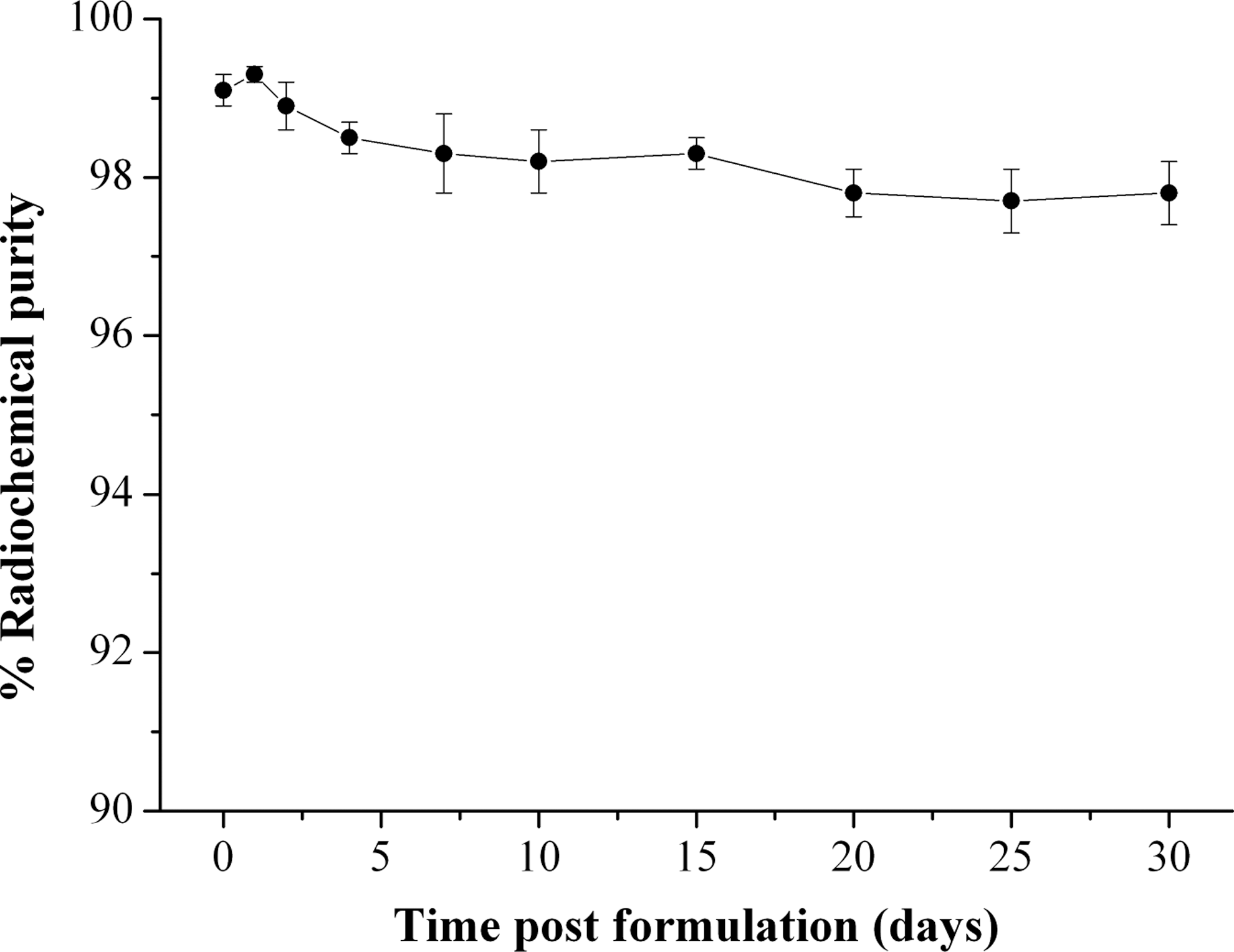
Radiochemical purity of the Na3[32P]PO4 formulation at different time intervals postpreparation.
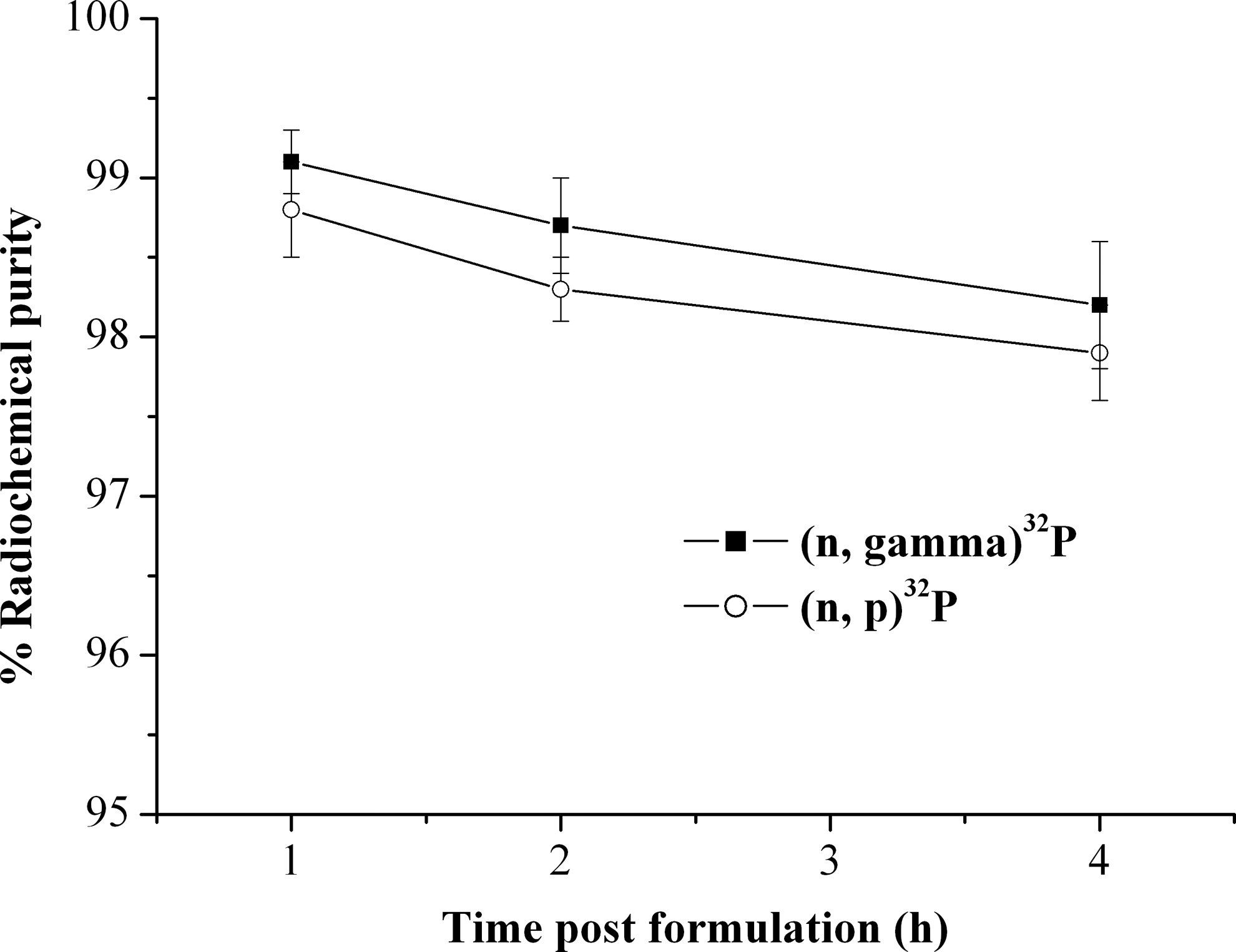
Radiochemical purities of Na3[32P]PO4 formulation prepared using 32P produced by 31P(n,γ)32P route and 32S(n,p)32P route at various time intervals after incubation in human serum at 37°C.
Biodistribution studies
The biodistribution pattern of Na3[32P]PO4 prepared from (n,γ) produced 32P in normal Wistar rats are tabulated in Table 2. The study revealed significant uptake in skeleton (57.47%±0.55% IA) within 3 hours p.i. Significant accumulation of activity was observed in the muscles (14.86%±0.10% IA) at 3 hours p.i. Some uptake was also observed in blood (1.99%±0.04% IA), liver (4.20%±0.06% IA), and GIT (1.57%±0.34% IA) at this time point. However, a steady increase in uptake was observed in skeleton with progress of time accompanied by gradual decrease of accumulated activity from other major nontarget organs/tissue, particularly muscle. While the uptake in muscle was found to decrease to (0.94%±0.10% IA), the skeletal uptake increased to (72.50%±0.59% IA) at 14 days p.i. The biodistribution pattern of Na3[32P]PO4 prepared using NCA 32P is given in Table 3. A comparison of the biodistribution patterns revealed that the two Na3[32P]PO4 formulations prepared using 32P obtained from two different routes exhibit near identical pharmacokinetic properties in normal Wistar rats.
Figures in the parentheses represent standard deviations.
At every time point 4 animals have been used.
Excretion has been calculated by subtracting the activity accounted in all the organs from the total activity injected.
% IA, % injected activity.
Figures in the parentheses represent standard deviations.
At every time point 4 animals have been used.
Excretion has been calculated by subtracting the activity accounted in all the organs from the total activity injected.
Discussion
Despite the introduction of a number of clinically effective agents, namely 89SrCl2, 153Sm-EDTMP, and 186Re-HEDP, for palliative care of bone pain arising from metastases, 32P-sodium orthophosphate continues to be in demand as a cost-effective agent. A study comparing single, oral administration of 444 MBq (12 mCi) of 32P with intravenous administration of 148 MBq (4 mCi) of 89Sr in 31 patients with painful skeletal metastases demonstrated equal efficacy with comparable toxicity. 6
In India, 370–555 GBq (10–15 Ci) of 32P as Na3[32P]PO4 is required annually to meet the need of cancer patients. Thereby, large-scale production of 32P at an affordable cost has significant importance. Our experience in 32P production in “Dhruva” research reactor of our institute reveals that while 31P(n,γ)32P route yields 230±15 MBq (6.2±0.4 mCi) of 32P per mg of red phosphorus target, only 200±30 KBq (5.5±0.8 μCi) of 32P was obtained per mg of sulfur target when irradiation was carried out at a thermal neutron flux of ∼8×10¹³ n.cm2.s−1 (with 1% fast neutrons) for 60 days. It implies that to meet the monthly requirement of ∼37 GBq (∼1 Ci) of 32P activity, 200 g of elemental sulfur needs to be irradiated and this requires at least 12 irradiation positions (maximum capacity of irradiation container at a particular position: ∼18 g for elemental sulfur). On the other hand, thermal neutron bombardment of only 200 mg of phosphorus encapsulated in one irradiation container is sufficient to yield 37 GBq of 32P activity. Moreover, much larger quantity (up to 20 g) of elemental red phosphorus can be irradiated per can. This implies that a maximum of ∼3700 GBq (100 Ci) of 32P activity can be produced using a single irradiation position. Hence, there will be no constraint on the quantity of the 32P activity that could be produced, if this route is employed for the production of 32P.
The present study has demonstrated the preparation of 370–555 MBq doses of Na3[32P]PO4, as administered in human patients for bone pain palliation, in radiochemically pure form using 32P produced from (n,γ) route. The formulation demonstrated good in vitro stabilities. Biodistribution studies carried out in normal Wistar rats (Table 2) showed near identical pattern as obtained with Na3[32P]PO4 formulation prepared using NCA 32P (Table 3), which is currenly used in the clinics. Therefore, it is evident that the use of thermal neutron activation of red phosphorus target would be the more convenient route for production of 32P compared with that of traditional 32S(n,p)32P route for its use in bone pain palliation. This change in production methodology leads to the reduction of a considerable irradiation volume, which in turn can be utilized to enhance the production of other radioisotopes and consequently expected to bring down the cost of production of 32P, thereby making it more affordable to the patients. Apart from this, the postirradiation radiochemical processing in direct activation route is simple compared with the lengthy and tedious procedure involved in the (n,p) route, which in turn significantly reduces the radiation exposure to the working personnel.
Conclusion
Production of 32P by direct activation of elemental red phosphorus target offers a simple and more convenient approach for preparation of raw material for Na3[32P]PO4 injection for use in patients needing palliative care of bone pain arising from skeletal metastasis. Irradiation of red phosphorus target at a neutron flux of 8×10¹³ n.cm2.s−1 for 60 days yielded 32P with a specific activity of 230±15 MBq/mg (6.2±0.4 mCi/mg) having radionuclide purity >99.9%. Doses of 32P-sodium orthophosphate of 370–555 MBq each were formulated using the 32P produced via this route. The formulation exhibited the required radiochemical purity, in vitro stability, and desirable biological properties in normal Wistar rats. The proposed production route of 32P will ensure better utilization of research reactors for large-scale production of other commercially valuable radionuclides such as 131I, 99Mo, 153Sm, and 177Lu.
Footnotes
Acknowledgments
The authors sincerely acknowledge Dr. M. R. A. Pillai, Head, Radiopharmaceuticals Division, Bhabha Atomic Research Centre, for his scientific guidance to this work and for editing the article. The sincere help received from the staff-members of the Animal House Facility of Bhabha Atomic Research Centre during the course of animal experimentations is also gratefully acknowledged.
Disclosure Statement
The authors would like to clarify that there are no financial or other conflicting interests in the work reported.