




Abstract
Objective:
Thulium-170 [T1/2=128.4 days, Eβ(max)=968 keV, and Eγ=84 keV (3.26%)] could be considered an easily producible and cost-effective alternative to 89Sr for the preparation of radiopharmaceuticals for palliation of bone pain arising due to skeletal metastases. Multidentate aminomethylene polyphosphonic acids have already been proven to be effective as carrier moieties for developing radiolabeled bone pain palliation agents using lanthanide radionuclides. Therefore, an attempt was made to evaluate the potential of a series of 170Tm-labeled acyclic (diethylenetriaminepentamethylene phosphonic acid and triethylenetetraminehexamethylene phosphonic acid) and cyclic polyaminopolyphosphonic acids (1,4,7,10-tetraazacyclododecane-1,4,7,10-tetramethylene phosphonic acid [DOTMP] and 1,4,8,11-tetraazacyclotetradecane-1,4,8,11-tetramethylene phosphonic acid [CTMP]) toward their use as alternative bone pain palliation agents.
Experimental:
Thulium-170 was produced by irradiating the natural Tm2O3 target at a thermal neutron flux of 7×10¹³ n·cm−2·s−1 for a period of 60 days. All the phosphonic acid ligands were synthesized and characterized in-house. The protocols for radiolabeling the phosphonic acids with 170Tm were standardized. Biological evaluation of the 170Tm-labeled phosphonic acids were carried out in normal Wistar rats by biodistribution as well as by scintigraphic studies.
Results:
Thulium-170 was produced with adequate specific activity (173 Ci/g, 6.41 TBq/g) and high radionuclidic purity (99.62%). All the 170Tm-labeled phosphonic acids, except 170Tm-CTMP, were prepared with very high radiochemical purity (>98%) under optimized reaction conditions and exhibited high stability. All the agents showed selective skeletal accumulation with insignificant uptake in other vital organs/tissues and major clearance through renal pathway. These findings were also substantiated by scintigraphic studies.
Conclusions:
Although all the 170Tm-labeled phosphonic acids showed significant and selective skeletal accumulation, radiochemical studies indicate that 170Tm-DOTMP is the best choice for carrying out further evaluation toward its use for clinical applications.
Introduction
More than half of the patients suffering from breast, lung, and prostate cancers are reported to develop bone metastases sometime during the course of the disease. 1,2 In the United States alone, every year, more than 200,000 patients experience severe and chronic pain due to the metastases in the bone. 3 Apart from the excruciating pain, other related symptoms, such as lack of mobility, depression, neurological deficits, and those associated with hypercalcemia, adversely affect the quality of life of the patients suffering from bone metastases. 1,2,4,5 Although external beam radiotherapy and administration of narcotic drugs are frequently used in the management of metastatic bone pain of cancer patients, they have multiple side-effects. It is well documented that radionuclide therapy employing radiopharmaceuticals labeled with β−/conversion electron-emitting radionuclides is the best possible option for providing palliative care to the patients suffering from secondary skeletal metastases. 1,2,5 –10 Toward this, moderate energy β− particle emitters are preferred as they are expected to deliver sufficient dose to the bone lesions without much bone marrow suppression. 9 –12 At present, there are quite a few approved radiopharmaceuticals, which are used to provide palliative care to the patients suffering from metastatic bone pain. These include 89SrCl2 (Metastron®) [T1/2=50.5 days, Eβ(max)=1.49 MeV, no γ], Na3 32 PO4 [T1/2=14.3 days, Eβ(max)=1.71 MeV, no γ], and 153Sm-EDTMP (Quadramet®) (EDTMP: ethylenediaminetetramethylene phosphonic acid) [T1/2=47 hours, Eβ(max)=0.81 MeV, Eγ=103 keV (28%)]. 1,2,8,13 –20 Among these, 89SrCl2 provides more flexibility in treatment planning and long-term pain relief to the cancer patients owing to its comparatively longer half-life. 12,16 However, 89Sr being a high-energy β− particle emitter also leads to considerable bone marrow suppression when administered to the patients. Moreover, the absence of gamma photons in 89Sr does not permit simultaneous imaging of the diseased site following the administration of the agent. Apart from these, the production of 89Sr is difficult in most of the reactors as the cross sections of the reactions by which the radionuclide can be produced are very low. 3,18 We have published a preliminary report on the use of 170Tm [T1/2=128.4 days, E(βmax)=968 keV, and Eγ=84 keV (3.26%)] labeled with EDTMP as a potential alternative to 89Sr for bone pain palliation. 21 The β(max) energy of 170Tm is significantly lower compared with 89Sr, and hence, the bone marrow suppression is expected to be much lower. The presence of accompanying low-energy (Eγ=84 keV) gamma photons in low abundances (3.26%) is advantageous in carrying out scintigraphy studies, with minimal radiation dose burden to the patients and bystanders. A major advantage of this radionuclide is the ability to be made in large quantities due to the high thermal neutron capture cross section of 169Tm (σ=103 b, 100% natural abundance). 21
It is well documented that multidentate aminomethylene phosphonic acid ligands form stable complexes with many radiometals, and these complexes have shown potential as bone pain palliative agents. 1,2,17,20 –31 The high affinity of the phosphonic acids toward the calcium present in the actively growing bone of the cancer sites is considered to be the reason of selective accumulation of these ligands in the bone lesions. 1,24,25,29,31,32 Preliminary studies reported with 170Tm-EDTMP have shown encouraging results. 21 In the present article, we have carried out 170Tm labeling and biological studies of polyaminopolyphosphonic acids, namely, diethylenetriaminepentamethylene phosphonic acid (DTPMP), triethylenetetraminehexamethylene phosphonic acid (TTHMP), 1,4,7,10-tetraazacyclododecane-1,4,7,10-tetramethylene phosphonic acid (DOTMP), and 1,4,8,11-tetraazacyclotetradecane-1,4,8,11-tetramethylene phosphonic acid (CTMP) (Fig. 1). The choice of the acyclic phosphonic acid ligands, namely, DTPMP and TTHMP, is based on the fact that the presence of an increasing number of phosphonic acid groups may increase the skeletal uptake exhibited by the agents, as the accumulation is dependent on the affinity of phosphonic acid groups toward the calcium present in the bone. On the other hand, it is reported that cyclic chelators form thermodynamically more stable and kinetically less labile complexes with lanthanides compared to their acyclic analogs. 11,31,33,34 In this study, we report the preparation of 170Tm-labeled DTPMP, TTHMP, DOTMP, and CTMP complexes and their preliminary biological behavior in normal Wistar rats.
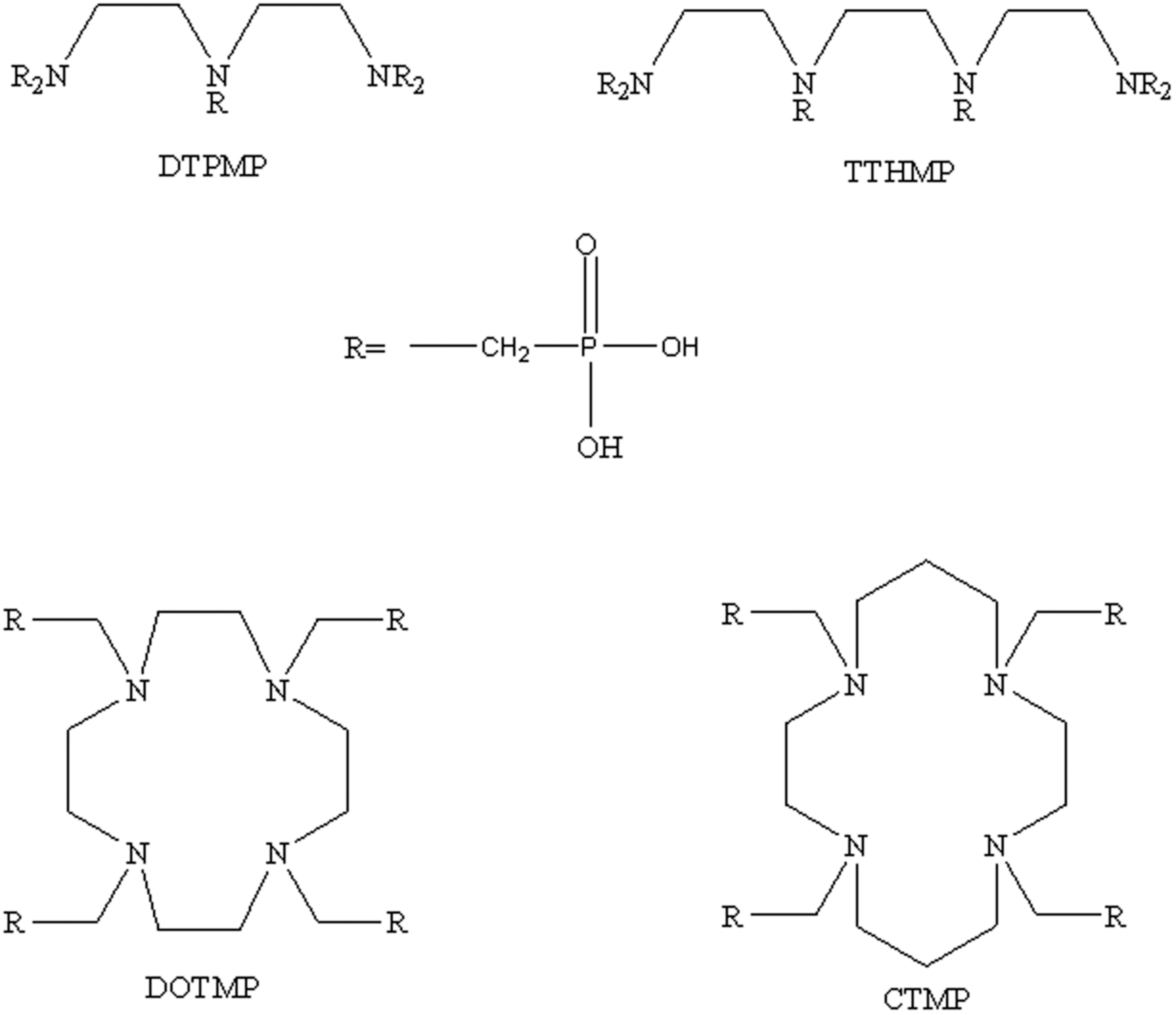
Structures of phosphonic acid ligands used in the present study.
Experimental
Materials and methods
Thulium oxide (spectroscopic grade, 99.999% chemically pure) used as the target material for the production of 170Tm was obtained from Merck. Diethylenetriamine, triethylenetetramine, 1,4,7,10-tetraazacyclododecane (cyclen), 1,4,8,11-tetraazacyclotetradecane (cyclam), orthophosphorus acid, and formaldehyde, used for the syntheses of various acyclic and cyclic phosphonic acid ligands, were obtained from Aldrich Chemical Company. All other chemicals used for the present study were purchased from reputed local manufacturers and were of AR grade. Fourier transform-infrared (FT-IR) and proton-nuclear magnetic resonance (1H-NMR) spectra of the synthesized ligands were recorded using the JASCO FT/IR-420 spectrometer and the 300 MHz Varian VXR 300S NMR spectrometer, respectively. Whatman 3MM chromatography paper was used for paper chromatography (PC) studies.
Radionuclidic purity of 170Tm was determined by using the HPGe detector coupled to a 4K multichannel analyzer (MCA) system. Eu-152 reference source, obtained from Amersham, Inc., was used for both energy and efficiency calibrations of the detector. All other radioactivity measurements were carried out using a well-type NaI(Tl) scintillation counter (Electronics Corporation of India Limited), keeping the baseline at 50 keV and a window of 100 keV for detecting the 84 keV gamma radiation of 170Tm.
Animal experimentations were carried out in normal Wistar rats that were bred and reared in the laboratory animal facility of the Institute under standard management practice. Radioactive counting associated with the animal studies were carried out using a flat-type NaI(Tl) scintillation counter (Electronics Corporation of India Limited) by keeping the baseline and windows at 50 and 100 keV, respectively. Scintigraphic images were recorded using a single-head digital single photon emission computed tomography gamma camera (GE Wipro) with a low-energy high-resolution collimator. The gamma camera was calibrated for 84 keV gamma photons of 170Tm with 20% window for acquisition of the images. Xylazine hydrochloride and ketamine hydrochloride, used for anesthetizing the animals before recording the scintigraphic images, were purchased from Indian Immunologicals Limited and Themis Medicare Limited, respectively. All the animal experiments were carried out in strict compliance with the relevant national laws relating to the conduct of animal experimentation.
Syntheses of ligands
All the polyaminopolyphosphonic acid ligands used in the present study, namely, DTPMP, TTHMP, DOTMP, and CTMP, were synthesized in-house following the procedure reported in the literature. 24,25,35 In brief, these ligands were synthesized by a Mannich-type reaction in the strong acidic condition. This involves dropwise addition of formaldehyde in the refluxing mixture of corresponding amines or polyaza compounds and orthophosphorus acid in the presence of hydrochloric acid. The refluxing was continued for few hours, and the reaction mixtures were poured into cold absolute alcohol after their temperatures were brought down to 4°C. The ligands were recrystallized from aqueous alcohol and used for the subsequent studies. The synthesized ligands were characterized by employing standard spectroscopic techniques, such as FT-IR and 1H-NMR spectroscopy, and comparing the results with that of the reported values.
Production and radiochemical processing of 170Tm
Tm-170 was produced by thermal neutron bombardment on natural Tm2O3 (100% abundance) target in the Dhruva reactor at a flux of 7×10¹³ n·cm2·s−1 for 60 days. In a typical batch, 10 mg of the target was weighed in a quartz ampoule, flame sealed, and irradiated after placing the ampoule inside an aluminum container. After irradiation, the container was decapped inside a lead-shielded plant and the target was dissolved in 10 mL of 1 N HCl by gentle warming. The solution was evaporated to near dryness and reconstituted in 10 mL of double distilled water. Radioactivity assay involving the total activity produced and radionuclidic purity of 170Tm was carried out using a HPGe detector coupled to a 4K MCA system.
Preparation of 170Tm-complexes
Tm-170 complexes of all the phosphonic acid ligands were prepared by following a general protocol involving the incubation of the ligands dissolved in 400 μL of 0.5 M NaHCO3 (pH ∼9) with 550 μL of normal saline and 50 μL of 170TmCl3 (8.85 μg of Tm, 1 mCi, 37 MBq) at room temperature. The pH of the resulting mixtures was adjusted to ∼7 using either a dilute NaOH or HCl solution before the incubation. The effect of variation of different reaction parameters, such as ligand concentration, pH of the reaction mixture (varied by using either dilute NaOH or HCl solution), and reaction time on the complexation yield, was studied extensively for arriving at the optimum radiolabeling protocol for all the ligands.
Quality control techniques
The complexes were characterized, and the radiolabeling yields were determined by employing the PC technique using normal saline as the eluting solvent. An aliquot of the reaction mixtures (∼5 μL) was spotted 1.5 cm above from the one end of the PC strips (12×1 cm). The spots were dried and the strips were eluted in normal saline. Subsequently, the strips were dried, cut into 1 cm segments, and the activity associated with each segment was determined by using a well-type NaI(Tl) detector.
Stability studies
The stability of 170Tm-labeled phosphonic acid complexes was studied by storing the preparations at room temperature and determining the radiochemical purities of the complexes at different time intervals following the standard quality control technique mentioned above.
Biodistribution studies
The preliminary biological behavior of the 170Tm-labeled complexes was studied by carrying out biodistribution studies in normal Wistar rats (6–8 weeks of age) each weighing 225–250 g. Radiolabeled preparations (100 μL, ∼3.7 MBq, ∼100 μCi) were administered in each animal through the tail vein, and the animals were sacrificed by cardiac puncture postanesthesia at 3 hours, 1, 2, and 7 days postinjection (p.i.). Three animals were used for each time point. Various organs and tissues were excised following sacrifice, washed with normal saline, dried, and the radioactivity associated with each organ and tissue was determined using a flat-type NaI(Tl) counter. The weight of each organ was also determined by using an analytical balance. The percentage of injected activity (%IA) in various organs/tissues were calculated from the above data and expressed as percentage IA per gram (%IA/g) of organ/tissue. The total uptake in blood, bone, and muscles was calculated by assuming that 7%, 10%, and 40% of the body weight are constituted by these organs/tissue, respectively. 21,22,36 The activity excreted was indirectly determined from the difference between total IA and the %IA accounted for in all the organs.
Scintigraphic imaging
Distribution patterns of the 170Tm-labeled phosphonic acid complexes in normal Wistar rats were also studied by carrying out scintigraphic imaging studies, for which, each animal was administered with the radiolabeled preparation (200 μL, ∼7.4 MBq, ∼200 μCi) through the tail vein. Serial scintigraphic images were recorded at 3 hours, 1, 2, 4, 7, and 15 days p.i. after anesthetizing the animal with a combination of xylazine hydrochloride and ketamine hydrochloride. All the images were recorded by acquiring 200 K counts using 256×256 matrix size.
Results
Production of 170Tm
Irradiation of 10 mg natural Tm2O3 at a thermal neutron flux of 7×10¹³ n·cm2·s−1 for 60 days yielded 1.51 Ci (55.87 GBq) of 170Tm with a specific activity of 173 Ci/g (6.44 TBq/g) at the end of bombardment (EOB). Gamma-ray spectrum of the appropriately diluted sample recorded after radiochemical processing showed the major gamma peak at 84 keV, which is the photopeak of 170Tm, along with two minor peaks at 54 and 59 keV, which are X-rays associated with the decay of 170Tm. No other photopeaks were visible in the gamma-ray spectrum. However, it is worthwhile to mention that there is a possibility of formation of 171Tm (T1/2=1.92 years) via the double neutron capture on 169Tm, and therefore, 171Tm is expected to be present as a radionuclidic impurity in 170Tm. Although it is difficult to experimentally determine the amount of 171Tm activity formed as it exhibits nearly identical gamma photopeaks with 170Tm, theoretical calculation shows the formation of 5.77 mCi (213.49 MBq) of 171Tm at EOB under the irradiation conditions employed for the present study. Therefore, it can be inferred that 170Tm was obtained with a radionuclide purity of 99.62% at EOB.
Characterization of 170Tm-labeled phosphonic acid complexes
All four 170Tm-labeled phosphonic acid complexes were characterized by PC using normal saline as the eluting solvent. It was observed that 170Tm-labeled complexes moved toward the solvent front (Rf=0.9–1.0 for 170Tm-DTPMP and 170Tm-TTHMP, Rf=0.8–1.0 for 170Tm-CTMP, and Rf=1.0 for 170Tm-DOTMP), whereas the uncomplexed 170TmCl3 remained at the point of spotting (Rf=0.0) under identical conditions. PC patterns of 170Tm-DTPMP, 170Tm-TTHMP, 170Tm-CTMP, and 170Tm-DOTMP are shown in Figure 2.
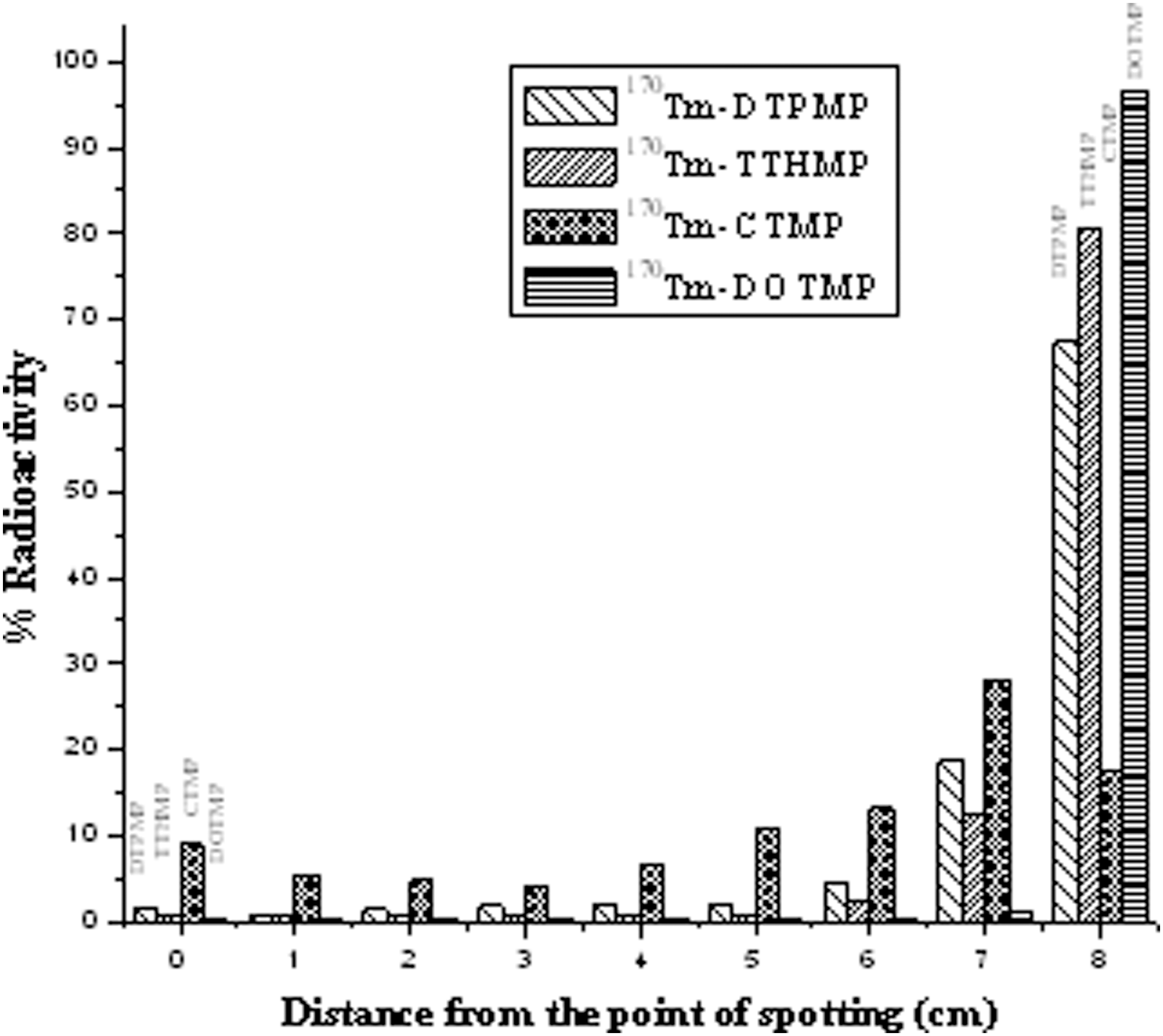
Paper chromatography patterns of 170Tm-DTPMP, 170Tm-TTHMP, 170Tm-DOTMP, and 170Tm-CTMP complexes. DTPMP, diethylenetriaminepentamethylene phosphonic acid; TTHMP, triethylenetetraminehexamethylene phosphonic acid; DOTMP, 1,4,7,10-tetraazacyclododecane-1,4,7,10-tetramethylene phosphonic acid; CTMP, 1,4,8,11-tetraazacyclotetradecane-1,4,8,11-tetramethylene phosphonic acid.
Radiochemical studies
Efforts were made to prepare all the 170Tm-labeled phosphonic acid complexes with maximum possible radiochemical purity, and toward these, radiolabeling experiments were carried out by varying different reaction parameters, such as ligand concentration, pH of the reaction mixture, reaction time, and incubation temperature. Figure 3 shows the effect of ligand concentration on the complexation yield of different 170Tm-labeled phosphonic acid complexes. It was observed that the amount of ligands used have a significant effect on the complexation yields. While 170Tm-DTPMP and 170Tm-TTHMP complexes could be prepared with >98% complexation yield by using a ligand concentration of 2.5 mg/mL, the same complexation yield of 170Tm-DOTMP could be achieved by using only 50 μg/mL of DOTMP. On the other hand, using 2.5 mg/mL ligand concentration, only 90% complexation yield for 170Tm-CTMP could be obtained. It was observed that to prepare 170Tm-CTMP with a complexation yield of ∼97%, minimum 10 mg/mL of CTMP was needed.
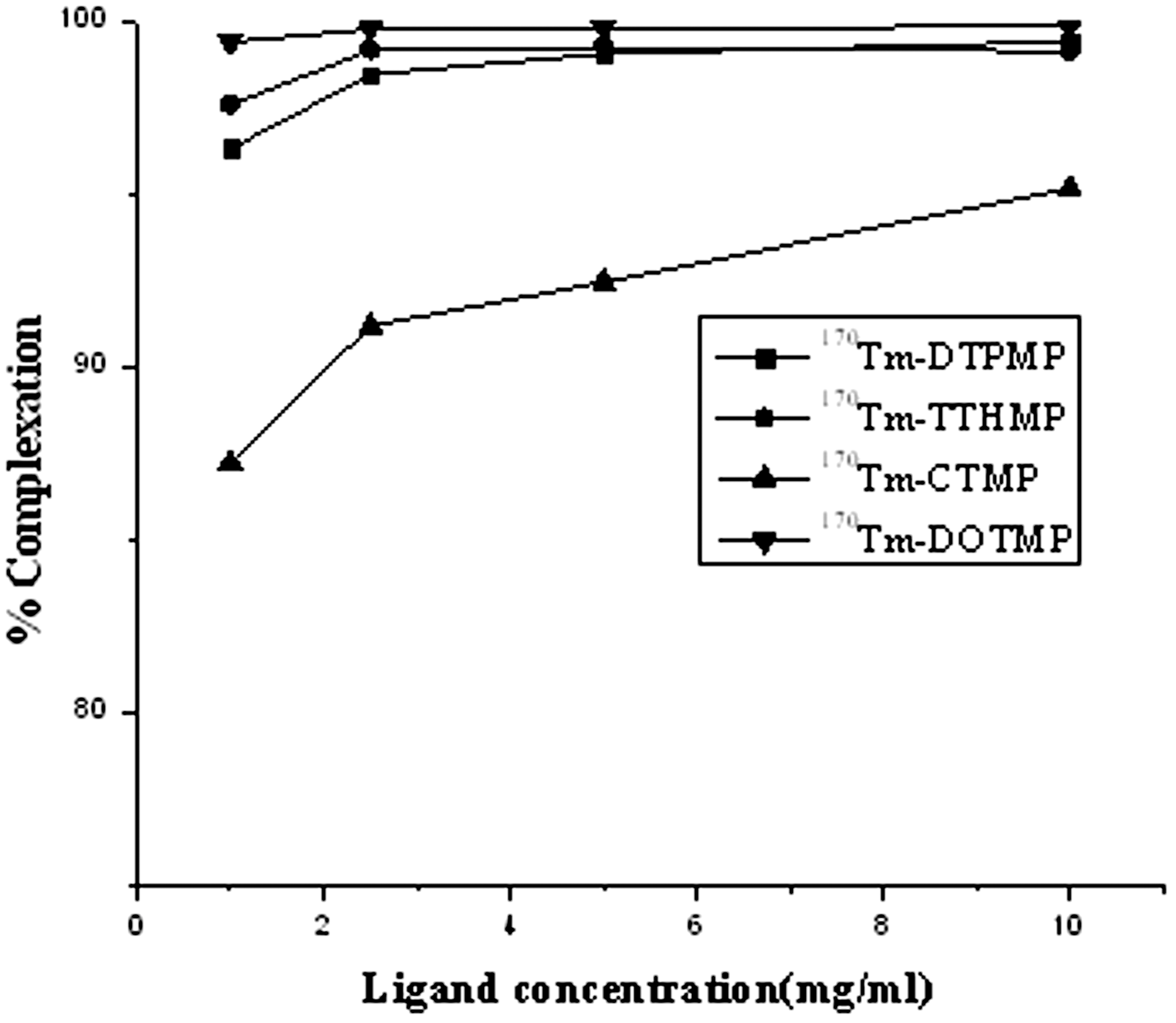
Effect of ligand concentrations on the complexation yields of 170Tm-labeled phosphonic acid complexes.
To study the effect of incubation time on the complexation yield, reaction mixtures were incubated at room temperature for different time periods and complexation yields were determined using the standard quality control technique mentioned above. It was observed that for DOTMP, >99% complexation yield was obtained almost instantaneously, whereas for TTHMP and DTPMP, 15 minutes of incubation at room temperature was found to be adequate for obtaining ∼98% complexation yield. However, in case of CTMP, 30 minutes of incubation at room temperature was required to obtain ∼95% complexation yield.
To study the effect of pH on the complexation yield, the complexes were prepared at different pH ranging between 2 and 10. It was observed that for 170Tm-DTPMP, 170Tm-TTHMP, and 170Tm-CTMP, maximum complexation yield could be achieved in the pH range of 7–10, whereas for 170Tm-DOTMP, ∼99% complexation yield could be obtained at any pH between 2 and 10. Figure 4 shows the effect of variation of pH on the complexation yield of different 170Tm-labeled phosphonic acids.

Effect of pH of the reaction mixture on the complexation yields of 170Tm-labeled phosphonic acid complexes.
The effect of metal concentration on the complexation yield was studied by keeping the ligand concentration fixed at the optimized value and gradually increasing the amount of thulium by adding carrier 169TmCl3 solution during the complexation. Table 1 shows the complexation yield at different metal to ligand ratios for all the four polyaminopolyphosphonic acid ligands. It was observed that while ∼78% complexation yield could be achieved for 170Tm-DOTMP at the metal:ligand ratio of 1:1, it was only ∼20% for 170Tm-labeled acyclic phosphonic acids (DTPMP and TTHMP) and ∼40% for 170Tm-CTMP under identical conditions. It is also evident that to achieve >99% complexation yield, the use of the metal:ligand ratio of 1:20 is essential for DTPMP and TTHMP, whereas the same could be achieved by using the metal:ligand ratio of 1:10 in case of DOTMP. On the other hand, the 170Tm-CTMP complex could not be prepared with >99% complexation yield even by using a reasonably high amount of the ligand. The optimum protocols for the preparation of 170Tm-labeled phosphonic acid complexes, as arrived from the above sets of radiochemical studies, are summarized in Table 2.
DTPMP, diethylenetriaminepentamethylene phosphonic acid; TTHMP, triethylenetetraminehexamethylene phosphonic acid; DOTMP, 1,4,7,10-tetraazacyclododecane-1,4,7,10-tetramethylene phosphonic acid; CTMP, 1,4,8,11-tetraazacyclotetradecane-1,4,8,11-tetramethylene phosphonic acid.
Stability studies
The 170Tm complexes of DTPMP, TTHMP, and DOTMP, prepared under optimized conditions, were found to be stable (retained >95% radiochemical purity) at room temperature for 30 days postpreparation, up to which, the studies were continued. However, the stability of 170Tm-CTMP was found to be much less as its radiochemical purity was reduced to ∼80% at 15 days postpreparation under identical conditions.
Biodistribution studies
The results of the biodistribution studies of 170Tm-DTPMP, 170Tm-TTHMP, 170Tm-DOTMP, and 170Tm-CTMP, carried out in normal Wistar rats, are shown in Tables 3 –6, respectively. The results of the biodistribution studies revealed significant bone uptake (2–3% IA·g−1) within 3 hours p.i. for three of the 170Tm-labeled phosphonic acid complexes, namely, 170Tm-DTPMP, 170Tm-TTHMP, and 170Tm-DOTMP while it was found to be ∼1.5% IA·g−1 for 170Tm-CTMP. Although the bone uptake of 170Tm-CTMP was observed to increase with time, it reached a maximum value of ∼2.5% IA·g−1. For all the remaining three 170Tm-labeled phosphonic acid complexes, the skeletal uptake was observed to remain almost constant until 7 days postadministration, up to which the biodistribution studies were continued. None of the complexes showed significant uptake in any of the major organs/tissues other than skeleton at any time point of study. The nonaccumulated activity exhibited a major clearance (30–50% IA within 24 hours p.i.) through the renal pathway for all the 170Tm-labeled complexes.
Figures in the parentheses represent standard deviations.
Values are the average for three animals at each time point.
Excretion has been calculated by subtracting the activity accounted in all the organs from the total activity injected.
Figures in the parentheses represent standard deviations.
Values are the average for three animals at each time point.
Excretion has been calculated by subtracting the activity accounted in all the organs from the total activity injected.
Figures in the parentheses represent standard deviations.
Values are the average for three animals at each time point.
Excretion has been calculated by subtracting the activity accounted in all the organs from the total activity injected.
Figures in the parentheses represent standard deviations.
Values are the average for three animals at each time point.
Excretion has been calculated by subtracting the activity accounted in all the organs from the total activity injected.
Scintigraphic imaging studies
Scintigraphic images of normal Wistar rats injected with 170Tm-labeled phosphonic acid complexes recorded at various postadministration time points corroborated the results obtained in biodistribution studies. The images exhibited selective skeletal accumulation of the radiolabeled phosphonic acid complexes with no retention of activity in any other major organs/tissues. The whole-body images of Wistar rats injected with 170Tm-DTPMP, 170Tm-TTHMP, 170Tm-DOTMP, and 170Tm-CTMP recorded at 1 day p.i. are shown in Figure 5A–D, respectively.

Whole-body scintigraphic images of
Discussion
Palliative therapy provided to the patients suffering from skeletal metastases using bone-seeking radiopharmaceuticals constitutes the second most widely used application of therapeutic radiopharmaceuticals. 3 However, in spite of the availability of several proven and efficacious radiopharmaceuticals, such as 153Sm-EDTMP, Na3 32 PO4, 89SrCl2, and 186Re-HEDP, 11 –17 this modality is yet to harness its full potential. This is evident from the restricted use of the radiopharmaceuticals compared with other treatment modalities, such as the use of analgesics or hemibody radiation, which are most frequently used to treat the cancer patients needing palliative care. This may be attributed to several factors that include difficulty in transportation of radiopharmaceuticals owing to the short half-life of the radionuclides involved (153Sm-EDTMP and 186Re-HEDP) and/or the higher cost of the radiopharmaceuticals arising due to the limited production capacity of the radionuclide (89SrCl2). 153Sm-EDTMP (Quadramet) is regularly used in the clinics and already proven to be a successful radiopharmaceutical. 20,37,38 The radionuclide can be easily produced in adequate quantities and sufficient radionuclide purity by a simple (n,γ) reaction in a medium flux research reactor. However, the short half-life of 153Sm (T1/2=47 hours) is a major impediment of the widespread distribution of the agent across the globe. 3 On the other hand, 89SrCl2 (Metastron) enjoys excellent logistic advantage owing to the comparatively longer half-life of 89Sr (T½=50.5 days) and thus could be supplied to any part of the globe without much concern about the decay loss. Moreover, the need of just 4–5 mCi (148–185 MBq) of 89Sr activity as a single patient dose indicates a much lesser cumulative activity requirement to meet the global demand. Hence, 89SrCl2 is an established radiopharmaceutical that finds wider, but restrictive, use in several countries in the world. 3,39,40 However, the major disadvantage toward its widespread use arises from the large-scale production of 89Sr, which requires the use of an enriched target and a very high flux reactor. 3 Strontium-89 could be produced by two different routes, namely, 88Sr(n,γ)89Sr and 89Y(n,p)89Sr. Despite the high natural isotopic abundance of 88Sr (82%), further enrichment is required to minimize the coproduction of 85Sr impurity when 89Sr is produced by the former route. More significantly, very low thermal neutron capture cross section of 88Sr(n,γ)89Sr (0.0058 b) necessitates the use of a very high flux reactor (>5×10¹⁴ n·cm2·s−1) to produce 89Sr with a reasonably good production yield and adequate specific activity. 3,21 On the other hand, no-carrier-added 89Sr can be produced using 89Y(n,p)89Sr nuclear reaction, but the cross section of this reaction with thermal neutrons is very low (0.0002044 b), thereby again making it essential to produce the radionuclide in a very high flux reactor. In fact, it is reported that the production of 89Sr can be accomplished more effectively with high-intensity fast neutron spectral sources (e.g., a spallation source) rather than with the current traditional research reactors. 41
Thumium-170 could be considered a cost-effective alternative to 89Sr for developing bone pain palliation agents. Thulium-170 can be produced by neutron bombardment on natural Tm2O3 target. The mononuclidic nature of thulium ensures that the radionuclide can be produced with high radionuclidic purity using the inexpensive natural target. 21 Most importantly, the high thermal neutron capture cross section of 169Tm (103 b) helps to produce 170Tm in reasonably good specific activity and adequate quantity using the medium flux research reactors. As in the present case, 1.51 Ci (55.87 GBq) of 170Tm was produced with a specific activity of 173.37 Ci/g (6.41 TBq/g) by irradiating 10 mg of natural Tm2O3 target at a thermal neutron flux of 7×10¹³ n·cm2·s−1 for a period of 60 days. The long half-life ensures that the radionuclide could be supplied to any corner of the world without much decay loss. Apart from the production feasibilities, 170Tm also scores over 89Sr for bone pain palliation application owing to its more favorable nuclear decay characteristics. The comparatively lower β− (max) energy of 170Tm is expected to cause less bone marrow toxicity, which is one of the prime requirements of bone pain palliative therapy. 21 Moreover, it is simple to follow the pharmacokinetics and study the dosimetry of 170Tm-based agents owing to the presence of low-energy gamma-ray component.
The use of a wide variety of phosphonic acid groups labeled with an array of radionuclides has been reported in the literature for bone pain palliation application. 1,2,17,20 –31 Tm-170 has also been coupled with EDTMP and its potential as a bone pain palliative has been documented by us earlier. 21 Although 170Tm-EDTMP has shown promising results in the preliminary studies, it is essential to study the other phosphonic acid derivatives to find the most suitable 170Tm-labeled polyaminopolyphosphonic acid, which could be translated toward human administration. Therefore, in the present study, a series of polyaminoployphosphonic acids were chosen for complexation with 170Tm and their radiochemical and preliminary biological behaviors were studied.
It is evident from the present studies that, apart from the 170Tm-CTMP, all the other three complexes, namely, 170Tm-DTPMP, 170Tm-TTHMP, and 170Tm-DOTMP, could be prepared with very high radiochemical purity (>98%) and with excellent stability by incubating the ingredients at room temperature using a reasonable amount of the ligands. It is also apparent that for DOTMP, a minimum amount of ligand is required to prepare a highly stable 170Tm-DOTMP complex. When attempts were made to prepare the 170Tm-phosphonic acid complexes using an equimolar amount of metal and ligand, it was observed that only 170Tm-DOTMP complex is formed with a reasonably good yield of ∼80%, and for all the remaining phosphonic acid complexes, the yield obtained was between 20% and 40%. All these studies indicate toward the comparatively higher thermodynamic stability of 170Tm-DOTMP over the other 170Tm-labeled phosphonic acids studied. The 170Tm-DOTMP complex prepared by using only 1 mg of DOTMP has shown high in vitro stability at room temperature until 30 days. Moreover, the complex could be prepared in high yields at any pH between 2 and 10.
All the 170Tm-labeled phosphonic acids showed selective localization in skeleton with insignificant retention of activity in any of the vital organs/tissues in normal Wistar rats. The nonaccumulated activity showed clearance through renal pathway. The skeletal uptake observed in all the four 170Tm-labeled phosphonic acids studied is found to be closely comparable with each other. These findings were also corroborated in the scintigraphic studies. Therefore, the biological behavior of the 170Tm-labeled phosphonic acids studied appeared to be similar. However, from the radiochemical studies, it is concluded that 170Tm-labeled DOTMP is the best possible candidate for further development toward clinical applications.
Conclusions
A series of aminomethylene phosphonic acid ligands comprising of both acyclic and cyclic polyaminopolyphosphonic acids were synthesized in-house and labeled with 170Tm, a potential radionuclide for developing metastatic bone pain palliation agents. All the complexes except 170Tm-CTMP were prepared with good radiochemical purity and excellent stability at room temperature. Preliminary biological studies carried out in normal Wistar rats showed selective accumulation of activity in the skeleton with insignificant retention in any of the vital organs/tissues for all the 170Tm-labeled phosphonic acids. The nonaccumulated activity exhibited major renal clearance. These observations were also corroborated in scintigraphy studies. Although the biological behaviors appear to be quite similar for all the 170Tm-labeled phosphonic acids studied, radiochemical studies indicate that 170Tm-DOTMP is the best choice for carrying out further evaluation toward its clinical use.
Footnotes
Acknowledgments
The authors thank Dr. S.V. Thakare and Mr. K.C. Jagadeesan for their help in carrying out irradiation of Tm target and Mr. Shahir Alam Khan for radiochemical processing of the irradiated target. The help rendered by the staff members of the Animal House Facility of Bhabha Atomic Research Centre in carrying out the biological studies is also acknowledged.
Disclosure Statement
The authors clarify that there is no financial or other conflict of interests in the work reported.