




Abstract
An unsymmetrically substituted porphyrin, 5-[4-(3-amino)-n-propyloxyphenyl]-10,15,20-tris-(4-carboxymethyleneoxyphenyl)porphyrin, was synthesized and coupled with p-NCS-benzyl-DOTA [p-isothiocyanato-benzyl-1,4,7,10-tetraazacyclododecane-1,4,7,10-tetraacetic acid] for exploring its possible potential in targeted tumor therapy. The porphyrin-DOTA conjugate was radiolabeled with 90Y, obtained from a 90Sr/90Y electrochemical generator, developed in-house. Biodistribution studies performed in Swiss mice bearing fibrosarcoma tumor showed good tumor uptake (∼3.4% injected activity in per g of tumor) within 30 minutes postinjection. The tumor activity decreased with the progress of time, however, tumor to blood and tumor to muscle ratios considerably increased at 4 days postadministration owing to the clearance of the initially accumulated activities from the nontarget organs. The nonaccumulated activity exhibited major clearance through renal pathway.
Introduction
T
Porphyrins are tetrapyrrolic macrocycles, which have been extensively studied for photodynamic therapy (PDT), 13 –16 and in boron neutron capture therapy for destroying tumor cells. 17,18 Although the mechanism of preferential localization of porphyrins in tumor lesions is not known with certainty, there are explanations that attribute preferential localization of these macrocyclic compounds to the properties of tumor itself, which include low pH, elevated number of low density lipoprotein, presence of macrophages, a leaky vasculature, and so on. 19 –21 Contrary to PDT, which is an invasive technique used to achieve the therapeutic effects, 19 –21 the preferential localization of porphyrins in tumor cells can be exploited for cancer therapy by radiolabeling them with suitable therapeutic radioisotopes.
In the present study, we report our work on the development of a potential agent for targeted therapy based on a suitably modified porphyrin derivative labeled with 90Y. An unsymmetrically substituted porphyrin was synthesized and then attached to the macrocyclic chelator, DOTA (1,4,7,10-tetraazacyclododecane-1,4,7,10-tetraacetic acid) for rendering it suitable for radiolabeling with 90Y. The peripheral substituents in the porphyrin moiety was designed such that only one site of attachment was available for conjugation with DOTA. To achieve that, 5-[4-(3-amino)-n-propyloxyphenyl]-10,15,20-tris-(4-carboxymethyleneoxyphenyl)porphyrin was coupled with p-NCS-benzyl-DOTA. p-NCS-benzyl-DOTA was chosen as the bifunctional chelating agent for the present study due to the high thermodynamic and kinetic stability of Y+3-DOTA conjugate. 22 The resultant porphyrin-DOTA conjugate was radiolabeled with 90YCl3 obtained from an electrochemical 90Sr/90Y generator. 23 Further, in-vivo biodistribution studies in tumor-bearing animals were carried out to explore the potential of this novel 90Y-DOTA-porphyrin conjugate.
Materials and Methods
Pyrrole, 4-hydroxybenzaldehyde, ethylbromoacetate, nitrobenzene, di-tert-butyldicarbonate, trifluoroacetic acid, and bromopropylamine, which were used for the synthesis of the porphyrin derivative, were purchased from Aldrich Chemical Company. Propionic acid was obtained from S.D. Fine Chemicals. p-NCS-benzyl-DOTA was procured from Macrocyclics. Analytical thin-layer chromatography (TLC) was performed with silica gel plates (Silica Gel 60 F254) obtained from E. Merck. Flexible silica gel plates used for carrying out preparative TLC studies were obtained from Bakerflex Chemical Company. Paper chromatography (PC) strips used in the present study were purchased from Whatman. Column chromatography was performed using silica gel (60–120 mesh size) purchased from E. Merck (India). All other chemicals were of analytical grade and used without further purification unless mentioned otherwise.
Ultraviolet-visible (UV-Vis) spectra were recorded using JASCO V-530 UV/VIS spectrophotometer. Fourier Transform Infra-Red (FT-IR) spectra were recorded in a JASCO FT/IR-420 spectrophotometer using KBr pellets. Proton nuclear magnetic resonance (1H-NMR) spectra were recorded in a 300 MHz Varian VXR 300S spectrometer using CDCl3 or D2O as the solvent. Mass spectra were recorded on QTOF Micromass Instrument using electron spray ionization (ESI) in positive mode. The high-performance liquid chromatography (HPLC) system (PU 1580) was obtained from JASCO. The elution was monitored by detecting the radioactivity signal using a NaI(Tl) detector coupled with the HPLC system. All the solvents used for HPLC were degassed and filtered prior to use and were of HPLC grade.
Female Swiss mice (6–8 weeks age) were bred and reared in the laboratory animal facility of our institute under standard management practice. Fibrosarcoma cell line, used for raising the tumors, was purchased from the National Centre for Cell Science. Radioactive counting associated with the animal studies were carried out using a flat-type NaI(Tl) scintillation counter obtained from Electronics Corporation of India Limited. All the animal experiments reported in the article were carried out in strict compliance with the relevant national laws relating to the conduct of animal experimentations.
Synthesis of porphyrin-BFCA conjugate
The porphyrin derivative, namely 5-[4-(3-amino)-n-propyloxyphenyl]-10,15,20-tris-(4-carboxymethyleneoxyphenyl)porphyrin (I) was synthesized in-house following the procedure reported in the literature. 24,25 In brief, the precursor porphyrin 5-(4-hydroxyphenyl)-10,15,20-tris-(carboethoxymethyleneoxyphenyl)porphyrin was synthesized by the reaction of 4-carboethoxymethyleneoxybenzaldehyde, 4-hydroxybenzaldehyde, and pyrrole using modified Adler–Longo method. 24,25 Subsequently, amino group was introduced in the porphyrin moiety using N-Boc-3-bromopropylamine, followed by the deprotection of amino group with TFA (trifluoroacetic acid). Finally, three ester groups were hydrolyzed under alkaline condition to yield the desired porphyrin (I).
The scheme for the synthesis of porphyrin-BFCA conjugate is shown in Figure 1. Porphyrin-p-NCS-benzyl-DOTA conjugate (II) was prepared by allowing p-NCS-benzyl-DOTA (11 mg, 0.02 mmol) to react with the synthesized porphyrin derivative (I) (20 mg, 0.02 mmol) in presence of 5 mL of acetonitrile. The pH of the reaction mixture was adjusted to 9 by using 2N KOH solution and the reaction was continued at room temperature for 48 hours. The progress of the reaction was monitored by TLC using 5% ammonium hydroxide in methanol as the eluting solvent. The crude conjugate thus obtained was purified by preparative TLC using 3% ammonium hydroxide in methanol as the mobile phase whereby ∼25 mg (∼80% yield) of the pure porphyrin-BFCA conjugate was obtained. The purified product thus obtained was characterized by spectroscopic techniques, namely FT-IR, 1H-NMR, and ESI-MS.
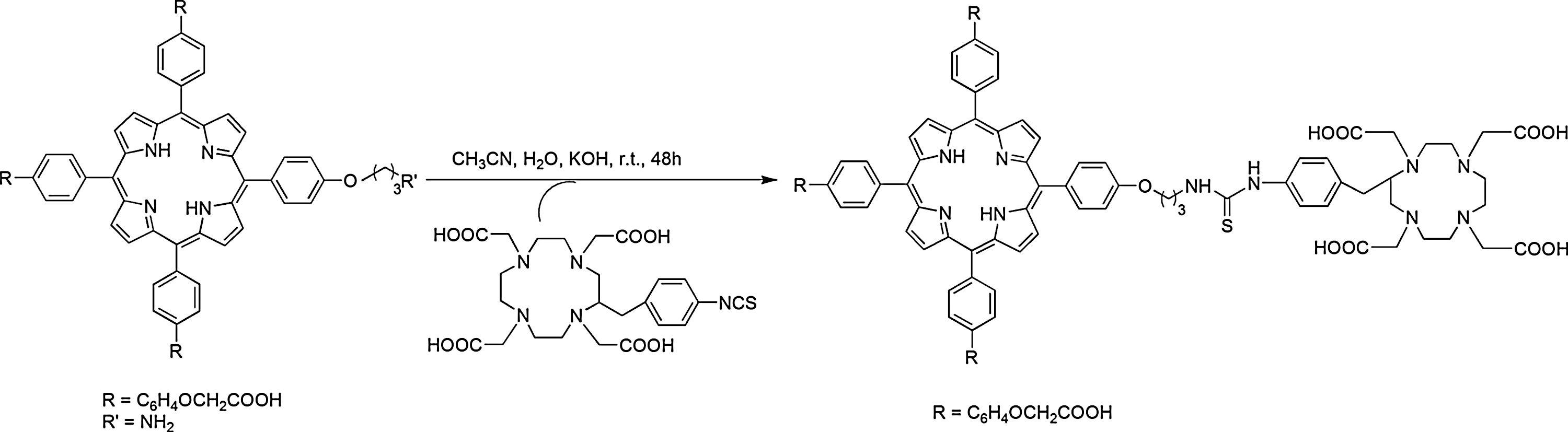
Synthetic scheme of porphyrin-p-NCS-benzyl-DOTA conjugate.
FT-IR (KBr, ν cm−1): 3210-3080 (-OH, NH2), 1725 (>C=O), 1650 (-NH bending).
1H-NMR (D2O, δ ppm): −2.80 (s, 2H, >N
ESI-MS (m/z): (calc.) C77H76O18N10S 1460.51; (obs.) (M+K) 1499.45.
Production of 90Y from electrochemical 90Sr/90Y generator
Yttrium-90 used for the present study was obtained from an electrochemical 90Sr/90Y generator developed in-house. In brief, a 2M HNO3 solution containing 90Sr in equilibrium with 90Y is used as an electrolyte and radionuclidically pure 90Y was obtained by a two-step electrolysis process. 23 The first electrolysis was performed for 90 minutes in 90Sr(NO3)2 feed solution at pH 2–3 at a potential of −2.5 V with 100–200 mA current using platinum electrodes. The platinum cathode on which 90Y was deposited during the first cycle of electrolysis was removed and used as an anode in the second step along with a fresh circular platinum electrode as cathode. The second electrolysis step was performed for 45 minutes in 3 mM HNO3 at a potential of −2.5 V with 100 mA current. The 90Y deposited on the circular cathode after the second electrolysis was dissolved in hydrochloric acid to obtain 90YCl3, which was subsequently used for all the studies. Prior to radiolabeling, radionuclidic purity of 90Y was evaluated following extraction paper chromatography (EPC). 26
Radiolabeling of porphyrin-DOTA conjugate with 90Y
For 90Y labeling of the porphyrin-DOTA conjugate, first a stock solution of the conjugate was prepared by dissolving it in 0.1 M ammonium acetate buffer (pH 5) with a concentration of 5 mg/mL. To 20 μL of this stock solution (100 μg conjugate), 210 μL of 0.1 M ammonium acetate buffer (pH 5) and 20 μL of 90YCl3 were added and the resulting solution was incubated at 60°C–70°C for a period of 1 hour. Several reaction parameters such as ligand concentration, reaction time, incubation temperature and so on were varied widely to obtain the 90Y-labeled porphyrin-DOTA conjugate with maximum radiochemical purity.
Purification of 90Y-labeled porphyrin-DOTA conjugate
Purification of 90Y-labeled porphyrin-DOTA conjugate was carried out using Sep-pak® C18 cartridge following the procedure mentioned below. The cartridge was preconditioned with 4 mL of ethanol followed by 2 mL of distilled water. The crude complex mixture was loaded in the cartridge and subsequently washed with 4 mL of distilled water whereby uncomplexed 90Y was eluted out from the column. Finally, on eluting the cartridge with 1 mL of ethanol yielded the radiochemically pure 90Y-labeled porphyrin-DOTA conjugate. The ethanol was removed by gentle heating and the radiolabeled complex was reconstituted in normal saline for further studies.
Characterization of 90Y-labeled porphyrin-DOTA conjugate
The radiolabeling yield was determined by PC and HPLC studies. PC was carried out using Whatman 3MM paper (12 cm×1 cm) using acetonitrile: water (1:1 v/v) as the eluting solvent. HPLC was carried out using a dual pump HPLC unit with a C-18 reverse phase column (25 cm×0.46 cm) and a flow rate of 1 mL/min was maintained. The HPLC profile was monitored by tracking the radioactivity signals. Water (solvent A) and acetonitrile (solvent B) containing 0.1% trifluoroacetic acid were used as the mobile phase and gradient elution (0–28 minutes: 90% A-10% A; 28–30 minutes: 10% A; 30–32 minutes, 10% A-90%) was adopted for determining the complexation yield.
Biodistribution studies
Biological behavior of 90Y-labeled porphyrin-DOTA conjugate was studied in Swiss mice bearing fibrosarcoma tumors. Fibrosarcoma cells were prepared in normal saline (106 cells/mL) and 200 μL of the cell-suspension was subcutaneously injected into each Swiss mice weighing 20–25 g. The animals were observed for visibility of tumors and subsequently allowed to grow for 2 weeks to attain a tumor size of ∼1 cm diameter. The purified 90Y-labeled conjugate [100 μCi (3.7 MBq) in 100 μL] was injected through the tail vein of each animal. The mice were sacrificed by cardiac puncture postanesthesia at 30 minutes, 3 hours, 1, 2, and 4 days postinjection (p.i.). All tissue/organs along with the tumor were excised, weighed, and radioactivity associated with them was measured using a flat-type NaI(Tl) counter. Similarly, blood was collected during the time of cardiac puncture and counted in the same counter for determining the associated blood activity. The percentage of injected activity (%IA) accumulated in various organs/tissue and tumor was calculated from the above data. Total activity accumulated in the blood, muscle, and bone were determined by considering the blood, muscle, and bone weight to be 7%, 40%, and 10% of the total body weight, respectively. 27,28 The activity excreted was indirectly determined from the difference between total injected activity and %IA accounted for all the organs.
Results and Discussion
Synthesis of porphyrin-BFCA conjugate
The unsymmetrical porphyrin, 5-[4-(3-amino)-n-propyloxyphenyl]-10,15,20-tris-(4-carboxymethyleneoxyphenyl)porphyrin (I) was synthesized and characterized by following the procedure reported in the literature. 24,25 For labeling with 90Y, the porphyrin derivative was coupled with a suitable macrocyclic BFCA, p-NCS-benzyl-DOTA, in presence of 2 N KOH in acetonitrile. The formation of porphyrin-p-NCS-benzyl-DOTA conjugate was confirmed by spectroscopic techniques, namely FT-IR, 1H-NMR, and ESI-MS. The signals and the peak intensities observed in the 1H-NMR spectrum were consistent with the expected structure of the porphyrin-BFCA conjugate. Conclusive evidence indicating the formation of the porphyrin-BFCA conjugate was also obtained from the m/z value observed in the mass spectrum.
Production of 90Y
Yttrium-90 used in this investigation was obtained from an electrochemical 90Sr/90Y generator, which was found to be effective in providing ∼3.7 GBq (100 mCi) of “no carrier added” grade 90Y per batch on a weekly basis. The overall yield of 90Y was >90% and 90Sr levels were found to be 30.23±15.21 kBq (817±411 nCi) per 37 GBq (1 Ci) of 90Y, as estimated by EPC. 26 This implies that radionuclidic purity of 90Y obtained was >99.9999%.
Radiochemical studies
The radiolabeling studies were carried out by incubating the porphyrin-DOTA conjugate with 90YCl3 in presence of ammonium acetate at 60–70°C for 1 hour. A maximum radiolabeling yield of ∼85% was obtained under the optimized conditions, which was determined both by PC and HPLC studies. In PC, carried out using acetonitrile and water (1:1 v/v) was the eluting solvents, the radiolabeled conjugate moved toward the solvent front (Rf=0.6–0.7), while uncomplexed 90YCl3 remained at the point of spotting (Rf=0.0), under identical conditions. In HPLC, the radiolabeled conjugate eluted as a single species with a retention time of about 16 minutes while 90YCl3 eluted within 3 minutes (Fig. 2A).

High-performance liquid chromatography profile of
Purification of 90Y-labeled porphyrin-BFCA conjugate
The 90Y-labeled porphyrin-BFCA conjugate was further purified by using Sep-pak® C18 cartridge. Radiochemical purity of the purified complex was determined by HPLC studies and found to be 100%. A typical HPLC profile of the purified complex is shown in Figure 2B. This purified complex was used for subsequent biological studies.
Biodistribution studies
The uptake of 90Y-labeled porphyrin-BFCA conjugate in the tumor and different organs/tissue of Swiss mice bearing fibrosarcoma tumors at different postinjection times is shown in Table 1. The results of the biodistribution studies revealed significant tumor uptake within 30 minutes p.i. (3.46±0.41%IA/g). Accumulation of activity is also observed in various organs/tissue, such as blood (3.70±0.37%IA/g), liver (3.89±1.01%IA/g), GIT (2.71±0.86%IA/g), kidneys (6.87±1.95%IA/g), and lungs (3.68±1.17%IA/g) at this time point. However, the uptake in the nontarget organs was observed to reduce considerably with the progress of time. Tumor uptake was also observed to reduce with time and found to be 0.14±0.12%IA/g at 4 days p.i. However, due to the clearance of activity from muscle and blood, tumor/blood and tumor/muscle ratios increased considerably with time. The nonaccumulated activity exhibited major clearance through renal pathway.
Five animals were used for each time point.
The figures in the parentheses indicate standard deviations.
The figures in boldface indicate tumor uptakes.
%Excretion has been indirectly calculated by subtracting the activity accounted for all the organs from total injected activity.
Discussion
Yttrium-90-labeled radiopharmaceuticals such as 90Y-ibritumomab tiuxetan (Zevalin®), 90Y-DOTA-TOC, and 90Y-microspheres are successfully used for the treatment of Non-Hodgkin's lymphoma, neuroendocrine tumors, and liver cancer, respectively. 6,29 –31 Apart from the suitable radionuclidic properties as a high-energy β− emitter useful for targeted therapy, 90Y offers the possibility of being made in large quantities as its parent radionuclide, 90Sr is available in plenty as a long-lived fission product. 32 Generator eluted 90Y is also no carrier added and hence offers the possibility of making high specific activity radiotracers. Several separation technologies have also been developed for the isolation of radionuclidically pure 90Y suitable for radiopharmaceutical application. 12 One of the most important criteria is to ensure the presence of extremely low (<10−4%) 90Sr in the final 90Y product to avoid 90Sr toxicity. 33 The electrochemical generator used in the present studies is capable of ensuring such stringent requirement and provides 90YCl3, which is directly usable for radiolabeling studies.
The ability of porphyrins to accumulate in certain type of cancers makes them potential small molecules to deliver therapeutic doses of β− particle emitting radionuclides to the tumor. Our earlier work using 186/188Re- and 177Lu-labeled porphyrins have demonstrated tumor accumulation of the systemically injected tracer. 27,34 –36 The porphyrin used for labeling with rhenium-186 was a symmetric porphyrin derivative while the porphyrin used in the present study is an unsymmetrically substituted one. In case of lutetium-177-labeled porphyrin, reported earlier, the synthetic route to DOTA coupled porphyrin is entirely different, which utilizes symmetric porphyrin namely 5,10,15,20-tetrakis[4-carboxymethyleoxyphenyl]porphyrin. In the present work, the use of an unsymmetrical porphyrin derivative was preferred owing to the fact that it can be more efficiently coupled with p-NCS-benzyl-DOTA selectively at one position, thereby ruling out the need for any rigorous purification procedure. Though essentially the structure of the final products (porphyrins) obtained in both cases is similar, the length and structure of linkers via which DOTA is attached to the porphyrin moiety are significantly different. Since, it is well established that the structure of the linker between the carrier moiety and the BFCA plays a role in determining the overall lipophilicity exhibited by the radiotracer, it is expected that the pharmacokinetics and the uptake of the two radiolabeled porphyrins being considered (177Lu and 90Y) will also be different. The presence of three -COOH groups in the porphyrin moiety is expected to make the radiolabeled porphyrin sufficiently hydrophilic, thereby increasing the renal clearance and thus reducing the accumulation of activity in the nontarget organs.
The envisaged porphyrin derivative was synthesized and coupled with p-NCS-benzyl-DOTA to obtain a conjugate suitable for radiolabeling. The conjugate was radiolabeled with 90Y and evaluated in tumor-bearing animal models. The results showed encouraging tumor uptake within 30 minutes postadministration. Though tumor activity decreased with the progress of time, tumor to blood and tumor to muscle ratios were enhanced at 4 days postadministration owing to the clearance of the initially accumulated activities from the nontarget organs. As expected, the radiolabeled conjugate exhibited predominant clearance through renal pathway. In comparison with our previous results obtained with 177Lu-porphyrin, the biodistribution studies show significantly higher tumor uptake for the 90Y-porphyrin in the initial time point. The overall improved pharmacokinetics shown by the radiotracer as compared with 177Lu-porphyrin, is the fast clearance of the activity from nontarget organ that is reflected in high tumor to blood and tumor to muscle ratios. Therefore, the work reported herein is an improved attempt w.r.t. the tracer design and probably constitutes the first report of a 90Y-labeled porphyrin.
Conclusions
An unsymmetrical porphyrin-DOTA conjugate was synthesized and successfully radiolabeled with 90Y, obtained from an electrochemical generator. Biodistribution studies in Swiss mice bearing fibrosarcoma tumor showed good tumor uptake and high tumor/muscle and tumor/blood ratios. There was no significant uptake in other organs and initially accumulated activity exhibited good clearance pattern. Encouraging results obtained in preliminary biodistribution studies indicate the potential of the synthesized porphyrin as an agent for targeting tumor and provides insight toward possibility of designing radiolabeled porphyrin derivatives as tumor-avid substrates for targeted tumor therapy.
Footnotes
Disclosure Statement
Research at the Bhabha Atomic Research Centre is part of the ongoing activities of the Department of Atomic Energy, India and fully supported by government funding. Our institution does not have any financial relationship with any commercial entity that has interest in the subject matter or materials discussed in this article. None of the authors of this article have any conflict of interest, financial or otherwise in the publication of this article.