




Abstract
For targeted alpha therapy (TAT) with 225Ac, daughter radioisotopes from the parent emissions should be controlled. Here, we report on a second-generation layered nanoparticle (NP) with improved daughter retention that can mediate TAT of lung tumor colonies. NPs of La3+, Gd3+, and 225Ac3+ ions were coated with additional layers of GdPO4 and then coated with gold via citrate reduction of NaAuCl4. MAb 201b, targeting thrombomodulin in lung endothelium, was added to a polyethylene glycol (dPEG)-COOH linker. The NPs:mAb ratio was quantified by labeling the mAb with 125I. NPs showed 30% injected dose/organ antibody-mediated uptake in the lung, which increased to 47% in mice pretreated with clodronate liposomes to reduce phagocytosis. Retention of daughter 213Bi in lung tissue was more than 70% at one hour and about 90% at 24 hours postinjection. Treatment of mice with lung-targeted 225Ac NP reduced EMT-6 lung colonies relative to cold antibody competition for targeting or phosphate-buffered saline injected controls. We conclude that LnPO4 NPs represent a viable solution to deliver the 225Ac as an in vivo α generator. The NPs successfully retain a large percentage of the daughter products without compromising the tumoricidal properties of the α-radiation.
Introduction
Radiotherapy is thought to function by inducing irreparable damage to deoxyribonucleic acid (DNA), usually as single- or double-strand breaks. Alpha radiation produces a predominance of DNA double-strand breaks that are generally very slowly repaired, thus leading to higher cytotoxicity. 1 The induced DNA double-strand breaks do not depend on peripheral factors such as cell cycle or oxygenation. 2 In addition, due to the short range of action, α-emitters show the most potential in treating circulating single neoplasms such as lymphoma/leukemia or peritoneal neoplastic small nodules or micro-metastases, where 6–8 MeV α particles, with a range of <100 μm, can reach all tumor nuclei. 3 Targeted α therapy (TAT) has long been seen as a possible method for tumor treatment. However, the advent of clinically relevant TAT is a relatively new phenomenon, with the first patient treatment reported in 1999. 4 The half life of many single α-emitting radionuclides is prohibitively short for all but specialized applications (intratumoral injection, treatment of accessible disease, and vascular targeting) due to the mismatch between the physical half life of the radionuclide and the biological half life of the targeting agent (often an antibody or peptide). 5 Longer-lived sequential α emitting radionuclides that more appropriately match biological half lives have been proposed as possible solutions. 5 For example, Alpharadin, 223RaCl2 has recently been approved for treatment of castration resistant prostate cancer. The parent α source, 223Ra, emits four α particles in its decay chain, acting as an in vivo generator. Due to the short range of α particles, 223Ra and its daughter products are able to effectively treat bone metastases with minimal damage to the adjacent bone marrow. 6 TAT with 223Ra (a chemical analogue of Ca), however, works only in the case of bone cancer due to its efficient targeting to the bone, and this approach cannot be extended to treatment of other tumor types. Further, the 223Ra decay daughters are either short lived or also have affinity for bone, limiting their movement into general circulation to damage non-target tissue. Translating 223Ra to other tumor types would require a different targeting approach. In order to bring the benefits of TAT with α generators to other tumor types, a new delivery method should be devised.
Other in vivo α generator radionuclides currently under investigation include 227Th and 225Ac. 7 –9 In a generalized targeted α therapeutic, the daughter radionuclides should be contained at the receptor site to minimize damage to healthy tissue. Various methods have been reported to accomplish this goal, including cellular endocytosis of the in vivo generator in conjunction with chelation therapy, 10 incorporation into liposomes or polymerosomes, 11 –13 and incorporation into fullerenes. 14 More recently, we investigated inorganic nanoparticles (NPs) for their ability to retain and deliver 225Ac to a target site. Lanthanum phosphate NPs were synthesized in high yield and showed good daughter radioisotope retention, 15 while next-generation multi-layered and gold-coated structures improved on retention and streamlined the addition of targeting agents such as antibodies. 16,17
In this work, we report the uptake and retention of 225Ac-containing multilayered NP-mAb 201b conjugates in key organs using gold-coated lanthanide phosphate NPs and the ability of those NPs to sequester daughter products of 225Ac decay. Gd was used for shells not only to improve daughter retention, but also to facilitate NP purification due to its magnetic properties We also examine the ability of clodronate liposomes to improve the uptake of the injected NPs in lung tissue and utilize an EMT-6 tumor cell line model to evaluate the ability of the conjugates to deliver a tumor cell cytotoxic dose targeted to blood vessels serving tumor cells in the lung.
Materials and Methods
All chemicals were used as received from Sigma-Aldrich and were at least ACS grade unless noted. Water originated from an in-house 18 MΩ MilliQ system. Radioactivity measurements for monitoring NP synthesis and in vitro properties were performed with γ-ray spectroscopy employing a calibrated high-purity germanium detector with a PC-based multichannel analyzer (Canberra Industries). A γ-ray scintillation counter (Wizard Model 1480) gated on 212 keV (221Fr) and 440 keV (213Bi) was used to evaluate the amount of radioactivity present in the organs. 225AcCl3 was prepared as previously described from 229Th. 18 A Spectra/Por 10 kDa molecular-weight cutoff-regenerated cellulose dialysis membrane was used to separate NPs from smaller solutes. The dialysis membrane was washed of preservatives before dialysis against 18 MΩ water. A large 0.4 T NdFeB magnet (United Nuclear) was used for NP separation at various synthesis stages.
Preparation of {Gd0.5La0.5}(225Ac)PO4@4 GdPO4 shell@Au NPs
NPs containing 225AcCl3 were prepared as previously described. 16 In brief, 17 μL of 0.1 M of each LaCl3 and GdCl3 were mixed in a 1 mL glass V-bottom vial containing a spin vane and 9.25 MBq (in vitro retention studies) or 148 MBq (biodistribution studies) of 225Ac (as AcCl3). To this solution, 66 μL of 0.1 M sodium tripolyphosphate (Na-TPP) was added and mixed until the solution became clear and colorless; then, the solution was heated at 90°C for 3 hours. The resulting white suspension of particles was dialyzed overnight to produce monodisperse NPs of ∼4 nm diameter. The NP cores were collected, centrifuged at 3000 g for 3 minutes, and then, the supernate was decanted. Gd (III) is included in the NPs for magnetic separation purposes. The seven unpaired f electrons provided a sufficient paramagnetic moment to isolate 91% of the radioactive NPs from solution. In addition to improving daughter retention, adding additional shells of GdPO4 improved isolation efficiency and decreased the isolation time. Shell addition was stopped after four shells of GdPO4, as the NP solution becomes increasingly difficult to manipulate.
NPs were redispersed into a solution containing 66 μL of 0.05 M GdCl3 and 133 μL of 0.05 Na-TPP. These particles were then sonicated for 10 minutes in a bath sonicator, vortexed, and heated for an additional 3 hours at 90°C to add a layer of GdPO4. The layering procedure was repeated to deposit a total of four layers of GdPO4 on top of the {Gd0.5La0.5}(225Ac)PO4 core. The thick, white solution of NPs was then purified by dialysis overnight. Dialyzed NPs (4 mg) were evenly divided between two 5 mL V-bottom vials with spin vanes. Next, 300 μL of 0.1 Na-citrate was added to the vials, and 18 MΩ water was added to bring the final volume in each vial to 2 mL. The vials were then sonicated for 10 minutes in a bath sonicator and heated to 90°C. Over the course of 25 minutes, 2.5 mL of 1 mM NaAuCl4 in water was added dropwise, during which time the solution turned the deep purple-red color associated with gold NPs. The solution was heated for an additional 30–45 minutes and then allowed to cool. The NP solution was then placed next to the large NdFeB magnet overnight for separation of the coated NPs. The supernatant was decanted, and magnetically active particles were collected for further analysis. Non-radioactive analogs of the NPs, prepared as earlier, were characterized by transmission electron microscopy (TEM, JEOL 1400).
After separation, the gold-coated NPs were modified using a lipoamide-dPEG-carboxylic acid linker (Quanta Biodesign) to displace the citrate from the NPs, improve aqueous solubility, and prevent aggregation under in vivo conditions. The pH of the solution was adjusted to 7 with 0.1 M NaOH and 2.8 mg of dPEG was added, followed by 2.4 mg of tris(2-carboxyethyl)phosphine (TCEP) reducing agent to cleave the disulfide bond in the dPEG. 19 The reaction mixture was stirred for 4 hours and then centrifuged at 10,000 g to remove excess dPEG and TCEP. NPs were dispersed in a comparable amount of phosphate-buffered saline (0.01 M NaPO4 pH 7.6 in 0.15 M NaCl, PBS). UV-vis spectroscopy was used to confirm attachment of dPEG. The 530 nm plasmon resonance shifted to 535 nm after addition of the dPEG.
Conjugation of NPs to antibody
To attach antibodies to the NP, 10 μL of 0.1 M aqueous 3-sulfo-N-hydroxysuccinimide (sulfo-NHS) and 10 μL of 0.4 M 1-ethyl-3-(3-dimethylaminopropyl)-carbodiimide was added to 2.0 mg of sonically dispersed NPs. After 15 minutes, the solutions were centrifuged, the supernatant was removed, and the particles were redispersed in PBS. MAb 201b was added (∼1 mg of mAb/mg of NP), and the solution was mixed by end over end-tube rotation overnight. 15 The reaction was then quenched with 1 mg of glycine for 15 minutes. The NPs were then washed by centrifugation. The supernatant was removed, and the particles were dispersed by sonication with a Branson microprobe for 10 seconds in PBS containing 5 mg/mL bovine serum albumin (BSA/PBS).
Determination of antibody to NP ratio
MAb 201b was radio-iodinated with 125I and Chloramine T and dialyzed twice versus PBS to remove unbound 125I. 20 Three reaction tubes were set up containing 5, 55, or 250 μg of unlabeled mAb 201b. Each mAb addition contained 5 μg of radiolabeled antibody and an appropriate amount of cold antibody to provide the correct total mAb mass in a final volume of 100 μL in PBS. Ten μL of 0.5 M sodium phosphate buffer, pH 7.6 was added to each tube. NPs (1.5 mg in 600 μL of PBS) were activated as described earlier, and 200 μL of this solution was dispensed into each of 3 tubes containing 5, 55, or 250 μg of the antibody.
The mixture was allowed to react overnight, then quenched by addition of 5 μL of 1 M glycine, and stirred for 1 hour. The particles were centrifuged as earlier, and the supernatant was sampled for 125I content. The ratio of antibodies to NPs was calculated based on the mass of an individual particle assuming an inner LnPO4 shell with a 22.4 nm diameter and a density of 5 g/cm3 and a 0.5 nm-thick outer layer of Au with a density of 19.3 g/cm3. 16,17
Biodistribution studies
All experiments involving biodistribution measurements in mice were performed according to the Institutional Animal Care and Use Committee of the University of Tennessee approved protocol 1502. Female BALB/c mice (body mass ∼20 g) were used for all biodistribution and therapy experiments. For determination of the efficiency of targeting with different amounts of bound antibody, the NPs were resuspended, centrifuged, and the supernatant was decanted. NPs were resuspended in 0.5 mL of 5 mg/mL BSA in PBS and sonicated (Branson microprobe) for 2–5 seconds. Another 0.5 mL of BSA/PBS buffer was added, and 200 μL (0.1 mg of NPs) of the three preparations was injected via the tail vein into 4 normal mice per group (total of 12 mice). Mice (2 per group) were sacrificed 1 or 24 hours postinjection, and liver, spleen, kidneys, and lungs were collected for biodistribution studies. Tissues were analyzed in a Wizard counter. The samples were counted, gated for 225Ac, and 213Bi content at ∼20 minutes postsacrifice and then again at >3 hours when isotopic equilibrium between 213Bi and 225Ac had been established. Then, the samples were recounted, gated for 125I and 225Ac.
Biodistribution and daughter retention assays preparatory to the therapy experiments were performed using tail vein injections in four groups of mice, consisting of three mice per group. Mice received 7.5 μg of NPs with 44 kBq of 225Ac- and ∼5 μg of attached mAb 201b. Group 1 was injected with 0.1 mL clodronate liposomes followed at 24 hours by NP-mAb 201b conjugates. Mice in group 2 were injected with clodronate liposomes followed at 24 hours by a mixture of 330 μg of cold mAb 201b and NP-mAb 201b conjugates. Group 3 and 4 were injected as earlier except that they were not pretreated with clodronate liposomes. Mice were housed with food and water ad libitum in a light/dark cycle environment before sacrificing at 1 and 24 hours postinjection for biodistribution and in vivo retention studies. Quantities of 221Fr and 213Bi present at the precise time of animal sacrifice relative to counting time were determined by appropriate crossover and decay corrections as previously described. 16 Samples were collected and analyzed as described earlier. In addition, 6-μm paraffin sections were prepared for microautoradiography exposed to emulsion for 1 day and developed and counterstained as previously described. 21
Mice for SPECT/CT imaging (2 per group) were injected with the same targeted NP preparation; however, 20 times the amount of NP were injected to have enough radioactivity to image. To compete for targeting, unconjugated antibody was present at 16-fold the amount on the targeted NP. Mice were scanned on an Inveon trimodality SPECT/PET/CT instrument (Siemens Preclinical, Knoxville, TN) as previously described. 22 Settings for 225Ac scans were as follows: SPECT images were generated by acquiring sixty 16-second projections using 90 mm of bed travel. A 0.5-mm-diameter five-pinhole (Mouse Whole Body) collimator was used at 30 mm from the center of the field of view. Data were reconstructed using a 3D ordered subset expectation maximization (eight iterations and six subsets) with 0.5-mm isotropic voxels and with x and y dimensions of 68 and z dimension of 60. CT data were acquired using an x-ray voltage biased to 80 kVp with a 500 μA anode current. A 225 ms exposure was used, and 221 projections were collected covering 220° of rotation. The data were reconstructed using an implementation of the Feldkamp-filtered back-projection algorithm onto a 736×480×221 matrix with isotropic 105.77-μm voxels.
Electron microscopy samples
Experiments involving electron microscopy in mice were performed in accordance with the Animal Care Quality Assurance Office at the University of Missouri. Mice were anesthetized with isoflurane and catheterized in either the femoral or axillary vein. Each mouse received 100 μL of non-radioactive NPs prepared as earlier. After 45 minutes, mice were euthanized under terminal anesthesia by an injection with 4 mL of a fixative mixture of paraformaldehyde/glutaraldehyde/cacodylate buffer via the catheter. Mouse tissues were embedded in resin and stained appropriately for TEM.
EMT-6 therapy study
Fifteen mice were injected intravenously (iv) (tail vein) with 0.1 mL clodronate liposomes that was followed the next day by an injection of 80,000 log phase EMT-6 cells in 0.2 mL of PBS. EMT-6 cells form tumor colonies in lung tissue. 23 Forty eight hours after tumor cell injection, 5 mice were injected with PBS, 5 mice with unconjugated mAb 201b mixed with 44 kBq of NP-mAb 201b conjugates, and 5 mice with 44 kBq of NP-mAb 201b conjugates. The specific activities were identical to those used for biodistribution experiments. At 7 days postcell injection, mice were sacrificed by iosflurane overdose and immediately, lungs were inflated via tracheal catheter with 0.7 mL Bouin's fixative, the heart lung block was excised and suspended in fixative for 24 hours, and then washed into 70% ethanol/PBS. Paraffin sections were cut, stained immunohistochemically with mAb133-13A to CD44, 24 and tumor colonies were counted by a blinded observer to quantitate tumor colony growth. Separate samples were fixed in cacodylate buffer and allowed to decay for 6 months before examination on electron microscopy.
Results
Actinium-225 in NPs was nearly quantitatively recovered in the antibody concentration experiments after coupling of the antibody at different concentrations. Recovery of mAb 201b varied with the amount of antibody added (Table 1). The amount of antibody bound approached a maximum, indicating saturation of the available sites at slightly more than 4 antibodies per NP. Localization of the labeled NPs in the lung at 1 and 24 hours depended on the antibody to NP ratio (Fig. 1) with higher amounts of antibody resulting in higher values for %ID/g in lung.
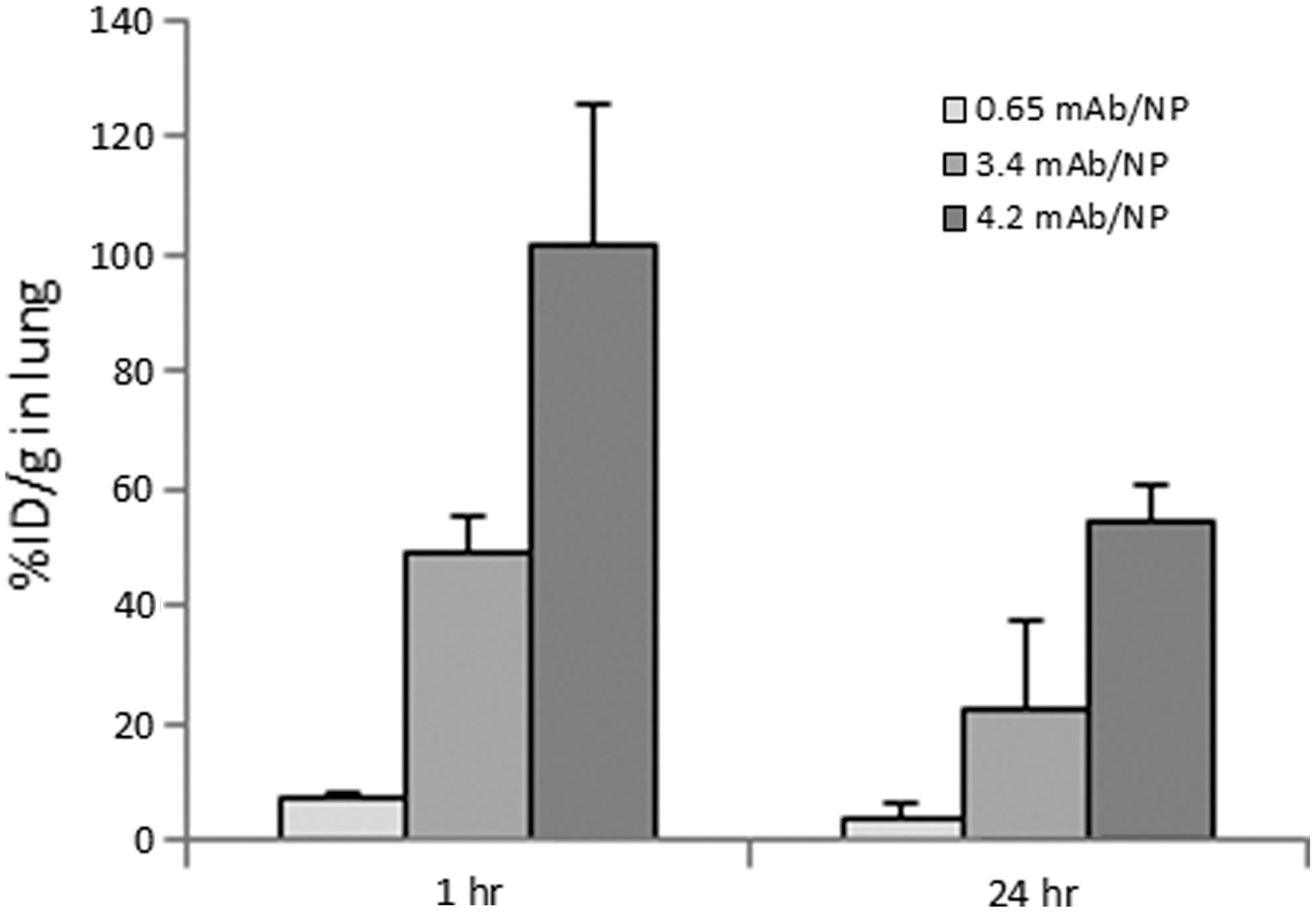
Biodistribution of 225Ac with radiolabeled NPs targeted with varying amounts of mAb 201B. Mice (n=2) were injected with 85 μg of NPs containing 100 kBq of 225Ac. Preparations had ratios of NPs to mAb of 100, 9.1, or 2.0 by weight. Organs were collected at 1 or 24 hours postinjection. NPs, nanoparticles.
In preparation for the therapy studies, {La0.5Gd0.5}(225Ac)PO4@4 GdPO4 shell@Au NPs were conjugated to mAb 201b using a mass ratio of antibody to NP of 1:1, which we project would give an NP conjugate with about three to four antibodies per NP. This mass ratio of NP:mAb should ensure optimal targeting (see Fig. 1). Biodistribution, micro-autoradiography and SPECT/CT imaging results for 225Ac at 1 hour postinjection are shown in Figure 2. All three methods demonstrate the efficient uptake of mAb 201b-targeted NP in the lung with some uptake in the liver and spleen. Specificity of the lung targeting was shown in competition experiments in which cold mAb 201b was mixed with the targeted NP (Fig. 2A). Competition rather than control IgG-conjugated NP was used so that the exact preparation of NPs could be compared directly, negating any differences of size, aggregation, or off-target binding. Competition resulted in nearly a 20-fold decrease in lung uptake, while values for liver and spleen were unchanged or slightly elevated. NPs accumulation in liver and spleen is well documented and is the result of particulates being recognized by the recticuloendothelial (RE) system. Biodistribution data mimic that for higher-ratio NP:mAb studies reported in Figure 1. Autoradiography of 225Ac (Fig. 2B) produces a unique pattern of a dark core with rays emanating from the center. This pattern is likely due to the sensitivity of the emulsion for the different types of radiation and their varied energies. The intensities of the supposed “single” events represent more than one decay chain of 225Ac and its daughters as would be expected if more than 1 atom of 225Ac were present in each NPs.
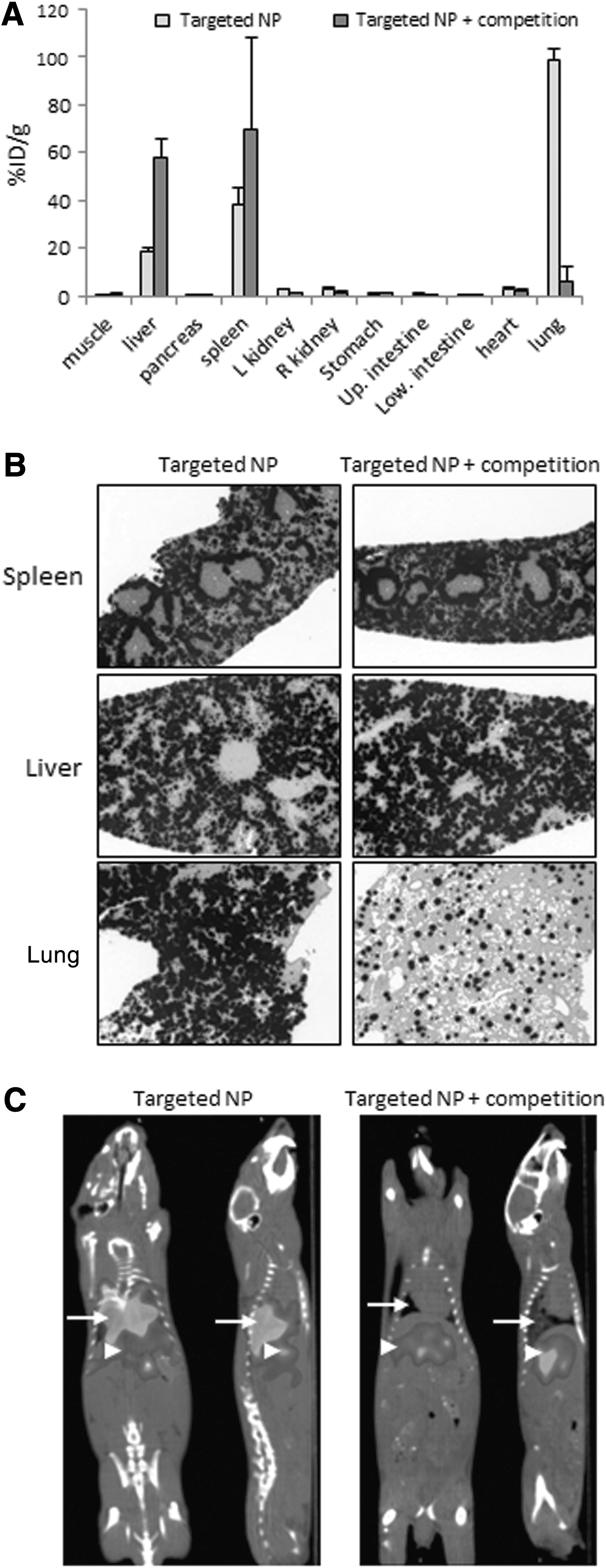
Distribution of mAb 201b-targeted NPs and competition controls at 1 hour postinjection in mice used for SPECT/CT imaging NPs (150 μg, 880 kBq) with coupled mAb 201b (100 μg) with or without cold competing free mAb (1600 μg) were injected, and mice were sacrificed at 1 hour. Mice were frozen and scanned the next day after 225Ac, and daughter radioisotopes were at equilibrium
SPECT/CT images confirm the distribution data and specificity of targeting in competition experiments (Fig. 2C). To minimize the effect of these phagocytic cells on targeted NPs uptake, clodronate containing liposomes were injected into mice 24 hours before the injection of NPs. Data in Figure 3 show that accumulation of NPs in lung was about 50% greater in mice pretreated with clodronate before NP injection, while the liver showed a higher accumulation in the mice that were mock treated. These data are consistent with the depletion of RE cells in the clodronate treated mice, enabling better target acquisition and less non-specific (liver) uptake. The effect of clodronate liposome pretreatment on lung NPs retention over 48 hours is shown in Figure 3B. The initial accumulation of NPs in lung was maintained at 24 and 48 hours postinjection, indicating that the NPs were retained at the site of targeting in either mock-treated or clodronate-treated mice. Electron micrographs of NPs targeted to the lung (Fig. 3C) demonstrate that particles bind to the lumen of lung blood vessels.

The effect of clodronate pretreatment of mice on biodistribution of mAb 201 b-targeted NPs. Mice were injected with 0.2 mL clodronate or PBS (controls) iv 24 hours before NP injection. NPs (7.5 μg, 44 kBq) targeted with mAb 201b (5 μg) were injected, and mice were sacrificed at various times for tissue collection and biodistribution (n=3/group).
Data in Figure 4 show that retention of 213Bi daughters within the layered NPs was high even in tissues in which non-specific accumulation occurred (liver and spleen). In the lung, the retention of 213Bi increased with time from 70.4%±0.8% for 1 hour to 91.4%±0.7% after 24 hours. Electron microscopy (Fig. 3C) showed mAb 201b NPs both lining the vascular space connected to lung epithelium, and internalized into the lung epithelial cells. Higher retention of 213Bi daughters may be due to the fact that NPs were taken up into cells.
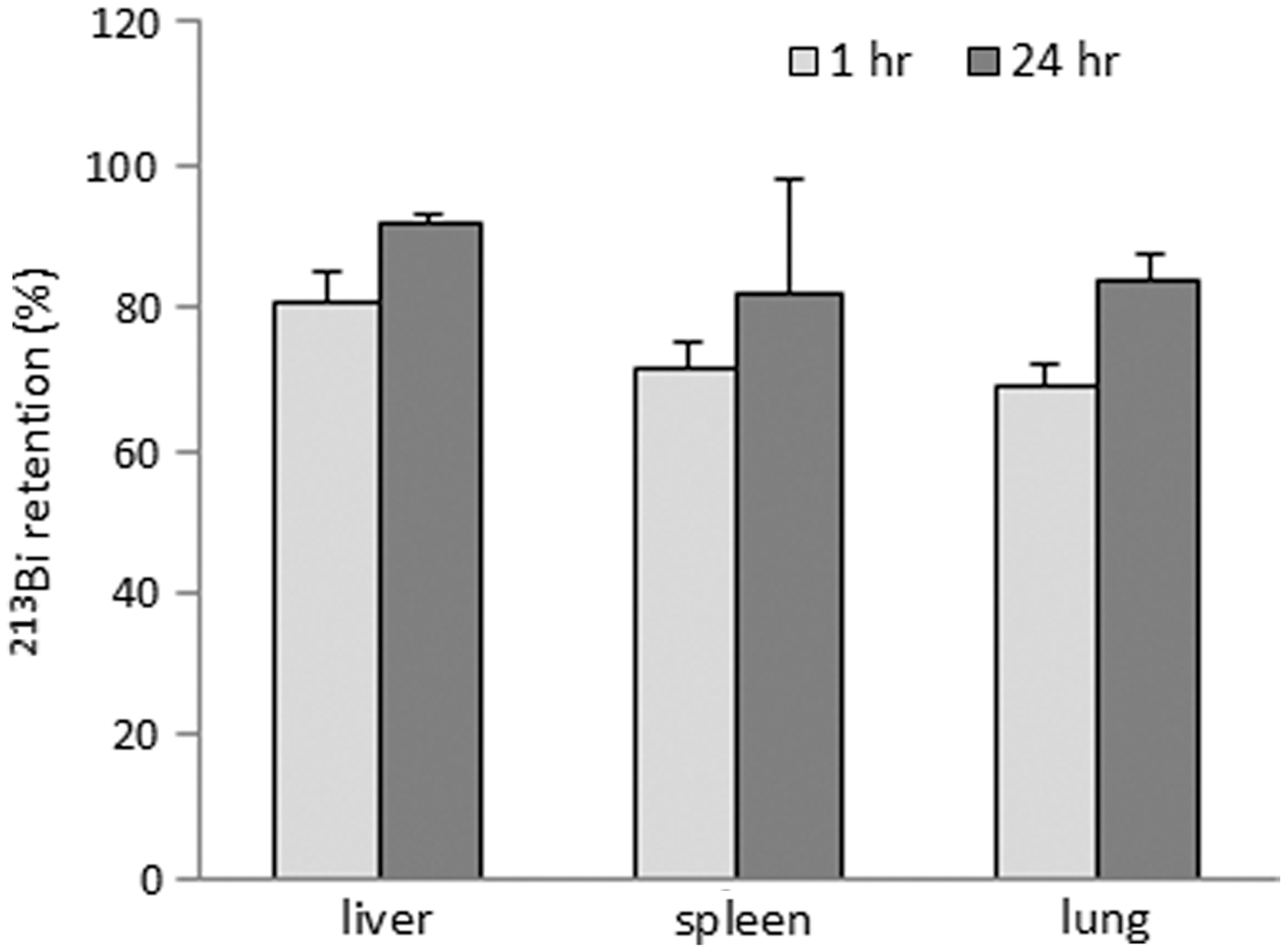
Bi-213 retention in lungs of clodronate-treated mice collected for biodistribution experiments described in legend to Figure 3. Tissues were evaluated for 213Bi content (dual energy counted at 20 minutes postsacrifice) and for total 225Ac content at equilibrium (counted >3 hours later). Data are shown for mice after 1 or 24 hours.
Mice injected iv with clodronate liposomes on day 0 were injected with EMT-6 tumor cells iv on day 1. Lung colonies were allowed to establish for 2 days before an injection with targeted NPs (group 3), NPs competed with cold antibody (group 2) or saline injection (group 1). At day 8, mice were sacrificed and lungs were inflated and fixed for histology evaluation. Colonies were small and difficult to enumerate at this time. Sections were stained with an antibody to CD44, which is highly expressed in EMT-6 cells. This antibody also stains alveolar macrophages and type II cells, but these isolated cells could be distinguished from multicell tumor colonies (Fig. 5B, C). Mice in group 1 (PBS control) averaged 78±34 colonies per tissue section area. Group 2 (NPs with competition) showed fewer colonies, with 57±22 colonies per section. Finally, group 3 (NPs without competition) had only 21±8 colonies per section, many of them smaller than those in control mice (Fig. 5A).

Colonies in lung of EMT-6 tumor cells injected iv.
Discussion
For use of α generator systems in which a parent radioisotope decays to radioactive daughters thus amplifying the dose that can be delivered by a single atom, it is essential that the daughters be retained at the targeting site. In general, 225Ac attached to antibodies by chelating agents fail to do this, 11 –13 and attempts to retain 225Ac daughters have met with limited success. 10 –12 The loss of daughters can be reduced by utilizing an antibody that is taken into the target cell which seems to partially sequester the daughters in the cell. 9 In an attempt to retain 225Ac daughter radioisotopes at the site of targeting, we had prepared NPs of LaPO4 doped with 225Ac, and while these preparations were promising, they retained only ∼50% of the daughter radioisotopes. 15 We reasoned that at least some of the 225Ac in the NPs preparations were bound near the NPs surface and thus after decay, daughters would be released. To further encapsulate the trapped 225Ac, we developed a shelled system to bury the parent 225Ac deeper into the NPs lattice. The shelled NPs were further closed by incorporating a gold shell on the outside. These NPs were also improved over previous LaPO4 materials by inclusion of Gd to produce magnetic NPs, allowing for purification from other NPs, notably pure gold NPs containing no 225Ac. This second generation of 225Ac NPs was characterized with regard to size, composition, and daughter retention in vitro. 16,17 In the current study, we are reporting the results from the second-generation NPs for targeting, daughter retention, and therapeutic efficiency.
Initial experiments were performed to determine how much antibody could be attached to the NP. A dual radioisotope method was devised to facilitate analyses of small amounts of material. An antibody radioiodinated with 125I was coupled at different amounts to a constant amount of NP material. Dual isotope counting of the products indicated that the amount of antibody coupled approached a limit (Table 1). These data along with knowledge about the particle size (see Materials and Methods section) was used to estimate the ratio of mAb to particle, which were 0.6, 3.4, and 4.2 in the three preparations. The antibody used in our studies, 201B, targets thrombomodulin protein expressed at high levels on the lumenal side of lung endothelial cells. 25 Due to the high concentration of thrombomodulin in murine pulmonary endothelium, the vascular-targeted NPs concentrate primarily in the lung. Extensive work has been reported with this antibody system demonstrating the binding specificity, binding kinetics, and retention in the lung. 20 It has been used as a model for vascular targeting that is essential for efficient accumulation of large payloads such as these NP. Both CdTe NPs 21 and LaPO4 NPs 15 have been targeted to murine lung with this antibody. The NPs with different amounts of antibody coupled were tested for targeting efficiency. Although surface area constraints can be used to calculate the maximum amount of antibody that could be bound, the number of variables associated with attachment orientation and the lack of an in vitro assay for mAb 201B activity preclude useful theoretical evaluations. The results in Figure 1 indicate that preparations with high Ab:NPs ratio of 4.2 and 3.4 gave more efficient accumulation. The effect was not linear, in that NPs with 4.2 mAbs accumulated twice as much in lung as did those with 3.4 mAb. It is possible that some of the attached antibody was inactive due to the random orientation of coupling or that some of the antibody coupled at lower concentrations was attached to the NPs with multiple chemical bonds reducing its efficiency. The loss of NPs from the lung was similar regardless of the Ab:NPs ratio. One would expect high ratio particles to be retained better if only the mAb attachment were involved. In fact, electron micrographs of the targeted NPs in the lung at 15 minutes postinjection (Fig. 3C) indicate that the NPs were actually taken up into the endothelial cells. When monitoring the 125I label associated with the particles, we noted (data not shown) that the 125I was lost from the lung much faster than the 225Ac. This could be a result of dehalogenation of internalized antibody as has been observed in many systems which utilize radioiodinated proteins 20 or that antibody is actually cleaved from the internalized mAb NP conjugate once targeted.
Biodistribution data, tissue section autoradiography, and SPECT/CT scans (Fig. 3) of mice injected with targeted NP show very high accumulation in the lungs. The specific nature of this accumulation was demonstrated by competing for binding with excess unlabeled free antibody. Particulates that are >100 μm in size are usually trapped in the lung non-specifically 15 The fact that free antibody competition for lung binding of the targeted NP was effective with excess added antibody proves that size trapping did not occur to any significant degree. Using 124I radiolabeled mAb 201b alone with dynamic PET scans, accumulation occurred with 15–20 seconds of injection. 20 Since lung capillaries are the first bed encountered from intravenous injections, a large fraction of the antibody can bind, possibly on the first pass of circulation. However, the data with targeted NPs show that there was a large amount of NPs captured in the liver and spleen, likely due to interactions with cells of the RE system. Utilizing clodronate liposomes to suppress phagocytic cell number 21 associated with NP clearance increased localization in the lung while decreasing liver uptake. Preinjection of clodronate liposomes increased lung uptake of NPs-201 b from 30.2%ID without clodronate to 46.7%ID with clodronate (Fig. 3), an improvement of ∼50%. These data support previous studies with both CdTe NPs 21 and the LaPO4 NP 15 targeted with mAb-201b. Consistent with studies with CdTe NPs, the LaPO4NPs retention of 225Ac was improved by clodronate pretreatment. The clearance of 225Ac from the lung was ∼20% in mice preinjected with clodronate liposomes and ∼33% in animals without clodronate liposome treatment.
The layered NP have been shown to retain the daughter radioisotope 221Fr to about 90% in vitro. 16,17 Data in Figure 4 indicate that 213Bi was retained in the lung to ∼70% at 1 hour and ∼90% at 24 hours postinjection. This result is consistent with the findings of others 9 that once internalized, 225Ac daughters are retained well within the cell. These retention values represent a significant improvement over the LaPO4 NPs studied earlier. 15
The enhanced targeting in the presence of clodronate (∼50% improvement) and the increment in NP retention (also ∼50% improvement), coupled with the improved retention of daughter radioisotopes (∼20% improvement over previous constructs), substantially lowers the amount of α particle radiation to non-target tissue. More complete kinetics studied over the lifetime of the parent 225Ac would be necessary to establish just how much of an improvement could be expected. With the current data, we estimate that absorbed dose to kidney by released 213Bi should be reduced by at least twofold. This improvement should allow for toleration of larger injected doses and more effective therapy.
mAb 201b has been shown to be useful for targeted radiotherapy of lung colonies with several different radioisotopes, including α emitters 213Bi 26 and 211At. 27 Although not directly translatable to human studies, this model system demonstrates the possible utility of vascular targeted endoradiotherapy using large constructs such as the NPs that were prepared for these studies. In this work, optimum conditions of targeting coupled with treatment of tumor inoculum at early times (2 days) postinjection resulted in a dramatic decrease in lung colonies (Fig. 5). In a two-sided, unequal-variance Student's t-test, the treatment group shows clear, statistically significant decreases in tumor colony numbers relative to both untargeted NPs (p=0.020) and competed NPs (p=0.019). Competition with non-radioactive mAb 201b decreased lung uptake of NPs by a factor of >17, although some non-significant (p=0.300) therapeutic effect was observed. This is consistent with other therapy experiments with α and β− emitters when controls were published. 27,28 This systemic radiation effect remains an unexplained phenomenon despite the efforts in our laboratories and others.
Our data demonstrate that TAT with these new classes of NPs is effective when higher doses, permitted by the improved characteristics of the NPs system, are employed.
Conclusion
LnPO4 NPs represent a viable solution for use of the 225Ac in vivo α generator as a therapeutic construct. The NPs successfully retain a large fraction of the daughter products without compromising the tumoricidal properties of the α-radiation. Utilization of clodronate liposomes significantly increases uptake in target tissue by neutralizing macrophages and therefore depressing clearance of NPs through the RE system. The improvements should allow more efficient delivery of the total α dose from 225Ac and daughters to be used for therapy. It might be possible to use lower injected activities to deliver the same tumor dose or larger injected activities to be used with manageable side-effects.
Footnotes
Acknowledgments
Research supported in part by the Isotope Production/Distribution Program, Office of Nuclear Physics of the U.S. Department of Energy (DOE), and under a DOE Nuclear Energy University Program Graduate Fellowship. A portion of this research was conducted at the Center for Nanophase Materials Sciences, which is sponsored at Oak Ridge National Laboratory by the Office of Basic Energy Sciences, U.S. DOE. ORNL is managed by UT-Battelle, LLC, for the U.S. Department of energy under contract DE-AC05-00OR22725. These studies were supported by the Molecular Imaging and Translational Research Program of the University of Tennessee Graduate School of Medicine. Technical assistance was provided by Alan Stuckey, Craig Wooliver, and Sally Macy.
Disclosure Statement
There are no existing financial conflicts.