




Abstract
We carried out this current meta-analysis of relevant cohort studies in an attempt to investigate the relationships between abnormal matrix metalloproteinases-2 (MMP2) expression and gastric cancer (GC) prognosis. A range of electronic databases were searched for relevant articles without any language restrictions: Web of Science (1945–2013), the Cochrane Library Database (Issue 12, 2013), PubMed (1966–2013), EMBASE (1980–2013), CINAHL (1982–2013), and the Chinese Biomedical Database (CBM) (1982–2013). Meta-analysis was conducted using the STATA 12.0 software. Crude hazard ratios (HRs), with 95% confidence intervals (95% CIs), were calculated. Ten clinical cohort studies with a total of 1669 GC patients were included in this meta-analysis. The results of our meta-analysis suggested that MMP2-positive patients display a shorter overall survival (OS) than MMP2-negative patients (HR=1.31, 95% CI=0.98–1.63, p<0.001). Subgroup analysis based on ethnicity revealed that abnormal MMP2 expression was associated with significantly worse OS in patients with GC among both Caucasian and Asian populations (all p<0.05). Our meta-analysis indicated that abnormal MMP2 expression may be strongly correlated with poor prognosis in patients with GC. Thus, MMP2 expression may serve as an independent prognostic factor for GC.
Introduction
Gastric cancer (GC) is a common digestive tract cancer, ranked the fourth most common cancer the second leading cause of cancer-related mortality worldwide, and comprises ∼10% of the total new cancer diagnoses and 12% of cancer deaths. 1,2 Despite a significant decline in both the incidence and mortality rates in developed regions of the world, GC remains prevalent in some areas of the world like Japan, Russia, and some Latin American countries, and poses a substantial public health concern. 3 Past epidemiological studies have suggested that exogenous factors, such as helicobacter pylori infection, one of the strongest established risk factors, tobacco use, and dietary habits, may be associated with the pathogenesis of GC. 4,5 Existing evidence appears to broadly support that multiple molecular drivers and molecular signal pathways may be implicated in the multistep process in the development of gastric carcinogenesis. 6,7 It is widely accepted that GC has a relatively poor prognosis with a 5-year survival rate below 30%, which is partly attributed to the rapid invasion and metastasis of tumor cells. 8
Matrix metalloproteinases-2 (MMP2), also known as gelatinase A or 72 kDa collagenase IV, is a zinc-dependent protease belonging to the MMP family, which is initially secreted as an inactive proenzyme and subsequently activated by N-terminal proteolytic cleavage. 9 MMP2 is regarded as a marker of malignant tumor invasion and metastasis that participates in the degradation of type IV collagen of extracellular matrices and basal membranes, indicating that it plays a significant role in the migration of malignant cells during physiological and pathological processes. 10,11 Due to its ability to degrade the basal membrane, MMP2 has been intensively hypothesized to be a potential marker in tumor progression and prognosis in several different kinds of malignancies, such as ovarian cancer, lung carcinoma, as well as GC. 12,13 It has been widely reported that MMP2 is expressed in a large number of cell types, and overexpressed in a wide variety of human cancers, including GC. 14 In addition, there is evidence that suggests that an elevated MMP2 level is significantly related to increased tumor metastasis and advanced stomach cancer. 13,15 More importantly, high levels of MMP2 expression in tissue and plasma are strongly correlated with the depth of tumor infiltration, and the severity of lymph node metastasis, distant metastasis, Union International Contre le Cancer (UICC) stage, and poor overall survival (OS). This could be an indication that MMP2 expression could be of value as a prognostic marker for GC patients. 12,16 Recently, certain studies have shown that abnormal expression of the MMP2 protein may be involved in the development of GC and could serve as a prognostic marker for GC, but contradictory results were also reported. 17 –19 Given the conflicting evidence on this issue, we decided to conduct a meta-analysis of all available cohort studies to determine whether abnormal MMP2 protein expression correlates with the poor prognosis in GC.
Methods
Search strategy
A range of electronic databases were searched without language restrictions for relevant publications: MEDLINE (1966–2013), the Cochrane Library Database (Issue 12, 2013), EMBASE (1980–2013), CINAHL (1982–2013), Web of Science (1945–2013), and the Chinese Biomedical Database (CBM) (1982–2013). We used the following keywords and MeSH terms in conjunction with a highly sensitive search strategy: [“gastric cancer” or “gastric neoplasms” or “GC” or “gastric carcinoma” or “stomach carcinomas” or “stomach cancer”] and [“matrix metalloproteinase 2” or “MMP2” or “72 kDa Type IV Collagenase” or “matrix metalloproteinase-2” or “MMP2 metalloproteinase”]. We also conducted a manual search of the references identified in the individual articles to find other potential publications.
Selection criteria
The following criteria were met in order for the studies to be included: (1) the study design must be a clinical cohort study that focused on the relationships between abnormal MMP2 expression and prognosis in GC patients; (2) all patients diagnosed with GC must be confirmed through histopathologic examinations; and (3) the study must provide sufficient information regarding the expression levels of the MMP2 protein. The studies were excluded if they did not meet the inclusion criteria. Either the most recent publication or the publication with the largest sample size was included when the authors published several studies using the same subjects.
Data extraction
Data from each included study were systematically extracted by two authors using a standardized form. The form used for data extraction documented the most relevant items, including language of publication, sample size, publication year, geographical location, the first author's surname, design of study, study type, protein expression levels, pathological subtype, source of samples, and detection method.
Quality assessment
Methodological quality was evaluated separately by two observers using the Newcastle-Ottawa Scale (NOS) criteria. 20 The NOS criteria included three aspects: (1) subject selection: 0–4; (2) comparability of subject: 0–2; and (3) clinical outcome: 0–3. NOS scores ranged from 0 to 9; and a score ≥7 indicates good quality.
Statistical analysis
Meta-analysis was performed using the STATA statistical software (Version 12.0; Stata Corporation, College Station, TX). Crude hazard ratios (HRs), with 95% confidence intervals (95% CIs), were calculated. The Z test was used to estimate the statistical significance of pooled ORs. Heterogeneity among studies was estimated with Cochran's Q-statistic and I2 tests. 21 If the Q-test shows a p<0.05 or the I2 test exhibits >50%, which indicates significant heterogeneity, the random-effects model was conducted; otherwise, the fixed-effects model was used. To evaluate the influence of single studies on the overall estimate, a sensitivity analysis was performed. Funnel plots and Egger's linear regression test were applied to investigate publication bias. 22
Results
Baseline characteristics of included studies
Initially, the highly sensitive search strategy identified 720 articles. We reviewed the titles and abstracts of all 720 articles and excluded 443 of them; then, we systematically reviewed the full text and another 263 articles were further excluded. Another three studies were also excluded due to the lack of data integrity (Fig. 1). Finally, 10 clinical cohort studies with a total of 1669 GC patients met all of our inclusion criteria for qualitative data analysis. 17 –19,23 –29 Publication years of the eligible studies ranged from 1998 to 2013. Distribution of the number of topic-related literatures in the electronic database during the last decade is shown in Figure 2. Overall, six studies were conducted among Asians and four studies among Caucasians. Three studies utilized the two-step immunohistochemistry (IHC) method and seven studies used the three-step IHC method. Peripheral blood samples were used to detect MMP2 expression. NOS scores of all included studies were ≥5. We summarized the study characteristics and methodological quality in Table 1.
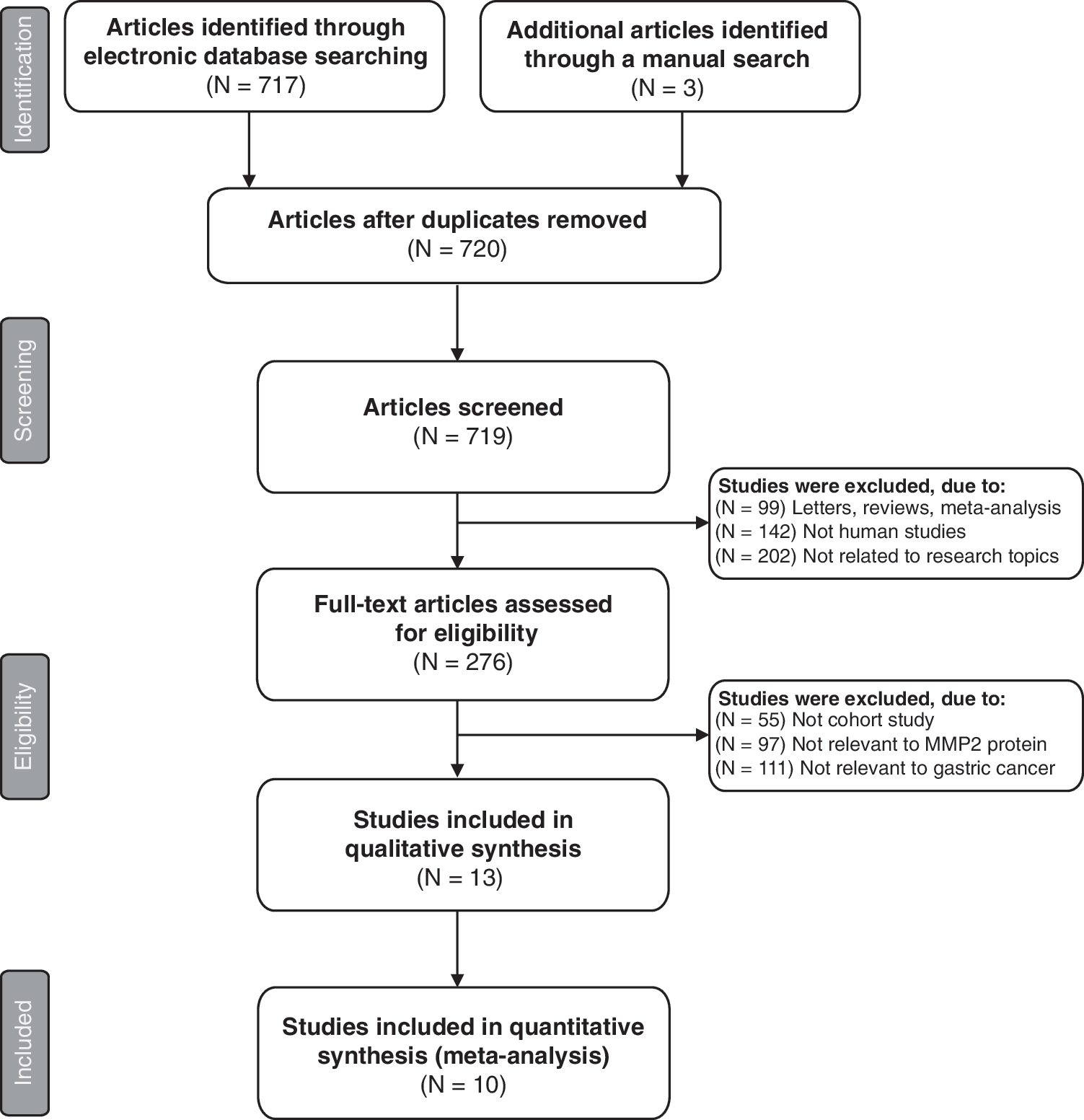
Flow chart shows the study selection procedure. Ten cohort studies were included in this meta-analysis.
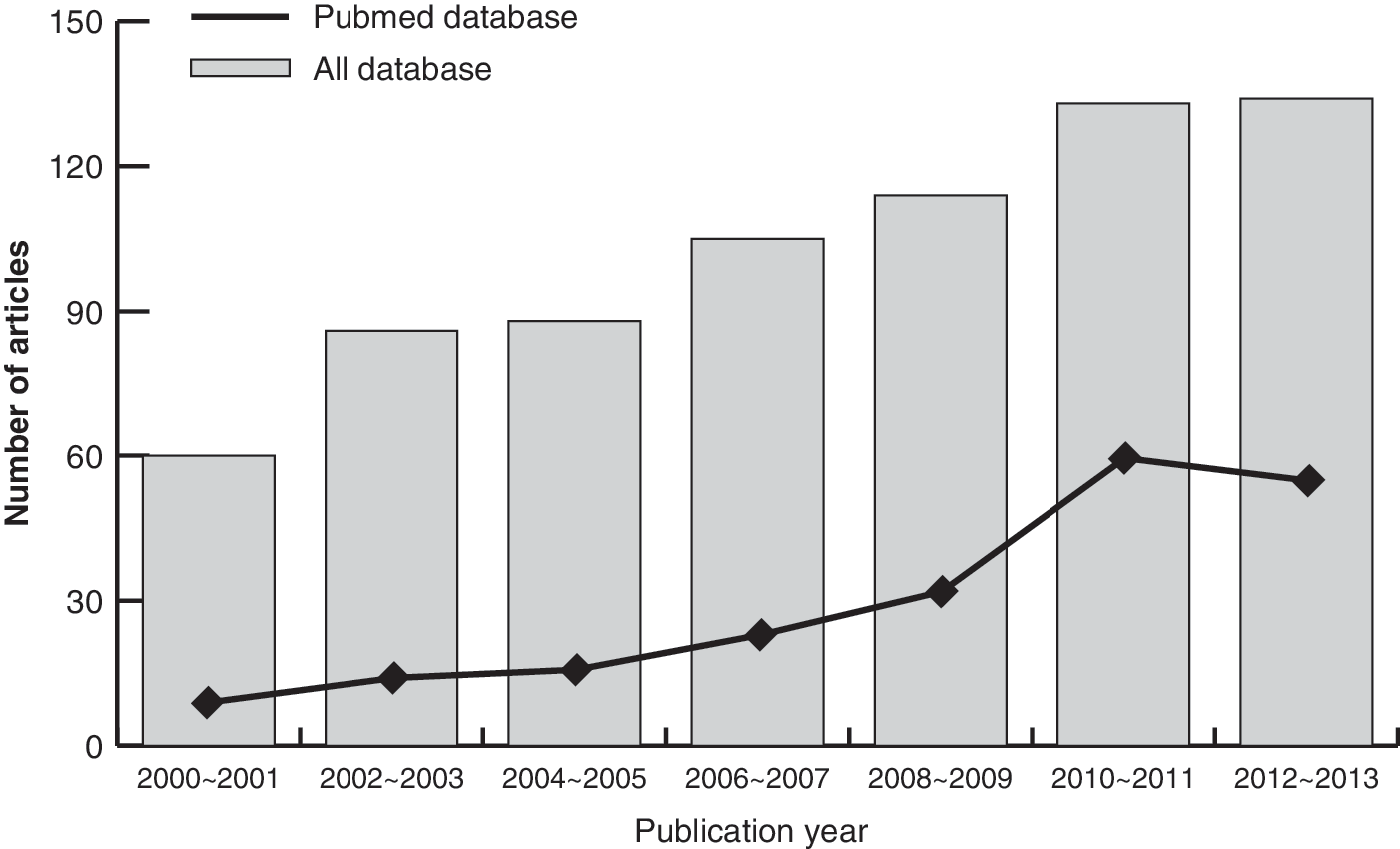
The distribution of the number of topic-related literature in the electronic database during the last decade.
M, male; F, female; MMP2, matrix metalloproteinases-2; IHC, immunohistochemistry; HR, hazard ratio; LL, lower limit; UL, upper limit; NOS, Newcastle-Ottawa Scale.
Quantitative data synthesis
Since no heterogeneity existed among studies (I2 =6.7%, p=0.380), the fixed-effects model was conducted. Our findings suggested that MMP2-positive patients displayed a shorter OS than MMP2-negative patients (HR=1.31, 95% CI=0.98–1.63, p<0.001) (Fig. 3). Subgroup analysis based on ethnicity revealed that abnormal MMP2 expression was associated with significantly worse OS in patients with GC among both Caucasians and Asians (Caucasians: HR=1.54, 95% CI=1.10–1.97, p<0.001; Asians: HR=1.15, 95% CI=0.64–1.66, p<0.001; respectively). Furthermore, subgroup analyses by country, detection method, and sample size also indicated that high expression of MMP2 protein was strongly linked to poor prognosis of GC patients in all of these subgroups (all p<0.05) (Fig. 4). Sensitivity analysis indicated that the overall pooled HRs were not affected by a single study (Fig. 5). No evidence for asymmetry was observed in the funnel plots (Fig. 6). Egger's test also failed to reveal any evidence of publication bias (t=−0.66, p=0.527).

Forest plots for the relationships between abnormal matrix metalloproteinases-2 (MMP2) expression and prognosis of patients with gastric cancer.

Subgroup analysis by ethnicity, country, detection method, and sample size of the relationships between abnormal MMP2 expression and prognosis of patients with gastric cancer.
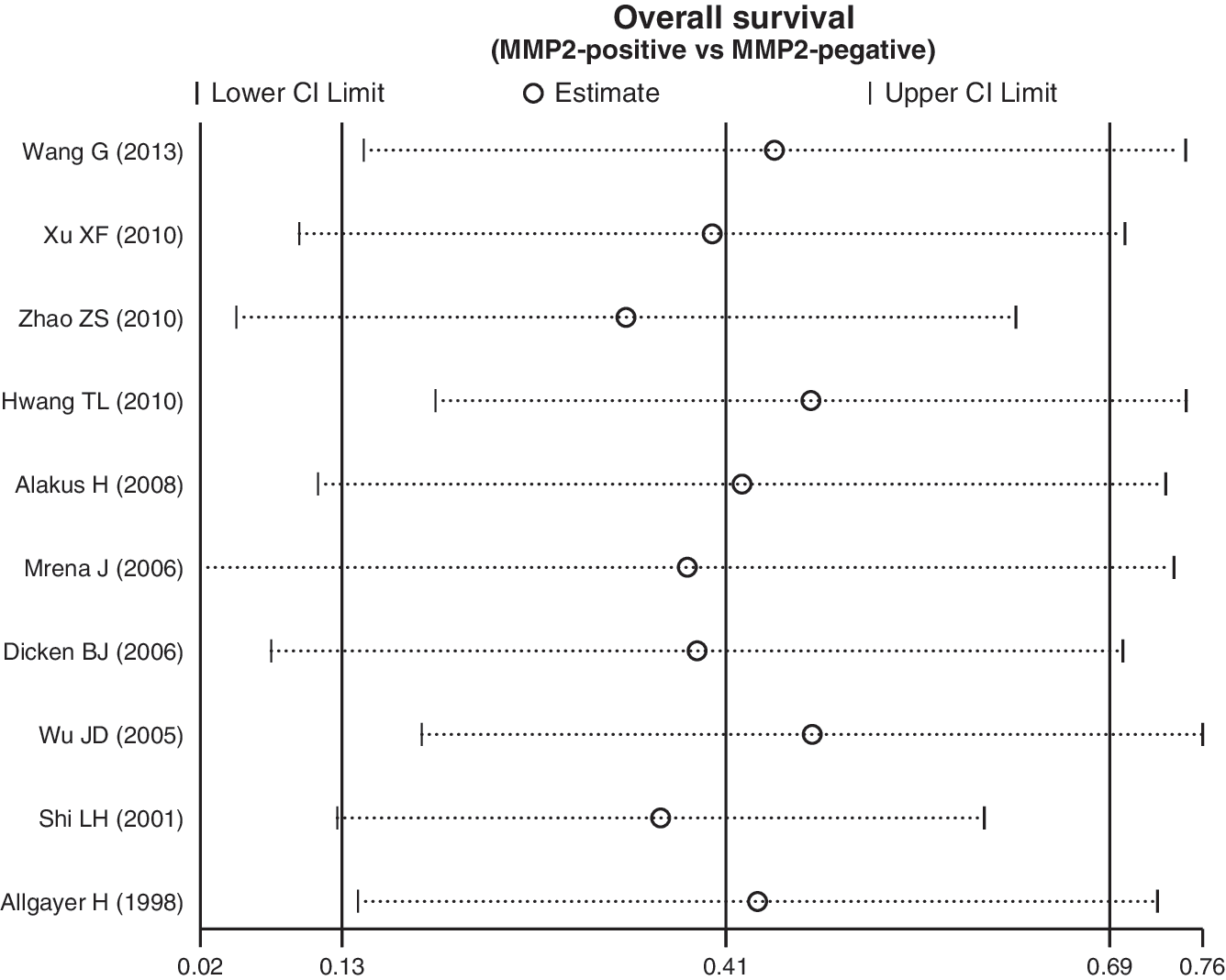
Sensitivity analysis of the summary odds ratio coefficients on the relationships between abnormal MMP2 expression and prognosis of patients with gastric cancer.

Begger's funnel plot of publication biases on the relationships between abnormal MMP2 expression and prognosis of patients with gastric cancer.
Discussion
In the current meta-analysis, the correlations between MMP2 protein expression and the prognosis of GC patients have been comprehensively investigated. The findings in our meta-analysis indicated that high expression of MMP2 was significantly related to advanced tumor stage and poor prognosis in GC patients, suggesting that abnormal MMP2 expression might play an important role in tumor invasion and metastasis in GC. Although the precise role of the MMP2 protein in the prognosis of GC patients is still only partially understood, we hypothesized that the overexpression of the MMP2 protein may enhance its functions suspected of playing a crucial role in the degradation of type IV collagen, gelatin, and laminin in the basement membrane and other extracellular matrices, which was considered a vital step in the growth, invasion, angiogenesis, and metastasis in malignant tumors. 29 Therefore, it is plausible that abnormal MMP2 expression may be implicated in tumor invasion and metastasis and may be of prognostic significance in GC patients.
Furthermore, we carefully performed a stratified analysis based on ethnicity. The results of the subgroup analysis by ethnicity showed that positive expression of MMP2 was strongly correlated with poor prognosis in GC patients among both Caucasian and Asian populations. It is well known that one crucial step in tumor invasion and metastasis is the degradation of collagen IV, which is a basic element of basement membranes. 30 MMP2, which belongs to the MMP family, is able to degrade gelatin and type IV collagen, which correlates with its role in tumor metastasis and may be of prognostic significance for cancer patients. 31 In general, MMP2 may promote the cleavage of extracellular matrix proteins, leading to the destruction of the basal membrane as well as tumor cell invasion into the connective tissue matrix, thereby resulting in tumor metastasis in GC. 13 In short, the current meta-analysis indicated that MMP2 protein expression may play an important role in the development of GC, suggesting that detection of MMP2 expression may be utilized as an independent prognostic marker for GC.
Nevertheless, there are also several limitations to our meta-analysis that should be interpreted. First, our results were short of the sufficient statistical power needed to evaluate the relationships between MMP2 expression and prognosis in GC patients. Second, meta-analysis is a retrospective study that may lead to subject selection bias, and thereby influence the reliability of our results. Third, our meta-analysis failed to obtain original data from the included studies, which may further limit our evaluation of the potential roles of MMP2 expression in the prognosis of GC. A fourth potential limitation stemmed from several of the results constrained by small numbers and wide standard deviations, thereby limiting confidence in drawing conclusions. Although our study has many limitations, this is the first meta-analysis focusing on the relationships between the expression of MMP2 and the prognosis of GC. Furthermore, we performed a highly sensitive literature search strategy for electronic databases. A manual search of the reference lists from the relevant articles was also conducted to find other potential articles. The selection process of eligible articles was based on strict inclusion and exclusion criteria. Importantly, rigorous statistical analysis of the single-nucleotide polymorphism data provided a basis for pooling information from individual studies.
In summary, our meta-analysis was the first chance to show that positive MMP2 expression may be strongly correlated with poor prognosis in GC patients. Thus, the detection of MMP2 expression may serve as an independent prognostic factor for GC. However, due to the limitations acknowledged above, more research with larger sample sizes and more comprehensive data are still required to provide a more representative statistical analysis.
Footnotes
Acknowledgments
This study is funded by the Science and Technology Projects of Science and Technology Agency of Liaoning Province (No. 2011408004). The authors would like to acknowledge the reviewers for their helpful comments on this article.
Disclosure Statement
The authors declare no conflict of interests exist.