




Abstract
This article describes the preparation, quality control, and biological evaluation of 90Y-skin patches based on Nafion® membrane as a viable treatment modality for superficial skin tumors such as melanoma. To arrive at the conditions for optimum uptake of 90Y on the membrane, influence of various experimental parameters, such as pH of the feed solution, inactive yttrium carrier concentration, reaction volume, contact time, and temperature, was systematically investigated. Under the optimized conditions, >95% of the 90Y activity (37–185 MBq) could be incorporated in the Nafion membranes to prepare 90Y-skin patches. Quality control tests were carried out to ensure nonleachability, uniform distribution of activity, and stability of the 90Y-patches. Mice bearing transplanted melanoma tumors that were treated with two doses of 74 MBq 90Y-Nafion membrane sources showed complete tumor regression. Histopathological examination of the treated area showed absence of tumor. The results of the study indicate the potential of 90Y-Nafion membrane sources for treatment of superficial skin tumors.
Introduction
Of the major cancers encountered worldwide, skin cancer has emerged as one of the most common cancers affecting the fair-skinned population and the incidence is increasing worldwide. 1 While skin cancers are named after the type of cell within the skin in which they originate, they can be broadly classified into melanoma or nonmelanoma types. 2,3 Melanoma that originates in the melanocytes, the cells within the epidermis, is considered as the deadliest form of skin cancer as it tends to metastasize into other organs. 4 Basal cell carcinoma (BCC) and squamous cell carcinoma (SCC) are collectively known as nonmelanoma skin cancers (NMSCs), 3,5,6 the most frequently diagnosed cancers in the United States. 7 While local surgical excision of the tumor along with the fringes of normal tissue remains the mainstay of treatment of skin cancers, 8,9 its utility is only restricted to localized, uncomplicated, and well-defined tumors. However, it can also lead to significant cosmetic or functional deficits especially for tumors on the face and around the nose, ears, and other structures. To circumvent the limitations of surgery and to treat skin cancers in the central areas of the face, including eyelids, nose, and lips, a broad panoply of alternative treatment modalities, such as cryosurgery, laser ablation, curettage, electro-chemotherapy, Mohs' microsurgery, and radiotherapy, have been successfully utilized. 2,10 –12 Among the available treatment options, radiotherapy is reported to be an attractive modality owing to its ability to treat not only the visible tumor but also the potential subclinical disease around the macroscopically visible tumor with a margin of uninvolved normal tissues. 13,14 For example, the cure rate of NMSCs by radiation therapy is reportedly >90%. 7 Radiotherapy also evades surgical morbidity to critical areas on the nose, eyelids, ears, and lips where reconstruction options are limited. Although the use of external beam radiotherapy constitutes a successful therapeutic option, 13 the necessity for expensive radiation therapy units as well as the adverse effects of penetrating radiations into underlying bone and soft tissues have emerged as the major impediments that restrict its utility. Moreover, “hard-to-reach” locations, tumors close to critical structures, and multiple lesions cannot be treated optimally by this mode. In light of the perceived need to improve the conformality of radiation dose to the disease site while sparing the irradiation of normal tissues, the scope of using radioactive patches containing β− emitting radionuclides, such as 90Y, 186Re, 166Ho, 32P, and, more recently, 188Re, appears to be promising owing to their ability to deliver therapeutic doses within a short range in tissues (few mms). 15 –24 Nevertheless, this modality of treatment not only offers the convenience of treating skin tumors at multiple sites simultaneously but also provides excellent cosmetic results. For instance, 32P skin patches have been used advantageously for treatment of patients with BCC in a small patient population and the authors have reported complete cure in 8 out of the 10 patients, in a 3-year follow-up study. 22 Similarly, 188Re-incorporated resin sources have been effectively utilized for treatment of BCC and SCC in 53 patients, all of whom showed complete tumor regression. 23
While the effectiveness of radioactive patches in the treatment of skin cancers “lives” at the interface between many disciplines, selection of an appropriate therapeutic radionuclide remains the cornerstone for its success. In the quest for an effective radionuclide to prepare radioactive patches, our attention was drawn towards the use of 90Y owing to its favorable nuclear characteristics, such as emission of high-energy β− radiations (E β-max=2.28 MeV, no γ emissions), suitable half-life (64.1 hours), and well-defined chemistry. 25 The highly energetic β− radiations emitted by 90Y have the advantage of relatively long-range tissue penetration. The need to prepare radioactive patches with 90Y of desired attributes prompted us to search for a viable technique. Over the past few years, several strategies have been evolved for the preparation of a variety of radioactive patches of diverse radionuclides. 15 –24 Among them, impregnation of radioactivity on a reactive polymer surface appears to be a favorable pathway and has attracted tremendous attention owing to the technical simplicity, cost effectiveness, and reproducibility. To tap the potential of reactive polymers for the preparation of radioactive patches, we had reported earlier the preparation of 90Y patches using ethylene glycol methacrylate phosphate (EGMP) membrane for their utility in the treatment of skin cancer. 20 Although effective, one of the major drawbacks of this method is the requirement of an elaborated synthesis protocol to prepare EGMP films of required features. With a view to mitigate this drawback, assessing the potential of commercially available polymer membranes is not only an interesting prospect, but may also be viewed as a necessity to ensure their wide-scale availability to derive the benefit of 90Y skin patches. The recent surge of interest in the use of commercially available polymer membranes for various applications prompted us to explore the possibility of using Nafion-115 membrane, a copolymer of perfluoro-sulfonic acid, consisting of hydrophobic fluorocarbon backbone with hydrophilic sulfonic acid pendent side chains for incorporating the 90Y activity. The scope of using Nafion-115 membrane is interesting owing to its excellent chemical stability, biological inertness, and ability to retain metallic cations from aqueous solution under appropriate experimental conditions. 26,27 While the use of Nafion-117 membranes to prepare 32P skin patches has been successfully realized by our group, 18 preparation of 90Y patch using the Nafion membrane matrix has not yet been explored. To unleash the potential of Nafion-115 membrane as an effective substrate to impregnate predicted quantity of 90Y from an aqueous solution, a systematic evaluation of its sorption characteristics was deemed worthy of consideration and motivated us to pursue this aim diligently.
In this article, a method for the impregnation of 90Y from an aqueous solution of 90YCl3 onto the surface of a Nafion-115 membrane is described. The factors that influence the impregnation of 90Y onto the Nafion-115 membrane were identified and a careful control of the experimental conditions was exercised to arrive at the conditions resulting in optimum deposition of 90Y activity. The quality of the prepared 90Y patches was evaluated in terms of adherence of 90Y activity to the substrate, uniformity of activity distribution, and the assessment of their efficacy in an animal model of melanoma. To the best of our knowledge, this is the first report on the use of Nafion membrane for the preparation of 90Y-based radioactive patches for potential use in treatment of superficial skin tumors.
Materials
Yttrium-90 for the work was obtained from an in-house electrochemical 90Sr/90Y generator. 28 Nafion-115® films (Nafion perfluorinated membranes) were purchased from Sigma Aldrich. Cocktail W (Sisco International) was used as the scintillation cocktail for liquid scintillation counting (LSC) purposes. All other chemicals (AR grade) were purchased from local manufacturers in India.
Scanning electron microscope (SEM; Vega MV-2300T/40) supplied by M/s TESCAN, Czech Republic, was used for SEM analysis. All the radioactivity measurements during the preparation of the 90Y-Nafion patch were carried out using a liquid scintillation counter procured from Hidex and a GM counter procured from PLA Electro Appliance Pvt. Ltd. A portable laminating unit obtained from Avanti Pvt. Ltd. was used for laminating the 90Y-incorporated Nafion membrane sources. Nontoxic, laminating films were obtained from Hi
All the animal experiments were carried out after the mandatory approvals from the Institutional Animal Ethics Committee.
Methods
Determination of 90Y adsorptive parameters
With an aim to arrive at the optimum conditions for the incorporation of 90Y ions in the Nafion-115 membranes, the effect of experimental parameters, such as pH of the 90Y feed solution, amount of 89Y carrier, reaction time, and temperature, was investigated by conducting a series of tracer level experiments. The adsorption experiments were performed by varying experimental parameters, such as the amount of 89Y carrier (25–500 μg), pH of the feed solution (pH 1–7), volume (1–5 mL), time (1–16 hours), and temperature (25°C, 35°C, and 40°C), of the reaction. In all the optimization experiments, the total feed solution volume was kept at 2 mL and ∼370 kBq (10 μCi) of 90Y was used as tracer.
A measured aliquot of the feed solution (100 μL) was withdrawn before and after the reaction, for activity measurement. Uptake studies of 90Y on Nafion-115 were carried out by dipping square-shaped membrane of 1×1 cm2 dimension in the 90Y solution for a predetermined time. Subsequently, the membranes were taken out from the solution, washed to remove any loosely bound 90Y activity, and the amount of 90Y activity taken up by the membrane was estimated as the difference in activity of the solution before and after adsorption, as measured by LSC. The percent adsorption (%) of 90Y was calculated using the relationship
Where Ai and Af are the measure of initial and final radioactivity of 90Y, respectively, in the feed solution. All the reactions were carried out in triplicates in order to ensure accuracy.
The loading capacity of yttrium ions on the Nafion-115 membrane was determined following the reported procedure. 18
Preparation of 90Y-Nafion patches
Based on the results obtained in the optimization experiments, 90Y-incorporated Nafion patches were prepared containing about 37–185 MBq (1–5 mCi) of 90Y activity. To impregnate ∼37–185 MBq (1–5 mCi) of 90Y into the Nafion-115 membrane, square-shaped membrane of 1×1 cm2 dimensions was taken in a small quartz vessel and immersed in 2 mL of 90YCl3 feed solution of ∼37–185 MBq (1–5 mCi) at pH=1 containing 400 μg of 89Y carrier, maintained at a temperature of 40°C for 6 hours. The 90Y-impregnated Nafion-115 membrane was then taken out from the solution with the help of tweezers and washed with water to remove loosely bound 90Y activity. The membrane was kept in a petri dish with adsorbent paper at the bottom and dried under an IR lamp for 10 minutes. In one batch, only one membrane was used for activity loading. The total 90Y activity impregnated in the membrane was assayed by LSC by drawing and measuring suitable aliquots before and after the impregnation of 90Y activity.
To prevent the leaching of 90Y activity from the 90Y-impregnated Nafion-115 membranes, they were immobilized within thermoplastic polyurethane (TPU) sheets of 40-μm thickness as per the reported procedure. 18
SEM and energy-dispersive X-ray analysis
SEM and energy-dispersive X-ray (EDS) analysis were carried out using nonradioactive-89Y-impregnated Nafion membranes of dimensions 1×1 cm2 prepared in an identical manner used for radioactive membrane. EDS microanalysis technique was used to identify the elemental constituents of the 89Y-impregnated Nafion membranes. SEM and EDS analyses were performed on a specimen coated with a thin (ca. 4 nm) over-layer of gold.
Evaluation of quality of 90Y-Nafion membranes
Determination of source strength
Radioactivity content of individual 90Y-impregnated Nafion-115 membrane was assayed in a calibrated isotope dose calibrator for appropriate time at a suitable geometry.
Uniformity of distribution of 90Y activity
To evaluate the distribution of 90Y activity on the surface of the Nafion-115 membranes, the 90Y-incorporated Nafion-115 membranes were subjected to autoradiography examination by exposing them to industrial X-ray films for 120 seconds. The optical density (OD) distribution of the exposed X-ray film was measured by black and white (B/W) transmission densitometer, at various locations of the film.
Leachability of 90Y activity from Nafion membranes
To determine the leachability of 90Y activity from the Nafion-115 membrane (as per the method prescribed by the Atomic Energy Regulatory Board [AERB], India), 29 triplicate samples of Nafion membranes of dimension 1×1 cm2 containing ∼37 MBq (1 mCi) of 90Y were taken and each of this was placed individually in beakers containing 100 mL of water and saline, respectively, for 48 hours at room temperature, at the end of which they were removed. The radioactivity in water and saline, respectively, was concentrated to 0.1 mL by heating and measured in a liquid scintillation counter to estimate 90Y contents.
Determination of surface contamination
TPU-laminated, 90Y-impregnated Nafion-115 membranes were tested for any loosely held activity (surface contamination) by swiping the sources using alcohol-immersed cotton wool and measuring the radioactivity associated in swipe using a plastic scintillation detector of known efficiency.
Immersion test
One 90Y-impregnated Nafion-115 membrane was immersed in 20 mL of water taken in a glass beaker and heated to 50°C–55°C for 5 hours. The radioactive membrane was removed, the water was concentrated, and the 90Y activity released was estimated in a liquid scintillation counter. Levels of radioactivity measuring up to 185 Bq in the water sample were considered to be the limit for acceptance. 29
Bioevaluation study in melanoma-bearing mice
The potential of 90Y-incorporated Nafion membrane sources for treatment of superficial skin tumors was evaluated in C57BL6 mice bearing melanoma. Melanoma tumors were induced in 6-week-old C57BL6 mice by subcutaneous injection of 1×10⁵ B16F1 melanoma cells on the back. Mice were provided with food and water ad libitum throughout the duration of the experiment in a temperature- and humidity-controlled room. Palpable tumors were observed ∼10 days after tumor cell transplantation. Subsequently, the animals were randomly divided into two groups (control group and treatment group, respectively, with each group containing five animals) for the purpose of evaluation of efficacy of treatment. The effect of two doses of 74 MBq of 90Y Nafion membrane sources on the growth of melanoma tumor was studied after shaving the tumor surface to completely expose the surface of tumor. The prepared 90Y Nafion membrane sources were placed on the tumors using adhesive tapes. Toward this, circular sources of 1 cm (φ) containing 74 MBq of 90Y on the date of application were prepared under the optimized experimental conditions (pH 1–2, 25 μg 89Y carrier, 40°C, 6 hours). Prior to application of the 90Y Nafion source on the tumor, the tumor diameter was measured using Vernier calipers. After the treatment duration of 3 hours, the 90Y Nafion source was removed and the tumor growth profile was determined by measuring the tumor size in comparison to controls. The control group and the treatment group consisted of five animals each. Tumor volume of both the treated and control animals was determined as per the formula
Where A is the length of the long axis and B is the length of the short axis. 19
Tissue samples from the treated area of the animals in the treated group that exhibited complete tumor regression were taken after sacrificing the animals. The tissue samples were then subjected to histopathological examination. Tissue samples from the melanoma tumor in the control animals were also collected after sacrificing them and then subjected to histopathological examination for comparison purposes. The samples were processed for paraffin sectioning and 5–6-μm-thick sections were stained with hematoxylin and eosin (H & E). Photomicrographs of the H & E-stained sections were taken at ×100 magnifications.
Results
The primary objective of this study consisted in exploring a viable pathway for the preparation of 90Y skin patches using the Nafion-115 membrane and evaluation of their suitability for treatment of superficial skin tumors. To realize this objective, a diligent and systematic study was carried out.
Optimization of 90Y adsorption parameters
With an aim to arrive at the optimum conditions for the impregnation of 90Y into the Nafion-115 membrane, exploratory studies on the influence of experimental parameters were carried out.
Effect of pH
The dependence of the percentage impregnation of 90Y on the Nafion-115 membrane on the pH is presented in Figure 1. From the results, it can be inferred that, within the range of pH investigated, optimum deposition of 90Y could be achieved at pH=1 and further increase of pH resulted in marginal decrease of the activity impregnation. The impregnation studies of 90Y were not pursued beyond pH 7 as 90Y would precipitate in alkaline solutions.
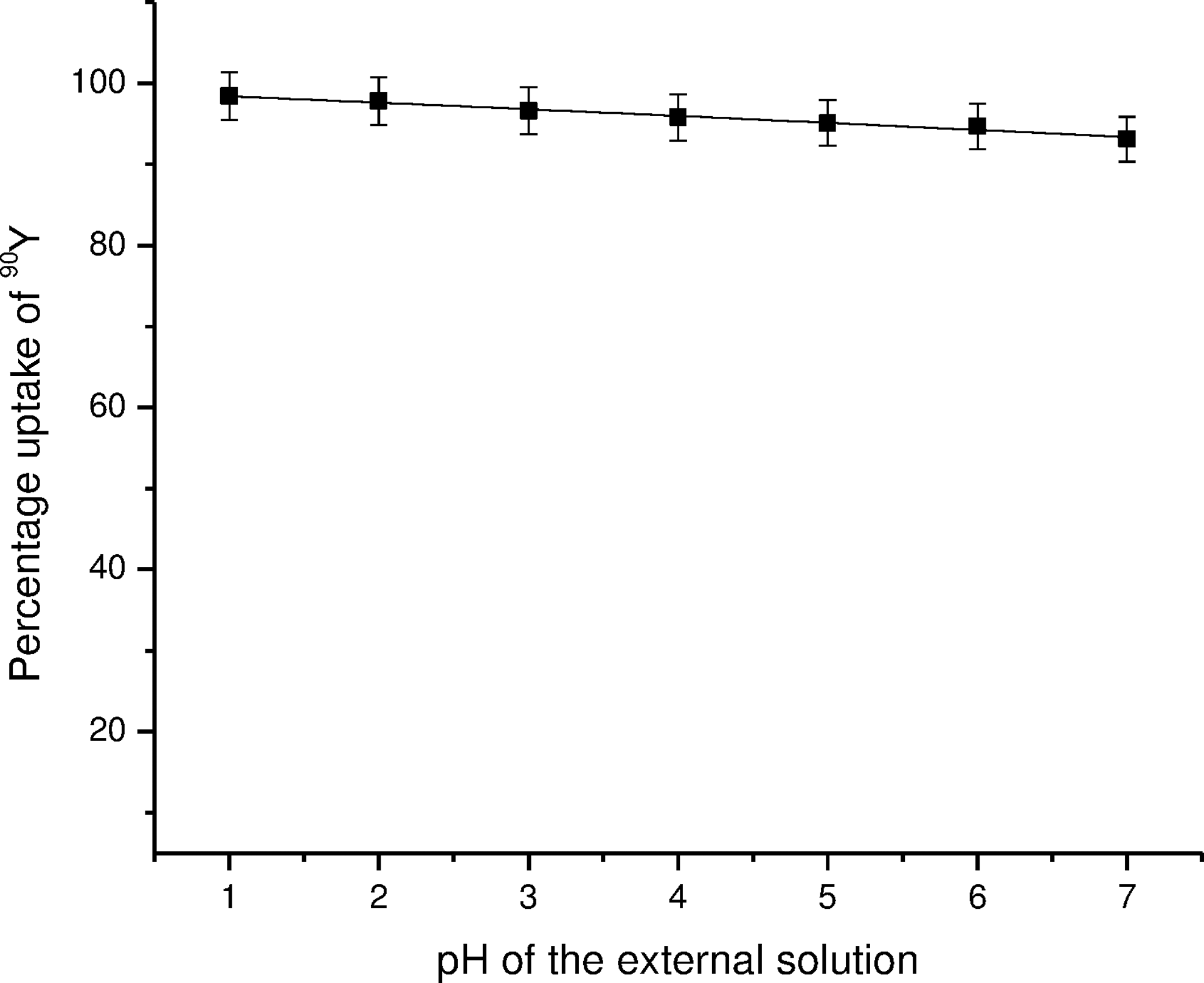
Influence of pH of feed solution on the impregnation of 90Y ions on Nafion membrane.
Nafion is known to be a matrix consisting of a hydrophobic tetrafluoroethylene backbone and perfluoroalkyl ether side chains that account for nearly 90 vol% and very hydrophilic sulfonic acid groups that account for ∼10 vol%. The uptake of 90Y3+ can be attributed to electrostatic attraction between sulfonic acid groups with their hydration spheres. At neutral and alkaline pH, the yttrium salt undergoes hydrolysis. The preferential retention at lower pH may be due to the presence of 90Y3+ ion in nonhydrolysable form. Other factors such as the surface area and porosity of the Nafion membrane as well as the hydration energy of 90Y3+ ion, concentration of 90Y3+ ions in the feed solution, and presence of competing ions may also play a vital role in the uptake of 90Y by the membrane. From Figure 1, it can be inferred that a pH near to 1 provided an environment conducive for the retention of 90Y3+ ions in its structural scaffold.
Effect of contact time and temperature
The reaction time required to achieve near-quantitative impregnation of 90Y ions in the Nafion-115 membrane is another crucial parameter, which needed to be optimized. To study the effect of contact time on the impregnation of 90Y ions in the Nafion-115 membrane, experiments were carried out at various time intervals as well as at different temperatures and the result is depicted in Figure 2. It is evident from the result that the impregnation of 90Y ions in the Nafion-115 membrane increased with increasing contact time and remained constant after 8 hours of contact at room temperature (25°C). The impregnation of 90Y in the Nafion-115 membrane takes place by 90Y3+ ion diffusion. As the contact time increases, more and more 90Y3+ ions gradually overcome the energy barrier and diffuse into the Nafion-115 membrane leading to the increase in the impregnation. The maximum impregnation rate may be resulting from the completion of 90Y3+ ion diffusion.

Effect of contact time and temperature on the uptake of 90Y on Nafion membrane.
It is seen from the result (Fig. 2) that the percentage of 90Y impregnation increases with increasing the temperature and it is possible to obtain near quantitative impregnation of 90Y after 6 hours when the temperature of the 90Y feed solution was maintained at 40°C. While the increase in contact time on the impregnation of 90Y in the Nafion-115 membrane has tangible benefits in enhancing the percentage of 90Y impregnation, increasing the temperature of the 90Y solution along with contact time is a trustworthy proposition. It can be inferred that the increase in temperature along with contact time leads to an increase in the mobility of 90Y3+ ions, which in turn enhances the percentage of 90Y impregnation. With a view to impregnate >95% of the initial 90Y activity in the Nafion-115 membrane, a contact period of 6 hours at 40°C was determined to be optimum.
Effect of carrier concentration
The results obtained in the investigations carried out to determine the influence of carrier yttrium concentration on the impregnation of 90Y into the Nafion-115 membrane are shown in Figure 3. It is noticeable that the percentage of 90Y impregnation increases initially with increasing yttrium carrier concentration up to 400 μg/mL and thereafter decreases with further increase in carrier concentration. With a view to realize quantitative impregnation of 90Y into the Nafion-115 membrane, it is essential to keep the carrier concentration of yttrium at ∼400 μg/mL.

Effect of carrier yttrium concentration.
Capacity of Nafion-115 membrane for 90Y
The capacity of Nafion-115 toward yttrium ions was experimentally found to be ∼18.9±1.2 mg/g, which works out to be ∼8.1 meq of yttrium per gram of Nafion-115 membrane. Therefore, it is possible to incorporate 265 Ci of 90Y per cm2 of membrane, which is significantly higher than the activity needed for superficial brachytherapy applications.
SEM and EDS analysis
SEM micrograph of the Nafion membrane incorporated with inactive yttrium ions under 1000 times magnification is shown in Figure 4. The membrane surface appears smooth and homogeneous without any irregularity such as cracking or flaking.

Scanning electron microscope micrograph of 90Y-impregnated Nafion membrane.
The EDS profile that verifies the elemental composition of the yttrium-incorporated Nafion membrane is shown in Figure 5. The elemental composition of the 89Y-Nafion membrane surface was determined from the intensity of the peaks pertaining to different elements and the quantification of results as weight percentage is given in Table 1. The results of EDS analysis of the yttrium-incorporated membrane confirm the presence of C, O, F, S, and Y ions. The presence of Au in the polymeric membrane is due to gold coating during the EDS analysis.
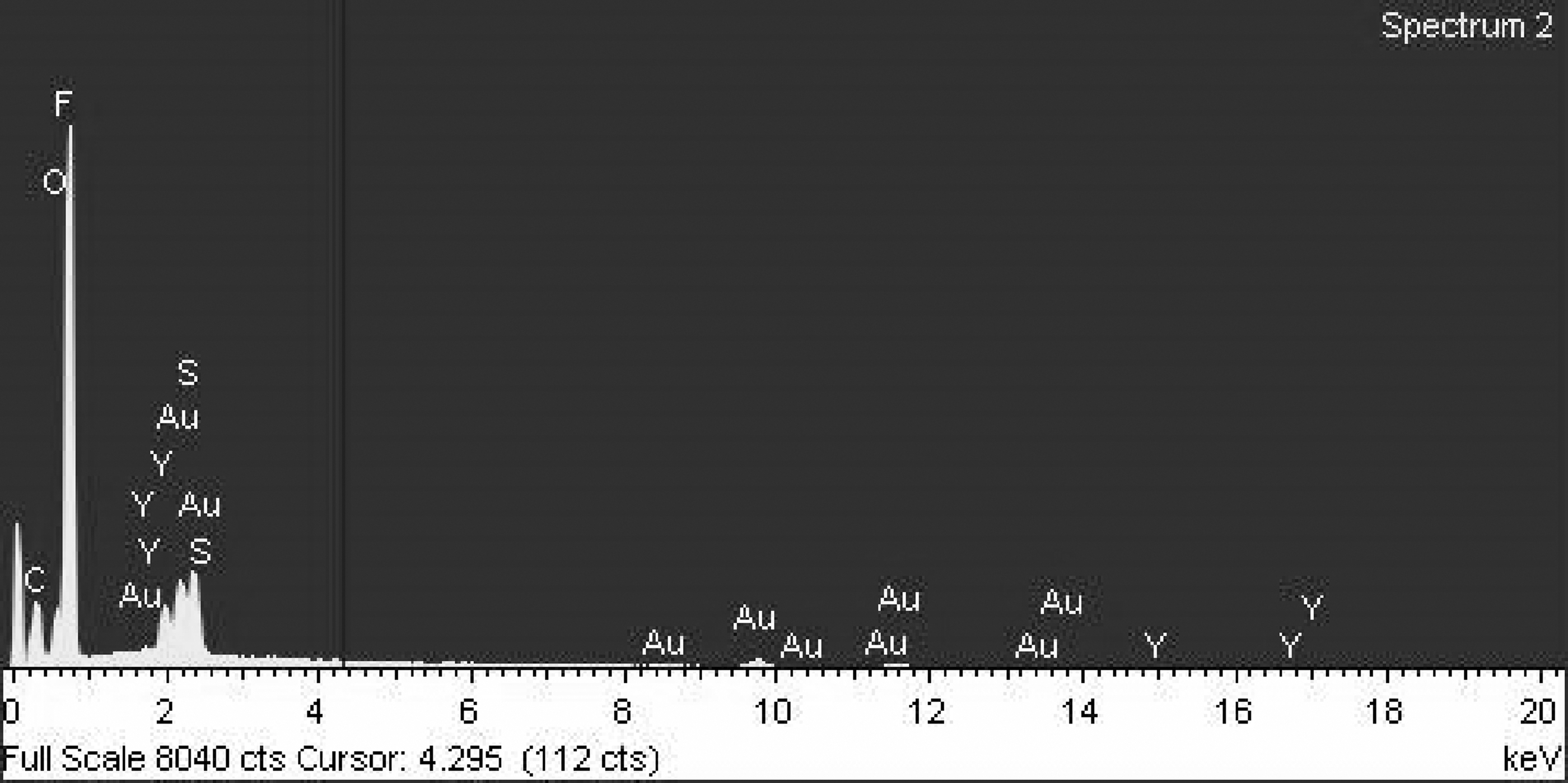
Energy-dispersive X-ray spectrum of 90Y-Nafion membrane.
To ascertain the homogeneity of distribution of yttrium ions on the Nafion membrane, the EDS spectra were recorded at various locations and the quantification of results as weight percentage revealed that the variation in distribution of yttrium ions on the surface of the membrane was within ±2.5%, which is below the limit of 10% required for this application.
Preparation of 90Y patches
Following the procedure described previously, several batches of 90Y patches using Nafion-115 membrane were prepared. In light of the perceived need to assess the efficacy of the Nafion-115 membrane to impregnate 90Y activity, a comparative evaluation study was considered worthwhile investigating using various dimensions of membrane. Table 2 depicts the 90Y activity retained by various sizes of Nafion-115 membrane. It is seen from the result that the efficiency of 90Y impregnation remained impervious irrespective of the dimensions of Nafion-115 membrane.
Reaction volume=1 mL, amount of carrier=400 μg, pH=1, temperature=40°C, time=6 hours.
The thickness of TPU laminating sheet was kept 40 μm based on the optimized studied carried out in the reported literature. 18
Evaluation of quality of 90Y-Nafion membranes
Determination of source strength
The measurement of 90Y activity of the final source by isotope dose calibrator was used for quoting the total amount of activity impregnated in the Nafion-115 membrane. Measurement results show that the prepared 90Y source was able to provide activity values with standard deviation of <5%, which is far below the limit of 10% prescribed by AERB.
Uniformity of distribution of 90Y activity
To evaluate the distribution of 90Y activity in the Nafion-115 membrane, the OD of the exposed radiographic film was measured at various locations. The results obtained with three different sources are depicted in Table 3. It is observed that the variation in distribution of 90Y along the surface of the membrane was within ±3%, which corroborated the values obtained by EDS technique. As values less than ±10% are acceptable, the source prepared by the earlier method meets the specifications.
Leachability of 90Y activity from Nafion membranes
The results on leachability conducted on five randomly selected samples of 90Y-impregnated Nafion-115 membrane of 1×1 cm2 dimension indicated that ∼2.0% of the original activity leached out in 48 hours, which was significantly higher than the AERB norms. 25 Hence, the 90Y-impregnated Nafion-115 membrane sources were laminated using TPU sheet to retard the leaching. Table 4 depicts the results of the leachability studies conducted on TPU-sheet-laminated, 90Y-impregnated Nafion-115 membranes in water and saline, respectively. It is evident from the result that the lamination of 90Y-impregnated Nafion-115 membrane reduced the leachability to <0.01% of the source activity in water as well as in isotonic saline, which complies with the specifications laid by the AERB, India.
n=3, yttrium carrier=400 μg, source strength=37 MBq each.
Determination of surface contamination
The results of surface contamination tests carried out on randomly selected TPU-laminated 90Y-Nafion-115 membrane source from five different batches following the described procedure revealed that the radioactivity on the swabs was almost negligible. The samples counted for 20-minute duration showed almost background counts and hence the surface contamination was far below the permissible level of 185 Bq.
Immersion test
The results of immersion test carried out on TPU-laminated 90Y-Nafion-115 membrane as per the procedure described in the experimental section revealed that the release of radioactivity from the laminated 90Y-Nafion-115 membrane was found to be much below the permissible level of 185 Bq. Results of quality assurance tests carried out using five different sources are shown in Table 5.
Bioevaluation studies in melanoma model
Bioevaluation studies carried out in C57BL6 mice bearing melanoma showed that complete regression of tumor could be achieved by application of 74 MBq sources (two doses at days 1 and 3, respectively, and 3 hours/application). The results of bioevaluation experiment are as shown in Figure 6 wherein the tumor growth profile of treated animals is compared with control animals. It can be seen that all the five animals in the treatment group subjected to treatment with 74 MBq sources exhibited complete regression of tumor. In the meantime, all the control animals were sacrificed when the tumor volume exceeded 1 cm3, as per ethical guidelines. Histopathology of the skin section from one of the control animals and an animal treated with 90Y-incorporated Nafion membrane sources (two doses of 74 MBq each) is presented in Figures 7 and 8, respectively. Figure 7 shows transplanted melanoma tumor in the subcutaneous tissue with mild-to-moderate degree of vascularization, multifocal mild degree leucocytic infiltration, and milder atrophy of epidermal tissue overlying the tumor. Figure 8 is the photomicrograph of the skin section from the treated animal showing the absence of tumor. Histopathology of the treated region of the skin showed focal ulceration with epidermal discontinuity, necrotic changes, and high leucocytic infiltration. Dermal layers in other part of the skin showed mild leucocytic infiltration with focal increase in connective tissue stroma. However, the treated area of the skin that appeared hard and necrotic after treatment became normal within a few days and regrowth of hair was also observed in the region.
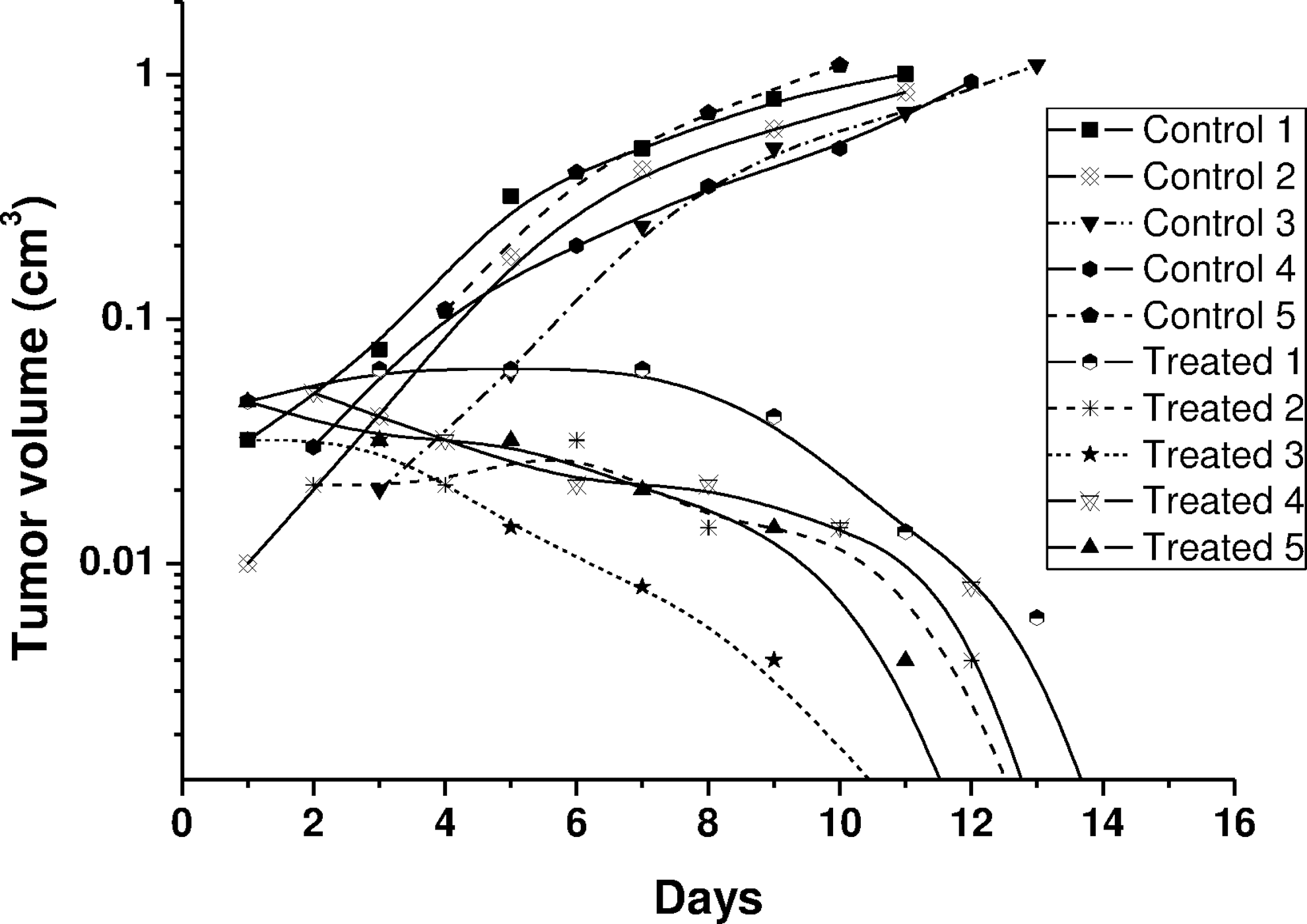
Tumor growth profile in C57BL6 mice bearing melanoma treated with two doses of 74 MBq 90Y-Nafion membrane sources in comparison to control animals.
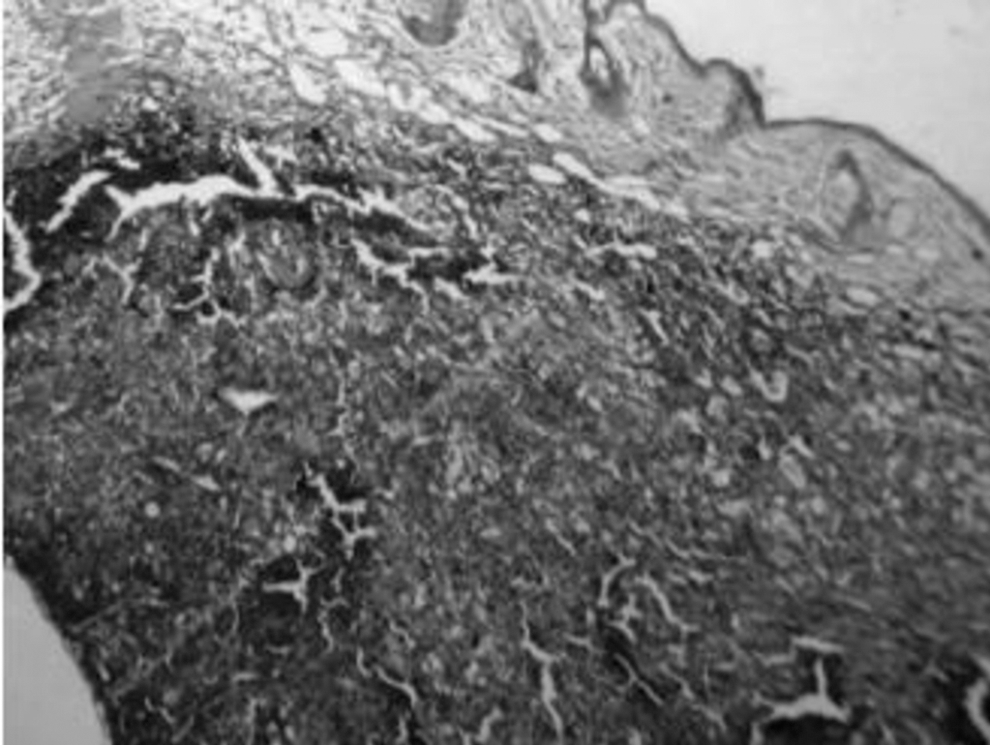
Photomicrograph showing representative skin section from a transplanted-melanoma-bearing C57BL/6 mice (H & E, magnification ×10). H & E, hematoxylin & eosin.
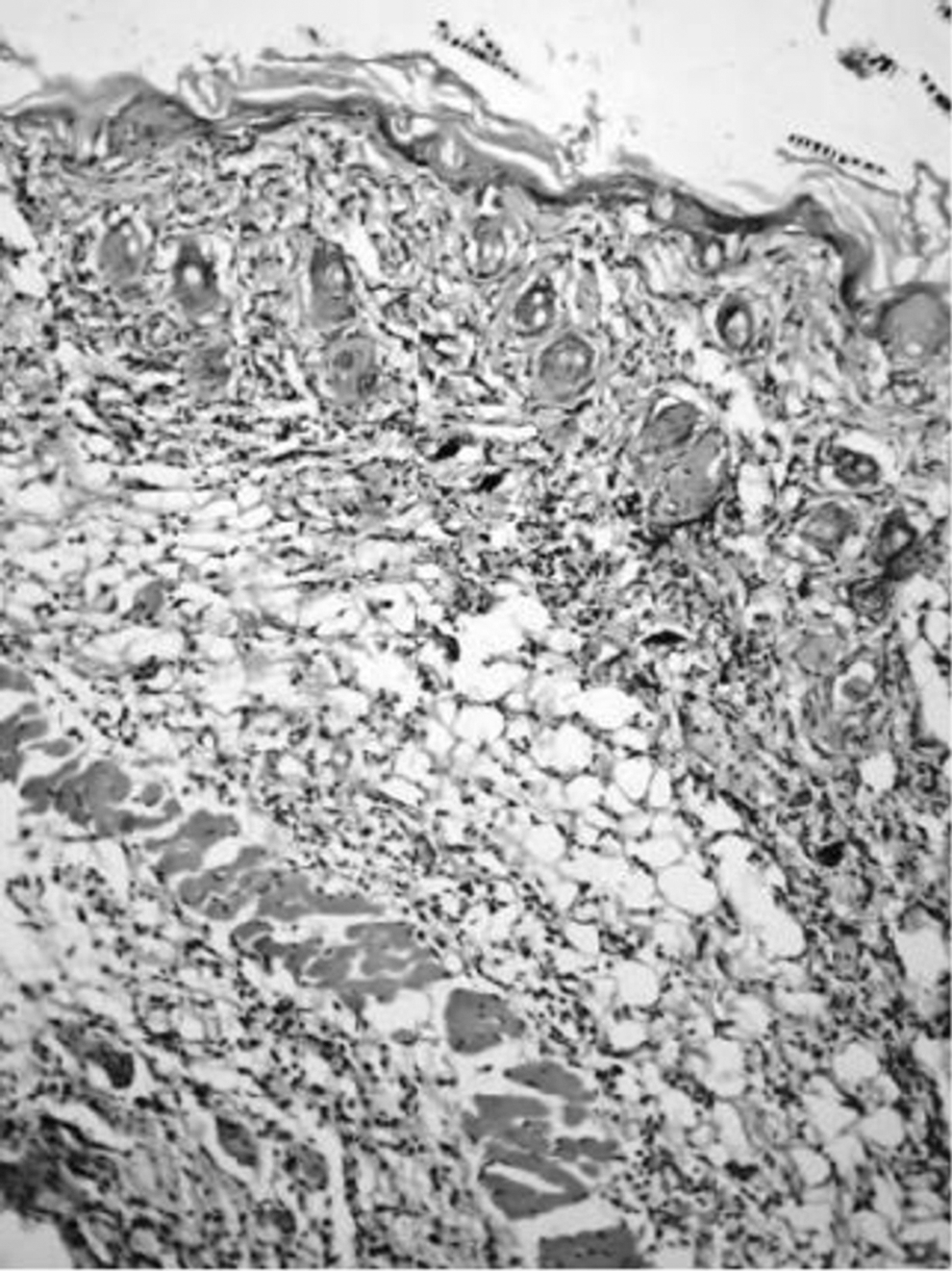
Photomicrograph showing representative skin section from a melanoma-bearing C57BL/6 mouse treated with 90Y-Nafion membrane source (H & E, magnification ×20).
Discussion
The use of radioactive patches in the treatment of superficial skin cancers has very high potential as they can be used in inoperable cases, offering the scope of treating patients in poor health with fewer complications and ability to treat patients on anticoagulant therapy or with allergies to anesthetics. Development of facile routes for preparation of radioactive patches is not only an intuitive proposition but also represents an important driving force to realize their therapeutic potential in the management of patients with skin cancers. The key to the success of this treatment modality relies on the continued “fueling” of the field with new source-preparation strategies and with new radionuclides. Although significant strides have been made in this direction, there is ample scope for further improvement.
While the use of radioactive patches containing β− emitting radionuclides represents a successful paradigm for treating superficial skin cancers, selection of the radionuclide is not only the first step but also constitutes the pillar of success in therapy. Availability of the required radionuclide with high specific activity and purity on demand in a cost-effective manner is a major determinant for ensuring its utility in therapy. Among the β− emitting radionuclides used for treating skin cancer, generator-produced 90Y is noteworthy. The 2.3 MeV β− radiations of 90Y have an average range of ∼3 mm in tissues, 30 suitable for treatment of superficial lesions, thereby avoiding undue radiation dose to the underlying bone and tissues. The absence of γ emissions in the decay of 90Y also is an advantage for such applications, as it precludes the unnecessary radiation exposure to the personnel involved in the preparation and application of the source as well as the patient undergoing treatment. To prepare radioactive patches in accordance with the shape of the tumor at the hospital radiopharmacy, the scope of using 90Sr/90Y generators seemed attractive owing to the ability to avail no-carrier-added (NCA) 90Y on demand. The long half-life of 90Sr (t½ =28.8 years) not only ensures cost-effective availability of 90Y for long periods of time but also obviates the reliance on local reactor production capabilities.
Ensuring successful utilization of 90Y in skin cancer therapy at hospital radiopharmacy demands not only an onsite 90Sr/90Y generator but also a facile route for the preparation of radioactive patches. There appears to be enticing interest to consider the use of perfluorinated ionomer membrane, commercially known as Nafion, by virtue of its “Teflon-like” backbone with side chains terminating in -SO3H group. In aqueous solution, these sulfonic acid groups dissociate protonating the solvent molecules and forming a hydrophilic phase that includes the solvated -SO3 − ions tethered to the hydrophobic backbone through the side chain. The protons of the sulfonic acid groups are labile and can be exchanged with metal ions such as 90Y3+ in aqueous solutions under appropriate conditions. With a view to impregnate predictable quantities of 90Y into the Nafion-115 membrane from aqueous solution, an exploratory study on the effect of experimental parameters was pivotal not only to arrive at the optimum conditions for 90Y3+ ion impregnation but also in tailoring the activity content in the membrane for propitious outcome. Addition of nonradioactive yttrium (89Y) as carrier not only provided the scope of achieving uniform distribution of activity on the Nafion-115 membrane surface but also improved the kinetics of impregnation.
Our pursuit of development of a process for the preparation of radioactive patches with 90Y using Nafion-115 membrane was driven mainly by three considerations, namely, (i) regular and well-established production of 90Y using the electrochemical 90Sr/90Y generator developed in-house, (ii) need for an easy and readily adaptable skin patch preparation strategy that could be realized in hospital radiopharmacy, and (iii) facilitate the scope of using 90Y-based radioactive patches for the treatment of skin cancer.
The reported procedure of preparing 90Y patches using Nafion-115 membrane seemed sagacious as it would provide the scope of using commercially available reactive polymer and at the same time offer the convenience of availing required quantity of NCA 90Y from an electrochemical 90Sr/90Y generator commensurate with therapeutic requirement. The procedure described in this article demonstrates the usability of Nafion-115 membranes to prepare sources incorporating 37–185 MBq activities of 90Y. Although these sources are proposed to be utilized for in vitro applications on the skin of the patient, the radioactivity-release studies were carried out in order to ensure compliance with regulatory requirements for contact brachytherapy sources. The uniformity of dose distribution on the source matrix has important consequences in terms of tumor response and was therefore confirmed by autoradiography studies. The lamination of 90Y-impregnated Nafion-115 membrane not only retarded the leachability of 90Y to an acceptable level but also provided adequate mechanical strength to ensure its integrity during application. The scope of using TPU film is appealing owing to its high toughness, mechanical strength, biocompatibility, and resistance against atmospheric moisture. The reduction in dose due to the lamination was found to be marginal (<2%).
Although melanoma has been considered to be a relatively radiation-resistant tumor, improved therapeutic outcomes have been achieved in recent times using radiation therapy. 31 In the present work, murine melanoma tumor showed complete tumor regression on treatment with two doses of 74 MBq 90Y-Nafion membrane source. Tumor histology slides confirmed absence of tumor in the treated animals. These findings confirm the potential of 90Y-incorporated Nafion membrane sources for applications in treatment of superficial skin tumors.
The novelty of the reported procedure for making 90Y patches lies in the ability to fine-tune the amount of activity that could be impregnated into the Nafion-115 membrane, means of achieving homogeneous distribution of 90Y throughout the surface area of Nafion-115 membrane, ability to produce 90Y patches of conformal shape and dimensions with negligible release of activity in saline and water, and in the ability of safe handling of radioactivity in mild experimental conditions.
Conclusions
Potential utility of Nafion membrane for the preparation of 90Y patches for the treatment of skin melanoma using generator produced 90YCl3 commensurate with therapeutic need and compliance with the regulatory requirements for safe handling during applications has been amply demonstrated. The radioactive membrane sources not only exhibited a uniform distribution of 90Y but also were found to be free from any surface contamination. The process is simple and robust, and generates minimum quantity of radioactive waste. Using the reported procedure, it was possible to prepare membrane sources containing ∼185 MBq/cm2 with very good reproducibility. This methodology offers the scope of preparing 90Y patches of different geometries and radioactivity levels commensurate with therapeutic requirement. Bioevaluation studies carried out in animal model of melanoma gave complete treatment response, demonstrating the viability of the 90Y patches for the management of superficial skin tumors. These data suggest that 90Y patches prepared using the reported procedure have the potential to be translated into clinical practice. It is envisaged that the reported procedure that is technically less demanding would serve in good stead for ensuring onsite availability of 90Y-labeled skin patches for therapy, particularly in countries having no research reactor facility for radioisotope production.
Footnotes
Acknowledgments
Research at the Bhabha Atomic Research Centre (BARC) is part of the ongoing activities of the Department of Atomic Energy, India, and is fully supported by government funding. The authors express their sincere thanks to Dr. Gursharan Singh, Associate Director (I), RC&I Group, BARC for his encouragement and support.
Disclosure Statement
The authors have neither received any outside funding nor received any grants from any external agencies in support of this study. Our institution does not have a financial relationship with any commercial entity that has an interest in the subject matter or materials discussed in this article. None of the authors in this article have any conflict of interest, financial, or otherwise in the publication of this material.