




Abstract
Painful bone lesions, both benign and metastatic, are often managed using conventional analgesics. However, the treatment response is not immediate and is often associated with side-effects. Radionuclide therapy is used for pain palliation in bone metastases as well as some benign neoplasms. Endoradiotherapy has direct impact on the pain-producing bone elements, and hence, response is significant, with minimal or no side-effects. A new potential compound for endoradiotherapy is [177Lu]BPAMD. It combines a highly affine bisphosphonate, covalently bridged with DOTA through an amide bond, with the low-energy β− emitting therapeutic radiolanthanide 177Lu. For routine chemical application, an automated synthesis of this radiopharmaceutical and a Kit-type labeling procedure appears to be a basic requirement for its good manufacturing practice (GMP) based production. A Kit formulation combining BPAMD, acetate buffer, and ethanol resulted in almost quantitative labeling yields. The use of ethanol and ascorbic acid as quenchers prevented radiolysis over 48 hours. An automated synthesis unit was designed for the production of therapeutic doses of [177Lu]BPAMD up to 5 GBq. The procedure was successfully applied for patient treatments.
Introduction
Management of metastatic bone pain is often a multidisciplinary concept, where nuclear medicine can significantly contribute by applying therapeutic β− particle-emitting radiopharmaceuticals. However, associated side-effects and the absence of imaging surrogates of some of these tracers are challenging. There has been an increasing research in this area for producing an ideal tracer, which could relieve pain symptoms, with minimal toxicity, and provide good physical characteristics for assessing biodistribution with positron emitters prior therapeutic applications. There are several bone-targeting radiopharmaceuticals commercially available applying β− emitting radionuclides, like [153Sm]EDTMP, [186Re]HEDP, and 89SrCl2. 1 More recently, the α-particle-emitting 223RaCl2 was approved in Europe and by the FDA. 2
While EDTMP and HEDP represent nonmacrocyclic phosphonate ligands, a new macrocyclic diphosphonate (4-{[(bis(phosphonomethyl))carbamoyl]methyl}-7,10-bis(carboxymethyl)-1,4,7,10-tetraazacyclododec-1-yl)acetic acid (BPAMD, Fig. 1) showed promising results in the detection of skeletal-related events in the first human studies, when labeled with the generator-derived positron emission tomography (PET) nuclide 68Ga.
3
This compound can further be used as an endoradiotherapeutic agent (Fig. 2) by a stable complexation with the beta-emitter 177Lu (t
1/2=6.7 days, E
βmax=0.5 MeV).
4
The physical characteristics of 177Lu (long half-life and low β-range) are very suitable for the treatment of discriminated bone metastases. Low ranges of the particles emitted are essential for avoiding side-effects, like hematotoxicity as induced by irradiation of the red bone marrow. Current production routes of 177Lu by the 176Yb pathway exclude the waste problematic metastable 177mLu (t
1/2=160.4 days) and carrier additions.
5

Structure of the macrocyclic bisphosphonate ligand BPAMD and its use as Theranostic when labeled with 68Ga (PET/CT) or 177Lu (ERT). CT, computed tomography; ERT, endoradiotherapy; PET, positron emission tomography.
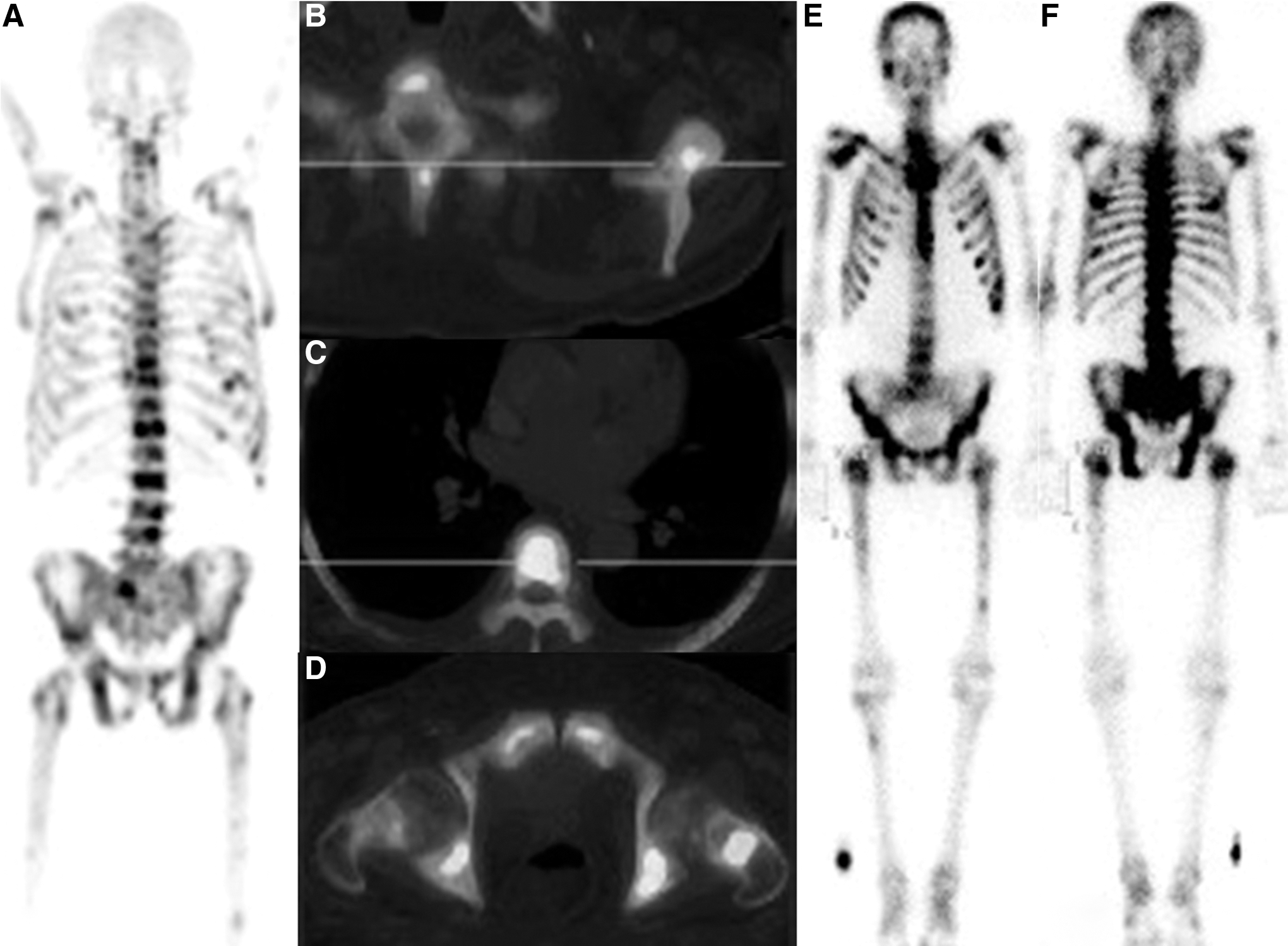
Seventy-year-old male, case of prostate cancer, with rising PSA levels underwent 18F-Fluoride PET/CT. Coronal MIP image
Using [68Ga]BPAMD PET/CT for pre- and post-therapeutic molecular imaging when using [177Lu]BPAMD for endoradiotherapy (ERT), offers a system [*Me]BPAMD, which reflects truly a theranostic (Figs. 1 and 2) option. 6 –8 The use of 68Ga and 177Lu as a nuclide pair for diagnosis and therapy in nuclear medicine is well established in the peptide receptor radiotherapy for the treatment of neuroendrocrine tumors with DOTA-conjugated somatostatin analogs (Table 1). 8
PET, positron emission tomography.
Since bone pain palliation was reported for [177Lu]EDTMP complexes in a phase II study, 12,13 [177Lu]BPAMD is therefore considered a very promising next-generation compound for bone-targeted ERT. However, for future clinical trials, a Kit-type labeling synthesis and an automated labeling module need to be developed, resulting in high radiochemical yields (RCYs) suitable for routine preparation. To design the Kit formulation in a way that prevents any upcoming radiolysis in therapeutic dose ranges over a reasonable time scale is also a challenge.
The authors investigated different Kit compositions varying the ligand concentration, buffer, and scavenger amount for labeling with no carrier added (n.c.a.) 177LuCl3 with activities up to 5 GBq. Labeling efficiency, [177Lu]BPAMD complex stability, and radiolysis of the different batches were compared.
Materials and Methods
Chemicals
(4-{[(bis(phosphonomethyl))carbamoyl]methyl}-7,10-bis(carboxymethyl)-1,4,7,10-tetraazacyclododec-1-yl) acetic acid (BPAMD) was purchased from ABX (Radeberg, Germany). N.c.a. 177LuCl3 in 0.05 M HCl was provided by ITG (Garching, Germany) in a volume of 500 μL containing activities between 3 and 5 GBq. Sodium acetate, sodium ascorbate, and ascorbic acid are commercially available by Sigma-Aldrich (Steinheim, Germany) in BioXtra® (≥99.0%) or ReagentPlus® (≥99.0%) grade, as well as ethanol (CHROMASOLV®), water (TraceSELECT®), and citrate.
Kit formulation
The ligand BPAMD as well as sodium acetate, sodium ascorbate, and ascorbic acid was dissolved in water with a concentration of 1 mg/mL. Six different concentrations of BPAMD and additives were mixed in a microreaction vial and lyophilized (Kit #1–6, Table 2). In addition, another vial containing 2.5 mg gentisinic acid, without any ascorbate, was prepared (Kit #7). Prior the essential labeling process, the single Kits were dissolved in water (1 mL/1 GBq 177Lu) with exceptions for the Kits #4 and #5, which were dissolved in water containing 10% EtOH. Kit #7 was prepared with the lowest amount of 40 μg BPAMD still suitable for an efficient 177Lu labeling. Instead of sodium ascorbate, 2.5 mg of gentisinic acid, which is reported as a potent scavenger, was used. 14
Automated synthesis module
Single modular parts of an automated synthesis module of the company Eckert & Ziegler (Berlin, Germany) were combined to form a new device specially designed for the preparation of [177Lu]BPAMD. This unit is a one-reactor system that works with over pressure. The control platform of this synthesis unit is shown in Figure 3. Here shown is that the unit contains one Peltier Reaction Module (R1), nine valves (two Stopcock Manifold Modules and one PharmTracer Module, V1–V9), six vials (G1–G6), and one optional solid-phase extraction (SPE) cartridge (T1). The whole system is controlled by the electrical cabinet and the program Modular-Lab (EZAG, Berlin, Germany). The reactor has a temperature area from −15°C up to 150°C and is cooled with an external heat exchanger. Glass vials (microreaction vials) common for modular radiosynthesis were purchased from Sigma-Aldrich. The dissolved BPAMD Kit is placed in vial G1. Vial G2 is reserved for the 177LuCl3 solution, while G3 is the product vial and G4 is the waste vial. The vials G5 and G6 are needed for the optional purification step using SPE. In this study, G5 contains pure water as a washing solution and G6 the eluent solution. The unit is constructed for GMP-based synthesis; therefore the reactor, valves, and tubes are disposable and can be replaced. Also, this unit can be run with pure helium or argon instead of a pump. If the synthesis must not be GMP based, it is possible to run a cleaning program and reuse all the disposable parts. It is also possible to run a purification step after the initial labeling reaction. If the purification step is activated, the product is trapped on an SPE cartridge (T1), washed with 5 mL water in G5, and eluted into G3 with the eluent solution in G6. In this case, the whole reaction takes place in 50 minutes.
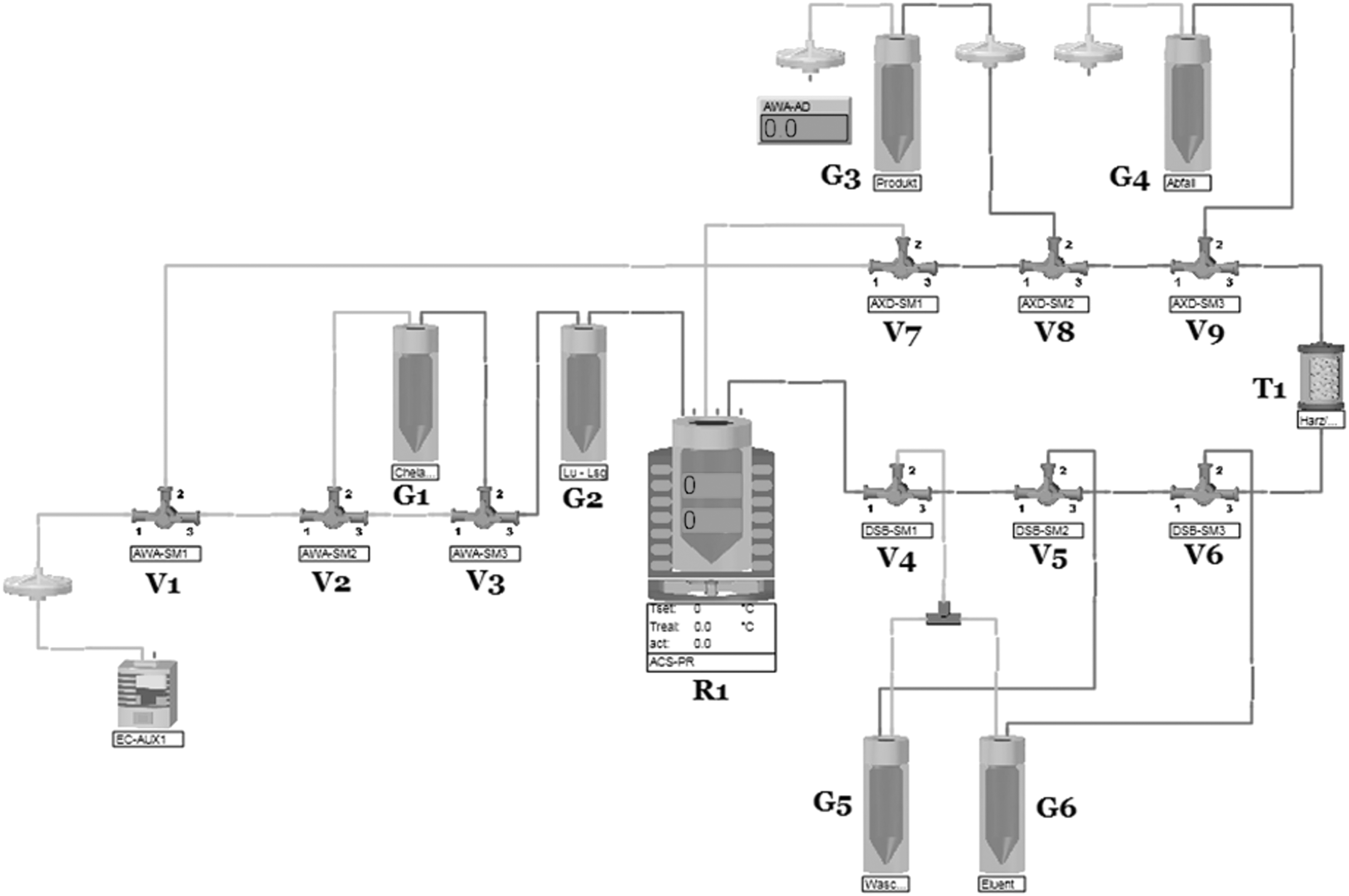
Schematic overview of the module composition out of EZAG-modular compartments. The sketch is shown as presented in the control platform of the synthesis unit in the program: Modular-Lab.
Automated radiolabeling
Labeling of BPAMD was performed with 3–5 GBq 177LuCl3. For this purpose, the single Kits, listed in Table 1, were dissolved in water or water+10% EtOH to a final concentration of 1 mL per 1 GBq 177Lu and placed in the automated synthesis module as well as the 177LuCl3 containing vessel (G2). The177LuCl3 solution (500 μL in 0.05 M HCl) was transferred by over pressure to the Peltier Reaction Module (R1) followed by the Kit solutions from vial G1. The reaction mixture is heated under stirring at 100°C for 30 minutes. After cooling the whole system, the solution is transferred to the product vial (G3). The whole reaction takes place in 36 minutes. Because of the evaluation of the different Kit formulations in terms of labeling efficiency and complex stability, the purification step was always skipped. RCYs and stability were determined by thin-layer chromatography (TLC) (Merck Silica, solvent: 0.1 M sodium citrate pH 4) at the time points 0, 1, 2, 4, 24, and 48 hours after labeling.
Serum stability test
The stability of the best performing Kits from the above-mentioned experiments was further evaluated regarding the long-term stability of [177Lu]BPAMD. The reaction products were mixed in a 1:8 ratio with human serum and were incubated at 37°C over a period of 48 hours. Radio-TLC analyses were done at time points of 0, 1, 2, 4, 24, and 48 hours similar to the radiolysis experiment.
Results
The lyophilized Kits presented the content as a white powder and were easily soluble in 3–5 mL water within a minute. Additives of 10% vol ethanol showed no influence on the solubility and were thus added as an additional scavenger. Labeling with n.c.a. 177Lu was almost quantitative (RCY≥98%) within 30 minutes reaction time for the Kit formulations #2, #5, #6, and #7 (Table 3). The Kit formulations #1 and #4 showed a somewhat less RCY of 97.0% for Kit #1 and 96.9% for Kit #4, respectively. Lowest yields of 68.5% were obtained for Kit #3. The total process time for the preparation of [177Lu]BPAMD in batches up to 5 GBq could be achieved in 36 minutes and without any need for purification.
SD, standard deviation out of a triplicate.
While Kit #1 and #7 showed a continuous degradation of the complex with a resulting value of 68.0% and 39.0%, Kit #3 and #4 showed a good but not sufficient stability of 91.7% and 90.2% after 48 hours. Optimum complex stability of >98% was observed for Kit #5 and Kit #6, followed by the Kit composition #2 with 97.7% of intact [177Lu]BPAMD after 48 hours (cf. Table 3). In Table 4, the results from the serum stability test of the [177Lu]BPAMD Kit #6 are listed. No degradation of the [177Lu]BPAMD complex, prepared with Kit #6 was observed in human serum over a period of 48 hours.
Data are presented as mean percentage of intact complex out of a triplicate.
Discussion
The automated synthesis device proved useful to perform [177Lu]BPAMD preparations up to 5 GBq. Different Kit compositions were tested in terms of RCY and radiolytic stability under GMP-like conditions.
(a) Amount of BPAMD: In Kit #1 and Kit #2, the amount of precursor was increased from 100 to 250 μg BPAMD, whereas the concentration of the ascorbate scavenger was kept constant. Only marginal changes in the RCY were observed, but with slightly better results for Kit #2 with 250 μg BPAMD. Radiolytic stability increased significantly with higher amounts of ligand from 68.0% for Kit #1 to 97.7% for Kit #2.
(b) Amount of scavenger: Kit #3 differed from Kit #1 in the amount of ascorbate scavenger, while the ligand concentration was kept constant. The increased sodium ascorbate amount of 500 mg resulted in an unsteady labeling yield based on reaction pH of >6. Nevertheless, an increasing stability concerning radiolysis could be observed for higher scavenger amounts resulting in 91.7% intact [177Lu]BPAMD for Kit #3 compared to 68.0% for Kit #1 after 48 hours.
(c) Effect of ethanol: The formulation was kept constant for the Kits #1 and #4, but instead of dissolving the batch in pure water, a mixture of water containing 10% vol EtOH was used for Kit #4. The ethanol did not influence the solubility of the ingredients, but rather it functioned as an additional radical scavenger. Labeling yields were similar and indeed a higher stability of 90.2% for the Kit #4 was obtained compared to the 68.0% for Kit #1 after 48 hours, demonstrating that ethanol additions are useful to gain Kit stabilities. Based on these results, Kit #5 was prepared equal to Kit #2, but dissolved in 10% vol EtOH as for Kit #4. The formulation of Kit #5 with 250 μg ligand, 100 mg sodium ascorbate, and a 10% vol of EtOH showed an RCY of 99.2% and a radiolytic stability of 98.8% over 48 hours.
Finally, Kit #6 was prepared similar to Kit #3 containing 100 μg BPAMD, that is, with a higher specific activity compared to Kit #5 containing 250 μg BPAMD. Instead of sodium ascorbate only, a mixture of sodium ascorbate and ascorbic acid was used to adjust a reaction pH<6, which results in the best RCY of 99.6% compared to that of Kit #3. Stability could be maintained over 48 hours (99.3% of the intact complex), similar to that of Kit #5. [177Lu]BPAMD prepared with Kit #6 exhibited also no complex degradation in human serum within 24 hours. An additional approach was the reduction of cold BPAMD carrier amounts. Kit #7 exhibited the best specific activity of 125 MBq (177Lu) per 1 μg (BPAMD), but showed also the lowest stability over time.
Conclusion
The BPAMD Kit formulation containing a mixture of 100 μg ligand, 400 mg sodium ascorbate, and 100 mg ascorbic acid exhibited the best synthesis yields and the best radiolytic stabilities over 48 hours, with a specific activity of 50 MBq 177Lu/μg BPAMD. An automated synthesis module for the preparation of [177Lu]BPAMD in scales of up to 5 GBq has been successfully established. The Kit and the automated synthesis unit enable a safe and routine in-house production of the therapeutic tracer [177Lu]BPAMD for the treatment of bone metastases. In addition, the stability over 48 hours is an appropriate time scale to even allow the shipment of batches from production facilities ready-to-use to clinical departments. The [177Lu]BPAMD prepared this way selectively accumulates in disseminated bone metastases. Preliminary therapeutic data are promising and will be reported in detail elsewhere.
Footnotes
Acknowledgments
The authors are grateful to ITG (Garching, Germany) for providing 177Lu. The assistance of Dr. Markus Piel and Sabine Höhnemann for the arrangement of the automated synthesis module is greatly acknowledged. This work was supported by a scientific grant of the Wilhelm u. Ingeburg Dinse-Gedächtnis-Stiftung (Hamburg, Germany), provided to the Theranostics Research Network, ENETS Center of Excellence, Zentralklinik Bad Berka, Germany. The financial support by the Grant of the Max Planck Graduate Center is greatly acknowledged. The author(s) would like to acknowledge the contribution of the COST Action TD1004.
Disclosure Statement
No competing financial interests exist.