




Abstract
A feasibility study was performed to design thermal and epithermal neutron sources for radioisotope production and boron neutron capture therapy (BNCT) by moderating fast neutrons. The neutrons were emitted from the reaction between 9Be, 181Ta, and 184W targets and 30 MeV protons accelerated by a small cyclotron at 300 μA. In this study, the adiabatic resonance crossing (ARC) method was investigated by means of 207Pb and 208Pb moderators, graphite reflector, and boron absorber around the moderator region. Thermal/epithermal flux, energy, and cross section of accumulated neutrons in the activator were examined through diverse thicknesses of the specified regions. Simulation results revealed that the 181Ta target had the highest neutron yield, and also tungsten was found to have the highest values in both surface and volumetric flux ratio. Transmutation in the 98Mo sample through radiative capture was investigated for the natural lead moderator. When the sample radial distance from the target was increased inside the graphite region, the production yield had the greatest value of activity. The potential of the ARC method is a replacement or complements the current reactor-based supply sources of BNCT purposes.
Highlights
• A feasibility study was performed to design thermal and epithermal neutron sources.
• Neutrons were emitted from three targets and 30 MeV protons through a small cyclotron.
• Adiabatic resonance crossing method studied by lead moderator in radioisotope production and boron neutron capture therapy purposes.
• An alternative production method of 99Mo using accelerators was developed.
• Cheaper and safer way suggested in medical radiochemistry applications.
Introduction
There are essentially three processes that can be modeled in accelerator-driven systems for neutron radioisotope production and also for boron neutron capture therapy (BNCT) applications: neutron production, moderation, and capture or collimation. 1 –6 In this study, the authors consider low-current proton sources incident on an appropriate target to produce neutrons for driving the neutron activator.
Moderation is the process of slowing neutrons down through interactions with the nuclei of a material. When neutrons collide with nuclei, they lose momentum and slow down until they are in epithermal and thermal equilibrium with the medium they are moving through. 7,8 The adiabatic resonance crossing (ARC) technique has been proposed by Rubbia in 19979 for element activation and waste transmutation by neutron capture. 10 –12
An accelerator-driven neutron activator that is based on the ARC method has been simulated in the frame of the Karaj cyclotron (Cyclon30; IBA, Belgium) in Iran. The investigation was made with the aim of efficiently utilizing ion-beam-generated neutrons for production of thermal and epithermal neutrons in the lead storage region. MCNPX (Monte Carlo N-Particle version ×2.7.0) 13 simulations were carried out to optimize the scheme of the activator, which is based on neutron production from an incident low-energy proton, lead moderator and dispersal, graphite reflector, and boron absorber. The framework has been divided into investigating low-energy proton, target design, moderator, and reflector material.
Yonai et al. 14 and Tahara et al. 15 investigated a neutron source using spallation reactions that occur for 30–50 MeV protons incident on a tantalum target. Tahara et al. showed that the epithermal neutron field required by BNCT is 1 mA for 30 MeV incident protons. Energy amplifier systems consist of a subcritical fast neutron core driven by a proton accelerator, and Kadi, 16 Bak, 17 Schwenk-Ferrero, 18 and Hong 19 demonstrated transmutation capabilities through fission and transuranic elements presently produced by nuclear reactors. Meanwhile, Kadi and Revol 20 have proposed an accelerator-driven system for the destruction of nuclear waste and testing minimal cost long-lived fission fragments using the concept of the ARC method.
Furthermore, BNCT is a technique that was designed to selectively target high-LET heavy charged particle radiation to tumors at the cellular level. 10B absorbs a thermal neutron in a (n,α) reaction. The energetic emitted α particle and the recoiling 7Li ion result in locally deposited energy averaging about 2.33 MeV. About 94% of the time, the recoiling 7Li ion is produced in an excited state and de-excites in flight, emitting a 477 keV γ ray. In the remaining events, 7Li is emitted in the ground state with no γ ray emission, which can be ignored from a dosimetry perspective, although they are frequently utilized for 10B analysis purposes. 21 –23 In this project, the authors have shown that an epithermal and thermal neutron field required by BNCT and radioisotope production, respectively, can be realized when a proton of 300 μA at 30 MeV by cyclotron is used.
Methods and Materials
Neutron generator system by proton reaction through target design
Design and development of a target design for radioisotope production or BNCT require making a balance among neutronic, mechanical, and thermal considerations. The target must produce a sufficient number of neutrons when irradiated by a suitable proton beam. The charged particle beam striking the target should also be as large as possible to spread the heat load, but must still remain small enough to limit the loss of those neutrons generated near the edges of the target. Since the charged particle beam generates heat when it is stopped by the target material, a target heat removal system must be designed to keep the target cool and mechanically stable. This entire target and cooling assembly must be integrated into the moderator/reflector assembly without adversely affecting the neutron field either by reducing the flux or by altering the desired neutron energy spectrum. The low-energy proton beam with 0.5 cm radius in 30 MeV at 1 μA current has produced 30 J/second on the target area.
The target was designed in a cylindrical shape with 0.83 cm radius and 1 cm length. Moreover, the target was equipped with a cooling system and water was used as its coolant. Beryllium, tungsten, and tantalum are considered as target materials because they possess a high melting point equal to 1287°C, 3422°C, and 3017°C, respectively, and also fine mechanical properties with a density of 1.85, 19.3, and 16.4 g/cm3, respectively. Equation 1 demonstrates the produced neutron source per volume per second inside × thickness of target as
where N (nucleus/cm3) is the density of target nuclide, j (proton/cm2/s) is beam intensity, and σ (cm2) is the microscopic cross section. Then, the authors can calculate the S/j ratio as neutron yield:
where dE/dx is stopping power (MeV/cm), R is reaction rate, and λ is mean free path of the incident proton. Moreover, the differential thick target neutron yield is given as
where E0 is the incident particle energy (MeV), X is thickness of the target (cm), and σnonel is the nonelastic cross section (cm2). In this study, absorption, elastic, and capture cross sections of neutrons were considered from the ENDF/B-VII.1 libraries. 24
Moderator and reflector designs
MCNP code is widely used for neutron transport and also for simulating moderation and reflection. The MCNPX version 2.7.0 will be used with a 30 MeV proton source to test varying moderator and reflector setups. In this study, the materials used were tested in the code and the final flux and energy spectra were compared. For each test, the same setup is used for several radiuses' sphere of material with a spherical detector layer at a radius of 2.2, 5, 7, and 20 cm inside the material that allows for backscattering.
Neutron physics characteristics of some light moderators (hydrogen, deuterium, graphite, and oxygen) and heavy materials (natural lead and lead isotope 208Pb) are presented in Table 1. Elastic cross sections of natural lead and 208Pb do not differ significantly from the others, being between the corresponding values for hydrogen and other light nuclides. Slowing down of neutrons from 0.1 MeV to 0.5 eV requires from 12 to 102 elastic collisions with light nuclides, whereas slowing down of the same neutrons requires about 1270 elastic collisions with natural lead or 208Pb. The reason is the high atomic mass of lead compared to the other light nuclides. From this point of view, neither natural lead nor 208Pb is an effective neutron moderator. 25 –28 Taking into account that capture cross section at thermal energy and capture resonance integral of natural lead are much larger than the corresponding values of most of the light nuclides, it is safe to say that neutrons are captured during the slowing down process in natural lead with a higher probability compared to the slowing down process in light materials. Therefore, only a small part of neutrons will slow down to thermal energy. This means that thermal neutron flux in natural lead will be much lower than in the light materials. At the same time, the nucleus of 208Pb is a double magic nucleus with closed proton and neutron shells. Thanks to this, the capture cross section at thermal energy and capture resonance integral of 208Pb are much lower than the corresponding values of lighter nuclides. The authors can, therefore, expect that even with multiple scattering of neutrons on 208Pb during the process of their slowing down, they will be slowed down to thermal energy with a high probability and thus will create a high thermal neutron flux.
The effective material for reflection of neutrons would be very useful as it would increase the chances of capture or collimation. Graphite is used in nuclear reactors to reflect neutrons back into uranium to cause more fission. 29 A good reflector material has a high probability of scattering neutrons backward at a range of energies.
In this study, an evaluation of ARC in accelerator-driven systems has been simulated by the MCNPX code. The assembly of simulation in a neutron activator and bulk storage of epithermal neutrons are shown in Figure 1. Lead moderator assembly with 30 cm radius is surrounded by a spherical graphite reflector, which is radially 35 cm thick. The third layer is a 5 cm thick boron as a neutron absorber. In the simulation of lead moderator, both 207Pb and 208Pb have been considered to estimate thermal and epithermal neutron flux.

The schematic of neutron storage, including neutron generator and moderator, is surrounded by spherical reflector and absorber.
98Mo sample position inside the activator for 99Mo production
The target was surrounded by a moderator assembly. Transmutation was prepared in lead moderator and graphite reflector regions. Figure 1 shows 98Mo locations at diverse regions, which were settled in the direction of the beam axis. The beam axis is perpendicular to the base of the cylindrical target as well as the target places in origin. Induced neutrons slowed down inside the moderator region at first. Then, the graphite reflector, which had a 35 cm thickness around the moderator assembly, saved the derived neutrons. Graphite was preferred as a reflector because of its high elastic scattering cross section and low-absorption cross section to store the neutrons in a superior flux. Moreover, boron with a 5 cm thickness was used as the absorbent matter to enclose the reflector.
98Mo samples were spheres with a 1 cm radius and were arranged at distances of 15 and 25 cm from the target inside the lead moderator region and at 38 and 45 cm inside the graphite reflector region. The 99Mo production yield related to the neutron flux in the thermal range must be proper to achieve gains. Therefore, the use of a desirable system and location of samples inside lead or graphite regions for production yield is very important.
Conceptual design for BNCT purposes
The induced neutron source from the target in the activator region needed to be amassed in the lead region and then guided to the beam port with the reflector material. The schematic of the neutron activator and storage space of neutrons is shown in Figure 2. The reflector was designed in an arc shape around the lead buffer to prevent neutron waste. Heading the appropriate beam components for epithermal neutrons in the direction of the head phantom necessitates a collimator and filter assemblies. The collimator is made up of two layers of boron carbide (B4C) and Bi materials. The internal layer of the collimator acts as an absorber that should eliminate the dispersed neutrons. The external layer works as a γ shield, which is supposes to reduce hard γ rays. The filtered beam facilities support of the proper flux of epithermal neutrons within air with the order of 1E+9 n/cm2/s, and likewise IAEA-TECDOC-122323 has recommended beam quality parameters and corresponding neutron beam energy limits in BNCT. The epithermal energy group is between 1 eV and 10 keV. The scalp–skull–brain phantom consisting of homogeneous regions of bone- or brain-equivalent material was simulated to assess the dosimetric effect in the brain. Table 2 gives the elemental composition of the biological tissues used in the Monte Carlo simulations according to the International Commission on Radiation Units and Measurements (ICRU) report 46 (ICRU 1992). The geometry of the phantom was defined as a spherical shape, and the 1 cm seated tumor in the head phantom was compounded at 7.14% 1H, 57.14% 16O, and 35.72% 10B with the density of this segment calculated as 1.77 g/cm3.
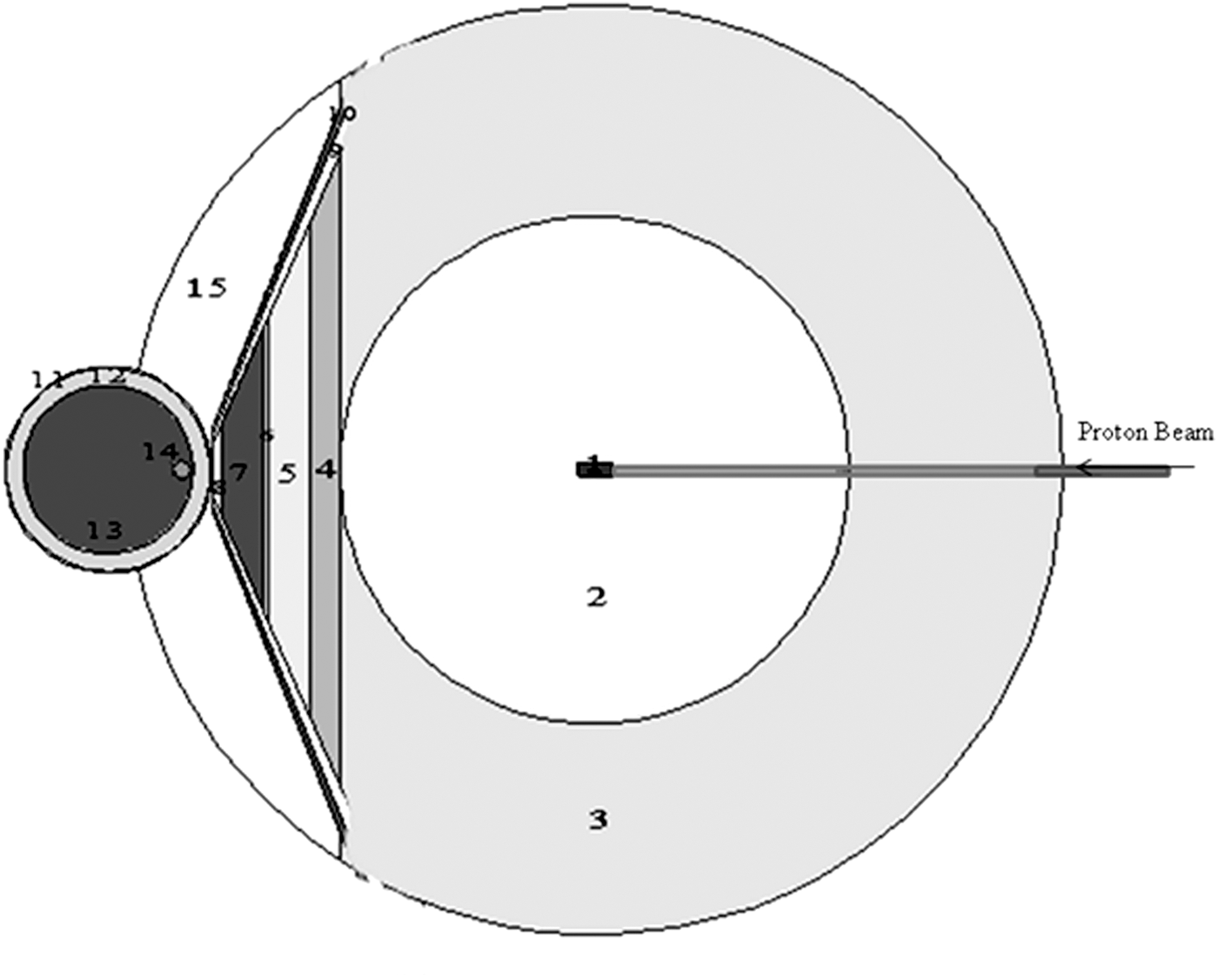
The proposed design in boron neutron capture therapy and the thicknesses are as follows: (1) typical target with 0.83 cm radius, (2) 30 cm in radius natural lead moderator, (3) 25 cm in thickness graphite reflector, (4) Fluental moderator, (5) first Fe filter, (6) 0.5 cm Li filter, (7) Bi filter, (8) second Fe filter, (9) B4C frustum 65 cm gateway radius and 4 cm end of cone radius, (10) Bi frustum 68 cm entrance radius and 5 cm egress radius, (11) 0.2 cm scalp, (12) 2 cm skull, (13) 10 cm in radius of brain, (14) 1 cm in radius of tumor at depth of 1 cm inside brain region, and (15) lead shield.
ICRU, International Commission on Radiation Units and Measurements.
Epithermal neutrons can pass through the scalp, temporal muscle, and the cranial bone and convert to thermal neutrons in the tissue. Therefore, epithermal neutrons would improve the number of thermal neutrons delivered to deep-seated lesions. Subsequently, it was determined that for deep-seated brain tumors, a beam of epithermal neutrons, defined as neutrons with energies between 0.5 eV and 10 keV, was preferable to a beam of thermal neutrons. 23
Results and Discussion
Neutron yield from diverse targets
A conceptual design for neutron source is proposed for low-energy protons in 9Be, 184W, and 181Ta targets. Three targets were simulated in air and lead mediums encircling the target for incident protons with energy of 30 MeV and current of 300 μA, as well as the beam axis is perpendicular to the base of the cylindrical target.
Interaction of the proton beam in the target results in target disintegration because of the proton energy range and target characteristics. The projected range in 9Be, 184W, and 181Ta targets was calculated as 0.580, 0.103, and 0.120 cm, respectively, for 30 MeV energy of incident protons. The values of the total number of neutrons per second and per microampere in these three targets produced by incident protons were 0.0192, 0.0182, and 0.0208, respectively. Meanwhile, the neutron yields were simulated at 300 μA equal to 3.60E+13, 3.41E+13, and 3.89E+13 n/s, respectively. The simulated results revealed that the tantalum target had the highest value in the neutron-to-proton (n/p) ratio equal to 0.0208 for 1 μA of proton beam, and then the 181Ta target had the highest neutron yield. The formula of Rubbia 1997 9 has exposed the total of neutrons produced by the proton reaction.
The generated neutrons from proton interactions are spread around the target. Analysis of neutron dispersion is related to property of the target, in addition, neutron flux reduces exponentially with increase in distance from the target. Neutronic surface flux ratio to neutron yield at 5 cm distance of spherical geometry around the target in air medium was 0.086, 0.106, and 0.042 for 9Be, 184W, and 181Ta, respectively. Meanwhile, neutron flux in a spherical volume to volumetric neutron yield was simulated at 7 cm distance from diverse targets in the air in which these ratios were 0.032, 0.050, and 0.046 for 9Be, 184W, and 181Ta, respectively, and also tungsten indicated the highest values.
Flux of accumulated neutrons through 207Pb and 208Pb moderators
During the interaction of incipient proton with diverse targets, the generated neutrons disperse in the surrounding lead. The generated neutrons in various angles were simulated in 207Pb and 208Pb moderators from the target through F2 tally in Monte Carlo simulations. Figure 3 reveals surface flux in terms of angle of the generated neutrons from the center of the cylindrical target for the 208Pb moderator at 2.2, 5, and 20 cm distances. The angle between 20° and 30° at 2.2 cm distance from the surface of 9Be target had the curve peak by means of the 208Pb moderator. Meanwhile, the flux was drawn at r = 2.2 cm distance inside the 207Pb region for three targets. When the distance from the target increased, the peak of the surface flux curve in the lead buffer decreased. At this time, the maximum point shifted to lesser angles. Comparison of the flux at 2.2 cm distance inside 207Pb and 208Pb showed that the 9Be target in 22° contains the maximum surface flux, and the 208Pb moderator revealed a higher value than the 207Pb moderator. 181Ta and 184W targets had the maximum surface flux in 30° into the beam axis, and the 181Ta target in the 208Pb moderator showed higher values than others.
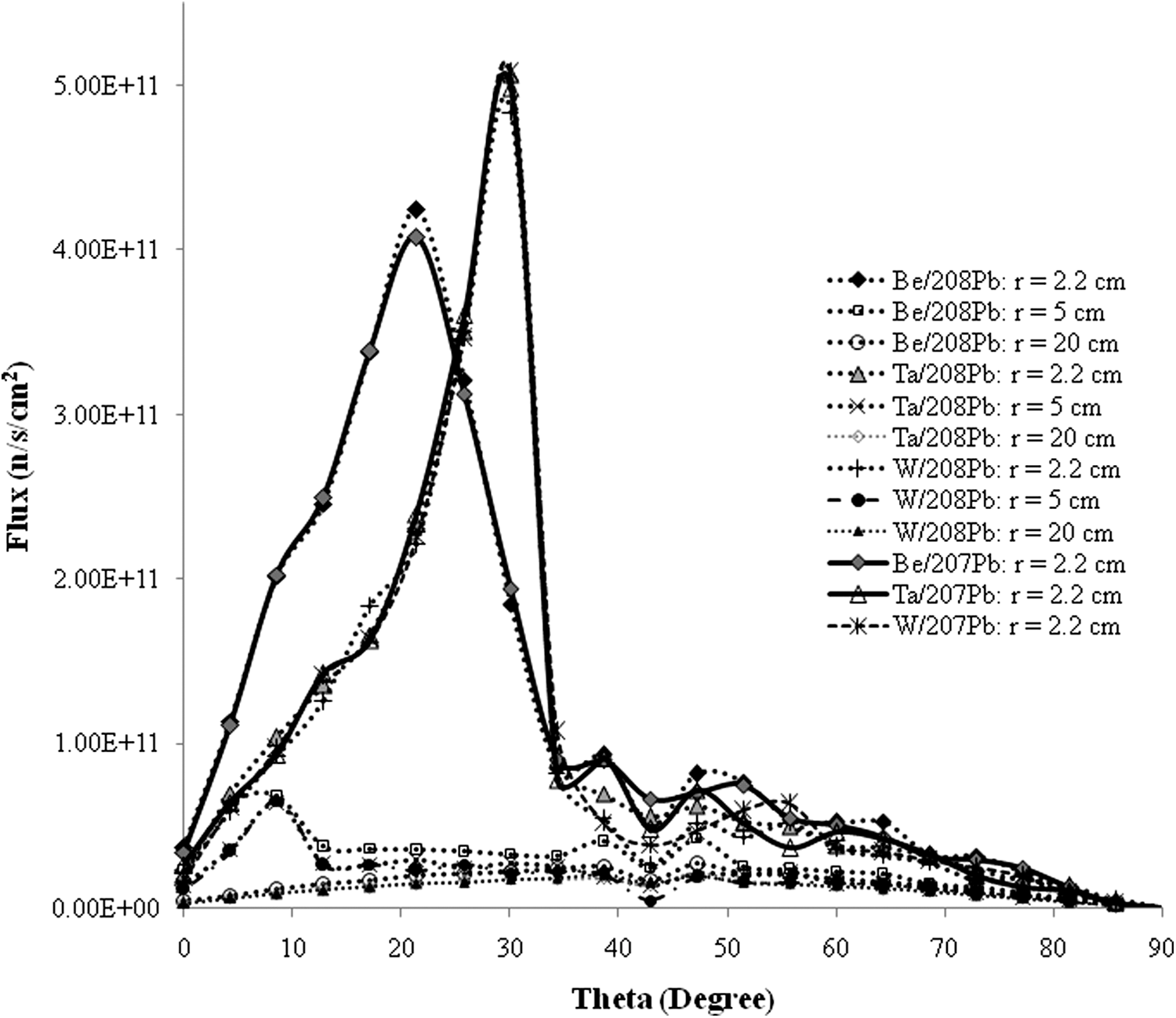
Surface flux from three targets at different distances in terms of angle of generated neutrons inside 208Pb moderator and at 2.2 cm distance inside 207Pb moderator.
Exploration of volume flux in different thicknesses of lead moderator and graphite reflector
The scheme was simulated in different thicknesses of lead moderator and graphite reflector. The thickness of boron absorber was chosen 5 cm around the reflector. The F4 tally in MCNP, which was used, is a track length tally, which sums the distances traveled by a particular type of particle in a defined volume. The unit of a volume and time-normalized F4 tally is particle · cm/cm3/s. Table 3 shows the simulated results of the neutron volumetric flux in thermal, epithermal, and fast ranges, plus total flux within the last column in the 207Pb moderator. Thermal and epithermal flux in 207Pb were in the order of 1E+9 and 1E+10 n/cm2/s, respectively, except 9Be in thermal range with 25 and 40 cm in 207Pb and graphite thicknesses, respectively. Some results of simulation in thermal and epithermal ranges were shown in italic/bold with higher/highest flux values, for instance 9Be and 181Ta targets with 207Pb thickness of 25 cm and graphite thickness of 40 cm had greater flux values, as well as the 184W target with moderator and reflector thicknesses of 35 cm had a superior value in the thermal neutron range. Moreover, in the epithermal neutron range, the 9Be target with moderator thickness of 25 cm had a maximum value in neutron flux between 0.1 eV and 5 keV energy of reduced neutron energy.
The values in italic show higher flux for the distinct targets, while the value in bold indicates the highest flux for the distinct targets.
The results of changing in 208Pb and graphite thicknesses are demonstrated in Table 4. In the 208Pb moderator, both thermal and epithermal ranges were in the order of 1E+10 n/cm2/s. The maximum flux in the thermal range for 9Be and 181Ta is with 208Pb thickness of 25 cm, but that for the 184W target is with 208Pb thickness of 35 cm. The epithermal neutrons derived from the 9Be target with 208P thickness of 25 cm had greater values among the two other thicknesses of 208P. Hence, on the basis of these simulations, it is very important to develop an alternative production method of 99Mo using accelerators because of the economic advantages. This method was founded on the production and collimation with respect to the standard nuclear reactor route, which will be completely weighed up. For this reason, the result of thermal and epithermal energy and flux can be suitable for production of some radioisotopes and BNCT applications.
The values in italic show higher flux for the distinct targets, while the value in bold indicates the highest flux for the distinct targets.
Radioisotope production and BNCT process are related to the proper neutron flux in thermal and epithermal ranges to achieve gains. Therefore, using this scheme, positioning of samples for activation yields in the lead or graphite region is very important for radioisotope production. Meanwhile, in the BNCT route, location of the collimator gate from lead or graphite is insignificant to realize dose values in the tumor. Thus, investigation into the volumetric flux of neutrons in thermal and epithermal ranges was simulated in three parts of this scheme, including moderator, reflector, and absorber for different ranges of neutron energy from three targets, and is also tabulated in Tables 5 and 6 for 207Pb and 208Pb moderators, respectively. In these simulations, the flux of neutrons derived from three targets was considered in the lead moderators with thickness of 30 cm and graphite reflector with thickness of 35 cm surrounded by 5 cm boron.
The values in italic show higher flux for the distinct targets.
The values in italic show higher flux for the distinct targets.
The comparison between 207Pb and 208Pb moderators demonstrated that the 208Pb moderator had greater values of neutron flux in both the thermal and epithermal ranges. According to Table 5, flux of thermal neutrons for all targets in the graphite region is higher than in the 207Pb and boron regions; as for the epithermal range, higher flux takes place in the 207Pb region. Furthermore, the use of the 208Pb moderator is significantly different from that of the 207Pb moderator. Table 6 demonstrates that all thermal neutron fluxes in 208Pb and graphite regions are in the order of 1E+10 n/cm2/s, and higher values of flux occur in the 208Pb region for both thermal and epithermal ranges. These simulations indicate that the use of 208Pb moderator could be compatible with medical applications to accumulated neutrons in a specified region for two ranges of neutron energies. Moreover, gathering thermal or epithermal neutrons in a region is related to target and moderator properties, in addition to thickness of the reflector. The 9Be target revealed greater values of flux in both thermal and epithermal ranges using 207Pb and also 208Pb moderators.
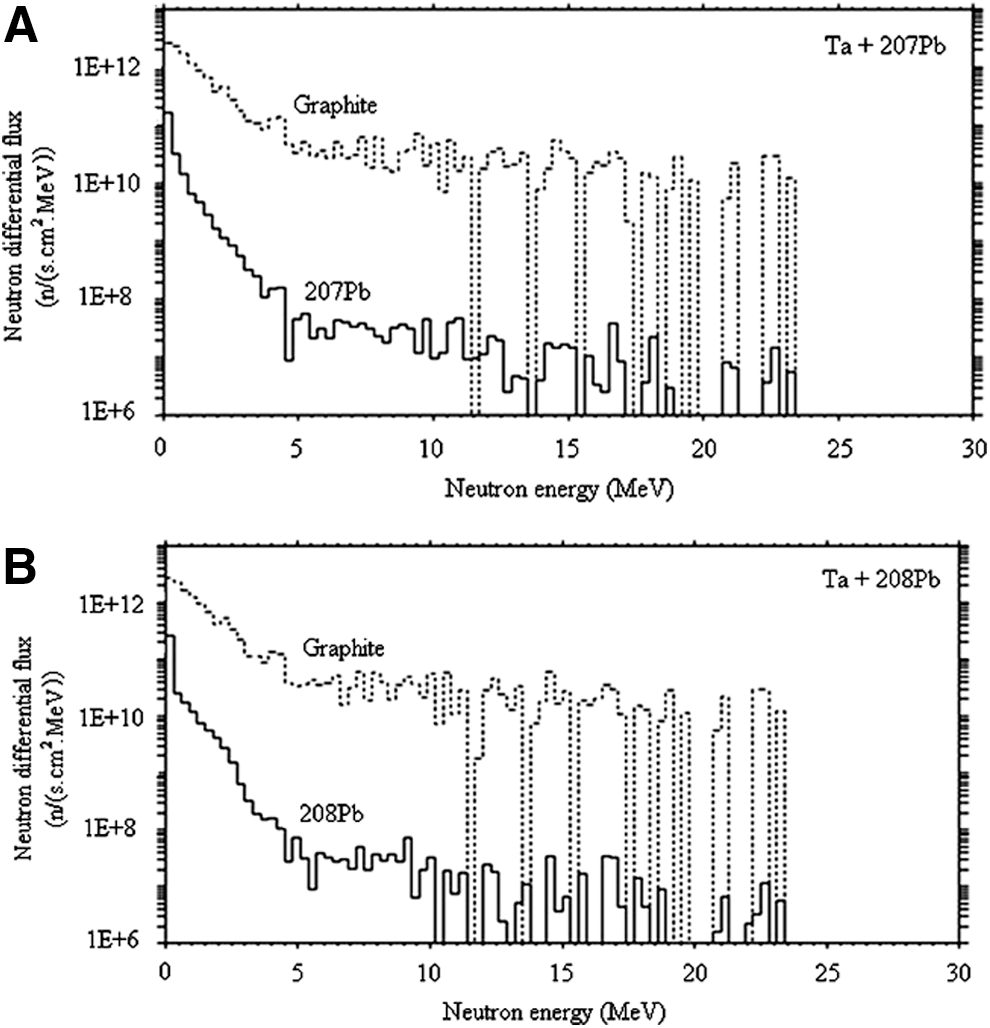
Total flux of accumulated epithermal and thermal neutrons in diverse regions relies on velocity of neutrons, and also the regional storage in lead or graphite volume alters the flux of collected neutrons. Figure 4a and b reveal the neutronic flux in terms of n/s/cm2/MeV/particle using 207Pb and 208Pb procedures, and also 208Pb shows higher total flux than 207Pb. Furthermore, the gathered neutrons in thermal and epithermal ranges inside the graphite region were considerably more than the lead region with order of 1E+10 n/cm2/s.
Radiative capture yield in 99Mo production
The 99Mo activity per gram and 98Mo placement from the three targets for lead moderator were investigated. When the sample radial distance from the 9Be target was 38 cm inside the graphite region, the production yield had the greatest value of activity equal to 249.25 MBq/g. The activities generated in molybdenum samples are tabulated in Table 7 for the three targets using the natural lead moderator. When the material changed from lead to graphite, the activity increased, this increase for the 9Be target was greater than the increase for the 181Ta and 184W targets. The energy threshold of 98Mo(n,γ)99Mo reaction was 480 eV with the cross section of activated molybdenum 0.72 barns, in which the radiative capture resonances happened in thermal ranges of neutron energies. 13,24 Frequently, 99Mo is produced by the neutron fission of enriched uranium. Assuming a specific in the fissium with an atomic fraction λ and the exposure time texp equal to one half-life of compound, the initial activity for 1 kg of activated sample is 2.5 × 10⁻¹⁰ S0ληf (GBq/kg), in which S0 is the neutronic source (n/s) and ηf is fissium efficiency (kg −1). If the target is 20% enriched metallic uranium of a mass of 33 kg, and the exposure time is set to 10 days, the asymptotic yield is calculated to 51.3 GBq/kg 9,18 –20
Neutron flux analysis in BNCT applications
In BNCT, the epithermal-to-fast flux ratio and the epithermal-to-thermal flux ratio must be larger than 20 and 100, respectively. 23 Table 8 demonstrates surface flux of derived neutrons at the end of the collimator (in air) from thickness changing in Fluental and the first Fe filters. The thicknesses of Fluental and first Fe filters were considered between 1.4–5.4 and 3–7 cm, respectively, and thicknesses of second Fe, Bi, and Li filters were kept constant at 1, 5, and 0.5 cm, respectively. The minimum flux of fast and thermal neutrons occurred in 5.4 and 4.4 cm Fluental, respectively. The greatest amount of epithermal neutron flux occurred at 4.4 cm Fluental and 4 cm first Fe. At the same time, the fast and thermal fluxes were 2.62E+8 and 1.63E+7 n/cm2/s, respectively. Table 9 shows the surface neutronic flux in different thicknesses of second Fe and Bi filters at the end of the collimator (in air), when the thicknesses of Fluental, first Fe, and Li filters were kept constant at 2.4, 6, and 0.5 cm, respectively. Using 5.2 cm Bi and 0.8 cm second Fe filters, the maximum epithermal neutron flux was equal to 8.39E+9 n/cm2/s. Table 10 exhibits the surface neutronic flux with different thicknesses of filters (7.4 cm Fluental, 4 cm Fe, 0.5 cm Li, and 3 cm Bi), exclusive of second Fe filter in diverse regions. In the proposed work, the epithermal-to-thermal neutron flux ratio was higher than that recommended by IAEA. In that case, to reach the IAEA recommended level, the authors had to increase the neutronic epithermal flux against the fast flux using different filters and diverse thicknesses. Neutron and photon dose values at the epithermal range in three regions of the phantom were tabulated in terms of Gy/h/#/cm2/s, where # is the number of neutrons or photons per particle. The value of quality factor for neutron radiation is energy dependent and this value in the epithermal range amounts to 5. Photon dose decreased in scalp, tumor, and brain regions, respectively.
Cross-section properties
The high atomic mass of lead causes mounting neutron energy loss through the elastic scattering procedure, and its high transparency to fast neutron results in a long storage time inside the activator, provided that the lead volume is large enough to minimize neutron escape from the system. This should allow exploitation of the resonance peaks in the thermal and epithermal energy ranges of neutrons in the cross-section chart for radioisotope production or BNCT submissions. Total cross section of neutrons in the 207Pb region is compared with elastic cross section in Figure 5a, and also this comparison is carried out in the208Pb region as shown in Figure 5b. The significant resonances in the 207Pb material are raised between 0.01 and 1 MeV of neutron energy, but these peaks in the 208Pb material happened between 0.1 and 1 MeV. Maximum peaks of cross section occurred between 10 and 100 barn for both 207Pb and 208Pb moderators. Elastic cross section of neutrons in the 207Pb region had lesser values rather than in the 208Pb region between 1E−11 and 1E−5 MeV.

Absorption and elastic cross sections in 207Pb and 208Pb volumes are compared in Figure 6a and b, respectively, because of greater elastic characteristics in absorption than in other moderators, with the exception of 1H, as explained in Table 1. Although the 207Pb material indicated some resonances between 0.001 and 0.1 MeV with higher absorption resonances than in the208Pb material, the 208Pb material showed resonances between 0.1 and 1 MeV of neutron energy. The 208Pb material has distinct characteristics such as immense elastic than absorption cross sections at thermal and epithermal ranges and also high transparency to fast neutrons. Then, these properties of the 208Pb choose it as a good moderator in the neutron storage purposes. Figure 7 indicates the elastic cross section in the 208Pb moderator and graphite reflector, as well as in graphite that shows less significant elastic properties than 208Pb between 1E−8 and 30 MeV.


Elastic cross section of neutrons in 208Pb region (solid line) and graphite region (dash line).
Transport of fast neutrons in the moderator with a short mean free path and low energy loss per collision decelerates the fast neutrons, and in addition, (n,2n) and (n,3n) interactions transpire in the moderator. Fast neutrons can have interactions with the moderator to produce induction neutrons related to the reaction's Q value. The Q value of (n,2n) and (n,3n) interactions with the 207Pb moderator was about 7 and 17 MeV, respectively, and also these reactions with the 208Pb moderator extracted about 8 and 15 MeV, respectively, as shown in Figure 8a and b. The cross section of the activated molybdenum sample is shown in Figure 9, in which the radiative capture resonances happen in thermal ranges of neutron energies.

(
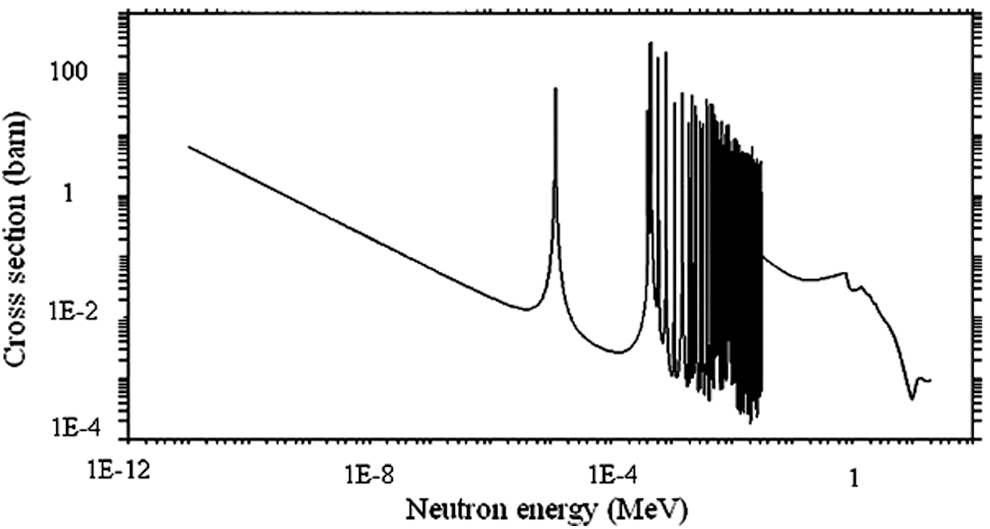
(n,γ) Cross section inside the 98Mo sample.
Figure 10 specifies the absorption cross section of neutrons in the graphite buffer and boron absorber. At the thermal range, graphite absorbed neutrons less than boron, but at the epithermal range, this action was vice versa.
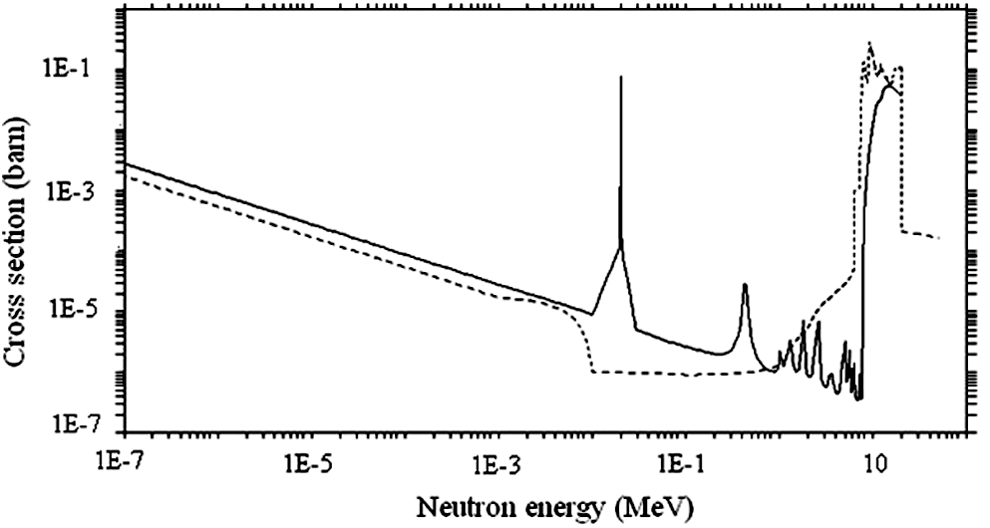
Absorption cross section of neutrons in boron region (solid line) and graphite region (dash line).
Figure 11 shows (n,α) cross section inside the brain and tumor, and (n,α) cross section in the tumor region had higher values than the region inside the brain. In addition, in the lower energy of neutrons, the neutron capture had highly enhanced cross-section values. Figure 12 shows (n,γ) cross sections in the bismuth filter and lead region. Bi had higher (n,γ) cross-section values in the lower neutron energies into lead, and this property selected the Bi as the γ filter.
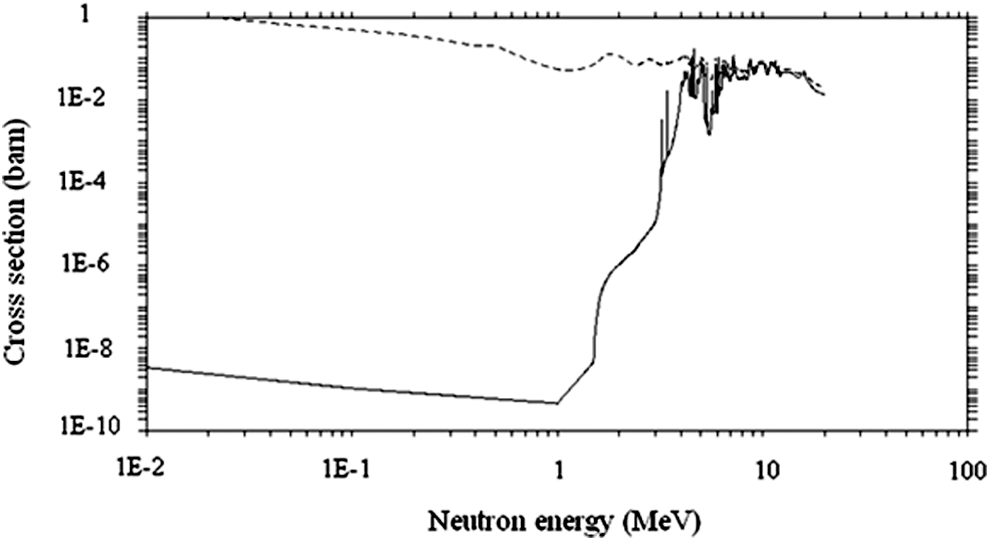
(n,α) Cross section in brain (solid line) and in tumor (dash line) regions.
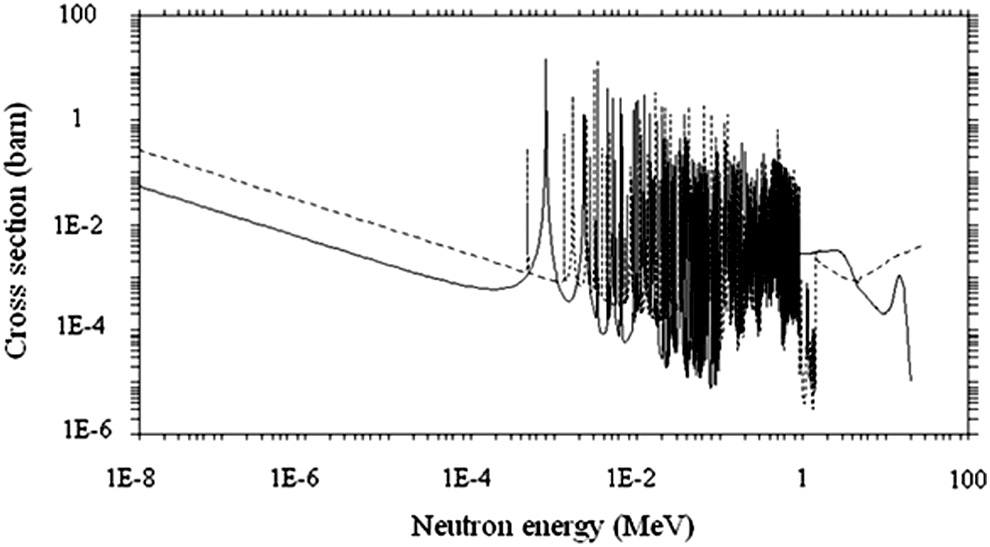
(n, γ) Cross section in Bi material (solid line) and in lead buffer (dash line).
Discussion
To generate epithermal and thermal neutrons for radioisotope production and BNCT, the authors proposed a review of moderating fast neutrons, which are emitted from the reactions between diverse targets and low energy and current protons accelerated by a small cyclotron. The ARC method has been investigated in this study, by means of lead moderator and graphite reflector for assessment of energy and cross section of accumulated neutrons in the lead storage.
The performance of an accelerator-driven system is conditioned by the optimization of the geometrical coupling between the accelerator and intended assembly. The aim of this review is to investigate some parameters (neutron yield, target property, neutron flux, and cross section) for a low-energy accelerator configuration. Neutrons produced in the nuclear reactions mentioned before are generally at energies above the resonance peaks in a sample and need to be moderated to reach more useful energies for capturing in radioisotope production. Using the flux and energy spectrum of neutrons exiting the moderator, the authors can estimate how much a specified radioisotope is produced through capture. They can therefore expect that even with multiple scattering of neutrons on 208Pb during the process of their slowing down, they will be slowed down to thermal energy with a high probability and thus create a high thermal neutron flux.
The ARC method was investigated through slowing down of neutrons from their original energy to the final thermal energy through collisions with the nuclei of the moderator. This collision and energy loss simulated as a continuous process that is valid if the neutron energy loss is for radioisotope production through the inserted “father radioisotope” inside the activator. In the standard ARC scheme, natural lead is used as both a spallation target and moderator, its moderating inefficiency being an important feature for the ARC process; but in this study, the ARC method was explored through three targets. Neutronic flux around the target goes with 1/r inside the lead moderator instead of 1/r2 inside air (for bare target) that is the power of ARC, and that it is “amplifying geometrically” the neutron source strength in the lead as a heavy nuclei. Meanwhile, transport of fast neutrons in the lead moderator by a short mean free path and low energy loss per collision decelerates the fast neutrons, and in addition to (n,2n) and (n,3n), interactions transpire in the moderator. Fast neutrons can have interactions with the moderator to produce induction neutrons related to the reaction's Q value. Moreover, capture cross section at thermal energy and capture resonance integral of natural lead are much larger than the corresponding values of most of the light nuclides, therefore it is safe to say that neutrons are captured during the slowing down process in natural lead with a higher probability than the slowing down process in light materials. Therefore, only a small part of neutrons will slow down to thermal energy. This means that thermal neutron flux in natural lead will be much lower than in light materials.
Simulation results revealed that the 181Ta target had the highest neutron yield, and tungsten had the highest values in both surface and volumetric ratios. Comparison of the maximum surface flux at 2.2 cm distance inside 207Pb and 208Pb schemes demonstrated that 208Pb led to a higher value than 207Pb. 9Be in 22° and also 181Ta and 184W in 30° into the beam axis had the maximum surface flux, and 181Ta through 208Pb showed a higher value than others.
The epithermal neutrons derived from 9Be target with 208Pb thickness of 25 cm had higher flux value than the two other thicknesses of 208Pb. Hence, on the basis of these simulations, the authors can suggest an experimental production of this plan. The economic advantages of an accelerator founded upon production and collimation with respect to the standard nuclear reactor route will be fully evaluated. For this reason, the result of thermal and epithermal energy and flux can be suitable for some radioisotope production and BNCT applications.
In this study, the neutron activator has included graphite reflector and boron absorber. Comparison between utilizing 207Pb and 208Pb moderators demonstrated that the 208Pb moderator had greater values of neutron flux in both thermal and epithermal ranges in the moderator, reflector, and absorber regions. Flux of thermal neutrons for all targets using 207Pb and 208Pb systems had higher values in graphite and 208Pb regions, respectively. However, greater values of flux for epithermal neutrons were revealed in the lead buffer; consequently using this system in BNCT application, the collimator gate must be set about the lead buffer, not through the graphite region. These investigations indicated that the use of the 9Be target and the 208Pb moderator could be compatible with medical applications to accumulated neutrons in a specified region for two ranges of neutron energies. The potential of the ARC method is a replacement or complements the current reactor-based supply sources of BNCT purposes. When the epithermal neutron flux inside air before the phantom is in order of 1E+9 n/cm2/s, BNCT using the ARC method will be very attainable.
In this study, the authors have shown that a 30 MeV proton cyclotron can be used to generate useful quantities of 99Mo and can be used as a source of epithermal neutrons for BNCT.
Conclusions
The ARC method is well known with respect to the field of minor actinides transmutation, therefore assessment in the neutron activator opens new perspectives regarding the use of ion-beam-generated neutrons for production of medical radioisotopes that are currently produced in nuclear reactors. Hence, it is very important to develop an alternative production method of 99Mo-99mTc and BNCT applications using small accelerators.
Footnotes
Acknowledgments
The author thankfully acknowledges the spiritual and financial maintenance from Gerashian people who have constructed and supplied the Gerash University of Medical and Paramedical Sciences, Amir-Al-Momenin Hospital, Medical Laboratories, Home residence, and requirements in Fars province, especially Sheikh-Ahmad Ansari, Gerash charity institution, and social support with low governmental provision rate in regional public welfare and health promotion.
Disclosure Statement
No competing financial interests exist.