




Abstract
188Re-HEDP is an established radiopharmaceutical used for pain palliation in patients with osseous metastasis. Considering commercial availability of 188W/188Re generator, the accessibility to a lyophilized kit would make preparation of this radiopharmaceutical feasible at the hospital radiopharmacy having access to a generator. A protocol for the preparation of a single-vial lyophilized hydroxyethane 1,1-diphosphonic acid (HEDP) kit was developed and its consistency was checked by preparing six batches. Each sterile lyophilized kit prepared as per the protocol contained 9 mg of HEDP, 3 mg of gentisic acid, and 4 mg of SnCl2.2H2O. Randomly selected kits from all six batches were subjected to thorough quality control tests that were passed by all batches. 188Re-HEDP could be prepared by addition of 1 mL of freshly eluted Na188ReO4 (up to 3700 MBq) containing 1 μmol of carrier ReO4 − (perrhenate) and heating at 100°C for 15 minutes. 188Re-HEDP with >95% radiochemical purity could be consistently prepared using the lyophilized kits. Sterile 188Re-HEDP prepared using the lyophilized kit was evaluated in patients with osseous metastasis. Post-therapy images of the patient were compared with 99mTc-MDP bone scan and found to be satisfactory. The bone-to-background as well as tumor-to-normal bone uptake ratio was found to be significant. All patients who received therapy reported significant pain relief within a week to 10 days post-administration of 188Re-HEDP.
Introduction
Bone metastasis is common in patients with cancers of prostate, breast, lung, bladder, and thyroid. Problems associated with bone metastasis include severe pain, pathological fracture, spinal cord compression etc., which can compromise the quality of life of the patient by affecting mobility and sleep. Clinical management of pain itself can significantly improve the quality of life of the patient. To achieve this, a treatment modality that can be repeated and well tolerated by the patient is necessary. At present, available options are the use of conventional analgesics, external beam radiation therapy, and radionuclidic therapy. 1,2
Radionuclidic therapy is one of the modalities widely being practiced for bone pain palliation. This involves selective delivery of radiation dose to the affected bone lesions, which are responsible for pain to the patient. Radiopharmaceuticals for bone pain palliation have a long history. For example, 32P (as orthophosphate) was used as early as 1932. 3 Strontium-89 chloride (Metastron™) is an FDA-approved radiopharmaceutical for the treatment of bone pain. 4,5 Thereafter, several other radiopharmaceuticals, such as 153Sm-EDTMP (Quadramet®; EDTMP—ethylenediamine tetramethylene phosphonic acid), 6186Re-HEDP (hydroxyethane 1,1-diphosphonic acid), 7 and 188Re-HEDP 8 , have been clinically used for bone pain palliation. 177Lu-EDTMP is the latest entry to the list of clinically useful bone pain palliating agents. 9 Guerra Liberal el al. recently reviewed therapeutic radiopharmaceuticals for bone pain palliation and provided a perspective beyond 89Sr and 153Sm. 10
Bisphosphonates are by far the most widely explored molecules for preparing bone-seeking radiopharmaceuticals. 11 HEDP is one such phosphonate, which has shown strong adsorption on hydroxyapatite in vitro. 11186Re (t 1/2 = 3.71 days, E βmax = 1.07 MeV, E γ = 139 KeV [9% abundance]) can be produced in a reactor by neutron activation of enriched 185Re target. 186Re-HEDP has shown uptake in both primary and metastatic bone lesions. Mathieu et al. first reported the clinical use of 186Re-HEDP for the treatment of osseous metastasis. 7,12 Later, Maxon et al. reported the use of 186Re-HEDP for the treatment of painful skeletal metastasis in prostate and breast cancer patients. 13 These studies reported significant pain relief to >80% patients who received therapy with 186Re-HEDP. 13 The same group of researchers also reported the use of 188Re-HEDP for bone pain palliation. 8
Liepe et al. reported a comparative study of surface bone-seeking radiopharmaceuticals, 186Re-HEDP, 188Re-HEDP, 153Sm-EDTMP, and the volume seeker 89Sr, for the treatment of skeletal metastases. 14 Of the 79 patients involved in the study, 73% reported pain relief after therapy with one of the radiopharmaceuticals listed above. About 77% of patients reported pain relief with 188Re-HEDP, while 67% patients reported pain relief with 186Re-HEDP. With 153Sm-EDTMP and 89Sr, 73% and 72% patients, respectively, reported pain relief. This study concluded that all the radiopharmaceuticals are helpful in rendering pain relief to the patient with no significant difference in their therapeutic efficacy or toxicity. 14 There are other reports that indicate therapeutic efficacy of 188Re-HEDP and other radiopharmaceuticals in similar lines. 8,15,16 Recently, Fernandes et al. had reported preparation of 188Re-based multifunctional bone-seeking agents. 17 The results of their study using 188Re radiopharmaceutical on metastatic breast cancer cells are encouraging.
Like 186Re, 188Re (t 1/2 = 17.0 hours, E βmax = 2.12 MeV [71.1%], 1.97 MeV [25.6%], E γ = 155 keV [15% abundance]) can be produced in a reactor from enriched 187Re target. A second route for obtaining 188Re is through the decay of 188W, produced by double neutron capture of 186W in a high flux nuclear reactor. Like the 99Mo/99mTc generator system, 188W/188Re generators are now commercially available, which has facilitated routine preparation of 188Re radiopharmaceuticals in hospital radiopharmacy. 18 In this context, formulation of a lyophilized HEDP kit would allow in situ preparation of 188Re-HEDP at the hospital radiopharmacy having access to 188W/188Re generator. The present study reports on the formulation of a freeze-dried HEDP kit, preparation of 188Re-HEDP using the freeze-dried kit, and its preliminary clinical evaluation in patients with osseous metastasis.
Materials and Methods
Etidronic acid (HEDP) and gentisic acid were purchased from M/s. Sigma-Aldrich, stannous chloride dihydrate from M/s. Fluka, and HPLC grade water from Merck. Perrhenic acid solution (75%–80% wt. in water) as well as ammonium perrhenate, which is used as carrier perrhenate source, was purchased from M/s. Sigma-Aldrich. 188Re as Na188ReO4 was obtained from 188W/188Re generator purchased from ITG, Germany. Silica gel-based instant thin-layer chromatography (ITLC-SG) paper was procured from M/s. Varian, USA. Radioactivity distribution on ITLC strips was recorded on a MiniGITA γ-radioactivity TLC scanner, obtained from Raytest, Germany. Glass vials, rubber closures, aluminum caps, and other glassware used for the preparation of lyophilized kits were thoroughly cleaned and sterilized by autoclaving. Lyophilization was carried out using the Alpha 1–2 LD plus lyophilizer (Martin Christ, GmBH). The sterility test kit containing sterile fluid thioglycolate media and soybean casein media, 100 mL each, was purchased from Himedia Laboratories. Endotoxin levels in the lyophilized kits were determined using Endosafe® PTS instrument and cartridges (sensitivity: 0.5–0.05 EU/mL) procured from Charles River Laboratories Pvt., Ltd. Whole-body images were acquired on a SIEMENS Symbia Truepoint dual-headed detector system with high energy general purpose collimator.
Preparation of lyophilized HEDP kits
The optimized protocol for the preparation of a batch of 20 lyophilized HEDP kit vials is as follows. HEDP (198 mg) and gentisic acid (66 mg) were dissolved in water for injection (20 mL) thoroughly purged with nitrogen. To this solution, freshly prepared stannous chloride solution (2 mL, 88 mg) was added. This solution was filtered through a 0.22-μM filter and 1 mL each was dispensed into autoclaved 10 mL vials. The contents of the vials were frozen in a dry ice bath and then lyophilized. After lyophilization, the kits were sealed under vacuum and stored at 2°C–8°C till use.
Quality control of lyophilized HEDP kits
Sterility test
Sterility test was carried out following a procedure reported earlier. 19 The kit components were dissolved in 2 mL of sterile saline. Approximately 1 mL of this solution was separately inoculated with Soybean casein digest medium and fluid thioglycollate medium. Soybean casein digest medium was incubated at ambient temperature, while fluid thioglycollate medium was incubated at 37°C. Both the solutions were incubated for 14 days. Positive and negative controls were also included along with the samples. The solutions were inspected visually for 2 weeks and compared with the controls for any bacterial or fungal contamination.
Bacterial endotoxin test
The level of bacterial endotoxins in the lyophilized HEDP kit was determined using the Endosafe PTS unit from Charles River Laboratories. FDA-licensed disposable cartridges with a sensitivity range of 0.5–0.05 EU/mL were used for the analysis. The kit components were dissolved in 1 mL of sterile saline. The sample for analysis was prepared by 1:200 dilution using endotoxin-free water. The quantitative endotoxin determination was carried out using a handheld spectrophotometer.
Preparation of 188Re-HEDP using lyophilized HEDP kits
188Re-HEDP was prepared as per the reported protocol 16 wherein about 1 μmol (in ∼10 μL) of perrhenic acid (HReO4) or ammonium perrhenate (NH4ReO4) was thoroughly mixed with 1 mL of freshly eluted Na188ReO4 from a 188W/188Re generator. This solution was then added to the sterile lyophilized kit vial through a 0.22-μm sterile filter. The contents of the kit vial were thoroughly mixed and heated at 100°C for 15 minutes. After cooling, the preparation was brought to physiological pH by adding 0.5 mL of 1 M sodium acetate solution through a sterile 0.22-μm filter.
Determination of radiochemical purity of 188Re-HEDP
Radiochemical purity (RCP) of 188Re-HEDP complex was determined by ITLC-SG using the two-solvent system, viz, acetone and physiological saline. 16 Two ITLC-SG strips (11.5 cm long) were prepared by spotting ∼4 μL of the test solution. One of the strips was developed in acetone, while the other was developed in physiological saline. In the acetone system, 188Re-HEDP complex and reduced rhenium (ReO2) remained at the point of spotting, while perrhenate moved to the solvent front. In saline, both 188Re-HEDP and perrhenate moved to the solvent front, while reduced rhenium remained at the point of spotting. Developed strips were analyzed on a TLC scanner and from the peak area measurements; RCP of 188Re-HEDP complex was calculated.
Stability of 188Re-HEDP prepared using lyophilized HEDP kits
Stability of 188Re-HEDP was assessed by determining the RCP at different time points, viz, 3, 6, and 24 hours postpreparation, when stored at room temperature (RT).
Stability of lyophilized HEDP kits
Shelf life of lyophilized HEDP kits stored at 2°C–8°C was assessed by determining the RCP of 188Re-HEDP prepared using kits, which were 1, 3, 6, and 12 months old. Shelf life of the kit is the maximum time up to which the kit can give 188Re-HEDP with more than 95% RCP.
Clinical imaging
188Re-HEDP administration
Patients selected for undergoing therapy were admitted to the day care unit of the nuclear medicine or radiation oncology department and were administered with 2960–3700 MBq (80–100 mCi) of 188Re-HEDP in 50 mL of saline through a running intravenous line for 10 minutes. The patients were subsequently kept under observation in an isolation room for 2–4 hours. All patients received hydration orally or intravenously (∼500 mL) before and after the infusion of 188Re-HEDP. Urinary incontinence, if present, was managed by bladder catheterization before administration of the drug.
Imaging protocol for 188Re-HEDP
Scintigraphic imaging was performed within 4–24 hours after administration of 188Re-HEDP. Anterior and posterior views were acquired for the patient in supine position. The acquisition parameters for whole-body acquisition were as follows: Mode: continuous, matrix size: 250 × 1024, zoom: 1, scan speed: 10 cm/min, scan length: 200 cm, and auto contour: on. In some cases, the patients were imaged again after 24–48 hours postadministration of 188Re-HEDP to assess skeletal retention and background clearance.
Results and Discussion
Total rhenium content in the formulation plays a critical role in the formation of 188Re-HEDP complex, which possesses the desired pharmacokinetic and dosimetric characteristics suitable for clinical administration as a pain palliating agent for osseous metastasis. Elder et al. carefully studied Re-HEDP species formed under different conditions and found that medically effective species of Re-HEDP is a mixture of linear tetramers of rhenium bridged by HEDP molecules and a complex triangular cluster of rhenium atoms and HEDP molecules. 20 This medically useful mixture of Re-HEDP species could be consistently prepared only if the total rhenium content in the reaction mixture is at least 100 μg. 8 Required amount of perrhenic acid or ammonium perrhenate, both stable in solution for a sufficiently long time, is used for this purpose.
Formulation of lyophilized HEDP kits for the preparation of 188Re-HEDP was initially reported by Verdera et al. 21 Later, Marczewski et al. reported a liquid kit preparation for the same purpose. 22 Practical difficulty associated with liquid kit formulation involved its shelf life (∼9 days) and logistics associated with its transportation to distant places.
There is wide variation in the amount of HEDP, gentisic acid, and stannous chloride dihydrate reported by different groups for the preparation of 188Re-HEDP. 21 –23 In the present work, although the amounts of reagents used were similar to that reported by Verdera et al., there is a significant difference between the two formulations. While the rhenium carrier (300 μg potassium perrhenate; total rhenium metal content 193 μg) is included in the lyophilized kit formulated by Verdera et al., no rhenium carrier was included in the kit vial reported herein. This was done to avoid the possibility of the Sn+2 ions being consumed by carrier rhenium in the kit, which could ultimately affect the shelf life of the kit.
Preparation of lyophilized HEDP kits and quality control
Six batches (20 vials per batch) of lyophilized HEDP kits were prepared as per the procedure mentioned in the Materials and Methods section. Each kit contained ∼9 mg of HEDP, 3 mg of gentisic acid, and 4 mg of SnCl2.2H2O. The lyophilized vials were stored in a refrigerator at 2°C–8°C. Few kits from each batch were randomly selected and tested for sterility and bacterial endotoxin content. All the batches passed the sterility test, and the endotoxin content was found to be less than the permissible limits of <25 EU/mL.
Preparation of 188Re-HEDP using lyophilized HEDP kits and its quality control
188Re-HEDP was prepared following the procedure mentioned earlier. It could be noted that unlike the method reported by Verdera et al., 1 μmol of perrhenic acid or ammonium perrhenate (total rhenium content ∼186.2 μg) in 100 μL was mixed with 1 mL of freshly eluted Na188ReO4 (total volume 1.1 mL) before adding to the kit vial. Randomly selected kits from all six batches were used for preparing 188Re-HEDP. Quality control parameters included visual inspection of the clarity, color, and pH of the preparation and determination of RCP (Table 1) of 188Re-HEDP by ITLC-SG. RCP >95% is mandatory for the kit to pass the quality control check. Typical ITLC-SG pattern of 188Re-HEDP is shown in Figure 1.
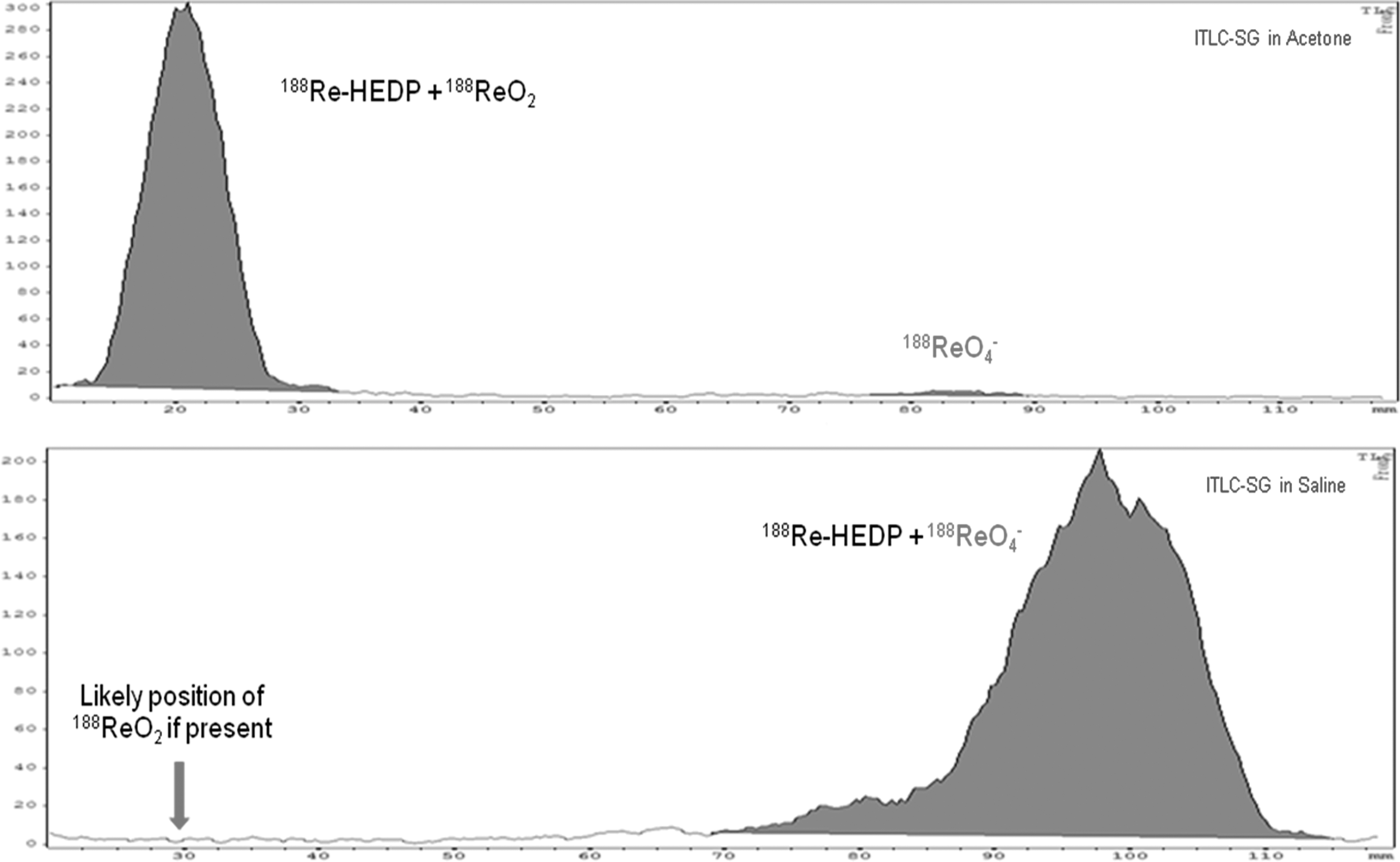
Typical ITLC-SG pattern of 188Re-HEDP in acetone and saline. HEDP, hydroxyethane 1,1-diphosphonic acid; ITLC-SG, silica gel-based instant thin-layer chromatography.
HEDP, hydroxyethane 1,1-diphosphonic acid; RCP, radiochemical purity; ITLC-SG, silica gel-based instant thin-layer chromatography.
The lyophilized HEDP kits were gradually challenged with higher 188Re activity (Table 2). Total volume of the activity added to the kit vial was fixed at 1.01 mL. From Table 2, it could be observed that 188Re-HEDP could be prepared in >95% yield with activity as high as 100 mCi/mL.
HEDP, hydroxyethane 1,1-diphosphonic acid; RCP, radiochemical purity; Avg., average; SD, standard deviation.
The stability of 188Re-HEDP kept at RT was followed up to 24 hours after preparation (Table 3). It could be noted that 188Re-HEDP is stable for up to 24 hours.
HEDP, hydroxyethane 1,1-diphosphonic acid; RCP, radiochemical purity; Avg., average; SD, standard deviation.
Shelf life of lyophilized HEDP kits
The shelf life of lyophilized HEDP kits was assessed by determining the RCP of 188Re-HEDP complex prepared using the kits stored at 2°C–8°C over a period of 12 months. RCP of 188Re-HEDP complex prepared using kits, which are 1, 3, 6, and 12 months old, is shown in Table 4. It could be noted that (Table 4) even after 12 months, the kits were acceptable for the preparation of 188Re-HEDP with >95% RCP.
HEDP, hydroxyethane 1,1-diphosphonic acid; RCP, radiochemical purity; Avg., average; SD, standard deviation.
Clinical studies
The study was approved by the local hospital ethics committee and performed in accordance with the Declaration of Helsinki. Patients gave their written informed consent for participation. The patients selected for the preliminary clinical evaluation of 188Re-HEDP complex had widespread skeletal involvement with painful metastases. In most of the patients, opioids were ineffective. A large proportion of patients had received prior palliative radiotherapy and/or systemic hormonal therapy or chemotherapy. Therapeutic dose in the range of 2960–3700 MBq (80–100 mCi) of 188Re-HEDP was administered intravenously over a 10–15-minute duration. Typical image obtained 24 hours postadministration of 188Re-HEDP complex is shown in Figure 2. There was good bone-to-background as well as tumor-to-normal bone uptake. Figure 3 shows 188Re-HEDP scan and 99mTc-MDP scan of the same patient 4 hours postadministration of the respective radiopharmaceutical. It is pertinent to note the one-to-one concordance between the two scans. All patients treated with 188Re-HEDP reported significant pain relief within a week to 10 days postadministration.
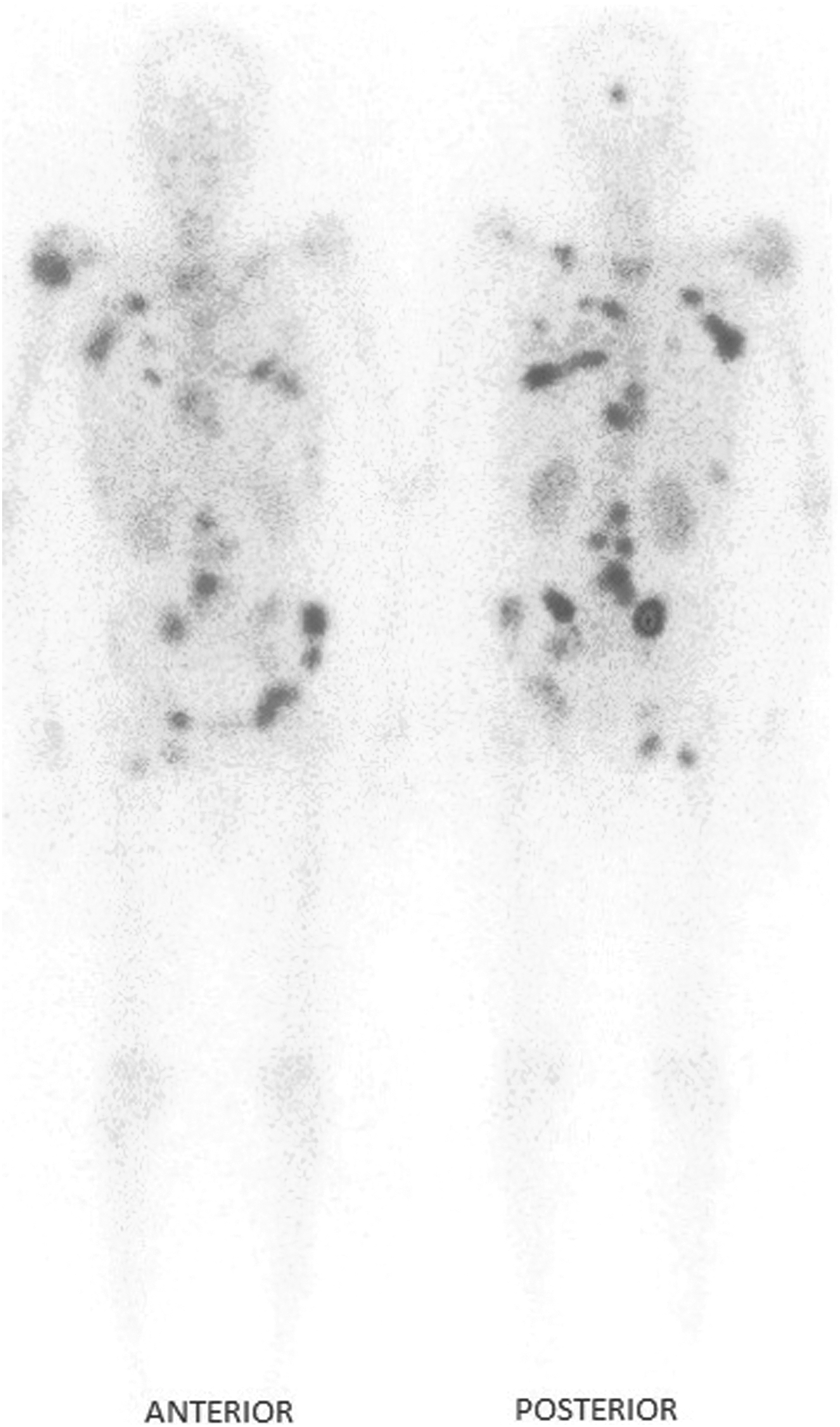
Typical clinical image of a patient injected with therapeutic dose of 188Re-HEDP complex 24 hours postadministration.

Whole-body anterior
Conclusions
A single-vial kit, which could prepare up to 3700 MBq (100 mCi) of 188Re-HEDP with RCP >95%, was developed. The kit had a minimum shelf life of 12 months. The results obtained after clinical evaluation were consistent with the data reported earlier using 188Re-HEDP and patients got significant pain relief within 10 days post-therapy.
Footnotes
Acknowledgments
The authors are grateful to Dr. K.L. Ramakumar, Director Radiochemistry and Isotope Group, Bhabha Atomic Research Centre, for providing the necessary support in carrying out the work. The authors are also thankful to Dr. M.R.A. Pillai, erstwhile Head, Radiopharmaceuticals Division, BARC, and Dr. Grace Samuel, Head, Radiopharmaceuticals Evaluation Section, for providing the initial impetus and help to carry out this work.
Disclosure Statement
There are no existing financial conflicts.