




Abstract
Intra-arterial injection of 131I Lipiodol is an effective treatment option for primary hepatocellular carcinoma as it delivers high radiation dose to liver tumor tissue with minimal accumulation in adjacent normal tissue. The present article demonstrates design, fabrication, and utilization of a semiautomated radiosynthesis module for preparation of 131I labeled Lipiodol. The radiolabeling method was standardized for preparation of patient dose of 131I labeled Lipiodol radiochemical yield (RCY); radiochemical purity (RCP) and pharmaceutical purity of the product were determined using optimized procedures. Sterile and apyrogenic 131I labeled Lipiodol in >60% RCY could be prepared with >95% RCP. Preclinical evaluation in animals indicated retention of more than 90% of activity at 24 hours postportal vein injection. This is the first report demonstrating potential application of simple user friendly and safe semiautomated system for routine production of 131I labeled Lipiodol, which is adaptable at centralized hospital radiopharmacies. The described prototype module can be modified as per demand for preparation of other therapeutic radiopharmaceuticals.
Introduction
Hepatocellular carcinoma (HCC) is a major form of malignant disease 1 –3 especially in the Asian and African regions, where more than 95% of patients do not survive 5 years past the initial diagnosis. 4,5
Transarterial chemoembolization (TACE) has been successfully practiced for treating HCC for more than three decades. While the majority of normal hepatic blood supply is through the portal vein, neoangiogenic vessels primarily connect to the hepatic artery; hence therapeutic agents administered intra-arterially get preferentially localized in regions of tumor. This is the underlying principle of TACE. Drugs like cisplatin, doxorubicin, methotrexate, and paclitaxel have been used as single agents or in different combinations, in conjunction with Lipiodol for locoregional therapy. 6,7 In this study, Lipiodol serves as both drug carrier and embolizing agent. Intra-vassal retention of Lipiodol leads to starvation of tumor cells of nutrient and oxygen supply and delivers high doses of the drug(s) locoregionally, which provides greater chemotherapeutic effect than by the systemic route. Embolization in conjunction with a radiotherapy agent is called radioembolization. There are two main categories of radioembolic agents approved for clinical use. 8,9 First category is based on micron-range particulates that encapsulate or adsorb therapeutic radionuclides like 90Y-bearing glass spheres (TheraSphere®) and polymeric SIR-Spheres® and another is Lipiodol or related embolic substances tagged with therapeutic radioactivity. Lipiodol or ethiodized oil is a naturally iodinated fatty acid ethyl ester of poppy seed oil (37%w/w of iodine). It is used as a magnetic resonance imaging contrast agent for the liver and has also been labeled with therapeutic radionuclides such as 131I and 188Re for HCC treatment. 10 131I is easily produced by irradiation of Tellurium target in nuclear reactors, and the dry distillation process for 131I production leads to availability of large quantities of 131I on regular basis. Suitable half-life of 131I permits convenient logistics of production and quality control checks before product release.
Standard activity of 2.22 GBq (60mCi)131I labeled Lipiodol in 2–10 mL volume is administered by slow intra-arterial injection under fluoroscopic guidance as per European Association of Nuclear Medicine (EANM) guidelines for Lipiodol therapy. 11 131I labeled Lipiodol would be best adapted for patients with small tumors dispersed in the liver to deliver high-dose radiation to the tumor and little radiation to the surrounding liver. Lipiocis® is licensed in France for the treatment of patients with HCC and portal vein thrombosis. Low cost of 131 I labeled Lipiodol compared to other agents makes it a promising therapeutic agent especially for cancer patients in developing countries. 12 The high-energy gamma radiations (0.364 MeV, 81% abundance) of 131I pose considerable safety related limitations for preparation of patient doses of 131I labeled Lipiodol with high amounts of initial activity (>3.7 GBq) of 131I. Although automated modules for radiosynthesis are widely reported for preparation of positron emission tomography agents, comparatively fewer reports are available on preparation of therapeutic radiopharmaceuticals using automated or semiautomated modules. 13,14 Hence, a semiautomated modular system was designed and fabricated to ensure operator safety, as well as pharmaceutical purity and safety of the product. Quality control tests were carried out to estimate radiochemical yield (RCY), radiochemical purity (RCP), and to determine sterility and apyrogenicity of the preparation. Preclinical evaluation was done in Wistar rats to ascertain liver retention of 131I labeled Lipiodol.
Materials and Methods
Lipiodol® Ultra Fluid 4.8 g Iodine per 10 mL (38% w/w) was procured from Guerbet (Asia Pacific). No carrier added 131I-Sodium iodide solution of >99.99% chemical purity, specific activity ∼18.5 GBq/mL radioactive concentration, and >99.9% radionuclidic purity were produced as reported. 15 Analytical grade absolute ethanol (Assay: >98.5%) was from Brampton, Canada. Whatman 3MM paper was used for paper chromatography. All glassware and accessories used for production were cleaned and processed to render them sterile.
Radioactivity assay of 131I activity was carried out by high-resolution gamma ray spectrometry using an HPGe detector (EGG Ortec/Canberra detector) coupled to a 4K multichannel analyzer system. All other radioactivity measurements were carried out using ion chamber or NaI (Tl) scintillation counter (Mucha, Raytest, Germany). Sterility Test Kits containing fluid thioglycollate media (FTG) and soybean casein digest media (SCD) were obtained from HiMedia Laboratories, India, and Endotoxin standards and LAL reagent pyrogen-free water for endotoxin detection were procured from Charles River Laboratories India Pvt. Ltd.
Design and fabrication of semiautomated module
An independent stand alone modular system was designed suitable to be fitted in a mini hot cell. The module holds two lead pots, one containing Na131I vial and the other housing the reaction vessel. The reaction vessel assembly was enclosed in silicon glycerin bath. Facility was made for remote addition of reagents to vial containing Na131I activity, as well as to reaction vessel. The heating of reaction vessel was precisely carried out using thermocouple. All transfers were carried out by tubing connected to solenoid valves, which are mounted on plate and connected to junction box; inert nitrogen gas of high purity was used for pressurizing vessels. The module was placed inside indigenously designed and fabricated shielded facility similar to commercially available mini hot cell with adequate lead shielding having negative pressure and charcoal filters fitted at release duct. Electrical valve operations and heating controls were placed separately on control panel. Valve operation sequence was standardized based on optimized reaction parameters. Radiation field, air activity, and activity released through charcoal trap were monitored during all operations. Several batches of 131I labeled Lipiodol were prepared using standardized operating protocol.
Preparation of 131I labeled lipiodol
Isotope exchange reaction between organic iodine of Lipiodol with ionic 131I was carried out with slight modifications in the reported procedure. 16 The initial standardization of optimum time and temperature was carried out using trace amounts of radioiodine keeping same volume of aqueous ethanol and Lipiodol estimated for patient dose preparation.
Typically 2 × 2 mL of absolute ethanol was injected to the 131I activity vial (∼3.7 GBq in 0.1 mL) followed by transfer of complete activity into the reaction vessel reactor and heating at 55°C for 15 minutes under nitrogen. Two milliliters Lipiodol was injected directly into the reaction vessel, and the exchange reaction was carried out by heating Lipiodol with 131I in ethanol at 80°C for 20 minutes and, subsequently, at 100°C for 30 minutes.
The reaction mixture was allowed to cool and additional 1 mL Lipiodol was added to the reaction vial and mixed, and the product was transferred to product vial through 0.22 μ sterile filter. Five hundred microliters of sample was transferred to two other similar vials for quality control analyses. The reaction was monitored for 131I activity measurement at all the stages of production. The percentage reaction yield was calculated by measuring activity in product vials compared to starting activity by decay correction.
Test for radionuclide identification
The gamma-ray spectrum of the preparation was taken as per standard procedure of gamma ray spectrometry using a high-purity germanium crystal or Ge (Li) crystal assembly. The most prominent gamma photon of 0.364 MeV energy was examined to estimate radionuclide purity of 131I.
Test for RCP
The RCP of 131I labeled Lipiodol was determined by paper chromatography. Two microliter aliquots of carrier solution (1.5% KI) and sterile product were spotted on Whatman 3MM paper chromatography strips, which were then developed in two different solvent systems, 85% methanol and ether/petroleum ether (1:2), respectively, by ascending chromatography. The movement of ionic I-131 and the radiolabeled product was measured using NaI (Tl) detector with suitable energy window.
Stability
The product was stored at 4°C protected from light and tested repeatedly for RCP using paper chromatography technique for up to 3 weeks.
Sterility and bacterial endotoxin testing
To ensure pharmaceutical purity of the product, sterility and bacterial endotoxin testing (BET) was carried out as per Indian Pharmacopeia procedures listed in General Chapter on Radiopharmaceuticals. 17 0.1 mL of 131I labeled Lipiodol was diluted with 1.9 mL Lipiodol Ultra Fluid injection under aseptic conditions and used for sterility and BET.
Biological evaluation
In vivo distribution studies of 131I labeled Lipiodol were carried out in normal adult Wistar rats (male, ∼200–225 g). The animals were fasted for 6 hours before the procedure. Approximately 100 μL of 131I labeled Lipiodol was administered through portal vein following a previously reported protocol of viable surgery under anesthesia. 18 Animals were sacrificed at different time points, and percentage of injected activity associated with different organs/tissue was determined.
Results and Discussion
Design and fabrication of semiautomated module
The simple remote operating procedures standardized for production of 131I labeled Lipiodol considerably reduce dose exposure to the radiation worker and also assure pharmaceutical purity and safety of product. Figure 1 depicts the schematics of the semiautomated synthesis module.

Schematics of the semiautomated synthesis module for production of 131I labeled Lipiodol. B, bubbler; F, sterile membrane filter; H, heater; N, Nitrogen gas inlet; P, sterile apyrogenic product vial; R1, vial containing Na131I placed inside a lead pot; R2, reaction vessel; S1 and S2, syringe ports; T, thermocouple; V, vent.
Actual photograph of the module with two lead pots, valve mounting plate, junction box, etc. is shown in Figure 2. The safety features that were included while designing the module resulted in significantly reducing the radiation exposure to the operator. The cleaning and drying procedures of module carried out before synthesis and collection of final product in sterile pyrogen-free vial through sterile membrane filter ensured compliance with good manufacturing practices. The optimized cleaning protocol after batch preparations removes most of the residual activity, which aids in maintenance of module parts.
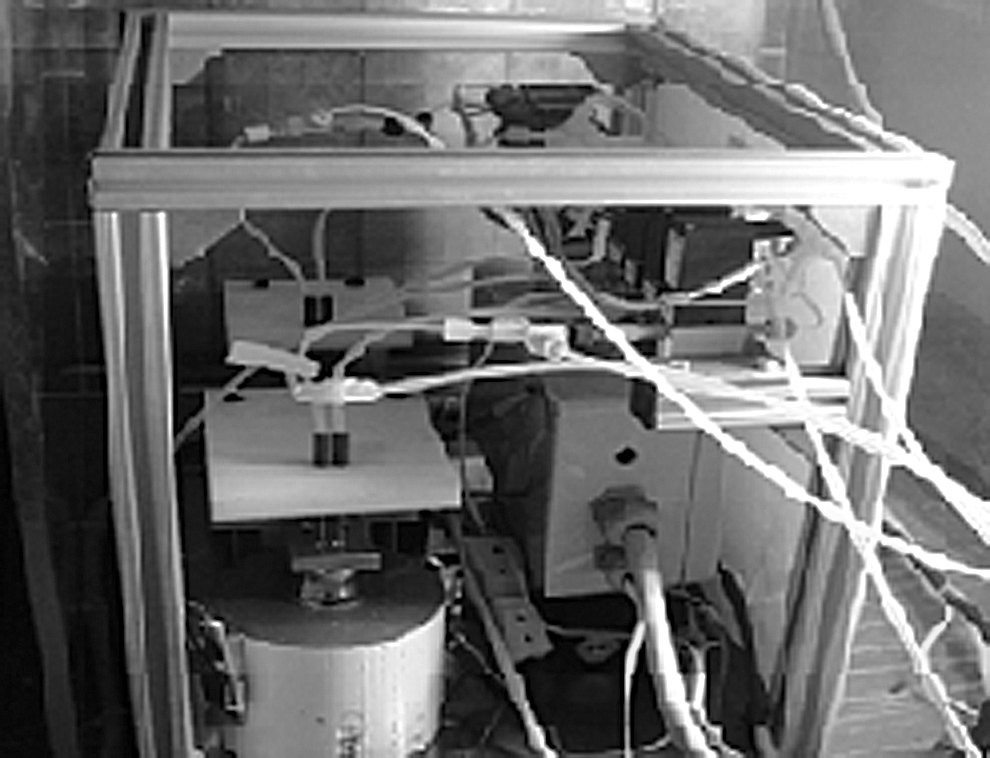
Actual photograph of the semiautomated synthesis module inside shielded facility for production of 131I labeled Lipiodol.
Preparation of 131I labeled lipiodol
It was observed that under controlled nitrogen flow, complete drying of aqueous alkaline solution of Na 131I in ethanol occurs within 10 minutes of heating at 55°C. The radiolabeling yields varied between 50% and 70% when 2 mL of Lipiodol was used. The yield was found to be consistent when temperature was increased from 80°C to 100°C, however longer time heating at 100°C did not result in substantial increase in yields. Diluting reaction mixture with additional 1 mL Lipiodol resulted in >80% recovery of the product from the reaction vessel without compromising quality.
The activity distribution determined as in-process quality control (QC) parameter showed low retention (<3% to 5%) of Na131I in activity vial, indicating almost complete transfer to reaction vessel. The activity recovered in ethanol during distillation was ∼5% to 7%, and ∼10% to 15% of the activity was trapped in charcoal. The sterile syringe filter used for terminal filtration showed <2% retention of the product.
Evaluation of 131I labeled Lipiodol
The principal gamma photon energy peaks of 364 and 637 keV (±5 keV) were observed for all the samples of 131I labeled Lipiodol in gamma ray spectrum fulfilling the test of radionuclide identification. Table 1 depicts RCYs (60%–70%) obtained when production of 131I labeled Lipiodol was carried out by varying 131I activity from 222 to 5180 MBq. RCP of the product was >95% when estimated by paper chromatography in two different solvent systems. In 85% methanol as solvent, 131I labeled Lipiodol shows Rf of 0–0.2, while Rf of free Iodide is 0.8–0.9. Another solvent system, ethyl ether/petroleum ether, wherein 131I labeled Lipiodol shows Rf of 0.9 and Rf of free Iodide as 0.0–0.1, was used for comparison. RCP values of different batches of 131I labeled Lipiodol estimated on next day and 2 weeks after preparation are tabulated in Table 2. The final specifications and QC acceptance criteria are given in Table 3. The stability of the product evaluated over a period of 3 weeks ascertains the logistics of supply to other nuclear medicine centers.
RCY, radiochemical yield.
The figures are rounded off to the nearest integers to one decimal point.
RCP, radiochemical purity.
BET, bacterial endotoxin testing; FTG, fluid thioglycollate medium; RNP, radionuclide purity; SCD, soybean casein digest medium.
There are not many reports on preclinical animal biodistribution studies of 131I labeled Lipiodol. Hence our pharmacokinetic studies extended till 5 day postinjection gives more insight to the in vivo fate of the product. The results of in vivo distribution studies are given in Table 4. At 24 hours, more than 90% of injected 131I activity was associated with the liver with negligible activity in the nontarget tissues and organs. Good localization and retention of the labeled preparation in the hepatic tissue were observed. At 3 days postsurgery, around 80% of 131 I labeled Lipiodol was retained in the liver, while after 5 days liver activity decreased to 70% compared to >90% at 24 hours. Normal liver contains specific macrophages (Kupffer cells), which are known to metabolize Lipiodol and will cause its release from the liver over a period of days. 19 It is expected that in HCC tissue, which lacks macrophages, such loss of radiolabeled Lipiodol will not be observed ensuring retention and in vivo stability of the product after locoregional intravascular application. Other organs did not show any appreciable accumulation of the activity, and most of the activity was excreted through urine. It is notable that the thyroid, known to absorb iodine from the bloodstream, did not harbor any mentionable radioactivity from the preparation, indicating that 131I-iodine remains stably associated with Lipiodol.
SD, standard deviation.
Conclusions
To the best of our knowledge this is the first report on successful radiosynthesis of an 131I labeled Lipiodol utilizing semiautomated synthesis module useful in nuclear medicine setups where access to a 188W-188Re generator is economically or logistically inconvenient.131I labeled Lipiodol can be easily and safely synthesized by installing such modules inside mini hot cells in centralized or hospital radiopharmacy. Preparation of other therapeutic radiopharmaceuticals can also be envisaged using similar modules for radiosynthesis.
Footnotes
Acknowledgments
Research at the Bhabha Atomic Research Centre (BARC) is part of the ongoing activities of the Department of Atomic Energy, India, and is fully supported by government funding. The authors express their sincere thanks and gratitude to Dr. M. R. A. Pillai, former Head, Radiopharmaceuticals Division, and Dr. Grace Samuel, former Head, RPES, Radiopharmaceutical Division for their encouragement during this work. The authors also gratefully acknowledge officers and staff of irradiation section and health physicists at BARC for their help during the course of the work.
Disclosure Statement
Research at Bhabha Atomic Research Centre is fully supported by Government of India funding. The authors do not have any conflict of interest.