




Abstract
68Ga-labeled capsaicin using a DOTA (1,4,7,10-tetraazocyclododecane-N,N′,N″,N′″-tetraacetic acid) derivative [68Ga-SCN-Benzyl(Bn)-DOTA-capsaicin] was studied for the diagnosis of breast cancers, such as MCF-7 and SK-BR-3. The standard compound, 69Ga-SCN-Bn-DOTA-capsaicin, was also prepared and characterized by spectroscopic analysis. The binding affinity of 68Ga-SCN-Bn-DOTA-capsaicin was evaluated by using breast cancer cell lines (MCF-7, SK-BR-3) and colon cancer cell (CT-26); the biodistribution was carried out by using MCF-7-bearing nude mice, after which the positron emission tomography (PET) images were obtained at different time intervals (15–120 minutes). 68Ga-SCN-Bn-DOTA-capsaicin showed a cellular uptake of 0.93% Injected Dose (ID) after 30 minutes of incubation, whereas 68Ga-SCN-Bn-DOTA showed a lower uptake of 0.25% ID. The tumor-to-blood ID/g% ratios increased and were found to be 0.49, 0.22, and 0.77 for 15, 30, and 60 minutes, respectively. The small-animal PET study showed that the uptake of 68Ga-SCN-Bn-DOTA-capsaicin was higher in the tumor regions even at 30 minutes after injection. These results suggest that 68Ga-SCN-Bn-DOTA-capsaicin is a potential targeting agent for PET imaging of MCF-7.
Introduction
Breast cancer is one of the most common among other cancers in women because it undergoes uncontrolled growth and metastasizes to other organs. 1 Diagnosis of cancer in the early stages is important because the survival rate decreases with time. 2 Epithelial cells in the breast begin to grow and divide under the stimulation of female hormones, such as estrogen. 3 Positron emission tomography (PET) has become an increasingly important technique for an evaluation of the position and size of a variety of cancer with high sensitivity and high resolution. 4,5 In general, 11C and 18F produced by a cyclotron are the radionuclides used most widely for PET with a half-life of 20.39 and 109.8 minutes, respectively. 6,7
Recent interest has been focused on radio metals, such as 68Ga, 44Sc, 64Cu, 67Cu, and 86Y because of their convenient labeling procedures and the stability of the radio metal-labeled compounds.
8
Among the radiometals, positron-emitting 68Ga and 44Sc can be produced by 68Ge/68Ga and 44Ti/44Sc generator systems. The main advantages of the generator systems are the independence from a cyclotron/reactor and multi elutions per day of the daughter radio nuclide, which allows flexibility in its uses and applications.68Ga has a half-life of 68 minutes and is formed from the decay of its mother nuclide 68Ge with a half-life of 270 days.
968Ga-labeled compounds have been studied widely because 68Ga has a well-established chemistry and stability after chelation with a range of chelating agents, such as 1,4,7,10-tetra-azacyclododecane-1,4,7,10-tetraacetic acid [DOTA; log Kf
(Ga-DOTA) = 21.3], 1,4,7-triazacyclononane-1,4,7-triacetic acid [NOTA; log Kf
(Ga-NOTA) = 31.0], diethylenetriaminepentacetic acid [DTPA; log Kf
(Ga-DTPA) = 25.5], and 1,4,8,11-tetraazacyclododecane-1,4,8,11-tetraacetic acid [TETA; log Kf
(Ga-TETA) = 19.7]. Among these chelating agents, extensive research on DOTA
10
–13
and NOTA
14
has been done. Other 68Ga-labeled bifunctional chelating agents have also been reported, such as 68Ga-SCN-DOTA-Benzamide,
15
68Ga-DOTA-peptide,
16
68Ga-DOTA-polyamido-amine dendrimer,
17
68Ga-DOTA-TATE (68Ga-N-(4,7,10-(tris(carboxymethyl)-1,4,7,10-tetraazacyclododecan-1-yl)acetyl-
Capsaicin is one of the widely used ingredients in the food and drug industries, 19 and it is involved in sense, pain, and a host of chronic neuro-inflammatory conditions. 20,21 The anticancer activity of capsaicin has been intensively investigated in various types of cancer, including colon, bladder, prostate, and breast cancer, and it was confirmed that capsaicin has strong anticancer activity in vitro and a chemotherapeutic effect in in vivo tumor models. 22,23 Although the exact mechanism of anticancer activity of capsaicin is still not clear, many studies have reported that capsaicin has an effect on apoptosis, cell cycle arrest, and angiogenesis. 24 –31 In particular, capsaicin has been reported to induce apoptosis and cell cycle arrest in diverse cancer cells and its activity seems to be related to TRPV1 and TRPV6, which are known to be capsaicin receptors. 25,26,29,32,33 In breast cancer cells, capsaicin is known to efficiently inhibit the cellular progression and cell proliferation by inducing cell cycle arrest and apoptosis by modulation of EGFR and HER2 signaling in ER-positive and -negative cells, 28 which means that capsaicin could be a strong ligand targeting apoptosis and cell cycle arrest for the development of therapeutics and diagnostics against breast cancer.
Thus, based on the reported results on the anticancer effect of capsaicin, we hypothesized that radio metal-labeled capsaicin can be localized to tumor tissues and effectively visualize cancer in vivo with PET. This study could show some clues for understanding the mode of action of capsaicin against breast cancer, and it could also show the possibility of capsaicin as a ligand targeting apoptosis and cell cycle arrest in tumors. For this purpose, 68Ga-labeled SCN-benzyl(Bn)-DOTA-capsaicin was prepared as a breast cancer target compound. This article reports the synthesis and preliminary biological evaluation of 68Ga-SCN-Bn-DOTA-capsaicin.
Materials and Methods
General
p-SCN-Bn-DOTA (8-Methyl-
Preparation of p-SCN-Bn-DOTA-capsaicin
A mixture of 4-(aminomethyl)-2-methoxyphenol hydrochloride (0.18 g, 10 mmol) and 6-aminohexanoic acid (10 mmol) in 1 mL dimethylformamide (DMF) containing TBTU(O-(benzotriazol-1-yl)-N,N,N′,N′,-tetramethyluronium tertrafluoroborate) (10 mmol) and DIEA(N,N-diisopropylethylamine) (10 mmol) was stirred for 5 hours at room temperature. The reaction mixture of 6-amino-N-(4-hydroxy-3-methoxybenzylhexanmide (1 mmol) and p-SCN-Bn-DOTA (1 mmol) was stirred in 1 mL DMF for 2 hours at room temperature. The solvent was evaporated under reduced pressure, and the resulting mixture was purified by semi-preparative HPLC (gradient 80% of H2O for 4 minutes and 0%–100% MeCN for 10 minutes; flow rate, 4 mL/min; 240 nm; tR, 20 minutes) to give p-SCN-Bn-DOTA-capsaicin as a pale yellow solid (50 mg, 99%) (Fig. 1).
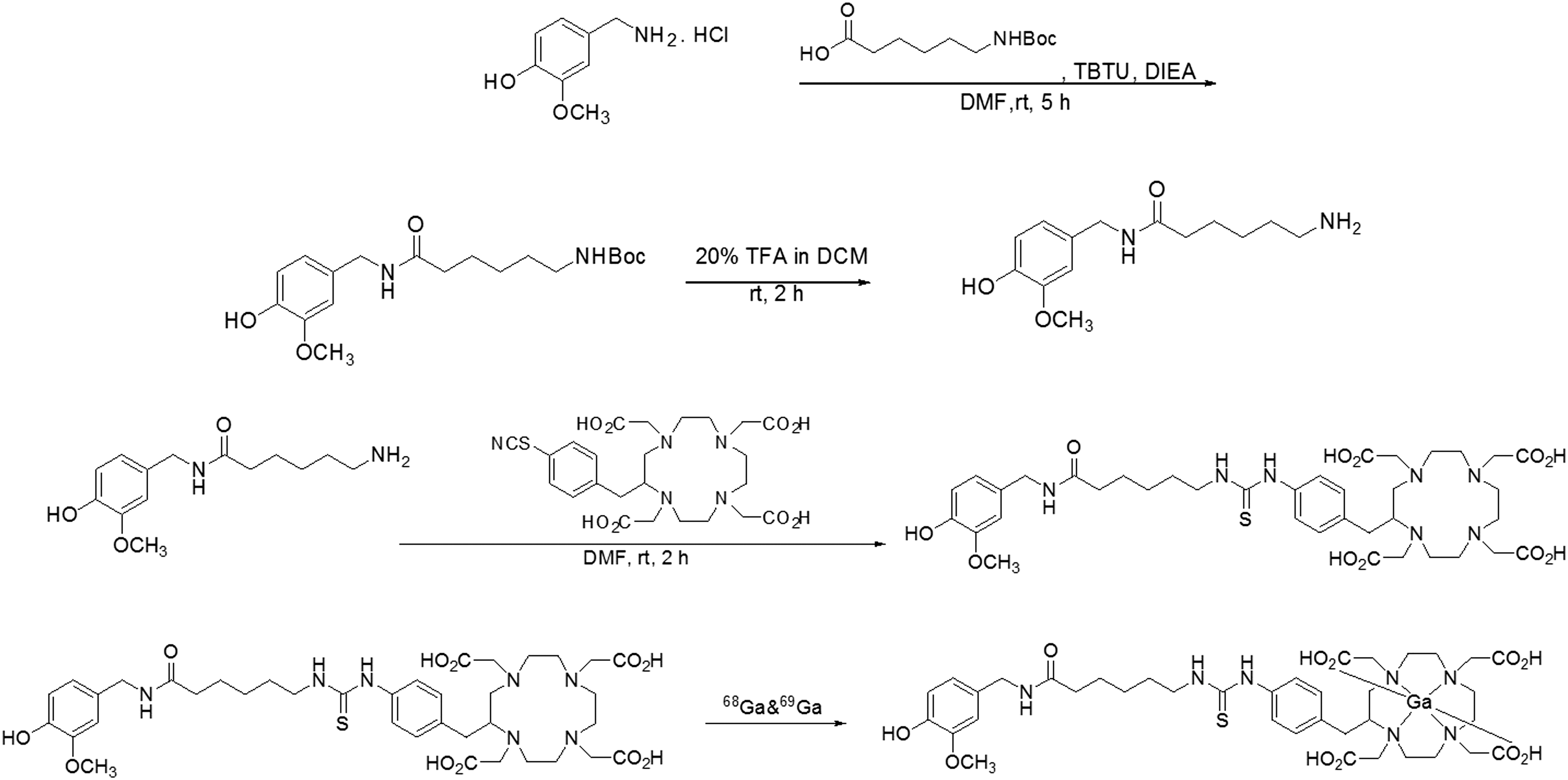
Synthesis of 68&69Ga-SCN-Bn-DOTA-capsaicin.
Preparation of 69Ga-SCN-Bn-DOTA-capsaicin
The stable isotope reference compound, 69Ga-SCN-Bn-DOTA-capsaicin was synthesized by reacting p-SCN-Bn-DOTA-capsaicin with GaCl3 + (1 equation) in deionized water. The pH was adjusted to 4 with a 0.5 M sodium acetate buffer solution. The reaction mixture was stirred for 30 minutes at 100°C, and the crude compound was purified by RP-HPLC (gradient, 80% H2O for 4 minutes and 20%–100% MeCN for 10 minutes; flow rate, 5 mL/min; 240 nm).
Preparation of 68Ga-SCN-Bn-DOTA-capsaicin
68Ga (∼80 MBq) was eluted from 68Ge/68Ga generator with 0.05 N HCl. One milligram of p-SCN-Bn-DOTA-capsaicin was added to the HCl solution containing 68Ga, and the pH of the solution was adjusted by adding 1 M sodium acetate buffer (pH 5) to give pH 4. The mixture was stirred for 10 minutes at 100°C. 34 The reaction mixture containing 68Ga-SCN-Bn-DOTA-capsaicin was injected in the RP-HPLC system (gradient, 70% H2O for 5 minutes and 0%–100% MeCN for 10 minutes; flow rate, 4 mL/min; 240 nm). 68Ga-SCN-Bn-DOTA-capsaicin was confirmed by a coinjection of the authentic compound, 69Ga-SCN-Bn-DOTA-capsaicin. This purified product was dried and dissolved in saline for the biological experiments.
Binding constant of gallium conjugate
The binding constant of p-SCN-Bn-DOTA with 69Ga was measured according to the standard calibration curve method. The reaction is determinated by the on-rate constant [kon] and the off-rate constant [koff]. The binding constant can be calculated as:
where [H], [G], and [HG] are the concentrations of the 69Ga, p-SCN-Bn-DOTA-capsaicin and 69Ga-SCN-Bn-DOTA-capsaicin complex, respectively.
Cell culture and tumor model
Human breast cancer cell MCF-7 and SK-BR-3 cells were cultured in RPMI-1640 medium supplemented with 10% fetal bovine serum (FBS). Mouse colorectal cancer cell CT-26 was cultured in Dulbecco's modified Eagle's medium (DMEM) and supplemented with 10% FBS. All cancer cell lines were maintained at 37°C in a humidified atmosphere containing 5% CO2. 35,36 All animal studies were progressed according to a protocol approved by the Orient (Gyeonggi-do, Korea) and Korea Atomic Energy Research Institute. The mouse model consisted of female Balb/c nude mice (4–6 weeks old, body weight of 20–25 g). Human breast cancer MCF-7 cells xenograft models were injected by 5 × 10⁶ tumor cells into the left thigh. The tumors were cultured and grown 2 to 3 weeks before the micro animal-PET imaging experiments.
Partition coefficient (Log P)
The Log P was measured by mixing 1.85 MBq of 68Ga-SCN-Bn-DOTA-capsaicin with 1 mL of 1-octanol and 1 mL of phosphate buffer saline (PBS, pH 7.4) in a test tube. The test tube was agitated for 10 minutes at 25°C and centrifuged at 10,000 rpm for 5 minutes. Each aliquot, 200 μL of PBS and 200 μL of 1-octanol, was taken and counted on a γ counter in triplicate.
37
The log p-value was calculated by using the following equation:
In vitro stability
A total of 370 kBq of 68Ga-SCN-Bn-DOTA-capsaicin was incubated with 1.0 mL of human serum in a water bath at 37°C for 15, 30, 60, and 120 minutes, and then measured by radio-TLC; 0.1 M Na2CO3 and MeOH (1:1) were used as the solvents. All the data were collected in triplicate.
Cellular uptake of 68Ga-SCN-Bn-DOTA-capsaicin
The cellular uptake was measured with MCF-7, SK-BR-3, and CT-26 cells by using 68Ga-SCN-Bn-DOTA-capsaicin and 68Ga-SCN-Bn-DOTA. The cells were cultured in DMEM (Gibco Life Sciences) supplemented with 10% FBS and 1% penicillin-streptomycin. The cells were incubated at 37°C in a 5% CO2. The cells were sub-cultured in 12-well plates (1 × 10⁶ of MCF-7, SK-BR-3, and CT-26 cancer cells); incubated at 37°C for 15, 30, 60, and 120 minutes with 185 kBq/well of either 68Ga-SCN-Bn-DOTA-capsaicin or 68Ga-SCN-Bn-DOTA. After incubation, the 20 μL of supernatant was collected and the remainder of the media was discarded, after which cells were washed with 500 μL of cold PBS to remove the unbounded compound. For solubilization of the cell membrane, 200 μL of 0.1% sodium dodecyl sulfate was added to cell pellets. 15 The radioactivity of the 20 μL of supernatant and 100 μL of cell suspension was determined by using a γ counter. Cellular uptake value of the 68Ga-SCN-Bn-DOTA-capsaicin was calculated and recorded as percentage of inoculation dose (%ID).
Biodistribution studies
Biodistribution was studied by measuring the radioactivity after injecting 68Ga-SCN-Bn-DOTA-capsaicin in the mice. 68Ga-SCN-Bn-DOTA-capsaicin (3.7 MBq) was injected intravenously via the tail vein in MCF-7-bearing mice. The mice organs were measured at 15, 30, 60, and 120 minutes after the injection in triplicate. A mouse blood sample was collected by heart puncture and organs were extracted with heart, lung, liver, spleen, stomach, intestine, pancreas, kidney, muscle, fat, bone, skin, tail, tumor, and brain, after which the radioactivity in these organs were measured by using the γ counter.
Animal-PET study
The mouse was anesthetized by ketamine hydrochloride (100 mg/kg) and xylazine hydrochloride (2.5 mg/kg). The MCF-7 xenograft mice were imaged at 15, 30, 60, and 120 minutes after the iv injection of 3.7 MBq of 68Ga-SCN-Bn-DOTA-capsaicin. The tumor blocking test of 68Ga-SCN-Bn-DOTA-capsaicin was also done with MCF-7-bearing mice (18–20 g) treated with capsaicin, which presumably binds to TRPV 1. Capsaicin compound (3 mg/kg) was injected via tail vein, followed by an injection of 68Ga-SCN-Bn-DOTA-capsaicin after 10 minutes. The PET images were acquired after 60 minutes.
Results and Discussion
Chemistry
69Ga-SCN-Bn-DOTA-capsaicin was prepared, as shown in Figure 1. The resulting reaction mixture was purified by RP-HPLC to give p-SCN-Bn-DOTA-capsaicin with ∼70% yield (Supplementary data available at
p-SCN-Bn-DOTA-capsaicin; 1H NMR (500 MHz, D2O) δ = 7.24 (d, 2 H, J = 7.6 Hz), 7.14 (brs, 2 H), 6.90 (d, 1 H, J = 1.6 Hz), 6.82 (d, 1 H, J = 8.0 Hz), 6.76 (d, 1 H, J = 8.4 Hz), 4.24 (s, 2 H), 3.91 (brs, 4 H), 3.78 (s, 3 H), 3.72–2.49 (m, 23 H), 2.27 (t, 2 H, J = 7.2 Hz), 1.69–1.49 (m, 4 H), and 1.35–1.24 (m, 2 H); 13C NMR (100 MHz, D2O) δ = 178.9, 175.7, 174.5, 173.7, 168.2, 147.2, 143.9, 135.7, 134.5, 130.4, 130.2, 125.4, 119.7, 119.1, 115.2, 111.2, 105.0, 55.6, 54.4, 53.9, 52.9, 52.1, 51.6, 50.0, 49.6, 49.1, 46.6, 44.4, 42.4, 35.6, 31.1, 28.0, 25.6, 25.2, and 0.8; MS (electrospray ionization): [M+H]+ = 818.6 (m/z), calc (molecular weight): 818.0 (C38H55N7O11S) (Figs. S4, S5, S6).
69Ga-SCN-Bn-DOTA-capsaicin; 1H-NMR (500MHz, D2O) δ = 9.33 (d, 2 H, J = 8.1 Hz), 7.25 (brs, 2 H), 6.99 (d, 1 H, J = 1.6 Hz), 6.82–6.70 (d, 2 H, J = 8 Hz), 4.74–4.60 (m, 1 H), 4.13 (s, 2 H) 3.71 (brs, 4 H), 1.87–1.80 (m, 4 H), and 1.30–1.01 (m, 2 H); 13C (125 MHz, D2O) δ = 205.9, 176.9, 147.4, 144.9, 143.9, 130.8, 120.1, 118.1, 115.5, 111.7, 55.9, 42.6, 35.6, 25.4, and 25.1; MS (liquid chromatography-MS): 887.2 of C40H66GaN7O11S (Figs. S7, S8).
Radiochemistry
To confirm the optimal labeling yield, the excess amount of p-SCN-Bn-DOTA-capsaicin was added in 68GaCl3 solution. 68Ga-SCN-Bn-DOTA-capsaicin was easily obtained by a one-step reaction.
The 68Ga-SCN-Bn-DOTA-capsaicin obtained through the RP-HPLC with radiochemical yield was about 70% (Fig. 2), and radiochemical purity was measured by radio-TLC with 98% (Fig. S9).
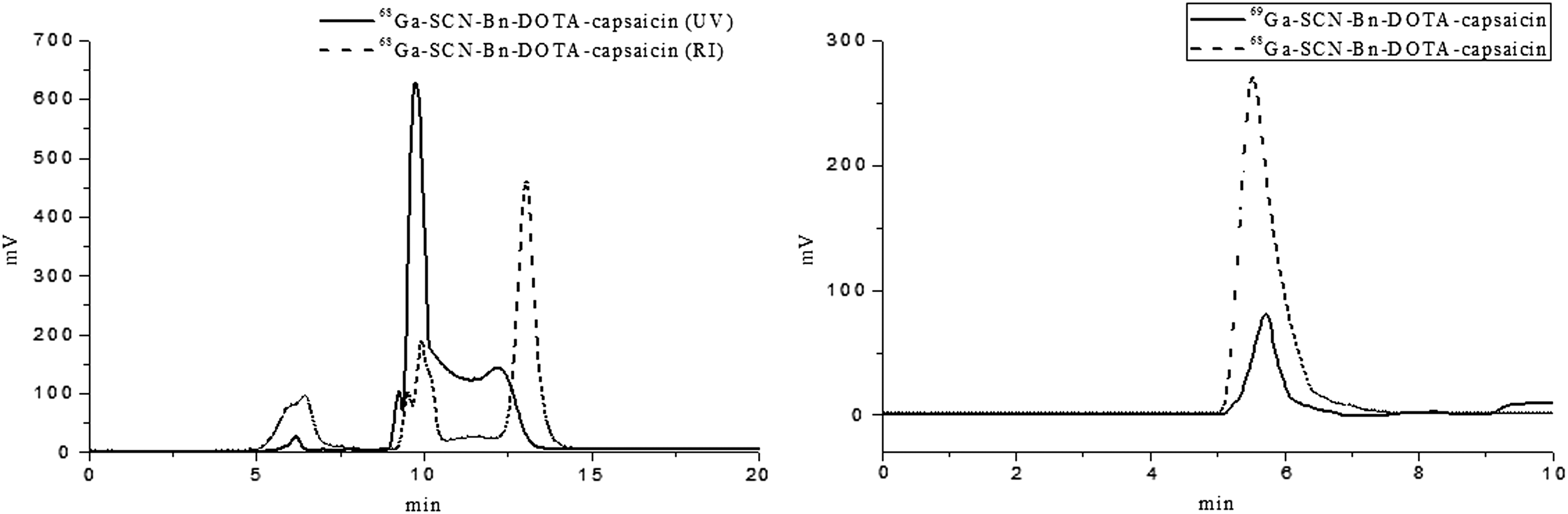
HPLC chromatograms of 68&69Ga-SCN-Bn-DOTA-capsaicin (Left: after synthesis, Right: after purification) RP-HPLC condition (gradient, 80% H2O for 4 minutes and 20%–100% MeCN for 10 minutes; flow rate, 5 mL/min; 240 nm; tR, 13 minutes).
Partition coefficient and stability in human serum
The measured log p-value of 68Ga-SCN-Bn-DOTA-capsaicin was −2.32 ± 0.18. The log p-value shows that this radiopharmaceutical is water soluble. As hydrophilic drugs are rapidly removed from the body and there is less concern about drug toxicity, 68Ga-SCN-Bn-DOTA-capsaicin will also show rapid clearance from the body.
The stability of 68Ga-SCN-Bn-DOTA-capsaicin in human serum was indicated by radiochemical purity of the tracer. As a result, the stability of coordinated 68Ga proved to be better than 93% until 120 minutes (Fig. 3). These results are expected to be stable from a pharmacokinetic perspective.
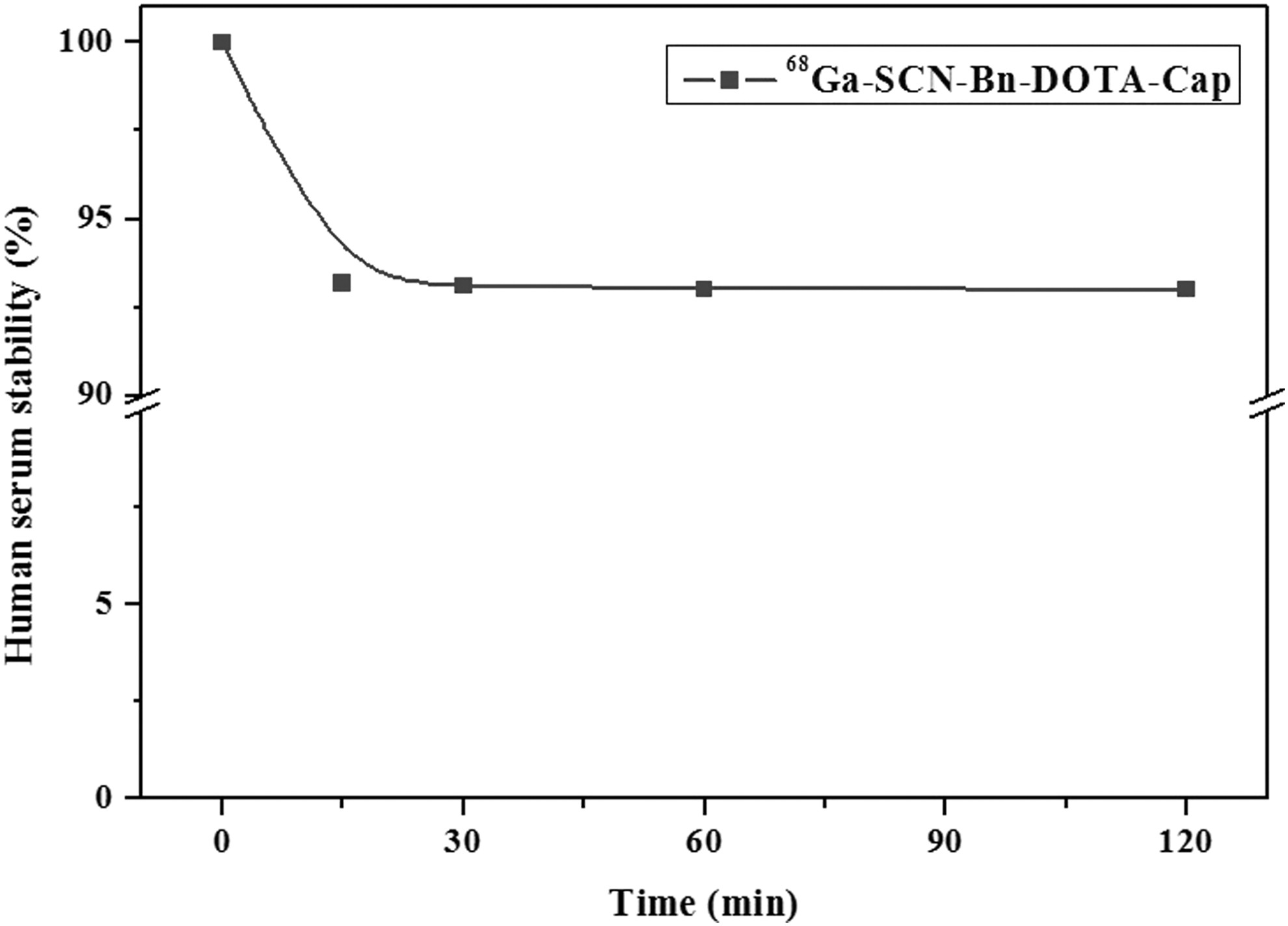
In vitro serum stability of 68Ga-SCN-Bn-DOTA-capsaicin with incubation time (15, 30, 60, and 120 minutes) at 37°C (n = 3).
In vitro cellular uptake
Cellular uptake of capsaicin was evaluated with 68Ga-SCN-Bn-DOTA-capsaicin and 68Ga-SCN-Bn-DOTA. Cellular uptake results have been shown that affinity of cancer cells is dependent on the level of TRPV 1 receptor by the various cells with MCF-7, SK-BR-3, and CT-26 cells.68Ga-SCN-Bn-DOTA-capsaicin showed a relatively high cellular uptake of 0.93% ID as compared with that of 0.25% for 68Ga-SCN-Bn-DOTA after 30 minutes of incubation for MCF-7. These results indicate a high affinity of capsaicin for breast cancer. However, cellular uptake showed a negligible value for both 68Ga-SCN-Bn-DOTA-capsaicin and 68Ga-SCN-Bn-DOTA (Fig. 4).

Cellular uptake of 68Ga-SCN-Bn-DOTA-capsaicin and 68Ga-SCN-Bn-DOTA in MCF-7, SK-BR-3, and CT-26 cells. The photographs shown were of MCF-7 (positive control) and SK-BR-3, CT-26 (negative control).
Biodistribution studies
The time-dependent biodistribution studies carried out in MCF-7 xenografted balb/c mice exhibit the highest and rapid (∼15 minutes) uptake of 68Ga-labeled molecule by tumor as compared with that with the other organs. The uptake also follows rapid clearance, except in the case of the intestine, which manifests a bit higher time for complete removal of 68Ga (Fig. 5). Thirty minutes of the uptake kinetics after injection are compatible with the half-life of 68Ga and the tumor-to-blood (T/B) ratio, in addition to the tumor-to-muscle ratio as seen from Table 1.

Biodistribution studies in MCF-7-bearing mice at 15, 30, 60, and 120 minutes after an iv injection of 68Ga-SCN-Bn-DOTA-capsaicin. The data are expressed as the percentage of administered activity (injection dose) per gram of tissue (%ID/g, n = 3).
Animal PET image
PET image intensities clearly predict the relatively highest uptake values of 68Ga-DOTA-capsaicin in xenografted tumor as compared with other organs under study, and they were achieved in 30 minutes. In addition, tumor-specific uptake was reconfirmed by the blocking studies, as shown in Figure 6. The results determined by this study suggest the possible use of 68Ga-SCN-Bn-DOTA-capsaicin as a potential PET imaging probe for breast cancer.
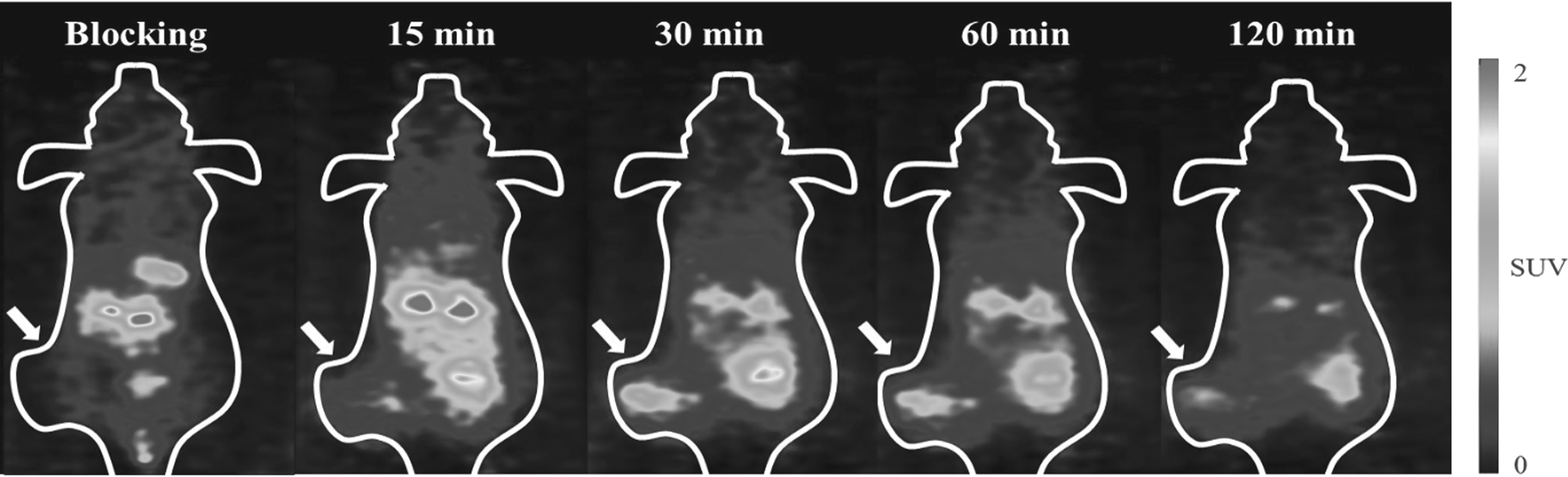
Animal-positron emission tomography images of MCF-7 xenografted mice of 68Ga-SCN-Bn-DOTA-capsaicin.
Conclusions
This article describes the synthesis and in vitro and in vivo evaluation of 68Ga-SCN-Bn-DOTA-capsaicin for MCF-7 breast cancer cell imaging. 68Ga-SCN-Bn-DOTA-capsaicin was synthesized successfully with >70% radiochemical yield and >98% radiochemical purity. Selective uptake of 68Ga-SCN-Bn-DOTA-capsaicin was observed in ER-positive MCF-7 cells in vitro. The biodistribution results of 68Ga-SCN-Bn-DOTA-capsaicin showed higher tracer uptake in xenograft tumors, suggesting that capsaicin can be used as a potent ligand targeting tumor for the development of chemotherapeutics and diagnostics. However, tumor uptake seems to slow release. Advantages of DOTA-conjugated tracers are the increased T/B ratios, rapid renal excretion caused by higher hydrophilicity of DOTA and capsaicin, and high in vivo stability of 68Ga-chelated SCN-Bn-DOTA-capsaicin. Micro-PET studies of 68Ga-SCN-Bn-DOTA-capsaicin with an MCF-7 model showed that this tracer was significantly accumulated in the tumor cells. However, blocking study results confirmed the low affinity for tumor. These biological results suggest that 68Ga-SCN-Bn-DOTA-capsaicin could be a promising PET probe for MCF-7 through specific tumor uptake. As mentioned in the Introduction, the mode of action of capsaicin in targeting tumors has not been clearly determined but some reports said that pro-apopotic activity of capsaicin may be related to the signaling of TRPV1 and TRPV6, which are the receptors binding with capsaicin. 25,26,29,32,33 Thus, we have a plan to develop a capsaicin derivative with a higher binding affinity to TRPV receptors to confirm whether the uptake of capsaicin in tumor is mediated via TRPV1 and TRPV6, and we will report about our results.
Footnotes
Acknowledgments
This research was supported by the Nuclear R&D Program through the National Research Foundation of Korea funded by the Ministry of Science, ICT and Future Planning (2015M2A2A4A02043265, 2015M2A2A4A02043268, and 2016M2C2A1937989) and Dongguk University Research Fund, Republic of Korea.
Disclosure Statement
No competing financial interests exist.
References
Supplementary Material
Please find the following supplemental material available below.
For Open Access articles published under a Creative Commons License, all supplemental material carries the same license as the article it is associated with.
For non-Open Access articles published, all supplemental material carries a non-exclusive license, and permission requests for re-use of supplemental material or any part of supplemental material shall be sent directly to the copyright owner as specified in the copyright notice associated with the article.
