




Abstract
Scandium radionuclides have been identified in the late 1990s as promising for nuclear medicine applications, but have been set aside for about 20 years. Among the different isotopes of scandium, 43Sc and 44Sc are interesting for positron emission tomography imaging, whereas 47Sc is interesting for therapy. The 44Sc/47Sc or 43Sc/47Sc pairs could be thus envisaged as true theranostic pairs. Another interesting aspect of scandium is that its chemistry is governed by the trivalent ion, Sc3+. When combined with its hardness and its size, it gives this element a lanthanide-like behavior. It is then also possible to use it in a theranostic approach in combination with 177Lu or other lanthanides. This article aims to review the progresses that have been made over the last decade on scandium isotope production and coordination chemistry. It also reviews the radiolabeling aspects and the first (pre) clinical studies performed.
Introduction
N
For that purpose, it is necessary to have access to a radionuclide for imaging and to another one for therapy. Such a pair of isotopes can be of a same element (often called true theranostic pairs like 64 Cu/ 67 Cu, 44Sc/ 47 Sc, 124I/131I, …) or of elements sharing similar chemistry (such as 68 Ga/177Lu,44Sc/177Lu, 99mTc/188Re, …). 1,2177Lu is, at this time, widely used in targeted therapy. 3 However, there is no possibility for true theranostic applications with 177Lu. At the moment, either 111In or 68 Ga are used to make images but with the risk of not having the same behavior due to the different chemistry or the same biodistribution information due to the different half-life. Several β−-emitters have close physical properties such as 47 Sc, 67 Cu, and 177Lu. 4 They all can be used for targeted radionuclide therapy. 5 –8
Many clinical studies have shown that 68 Ga-labeled peptides are relevant positron emission tomography (PET) tracers for imaging of many tumors and their metastases. 9 However, the half-life of 68 Ga (T1/2 = 67.7 min) may limit its use in clinical applications. The relatively high cost of the generators and perhaps, more importantly, the equipment for postelution purification and concentration of 68 Ga solution to small volume could limit the use of this isotope in clinical applications. 10
Therefore, the use of radionuclides of longer physical half-life is of growing interest. An alternative could be the cyclotron produced 64 Cu (T1/2 = 12.7 h) which has been applied in a large number of preclinical and clinical PET studies. 11 Its longer half-life offers the possibility to label monoclonal antibodies (mAbs) or fragments and to use 64 Cu radiopharmaceuticals in hospitals without cyclotrons and radiopharmaceutical units. However, the chemistry of copper could lead to form unstable in vivo chelate complexes due to the changes in oxidation states. In addition, 64 Cu presents relatively low positron branching ratio (17.6%).
Scandium possesses two radionuclides emitting β+ radiations (44Sc or 43 Sc) that become appropriate candidates in positron emission tomography/computed tomography (PET/CT) diagnosis, due to the half-life of around 4 h and decay to the nontoxic Ca. For both radionuclides, the half-life is compatible with the pharmacokinetics of a fairly wide range of targeting vectors (such as peptides, antibodies, antibody fragments, and oligonucleotides). The validity, usefulness, and advantages of 44Sc have been demonstrated by examples featuring 44Sc-radiolabeled targeting vectors, including 44Sc-radiopharmaceuticals very recently used in patients. 12 Other recent studies have shown also the validity of 43 Sc-radiolabeled targeting vectors. 13
Finally, 47 Sc is a low energy β−-emitter which is suitable for single photon emission computed tomography (SPECT) and planar imaging. 47 Sc can be also used for targeted radionuclide therapy, opens the field of Sc-based vectors from diagnosis to therapy, and gives a great opportunity for dosimetric calculations. Scandium displays favorable chemistry for conjugation to mAb-chelate systems. It is chemically similar to 90Y, close to 177Lu, and the same ligands developed for 90Y or 177Lu can be used for chelating 47 Sc.
Thus, there are two true theranostic pairs of scandium (i.e., the same molecule labelled with the different RN of the same chemical element) which are compatible with a centralized production (half-lives ≥4 h) and that make them very attractive from an industrial point of view. 43 Sc/44Sc can be thus used for more accurate planning and dosimetry calculations before treatment with 47 Sc. It has to be mentioned that 44Sc has also been successfully used as a theranostic counterpart of 177Lu.14
In this article, the authors aim to review the progresses that have been made over the last decade on scandium isotope production, coordination chemistry, radiolabeling, as well as the few preclinical and clinical studies that were performed.
Production of Scandium Isotopes
In 2010, the 44Sc radionuclide has been proposed by Roesch as a potential alternative for 68 Ga in clinical PET diagnosis. 15,16 More recently, the scandium chemistry has revealed a growing interest with an increasing number of articles available on scandium: from 44Ti/44Sc generator, 17 –19 from neutron irradiated Ti, 20,21 cyclotron produced 44mSc/44Sc, 22,23 natSc, 24 46 Sc, 25,26 or 47 Sc. 27 –30 In this section, the authors will review the different production routes for the theranostic scandium isotopes, and these routes are summarized in Table 1, together with the corresponding half-lives and energies of each radionuclide.
Production Routes of Scandium Isotopes, Half-Lives, and Energies
Most of the cross-sectional values are available on the nndc database (
Scandium-43
43 Sc is a PET imaging radionuclide of scandium that can be used. It has similar properties to 44Sc but with a lower energy of concurrent gamma emissions. 31 This makes it a potential better candidate for conventional PET imaging with scandium. However, its production is restricted to the use of particle accelerator and is quite difficult.
43 Sc can be obtained through different production routes. Two production routes use low energy protons available on a biomedical cyclotron. The first route corresponds to the higher cross-sectional values and uses 43 Ca, which has a natural abundance of only 0.135%. It is then required to use enriched materials to get high yields through the 43 CaCO3(p,n) 43 Sc reaction 32 and to limit the production of 44Sc. 13 Unfortunately 43 Ca enrichment is limited (maximum 90%), and the cost of enriched calcium targets is very high.
The second route was proposed by Krajewski et al. 33 This 46 TiO2 (p,a) 43 Sc route uses enriched 46 Ti of natural abundance of 8.25%. In this case, the cross-sectional values are lower than in the previous case. A recent comparative study 34 has shown that 43 Ca route, in addition to the recovery process of the enriched target material, has to be preferred for 43 Sc using protons in a biomedical accelerator.
If one has access to deuteron beams, alternative production route could be 42 Ca(d,n) 43 Sc. 22,23 The maximum available enrichment level of the target material is slightly higher than in the case of 43 Ca (i.e., 96.8% vs. 90%). The energy range of interest is between 2 and 11 MeV with maximum cross-sectional values of 200 mb. This leads to a limited production yield even if the energy range fits well with some of the biomedical cyclotrons installed for 18 F production.
Finally, the novel method for 43 Sc production is alpha irradiation of natural calcium target. Due to the composition of natural calcium which contains mainly 40 Ca (natural abundance 96.94%), 43 Sc can be easily produced through the direct route 40 Ca(α,n) 43 Sc or through the indirect production reaction natCaCO3 (α,n) 43 Ti (T1/2 = 509 ms) → 43 Sc. Both reactions occur in the energy range from 10 to 25 MeV with a quite high total cross section. 35 The major limitation of this production route is the availability of cyclotrons with intense α beam. However with the near to 4-h half-life and predicted production cross section approaching one barn, 36 a potential exists for regional distribution which follows mass production at a single cyclotron unit.
Scandium-44
44Sc is highly attractive for clinical PET applications because its half-life enables transportation of 44Sc-labeled radiopharmaceuticals to hospitals that are located quite far away from the radiopharmaceutical production site. However, the co-emission of a high-energy γ-ray similar to 89Zr has to be taken into consideration. If not controlled, it may increase the radiation dose to the patient and staff. When produced from particle irradiation, the metastable state 44mSc is also coproduced. The pair 44mSc/44Sc has many characteristics that make it a good candidate for an in vivo generator compared with previously considered in vivo generators. 37 Indeed, the energetic properties of these two radionuclides 44mSc/44Sc are suitable, they are isotopes of the same chemical element, and no change in oxidation state occurs after decay. This should allow to keep the labelling properties of the compound after decay. There is a little recoil due to the gamma emission but it stays below the chemical bound strength and should not lead to the release of the isotope from the chelating molecule. 26 Finally, there is only a little radiolysis effect coming from the secondary emission, by variance with previously considered in vivo generators. 22 All these aspects indicate that 44mSc/44Sc may be used as an in vivo generator to increase the effective half-life of 44Sc and allows its use with large vectors such as antibodies that require long time to distribute within the body.
Last but not least, 44Sc could be relevant in a new nuclear medical imaging technique based on the measurement of the emitter location in three dimensions with a few mm spatial resolution using β+/γ emitters, as proposed by Grignon et al. 38 Such measurements could be realized with radionuclides that emit a 1 MeV γ-ray quasi-simultaneously with the β+ decay, like 44Sc. The aim of this technique is to reconstruct the intersection of the classical line of response (obtained as for a standard PET camera) with the geometrical cone constructed from the information associated to the third γ-ray. The measurement of the emission angle of this additional γ-ray involves the use of a Compton telescope. A new generation of cameras based on a liquid xenon time projection chamber is foreseen for that purpose. A spatial resolution of 2.3 mm has been determined with an injected activity of 0.5 MBq for a 44Sc point source emitter.
Many different ways have been investigated to produce 44Sc: mostly using cyclotrons or generators.
Generator-based production
One source of 44Sc is through the long-lived parent nuclide 44Ti (T1/2 = 60 years), so-called 44Ti/44Sc generator. 19,39 Titanium-44 is generated by proton irradiation through 45 Sc(p,2n)44Ti reaction or by spallation on natFe or natCu. 40 It would have the ability to provide on a daily basis 10 radiochemically pure 44Sc, that is, with no 44mSc obtained in contrast to the other production routes. Dedicated production runs require high beam currents and long irradiation times to be able to produce sufficient activities. 41 For instance, it has been shown that 150 MBq could be produced over 9 d irradiation at 220 μA which allows to elute every 4 h up to 60 MBq (i.e., activity necessary for one imaging dose). This leads to high cost for the production and the necessity to have a regular and efficient use of the generator over a long period of time. The separation of 44Ti from scandium target material is not trivial, even if some progress has been made recently in this field. 39,41,42 In addition, a generator system implies the development of an efficient separation with high 44Sc elution yields and minimal breakthrough of the parent 44Ti. 19 Finally, the long half-life of 44Ti (T1/2 = 60 years) would lead to difficult management of this generator in nuclear medicine services, and a centralized pharmacy may be better suited to manage such a generator.
Several separation methods have been tested using DGA® resin or ZR® resin. Radchenko et al. 39 highlighted the fact that DGA resin could be used for Ti/Sc trace separations in the context of a fine purification of 44Ti from residual scandium target material. By contrast, ZR resin was shown to exhibit a high sorption affinity for titanium, whereas scandium could be eluted with HCl solutions. Nonetheless, there are some drawbacks concerning this generator since some breakthrough of 44Ti has been observed after several bed elutions. This is particularly important for such a generator with an expected long shelf life. Filosofov et al. 19 proposed to circumvent this issue by applying alternatively reverse eluting flows through the column. Using ZR resin, Radchenko et al. 41 have evidenced a lower breakthrough letting these authors envisage a long-term use of this generator without reverse flow elution stages. Even so, as high activities could be loaded on these columns, leaching of the extractant molecules or deterioration of the sorption performances could occur with time. These effects have to be accurately studied as they may limit the duration of the use of the generator.
Direct production of 44Sc
Like 43 Sc, medical cyclotrons that currently supply 18 F to hospitals can be used to produce 44Sc. Low energy proton beams can be used with both liquid and solid target containing 44Ca to realize the (p,n) reaction. By selecting a proton incident energy below 14.46 MeV (i.e., energy threshold for the [p,2n] reaction), it is possible to prevent the production of 43 Sc. Attempts have been made to use a solution containing natCa, that is, natCa(NO3)2, 4H20. 43,44 On one hand, this method presents the main advantage to be able to use the existing 18 F-targetry to produce 44Sc. It is then possible to benefit for large numbers of installed cyclotrons and to widespread the availability of 44Sc. On the other hand, production yields would be quite low due to the low content of calcium in these targets. Thus, the use of 44Ca enriched material would be required.
With solid targets, yields would be higher 45 but would require the addition of a dedicated targetry which is available from cyclotron providers but not frequently installed on 18 F production machines. Solid targets must contain enriched 44Ca. There is no specific chemical form for doing such, even if most attempts have been made using carbonate that corresponds to the available form of the enriched material that is supplied. The maximum enrichment level is close to 99%. This method is very efficient, and GBq batches can be easily produced with high purities (i.e., radionuclidic and chemical purities) thanks to the high levels of enrichment of the initial target. Recovery of the enriched target material has been developed 22 and has shown that traces of 45 Ca (T1/2 = 162.61 d) are present. Nonetheless, no difference has been evidenced in the final product from targets containing recovered 44Ca with regards to the targets irradiated with “fresh” enriched 44Ca. When irradiating 44Ca, both ground 44Sc and metastable 44mSc states are produced whichever of the following routes are considered.
44CaCO3 (p,n) 44Sc/44mSc
or
44CaCO3 (d,2n) 44Sc/44mSc
The metastable state decays to the ground state leading to the emission of a 270 keV γ-ray. The ratio of 44mSc/44Sc depends on the chosen beam energy and on the nature of the beam. For quantifying 44mSc versus 44Sc, the energy rays are 271.1 and 1157 keV for 44mSc and 44Sc, respectively, with a branching ratio of 98.8% and 99.9%. Indeed, the first pathway requires low energy protons and leads to high yield of 44Sc with limited amount of 44mSc. With a deuteron beam, a higher amount of 44mSc is produced. This second route is an interesting alternative route of production. 23 44 Ca(d,2n) reaction has an energy threshold of 6.96 MeV, and cross-sectional data 46 show a broad maximum around 15 MeV with values close to 500 mb. Nonetheless, production yields of 44Sc using proton or deuteron are of the same order of magnitude.
Concerning the by-products produced by deuteron irradiation at a beam energy of 16 MeV, no 43 Sc was detected, which was normal with an energy threshold of 17 MeV, and about 0.7 MBq 42 K and 0.6 kBq of 43 K were determined. The potassium impurities have been shown to be easily discarded by the purification process. 23 Radionuclidic analysis through gamma spectrometry showed that the final solutions contained only 44,44mSc. No other significant radionuclides were evidenced, even after a cooling time corresponding to several half-lives of scandium.
The use of a deuteron beam is then mostly restricted to the cases where there is a clear need of having the metastable state allowing thus an in vivo 44mSc/44Sc generator for monitoring long-pharmacokinetic biological processes.
It is also possible to use the low energy proton or deuteron beam interacting on an enriched titanium target to produce 44Sc. To limit the production radio-contaminants of scandium (mostly 46 Sc and 43 Sc), it is important to use enriched 47 Ti target material (max. enrichment is 95%) and restrict projectile energies below 15 MeV. The energy threshold associated to the production of 46 Sc is 10.7 MeV, but its production cross section evolves slowly and becomes significant only around 15 MeV. Production yield in this case will be small. 48 Ti can be used but the associated production of 46 Sc and 47 Sc has to be carefully studied since they will have an impact on the radionuclidic purity of the final product.
Scandium-47
Application of 47 Sc, as an alternative radionuclide to 177Lu, was proposed in earlier work. 25 The advantage of 47 Sc production compared to that of 177Lu is relatively easy isolation of the radionuclide from the target, but the disadvantage is the smaller cross section of the nuclear reaction compared to 177Lu production. 20,23 Scandium-47 has nuclear decay properties that are useful for therapy with low-to-moderate energy beta emissions and a gamma emission similar to that of 99mTc that makes it ideal for actual SPECT cameras. As highlighted recently by Domnanich et al., 13 while the production and applications of 44Sc was quite extensively studied, 47 Sc remains poorly scrutinized. 47 Sc could be produced from neutron irradiated in nuclear reactor according to and it is summarized in Table 1:
Other ways of producing 47 Sc are through charged particle beams using the following reactions:
None of these pathways reported has been identified so far, as being the most suitable for the production of 47 Sc. Nonetheless, the limitations from one method to the others are mostly impurities in some cases, for example, the coproduction of 46 Sc (T1/2 = 83.79 d) which is problematic for a medical use when using high energy protons. Another limitation could be due to the starting enriched material availability associated to the setup of an efficient separation chemistry in the case of gamma induced reactions.
Domnanich et al. 13 have shown that the production of 47 Sc through the 46 Ca(n,γ) 47 Ca nuclear reaction demonstrated significant advantages over the 47 Ti production route, as it provided higher quantities of a radionuclidically pure product. Research teams across the world pursue their work on that isotope of interest to find ways to overcome these limitations.
Extraction and Separation Methods
Many different extraction and separation methods have been described in the literature. These methods are strongly related to the form of the initial target material. Enriched calcium is often available within its carbonate form. In that case, the following methods have been described for further extraction and purification.
In the first method described by Valdovinos et al., 52 the irradiated natCaCO3 target was dissolved in HCl solution, was passed through an UTEVA® resin column, and the column was washed with HCl. The scandium radionuclides were eluted with H2O.
The second method reported in the article of Müller et al. 53 consists in dissolving the CaCO3 targets in HCl solution, passed through a DGA resin with HCl. Afterward, the acidic 43 Sc solution was loaded on a second column filled with DOWEX 50 cation exchange resin, and 43 Sc was eluted using ammonium acetate solution at pH 4.
The third method proposed by Walczak et al. 31 concerns dissolution of the target in HCl and adsorption of 43 Sc onto a chelating ion exchange resin Chelex 100. After adsorption of 43 Sc and Ca2+, the column was washed with HCl at 0.01 M to remove Ca2+, and scandium was eluted with HCl at 1 M.
The fourth and last separation method has been described by Alliot et al. 23 Briefly, it consists in loading the dissolved target acidic solution onto DGA. Matrix elements, including alkali and transition metals such as Co, Cu, and Ni, were removed from the resin during the load and subsequent rinse in 4 mol/L HCl. More than 90% of the enriched calcium could be recovered through that step but with some loss. Nonetheless, as it is necessary to discard other metallic elements before recovering scandium, the remaining 10% have been shown to be recovered simultaneously with these elements to optimize purification time. Following this first step of elution, HNO3 was used to elute iron and zinc. This second step allowed discarding all potential impurities by contrast to Krajewski et al. 54 HCl was then necessary to elute quantitatively scandium from the DGA resin. 44Sc was separated from the irradiated calcium target using the procedure reported previously. The efficiency of this separation method was 88% ± 3%, which was consistent with the previously reported procedures using DGA resin, 55 and allowed the achievement of specific activity of the final batch higher than 50 MBq/μmol. Finally, due to the high cost of enriched material, a recycling process of the target was developed by their group. 22 The 4 mol/L HCl and 1 mol/L solutions obtained from the extraction process were mixed and evaporated to dryness. With the mixture bicarbonate/methanol, the kinetic of solvent evaporation was increased and the solubility of calcium carbonate was lowered. 57 The recovery yield of enriched calcium was 90% ± 2%. The suspension was kept for further process recycling to minimize calcium losses. The recycling targets were irradiated, and no significant difference of production yield was observed.
When the starting material is titanium, four procedures have been tested by Pietrelli et al. 20 based on ion exchange, solvent extraction, and extraction chromatography, showing a selective and rapid separation by all methods. Briefly, for solvent extraction and extraction chromatographic studies, tri-n-butyl phosphate (TBP) was used with an equal volume of 8 N HCl, washed with H2O and 6% of carbonate solution. Equal volumes of aqueous phase of ion solution and TBP were used. For cation exchange studies, the AG MP-500 (Bio-Rad) was used after a preliminary treatment in 5 N HNO3 and rinsing with H2O. Pietrelli et al. 20 showed that scandium has much larger distribution coefficient with this resin compared to other strongly acidic cation exchangers, whereas on the other hand, Ti(IV) was poorly sorbed. Then, they eluted scandium using ammonium acetate. For solvent extraction, cupferron was also used, Ti(IV) was extracted as cupferrate by 100% chloroform, and the separation of Sc from Ti was done by “gravity” with 98% of Sc extracted. The extraction chromatography with TBP sorbed onto silica realized by Pietrelli et al. 20 showed that 97.7% of Sc(III) were eluted with 2 mL of HCl 0.1 N. No titanium was detected in the final samples.
All these procedures were shown to be fast and simple. A very recent work has reviewed the different developments that have been made over time on separation and purification of scandium. 42
Coordination Chemistry of Scandium
Metallic radioisotopes utilized in nuclear medicine must be tightly bound in a complex to avoid nonspecific deposition in tissues. Mostly, these complexes must exhibit a high thermodynamic stability and kinetic inertness. In addition, the ligands have to manifest a fast complexation of the metallic radioisotopes, a high selectivity for the particular metal ion, as well as an ability to be conjugated to a biological vector molecule (bifunctional ligands). A number of reviews have shown that the design of new radiopharmaceuticals is a viable multidisciplinary field involving physics, chemistry, biology, and medicine. 57 –63
Scandium is generally considered as a cousin of lanthanides, and similarly, scandium is almost exclusively present in its compounds in trivalent state. However, chemistry of trivalent scandium has some differences; it is smaller (thus, being harder and with higher preference for hard oxygen donor ligands) and prefers donor numbers from six to eight. However, the chemistry of trivalent scandium was much less developed compared with other trivalent lanthanides. For medical application with scandium radioisotopes, multidentate ligands already used in Gd(III)-based magnetic resonance imaging (MRI) contrast agents, as well as for radiolanthanides, that is, derivatives of DTPA or DOTA, were considered to be the first choice. Thermodynamic data for scandium (III) complexes with polydentate ligands were still scarce. For other polyamino-polycarboxylic ligands, that is, NOTA, EDTA, and TETA, respectively, values of the complexation are found in Huclier-Markai et al. 22 The structure of the different ligands is summarized in Figure 1. The log K for ScL complex and the arising pSc for pH 7.4 are summarized in Table 2. Some stability constant data have been published for Sc(III) complexes of DTPA and DOTA. 20 Stability constants were determined for both complexes by combination of potentiometry and nuclear magnetic resonance spectrometry. 64
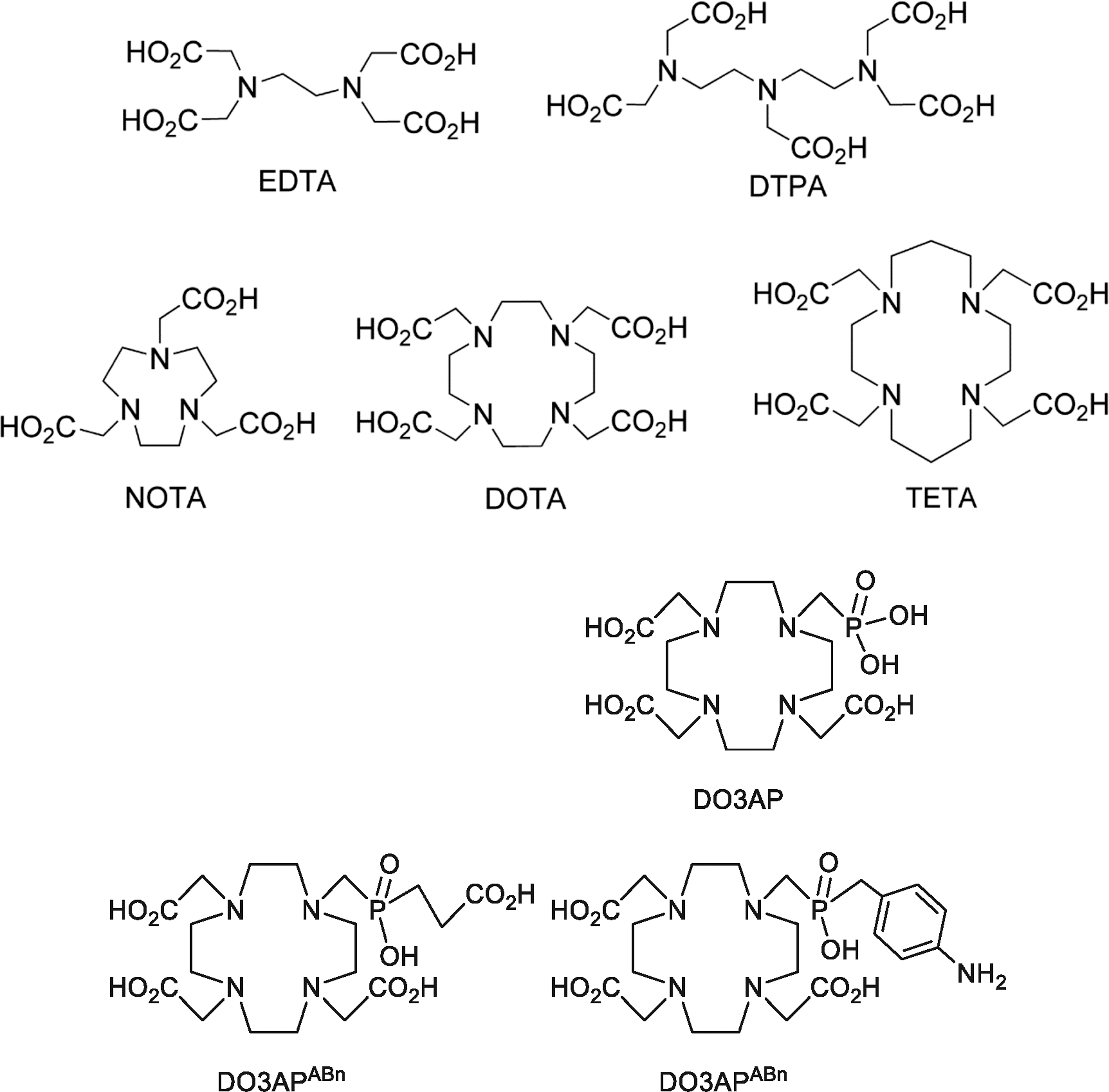
Structure of ligands.
Some discrepancies have been noticed for the Sc(III)-DOTA or DTPA systems depending upon the method used for the determination of the stability constant (i.e., free ion selective radiotracer extraction method [FISRE] or potentiometry) or in other words, depending on the scale used (i.e., macroscopic concentrations or trace concentrations). For instance, stability constant values have been reported for FISRE to be 22 and 22.5 for DTPA and DOTA, respectively, 20 whereas more recently, the stability constants log K ScL determined by potentiometry were 27.43 and 30.79 for DTPA and DOTA complexes, respectively. 64 These values were several orders of magnitude higher than those of lanthanide (III) complexes of the same ligands. Those discrepancies were against all thermodynamic principles. The methods have to be combined as potentiometry itself led to misleading results due to quantitative complex formation at pH below 1.5, thus, out of potentiometric pH range. In addition for Sc(III)-DOTA system, slow complex formation complicated the measurements. 64 While FISRE was based on competition of chelating resin and ligand in solution for a metal ion, it could give an access to the conditional thermodynamic equilibrium constant under nonideal conditions. The ligand-metal ion stability constant can be determined through analysis of efficiency of the competition as a function of the parameters affecting the complexation, that is, concentration/excess of the ligand or pH. Thus, stability constants could be estimated by a fitting dependence of the distribution coefficient of Sc(III) between the resin and supernatant, K d, on the ligand concentration in the supernatant. The FISRE method gave qualitatively similar results but it has an advantage over the common method that, as it is based on trace amount of metal ions, can be used for several radiometal ions where conventional methods for stability constant determination can be hardly implemented. Such potential metal ions of radiopharmaceutical interest include, for example, easily hydrolyzing metal ions as Zr(IV), Bi(III), Ac(III), or Th(IV). In addition, experimental conditions of the method are more close to the real conditions used for preparation of radiopharmaceuticals.
Finally, a recent study by capillary electrophoresis-inductively coupled plasma mass spectrometry (CE-ICP-MS) from their group confirmed that DOTA was a suitable chelator for trivalent scandium; the thermodynamically very stable complex was formed rather quickly and was kinetically inert. 64
With regards to the half-life of 44Sc, the thermodynamic properties of complexation is not the only important parameter; the kinetics of complexation at room temperature is equally very important. For this reason, as scandium(III) is a “harder” metal ion than other trivalent lanthanides, oxygen atoms having “harder” character than those in carboxylate group as, for example, in derivatives of phosphoric acid, that is, in phosphonic (R–PO3H2) or phosphinic (R2PO2H) acids, may alter ligand behavior in the desired direction. 66 Such ligands have been already investigated for complexation of trivalent lanthanides to utilize the complexes in nuclear medicine. Ligand structures are summarized in Figure 1. The ligands were shown to form thermodynamically stable and kinetically inert complexes with rather enhanced complexation kinetics. 66 Trivalent gallium, which is a hard metal ion, showed much faster 68 Ga labeling with phosphinic acid derivatives of NOTA than the parent ligand. The complexes/conjugates were stable in vivo and showed good pharmacokinetic properties due to their high hydrophilicity. Thus, it was suggested that substitution of acetic pendant arm(s) in DOTA with methylphosphonic/phosphinic acid group(s) could lead to ligands endowed with faster complexation of trivalent scandium as well. 67 The phosphorus acid DOTA derivatives bearing one methylphosphonic/methylphosphinic acid pendant arm, DO3AP, DO3APPrA, and DO3APABn, were evaluated as chelators for trivalent scandium. 64 Thermodynamic stabilities of their Sc(III) complexes are very high and similar to that of the [Sc-DOTA]–complex. As expected, stability constants with Sc(III) were several orders of magnitude higher than those for trivalent lanthanides. The logK values are also summarized in Table 1. But as for DOTA complexes, the kinetics of complexation has not been shown to be improved with these chelating agents at room temperature. These ligands can be further used with peptides, but still remained difficult for labelling when coupled with antibodies.
Finally, Nagy et al. have demonstrated that AAZTA chelate could complex Sc(III) with a high thermodynamic stability constant, that is, log K Sc(AAZTA) = 27.69, even if lower than DOTA. 68 They showed that Sc(AAZTA) exhibited a fast complexation kinetic.
It is generally accepted that, to estimate the fate of the complexes in vivo, the kinetic properties of complexes are more important than the thermodynamic ones. Thus, the kinetics of acid-assisted decomplexation of the [Sc-DOTA)]− complex was investigated and compared with the published data for [Ln-DOTA]− complexes. The scandium(III) complex of DTPA is decomposed quickly in highly acidic solutions. Decomplexation of the [Sc-DOTA]− complex in acidic media was studied at 25°C in proton concentration range 0.5–3.0 M. The disadvantage of this kinetic study is to determine the inertness of scandium complex in conditions that are very different from in vivo conditions (high acidic conditions and high ionic strength). The [Sc-DOTA]− complex is more kinetically inert than lanthanide(III)-DOTA complexes; t1/2 at pH 0 and 25°C are 3.0 and 22.9 h for the [Eu-DOTA]− and [Gd-DOTA]− complexes. 64 This is expected as, generally, ligand exchange on trivalent scandium is rather slow and it is given by smaller size and more hard character of Sc3+ ion if compared with Ln3+ ions. In addition, the [Sc-DOTA]− complex is probably present in solution as square-antiprismatic (SA) isomer, and this isomer is much less flexible than twisted square-antiprismatic (TSA) isomer; most of the [Ln-DOTA]− complexes are present in aqueous solution as a mixture of the SA and TSA isomers. Such high kinetic inertness is very important for possible in vivo applications of scandium radiopharmaceuticals based on DOTA or its derivatives.
The potential transchelation of Sc(III) from the complex to the protein was monitored by ultraviolet (UV) after having checked that free Sc(III) is bound in the iron site of the protein with a molar ratio of two Sc(III) per protein. 22 The authors used a complex to protein ratio of two since the protein has two metal ion binding sites. It was also verified that the Sc(III)-ligand complexes did not absorb in the region of interest of the protein. It was shown that no Sc(III) transfer was observed from Sc-DOTA complex to transferrin, at least during the experiment time of 2 h. This study was performed in close conditions to the in vivo ones, but the time frame of this study could be considered to be too short with regards to the scandium half-life. Similar observations were made for DTPA, EDTA, and NOTA. For Sc-TETA complex, the behavior was different. From the very first minute once Sc-TETA and transferrin were put in contact, a shift of the wavelength to 257 nm was observed, indicating a deprotonation of tyrosine phenolate groups of the protein.
Nagy et al. have also determined the kinetic inertness close to physiological conditions by studying the transmetalation reactions of Sc(AAZTA)− with Cu2+. 68 This approach, as the one mentioned above, is very interesting since it is performed in in vivo like conditions. Nonetheless, the choice of metal seems difficult to be justified. Indeed, if the scandium complexation is very fast and very specific, the alternative metal for transmetalation can be complicated. Nevertheless, the authors have evidenced a very high kinetic inertness (t1/2 = 4.9 × 10 4 h) but still lower than DOTA (t1/2 = 8.0 × 10 8 h) in the same conditions. But this result has to be compared to scandium half-life. The measure 4.9 × 10 4 h represents more than 5 years. Consequently the difference between DOTA and AAZTA is not significant as regard to kinetic inertness. 68
So far, DOTA remains the most suitable ligand for Scandium with proteins. Although DOTA forms very stable complexes, this slow formation kinetics at room temperature remains an important obstacle that limits use of DOTA-like chelators in some radiopharmaceuticals. To circumvent this, heating might be the answer, but will limit the coupling to antibodies.
Therefore, ligands permitting formation of complexes with faster kinetics, or at much lower temperatures than DOTA, are still sought. AAZTA seems to be an interesting alternative.
Radiolabeling
The choice of the labelling approach is driven by the nature and the chemical properties of the radionuclide and generally consists in the first step in the development of radiopharmaceuticals with the bioconjugates. The peptide or the antibody is covalently coupled to a chelator, which can complex radiometals. Labelling protocols should allow very high labelling yields, radiochemical purity, and specific activity. 69 Labelling efficiency of ligands is usually tested at different solution pH's, temperatures, and ligand concentrations (or more correctly, at different radiometal-to-ligand molar ratios) and monitored as a function of time to optimize the radiolabeling. Herein, the authors discuss the development of labelling methods that were developed for radio scandium.
Due to the limited availability of scandium isotopes, the very first studies were performed using 46 Sc (T1/2 = 83.79 d), which has low specific activities and which is of low interest with regards to imaging or therapeutic purposes. Despite this fact, for a methodological point of view, these studies were relevant since this isotope has a quite long half-life that allows its everyday use for studies and its gamma emissions allow an easy measurement. Majkowska-Pilip and Bilewicz 26 studied the 46 Sc labeling yield of macrocyclic ligands at different pH values and different metal-to-ligand molar ratios. They have shown that at pH 6.0 more than 99% of 46 Sc–DOTA was obtained in a complex with the 2:1 ligand-to-metal molar ratio. In the case of the 46 Sc–NOTA complex, at the 20:1 molar ratio, 98% labeling was achieved at pH 6.0. They showed also that pH had a significant influence on the labeling yield. At pH 5, their group 22 has evidenced that the overall percentage of radiolabeled compound was found to be 90% for DOTA and 80% for DTPA, respectively, for an Sc:L molar ratio of 1:3 using also 46 Sc. Scandium belongs to the transition metal group, and its complex formation is strongly dependent on the pH of the aqueous solution. Therefore, pH is an important parameter during the radiolabeling optimization process. Since it is a trivalent element with a lanthanide-like behavior, a range between 2 and 6 for the pH values was considered.
Their group then performed the radiolabeling of DOTA with 44m/44Sc and indicated as result that increasing the pH up to six caused some decrease in labelling yields due to the hydrolysis of 44Sc(III). 37 Acidifying the solution below pH 2 resulted in an extreme decrease in labelling yields, reaching ∼40%, probably due to the protonation of the DOTA chelator. For further radiolabeling, a pH between 4 and 5.5 seemed to be appropriate for 44mSc/44Sc with DOTA-based ligands. The authors also indicated the necessity of elevated temperature (>70°C) for efficient labelling. 37 For oligopeptides, such a high temperature is not a critical parameter. No significant difference was observed for the radiolabeling yield in this range. The yields were 92%–94% for DOTA and 92%–95% for DOTATATE in this range. However, antibodies or their fragments require much lower labelling temperature (mostly below 37°C) to preserve their immunoreactivity.
In another work, DTPA and EGTA form complexes with noncarrier-added (nca) 47 Sc, in lower amount of ligand than those formed by DOTA. 23 Particularly in the case of EGTA, only 2 nmol of the ligand was sufficient to achieve labelling higher than 97%. 17
Monophosphorus acid DOTA analogs, DO3AP, DO3APABn, and DO3APPrA, were also considered as better ligands than DOTA (see Coordination Chemistry of Scandium section). 64 Solution investigations of their complexes were complemented by radiochemical studies with nca 44Sc from two sources, 44Ti/44Sc generator (finally obtained in 0.25 m aq. ammonium acetate buffer, pH 4) and from ARRONAX cyclotron (finally obtained in 0.1 M aq. HCl).
With generator 44Sc, overall radiolabeling yields for 44Sc-DOTA and 44Sc-DO3AP were quite similar ranging from 10% to 95% if 1 or 5 nmol of the ligand, respectively, was added. In contrast, radiolabeling yield for 44Sc-DO3APABn was much lower (∼25% if <10 nmol of DO3APABn was used), and 20 nmol of the ligand was required to reach 95% radiolabeling. With cyclotron 44m/44Sc, amount of the ligands required to reach the same radiolabeling yields was significantly lower, although the same general trend was observed. Thus, 0.2 nmol of the ligands is enough for cyclotron 44m/44Sc to get a minimum of 95% radiolabeling versus more than 5 nmol of the ligands for the 44Sc from 44Ti/44Sc generator. The radio scandium from each source differs in specific activity commonly obtained and/or in cold metal ion impurity content. The calculated specific activity of the cyclotron 44m/44Sc was always higher than 10 MBq/nmol (4 h after end of beam). However for the generator 44Sc, specific activity was estimated to be max. ∼2 MBq/nmol (for DOTA; 4 h after end of elution).
DOTA-based oligopeptide, antibody, or other conjugates have been also investigated for complexation of the scandium radionuclides.
For instance, it was shown that the addition of 21 nmol of DOTATOC to 44Sc in ammonium acetate buffer pH 4.0 provided labeling yields of 98% within 25 min of heating in an oil bath at 95°C. This time can be reduced to 3 min only by applying microwave supported heating. 37 Radiolabeling of a DOTA-folate conjugate (cm09) was performed at 95°C within 10 min. 13 Radiolabeling of cm09 was achieved with a radiochemical yield of greater than 96% at a specific activity of 5.2 MBq/nmol.
One of the most informative stability assays that can be readily performed in the laboratory is a measurement of the stability of a metal ion complex in blood serum. While serum stability can be seen as a benchmark of in vivo stability in the extracellular environment (i.e., during blood perfusion), it cannot be relied as alone as it does not fully mimic the intracellular conditions that might be encountered. In addition, serum stability studies provide information on possible pathways by which the radiopharmaceutical in question can become demetallated. These studies are often informative and practical at this final stage before carrying the complexes forward for in vivo studies. The stabilities either with hydroxyapatite or rat serum were monitored as a function of time.
It was observed that Sc-DOTA complex was very stable over several days, either with regard to hydroxyapatite or serum. In contrast, Sc(III) started to be released from Sc-DTPA complex after 2 d in the serum. 11 This result was in agreement with the data from Anderson and Strand 70 showing that the DTPA-conjugated antibody with 46 Sc leads to 75% remaining bound to the antibody conjugate and 25% release of Sc(III) to transferrin, responsible for scandium metabolism in vivo. 71
Even the labelling studies with the monophosphorus acid DOTA analogs did not show improved properties; in vitro/in vivo properties of their 44m/44Sc complexes were evaluated. 64 The serum stability can be seen as benchmark of behavior of compounds in extracellular environment and provide information on possible pathways on how the radiopharmaceutical in question can be demetallated. It is well known that phosphonate-containing compounds may have a high affinity to bone and hydroxyapatite (HA); as an in vitro model material of bone, sorption was also investigated. Challenging studies against either hydroxyapatite or rat serum were monitored as a function of time. It was observed that 44Sc-DO3AP, 44Sc-DO3APABn, and 44Sc-DO3APPrA complexes were stable over several hours in serum, similarly to 44Sc-DOTA. It was also in accordance with previous studies on radiolanthanide complexes of DO3APABn and DO3APPrA. 64 Therefore, ligands with DOTA-like structure seem to be good chelators for Sc(III) forming stable complexes. Negligible sorption of all complexes, even that of 44Sc-DO3AP on HA, shows that no bone uptake should be expected after intravenous applications.
Finally, as other example, the stability of 44Sc- DOTA-folate conjugate (cm09) was tested in human plasma. 13
Imaging and Preclinical Studies
Compared to gallium-68 or fluorine-18, the longer half-life of 44Sc may allow for PET imaging at longer time or of larger peptides and antibody fragments that are currently limited due to the short half-lives of commonly used PET radionuclides. Associated with targeted radionuclide therapy is the necessity to perform dosimetry. This can be done using the same compound labeled with a β+ emitter of the same element. In this case, a PET image can be obtained and dosimetry can be assessed before the treatment to adjust the injected dose to minimize toxicity and maximize patient response.
Published in vivo data using scandium radionuclides remain limited. Rosoff et al. 72 have shown that the excretion of Sc citrate is slightly higher compared with rare earth elements administrated as chlorides in organs such as lung, muscle, and bone. Bone uptake of Sc is about 5%. Since the Sc chelates are excreted readily, the concentration of Sc compounds is low in all tissues. It has been shown that accumulation of Sc(III)-citrate (low stability constant) in the liver, spleen, and bone was much higher compared with Sc(III)-EDTA (high stability constant) following injection in mice. Some authors 71 have shown that when nitrilotriacetic acid (NTA) Sc(III)-NTA (intermediate stability constant) was injected, a relatively high concentration of Sc was accumulated in the bone compared to Sc(III)-citrate or Sc(III)-EDTA.
Moeller postulated a correlation between the ionic radius of a rare earth and its ability to form stable compounds. 73 Rare-earth chelates with a high stability constant dissociate very little and are rapidly excreted, while those of weak or intermediate stability constants dissociate more readily and the rare earth is deposited in tissues and excretion is minimal. In vitro studies have shown that the biological behavior of Sc is similar to that of other rare earths; for instance, Sc forms stable complexes with chelating agents of the amine carboxylates. 74 EDTA and DTPA are both effective in removing Sc from man, and DTPA especially led to a considerable excretion of scandium. 75 Scandium(III) has the remarkable property of enhancing the tumor/nontumor concentration ratios of intravenously administered 67 Ga. 67 Ga-citrate is now in widespread use for the detection of malignancies in man using scintigraphic scanning techniques. In animal studies where the toxicity of Sc was of interest because of its possible use as an augmentative agent for 67 Ga scanning patients with cancer, Byrd et al. observed that the uptake and retention of Sc in some tissues appeared to be exceedingly prolonged. 76 Furthermore, in distribution studies involving high specific activity 47 Sc, they found that the administration of stable Sc had an additional pronounced effect on the retention and tissue distribution of 47 Sc.
The distribution of high specific activity 47 Sc in rats appeared to be nonspecific in that few tissues showed any particular preferential affinity for the radionuclide. The spleen is a striking exception. The reason for the high concentration of high specific activity 47 Sc in the spleen is not apparent, although it does not appear to be due to deposition of colloidal material because other reticuloendothelial tissues did not show high uptake.
Thus, it was of importance for their group to perform biodistribution studies on 44/44mSc. 77 All animal experiments were approved by the local veterinarian department and were conducted in accordance to the French ethics laws. Biodistribution studies and PET imaging were first performed in acetate buffer pH 5.2, at 1 h postinjection (p.i.); free 44Sc in acetate buffer accumulated principally in lungs and heart, which can be explained by the formation of some colloids. Surprisingly an accumulation of free 44Sc was observed in the eyes. Since there was still stable Ca in the final Sc batches, 9 an assumption could be the formation of a coprecipitate of Sc-Ca and protein beta B2 and A3 beta crystalline which fixes the Ca. 78 To attempt to further demonstrate that assumption was done. For these reasons, biodistribution and PET imaging were performed again using another buffer. In the case of biodistribution studies and PET imaging performed with free 44m/44Sc in HEPES buffer (Fig. 2), which is widely used in cell culture, no accumulation of Sc in the eyes was observed, and free Sc was eliminated in the urine after 4 h p.i. Thus, this buffer was selected for further biodistribution studies with Sc-DOTA peptides. However a small bone uptake was observed 15 h p.i. in the epiphysis areas.
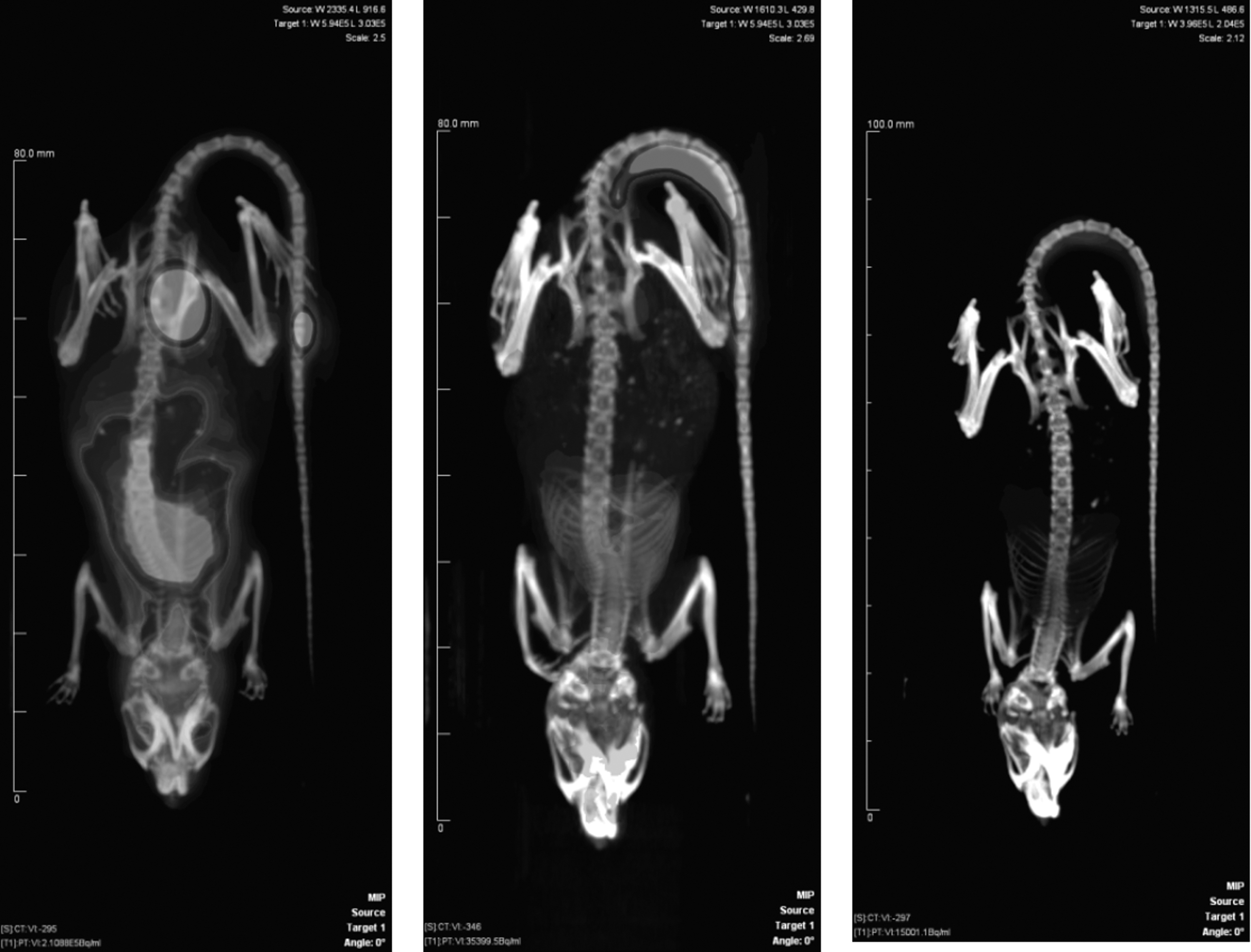
Free 44m/44Sc in HEPES buffer PET imaging at 1, 4, and 15 h p.i. PET, positron emission tomography; p.i., postinjection.
In the case of 44Ti/44Sc generator (Fig. 3), results obtained showed that an important accumulation of the free 44Sc was observed practically in lungs, blood, and liver that might be explained by the formation of colloids. The bone uptake was less than 1%. Same results were observed in the case of free 44m/44Sc in HEPES buffer at 1 h p.i. However the 44m/44Sc was completely eliminated 4 h after injection. Slight differences in the reported biodistribution data are possibly because of the difference in animal used between both experiments.

Biodistribution of free 44Sc from 44Ti/44Sc generator 30 min p.i.
Nagy et al. 68 have studied the biodistribution of 44Sc3+, 44Sc(AAZTA)−, and 44Sc-(AAZTA)-RGD compounds in healthy control and breast-cancer tumor bearing mice. PET/CT and MRI images were acquired showing a moderate accumulation of free Sc3+ in the liver, lungs, and spleen, whereas no thoracic accumulation was found with Sc(AAZTA)−. The 44Sc-(AAZTA)-RGD compound was also shown to highly accumulate in tumor.
Peptides display good tissue penetrating ability due to small molecular weight (on average less than 50 amino acids), low immunogenicity, high affinity to targets, acceptable stability and integrity in vivo, and easy to manipulate for synthesis and conjugation with other agents. 79 Peptides may act as agonists or antagonists to directly target cancer cells. However the main drawback of such small structures is that they are more rapidly cleared from the plasma, and therefore, they have shorter half-lives. 80 A DOTA-chelated Bombesin analog binding affinities to PC-3 cells in vitro were evaluated using nat Sc. 23,81 These authors have evidenced that natSc-DOTA-BN[2-14]NH2 has the lowest binding affinity (IC50 = 6.49 nM) to the BN-R type 2 receptors compared to natGa-DOTA-BN[2-14]NH2 (IC50 = 0.85 nM).
Another important work investigated 44Sc- DOTA-folate conjugate (cm09) in vitro using folate receptor–positive KB tumor cells and in vivo by PET/CT imaging of tumor-bearing mice. 28 In vitro, 44Sc-cm09 was stable in human plasma over the whole time of investigation and showed folate receptor-specific binding to KB tumor cells. PET/CT images of mice injected with 44Sc-cm09 allowed excellent visualization of tumor xenografts. In that work, comparison of cm09 labeled with 44Sc and 177Lu revealed almost identical pharmacokinetics. This study was confirmed later on by another article which evaluated a 47 Sc radiolabeled DOTA-folate conjugate with an albumin binding (cm10) into KB tumor cells. 53 SPECT/CT images indicated that radioactivity was accumulated in KB tumor cells and in kidneys. For mice which received 47 Sc-cm10, a significant tumor growth delay was also noticed. Thus these authors have confirmed the applicability of 44Sc/ 47 Sc as an excellent matched pair of nuclides for PET imaging and radionuclide therapy.
In addition, this group has recently evaluated the radiolabeled prostate-specific membrane antigen ligand 44Sc-PSMA-617 and compared it to the 177Lu and 68 Ga-labelled PSMA-617. 14 It was shown that the in vitro characteristics against PC3-cells and in vivo kinetics of 44Sc-PSMA-617 were more similar to 177Lu-PSMA-617 than 68 Ga-PSMA-617.
Finally, the same group has recently scrutinized the image quality that could be obtained with 44Sc by comparison to five other radionuclides, namely 11 C, 18 F, 64 Cu, 89Zr, and 68 Ga. 82 The resolution obtained on phantoms revealed that the value for 44Sc was between those of 68 Ga and 89Zr, accordingly to theoretical expectations based on the energy of the emitted positron.
44Sc has already been evaluated for binding with DOTA-conjugated peptides.23,85 44Sc-DOTATOC was prepared using the 44Ti/44Sc generator. After having verified that the resulting complex (>98% yield) remained stable, a patient was injected with 32 MBq of the complex formed and a PET/CT scan was done 19 h p.i. This was the first human use of 44Sc-DOTATOC in a patient with liver metastases. 14
Finally, scandium could be useful when coupled to an antibody. The only published data on that was done by Moghaddam-Banaem et al. who have worked on 46 Sc-DOTA-antiCD20 compounds.86 They performed the radiolabeling studies and the biodistribution in wild rats for up to 72 h. The binding of the radiolabeled antibody in Raji cells was about 60%. They showed that the accumulation of this radiolabeled antibody in liver, kidneys, spleen, and heart was demonstrated to have similar pattern compared to other radiolabeled anti-CD20 immunoconjugates.
Finally, a first in human study has been performed very recently using 44Sc-DOTATOC prepared from 44Sc produced in a cyclotron. 14 Two patients participated to this study after being treated by peptide receptor radionuclide therapy of neuroendocrine neoplasms. This very encouraging proof-of-concept study showed no clinical adverse effects with normal hematology and renal and hepatic profiles.
Conclusion
43 Sc and 44Sc are interesting for PET imaging, whereas 47 Sc is interesting for therapy. The 44Sc/ 47 Sc or 43 Sc/ 47 Sc pairs could be thus envisaged as true theranostic pairs, and 43 Sc or 44Sc can be used for theranostic studies with 177Lu or other lanthanides. Moreover, scandium has a chemistry close to 177Lu and a centralized production, which makes it more attractive than 68 Ga for its use in a theranostic pair. These radionuclides have gained some increasing interest this last decade, and their broader availability opens new fields of investigation.
Regarding the production, 44Sc is mostly available within two forms as follows: (i) 44m/44Sc produced with a cyclotron and for which the extraction/purification process is setup and optimized allowing to reach specific activities suitable for preclinical studies; and (ii) 44Ti/44Sc generator for which some optimizations are still necessary on the purification process and long-term use assessment is requested. This generator has been clinically used with interesting prospective. 85 43 Sc is also another interesting element for PET diagnosis, and its extraction/purification process is very similar to the one developed for 44m/44Sc, but its production remains quite expensive. With regards to the therapeutic isotope of 47 Sc, its very low availability limits its developments but with improvement in identifying the most suitable and cost-efficient production route, it will probably increase the number of studies.
Regarding the coordination chemistry and the subsequent radiolabeling of the corresponding ligands, DOTA is so far the most suitable chelate for Scandium but to radiolabel any DOTA-based biomolecules that need to be radiolabeled would require quite elevated temperatures (>70°C). This parameter is not a limitation if the biomolecules envisaged are peptides but is definitely one drawback with antibodies. This opens a field of research for designing and synthesizing new ligands exhibiting high thermodynamic constants with scandium, kinetics inertness, and antibody compatible temperature for radiolabeling.
With increasing availability of scandium PET isotopes, some preclinical studies performed have been done but remained limited and mostly performed with peptides. Since Scandium exhibits suitable conjugation chemistry to be coupled with MAbs, it paves the way for bringing new developments in this area.
Sc-based vectors from diagnosis to therapy will give a great opportunity for dosimetric calculations and for the development of personalized medicine.
Footnotes
Acknowledgments
This work has been, in part, supported by a grant from the French National Agency for Research called “Investissements d'Avenir,” Equipex Arronax-Plus noANR-11-EQPX-0004, and Labex IRON noANR-11-LABX-18-01. Part of this work has been realized within the framework of the European COST network–Action TD 1004.
Disclosure Statement
No competing financial interests exist.