




Abstract
Anthropogenic radioactivity generated by nuclear or chemical events results in the liberation of quadrillions of Becquerel and tons of materials to the environment. These events include nuclear accidents, nuclear weapon experiments, and high levels of generated radioactive and chemical waste. 210Po is a high-energy α emitter that presents in the environment at extremely low concentration. It is considered as one of the highly toxic elements and is estimated to contribute about 7% of the total effective dose equivalent to humans from ingested natural internal radiation. The assessment of 210Po activity/concentration in the environment could be used as an indicator of the level of anthropogenic radioactivity. The 210Po concentration present in the most frequently sold cigarette produced in Lebanon was assayed using α spectrometry after a radiochemical separation and spontaneous deposition of Po on a copper disk. Although the geographical nature of Lebanese land is an extension of Syrian territory, the polonium activity concentration obtained is 8.8 times higher and attributable to the excessive use of phosphate fertilizers in agriculture. The individual committed effective dose was estimated to be equal to 219 ± 17 μSv/year of cigarette smoking.
Introduction
The exposure of human beings to ionizing radiation from natural sources is a continuing and inescapable feature of life on earth. For most individuals, this exposure exceeds that from all man-made sources combined. The major natural background source contributors include: Radon gas, high-energy cosmic ray particles which come from outer space and their own sun (average dose in the United States is 0.3 mSv/year), and the terrestrial sources (30 mSv/year in some areas in Brazil and India). These terrestrial sources represent the radioactive nuclides that originated in the earth's crust and are present everywhere in the environment. These include radionuclides with half-lives comparable to the age of earth and their decay products. One of these long-lived radionuclides, which is widely presented in the terrestrial environments, from the decay of 238U, is 210Po (half-life of 138.376 ± 0.002). 1 210Po is considered as one of the most highly toxic elements due to its being a pure a emitter of high specific activity (166TBq/g), with the main hazard associated with ingestion and inhalation. 2 To illustrate this point, 1 μg of 210Po emits as many α particles per second as 4.5 mg of 226Ra, 262 mg of 238Pu, or 446 kg of 238U.
Tobacco can be considered as a good vector for radionuclide transfer to humans. It contains several toxic chemical substances that are considered carcinogenic, in addition to some radionuclides of natural origin. 3,4 Tobacco leaves have high affinity for polonium-210 and lead-210 radionuclides through absorption from soil and can be inhaled with cigarette smoke, due to its relatively high volatility at the temperature (600°C and 800°C) of a burning cigarette. 5 The carcinogenic effect of 210Po as a promoter for lung cancer is a serious problem in many countries with very high cigarette consumption. Conceptually, cancer development goes through three different phases, which are initiation, promotion, and progression. The initiation phase could be described by the modification in the DNA sequence in one cell, a change in gene expression or rearrangement. This initiation phase is mainly induced by an agent referred to as a promoter, for example, ionizing radiation, which is generally of low carcinogenic activity when taken at low doses over short periods of time. However, the chronic exposure to the radiation emitted from these radionuclides would trigger the initiation of the carcinogenic process. Then, the malignant cells undergo continuous mitotic division to produce tumors. Previous investigations indicated that α radiation coming from volatilization of 210Po in cigarettes might be a causative factor in increasing incidence of lung cancer among cigarette smokers. 6 –9 The polonium is present in the gaseous and particulate phase of the smoke and accumulates in the bronchial epithelium in the region of segmental bifurcations. 10 The concentration of the accumulated polonium in the trachea, lobar bronchi, and segmental bifurcation were evaluated to be 4.44, 7.03, and 166.5 mBq/g, respectively. 11
The main natural sources of polonium in cigarettes could come from: (a) the gaseous 222Rn which can escape into the environment from the earth's crust and that return to the soil after precipitation and can be absorbed by the tobacco plant, and (b) the lengthy drying stage of the tobacco leaf that may last from few months to 1 year which will allow for significant growth of 210Po from 210Pb radioactive decay with time. 12 Another source representing the anthropogenic impact includes the excessive usage of phosphate fertilizers, 13 –16 coal or peat combustion, 17 and the nuclear weapon use/testing. 18
The concentrations of 210Po measured in cigarette tobacco in different countries were in the range of 2.8–37 Bq/kg. The variation is due to the different varieties of tobacco used and different manufacturing procedures. 7,19 –22 Furthermore, the geological nature of different countries where tobacco is grown could explain the variation of 210Po concentration. Meanwhile, the anthropogenic radioactivity contributes to the amount of polonium in the tobacco field and thus its concentration in the product.
The aim of this study is to investigate whether the level of polonium in tobacco could be a significant indicator of its presence in the environment as a result of anthropogenic radioactivity.
Materials and Methods
All chemicals were purchased from different commercial sources and were of high purity. Commercially available nitric acid (70%; Fisher), perchloric acid (70%; Fluka), hydrochloric acid (35%, optima; Fisher), and copper foil (chemical purity 99.999%, 25 × 25 mm2, thickness 1 mm; Goodfellow) were used as received. All the solutions were prepared using Milli-Q (18 MΩ) water, and the experiment was conducted at room temperature (22°C ± 3°C). The experimental procedure was repeated in triplicate for reproducibility, and the average and associated standard deviation was reported.
Sample preparation
Four packs of freshly selected cigarettes corresponding to 72 g of tobacco were mixed. From the mixture, 17.9 g were dried at 100°C for 2 h to reduce the water content and achieve a constant mass. The cigarette content was transferred to a beaker, spiked with a mixture of 209Po and 208Po standards as tracer to determine radiochemical yield. The mixture was digested in a solution comprising of 200 mL of concentrated HNO3 (70%) and 10 mL of HClO4 (70%). The mixture was shaken for overnight at room temperature. The volume of the acidic solution was reduced by gentle evaporation for 8 h at 120°C followed by reconstitution in 10 mL of HCl (37%). The final solution was diluted by the addition of 190 mL of water to have a concentration of 0.6 M which is suitable for spontaneous deposition (Fig. 1).

Radiochemical separation of polonium-210 followed by spontaneous deposition.
Plating of Po
The spontaneous deposition of polonium (210Po, 209Po, and 208Po) on the copper disk from the 0.6 M HCl solution (containing the digested cigarette) was accomplished by heating in a water bath (75°C) with continuous stirring for 4 h. The disc was rinsed with distilled water and dried at room temperature.
Alpha spectrometry
The activity of polonium was measured by an α spectrometry system consisting of a 24 mm ruggedized surface barrier detector connected to a 7401 VR Canberra spectrometer. The spectra were obtained by a TRUMP 8 K multichannel buffer card on PC, and the efficiency of the detector was determined by means of a multi-α surface source calibration with geometry identical to the copper sample disks and was found to be 32% (Fig. 2).
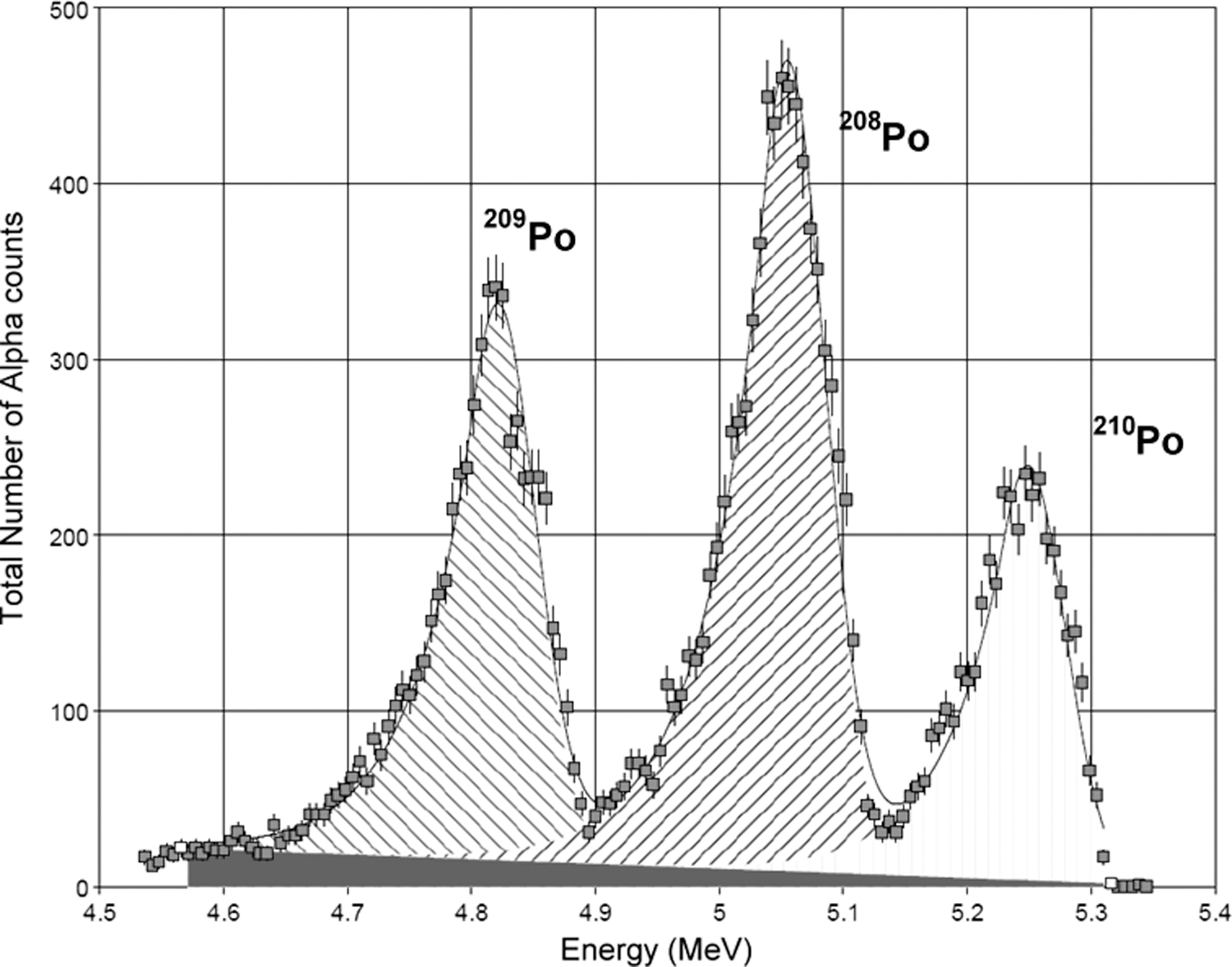
Alpha spectrogram of polonium in a cigarette tobacco sample, 208Po and 209Po were added as tracers to determine radiochemical yield.
Results and Discussion
210Po concentration in cigarette
The primary step in the assessment of 210Po activity concentration in an environmental sample is to transfer its total activity from the sample to the solution. This could be achieved by a total sample digestion. In their work, a mixture of nitric acid and perchloric acid were used to destroy the organic materials. The reconstitution into a hydrochloric acid medium was performed to obtain the polonium hydroxo-chloride species of Po(OH)2Cl2 23 which was spontaneously deposited over the metallic disc. The total recovery of polonium is followed using the radiotracers 208Po and 209Po. Figure 2 illustrates the α spectrogram of polonium deposition over copper disc. The global chemical yield of 210Po deposition, determined from 208Po and 209Po, was equal to 69%. The average range of 210Po activity concentration in this study is equal to 26 ± 2 mBq per cigarette.
The polonium activity concentration obtained in the examined cigarette was compared with the values measured elsewhere in the world and fell within the predictable range (Fig. 3). Apparently, the world measured 210Po activity concentration values between 2.8 and 37 mBq per cigarette and is varied with the cigarette brands. These data indicate that 210Po concentration ranged from 2.96 mBq per cigarette in Syrian 24 cigarettes and a maximum value of 36.80 mBq per cigarette in Indian cigarettes. 25
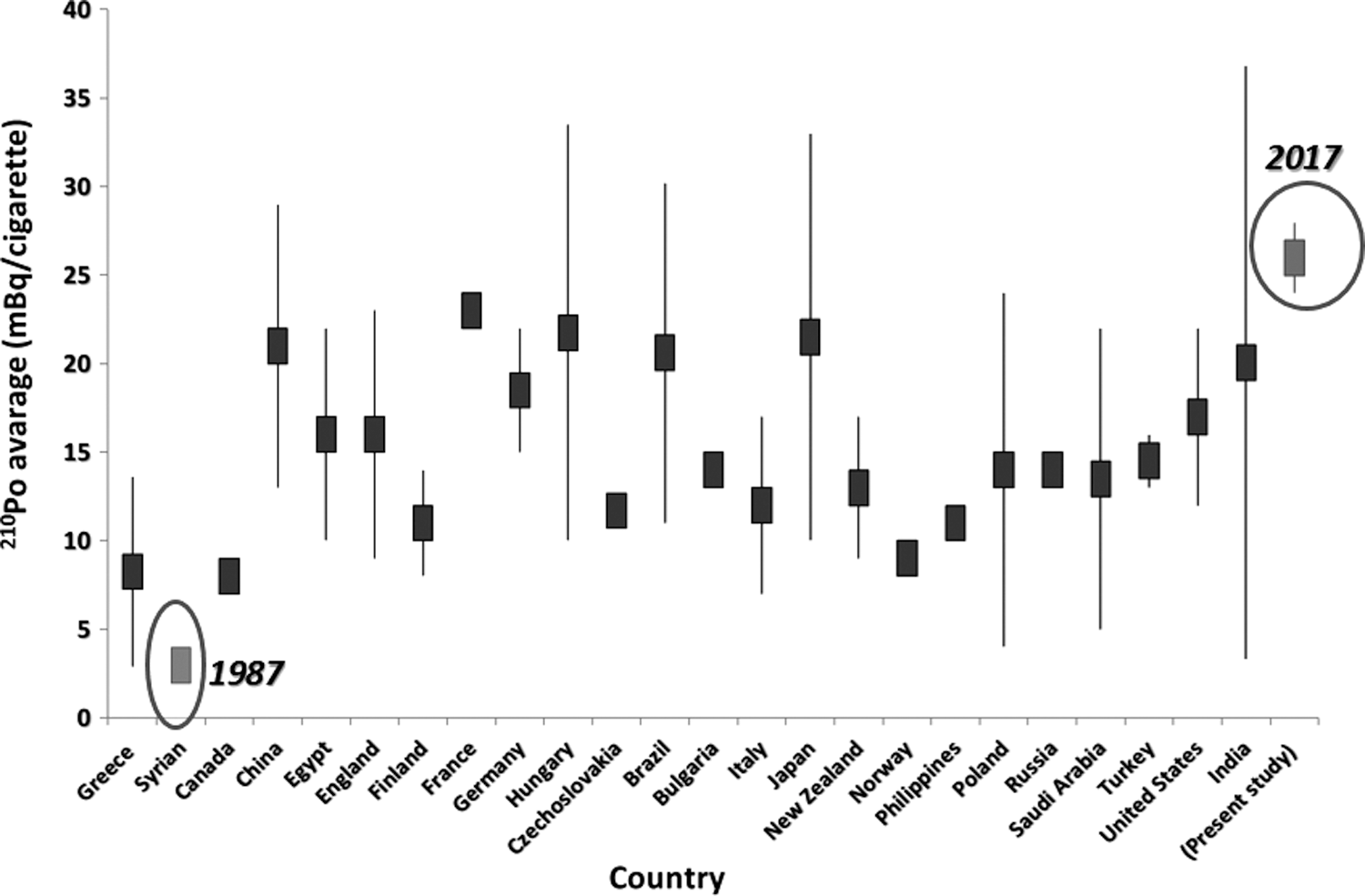
Polonium-210 activity range in cigarettes from different countries.
210Po as indicator of anthropogenic radioactivity
Although the geographical nature of Lebanese land is an extension of the Syrian territory, the polonium activity concentration obtained is 8.8 times higher. 24 This difference could be explained as a result of the anthropogenic radioactivity during the last 30 years. These activities are represented mainly by the increase in the phosphate fertilizer use in agriculture. The main raw material for fertilizer production is phosphate ore which contains different radionuclides such as 210Po. As with most Arab countries, Lebanon's gross domestic product depends on agriculture. The high use of fertilizer in Lebanon is related to the irregular legislative control of fertilizer handling and the lack of knowledge of its risks for most Lebanese farmers. The rate of applied fertilizers in Lebanon increased to 414 kg/ha in 2002 according to the Food and Agriculture Organization and the United Nations Economic and Social Commission for western Asia. Another source is the phosphate fertilizer plants that have limited environmental monitoring programs. These plants release their waste into the surrounding aquatic environment. Previous authors investigated the environmental radioactive pollution located in the Lebanese coastal zone. They reported the presence of different radionuclides in seawater, sediment, biota, and coastal samples near phosphate industrial plants. 26 The phosphogypsum waste contains uranium decay chain isotopes that could migrate from the marine environment and be distributed in soil where tobacco is grown.
210Po dosimetry estimation
The analyzed cigarette brand represents the popular Lebanese cigarette produced from different Lebanese tobacco fields and is one of the most frequently smoked cigarettes. According to the latest data by the World Health Organization—United Nations, Lebanon has one of the highest smoking rates in the world with 65% of 13–15-year-old boys considered as smokers. The direct and indirect exposure to tobacco smoke is considerably high. The total smoking rate in Lebanon is 31.9% among adults. The rate goes up to 42.7% among men and 21.9% among women, meaning nearly half of adult males and fifth of the adult females in Lebanon are smokers.
The mean individual committed effective dose of polonium from inhalation depends mainly on two factors: the cigarette smoke generated during the burning of the cigarette and the average inhaled smoke quantity per year. The mean individual committed effective dose from inhalation (E) could be calculated using the following formula:
where
F1, the average transfer factor from the tobacco to smoke,
F2, the inhaled smoke per total smoke ratio
K, the inhalation dose conversion factor of 210Po (Sv/Bq)
G, the number of cigarettes smoked (cigarettes/d)
C, the concentration of 210Po in the Lebanese cigarette (Bq/cigarette)
t, the duration of smoking (365 d).
For dose estimation, a consumption of 20 cigarettes per day as the standard was used. The percentage of polonium which gets into a cigarette smoke was reported in different publications as 70%. 21,27,28 The total inhalation of polonium from smoke is assumed to be 50%, and the dose conversion factor for adults was 3.3 × 10⁻⁶ Sv/Bq. 29,30 The estimated individual committed effective dose was 219 ± 17 μSv/year of cigarette smoke. The acceptable committed effective dose for a member of the public according to the International Atomic Energy Agency, the International Commission on Radiological Protection, and the European Law IAEA, ICPR must not exceed 1 mSv. Although the estimated committed effective dose reported in their study is lower than the international regulation, the sum of total dose coming from natural or anthropogenic sources and the dose reported in their work would exceed the limitation value. For instance, the reported estimated individual committed effective dose obtained from the consumption of Lebanese fish alone varies between 17.2 and 1110 μSv/year. 31
The Lebanese ministry has estimated that at least 3000 tobacco-related deaths will occur each year in the population of four and half million. The risks associated with cigarette smoking are not only due to the presence of the toxic substances but also to radiogenic substance that are carcinogenic. The carcinogenic effects are owed to the radiation dose accumulation from polonium which could be inhaled from the cigarette smoking. In addition to smokers, the second-hand smoke from tobacco sicken and kill nonsmokers. The second hand smoke exposure increases the risk of lung cancer by 20%–30% and the risk of coronary heart disease in nonsmokers by 25%–30%. 25 For instance, second-hand smoke causes about 3400 lung cancer deaths and 46,000 heart disease deaths a year in countries like the United States. 32
Conclusions
Cigarette smoking increases the internal intake of polonium whose activity concentration varies according to the origin of the cigarette. In this study, the polonium-210 activity concentration in the most sold Lebanese cigarette was investigated, and the mean individual committed effective dose was evaluated. Their results show that 210Po activity is equal to 26.0 ± 2.0 mBq per Lebanese cigarette. This result was compared to the range reported in the literature. The 210Po concentration in the Lebanese cigarette was found to be 8.8 times greater than Syrian cigarettes. This is due to the unregulated use of fertilizers and anthropogenic radioactivity occurring during the last 30 years. The assay of polonium concentration in cigarette could be used as an indicator of the range of anthropogenic radioactivity. The individual committed effective dose was calculated to be equal to 219 ± 17 μSv/year of cigarette smoking.
Footnotes
Acknowledgments
The authors thank the National Center of Scientific Research (CNRS) and the Region Pays de la Loire for performing this work.
Disclosure Statement
No competing financial interests exist.