




Abstract
New, targeted imaging tracers enable improved diagnosis, staging, and planning of treatment of disease and represent an important step toward personalized medicine applications. The combination of radioisotopes for nuclear imaging with fluorophores for fluorescence imaging provides the possibility to noninvasively assess disease burden in a patient using positron emission tomography/single-photon emission computed tomography, followed by fluorescence imaging-assisted surgical intervention in close succession. Probes enabling imaging with both modalities pose a design, synthesis, and pharmacokinetics challenge. In this study, the authors strive to summarize recent efforts toward optimized, discrete, bimodal probes as well as a perspective on future directions of this burgeoning subfield of targeted imaging probe development.
Introduction
The emergence of new, targeted nuclear imaging tracers enables improved diagnosis, staging, and planning of treatment of disease. Single-photon emission computed tomography (SPECT) tracers entered the clinical mainstay in the last century, with the cardiac perfusion agent, 99mTc sestamibi, gaining approval by the Food and Drug Administration in 1990. 1 Nuclear imaging applications have further broadened after approval of the positron emission tomography (PET) tracer, 18F-fluorodesoxyglucose (18FDG), for the study of abnormal glucose metabolism in the context of cancerous growths, coronary artery disease, and neurological dysfunctions such as seizures in the year 2000. 2 –5 This has led to a continuously increasing SPECT and PET scanner base, which in turn has motivated the development of novel targeted imaging tracers incorporating various positron-emissive radioisotopes onto small molecules, synthetic peptides, and biologics. Furthermore, the incorporation of β− and α-emitting radionuclides can provide therapeutic analogs to β+/γ-based imaging tracers, specifically for personalized medicine applications in oncology, where targeted PET imaging is an indispensable treatment stratification tool. 6 Often, evaluation of tumor burden is followed by surgical tumor debulking preceding chemotherapeutic intervention, where the surgeon relies on visual and tactile examination to identify tumor tissue. This impedes accurate delineation of margins and can result in nonresected malignancies leading to accelerated tumor metastasis and poor prognosis for the patient. 7 This clinical challenge presents a formidable opportunity for probe development; specifically, the design of probes that provide a visual readout in the surgical suite. Optical probes are ideally suited for this purpose, providing high sensitivity and spatial resolution. The lack of depth penetration of excitation sources has thus far impeded widespread translation of targeted fluorescent tracers from murine models. However, if combined with a nuclear tracer, sites of tumor infiltration can be identified using noninvasive nuclear imaging techniques and guide the subsequent surgical intervention and fluorescence-guided surgery. 8 Consequently, there is a need to combine nuclear and optical imaging tracers in one to improve patient outcomes. In an ideal clinical setting, one single bimodal compound could be administered to (1) assess total disease and operable tumor burden using nuclear imaging techniques, followed by (2) the intrasurgical identification of tumor margins using the optical modality to facilitate complete resection. The single component approach could be especially attractive to minimize burden on the patient and the healthcare provider; imaging immediately followed by image-guided surgery within a short time frame has the potential to drastically reduce inpatient time, which can accelerate improvement of health status and reduce the financial burden placed on healthcare. However, it is important to also note some of the disadvantages of the application of discrete bimodal systems (specifically when targeting vectors that are small molecules or peptides). Binding affinity and in vivo pharmacokinetics of targeted tracers incorporating large lipophilic chromophores are often drastically altered in comparison with the corresponding targeted, single-modality nuclear probe, thus control experiments that provide a quantitative comparison between bimodal and single-modality tracer are critically important. The detection limits for fluorescence versus nuclear tracer can differ by a minimum of two orders of magnitude, which limits the achievable specific activity for the reliable detection of both modalities. This indicates that dual modality tracer development is better suited for approaches incorporating radiometals onto molecules targeting receptors with enhanced accessibility and high expression levels over small molecules incorporating 11C or 18F. Furthermore, the lack of depth penetration and the nonquantitative nature of fluorescence emission remains one of the main impediments to fully implement this modality in a clinical setting.
This article places special emphasis on discrete, sequential molecular constructs; indeed, nanoparticle-mediated and single-center scaffold multimodal probes are also a widely explored and popular approach, but the authors defer to other excellent reviews on these topics. 9,10 The single component assembly of two modalities in combination with a targeting vector often represents a formidable synthetic chemistry challenge. In this perspective, they aim to summarize approaches to targeted bimodal probes from recent literature and provide an outlook on future challenges and applications of single-component multimodality tracer systems.
Common Probe Design Strategies
The incorporation of a nuclear and an optical beacon onto a targeting moiety can be achieved following a number of approaches. The primary challenge in designing an ideal bimodal tracer is to minimize the effect of the incorporation of both modalities on target affinity and off-target uptake. Specifically, the inclusion of fluorophores comprised of extended π systems can cause pronounced increase in lipophilicity and subsequent enhancement of hepatic probe clearance in vivo. Based on their survey of approaches employed thus far, the authors can identify three types of discrete, multimodal probe design: type A, where the targeting vector represents the link between fluorophore and radioisotope; type B, where the radioisotope (or more aptly, for radiometals, the chelator) links targeting vector and fluorophore; and type C, where the fluorophore joins targeting vector and radioisotope (Fig. 1). Type A has been explored most extensively, especially for large biomolecules with multiple available chemical conjugation sites in the context of nonspecific conjugation. Types B and C represent greater challenges in terms of chemical synthesis; the fluorophore and the site for incorporation of a radioisotope need to be joined before conjugation to the targeting vector. While more cumbersome to assemble, types B and C benefit from single-step conjugation to the targeting vector and direct control of targeting vector to radioisotope to fluorophore ratio. On the other hand, this approach can impede radiolabeling efficiency or alter fluorescence emission properties. All three approaches have been successfully utilized for multimodal, preclinical imaging. The ideal approach is determined by the properties of the conjugate, as the individual compound properties are not linearly cumulative. Below, they highlight work carried out using a variety of isotopes and fluorophores, grouped according to their linkage approach, and further broken down into categories based on targeting vector size and complexity; small molecules and peptides are typically more chemically inert to high-temperature reaction conditions involving nonphysiological pH or organic solvents, whereas biologics (antibodies, antibody fragments, and proteins) are more sensitive and constrain the scope of useable linker chemistry or molecular assembly considerably.
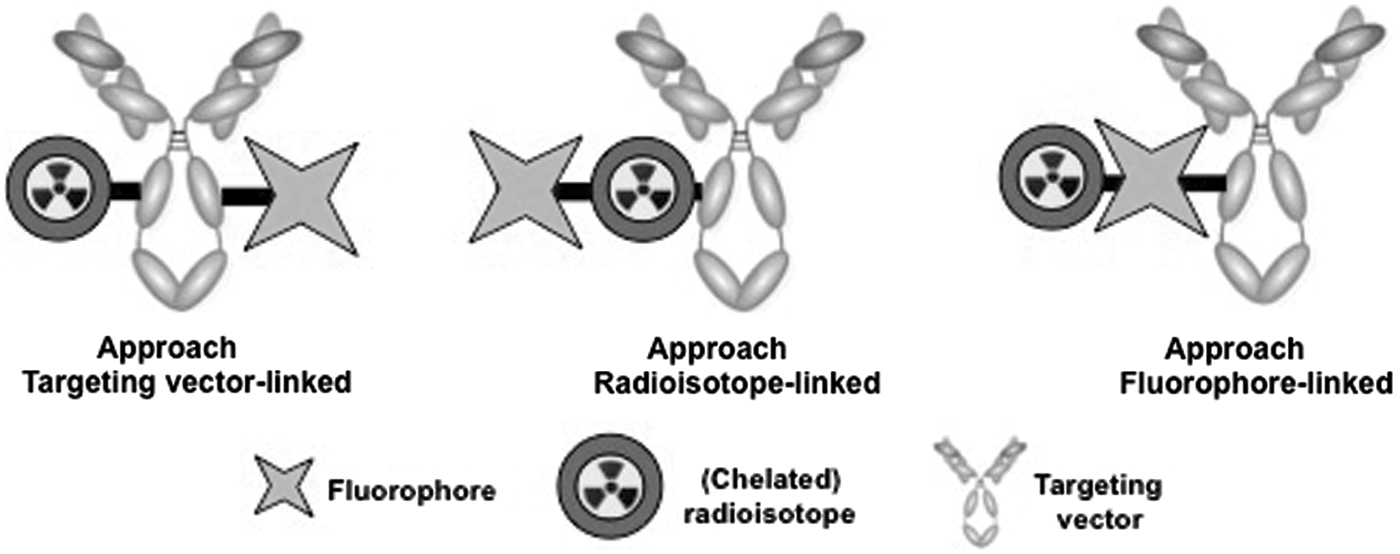
Schematic description of common multimodal probe design strategies based on linkage of individual components (radioisotope with prosthetic group/chelator, fluorophore, and targeting vector) discussed in this perspective.
Approach A: Targeting vector-linked bimodal probes
Targeting vector-linked bimodal probes have most extensively been explored in the context of monoclonal antibody (mAb) imaging. Primary linkage strategies include nonspecific incorporation of radioisotope and fluorophore by amide or thiourea bond formation with accessible lysines away from the variable region, as well as site-specific conjugation methods. 11 Small molecules and peptides are also amenable to approach A, but will experience more pronounced alteration of in vitro and in vivo properties.
Small molecules and peptides
The incorporation of two imaging beacons on a comparatively small peptide can have significant consequences on binding affinity and clearance properties of the resulting construct. Josephson and coworkers addressed this issue by incorporation of a polyethyleneglycol (PEG)-cloud onto their bimodal RGDyK peptide (RGD) conjugate incorporating an indocyanine dye derivative, Cy5.5, and an 111In-1,4,7,10-tetraazacyclododecane-1,4,7,10-tetraacetic acid (DOTA) chelate 12 or 89Zr-desferrioxamine (DFO) chelate. 13 The resulting conjugate exhibited enhanced quantum yields and improved pharmacokinetic properties, with the PEG-cloud exerting a shielding effect onto the lipophilic Cy5.5 fluorophore, preventing stacking interactions that would result in fluorescence quenching. PEG-clouded conjugates also exhibited longer blood residence time and improved tumor accumulation.
Caravan and coworkers reported the synthesis and in vitro characterization of a fibrin-targeting bimodal probe, where the fibrin-targeting peptide incorporates a fluorophore, fluorescein isothiocyanate (FITC), and a chelated radioisotope (64Cu(DOTA)) on each respective peptide terminus. This probe design was selected to address the accelerated metabolism of the peptide without C- and N-terminal “blocking groups.” Consequently, the bimodal probe shows excellent properties to visualize fibrin clots using fluorescence and PET without significant decrease of target affinity. 14
Antibodies
Application of approach A to antibodies represents both challenges and opportunities. The primary difficulty of the targeting vector-linked approach is close control of the number of imaging beacons incorporated, if a nonsite-specific conjugation approach is used. This is illustrated by the work of Rijpkema et al.,
15
where the authors studied the effect of increasing the number of near-infrared (NIR) fluorophores on the in vivo behavior of an 111In-radiolabeled antibody (Fig. 2,
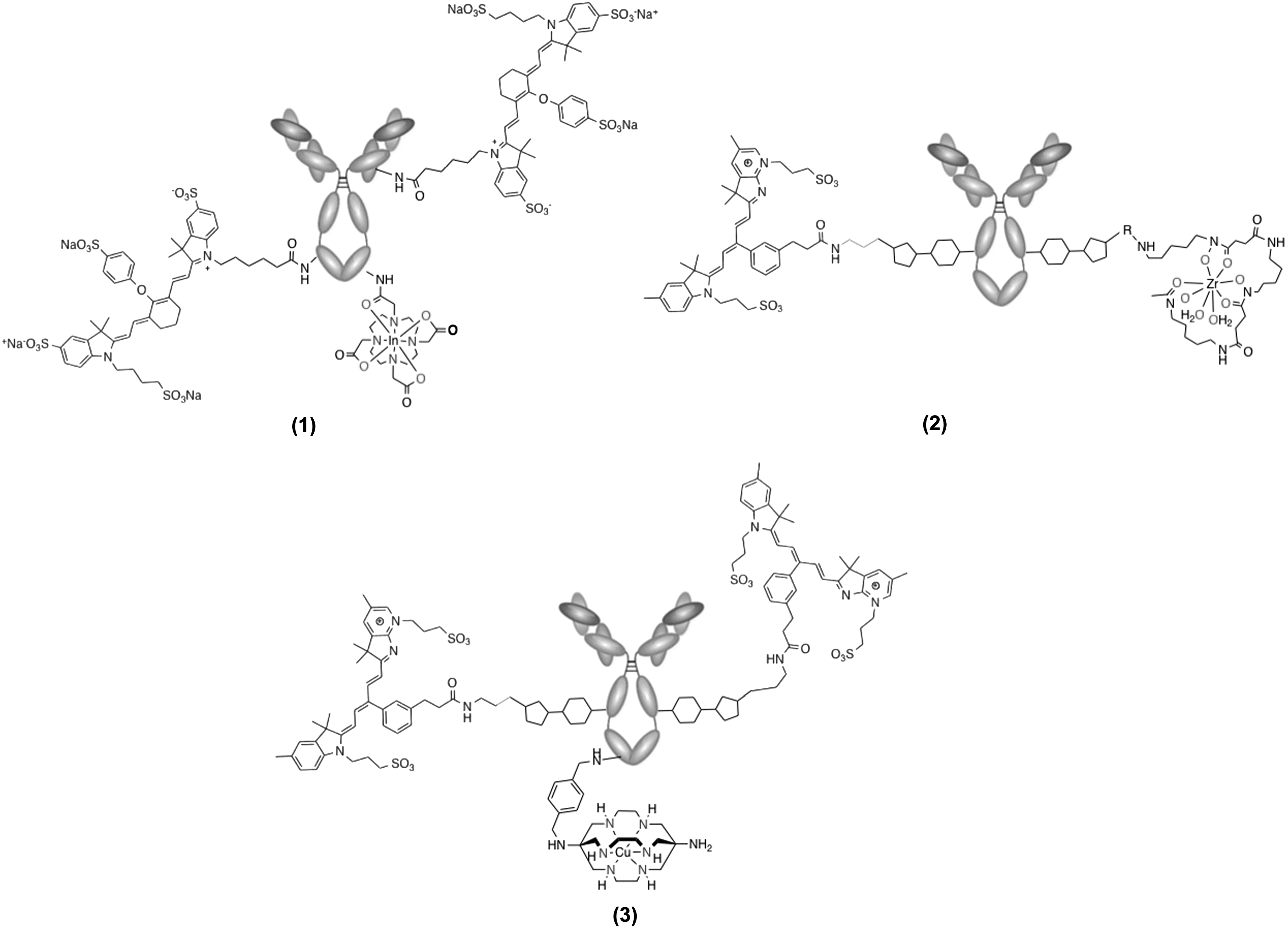
Antibody-linked multimodal probe approaches discussed in context of approach A.
Work by Zeglis et al.
16
exemplifies applications of approach A using a more controlled incorporation of fluorophore and radioisotope (Fig. 2,
This method for site-specific conjugation of DFO and fluorophore can be applied to other antibodies as well. Houghton et al. 17 conjugated DIBO-DFO and DBCO-FL to hu5B1, human antibody that targets CA19.9 in pancreatic cancer. The immunoconjugates were injected into mice bearing both CA19.9-positive (BxPC3) and CA19.9-negative (MIAPaCa-2) xenografts on right or left flank, respectively. Subsequently, acquired PET images showed that the uptake in BxPC3 xenografts is eightfold higher than that in MIAPaCA-2. Fluorescence images show a tumor-to-background ratio of 25:1, whereas postsurgery fluorescence imaging revealed multiple micrometastases that were not visible with naked eye or PET imaging.
Similarly, 64Cu has also been utilized in context of a bimodal PET/NIR fluorophore immunoconjugate system, despite its relatively short half-life of 12.7 h. Adumeau et al.
18
employed a pretargeting approach to overcome the difference between the physical half-life of 64Cu radioisotope and the extended pharmacokinetic half-life of targeting antibody. The huA33 antibody was first labeled with the NIR fluorophore Dye800 site specifically using the enzymatic heavy chain glycan modification; a trans-Cyclooctene (TCO) functional group was then attached separately through a lysine residue nonsite specifically to huA33 (Fig. 2,
Approach B: Radioisotope-linked bimodal probes
Approach B incorporates the functionalization of a radioisotope-bearing prosthetic group, typically a chelator, with a targeting vector and a fluorophore. This approach has been explored extensively for peptides, due to the orthogonal protection group chemistry employed, which is typically less amenable to biomolecules. The primary challenge of this approach is to maintain optimized radiolabeling properties of the chelator even under the constraints of direct functionalization with two comparatively large molecules (fluorophore and targeting vector).
Small molecules and peptides
Work by Reiner et al.
19
employed a 64Cu(SarAr) as a linker between a Cy5 fluorophore and exendin-4, a peptide targeting GLP-1 receptors expressed in pancreas and pancreatic islet cell tumors (Fig. 3,

Structures discussed in context of approach B, incorporating the radioisotope chelator as the linker between targeting vector and fluorophore.
Similarly, Ghosh et al. 20 devised a novel derivative of DOTA that allows for incorporation of the radioisotope while also acting as a linker between octreotide and a triazole-appended IR dye. The corresponding bimodal conjugate did not experience a significant loss in binding affinity to SSTR2. In vitro experiments utilized the IR dye to visualize the intracellular localization of the construct in HCT116-SSTR2 cells; in vivo experiments in healthy mice with the 68Ga-radiolabeled probe show longer in vivo half-life of the bimodal construct when compared with 68Ga-DOTA-TOC. Targeted studies are forthcoming.
Kuil et al.
21
conjugated Ac-TZ14011, a peptide that binds to chemokine receptor 4 (CXCR4), with a DTPA-Cy5.5 bimodal probe (Fig. 3,
Summer et al.
22
employed asymmetric functionalization of the siderophore, fusarinine C, to append the NIR fluorophore sulfo-Cy7 and two RDG to target avb3 or MG (minigastrin) peptides to target cholecystokinin-2 (Fig. 3,
Prostate-specific membrane antigen (PSMA)-targeting small molecules exhibit a faster clearance time. Baranski et al. 23 focused in on the now clinically established PSMA-targeting PET tracer, PSMA-11 (Glu-urea-Lys-HBED-CC), and coupled it to each of IRDye800CW, Dylight800, FITC, and AlexaFluor488. 23 The nanomolar binding affinity of PSMA-11 derivatives was only reduced twofold upon conjugation of fluorophore and radiolabeling, whereas cell-specific internalization and in vivo tumor uptake was improved upon fluorophore conjugation. The IRDye800CW- and DyLight800-conjugated bimodal probes show high tumor-to-blood and tumor-to-organ ratio 1 h after injection. Whereas the tumor uptake remains high over time, activity clears from other organs gradually, resulting in maximum tumor-to-background ratio after 6 h. The uptake in tumor was conspicuous in both in vivo PET and ex vivo fluorescence imaging.
Antibodies
Inspired by desferrichrome, a natural siderophore used by fungi and bacteria for abstracting Fe(III), their efforts have centered on the synthesis of linear desferrichrome derivatives Orn3-hx and Orn4-hx as Zr(IV) chelator molecules (Fig. 3,
Approach C: Fluorophore-linked bimodal probes
Approach C requires the functionalization of fluorophores to incorporate a biomolecule and a targeting vector. Besides the synthetic challenge of fluorophore modification, the primary concern is to not alter or even quench emissive properties of the linker fluorophore. Most approaches described herein have taken advantage of the chemical versatility of 4,4-difluoro-4-bora-3a,4a-diaza-s-indacene (BODIPY) derivatives.
Small molecules and peptides
BODIPY dyes contain a BF2 core that allows for specific ligand exchange reactions on the B center with other hard Lewis basic donors. This has been exploited for the direct radiofluorination of BODIPY using an isotope exchange reaction. Reiner et al.
19
and Carlucci et al.
25
have developed PARPi-FL, a poly(ADP-ribose) polymerase 1 (PARP-1)-targeting bimodal PET/fluorescence probe. PARP-1 is a protein that is overexpressed upon DNA damage, and PARP-1 upregulation is observed in various cancers, including breast cancer, ovarian cancer, hepatocellular cancer, colorectal cancer, leukemia, and glioblastoma.
26
–29
The BODIPY fluorophore is covalently attached to the PARPi-FL-targeting scaffold and undergoes 18F/19F exchange to afford the bimodal [18F]PARPi-FL imaging agent (Fig. 4,
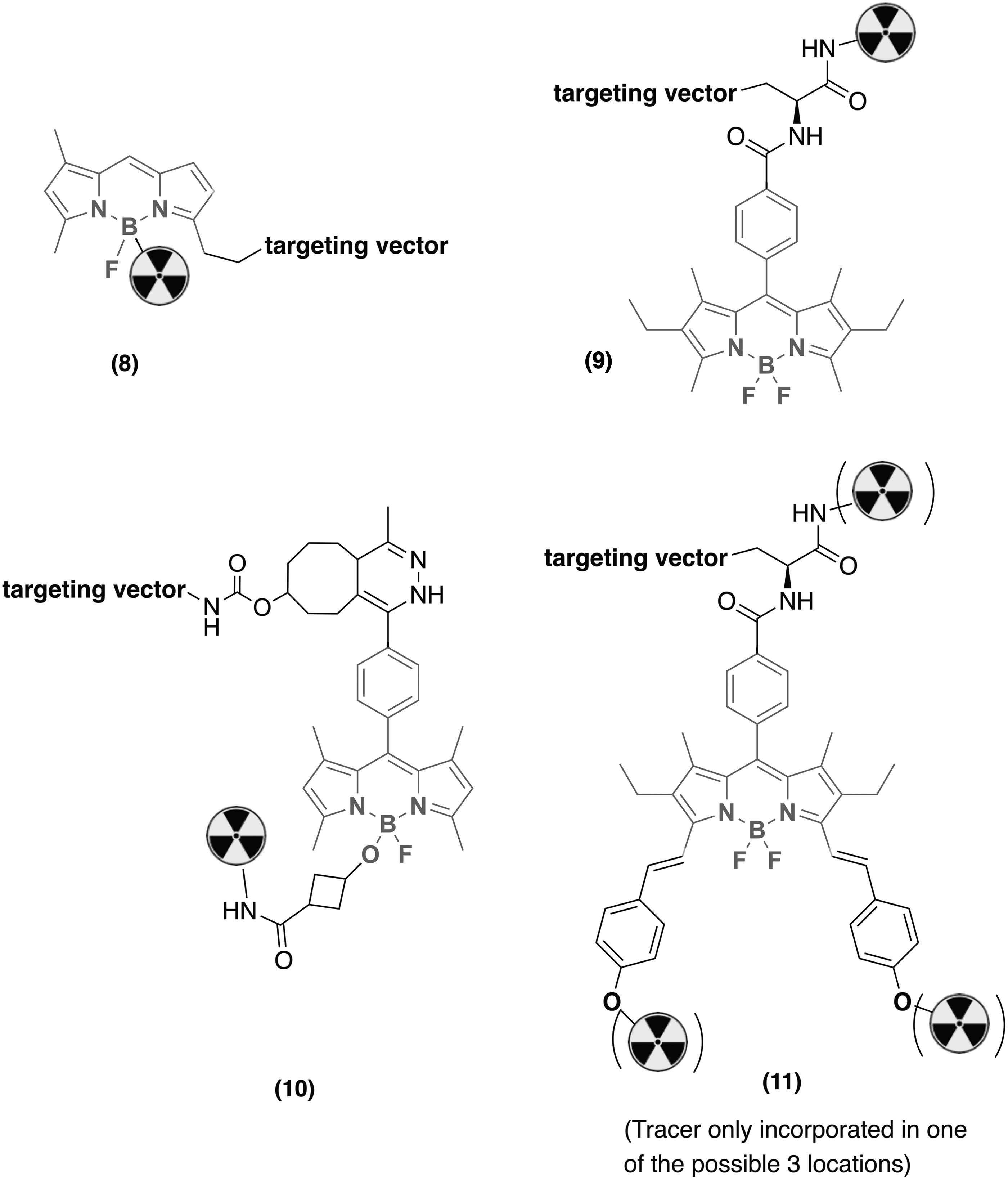
Structures discussed in context of approach C, incorporating the fluorophore as a linker between targeting vector and radioisotope.
Lhenry et al.
30
have reported a monomolecular multimodal imaging probe, in which various DOTA derivatives were attached to aryl-BODIPYs (Fig. 4,
Antibodies
Bimodal systems are useful not only for imaging tumors, but can also be applied in the study of the transport mechanism of lipopolysaccharides (LPS) in vivo. 31 A DOTA-BODIPY probe conjugated to LPS retained proinflammatory property even after radiolabeling with 111In. The 111In-DOTA-BODIPY-LPS conjugate was injected into naive C57Bl/6 mice, and monitored with SPECT-CT and fluorescence imaging over a 24 h period. After 3.5 h, most of the activity was detected in the liver and spleen, and fluorescent imaging of liver sections showed numerous spots corresponding to 111In-DOTA-BODIPY-LPS, providing insight into the in vivo metabolism of LPS conjugates.
Meimetis et al.
32
have designed a bimodal system in which BODIPY fluorophore was covalently linked to the Zr chelator DFO before conjugation to the antibody (Fig. 4,
Maindron et al.
33
also studied the antibody conjugates of the DOTA-BODIPY bimodal system (Fig. 4,
The primary disadvantage of the approaches described above is the noticeable absence of more red-shifted fluorophores with better in vivo imaging properties. Xu et al. 34 have successfully incorporated an indocyanine dye as a linking moiety. Evidently, one of the primary challenges with approach C is the limited chemical versatility of NIR dyes when compared with BODIPY derivatives and provides ample opportunities for creative synthetic approaches.
Conclusions and Outlook
Discrete bimodal probe systems have experienced a surge in interest over the past decade, which can be correlated with the availability of a wide array of imaging radionuclides in conjunction with the emergence of a myriad of small molecule, peptide, and antibody-targeting vectors for cell-surface receptor targeting. The ability to deliver an imaging tracer noninvasively to assess disease burden using the radionuclide, immediately followed by surgical intervention guided by the fluorophore is especially attractive from a logistical standpoint: In an ideal setting, a preliminary diagnosis can be made by less specific means of nuclear imaging (18FDG), followed by a more target-specific, personalized medicine approach using the bimodal, targeted tracer. Approaches A, B, and C to furnish bimodal probes each have their individual merits, thus the ideal approach has to be identified on a case-by-case basis. Specifically, the careful tuning of compound polarity and hydrophilicity is required to minimize off-target accumulation upon incorporation of lipophilic fluorophores. In addition to optimizing properties for ideal in vivo performance, other exciting challenges lie ahead to further enhance function and capability of multimodal probes. The incorporation of turn-on mechanisms or red shifting of emissive properties can act as additional, functional readouts on compound integrity and activity. This represents exciting opportunities to enhance the authors' understanding of the mechanism of action of targeted tracers and therapeutics and further improve the efficacy toward their ultimate goal to improving treatment outcomes for patients.
Footnotes
Acknowledgments
E.B. acknowledges funding sources, specifically the NIH for a pathway to independence award (Grant No. R00HL125728-03), a REACH award (Grant No. U01HL127522—18150031), and Stony Brook University for startup funds.
Disclosure Statement
There are no existing financial conflicts.