




Abstract
Background:
Production of effective, low-cost, and efficient radiopharmaceuticals is an important task and requires further research and clinical studies. In this clinical trial, safety and efficacy of 177Lu/153Sm-ethylenediamine tetramethylene phosphonic acid (EDTMP) cocktail has been evaluated for pain relief of bone metastases.
Materials and Methods:
Twenty-five patients with the mean age of 55.5 ± 15.8 years participated in this study. Patients received a total dose of 37 MBq/kg. Pain and performance assessments were followed using a Brief Pain Inventory form. Complete blood count and renal and liver function tests were also performed up to 12 weeks postadministration.
Results:
Eighteen patients (72%) demonstrated complete pain relief (relief = 100%) and approximately all patients (96%) experienced significant improvement in their quality of life. No grade IV hematological toxicity was observed during the 12-week follow-up period, and grade III toxicity was seen in 1 patient only. In addition, no abnormalities were seen in renal and liver function during the follow-up period.
Conclusions:
There were no considerable complications after administration of 177Lu/153Sm EDTMP; this cocktail seems to be a safe and effective treatment for bone pain palliation in patients with skeletal metastases and improves the quality of life.
Introduction
Bone metastasis is a sequela of many cancers, and is particularly frequent in breast, lung, and prostate cancers, 1 causing multiple complications and severe pain. 2 Metastatic bone pain often significantly impacts patients' quality of life. 3 Pain control is an essential and complicated step in all cancer management programs.
Studies have shown that radionuclide therapy (RNT) can improve the quality of life in a high percentage of patients who do not respond to routine therapies. 4 –7 The treated patients can experience pain relief, improvements in mobility, reduction in analgesics dependency, and prevention of pathological fractures. 4,5 Studies have shown that RNT can delay progression of osseous metastases. 6,7
The high bone affinity and selective localization in skeletal lesions noted with multidentate polyaminophosphonic acids, and their ability to form stable complexes, especially with lanthanides, make them the most promising carrier ligands for development of radiolabeled bone-seeking agents. 8 –10 Ethylenediamine tetramethylene phosphonic acid (EDTMP), one of the most widely used ligands for palliation of bone metastases, has shown favorable pharmacological characteristics as a radio-metal carrier in biological systems. 11 –14
Production of effective, low-cost, and high-quality radiopharmaceuticals is an important task and requires further research and clinical studies. 15,16 The therapeutic efficacy of a radiopharmaceutical for treatment bone pain depends significantly on the energy of the particulates emitted from the radionuclides. Moderate energy β− emitting radionuclides are the most efficient candidates for this purpose. 17 –19
Samarium-153 [T1/2 = 1.93 d, Eβmax = 0.81 MeV (20%), 0.71 MeV (49%), 0.64 MeV (30%), and Eγ = 103 keV (30%)] is the most commonly used radionuclide for bone pain palliation 3 and its efficacy has been well demonstrated with more than two decades clinical application of 153Sm-EDTMP. 3,12,20 Lutetium-177 [T1/2 = 6.73 d, Eβmax = 497 keV, Eγ = 113 keV (6.4%), 208 keV (11%)] is an alternative option with several advantages, 21 such as lower β− particle energy resulting in minimum bone marrow suppression 17,22 and relatively long physical half-life permitting adequate tumor irradiation dose with a constant dose rate. 23,24 Hence, 177Lu EDTMP has been used as an effective and safe radiopharmaceutical for palliation of metastatic bone pain. 25,26
Since Lu+3 and Sm+3 have similar coordination chemistry, it is expected 177Lu EDTMP and 153Sm-EDTMP complexes have similar pharmacokinetic properties. Animal studies of 153Sm/177Lu EDTMP mixture have shown nearly identical bio-distribution of 177Lu EDTMP and 153Sm EDTMP in most organs, especially in bone tissue. 27 This clinical study was performed to assess the efficacy and safety profile of the 177Lu/153Sm EDTMP mixture in patients treated for bone pain metastases. To the best of our knowledge, this is the first time an 153Sm/177Lu EDTMP cocktail has been used for bone pain palliation and a combined radiopharmaceutical is used clinically for therapeutic management in nuclear medicine.
Materials and Methods
177Lu and 153Sm were produced by 176Lu(n,γ)177Lu and 152Sm(n,γ)153Sm nuclear reactions, respectively. Enriched Lu2O3 (176Lu, 52%) and Samarium-152 with a purity of >98% were obtained from ISOTEC, Inc. EDTMP was supplied from Pars Isotope Co. All the other chemical reagents were purchased from Sigma-Aldrich Chemical Co. (Heidelberg, Germany). Radiochromatography was performed by using a bioscan AR-2000 radio TLC scanner instrument (Bioscan, Washington, DC). A dual-head SPECT gamma camera (Phillips Co., Germany; Get stream Forte software) was used for imaging studies. The study has been approved by the institutional review board, and all subjects signed an informed consent form.
Patients
Twenty-five patients with histologically proven breast or prostate carcinomas with painful blastic bone metastases were recruited.
Inclusion criteria for palliative therapy included consistency between the site of pain and abnormalities noted on the recent (within 4 weeks or less) 99mTc methylene diphosphonate (MDP) bone scan with baseline pain scores of >6 on the visual analog scale. 28 Laboratory data contained white blood cell (WBC) count >3000/L, platelets (PLTs) >70 × 109/L, and hemoglobin (Hb) >10 g/dL with normal liver and renal function. Life expectancy of >3 months was also considered.
The exclusion criteria included pathological bone fractures and spinal cord compression, abnormal complete blood count (CBC) (WBC <3000/L, PLT <70 × 109/L, and Hb <10 g/dL), impaired renal function (creatinine >1.5 mg/dL), neurogenic pain, pregnancy, and/or breastfeeding and any proven hypersensitivity or reaction to radionuclide/radiopharmaceutical. Patients who had received radiation therapy in last 12 weeks and/or chemotherapy in the last 4–6 weeks were also excluded.
A complete medical history, including the type and the amount of the analgesic used, was obtained. Written informed consent was obtained before recruitment and once again before administration of the cocktail.
Preparation and quality control of Sm-153/Lu-177 EDTMP complexes
153Sm/177Lu EDTMP complexes were prepared using 153Sm/177Lu chloride solutions (1 mL, 18.5 GBq) and EDTMP freeze-dried kits. For labeling, 1 mL (18.5 GBq) of the 153Sm/177Lu chloride solutions was added to each EDTMP kit. The stock solution was diluted to 18 mL with sterile normal saline. The complex solution was then kept at room temperature for 60 min. The final solution was passed through a 0.22 μm membrane filter. The pH was adjusted between 7 and 8. The radiochemical purity was determined using Whatman 3MM chromatography paper or ITLC-SG, eluted with NH4OH:methanol:water (0.2:2:4; v/v/v) mixture. The complexes were prepared with high radiochemical purity of 99.53% ± 0.38%.
Treatment and follow-up
This was a clinical trial for 153Sm/177Lu EDTMP cocktail and its protocol was approved by the institutional review board. Patients received a total dose of 37 MBq/kg (18.5 MBq of each complex/kg), whereas the maximum dose was limited to 2590 MBq (70 mCi). The radiopharmaceutical was slowly administered within 1 min through 18 or 20 gauge angiocatheter, flushed with normal saline. To evaluate any possible systemic side-effect of the cocktail, patients were under close observation for 6 h postinjection.
Patients were followed-up weekly for 12 weeks postadministration of the radiopharmaceutical using CBC experiments for evaluation of bone marrow suppression and Brief Pain Inventory (BPI) form 29 as a standard form for pain relief assessment. Toxicity was assessed according to Common Terminology Criteria for Adverse Events. WBC, PLTs, and Hb of all patients were compared each week and the p-values were derived from these statistical data. Renal and liver function tests were evaluated 1 week before and every 4 weeks after the injection of the cocktail. In addition, the patients were asked for flare phenomenon, and the events were recorded, including the start time and its duration.
Imaging studies
Whole-body scan was performed at 2, 24, 48, and 72 h after the cocktail administration using forte dual-head SPECT gamma camera (Philips, Amsterdam, the Netherlands) with low-energy high-resolution collimator at 103 keV (for 153Sm) and 113 keV (for 177Lu) and gamma energy peaks and windows of 2% (FOV = 40 cm, head distance to detector = 30 cm, speed = 15 cm/min, projection No. = 64, and matrix size = 64 × 64). The sensitivity or calibration factors for both gamma camera and the dose calibrator used in the study were calculated according to a standard method for both 177Lu and 153Sm radionuclides. 30,31
Statistical analysis
The data were analyzed using statistical software, Statistical Package for the Social Sciences, SPSS version 21. The variations trend of mean during the time was tested using Friedman's nonparametric test; p < 0.05 was considered significant.
Results
Patients
Twenty-five patients, 3 (12%) men with prostate cancer and 22 (88%) women with breast cancer participated in this study. The average of age and weight were 55.5 ± 15.8 years and 71.1 ± 10.8 kg, respectively. Demographic data of the patients are given in Table 1.
Demographic Data of Patients with Bone Metastases Eligible for Treatment with 177Lu/153Sm Ethylenediamine Tetramethylene Phosphonic Acid Cocktail
SD, standard deviation.
Close observation of the patients after the injection of the cocktail showed no skin reaction or systemic adverse effects. The flare phenomenon was observed in 4 (16%) patients with start time of 27 ± 15.1 h and duration of 57 ± 18 h postinjection (Table 2).
Flare Phenomenon in Patients After Injection of 177Lu/153Sm Ethylenediamine Tetramethylene Phosphonic Acid
Pain score assessment
Trend of pain criteria in BPI questionnaire by Friedman's nonparametric test are summarized in Table 3. Pain scores were noted weekly after interviewing of a nuclear medicine physician with each patient. According to the BPI form, a score of 0 means no pain and the score of 10 refers to the maximum possible pain. Figure 1 shows the mean pain assessment by BPI scoring in patients before and after treatment by 177Lu/153Sm EDTMP mixture. Pain relief began 1.24 ± 0.54 weeks after the injection with maximum effect noted in the eighth week. Eighteen patients (72%) demonstrated complete palliative pain response (relief = 100%); 6 patients (24%) revealed acceptable response (relief = 80%–90%); and 1 patient (4%) showed minimal response to treatment (relief = 30%). Total response was achieved in 24 patients (96%) (Table 3).
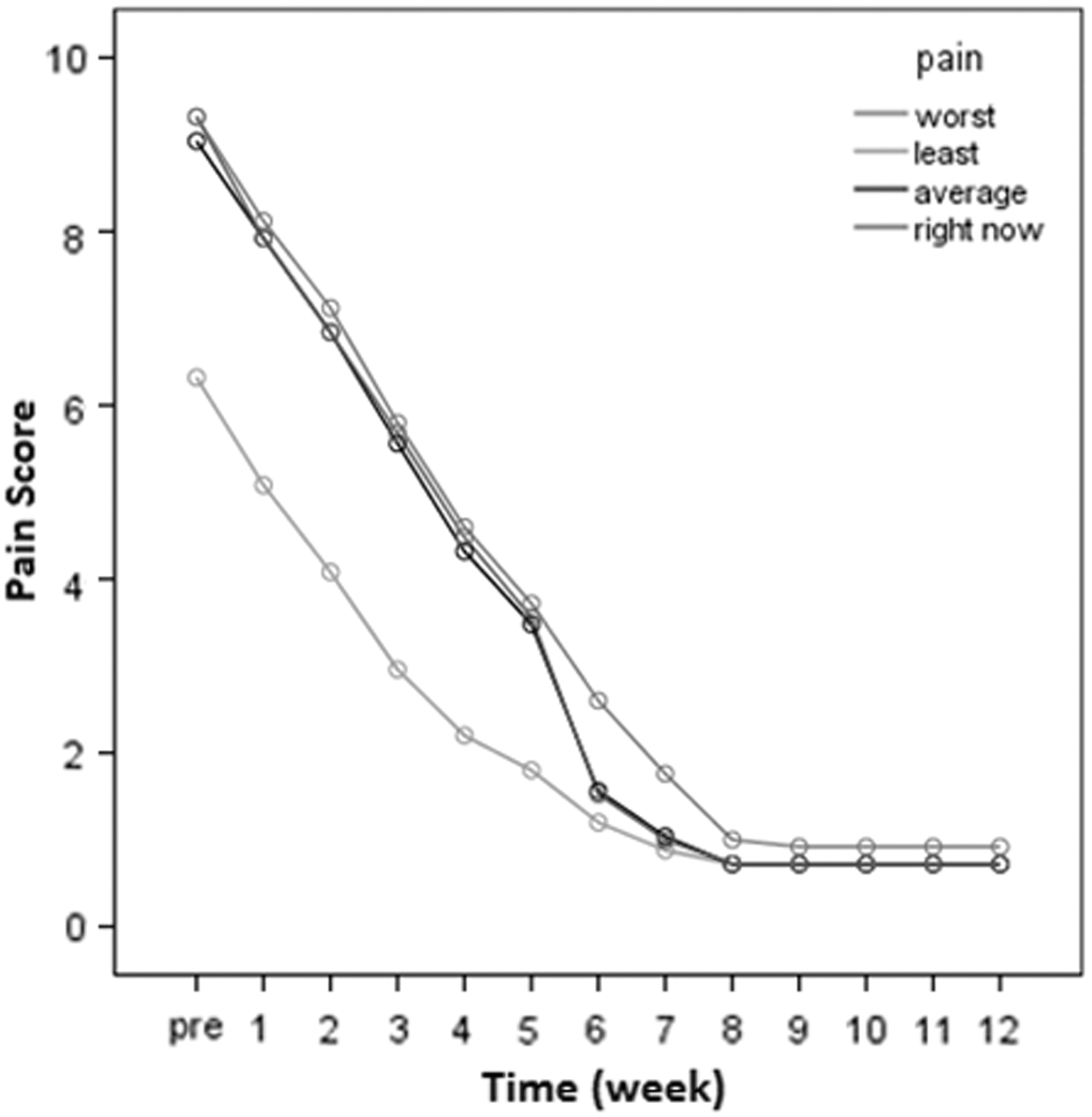
Mean pain assessment by Brief Pain Inventory scoring in the patients before and after treatment by 177Lu/153Sm EDTMP mixture up to 12 weeks postinjection. EBTMP, ethylenediamine tetramethylene phosphonic acid.
Trend for Pain Criteria in Brief Pain Inventory Questionnaire to Treatment Patients with Bone Metastasis
Values are given as mean ± SD and median (min–max).
Performance assessment
Results of BPI questionnaire for performance assessment by Friedman's nonparametric test are summarized in Table 4. Approximately all treated patients (96%) experienced significant improvement in their quality of life during the follow-up period.
Trend for Pain Interfering Criteria in Brief Pain Inventory Questionnaire to Treatment Patients with Bone Metastasis
Values are given as mean ± SD and median (min–max).
Toxicity assessment
Bone marrow suppression is the most important toxic sequela of radionuclide palliative agents. Results for the mean changes of the CBC parameters are provided in Table 5. However, the p-values (p < 0.001) showed that there are statistically meaningful changes in all three types of blood cell counts (WBC, PLTs, and Hb) before and after intervention, but clinically, these changes are in normal range.
Mean Complete Blood Count Parameters Before and After the Injection of the Cocktail
Values are given as mean ± SD.
WBC, white blood cell; Hb, hemoglobin.
No grade IV toxicities in WBC and PLT were noted postinjection, nor any grade III or IV toxicities in Hb. Grade III toxicities in WBC and PLT were seen in 2 (8%) and 1 (4%) patients, respectively. Subcutaneous injection of granulocyte colony-stimulating factor was required in 4 patients (16%) during the fourth to eighth weeks. All CBC parameters were normal at the end of the study.
Comparison of alkaline phosphatase before (298.85 ± 141.6) and after (282 ± 121.81) the injection of the cocktail showed no significant difference (p = 0.18). No abnormalities were seen in renal function test.
Imaging assessment
The results of whole-body scan of the patients at 2, 24, 48, and 72 h after administration of 153Sm/177Lu EDTMP demonstrated the high bone to nontarget uptake of radiopharmaceutical. The cocktail concentrated in metastatic bone lesions was detected on 99mTc MDP bone scans and no significant discrepancy was seen. Figure 2 gives the accumulation of 153Sm EDTMP (energy peak = 103 keV, windows = 2%) and 177Lu EDTMP (energy peak = 113 keV, windows = 2%) in 2 patients after injection of 153Sm/177Lu EDTMP cocktail.
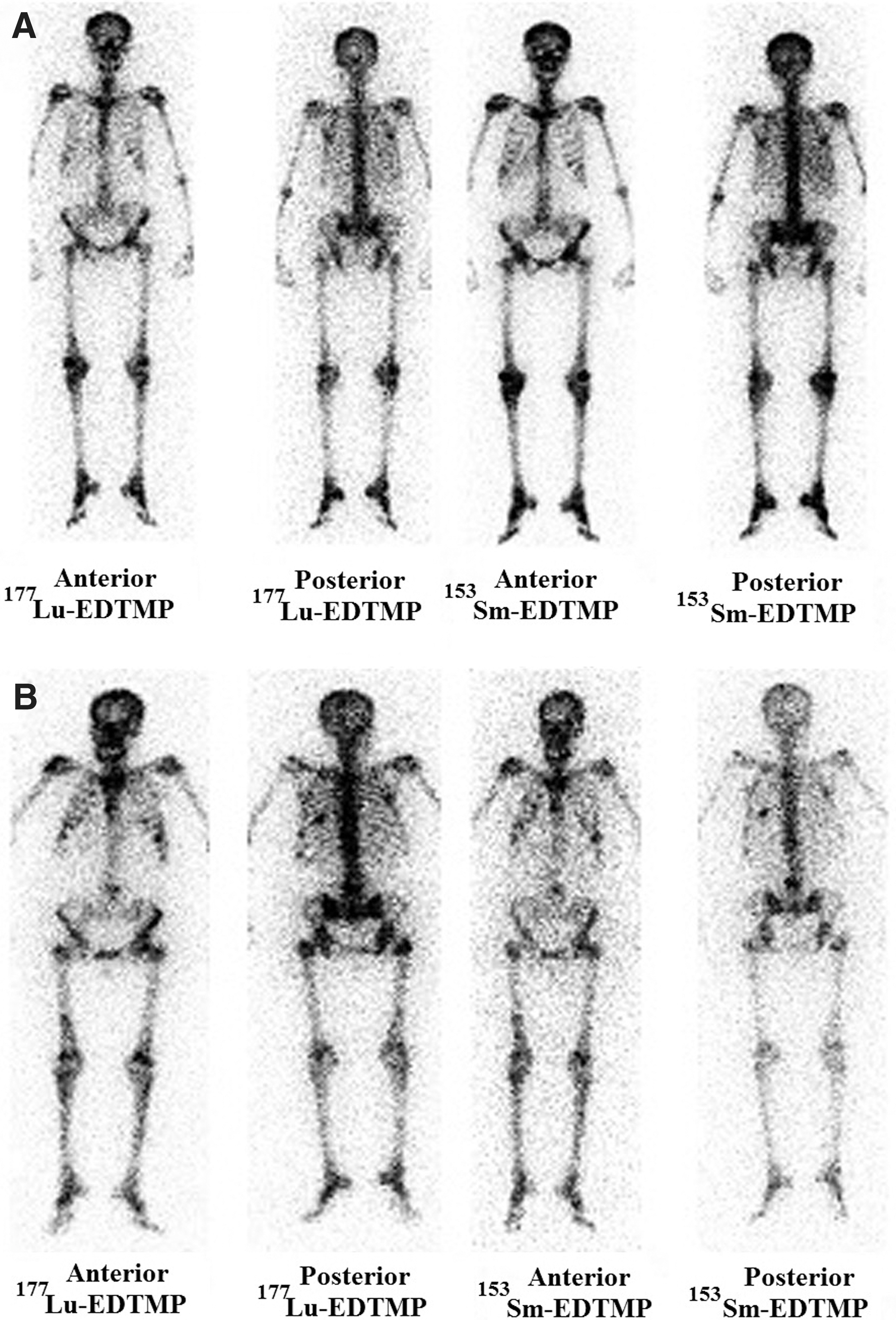
Whole-body scans of 2 patients after 24 h
Discussion
Management of bone pain is one of the most important and challenging clinical problems associated with bone metastatic cancers, which is further complicated when the pain does not respond to routine therapies, such as nonsteroidal anti-inflammatory drugs, opioids, or bisphosphonates. 26 Radiopharmaceuticals, including 186Re HEDP, 188Re HEDP, 32 P, 153Sm EDTMP, 89Sr chloride, 223Ra chloride, and 177Lu EDTMP, have been used as an efficient choice for treatment of bone pain in cancer patients for many years. 14,32
153Sm EDTMP is the most widely used bone pain palliative radiopharmaceutical in the United States 3 ; however, recent studies have recommended 177Lu EDTMP as an alternative for pain palliation of skeletal metastases 14,25 because of its favorable physical and biological characteristics 25,33,34 and appears to outscore other agents. 32
In treatment with 153Sm EDTMP, pain relief begins earlier compared with radiopharmaceuticals with longer half-life such as 177Lu EDTMP, but the duration of pain reduction seems less. In addition, different electrons of Sm-153 EDTMP and 177Lu EDTMP allow a certain degree of penetration in normal osseous tissue and bone marrow (∼4 mm and ∼2 mm, respectively). 32 The combination of 153Sm EDTMP and 177Lu EDTMP may bring benefits of both radiopharmaceuticals, and be effective for optimal effect on metastases with different sizes. In this clinical trial, the efficacy and safety of 153Sm/177Lu EDTMP cocktail was evaluated for pain palliation of bone metastases in patients with prostate or breast cancer.
The results have demonstrated considerable pain relief and improvement in quality of life with no significant hematological toxicities in approximately all patients (96%). The results of this study demonstrate that 153Sm/177Lu EDTMP cocktail has a remarkable palliative effect compared with stand-alone therapy using 153Sm EDTMP or 177Lu EDTMP. Different studies have reported various percentages of complete response (21%, 36.5%, and 40%) for 153Sm EDTMP. 35,36 Thapa et al. 14 have reported no significant difference between 153Sm EDTMP- and 177Lu EDTMP-treated patients. The overall rate of pain relief was 80% when treatment was carried out using 177Lu EDTMP, and 75% using 153Sm EDTMP. 3 In another clinical study using 177Lu EDTMP as the bone pain palliation agent, the overall response rate was 86% with complete, partial, and minimal responses of 13%, 48%, and 25%, respectively. 32 A study by Alavi et al. on 30 patients treated with 177Lu EDTMP showed a complete, partial, and no response of 53%, 30%, and 17%, respectively. 13 Pain relief began 1.24 ± 0.54 weeks compared with 1 week using 153Sm EDTMP and 2 weeks for 177Lu EDTMP. 27,37
Bone marrow toxicity is the major limiting factor associated with palliative therapy using bone-seeking radiopharmaceuticals that results in peripheral blood cell counts reduction. 38 In this clinical trial, although statistically meaningful changes were observed in all three types of blood cell counts from preintervention to 12th week, these variations were not clinically significant and all CBC parameters were normal at the end of the study. There were no grade IV hematological toxicities at any time after injection. Grade III/II hematological toxicities were seen in 8% and 24% patients, respectively.
In the palliative treatment study carried out by Agarwal et al. using 177Lu EDTMP, grade III/IV hematological toxicity were seen in 23% of patients. 32 The result of study carried out by Yuan et al. on the patients treated by 177Lu EDTMP also showed that 18.75% and 6.25% patients have experienced grade II and grade III hematological toxicity, respectively. 25 Thapa et al. have observed nonserious hematological toxicity (grade I/II) in 53.33% and 62.5% of patients treated with 177Lu EDTMP and 153Sm EDTMP, respectively, whereas serious toxicity (grade III/IV) was detected in 26.67% and 18.75% of patients treated with 177Lu EDTMP and 153Sm EDTMP, respectively. 14
This clinical trial was confined by the small sample number, short follow-up, and absence of a control group. It is recommended that larger studies with a long-term follow-up duration be carried out to evaluate safety and efficacy of 153Sm/177Lu EDTMP cocktail. In addition, the dosimetric evaluation of 177Lu/153Sm EDTMP cocktail was not performed in this step because of some limitation in the therapeutic center such as inaccessibility to SPECT/CT instrument for imaging and other terms; therefore, the need for dosimetry after injection of the cocktail is an important issue that should be considered in the future.
Conclusions
In this clinical trial, the efficacy and safety of 153Sm/177Lu EDTMP cocktail was evaluated for pain relief of bone metastases in patients with prostate or breast cancer. No significant early complications, such as bone marrow suppression, hematological toxicity, or systemic adverse effects were seen after administration of the cocktail. This study indicates that 153Sm/177Lu EDTMP cocktail is a safe and effective option for bone pain palliation of the patients with skeletal metastases that results in improved quality of life.
Footnotes
Authors Contributions
M.A.: Injection to the patients, treatment, and follow-up of the patients, toxicity assessment, imaging studies, and editing of the article. F.K.-R.: Injection to the patients, treatment, and follow-up of the patients, toxicity assessment, imaging studies, and writing of the article. H.Y.: Preparation and quality control of the radionuclides, preparation, and quality control of the radiolabeled compounds; injection to the patients; follow-up of the patients, and writing of the article. M.M.P.: Diagnosis and consultation for treatment. S.Z., A.B.-S., and M.G.-M.: Preparation and quality control of the radionuclides, preparation, and quality control of the radiolabeled compounds.
Disclosure Statement
There are no existing financial conflicts.