




Abstract
Background:
Downregulation of LncRNA LINC-PINT has been observed in different types of cancer cells, indicating its role as a tumor suppressor.
Materials and Methods:
Expression of LINC-PINT and miRNA-21 in tumor tissues and adjacent healthy tissues of 56 patients with osteosarcoma was detected by real-time quantitative PCR. Correlations between expression levels of LncRNA LINC-PINT and miRNA-21 were analyzed by Pearson's correlation coefficient.
Results:
In this study, we found that LncRNA LINC-PINT was inhibited, whereas miRNA-21 was promoted in tumor tissues than in adjacent healthy tissues of patients with osteosarcoma. Expression levels of LncRNA LINC-PINT were affected by both tumor size and tumor metastasis. LncRNA LINC-PINT and miRNA-21 were significantly and reversely correlated in both tumor cells and adjacent healthy tissues. LncRNA LINC-PINT overexpression led to downregulated miRNA-21 expression in cancer cells, whereas miRNA-21 overexpression did not significantly affect LINC-PINT expression. Overexpression of LncRNA LINC-PINT inhibited whereas miRNA-21 overexpression promoted cancer cell proliferation, migration, and invasion. In addition, miRNA-21 overexpression partially rescued the inhibited cell proliferation, migration, and invasion mediated by LncRNA LINC-PINT overexpression.
Conclusion:
Therefore, LncRNA LINC-PINT may inhibit cancer cell proliferation, invasion, and migration in osteosarcoma by downregulating miRNA-21.
Introduction
Osteosarcoma as the most common type of bone tumor mainly affects children, adolescents, and young adults. 1 Osteosarcoma is generally considered a rare type of human cancer that is only diagnosed in 5 out of 1,000,000 people. 2 With the efforts made on cancer treatment, long-term survival rate of osteosarcoma has significantly improved from less than 20% improved to 65%–70%. 3 However, no significant survival of osteosarcoma patients has been observed since 1984. 4 In addition, a considerable portion of patients were diagnosed with existing tumor metastasis (TM), which is a leading cause of failures in treatment. 5
A growing body of literature has shown that non-coding RNAs (ncRNAs) are crucial players in many pathological and physiological processes. 6 During the development of human diseases, certain ncRNAs usually show altered expression patterns and these differentially expressed ncRNAs were proved to be potential therapeutic targets for drug development. 7 –9 Long non-coding RNAs (LncRNAs) and microRNAs (miRNAs) are two subtypes of ncRNAs with different lengths. It has been well established that LncRNAs can interact with miRNAs to participate in human diseases, such as different types of cancers. 10,11 LncRNA LINC-PINT is a recently identified LncRNA with potential tumor suppression function in different types of human malignancies. 12,13 In this study, we proved that LncRNA LINC-PINT may inhibit cancer cell proliferation, invasion, and migration in osteosarcoma by downregulating miRNA-21, which is a well-studied oncogenic miRNA in osteosarcoma.
Materials and Methods
Human specimens and cell lines
Tumor tissue and adjacent healthy tissue (within 2 cm around tumors) specimens were obtained from 56 patients with osteosarcoma who were admitted in Cangzhou Central Hospital from June 2015 to June 2018. All specimens were confirmed by pathological examinations. Inclusion criteria: (1) patients with osteosarcoma diagnosed by pathological examination, (2) patients with complete medical record, and (3) patients who understood the experimental principles and signed informed consent. Exclusion criteria: (1) patients with other diseases, such as chronic diseases; (2) patients who failed to cooperate with researchers; and (3) patients who received treatment within 3 months before admission. There were 18 cases in stage I, 16 cases in stage II, and 22 cases in stage III. Among the 56 patients with osteosarcoma, 16 cases were with a primary tumor diameter <2 cm, 19 cases were between 2 and 5 cm, and 21 cases were >5 cm. TM was found in 22 cases. This study passed the review of the Ethics Committee of Cangzhou Central Hospital. Those patients include 32 men and 24 women, and age ranged from 13 to 29 years, with a mean age of 18.7 ± 3.2 years.
Our study included two human osteosarcoma cell lines, MG-63 and U2OS. Cells of these two cell lines were purchased from American Type Culture Collection (ATCC, Manassas, VA). The cells were cultivated with Eagle's minimum essential medium (Cat No. 30-2003; ATCC) supplemented with 10% heat-inactivated fetal bovine serum (FBS) in an incubator (37°C, 5% CO2).
Real-time quantitative PCR
Monarch® Total RNA Miniprep Kit (NEB) was used to extract total RNAs to detect the expression of LncRNA LINC-PINT. MiRNAs were extracted by using the mirVana miRNA Isolation Kit (Thermo Fisher Scientific) to detect the expression of miRNA-21. Applied Biosystems™ High-Capacity cDNA Reverse Transcription Kit and TaqMan MicroRNA Reverse Transcription Kit (Thermo Fisher Scientific) were used from total RNA and miRNA reverse transcriptions, respectively. SYBR® Green Real-Time PCR Master Mixes (Thermo Fisher Scientific) and Invitrogen™ NCode™ SYBR™ Green miRNA qRT-PCR Kit were used to prepare PCR reaction systems. Primers of LncRNA LINC-PINT were designed and synthesized by Sangon (Shanghai, China). Primers for miRNA-21 were purchased from Sigma-Aldrich (MIRAP00047; Sigma-Aldrich).ABI 7500 System was used to carry out PCR reactions through the following conditions: 1 min at 95°C, and then 40 cycles of 15 s at 95°C and 35 s at 58°C. Ct values of LncRNA LINC-PINT were normalized to GAPDH endogenous control. Ct values of miRNAs were normalized to U6 endogenous control. All normalizations were performed by using the 2−ΔΔCT method.
Vectors and cell transfections
LncRNA LINC-PINT -expressing vectors and empty vectors were provided by GenePharma (Shanghai, China). MISSION® microRNA Mimic hsa-miR-21 and scrambled negative control miRNAs were purchased from Sigma-Aldrich. Cells of MG-63 and U2OS cell lines were cultivated overnight to reach 70%–80% confluence, followed by cell transfections using Lipofectamine 2000 Reagent (Invitrogen, Carlsbad, CA) with vectors and miRNAs at doses of 15 and 30 nM, respectively. Transfections with empty vectors or scrambled negative control miRNAs were negative controls. Treatment with Lipofectamine 2000 Reagent only was used as a control.
Cell proliferation assay
Cell Counting Kit-8 (Dojindo) was used to measure cell proliferation rates at 24 h after transfection. Cells were collected to prepare cell suspensions with a cell density of 3 × 10 4 cells per mL. The cells were transferred to a 96-well plate with a 100 μL cell suspension in each well. The cells were cultivated in an incubator (37°C, 5% CO2), followed by addition of 10 μL CCK-8 solution 24, 48, 72, and 96 h later. Then, the cells were cultivated for an additional 4 h, and OD values at 450 nm were measured by using Epoch Microplate Spectrophotometer (Bio Tek) to represent cell proliferation.
Transwell migration and invasion assay
Cell migration and invasion assay were performed to measure the migration and invasion rates at 24 h after transfection. To perform migration assay, cells were collected to prepare cell suspensions with a cell density of 3 × 10 4 cells per mL. The cells were transferred to the upper chamber with a 100-μL cell suspension in each well, whereas the lower chamber was filled with Eagle's minimum essential medium containing 20% FBS. The cells were cultivated for 24 h, followed by staining of the upper chamber membrane with 0.5% crystal violet (Sigma-Aldrich) for 2 min at room temperature. Invasion assay was performed in the same way except that the upper chamber was pre-coated with Matrigel (356234; Millipore).
Statistical analysis
GraphPad Prism 6 software was used to perform all statistical analyses. All experiments were performed in a triplicate manner, and data were expressed by mean ± standard dev. Correlations between expression levels of LncRNA LINC-PINT and miRNA-21 were analyzed by Pearson's correlation coefficient. Paired t test was used for comparisons between tumor tissues and adjacent healthy tissues. One-way analysis of variance followed by Tukey test was used for comparisons among three groups. p < 0.05 was considered statistically significant.
Results
Expression of LncRNA LINC-PINT and miRNA-21 was altered in tumor tissues of osteosarcoma patients
Expression of LINC-PINT and miRNA-21 in tumor tissues and adjacent healthy tissues of 56 patients with osteosarcoma was detected by real-time quantitative PCR. Compared with adjacent healthy tissues, expression of LncRNA LINC-PINT was significantly inhibited (Fig. 1A, p < 0.05), whereas expression of miRNA-21 was significantly promoted (Fig. 1B, p < 0.05) in tumor tissues. Therefore, LncRNA LINC-PINT and miRNA-21 are likely involved in osteosarcoma.

Expression of LncRNA LINC-PINT and miRNA-21 was altered in tumor tissues of osteosarcoma patients. Expression of LncRNA LINC-PINT was significantly inhibited
Expression levels of LncRNA LINC-PINT were affected by both tumor size and TM
Among the 56 patients with osteosarcoma, 16 cases were with a primary tumor diameter <2 cm, 19 cases were between 2 and 5 cm, and 21 cases were >5 cm. As shown in Figure 2A, expression levels of LncRNA LINC-PINT decreased significantly with the increases in primary tumor diameter (p < 0.05). TM was found in 22 cases, compared with patients with non-tumor metastasis (NTM); patients with TM showed significantly decreased expression levels of LncRNA LINC-PINT (Fig. 2B, p < 0.05). Therefore, LncRNA LINC-PINT may be involved in both tumor growth and metastasis.
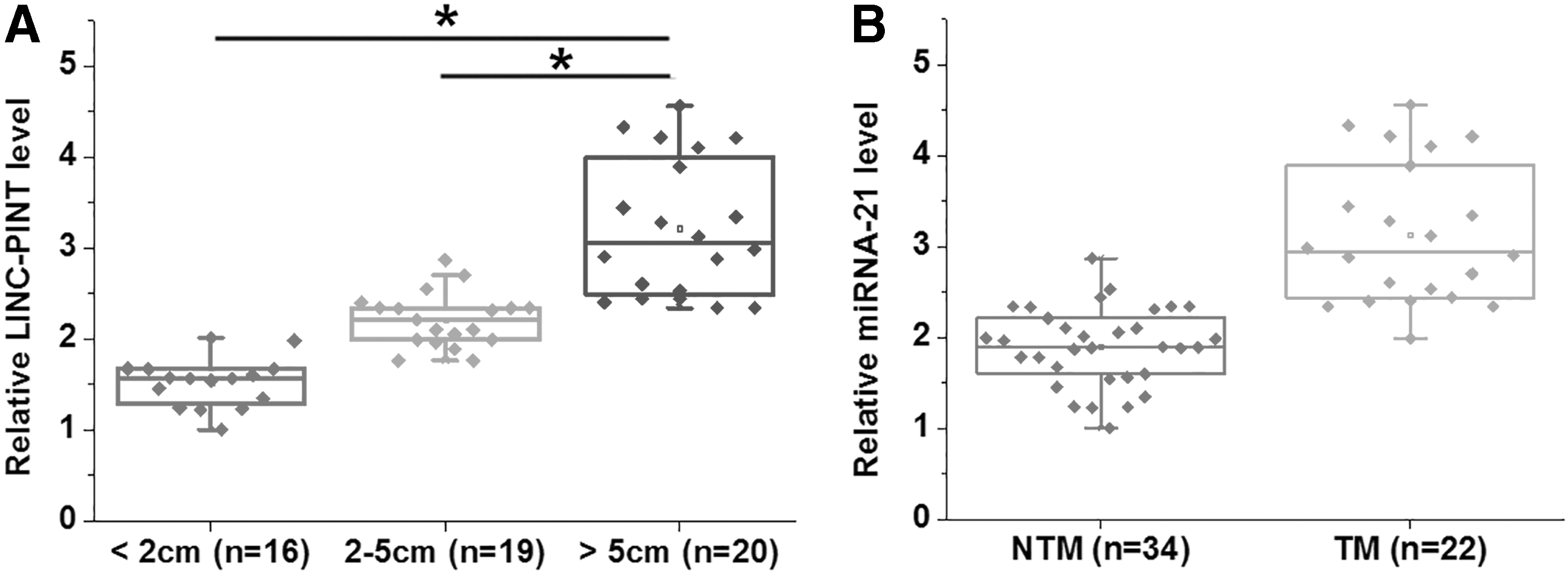
Expression levels of LncRNA LINC-PINT were affected by both tumor size and TM. Expression levels of LncRNA LINC-PINT decreased significantly with the increases in primary tumor diameter
LncRNA LINC-PINT and miRNA-21 were significantly and inversely correlated in both tumor cells and adjacent healthy tissues
Correlations between expression levels of LncRNA LINC-PINT and miRNA-21 were analyzed by Pearson's correlation coefficient. As shown in Figure 1, a significant and inverse correlation between the expression levels of LncRNA LINC-PINT and miRNA-21 was found in both tumor tissues (Fig. 3A) and adjacent healthy tissues (Fig. 3B), indicating the potential interactions between these two factors.
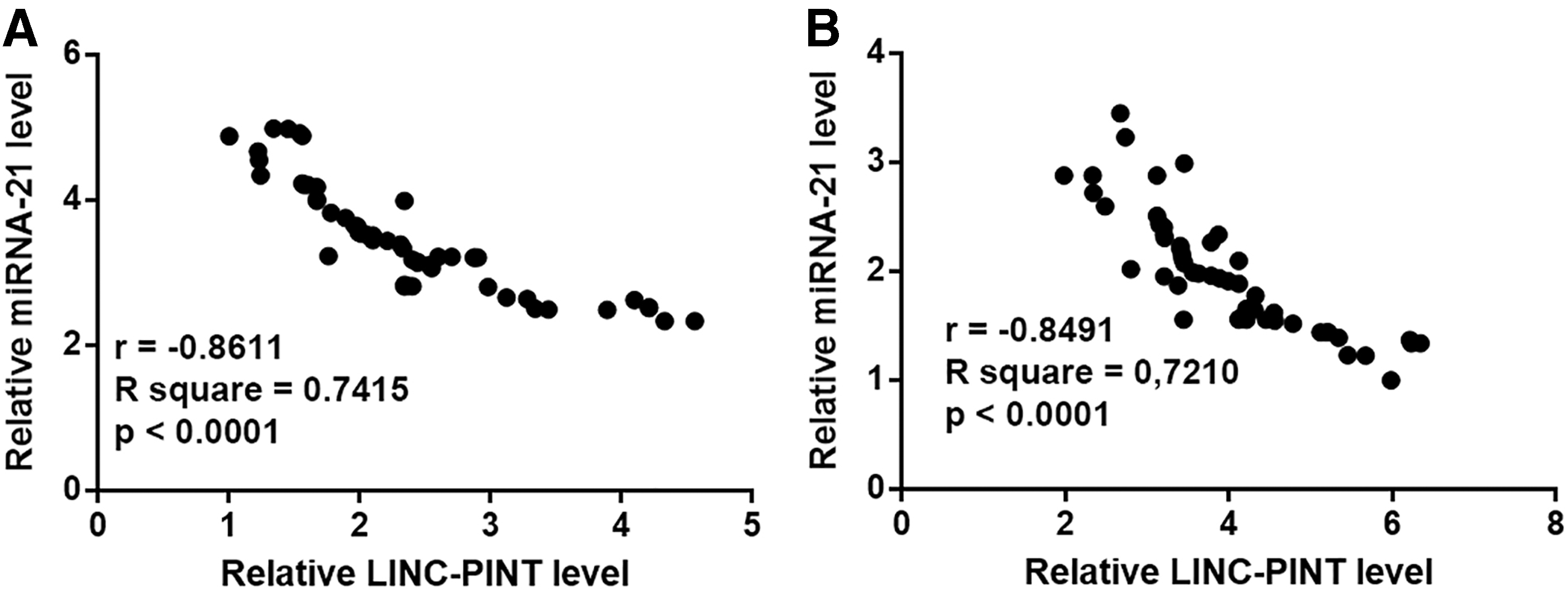
LncRNA LINC-PINT and miRNA-21 were significantly and inversely correlated in both tumor cells and adjacent healthy tissues. Pearson's correlation coefficient analysis revealed a significant and inverse correlation between the expression levels of LncRNA LINC-PINT, and miRNA-21 was found in both tumor tissues
LncRNA LINC-PINT is an upstream negative regulator of miRNA-21 in osteosarcoma cells
To further investigate the interactions between LncRNA LINC-PINT and miRNA-21 in osteosarcoma, overexpression of LncRNA LINC-PINT and miRNA-21 were achieved by LncRNA LINC-PINT expressing vectors and miRNA-21 mimic transfection (data not shown). Compared with control (C) and negative control (NC) groups, overexpression of LncRNA LINC-PINT led to inhibited expression of miRNA-21 in cells of osteosarcoma cell lines, MG-63 and U2OS (Fig. 4A, p < 0.05). However, no significant changes in expression levels of LncRNA LINC-PINT were found in these cells after miRNA-21 overexpression (Fig. 4B, p < 0.05). Therefore, LncRNA LINC-PINT is likely an upstream negative regulator of miRNA-21 in osteosarcoma cells.

LncRNA LINC-PINT is an upstream negative regulator of miRNA-21 in osteosarcoma cells. Overexpression of LncRNA LINC-PINT led to inhibited expression of miRNA-21 in cells of osteosarcoma cell lines MG-63 and U2OS
LncRNA LINC-PINT inhibited osteosarcoma cell proliferation, migration, and invasion, possibly through miRNA-21
Compared with control (C) and negative control (NC) groups, overexpression of LncRNA LINC-PINT led to inhibited whereas overexpression of miRNA-21 led to significantly promoted proliferation (Fig. 5A), migration (Fig. 5B), and invasion (Fig. 5B) of cells of both MG-63 and U2OS cell lines (p < 0.05). In addition, overexpression of miRNA-21 significantly attenuated the effects of LncRNA LINC-PINT overexpression on these cancer cell behaviors. Therefore, LncRNA LINC-PINT may inhibit osteosarcoma cell proliferation, migration, and invasion, possibly through miRNA-21.
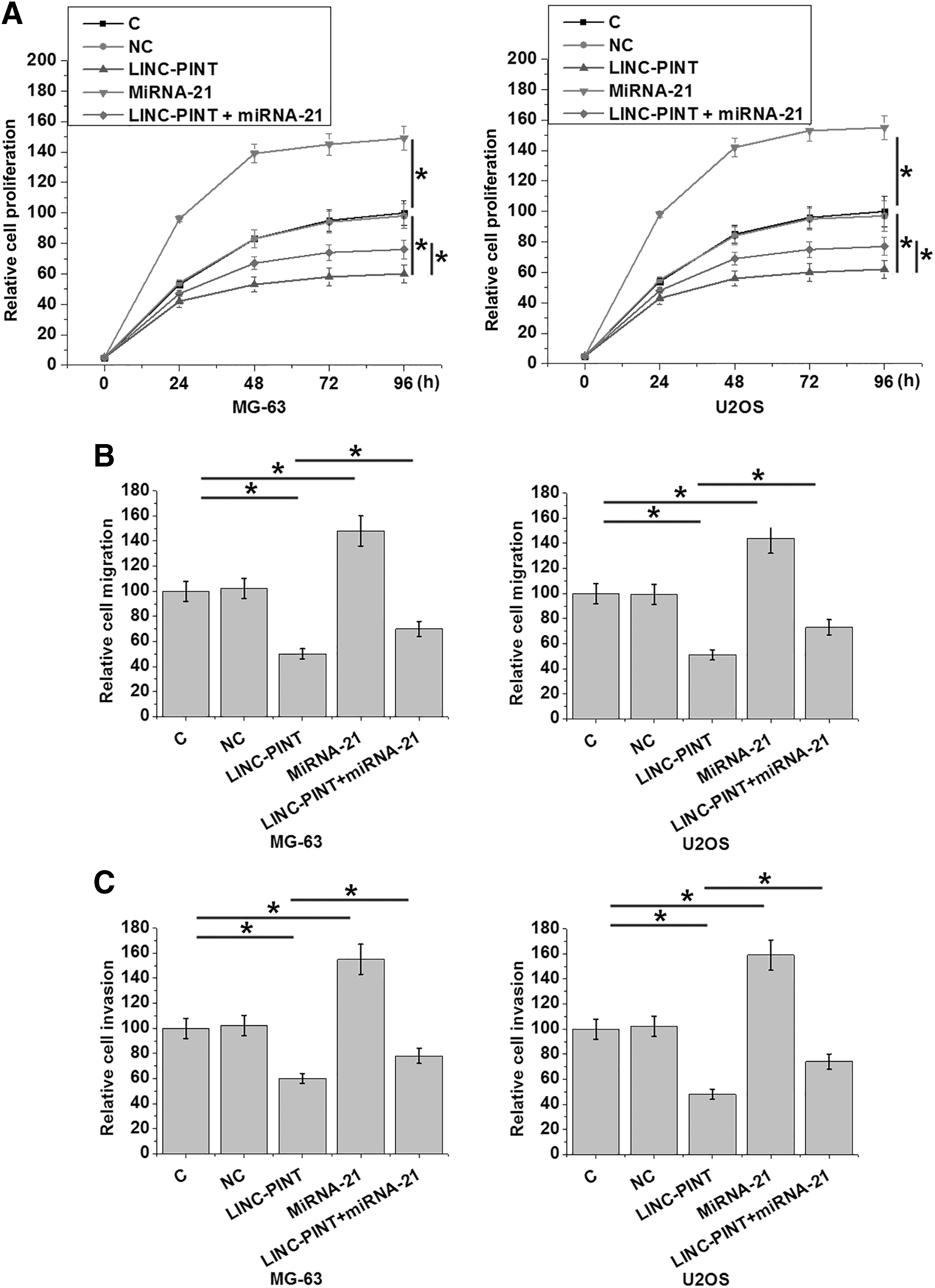
LncRNA LINC-PINT inhibited osteosarcoma cell proliferation, migration, and invasion, possibly through miRNA-21. Overexpression of LncRNA LINC-PINT led to inhibited whereas overexpression of miRNA-21 led to significantly promoted proliferation
Discussion
A recent study reported that LncRNA LINC-PINT was downregulated in different types of cancer cells and the inhibited expression of LncRNA LINC-PINT is responsible for the promoted invasion of cancer cells. 12 However, the functionality of LncRNA LINC-PINT in cancer biology and its clinical potentials are still unclear. The key finding of this study is that LncRNA LINC-PINT was also downregulated in osteosarcoma and overexpression of LncRNA LINC-PINT inhibited the proliferation, migration, and invasion of osteosarcoma, possibly by downregulating miRNA-21.
MiRNA-21 is a well-characterized oncogenic miRNA within a universally upregulated expression pattern in different types of cancers. 14 In a recent study, Yuan et al. reported that the upregulated serum level of miRNA-21 not only predicted the poor survival of osteosarcoma patients but also contributed to the development of chemoresistance during drug treatment. 15 In another study, Hu et al. showed that miRNA-21 overexpression was responsible for the accelerated proliferation of osteosarcoma cells, and inhibition of miRNA-21 led to inhibited cancer cell proliferation. 16 Consistently, our study also reported that miRNA-21 was upregulated in tumor tissues than in healthy tissues of osteosarcoma patients and miRNA-21 overexpression promoted osteosarcoma cell proliferation. Different from previous studies, our study also reported that miRNA-21 overexpression led to the promoted migration and invasion of osteosarcoma cells.
Our study first reported the downregulated expression of LncRNA LINC-PINT in tumor tissues than in healthy tissues. A recent study showed that LncRNA LINC-PINT is involved in the regulation of invasion of cancer cells. 12 In our study, we proved that LncRNA LINC-PINT not only affected osteosarcoma cell invasion but also regulated osteosarcoma cell proliferation and invasion. Our data enriched the functionality of LncRNA LINC-PINT in cancer biology.
Interactions between LncRNAs and miRNAs have been frequently observed during the development of human diseases, such as different types of human cancers. 11,17,18 Based on our knowledge, no interactions between LncRNA LINC-PINT and miRNAs have been reported. In this study, we found that LncRNA LINC-PINT is likely an upstream inhibitor of miRNA-21 in osteosarcoma cells. In addition, the interactions between LncRNA LINC-PINT and miRNA-21 participated in the proliferation, migration, and invasion of osteosarcoma cells. Therefore, LncRNA LINC-PINT may serve as a potential therapeutic target for osteosarcoma by downregulating miRNA-21.
In conclusion, LncRNA LINC-PINT was downregulated and miRNA-21 was upregulated in osteosarcoma. LncRNA LINC-PINT may inhibit cancer cell proliferation, invasion, and migration in osteosarcoma by downregulating miRNA-21.
Footnotes
Disclosure Statement
The authors declare that they have no competing interests.