




Abstract
The aim was to evaluate long-term effectiveness, functional outcome, and side effects of targeted α radiotherapy as an alternative treatment for low-grade gliomas (LGGs) in eloquent brain areas. Five patients with gliomas World Health Organization (WHO) II–IV were treated with tetraazacyclododecane-1,4,7,10-tetraacetic acid (DOTA)-213Bi substance P. In this study, the LGG patients' (WHO II) clinical and radiological long-term outcome was examined. Ten years after treatment with DOTA-213Bi substance P, both LGG patients are still alive without evidence for tumor recurrence and without new functional deficits. Targeted α radiotherapy of LGG might have the potential of long-term tumor control, due to the short tissue range of α particles especially for eloquently located LGG.
Introduction
Gliomas are so far not curable due to their infiltrative growth. Patients with low-grade gliomas (LGGs) are usually of younger age and are initially only minimally impaired. Main therapeutic goals are preservation of quality of life and delay of progression to a prognostically disastrous high-grade glioma (HGG). Early and aggressive treatment of LGG is currently recommended and consists of surgical tumor reduction, postoperative external beam radiotherapy, and chemotherapy. 1 Potential disadvantages are long-term disability after large-volume irradiation and systemic toxicity through chemotherapy.
As follow-up of a study published in 2010, 2 long-term effectiveness of targeted α radiotherapy as an alternative is discussed, especially for eloquently located LGG with limited surgical resectability. Targeted α particle therapy virtually treats invasive tumor cells in eloquent brain areas and spares adjacent neurons due to the limited tissue range of <0.1 mm and the high energy of >5 MeV.
LGGs are characterized by an infiltration zone beyond the putative tumor border visible on magnetic resonance imaging (MRI), which makes complete surgical resection virtually impossible and necessitates the treatment of infiltrating tumor cells. This approach is targeting infiltrating glioma cells with peptides that bind to neurokinin type 1-receptors (NK1R). NK1R are overexpressed on LGG and HGG. 3 Upon binding to its receptor, the peptide substance P—the natural ligand of NK1R—is internalized. 4 After labeling of a substance P-analogue with 213Bi as α particle emitter, the radiopharmaceutical is injected directly into the tumor, which bypasses the blood–brain barrier and minimizes systemic toxicity. In contrast to macromolecules (e.g., antibodies), small peptidic carriers (<2000 Da) such as tetraazacyclododecane-1,4,7,10-tetraacetic acid (DOTA)-substance P display rapid biodistribution. This approach has been evaluated in gliomas World Health Organization (WHO) grades II–IV in several clinical studies. 2,4,5
The initially used β- particle-emitting 90Y was replaced by the α particle-emitting 213Bi. The major advantage of α- over β- particle emitters is the shorter tissue range (0.08 mm vs. 5 mm) combined with higher energy (5.8 MeV vs. 2.1 MeV), which reduces collateral damage. In contrast to conventional radiotherapy, targeted α particles lead to irreversible tumor cell death without sublethal damage by inducing double-strand breaks. The short half-life time of 46 min of 213Bi (90Y: 64 h) demands a rapid labeling procedure and a low molecular weight carrier system for fast intratumoral distribution.
The trial published in 20102 provided proof of concept that targeted local radiotherapy using DOTA-213Bi substance P is feasible and may represent an effective treatment for eloquently located gliomas. However, long-term effectiveness has not yet been studied. This short communication provides a 10-year follow-up on disease development and MRI course of the included LGG patients.
Patients and Methods
In the initial pilot study, five patients with eloquently located gliomas (WHO grades II–IV) were treated with DOTA-213Bi substance P. In this study, the course of the two included LGG patients is given in detail. For comprehensive information on the initial trial, please see Ref. 2
Results
The observed 10-year survival itself is not uncommon; 10-year survival in LGG patients is ∼50%. In contrast, it is remarkable that both patients are so far without any evidence for tumor recurrence.
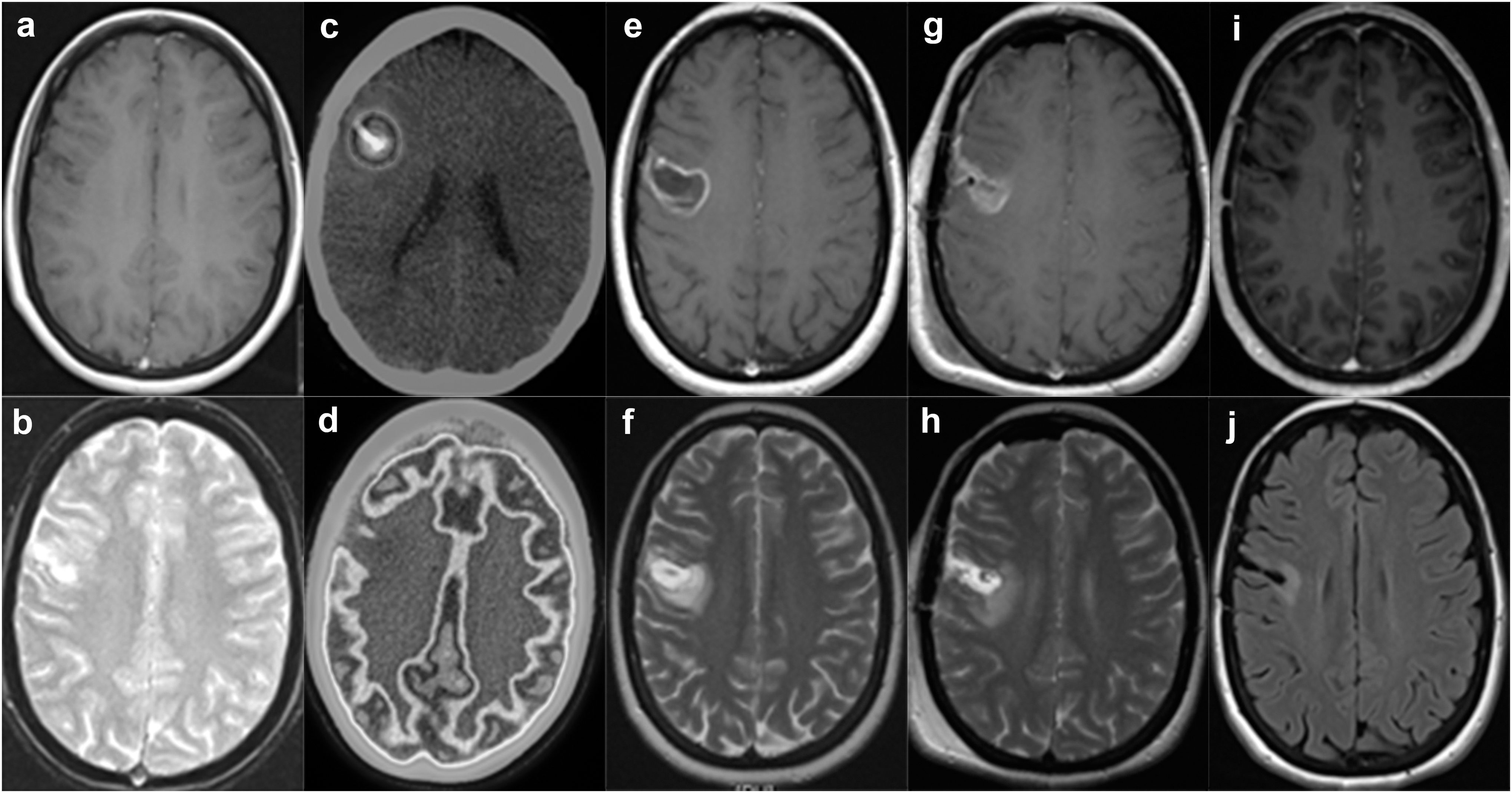
Patient 1 is a 33-year-old woman with a right frontal WHO grade II-astrocytoma involving the precentral gyrus and with a volume of 12 cm3. The MRI course is shown in Figure 1. She initially presented with brachiofacial seizures; she was otherwise healthy with a Barthel index of 100, and was working in an academic profession. After injection of 1.96 GBq of DOTA-213Bi substance P into the tumor (Fig. 1c), brachiofacial motor function was impaired for 6 weeks. 2-Fluor-2-desoxy-
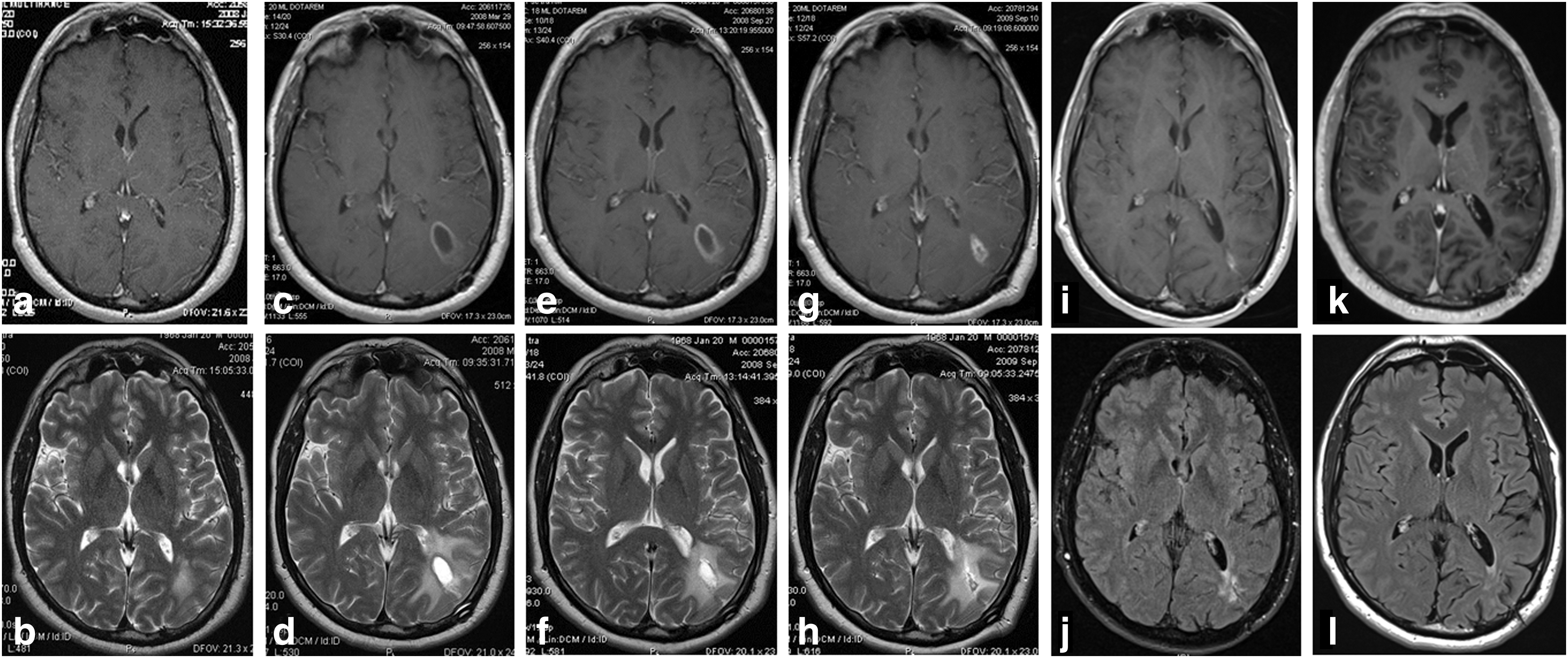
Patient 2, 39 years old, presented with new onset of generalized seizures. Ophthalmologic examination revealed hemianopic deficits to the contralateral side; otherwise, the Barthel index was 100. MRI was suggestive for a left occipital LGG with a volume of 17 cm3, and the biopsy revealed a WHO grade II-astrocytoma. After intratumoral injection of 2.00 Gbq of DOTA-213Bi substance P, MRI was suggestive of progressive radionecrosis (Fig. 2c–h); however, the patient refused tumor resection. Post-therapeutically, the visual deficit remained unchanged without any further neurological deficits and a persisting Barthel index of 100. Analogous to patient 1, the MRI signal abnormality gradually regressed for the following years (Fig. 2i, j); until today, there is no radiological evidence for tumor recurrence (Fig. 2k, l). The epilepsy has improved to less than one seizure per year under oxcarbazepine medication.
Toxicity was evaluated according to the “National Cancer Institute (NCI) Common Toxicity Criteria (CTC) scale (version 2.0).” None of the two patients exhibited any acute toxicity, especially no neurological, hematological, or renal toxicity. In the 10-year follow-up, no relevant chronic toxicity has been observed, especially no secondary neoplasms.
Discussion
In Europe, LGGs manifest at about 1500 new cases per year. LGGs usually affect people at a younger age, lead to protracted functional impairment, and finally evolve to a HGG.
Owing to infiltrative growth into normal adjacent brain tissue, gliomas cannot be cured by treatment that is focused on the main tumor mass, for example, debulking surgery or external beam therapy. In contrast, locally injected targeted radiolabeled peptidic carriers can penetrate the affected invasive zone beyond the visible tumor mass.
The short physical half-life of Bi-213 requires a vector system that quickly distributes the substance into the infiltration zone. In contrast to macromolecules, for example, antibodies, small peptidic molecules (<2000 Da) exhibit rapid distribution and can even cross the corpus callosum in bilateral tumors. 6 The short tissue range of α emitters limits its effect virtually exclusively on targeted tumor cells.
Tumor cell proliferation and invasion in LGG manifest at a much slower rate than in HGG. Therefore, treating LGG in an early stage with diffusible α-labeled peptidic carriers might offer the chance of eradicating most, virtually all infiltrating glioma cells.
A major concern in LGG patients is maintaining quality of life by preservation of neurological function. The observation of recovery of the motor function after injection of α emitters into the motor cortex in patient 1 as well as the stable neurological situation in patient 2 allows the conclusion that potential therapy-induced neuronal damage was rather less pronounced and compensable.
MRI in both patients 10 years after treatment is without evidence for tumor recurrence. The results in these LGG patients point to the potential long-term effectiveness of this approach. Furthermore, any acute and long-term toxicity in these patients is not observed.
Conclusions
Targeted α radiotherapy of LGG might have the potential of long-term tumor control. Owing to the short tissue range of α particles, this targeted radiotherapy can even be applied in eloquent brain areas to eradicate infiltrating glioma cells. Furthermore, primarily inoperable tumors might become operable in the course of treatment due to necrotic transformation.
Footnotes
Acknowledgments
The authors thank Dr. Selina Ackermann from the University Hospital Basel, Switzerland, for editorial assistance. The original study was supported by the European Commission FP7, contract TARCC No. HEALTH-F2-2007-201962.
Ethical Approval
All procedures performed in the original study were in accordance with the ethical standards of the institutional research committee (Ethics Committee of the University Hospitals of Basel, Switzerland), and with the 1964 Helsinki declaration and its later amendments or comparable ethical standards.
Informed Consent
Informed consent was obtained from all patients involved in the original study before inclusion.
Authors' Contributions
Both authors jointly designed the initial study, performed the statistical analyses, and interpreted the data. D.C. drafted the article, and A.M. critically revised it for important intellectual content. Both authors have approved the final version of this article.
Disclosure Statement
The authors declare that they have no conflict of interest.