




Abstract
Objective:
The aim of this study was to investigate and analyze the prognostic factors affecting lymph node (LN) metastasis and postoperative recurrence in patients with primary small cell carcinoma of the esophagus (SCCE).
Methods:
A total of 125 primary SCCE patients who received surgical resection in the Fourth Hospital of Hebei Medical University between March 2005 and August 2009 were included in this retrospective study. All the potential prognostic variables, including the patients' characteristics, tumor features, and treatment modalities, were analyzed by a Cox regression model to explore LN metastasis and the factors associated with postoperative recurrence.
Results:
LN metastasis rate was significantly correlated with depth of tumor invasion (p < 0.001) and tumor length (p = 0.006). LN metastasis ratio was positively correlated with pathological type (p < 0.001), tumor location (p = 0.002), depth of tumor invasion (p < 0.001), and tumor length (p < 0.001). LN stage and chemotherapy were found to be the independent risk factors for progression-free survival (PFS).
Conclusion:
Depth of tumor invasion and tumor length were main factors associated with LN metastasis in primary SCCE. The stage of LN metastasis and chemotherapy was independent factors affecting the postoperative PFS.
Introduction
Primary small cell carcinoma of the esophagus (SCCE) is a rarely aggressive disease, accounting only for 0.8%–3.1% of all esophageal malignancies. 1,2 It is characterized by rapid progression, widespread metastasis and poor prognosis. 3,4 Patients with SCCE are generally treated with surgical resection, chemotherapy, and radiotherapy, alone or in combination. 5 However, their clinical outcome remains grim due to a poor therapeutic response and a high recurrence rate. Currently, no standard therapeutic method has been established, as well as there are limited studies on its potential influential factors.
In clinical practice, the American Joint Committee on Cancer (AJCC) system for esophageal cancer has been applied to SCCE for staging. 6 Moreover, evaluation of locoregional lymph node (LN) metastasis is critical for assessing the stage of disease and predicting the prognosis. 7 There is increasing evidence demonstrating that certain factors may influence the LN metastasis and postoperative recurrence. Costi et al. 8 reported that tumor location and LN ratio metastasis are independent factors for predicting survival, although several studies revealed that surgical treatment may be beneficial for patients without LN involvement. 9,10 In addition, it was found that LN metastasis was associated with a number of factors, such as metastasis sites, depth of invasion, and tumor length. 11 Therefore, LN metastasis integrated with TNM classifications for prognosis assessment still remains a challenge. In this study, the influential factors affecting LN metastasis and postoperative recurrence in patients with SCCE were retrospectively analyzed.
Materials and Methods
Experimental design
The study was approved by Ethics Committee of the Fourth Hospital of Hebei Medical University. This is a retrospective study of primary SCCE patients who received surgical resection in the Fourth Hospital of Hebei Medical University between March 2005 and August 2009. The inclusion criteria were patients who had histologically proven diagnosis of primary SCCE without distant metastasis by endoscopic biopsy. The exclusion criteria were no other tumors and not underwent chemotherapy or radiotherapy before surgery. The patients' characteristics, presenting symptoms, tumor location, tumor size, clinical stage, and nodal metastasis were recorded. Informed consent was obtained from all individual participants included in the study. The patients were followed up until August 2014.
Statistical analysis
SPSS 19.0 (SPSS, Inc.) was applied to analyze all data. The data of normal distribution were presented by mean ± standard deviation. χ 2 test was used to examine the distribution of potential prognostic factors. Survival rate was analyzed by Kaplan–Meier analysis with log-rank test. A Cox proportional hazards regression model was used to identify independent prognostic factors. A confidence interval (CI) was 95%, and probability value of p < 0.05 was considered to be statistically significant.
Results
Patients and clinical characteristics
In total, 125 patients confirmed with SCCE were included in this study. The detailed characteristics of study population are presented in Table 1. The median age for the patients at the time of diagnosis was 60 years (range from 37 to 78 years). The proportion of male and female was 63.2% (n = 79) and 36.8% (n = 46), respectively. There were 11.2% (n = 14) of tumors located in the upper segment of the esophagus, 76% (n = 95) in the middle segment, and 12.8% (n = 16) in the lower segment. Forty-eight percent (n = 60) of the patients had LN metastases. According to the AJCC staging system, there are 19.2% (n = 24) patients in stage I, 16% (n = 20) patients in stage II, 45.6% (n = 57) patients in stage IIIa, and 19.2% (n = 24) patients in stage IIIb in this study.
Demographic Characteristics of Patients with Primary Small Cell Carcinoma of the Esophagus
AJCC, American Joint Committee on Cancer; LN, lymph node.
Correlation between LN metastasis and clinical characteristics
The relationship between LN metastasis and the clinical characteristics of the 125 patients with SCCE are given in Tables 2 and 3. This study showed that LN metastasis rate was significantly correlated with depth of invasion (p = 0.001) and tumor length (p = 0.006). In addition, pathological type (p = 0.001), tumor location (p = 0.002), depth of invasion (p = 0.000), and tumor length (p = 0.000) were found to be significantly associated with LN metastasis ratio. Both the LN metastasis rate and ratio have no correlation with gender and age.
Correlation of Lymph Nodes Metastasis Rate with Characteristics of Patients with Primary Small Cell Carcinoma of the Esophagus
Correlation of Lymph Nodes Metastasis Ratio with Characteristics of Patients with Primary Small Cell Carcinoma of the Esophagus
Survival analysis and postoperative recurrence
By August, 2014, 2 patients had died due to postoperative complications, and 11 patients were lost to follow-up. Among the patients with disease recurrence (112/125), 31 cases (24.8%) were local recurrence of mediastinum and anastomotic of mouth, followed by liver metastasis (17.6%), pulmonary metastasis (13.6%), supraclavicular LN metastasis (11.2%), bone metastases (8%), LN metastasis (8%), brain metastasis (4.8%), and subcutaneous and nasal metastases. The mean survival time (MST) was 16.7 months. The results of the correlation of progression-free survival (PFS) with characteristics of patients with primary SCCE are given in Table 4. The MST of patients with chemotherapy was longer than that of patients without chemotherapy (24.6 months vs. 13.1 months, p = 0.012). The MST of patients was found to be significantly different with N0, N1, or N2 (35.8 months vs. 18.8 months vs. 8.3 months, p = 0.001). In addition, the gender, pathology type, depth of invasion, and tumor length still influenced the survival and recurrence.
Correlation of Progression-Free Survival with Characteristics of Patients with Primary Small Cell Carcinoma of the Esophagus
LN, lymph node.
Several factors were presented in the Cox proportional hazards model after multivariate analysis. Among them, chemotherapy and LN staging were identified as independently main factors for PFS (Figs. 1 and 2). Patients who were treated with chemotherapy had a longer survival time than those not treated (OR = 0.459; 95% CI: 0.303–0.801; p = 0.012). This result suggested that chemotherapy was a protective factor for patients with primary SCCE, which can reduce the probability of recurrence. In addition, higher staging of LNs was associated with the higher probability of recurrence in patients (OR = 1.767; 95% CI: 1.245–2.217; p = 0.001).
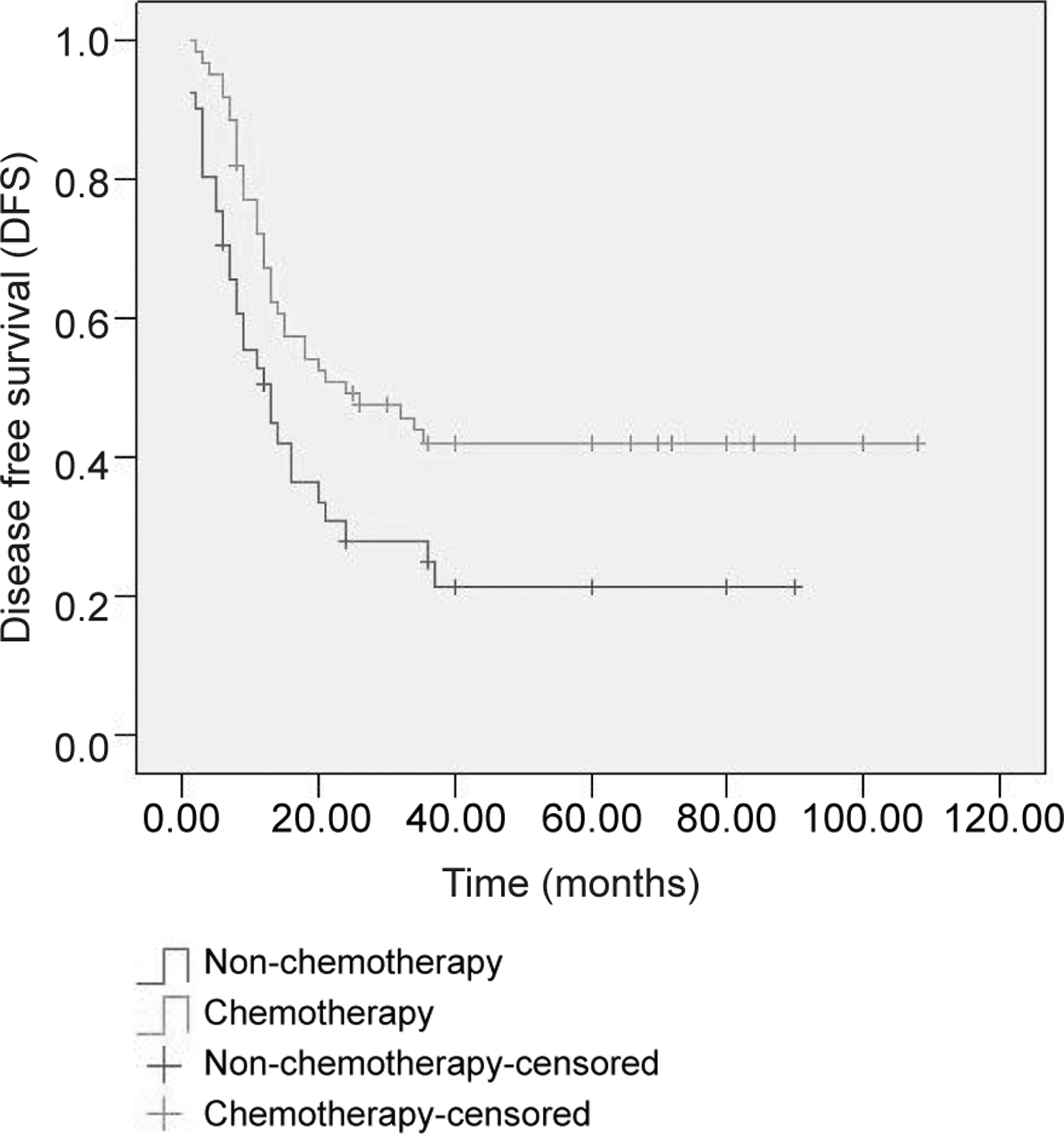
Relationship between chemotherapy and PFS. PFS, progression-free survival.
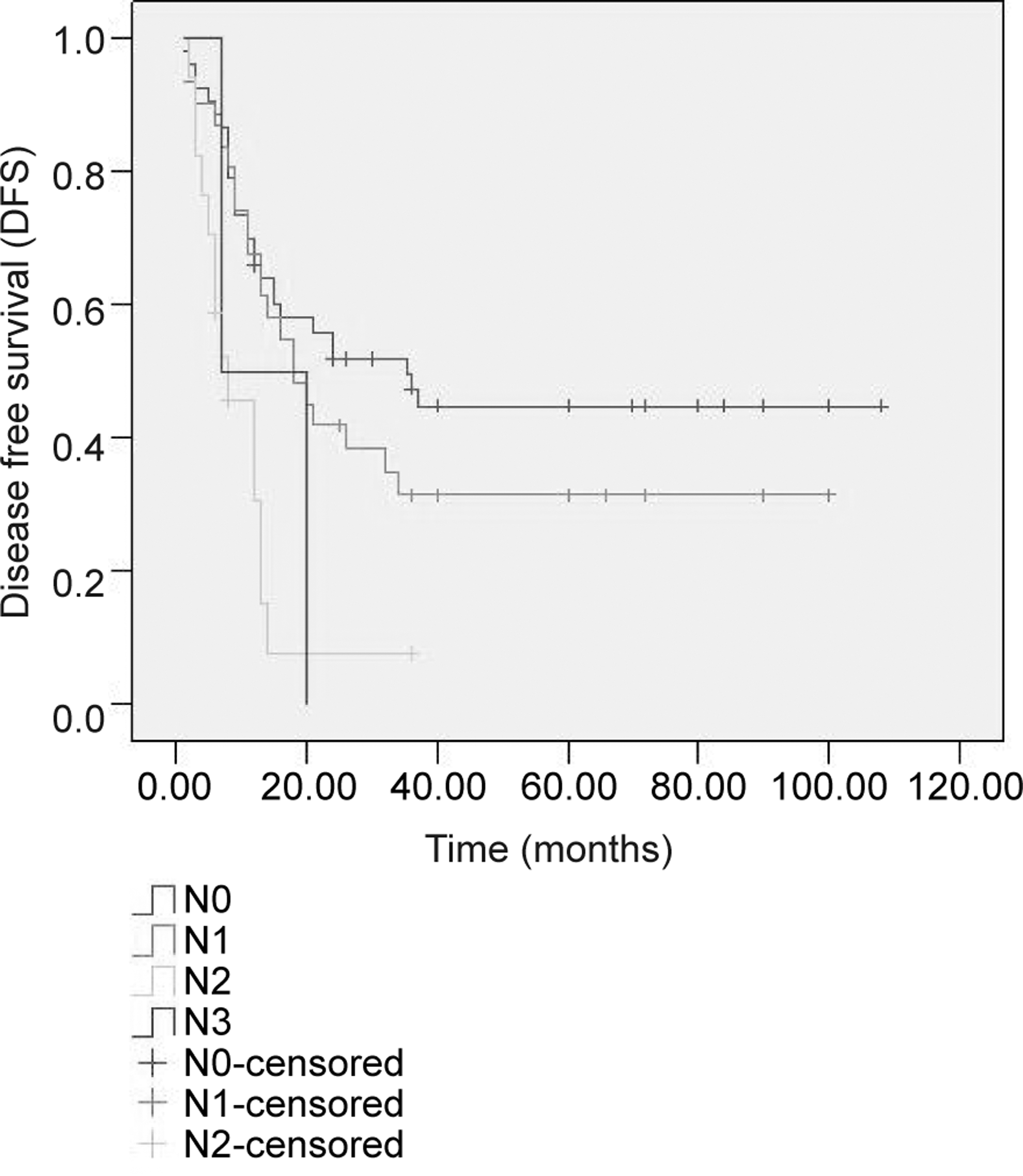
Relationship between lymph node metastasis and PFS.
Discussion
In this study, the feature of LN metastasis and postoperative recurrence outcome of 125 cases with SCCE were analyzed. The tumor invasion depth and tumor length were identified as the important factors affecting LN metastasis. In addition, the LN stage and chemotherapy are demonstrated to be the independent main factors that affect the PFS.
Primary SCCE is an uncommon metastatic malignancy and generally with an MST of <1 year. 1,4 To the best of the authors' knowledge, SCCE is derived from primary pluripotent stem cells of the esophageal mucosa. Pluripotent stem cells are mostly differentiated into squamous cell carcinoma, and a few differentiated into adenocarcinoma or small cell carcinoma. 12 SCCE tends to present at an advanced stage, with a high rate of recurrence after treatment and has a poor prognostic outcome. Moreover, most patients have metastasis at the time of diagnosis. 13,14 Currently, although there is no standard treatment for SCCE, chemotherapy combined with surgery is considered to be the gold standard for treating these patients. 15 However, the features of LN metastasis and recurrence of SCCE found in clinical practice have not yet been fully explored. Jiao et al. 11 reported that tumor invasion, submucosa breakthrough, and length of tumor are considered key factors affecting LN metastasis, which are consistent with this study.
Related factors such as gender, age, tumor location, depths of invasion, tumor length, pathological type, chemotherapy, and LN metastasis were also investigated for postoperative recurrence. This study found that chemotherapy and LN metastasis were independently risk factors for postoperative recurrence. Similar to the present results, Chen et al. 1 had reported that chemotherapy was an independent prognostic factor. A previous study also revealed that a trend toward prolonged survival was observed in patients who received chemotherapy. 4 In this study, the MST (24.6 months) of patients receiving chemotherapy was significantly longer than that of patients who had not been treated with chemotherapy (13.1 months), indicating that chemotherapy could be regarded as an effective treatment to delay the progression of the disease. According to the UICC (2009) staging standard, the relationships between stage of LN metastases and postoperative recurrence were analyzed. Results indicated that the recurrence time of N0 and N1 patients was significantly longer than that of the N2 patients, suggesting that the stage of LN metastases had an important influence on the PFS of the patients.
Conclusions
Tumor invasion depth and tumor length are two main factors for LN metastasis, and the LN staging and chemotherapy are independent risk factors for recurrence in primary SCCE. However, the sample size of the study is a limitation, which may have some influence on the research results. Therefore, the authors plan to increase the sample size and carry out further study in the following research.
Footnotes
Acknowledgment
This study was supported by Hebei Province Medical Science Research Key Project (No. 20190741).
Disclosure Statement
There are no existing financial conflicts.