




Abstract
Background:
Tumor-infiltrating lymphocytes have been reported to be associated with response to neoadjuvant chemotherapy and survival in breast cancer (BC) patients. However, little is known about the value of peripheral blood parameter in predicting the prognosis in BC.
Methods:
In this study, parameters of complete blood count from 417 BC patients with a median 7.6-year follow-up after surgery were collected and correlated with patient survival.
Results:
It was found that leukocyte counts were positively correlated with disease-free survival (DFS, p = 0.016) and overall survival (OS, p = 0.014), whereas platelet counts were negatively correlated with DFS (p = 0.003) and OS (p = 0.082) in BC. Leukocyte and platelet counts were independent prognostic factors for the BC patient survival. Besides, the prognostic value of leukocyte and platelet counts was further evaluated in the BC patients with different molecular subtypes. Together, BC patients with high leukocyte counts and low platelet counts had better DFS (p = 0.001) and OS (p = 0.017) than the other patients.
Conclusion:
Parameters of complete blood count could be acquired easily and serve as cost-effective prognostic biomarkers in BC.
Introduction
The association between complete blood count parameters and prognosis of tumor patients has been explored in previous studies. It is commonly believed that oncogenesis is associated with inflammation. Neutrophil to lymphocyte ratio (NLR) was recognized as a poor predictive and prognostic indicator in various cancers. 1 –3 Besides, platelets could promote tumor proliferation and metastasis through direct interaction and secreted proteins. 4 Nevertheless, most of these studies were carried out in relatively small size samples and the conclusions were still controversial. 5
For breast cancer (BC), peripheral tumor-infiltrating lymphocytes (TILs) as leukocytes, NLR, and platelet to lymphocyte ratio (PLR) have shown to be prognostic parameters in several studies. 6 –13 In some of the studies, high NLR is related to late stage, vascular invasion, or distant metastasis for those receiving adjuvant therapy. 6,7,11,12 Patients with NLRlow/PLRlow are more likely to achieve pathological complete response compared with those with NLRhigh/PLRhigh after neoadjuvant chemotherapy. 8
In this study, the value of complete blood count parameters in predicting the survival of BC patients was fully investigated in a retrospective cohort. More cost-effective prognostic biomarkers were expected to be explored in BC.
Materials and Methods
BC patients
Four hundred seventeen BC patients who did not receive neoadjuvant treatment in the First People's Hospital of Yunnan Province from 2001 to 2008 were enrolled. All of them had undergone breast-conserving surgery or mastectomy. Detailed information of these patients is shown in Table 1. Patients receive clinical assessment every 3 months within 2 years, every 6 months during 2–5 years, and every year over 5 years after surgery if there is no recurrence or metastasis. Radiological surveillance such as mammography and chest computed tomography was conducted every year. In case of suspicion, biopsy was carried out for diagnosis. The median follow-up time was 7.6 years, and a total of 92 events had been observed among 417 patients at the time of last follow-up. Patients with infectious disease, hematopoietic system disease, or other concomitant tumors in the last 6 months were excluded.
Association Between Clinicopathological Characteristics of Breast Cancer Patients and Peripheral Blood Parameter Counts
Bold indicates p values <0.05.
Based on Pearson Chi-squared test.
Anthracycline plus cyclophosphamide and 5-fluorouracil or anthracycline plus cyclophosphamide.
Anthracycline-based chemotherapy followed by or combined with taxanes.
Cyclophosphamide, methotrexate, and 5-fluorouracil or xeloda.
HER2, human epidermal growth factor receptor-2; HR, hormone receptor; PLT, platelet.
Definition of disease-free survival and overall survival
Disease-free survival (DFS) was defined as time from the date of surgery to the date of first relapse or death resulting from any cause. Overall survival (OS) was defined as time from the date of surgery to the date of death resulting from any cause.
Laboratory data
Parameters of complete blood count were immediately confirmed after BC diagnosis and before the initiation of any treatment modality, usually 1–2 weeks before surgery. NLR is calculated as neutrophil count divided by lymphocyte count. Cutoff of complete blood count parameters in the survival analysis was first determined by using the “Cut-off Finder” that was shown in a previous study. 14 Median value was used as cutoff when the “Cut-off Finder” could not find an appropriate value. The cutoff value was 5 × 10⁹/L for leukocytes, 218 × 109/L for platelets, 1.7 × 10⁹/L for lymphocytes, 0.4 × 10⁹/L for monocytes, 3.6 × 10⁹/L for neutrophils, and 2 for NLR.
Statistical analysis
Statistical Package for the Social Sciences software (version 17.0; SPSS, Inc., Chicago, IL) and GraphPad Prism 5 (GraphPad Software, La Jolla, CA) were used to analyze all the statistical data. Noncontinuous data were compared by the Chi-square test, and continuous data in two groups were analyzed by independent-samples t-test or the Mann–Whitney U test. Survival curves were generated by using the Kaplan–Meier method and compared by using the log-rank test. Univariate and multivariate Cox regression analyses were used to evaluate the significance of various parameters for survival. All p-values are two-sided, and p-values less than 0.05 were considered significant. Patients who died of causes other than BC without experiencing tumor recurrence were regarded as censored events at the date of death.
Results
Prognostic value of complete blood count parameters in BC
The prognostic value of complete blood count parameters in BC was investigated in a retrospective cohort including 417 patients. There were more leukocytes in the hormone receptor (HR)+ patients whereas there were more platelets in the estrogen receptor (ER)- patients (p = 0.023 and 0.035, respectively; Table 1). Total leukocyte counts were positively correlated with DFS (p = 0.017; Fig. 1a) and OS (p = 0.014; Fig. 1c) in BC. Reversely, the platelet counts were negatively correlated with DFS (p = 0.003; Fig. 1b) and OS (p = 0.082; Fig. 1d). There was no correlation between other peripheral blood parameter counts and survival in BC patients (Supplementary Figs. S1 and S2).
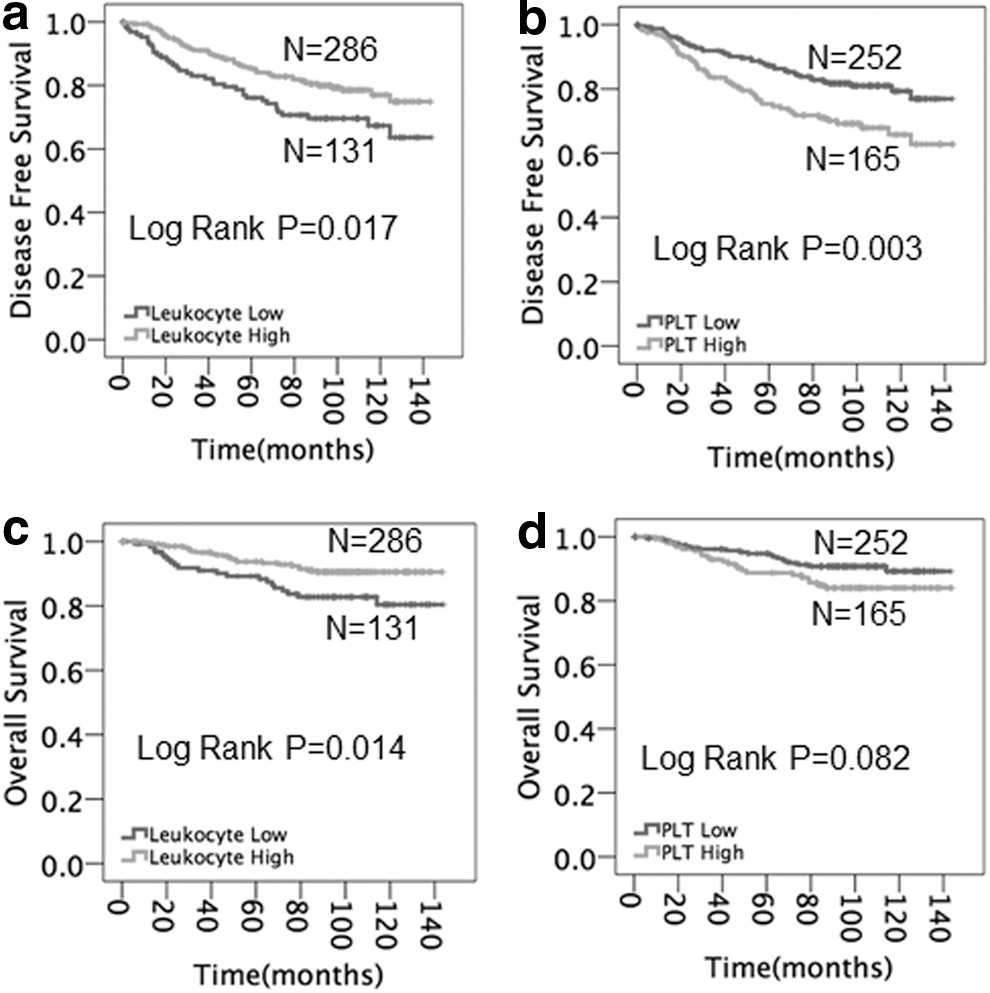
The prognostic value of peripheral blood leukocytes and PLTs in BC. Kaplan–Meier survival curves of DFS for leukocytes
Prognostic value of leukocytes and platelets in different molecular subtypes of BC
The prognostic value of leukocytes and platelets in different molecular subtypes of BC was further explored. For the leukocytes, it was positively correlated with DFS in HR+human epidermal growth factor receptor-2 (HER2)+ BC patients (p = 0.005; Fig. 2b) but not in HR+HER2- (p = 0.421; Fig. 2a), HR-HER2+ (p = 0.389; Fig. 2c), and HR-HER2- (p = 0.716; Fig. 2d). Similarly, there was no correlation between leukocyte counts and OS in different molecular subtypes (Supplementary Fig. 3a–d). For the platelets, their counts were negatively correlated with DFS (p < 0.001; Fig. 2e) and OS (p = 0.02; Supplementary Fig. 3e) only in HR+HER2- BC patients. There was also a trend in the HR-HER2- patients (p = 0.065 and 0.073, respectively; Fig. 2h and Supplementary Fig. 3h).

The prognostic value of peripheral blood leukocytes and PLTs in different molecular subtypes of BC. Kaplan–Meier survival curves of DFS for peripheral blood leukocytes in HR+HER2- patients
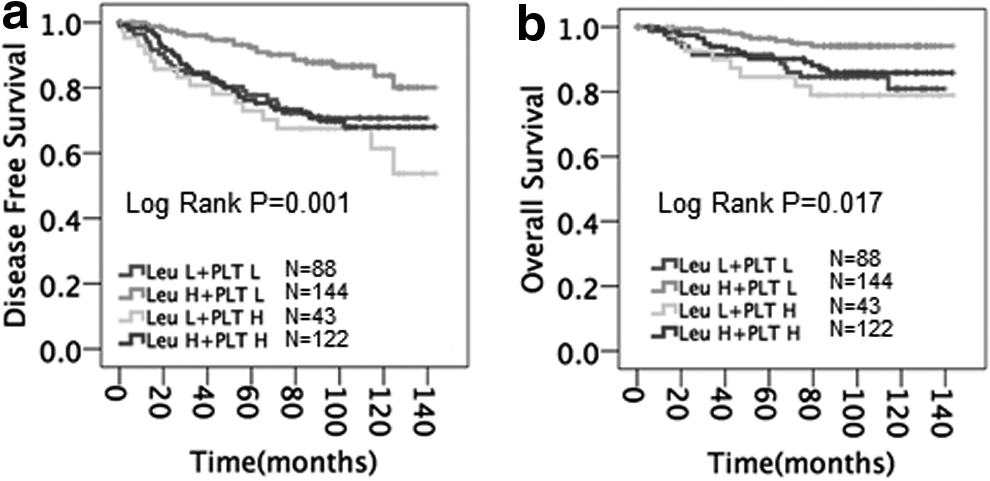
Prognostic value of the model that combined peripheral blood leukocytes and PLTs together in BC. Kaplan–Meier survival curves of DFS
Peripheral blood leukocytes and platelets served as independent prognostic factors in BC
For leukocytes, univariate analysis demonstrated an association with DFS in the global population (p = 0.018) and HR+HER2+ BC patients (p = 0.008). In multivariate analysis, leukocytes remained statistically significant (p = 0.014 and 0.003, respectively). Besides, leukocytes demonstrated an association with OS in the global population (p = 0.016) in univariate analysis and remained statistically significant in multivariate analysis (p = 0.01; Table 2).
Prognostic Value of Peripheral Blood Parameters According to Breast Cancer Subtypes
Bold indicates p values <0.05.
CI, confidence interval; DFS, disease-free survival; OS, overall survival.
Similarly, for platelets, univariate analysis demonstrated an association with DFS in the global population (p = 0.004) and HR+HER2- BC patients (p = 0.001). In multivariate analysis, platelets remained statistically significant (p = 0.001 and 0.001, respectively). Besides, platelets demonstrated an association with OS in the HR+HER2- population (p = 0.035) in univariate analysis and remained statistically significant in multivariate analysis (p = 0.02; Table 2).
However, TNM stage (p = 0.070), adjuvant chemotherapy (p = 0.224), adjuvant radiotherapy (p = 0.290), and adjuvant hormonal therapy (p = 0.090) show no significance in univariate analysis to DFS in our patients.
These data indicated that peripheral blood leukocytes and platelets could serve as independent prognostic biomarkers in BC.
The prognostic model in BC
To further improve the prognostic efficiency in BC, we combined leukocytes and platelets together in the survival analysis. The BC patients could be divided into four groups according to the peripheral blood leukocyte and platelet counts, as shown in Figure 3. The patients with low leukocyte and high platelet counts (n = 144) had significantly longer DFS (p = 0.001; Fig. 3a) and OS (p = 0.017; Fig. 3b) than those in other groups.
Discussion
Though many studies 6 –9,11,12,15 –18 have suggested that an elevated NLR and platelets are associated with poor survival in different cancers, most of these studies were implemented in a small sample and the conclusions were still controversial. Besides, the parameters in the complete blood count were not fully investigated. In this study, we systematically evaluated the value of complete blood count parameters in predicting patient prognosis in a cohort including 417 BC patients. Importantly, we established an overall model with the peripheral blood leukocyte and platelet counts that could effectively provide the prognostic information for the BC patients.
In this study, the pretreatment NLR had no prognostic value in BC. The association between NLR and prognosis is complex. Though it was speculated that elevated NLR represented high systemic inflammatory response and neutrophils could inhibit immune system function 19,20 and activate inflammatory markers, 21,22 leading to the progression of tumor, the function of NLR in BC still needs to be further explored.
Growing evidences indicated that platelets had a profound influence on circulating tumor cell and contributed to tumor metastasis, depending on the bidirectional cross-talk between platelets and tumor cells. 17,23,24 Our result was consistent with previous reports. 10,13 Even more importantly, we conducted further analysis in different molecular subtypes of BC and found that the platelet only had prognostic value in HR+HER2- patients, which reflected the tumor heterogeneity of BC. Long-term follow-up studies 25,26 have demonstrated a superior prognosis for luminal patients compared with other groups of women. The platelet counts would further distinguish the patients with worse prognosis from BC patients with luminal subtype.
Some of the studies have explored the prognostic markers in blood for BC patients. 6 –14 Mantas found that those patients who had developed distant metastasis had higher mean platelet volume and lower neutrophil count than those who did not. 10 They have compared 53 patients with metastasis and 37 without metastasis, and the mean follow-up is 65 months. Leukocyte and platelet are also the keys in our study. We have conducted tests in a larger group of 417 BC patients with a longer median follow-up of 7.6 years. Higher leukocytes and lower platelets are also found in those of better outcomes.
Interestingly, however, the prognostic value of leukocytes was mainly found in the HR+HER2+ subtypes in this study. Peripheral blood was the main source of tumor-infiltrating immune cells; hence, more peripheral blood leukocytes might mean more infiltration of tumor-infiltrating immune cells, which might be a reason to explain the prognostic value of peripheral blood leukocytes. An in-depth study was needed to explore the possible mechanism. The leukocyte counts together with the platelet counts greatly improve the predictive efficiency in the prognosis of BC patients. More importantly, these parameters could be easily achieved in the clinic and serve as cost-effective prognostic biomarkers in BC.
There are some limitations in this study. First, leukocyte and platelet counts are nonspecific parameters that may be influenced by infections, inflammation, or medications. Though strict inclusion and exclusion criteria were set, the confounding effect of concurrent inflammatory conditions cannot be completely excluded. Second, more cohorts were needed to further validate the conclusion. Third, only TILs in the blood of BC patients are discussed due to the tumor heterogeneity in the study. Several studies have shown that TILs are positively correlated with response to neoadjuvant chemotherapy and survival in BC patients 27 –34 and the immune system participates in the elimination of tumor cells and control of tumor growth. 35 –37 The concordance between tissue TILs and peripheral TILs still remains unclear to us. Further exploration of TILs in BC tissues may show more interesting results.
Currently, the role of TILs in predicting response to neoadjuvant chemotherapy and prognosis in BC is gaining much attention. In this study, we explored the prognostic value of complete blood count parameters in BC. Peripheral blood leukocyte counts were positively correlated with survival, and platelet counts were negatively correlated with survival in BC patients. The patients with high leukocyte and low platelet counts had significantly longer survival than those in other groups. Peripheral blood leukocyte and platelet counts could serve as independent and cost-effective prognostic factors in BC.
Footnotes
Acknowledgment
The authors wish to acknowledge the contribution of The First People's Hospital of Yunnan Province for their assistance with this research.
Disclosure Statement
No competing financial interests exist.
Funding Information
No funding was received.
Supplementary Material
Supplementary Figure S1
Supplementary Figure S2
Supplementary Figure S3
References
Supplementary Material
Please find the following supplemental material available below.
For Open Access articles published under a Creative Commons License, all supplemental material carries the same license as the article it is associated with.
For non-Open Access articles published, all supplemental material carries a non-exclusive license, and permission requests for re-use of supplemental material or any part of supplemental material shall be sent directly to the copyright owner as specified in the copyright notice associated with the article.
