




Abstract
Osteosarcoma (OST) is the most common bone tumor in children and adolescents with a second peak of incidence in elderly adults usually diagnosed as secondary tumors in Paget's disease or irradiated bone. Subjects with metastatic disease or whose disease relapses after the initial therapy have a poor prognosis. Moreover, multifocal OST contains tumor-initiating cells that are resistant to chemotherapy. The use of aggressive therapies in an attempt to eradicate these cells can have long-term negative consequences in these vulnerable patient populations. 227Th-labeled molecular probes based on ligands to OST-associated receptors such as IGF-1R (insulin-like growth factor receptor 1), HER2 (human epidermal growth factor receptor 2), and PSMA (prostate-specific membrane antigen) are expected to detect and treat osseous and nonosseous sites of multifocal OST. Published reports indicate that 227Th has limited myelotoxicity, can be stably chelated to its carriers and, as it decays at targeted sites, 227Th produces 223Ra that is subsequently incorporated into the areas of increased osteoblastic activity, that is, osseous metastatic lesions. Linear energy transfer of α particles emitted by 227Th and its daughter 223Ra is within the range of the optimum relative biological effectiveness. The radiotoxicity of α particles is virtually independent of the phase in the cell cycle, oxygenation, and the dose rate. For these reasons, even resistant OST cells remain susceptible to killing by high-energy α particles, which can also kill adjacent quiescent OST cells or cells with low expression of targeted receptors. Systemic side effects are minimized by the limited range of these intense radiations. Quantitative single-photon emission computed tomography of 227Th and 223Ra is feasible. Additionally, the availability of radionuclide pairs, for example, 89Zr for positron emission tomography and 227Th for therapy, establish a strong basis for the theranostic use of 227Th in the individualized treatment of multifocal OST.
Osteosarcoma (OST), an osteogenic primary bone tumor, is the most frequent skeletal neoplasm in children and adolescents. 1 –4 It represents ∼20% of all malignant primary bone tumors. OST is an aggressive tumor of mesenchymal origin capable of producing osteoid and immature bone, that is, malignant cells per se are able to form a primitive bone matrix. Approximately 25% of OST patients have pulmonary metastases at initial diagnosis. Additionally, metastases occur at a later stage usually within the first year of diagnosis in 40% of patients and are a poor prognostic sign. 5,6 Metastatic or relapsed OST is difficult to treat as it appears to be inherently radio- and chemoresistant. 6 –11
Better therapies are urgently needed for multifocal OST. The standard of care for primary OST remains the aggressive surgical resection of tumor in combination with the neoadjuvant systemic chemotherapy. This approach has not changed substantially in decades. However, satisfactory resections with acceptable margins are often difficult. Micrometastases are present in many patients at diagnosis and if metastatic OST develops, patients have poor outcomes. Chemotherapy has little impact in patients with OST lung metastases. For this population, the best treatment has yet to be invented. Radiation therapy is used only in cases of poor surgical margins or for tumors difficult to treat surgically. 12 –14 Whole lung irradiation in cases of pulmonary metastases is uncommon and the outcomes are not encouraging. 15 –17 New strategies to treat metastatic multifocal OST must be developed.
Increasingly, radiopharmaceuticals are successfully used in the management of various malignancies. Molecular radiotherapy of OST with tumor-targeted unsealed sources of radiation has a significant capacity to succeed. The skeletal disease as well as some visceral metastases of OST are osteoblastic and can incorporate bone-seeking radiopharmaceuticals. Bone scintigraphy with 99mTc-MDP is routinely performed at OST diagnosis to evaluate primary tumor uptake and exclude metastases. At the time of relapse, 99mTc-MDP bone scan is used to evaluate sites of the new bone formation by OST cells. The initial reports on the therapeutic efficacy of bone-seeking 153Sm-EDTMP (samarium-153 ethylenediamine tetramethylene phosphonate) in OST came from the therapy studies in dogs. 18,19 The first radiotherapy of human OST with 153Sm-EDTMP was reported by Bruland et al. 20 This case study was soon followed by several U.S. and European clinical trials. 21 –26 The clinical experience with 153Sm-EDTMP suggests a role for molecular radiotherapeutics to control OST and reduce pain. The dose-limiting toxicity of 153Sm-EDTMP, a beta-particle emitter, is pancytopenia caused by irradiation of the bone marrow, a serious side effect in children and adolescents. Although 153Sm-EDTMP has shown positive clinical responses, because of the side effects, its use is limited. Targeted delivery of α-particle emitting 227Th and its daughter 223Ra might be a safer and more effective treatment strategy for selected OST patients. 27 –29 The presence of visceral and bone OST metastases contributes to the treatment failures and death because of difficulties in treating the multifocal disease. α-particle emitting 227Th theranostic probes designed to concurrently target visceral and skeletal OST lesions can provide a new effective therapeutic approach to the management of OST.
Radionuclide
227Th is a promising candidate radionuclide for theranostic probes designed to concurrently target OST disseminated to osseous and nonosseous sites. Table 1 summarizes properties of this radionuclide. 227Th has a half-life of 18.7 d. As it decays it produces several α-particles (Table 2). It can be stably chelated and conjugated to small molecules and antibodies (Abs) for targeting to specific tumor sites. 30,31 227Th high-energy α-particles have a mean energy of 5.9 MeV, maximum range <0.1 mm (a few cell diameters), and high linear energy transfer (LET). They can kill chemo- and radio-resistant cancer cells and are cytotoxic to cells in the G0 phase, that is, dormant metastases and quiescent tumor-initiating cells. Relative biological effectiveness (RBE) of α-particles is at least 3–5 × higher compared with γ-radiation, is independent of the dose rate and tumor oxygenation. 32 –34 Using targeted 227Th-labeled agents, DNA-damaging energy can be deposited selectively in the OST cells and in cells within a close vicinity to the site of decay thereby sparing normal tissues.
Characteristics of 227Th
Lassmann and Nosske. 99
Benabdallah et al. 100
Boschi et al. 101
LET, linear energy transfer.
Decay Chain of 227Th and Characteristics of Emitted α Particles
CSDA, continuous slowing down approximation range (
99.72% to 207Tl.
227Th decays through 223Ra and other short-lived radionuclides to stable 207Pb with α emissions of 97.4% (Table 2). Published data 35 indicate that no significant uptake of 227Th released from its carriers is detected in liver or kidneys. As 227Th decays at the targeted site, 223Ra is slowly produced, redistributed in the body, and taken up into osteoblastic lesions (Fig. 1). 30,31,35,36 223Ra has demonstrated clinical tolerability and acceptable myelotoxicity. 28,36 Delivery of 223Ra to osteoblastic lesions does not require a carrier. It is incorporated directly into the bony matrix in areas of the increased osteoblastic activities. Emitted α particles induce mainly nonreparable, double strand DNA breaks in the adjacent cancer cells, osteoclasts and osteoblasts. Targeting of the osteoid surfaces ensures that trabecular marrow cavities receive very low radiation doses from 223Ra. In other words, the short range of α particles limits damage of normal tissues 37 and minimizes side effects as compared with β−-emitting 153Sm-EDTMP. In fact, 223Ra itself could be a good choice to treat osseous OST. 27,28,38 However, 223Ra is not able to target visceral metastases that lack osteoblastic properties and for this reason, its usefulness in the multifocal OST is limited.
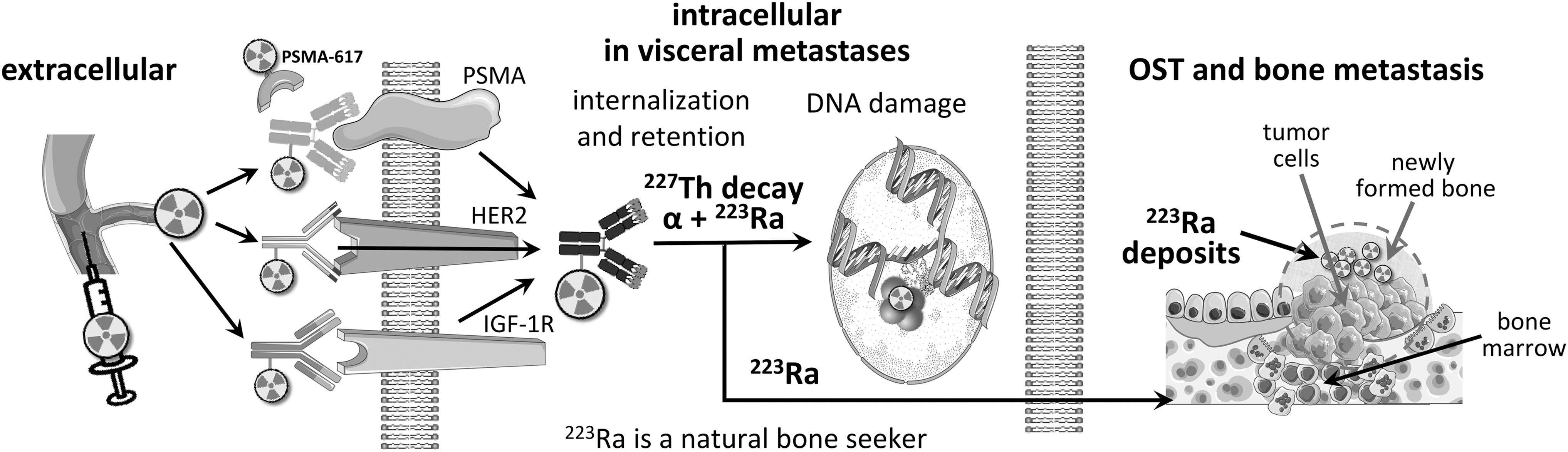
Basic mechanism of action for targeted α-particle-emitting molecular radiotherapeutics designed to treat simultaneously multiple osseous and nonosseous sites of OST. 227Th-labeled OST-targeted molecular radiotherapeutics bind to tumor or tumor-associated endothelial cell transmembrane receptors and are internalized. 227Th decays in tumor cells of visceral metastases, α particles capable of making nonrepairable DNA damage are produced killing metastatic cancer cells. 227Th daughter, 223Ra, diffuses back into circulation, rapidly targets hydroxyapatite and is incorporated into osteoblastic lesions and the bony matrix in the sclerotic parts of the new bone growth in and around metastases. 30,31,35,36 As 223Ra decays and emits α particles, nonrepairable double-strand DNA breaks are induced in adjacent tumor cells. OST, osteosarcoma.
227Th delivered to OST-associated targets can detect and treat multifocal disease. LET of α particles emitted by 227Th and its daughter 223Ra is within the range of the optimum RBE. 39 The radiotoxicity of α particles is virtually independent of the phase in the cell cycle (cytotoxic to G0 cells), oxygen concentration (cytotoxic to cells in the hypoxic environment) and the dose rate. 40,41 Moreover, quantitative 227Th single-photon emission computed tomography (SPECT) is feasible at the activity concentrations of 2.5 kBq/mL within the region of interests ranging in size from 1 to 28 cm3. 42 Published reports also indicate that quantitative imaging of 223Ra is feasible and can facilitate patient-specific dosimetry for the targeted α-emitting radionuclide therapy of bone metastases. For example, Hindorf et al. 43 quantified 223Ra activity in bone after administrations of 100 kBq/kg of Xofigo. The options of the gamma imaging for 227Th and its daughter 223Ra as well and the availability of radionuclide pairs, for example, 89 Zr for positron emission tomography and 227Th for therapy, 44 –46 establish a strong basis for the theranostic approach to the individualized treatment of multifocal OST.
Druggable OST Targets and Their Ligands
Three OST-associated receptors appear to be good targets for 227Th delivery to OST: insulin-like growth factor receptor 1 (IGF-1R), human epidermal growth factor receptor 2 (HER2) and folate hydrolase 1 (prostate specific membrane antigen [PSMA]). All three are transmembrane proteins that are upregulated in OST and in osteoblastic bone metastases secondary to cancers other than OST. 47 –51 Upon binding to their ligands, these receptors form internalizable complexes. 52 –61 The ligands are retained in the subcellular spaces assuring the retention and decay of 227Th within a close proximity to the cell's DNA (Fig. 1).
IGF-1R is associated with malignant transformation, tumor development and chemo- and radioresistance of tumor cells. This receptor is highly overexpressed in most malignant tissues and plays a major role in the pathogenesis and progression of OST. 62 Reportedly, 50% to nearly 100% of OSTs express high levels of IGF-1R. 63 –65 Anti-IFG-1R Abs 66 –68 and tyrosine kinase inhibitors 69 –71 were shown to be effective in several preclinical models of OST. Downregulation of IGF-1R decreases radioresistance of human OST cells. 72 R1507, a fully human anti-IGF-1R Ab, was examined in a phase 2 clinical trial. Partial responses were observed in two patients, however, patients with recurrent or refractory bone OST did not benefit from this therapy. 73 Overall, R1507 was found to be safe and well-tolerated indicating that anti-IGF-1R Abs are suitable carriers for theranostic probes in the OST management.
HER2 is overexpressed in ∼20%–80% of the OST cases. While its role as a prognostic marker in OST is debated, 74,75 HER2 remains a promising candidate for the targeted therapy as it is expressed by cancer cells in primary OST as well as lung metastases. 76 –78 Radioimmunotherapy with α-particle emitters using anti-HER2 Abs was explored in various mouse models. 20,79 –81 Several radiolabeled anti-HER2 Abs were also evaluated as the PET and SPECT imaging agents in OST. 56,57 Nonradioactive trastuzumab, 34 doses at 2 mg/kg, was also examined in 91 patients with OST in a phase 2 clinical trial. 82 Although the treatment with the nonradioactive Abs was found ineffective, this study demonstrated that the inclusion of dexrazoxane can minimize cardiotoxicity. Given the favorable toxicity profile of this treatment regimen, carrier-free radiolabeled anti-HER2 Abs administered at microgram levels are also expected to be safe as the OST-targeted delivery systems for 227Th.
The endothelial expression of PSMA in the tumor neovasculature of a variety of solid malignancies and osseous metastases is well established. This biomarker can be noninvasively detected in the neovasculature of many tumors including several bone malignancies using PSMA-targeted radiopharmaceuticals. 59 –61,83 –87 By analogy to the osteoblastic prostate cancer metastases, PSMA expressed on the OST neovasculature 83,84 appears to be an excellent target for radionuclide-based targeted 227Th-based antiangiogenic theranostics in OST.
These three OST-associated receptors provide a wide range of options for the noninvasive assessment of targets and site-specific delivery of 227Th-labeled probes to multifocal OST. Moreover, in the event that a ligand to one molecular target underperforms, a cocktail of ligands may be considered to provide the optimal outcome after the noninvasive assessment of the receptor expression.
Anti-IGF-1R, anti-HER2 and anti-PSMA IgG Abs such as robatumumab, 88,89 trastuzumab 30,81,82,90 and J591 59,61 represent excellent choices that can be repurposed for 227Th delivery to OST (Table 3). These Abs currently used in a clinic are available as fully human or humanized IgGs. They recognize the extracellular domain of their respective receptors/antigens. Most express immune effector mechanisms such as the antibody-dependent cellular cytotoxicity that may potentiate tumor responses. 66,91 –94 For the long-lived radionuclides such as 227Th, the full length IgGs are a good choice. If the unfavorable normal tissues absorbed radiation doses are detected and shorter biological half-lives are needed to decrease whole body radiation doses, the Fab or F(ab′)2 fragments, nanobodies, scFvs and similar can be derived from these IgGs. Additionally, low molecular weight PSMA-61795 or a high affinity CD105 ligand 96 may be used as 227Th carriers. PSMA-617 has a short biological half-life that should minimize the systemic exposure to ionizing radiation. PSMA-617 was successfully employed for tumor-specific delivery of 225Ac. The advantage of CD105 targeting is its expression not only by OST cancer cells but also by the OST stem-like cells. 97,98
Osteosarcoma-Associated Targets for 227Th Delivery
Asmane et al. 102
Chen and Sharon. 103
Tabak et al. 104
Ebb et al. 82
Zeng et al. 83
Ramirez-Fort et al. 105
HER2. human epidermal growth factor receptor 2; IGF-1R, insulin-like growth factor receptor 1; OST, osteosarcoma; PSMA, prostate-specific membrane antigen.
Conclusions
The main challenge in a search of effective therapies for multifocal cancers that spread to osseous and nonosseous sites is to find a method that can inhibit the growth of tumor cells at the primary site as well as distant metastases, visceral and skeletal. The therapy must be able to kill cancer cells but cause no or only negligible damage to normal tissues. Ideally, it should also include a diagnostic element that would allow the detection of tumor sites and assist in the treatment planning. 227Th-labeled probes to OST-associated targets appear to meet these requirements. This approach is also applicable to other malignancies that produce either osteoblastic or mixed metastases with osteoblastic and osteolytic components including breast, prostate, bladder, testicular, small cell lung, ovarian and stomach cancers, as well as Hodgkin's lymphoma, some carcinoids and medulloblastoma. Each year, >80,000 cancer patients are diagnosed with osteoblastic skeletal metastases. This cancer progression almost always indicates a poor prognosis. After cancer spreads to the bones, it is rarely curable. 227Th-labeled probes that target visceral metastases and co-target bone lesions via 223Ra have a potential to improve the management of these malignancies.
Footnotes
Acknowledgment
The authors are grateful to Dr. Zbigniew P. Kortylewicz for his advice and suggestions.
Disclosure Statement
No competing financial interests exist.
Funding Information
No funding was received for this article.