




Abstract
Background:
Glioma is a devastating disease with the worst prognosis among human malignant tumors. Although temozolomide (TMZ) improves the overall survival of glioma patients, there are still many glioma patients who are resistant to TMZ. In this study, we focused on the effect of apigenin (API) and TMZ on glioma cells in vitro and in vivo, and we studied the underlying molecular mechanisms.
Materials and Methods:
To investigate the effect of API on glioblastoma cell proliferation, cell viability was assessed after glioma cells were incubated with various concentrations of API with or without TMZ using MTT assays. Then, we explored the synergistic effect of API and TMZ on glioma cell cycle, apoptosis, and migration. To investigate the molecular mechanism behind the synergism of API and TMZ, we examined the related genes of the major signaling pathways involved in glioma pathogenesis by Western blotting.
Results:
In this study, we found that API significantly suppressed the proliferation of glioma cells in a dose- and time-dependent manner. Combining API and TMZ significantly induced glioma cells arrest at the G2 phase and inhibited glioma cells proliferation compared with API or TMZ alone. In addition, API promoted the ability of TMZ to induce glioma cells apoptosis and inhibit glioma cells invasion. Furthermore, compared with treatment with individual agents, the combination of API and TMZ significantly inhibited the growth of subcutaneous tumors in mice. These results implied that API could synergistically suppress the growth of glioma cells when combined with TMZ. Combining API and TMZ significantly inhibited the protein expression of p-AKT, cyclin D1, Bcl-2, Matrix Metallopeptidase 2, and Matrix Metallopeptidase 9.
Conclusion:
API and TMZ synergistically inhibited glioma growth through the PI3K/AKT pathway.
Introduction
Glioma is the most aggressive, abnormal proliferating and highly invasive malignant tumor, with an incidence rate of 3.2 per 100,000 population. 1 It is generally believed that there is no specific therapeutic treatment for glioblastoma (GBM). Multiple methods of treating GBM including surgical resection, postoperative concurrent chemoradiotherapy, and molecular targeted therapy have been developed in recent years, but the overall survival of patients has not been significantly improved, the disappointing median survival of 14.4 months after diagnosis. 2 Hence, it is urgent that a novel treatment with definite curative effects be identified to inhibit the irregular proliferation of glioma.
Temozolomide (TMZ), an alkylating agent that is a triazene compound, is a chemotherapeutic drug commonly used in the treatment of malignant tumors owing to the cell growth inhibition and cytotoxicity caused by alkylation agents. 3 –5 TMZ first showed potential for treating glioma patients in a phase I trial at Charing Cross Hospital in 1987. 6 Since then, TMZ has been shown to be more effective and safer than other agents, such as vincristine, procarbazine, and lomustine. 7 –9 The overall survival of patients with glioma treated with TMZ after surgery increased significantly to 18.9 months, whereas the overall survival of patients with glioma who did not receive TMZ chemotherapy was 9.8 months. 10
TMZ has been developed as the first-line chemotherapeutic drug for glioma patients. 11 Although TMZ significantly improves the overall survival of glioma patients, there are still many glioma patients who are resistant to TMZ. Therefore, it is necessary to find candidate agents for glioma patients who exhibit TMZ resistance. 12
Apigenin (API), a naturally occurring plant flavone, is found in the leaves and stems of plants and has been linked to reduced rates of cancer. API suppresses the initiation and promotion of carcinogenesis by strongly inhibiting mutagenicity with benzo[a]pyrene (BaP) or 2-aminoanthracene (2-AA). 13 Numerous studies have shown that API can act as a tumor suppressor in a wide array of cancers, such as nasopharyngeal carcinoma, cholangiocarcinoma, melanoma, and gliomas. 14 –17
API promotes cytotoxicity in GBM cells, promoting cell death and inhibiting proliferation in a dose- and time-dependent manner. 18 Furthermore, API induces a strong inhibitory effect on glioma cell growth by promoting the expression of miR-16 and the suppression of Bcl2 and NF-κB/Matrix Metallopeptidase 9 (MMP-9). 14 In addition, API obviously enhances the antitumor effect of cetuximab in nasopharyngeal carcinoma cells, suggesting that API possesses a potential ability to promote the toxic effects of other agents in cancer cells. 19 Therefore, in this study, we focused on the effect of API and TMZ on glioma cells in vitro and in vivo, and we studied the underlying molecular mechanisms.
Materials and Methods
Cell culture and reagents
Human GBM cell lines U87 and U251 were purchased from the Chinese Academy of Sciences Cell Bank. Both cell lines were cultured in Dulbecco's modified Eagle's medium (DMEM; Gibco) supplemented with 10% bovine serum albumin, and they were maintained in a 5% CO2, 37°C environment and were routinely passaged at regular intervals of 2–3 d. API was purchased from Sigma-Aldrich (St. Louis, MO). Glioma cells were supplemented with API for 24, 48, and 72 h for further experiments. TMZ (Sigma) was added to glioma cells at a final concentration of 100 μM for 48 h. 20
MTT assay
Glioma cells were seeded into 96-well plates at 2 × 10³ cells per well. After treatment with different drugs, 50 μL of MTT dilution (KeyGEN, China) was added to each well. The cells were further incubated for 4 h at 37°C. Subsequently, after discarding the supernatant, 200 μL of dimethyl sulfoxide was added to each well to dissolve the precipitate. Optical density (OD) was measured at a wavelength of 570 nm, and data are presented as mean ± SD. 21 –27
Cell cycle analysis
Cells were washed with phosphate-buffered saline (PBS) and fixed in 70% ethanol for at least 1 h. Then, the cells were suspended in HBSS (Hank's balanced salt solution) containing 50 μg/mL propidium iodide (PI) and 50 μg/mL RNase A, and they incubated at room temperature for 1 h. Cells were then analyzed by flow cytometry (FCM). 22 –28
Apoptosis assay
Annexin V fluorescein isothiocyanate isomer and PI dual staining assays were used to assess the apoptotic rate. Annexin V− and PI− cells were used as controls. Annexin V+ and PI− cells were designated as apoptotic, and Annexin V+ and PI+ cells were designated as necrotic. 23 –29
Transwell Matrigel invasion assay
Cell invasion was assessed by Transwell Matrigel invasion Assay (BD Biosciences, CA). Glioma cells (1 × 10⁶ cells/mL) that had been treated with different drugs were added to the upper compartment. Then, 600 μL of culture medium was added to the lower compartment of the chamber. After 48 h of incubation, the cells that had moved to the lower side of the filter were fixed with 4% paraformaldehyde, washed with PBS, stained with crystal violet, and then were finally observed under an inverted microscope. 24 –30
Western blot analysis
Total cellular protein was extracted by lysis buffer (Pierce, Rockford, IL) from cells treated with different drugs. Protein concentration was determined by Bradford protein assay (Pierce). Equal amounts of protein were loaded and subjected to SDS-PAGE in a 10% polyacrylamide gel. After electrophoresis, the separated proteins were transferred to NC membranes (Millipore Corp.). The membrane was blocked with 5% skim milk in TBST buffer for 1 h. After that, the membrane was incubated at 4°C overnight with the following antibodies: p-Akt (1:800; Cell Signaling Technology, MA), Bcl-2 (1:800; Cell Signaling Technology), cyclin D1 (1:800; Cell Signaling Technology), MMP-2 (1:800; Cell Signaling Technology), MMP-9 (1:800; Cell Signaling Technology) and GAPDH (1:000; Cell Signaling Technology). Then, membranes were incubated with a horseradish peroxidase-conjugated secondary antibody (1:2500; Santa Cruz). After incubating with the stripping buffer, the membrane was reprobed for GAPDH (1:5000; Kangchen, China) using ultra-enhanced chemiluminescence Western blotting detection reagents. All Western bands were quantified by densitometry and are presented in the form of a bar graph.
Xenograft tumor assay
Six-week-old female immunodeficient female nude mice (BALB/C-nu) were purchased from the Animal Center of the Cancer Institute of the Chinese Academy of Sciences. The study was approved by the Institutional Animal Care and Use Committee of Nanjing Medical University. All operations were performed according to international guidelines concerning the care and treatment of experimental animals.
The mice were bred in the experimental animal facility at Nanjing Medical University and placed in a micro-isolator with water and food in separate airy cages. All experiments were performed in accordance with the regulations of Nanjing Medical University and internal biosafety and bioethics guidelines. A subcutaneous U87 glioma xenograft model was established according to the methods described in the literature. 21 –25 When tumors reached a diameter of ∼5 mm, mice were randomly divided into four groups: (1) control group, untreated tumors; (2) 50 mg/kg/d API alone; (3) 20 mg/kg/d TMZ alone; and (4) 50 mg/kg/d API +20 mg/kg/d TMZ. Each group consisted of eight mice. During the 32 d of observation, the tumor volume was measured with calipers every 3 d using the following formula: volume = length × width 2 /2.
Statistical analyses
All the experimental data were analyzed using the statistical software SPSS 18.0. Normally distributed data are presented as mean ± standard deviation, and data with skewed distribution are presented as median and range. Mean values between multiple groups were analyzed by analysis of variance (ANOVA). Differences with p < 0.05 were considered statistically significant.
Results
Combined API and TMZ treatment induced a stronger inhibitory effect on GBM cell proliferation than treatment with either agent alone
To investigate the effect of API on GBM cell proliferation, cell viability was assessed after glioma cells were incubated with various concentrations of API (10, 20, 40, and 80 μM) with or without TMZ for 72 h using MTT assays. As given in Figure 1A and B, API inhibited U87 cells in a dose- and time-dependent manner, and a similar inhibitory effect was found in U251 cells. We further examined whether API could improve the sensitivity of glioma to TMZ chemotherapy. The glioma cells were exposed to 100 μM TMZ alone, 40 μM API alone, or both drugs in combination for 48 h. As observed in Figure 1C and D, 40 μM API or 100 μM TMZ alone exerted significantly lower inhibitory effect on U87 and U251 cells than the combined API and TMZ treatment, indicating that API unambiguously enhanced the inhibitory effect of TMZ on glioma cell proliferation.

Combined API and TMZ treatment induced a stronger inhibitory effect on glioma cell than treatment with either agent alone.
Synergistic effect of API and TMZ-induced glioma cell cycle arrest at G2 phase
Cell cycle distribution was analyzed by FCM. As given in Figure 2A and B, after 48 h of exposure, the fraction of U87 cells in the G2 phase in the control, 40 μM API, 100 μM TMZ, and API/TMZ combined treatments was 20.31%, 32.83%, 36.6 2%, and 45.37%, respectively. In addition, the fraction of U251 cells in the G2 phase in the control, 40 μM API, 100 μM TMZ, and API/TMZ combined treatments was 17.69%, 26.73%, 32.24%, and 45.12%, respectively. The results showed that the combined API and TMZ treatment can lead to glioma cell cycle arrest at G2 phase, and the effect was significantly stronger than it was in either the API or TMZ treatment.

Combined API and TMZ induced glioma cell cycle arrest at G2 phase and promoted glioma cell apoptosis.
Synergistic effect of API and TMZ on increased apoptosis of GBM cells
Annexin V and PI double staining was used to investigate the effects of 40 μM API and 100 μM TMZ on glioma cell apoptosis at 48 h after treatment. As given in Figure 2C and D, 40 μM API or 100 μM TMZ alone induced a mild increase in apoptosis compared with the control group in U87 and U251 GBM cells. However, significantly higher levels of cell death were found in 40 μM API- and 100 μM TMZ-treated cells. These results showed that the combined 40 μM API and 100 μM TMZ treatment triggered significantly higher levels of apoptosis than what was observed in either the 40 μM API or 100 μM TMZ treatment in glioma cells.
API synergistically suppressed the migration and invasion of glioma cells when combined with TMZ
To quantify the level of migration and invasion after the combined treatment with both drugs compared with treatment with the individual agents, we performed a transwell Matrigel invasion assay to evaluate the impact of 40 μM API and 100 μM TMZ after 48 h of treatment. As given in Figure 3, 40 μM API and 100 μM TMZ alone effectively inhibited the migration and invasion of glioma cells. Furthermore, the combined application of 40 μM API and 100 μM TMZ resulted in a significantly higher inhibitory effects compared with that of 40 μM API and 100 μM TMZ alone. These data demonstrated that 40 μM API and 100 μM TMZ synergistically suppressed the migration and invasion of glioma cells when used in combination.

Combined application of 40 μM API and 100 μM TMZ resulted in a significantly higher inhibitory effects compared with that of 40 μM API and 100 μM TMZ alone. *p < 0.05 versus TMZ, n = 5. Color images are available online.
API and TMZ acted synergistically to inhibit the PI3K/Akt signaling pathway and downstream-related genes
To investigate the molecular mechanism behind the synergism of 40 μM API and 100 μM TMZ, we examined the related genes of the major signaling pathways involved in glioma pathogenesis. As given in Figure 4A, 40 μM API inhibited the protein level of p-AKT in U87 cells, and 100 μM TMZ also decreased the p-Akt protein expression level. However, the expression level of p-Akt protein in the API plus TMZ group was significantly reduced compared with the levels after treatment with API or TMZ alone. The results in U251 cells were similar, and the inhibitory effect of API and TMZ on p-Akt protein expression was significantly superior to that of API or TMZ alone.

Effects of API and/or TMZ on the expression of p-Akt, Bcl-2, cyclin D1, MMP-2, and MMP-9.
The expression of Bcl-2 in GBM cells treated with API or TMZ alone was significantly lower than it was in GBM cells without treatment with the agents, and treatment with API plus TMZ notably reduced Bcl-2 expression compared with that of cells treated with API or TMZ alone. In addition, the protein expression of cyclin D1, MMP-2, and MMP-9 was decreased in API- or TMZ-treated glioma cells. Furthermore, the combination of API and TMZ treatment caused the expression of cyclin D1, MMP-2, and MMP-9 protein in glioma cells to be significantly lower than it was after treatment with API or TMZ treatment alone, and as given in Figure 4B; API + TMZ significantly also decreased gelatinolytic activities of MMP-2 and MMP-9. These results suggest that API and TMZ acted synergistically to inhibit the PI3K/Akt signaling pathway and downstream-related genes.
API and TMZ worked synergistically to suppress GBM xenograft growth
To further test the role of API and TMZ in tumor growth, we used API alone, TMZ alone, and both drugs in a mouse xenograft model with U87 cells. As given in Figure 5, API and TMZ alone resulted in little inhibitory effect on tumor growth in comparison with the control. However, the combination of API and TMZ significantly inhibited the growth of subcutaneous tumors in mice compared with the effect of individual agents (p < 0.05). These results demonstrated that API could act synergistically with TMZ to inhibit tumor growth in vivo.
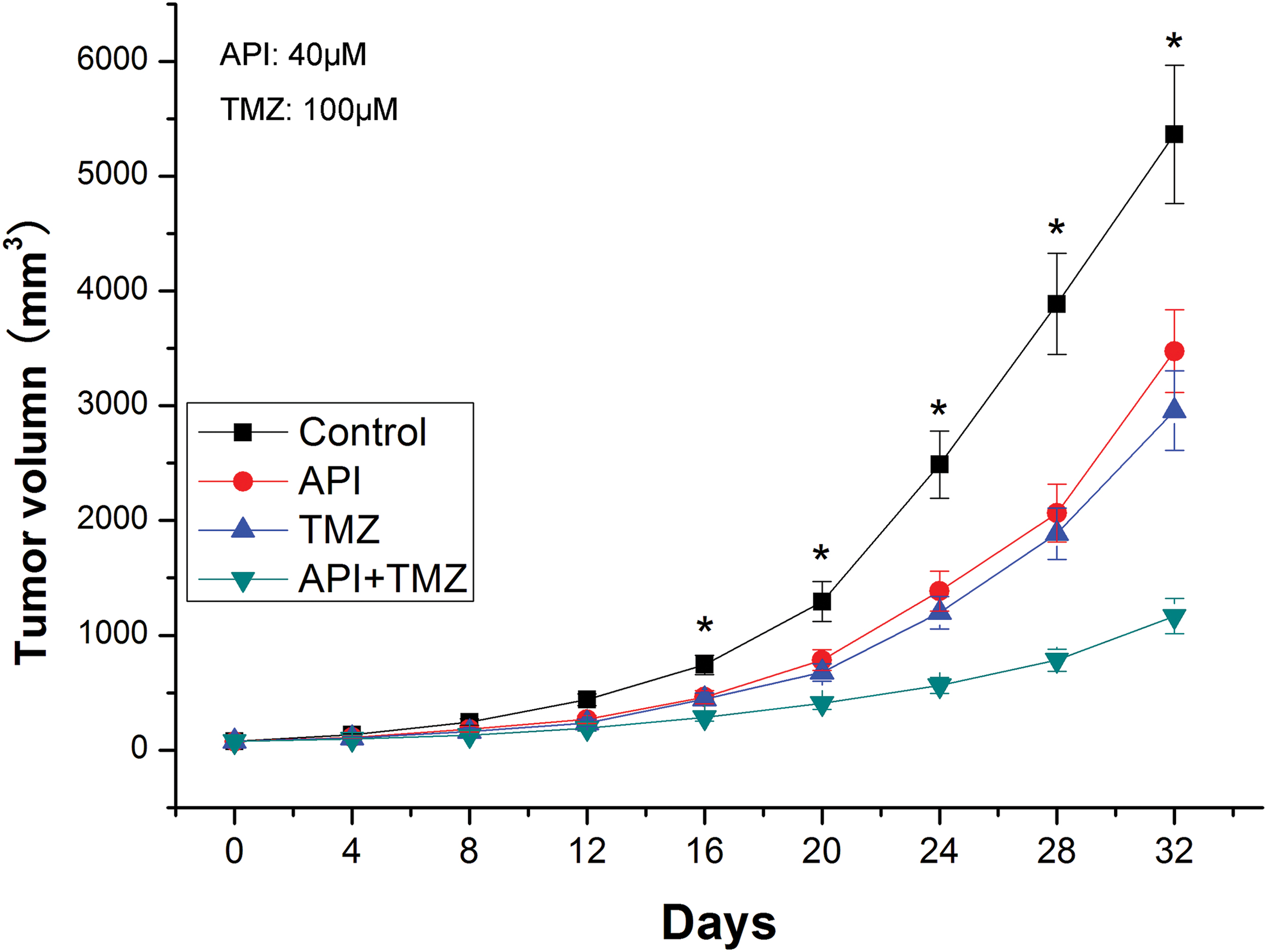
Combination of 40 μM API and 100 μM TMZ significantly inhibited the growth of subcutaneous tumors in mice compared with the effect of individual agents. *p < 0.05 versus control, n = 5. Color images are available online.
Discussion
Glioma is a devastating disease, and it has the worst prognosis among malignant human tumors. Maximal surgical resection combined with focal radiotherapy and concomitant TMZ chemotherapy are the current standard treatments for glioma. Although the identification of TMZ was a major breakthrough in the treatment of glioma, resistance to TMZ has become a severe obstacle to curing glioma, leading to a 5-year survival rate for glioma patients of <10%. 26 Therefore, enhancing the chemotherapeutic effect of TMZ on glioma and reducing resistance to chemotherapy have become the focus of glioma research.
In this study, we found that API could significantly suppress the proliferation of glioma cells in a dose- and time-dependent manner. Combining API and TMZ induced significant glioma cell arrest at the G2 phase and inhibited glioma cell proliferation compared with API or TMZ alone. At the same time, we observed that API worked with TMZ to strengthen the ability to induce glioma cell apoptosis and inhibit glioma cell invasion. Furthermore, the combination of API and TMZ significantly inhibited the growth of subcutaneous tumors in mice compared with individual agents. These results implied that API act synergistically with TMZ to suppress the growth of glioma cells.
To investigate the molecular mechanism behind the synergistic effect of API and TMZ, we assessed the key points of the major signaling pathways of glioma. The PI3K/AKT pathway has been confirmed to play a vital role in the initiation and development of glioma. 27 The continuous activation of PI3K/AKT phosphorylates the Ser136 site of the Bad protein, and the phosphorylated Bad can bind to the chaperone 14-3-3 protein (chaperone protein), preventing it from forming a dimer with Bcl-2 or Bcl-xL play a role in promoting apoptosis, thereby effectively blocking Bad-induced apoptosis of glioma cells.
In addition, the Ser184 site of Bax is phosphorylated and inactivated, thereby inhibiting the apoptosis of glioma cells. Studies have shown that the activation of PI3K/AKT signaling pathway increases the activity and expression of MMP-2 and MMP-9, thereby mediating the degradation of type IV collagen in the basement membrane of the extracellular matrix, promoting the infiltration of glioma cells to the surrounding area, and promoting glial tumor invasion and metastasis. 28,29 Our data demonstrated that API inhibited the protein level of p-AKT in GBM cells and that TMZ also reduced the protein expression level of p-Akt. However, obviously lower expression of p-AKT was revealed after treatment with the combination of API and TMZ compared with treatment with API or TMZ alone, suggesting that API/TMZ together exerted a significantly synergistic therapeutic effect through the PI3K/AKT signaling pathway.
Previous compelling evidence has verified that cyclin D1, Bcl-2, MMP-2, and MMP-9 are downstream genes of the PI3K/AKT signaling pathway, and the PI3K/AKT inhibitor LY294002 can inhibit the expression of these genes. 30 Our results revealed that treatment with API or TMZ alone induced alterations in cyclin D1, Bcl-2, MMP-2, and MMP-9 protein expression levels. Furthermore, the combination of API and TMZ significantly inhibited the protein expression of cyclin D1, Bcl-2, MMP-2, and MMP-9, suggesting that API/TMZ can simultaneously regulate cyclin D1, Bcl-2, MMP-2, and MMP-9 gene expression through the PI3K/AKT signaling pathway.
Conclusion
In this study, we reported that the combined API and TMZ treatment inhibited cell proliferation, promoted cell death, suppressed the migration and invasion of glioma cells, and notably reduced tumor growth in a mouse model. API and TMZ synergistically inhibited glioma growth through the PI3K/AKT pathway. These findings provide new insights into glioma treatment strategies, and further clinical trials on API and TMZ are warranted.
Ethics Approval and Consent
All animal experiments were approved by the committee on the ethics of animal experiments of Southern Medical University and performed strictly in accordance with the recommendations of the guide for the care and use of laboratory animals of the National Institutes of Health.
Footnotes
Authors' Contribution
D.W. and M.L. conceived and designed the study; D.W., X.D., and L.Z. were responsible for the development and methodology of the study; M.L. wrote the article.
Disclosure Statement
Not competing financial interests exist.
Funding Information
This study was supported by the Nanjing Science Foundation (201715071).