




Abstract
Background:
Mold brachytherapy using high-energy β −-emitting radioisotopes is a promising treatment modality for skin cancers and keloids. Simple methodologies for consistent and stable incorporation of radionuclides into the matrix are desired for preparation of therapeutic sources.
Methods:
The authors report a facile strategy for the stable incorporation of Yttrium-90 (90Y) into amidoxime-functionalized polyacrylonitrile–polyvinylidene fluoride (PAN-PVDF) membranes. The strategy consisted of surface modification of PAN-PVDF membranes by reaction with hydroxylamine, characterization of the functionalized membranes, and optimization of experimental variables for maximum loading of 90Y onto the membranes. Quality control tests essential for confirming the suitability of the 90Y therapeutic sources for human application, such as uniformity of activity distribution, absence of leaching of activity, and estimation of surface contamination, were performed. Theoretical calculations to estimate the dose imparted by the 90Y therapeutic sources at varying depths of tissue were also carried out to predict the possible therapeutic outcome of treatment.
Results:
A facile method for large-scale preparation of 90Y-based mold brachytherapy sources could be established.
Conclusions:
The source fabrication methodology standardized in this work could be tailored for fabrication of custom-made 90Y sources for individualized treatment of superficial tumors, Bowen's disease, and keloids.
Introduction
Skin cancers, broadly classified into melanoma and nonmelanoma, are among the most common types of malignant neoplasms. According to the GLOBOCAN 2020 report, over one million new cases (excluding basal cell carcinoma) and 64,000 deaths globally were reported in patients with nonmelanoma skin cancers. 1,2 A multitude of treatment modalities have been used for clinical management of skin cancers. 3,4 Radiation therapy has shown promising results in cutaneous oncology due to favorable cosmetic results. 5
Mold brachytherapy using β − particles is a promising treatment option for superficial skin lesions. 6 Compared with external beam radiotherapy, mold brachytherapy using therapeutic radionuclides is simpler, less traumatic, and less expensive. Moreover, better radiation protection of patients and paramedical staff is achieved with treatment using brachytherapy sources.
During the past two decades, fabrication of radioactive sources incorporating therapeutic radionuclides such as 166Ho, Yttrium-90 (90Y), 188Re, and 32P, employing different methodologies, has been reported for treatment of superficial tumors, Bowen's disease, and keloids. 7 –10 In the quest for a novel biocompatible material for quick and stable incorporation of the pure β − emitter, 90Y, the authors envisaged the use of amidoxime-functionalized polyacrylonitrile–polyvinylidene fluoride (PAN-PVDF) membranes.
The ideal radioisotope among the plethora of therapeutic radioisotopes available for treatment of superficial skin tumors and keloids is 90Y owing to its nuclear decay characteristics such as emission of highly energetic β − -radiation (Eβ (max) = 2.28 MeV), suitable half-life (T 1/2 = 64 h), and absence of gamma emissions. Availability of 90Y through the 90Sr-90Y generator system is an added advantage for the perennial supply of 90Y due to its long-lived parent 90Sr. 11,12
Herein, the authors report a facile strategy for the stable incorporation of 90Y into amidoxime-functionalized PAN-PVDF membranes. The strategy consisted of surface modification of PAN-PVDF membranes by reaction with hydroxylamine, characterization of amidoxime-functionalized PAN-PVDF membranes, and optimization of experimental variables for maximum loading of 90Y onto functionalized membranes.
Quality control tests essential for confirming the suitability of 90Y therapeutic sources for clinical application, such as uniformity of activity distribution, absence of leaching of activity, and estimation of surface contamination, were performed. Theoretical calculations to estimate the dose imparted by the 90Y therapeutic sources at varying depths of tissue were also carried out to predict the possible therapeutic outcome for treatment of tumors.
Experimental procedures
Materials
PVDF homopolymer (MW 320,000 D), dimethylformamide (DMF), hydroxylamine hydrochloride, and chloroform were obtained from M/s. S.D. Fine Chem. Ltd., Mumbai, India. PAN (average MW 150,000 D) and yttrium chloride of analytical grade were procured from Sigma-Aldrich, India. Hydrochloric acid and sodium hydroxide of spectroscopic grade were supplied by M/s. BDH, India. 90Y estimation was performed on a well-type NaI (Tl) counter (Electronics Corporation of India Limited, India).
A Capintec dose calibrator (Model No. VDC-606) was used for measuring the radioactivity of the final fabricated 90Y sources. Energy-dispersive X-ray fluorescence (ED-XRF) analyses were carried out on an EX 3600-M Xenemetrix ED-XRF spectrometer (Jordan Valley AR Ltd., Israel). Industrial X-ray films for autoradiography were obtained from Agfa India Pvt. Ltd., Mumbai.
Methods
90Sr-90Y generator
90Sr activity used for the growth of 90Y was separated and purified from high-level, liquid radioactive waste using multiple separation techniques. A two-stage supported liquid membrane (SLM) based 90Sr-90Y generator system was used for separation of the carrier-free 90Y daughter from 90Sr. 13 The two-stage 90Sr-90Y generator is depicted in Figure 1.

90Sr-90Y generator schematics.
Fabrication and characterization of surface-modified PAN-PVDF membranes
The amidoxime-PAN-PVDF membrane was synthesized using the nonsolvent-induced phase inversion technique for fabrication of the 90Y brachytherapy source. A polymer dope solution (18% total polymer in DMF) was prepared by dissolving PAN and PVDF in a 30:70 ratio. After complete mixing, a homogeneous dope solution was cast on a glass plate, followed by instantaneous relocation into deionized water at ambient temperature. The membrane was kept in deionized water for about 24 h to ensure complete phase inversion.
The synthesized membrane was then treated with a 6% alkaline solution of hydroxylamine hydrochloride under constant stirring to convert the nitrile group (−C≡N) of PAN to the amidoxime group. The amidoximated membrane was then washed with deionized water till neutral pH was achieved and stored in deionized water. The synthesized amidoxime-PAN-PVDF membrane was characterized by Fourier transform infrared (FT-IR) spectroscopy. The membrane was treated with Fe (III) solution for qualitative visual color examination.
Optimization of parameters for uptake of 90Y on functionalized PAN-PVDF membranes
90Y acetate eluted from an in-house generator system was used for preparation of therapeutic sources. Amidoxime-PAN-PVDF membranes were cut into 1 × 1-cm square sections for 90Y uptake experiments. Studies were carried out by incubating the membranes in 1 mL of 90Y solution (∼1.85 MBq) in reaction tubes at room temperature. The tubes were kept on a stirrer for uniform uptake of 90Y on the membranes. The effects of pH (3–8) of 90Y solution, carrier yttrium-89 concentration (0–40 μg/reaction), and time of incubation on uptake of 90Y on functionalized PAN-PVDF membranes were investigated.
The stock solution of 90Y acetate was diluted with solutions of pH ranging from 3 to 8, and the membranes were incubated for 3 h with 5 μg of carrier concentration. Dilute HCl was used to make solutions of pH 3 and 4, while sodium acetate solution of different molarities was used for preparing the solutions in the pH range of 5–8. Uptake of 90Y was ascertained by counting 50-μL aliquots from the tube before placing the membranes (A i, initial activity) and after the incubation period (A f, final activity). Percentage uptake in membranes was calculated by the following formula: % uptake of 90Y in the membrane = [(A i − Af)/A i] × 100.
Characterization and quality control analysis of sources
Integrity and stability evaluation of 90Y sources
For testing the integrity and stability of the therapeutic sources, bare sources without lamination (18.5 ± 0.5 MBq, n = 3) were washed twice with deionized water and then kept immersed in 1 mL of saline, phosphate-buffered saline (PBS), and Dulbecco's modified Eagle's medium (DMEM, cell culture medium) as simulated body fluid, respectively, for different time intervals. Aliquots of activity associated with respective solutions were taken after 1, 3, and 24 h and counted to quantitate activity, and percentage release of activity was calculated.
Leaching experiments using bare sources at different temperatures, that is, room temperature (RT), 37°C, and 45°C, to probe storage resilience and inertness were also carried out. Laminated 90Y sources were also tested under similar conditions. To check for surface contamination, therapeutic 90Y sources (37 MBq, n = 4) after lamination were swiped with a wet cotton swipe and activity associated with swipe samples was counted.
Autoradiography studies
To confirm uniform distribution of 90Y ions on functionalized membranes, autoradiography studies were carried out by exposing the radiographic X-ray film (D-7) to ∼18.5 MBq sources. Films were exposed for different time intervals from 5 to 50 s and developed using standard protocols.
ED-XRF analysis
Nonradioactive, yttrium-loaded amidoxime-PAN-PVDF membranes (1 × 1 cm) were prepared using the procedure optimized for 90Y-loaded membranes. ED-XRF analysis of the samples was carried out with an Rh target to substantiate the presence of yttrium in comparison with blank membranes.
Development of 90Y therapeutic sources
After optimization of experimental variables for optimum loading of 90Y activity on membranes, therapeutic sources were prepared by incubating 1 × 1-cm membranes in 37, 74, and 111 MBq of 90Y acetate solution in the presence of 5 μg of carrier 89Y in acetate solution, pH 6, for 3 h. After incubation, sources were removed and washed twice with deionized water to remove the surface-bound activity. The source activity was measured in a dose calibrator.
Sources were then laminated and applied on commercially available bandages for convenient application on the skin lesion.
Dosimetry studies
Theoretical calculations to generate a depth profile for human tissue and estimate the absorbed dose were done using a fully integrated, particle physics Monte Carlo method-based transport code, FLUKA. 14 A hemispherical tissue section was considered. Twenty-five consequent cubic cells/voxels with size 1 × 1 cm2 and depth 0.5 mm were constructed for dose–depth profiling, as shown in Figure 2a and b.
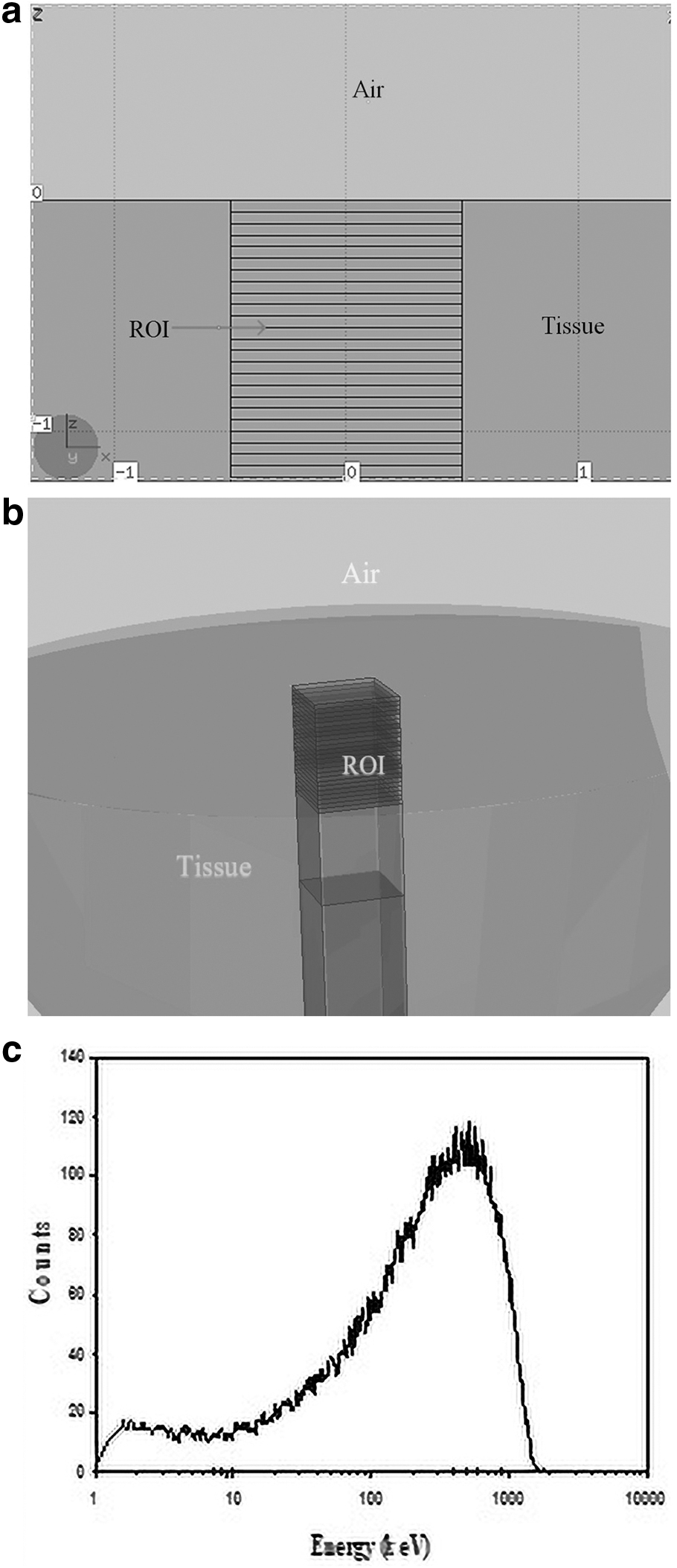
Geometric plot showing air, tissue, and ROI, that is, consequent voxels of size 1.0 × 1.0 × 0.05.
The energy spectrum of 90Y used in calculations was based on a spectrum reported by Lars Jødal with a mean energy of 0.934 MeV (Fig. 2c). 15,16 A uniform rectangular spread of 90Y beta source (size 3 × 3 cm2) over the tissue was considered. The large area was considered to compensate for the loss of energy to adjacent columns.
Results
90Sr-90Y generator
90Y acetate was obtained from an in-house 90Sr-90Y generator system with a high radioactive concentration (RAC) of ∼1665 MBq/mL at pH 2.5 suitable for preparation of therapeutic sources. Quality control parameters of 90Y acetate used for the study are reported elsewhere. 17
Fabrication and characterization of amidoxime-functionalized PVDF membranes
PAN-PVDF membranes were successfully synthesized. The thickness of the membrane was 210 ± 20 μm. The presence of amidoxime groups on the surface-modified PAN-PVDF membrane was ascertained by a visual color test using Fe (III) solution, wherein the film color changed from yellow to brownish red due to the uptake of Fe (III) ions, as shown in Figure 3a. This result could also be corroborated by the FT-IR analysis of amidoxime-PAN-PVDF membranes in comparison with unmodified membranes.

The FT-IR spectra of the membrane and its surface-modified counterpart are depicted in Figure 3b. In the spectrum of the PAN-PVDF membrane, the characteristic peak of the cyano group can be seen at 2243 cm−1. This peak is absent in the spectrum of amidoxime-PAN-PVDF, which confirms the complete conversion of the nitrile group of PAN to amidoxime in the surface-modified PVDF membrane.
The asymmetric and symmetric stretching vibrations and bending vibrations of the aliphatic CH2 groups give rise to peaks at 3022, 2988, and 1403 cm−1 in both the samples, while the peak at 1658 cm−1 is attributable to the C = O stretching vibrations. The C–F stretching vibrations of PVDF give rise to the peak at 838 cm−1. The spectra of PAN-PVDF and amidoxime-PAN-PVDF differ only in the peaks due to the cyano group (present in the former), which substantiates conversion of only the cyano group to the amidoxime group.
Optimization of parameters for uptake of 90Y on amidoxime-PAN-PVDF membranes
To optimize experimental variables that influence the uptake of 90Y ions on amidoximated PAN-PVDF membranes, pH of the solution, carrier yttrium concentration, and time of incubation were studied. The % uptake of 90Y in membranes at different pH values is depicted in Figure 4a. The figure reveals that sorption of 90Y on the surface-modified polymer membrane increases with pH from pH 2 to pH 6, followed by a decrease in uptake at pH 7 and pH 8. Since the highest uptake of 90Y, that is, 95.1% ± 1.56%, was observed at pH 6 after 3 h of incubation, further studies were carried out at pH 6.
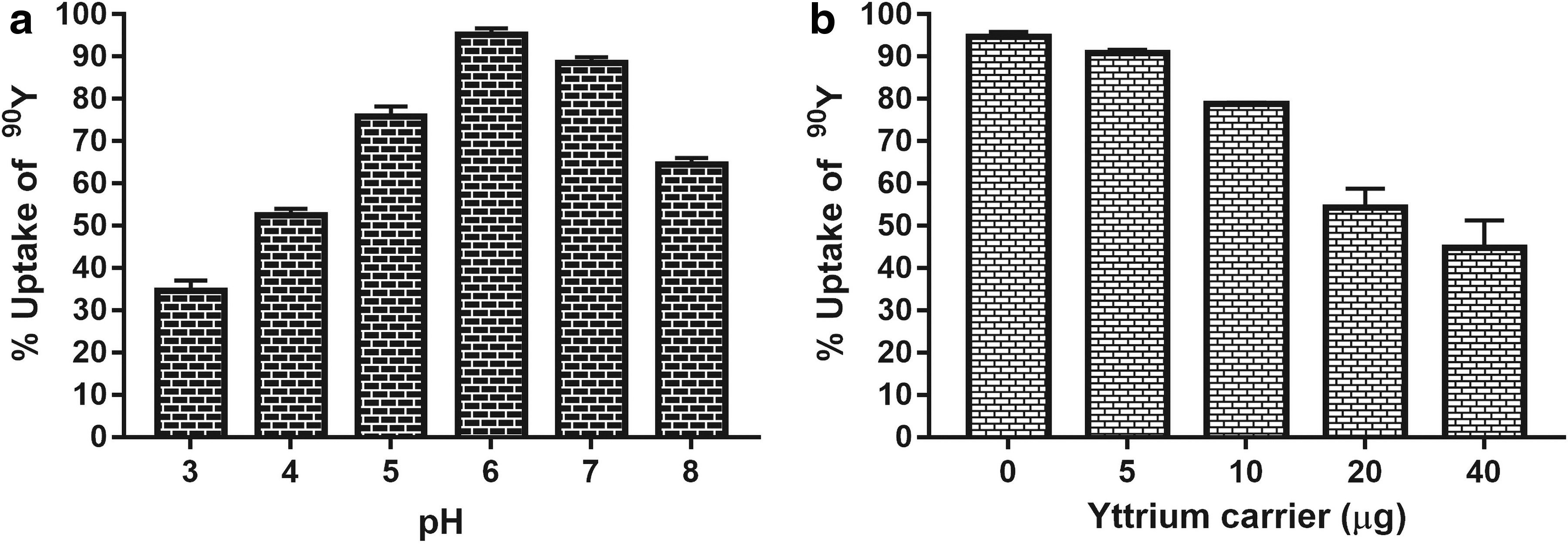
Optimization of 90Y uptake.
The sorption of yttrium ions on amidoximated PAN-PVDF membranes is also influenced by the concentration of yttrium ions in the solution. The effect of addition of carrier 89Y on uptake of 90Y on the membranes is depicted in Figure 4b. Greater than 90% of 90Y activity in the solution could be adsorbed on the membranes in the presence of 5 μg of carrier 89Y when incubated for 3 h. The optimized volume of solution for studying uptake in 1 × 1-cm membranes was 1 mL in the tubes with constant stirring.
By increasing the incubation time beyond 3 h, further increase in sorption of 90Y was observed, with 88% uptake in the presence of 10 μg of carrier after 6 h, revealing that amidoximated PAN-PVDF membranes have still higher capacity to adsorb 90Y. However, considering the relatively short half-life of 90Y, an incubation time of 3 h was used for further studies.
Characterization and quality control analysis of sources
Therapeutic sources incorporating 90Y into the functionalized membranes were successfully prepared. Schematics of source preparation are depicted in Figure 5. Nitrogen and oxygen atoms in the functional group, amidoxime, serve as donor atoms toward the formation of coordinate covalent bonds and result in 90Y complexation. The formation of polyamidoxime using PAN and the probable structure of the complex formed after chelation of 90Y to the amidoxime groups on the surface of the PAN-PVDF membrane are depicted in Figure 6.

Schematics of 90Y source preparation.

Structure.
Integrity and leachability evaluation of 90Y sources
Results of leaching experiments with different solutions and temperatures using bare sources are depicted in Table 1. Among different solutions tested for stability studies, minimal leaching of activity from bare sources was observed in PBS and at 45°C. However, when sources were laminated and tested under similar conditions, no activity leached out into the solution when studied up to 24 h.
Stability of 90Y Sources (18.5 ± 0.5 MBq) at Different Time Intervals (n = 3)
Values are given as mean ± SD.
After lamination of 90Y sources, no activity was observed in the wet cotton swipes when checked for surface contamination.
Autoradiography studies
Confirmatory evidence for the homogeneous distribution of 90Y on amidoximated PAN-PVDF membranes could be obtained from the autoradiography pattern (Fig. 7) on the X-ray film kept in contact with the source for different time intervals.
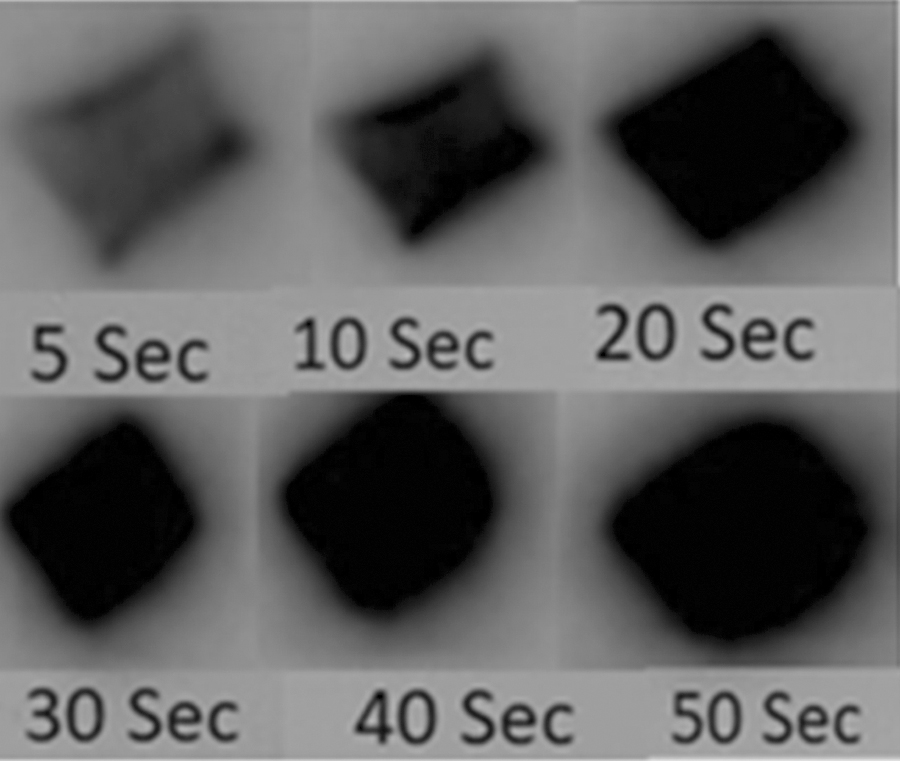
Autoradiography images of the 90Y therapeutic source.
ED-XRF analyses
Results of ED-XRF analysis of the yttrium-loaded membrane in comparison with a blank membrane are shown in Figure 8. In the spectrum of the yttrium-loaded membrane, sharp peaks at 14.9 and 16.7 keV corresponding to Kα and Kβ validate the presence of yttrium in the sample. These peaks are absent in the corresponding spectrum of the unloaded membrane.
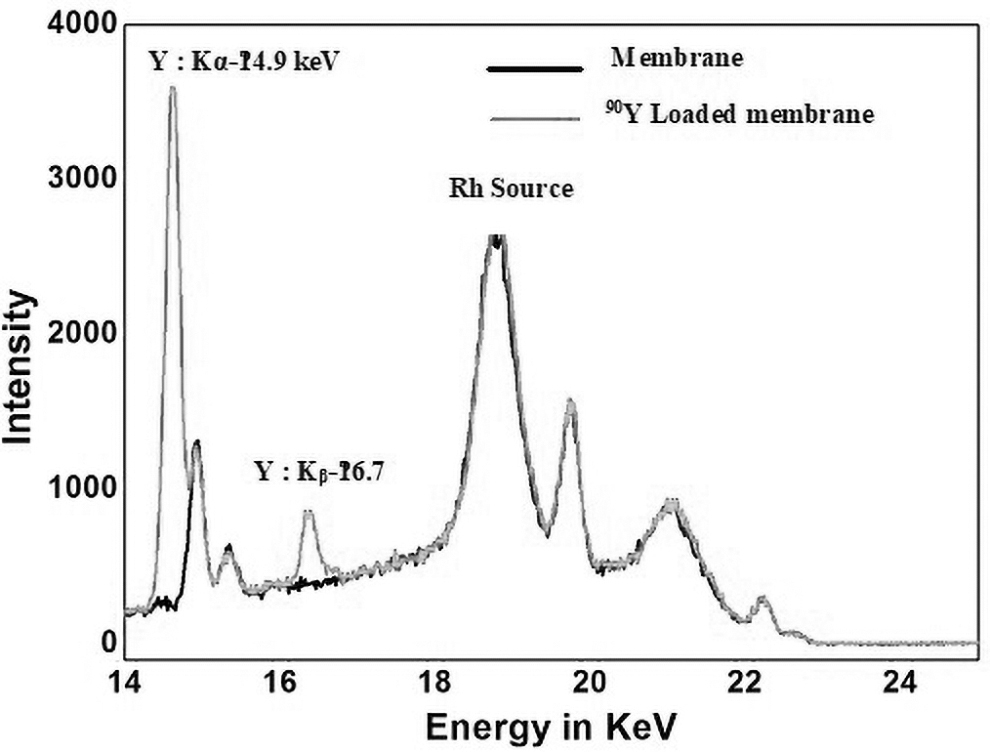
ED-XRF spectrum of (a) blank membrane (black color) and (b) Y-loaded membrane (gray color). ED-XRF, energy-dispersive X-ray fluorescence.
Preparation of 90Y therapeutic sources
Yttrium-90 therapeutic sources could be easily prepared in a very short duration of 3 h with activity levels up to 111 MBq/cm2 of the functionalized membranes.
Dosimetry studies
The dose deposited on each cell per 37 MBq of activity per hour was calculated and plotted against tissue depth (mm), as shown in Figure 9. The dose rate decreases rapidly with tissue depth; 60% of the total β − -energy is deposited up to a depth of 1.5 mm, 80% till 2.5 mm, and 92% within 4 mm.
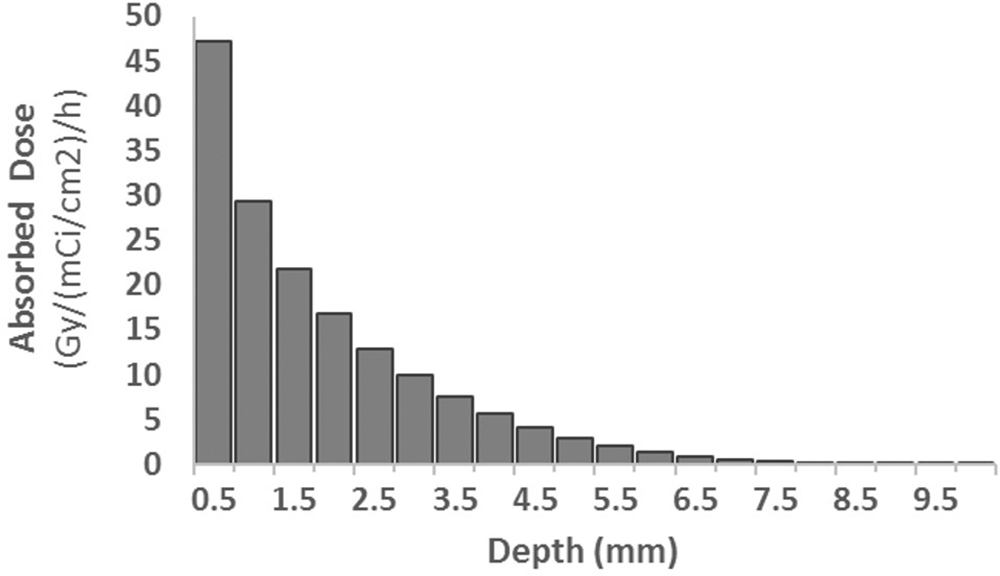
Dose–rate curve showing the theoretical dose deposited by the 90Y source at different tissue depths.
Discussion
The design, fabrication, and clinical utility of functionalized polymers have witnessed a meteoric rise in recent times. 18 Synthetic polymeric materials such as polyvinylidene fluoride (PVDF) are extensively used for various biomedical applications due to their suitable physicochemical properties and amenability for blending with other polymers for improving their properties. 19,20
Polyacrylonitrile (PAN) is another synthetic organic polymer with repeating nitrile groups that can be chemically modified for refining its physicochemical and biological properties. There are several reports on fabrication of composite PAN-PVDF membranes for various applications. 21,22
In the recent past, development and clinical translation of custom-made radioactive sources incorporating radioisotopes emitting β − radiations having β − energy greater than 1.5 MeV (90Y, 32P, 188Re, and 166Ho) for management of superficial skin tumors, Bowen's disease, and keloids are reported. 7 –10 In this mode of brachytherapy, the radiation source is applied onto the lesion for a fixed time interval depending upon the dose required for imparting therapeutic benefit. This mode of therapy is especially beneficial in situations wherein surgery is not advised either owing to the location of the tumor at critical areas or due to concerns related to esthetic factors.
Lee
Encouraged by these studies, the authors worked on the preparation of 90Y, 188Re, and 32P radioactive bandages and showed the effectiveness of these sources in preclinical animal models. 8 –10 However, strategies for incorporation of radionuclides in such sources were initial preparation of radioactive colloids or microspheres and filtration on membranes, followed by insertion between thin cellophane sheets. Although easy to prepare, sources fabricated using such methods involved filtration of radioactive colloids on membranes which might impart dose to the operator while fabrication. Moreover, leaching of activity from the sources is also possible as colloidal particles are adsorbed on the surface of the membranes.
Among the radionuclides used for such application, 90Y was chosen mainly because of its ideal nuclear characteristics for such application, that is, pure beta emission, no gamma emission, and suitable half-life. 90Y is advantageous due to high-energy β − particles that are in direct contact with the lesion with rapid dose fall off and no damage to underlying bony structures and surrounding healthy tissues. A suitable half-life of 64 h is ideal for preparation of sources, transport, and clinical application for treatment of skin lesions for few hours or days.
Availability of the 90Sr/90Y generator was an added advantage for carrying out this work. However, such sources can be prepared using low specific activity 90Y prepared using the 89Y target in a reactor by the (n, γ) route.
The focus of this work was to demonstrate the utility of functionalized, thin polymer membranes based on PAN-PVDF in fabrication of radioactive sources to overcome limitations of sources reported till now. In this work, PAN-PVDF membranes prepared by phase inversion were suitably functionalized to facilitate the uptake of metal ions wherein the cyano group of PAN was converted to amidoxime. A qualitative visual color test, as well as FT-IR analysis, was used for characterization.
High and stable uptake of 90Y ions on the amidoxime-PAN-PVDF membranes could be demonstrated under optimized reaction conditions. Leaching experiments using bare and laminated sources in different solutions (mimicking biological fluids) stored at different temperatures to probe storage resilience and inertness confirmed the stability of the source due to strong binding of 90Y ions to the amidoxime groups on the membrane surface.
An autoradiography study established the uniform distribution of 90Y, while ED-XRF studies using carrier yttrium-loaded membranes confirmed the presence of yttrium. In this study, a reliable method could be established for radioactive source preparation toward the possible treatment of superficial skin tumors and keloids. Moreover, 90Y for the study was obtained from an indigenous 90Sr-90Y generator easily scalable to elute higher 90Y activities.
As per GEC-ESTRO ACROP recommendations for skin brachytherapy, therapeutic doses can be delivered as a superficial application or as interstitial brachytherapy for tumors thicker than 5 mm. As per the dose–rate graph, 90Y therapeutic sources deposit maximum β − -energy till a depth of 5 mm with a dose rate as high as 48 Gy/mCi/cm2/h on the surface. 23
For large-scale preparation of 90Y sources, amidoxime-loaded PAN-PVDF membranes can be easily synthesized and characterized. The 90Sr/90Y generator from a commercial source can be employed as a source of 90Y, provided that 90Y is available in high RAC and the pH of the eluate is adjustable to pH 6 for maximum incorporation in membranes. Since source preparation requires only incubation of membranes in acetate solution (pH 6) for 3 h, followed by washing, many such sources can be prepared simultaneously using the standardized method.
It could be established from this study that leaching of radioactivity is minimal, even from unlaminated sources. For clinical applications, the source has to be laminated or encased inside thin cellophane sheets. After that step, estimation of surface contamination for radiation protection of staff during application of the source should be ensured.
While this study was performed with 90Y ions, other radiolanthanides such as 177Lu and 166Ho ions are also expected to behave similar to 90Y ions, and sources with such radioisotopes can be fabricated for varied applications. Additionally, these therapeutic sources can be tailor-made as per the tumor shape, location, size, and histological pattern.
This strategy can be easily translated for large-scale preparation of custom-made sources of varying dimensions for effective management of superficial skin cancers and keloids.
Conclusions
In this study, a simple and efficacious method for preparation of mold brachytherapy sources by the uptake of 90Y on functionalized PAN-PVDF membranes could be established. The standardized method can be easily utilized for large-scale fabrication of custom-made 90Y sources of different sizes and shapes for personalized treatment of cancers.
Footnotes
Acknowledgments
Dr. P.K. Pujari, Director, Radiochemistry & Isotope Group, BARC, is acknowledged for his support and encouragement. The authors would like to thank Smt. Smitha Manohar, Head, Fuel Reprocessing Division, BARC, for providing access to 90Y activity. The help provided by Mr. A.S. Tapase, Isotope and Radiation Application Division, BARC, for autoradiography is gratefully acknowledged.
Authors' Contributions
A.M. was involved in conceptualization, development of 90Y sources and characterization studies, and manuscript preparation; U.P. was involved in conceptualization and manuscript preparation; S.H.S. and S.A.K. were involved in synthesis and characterization of PAN-PVDF membranes; M.K. was involved in characterization studies; V.K. was involved in dosimetry studies; and P.J. and P.S.D. were involved in 90Y separation from the generator. All coauthors have reviewed and approved the manuscript before submission.
Disclosure Statement
No competing financial interests exist.
Funding Information
Research at the Bhabha Atomic Research Centre (BARC) is part of the ongoing activities of the Department of Atomic Energy, India, and is fully supported by government funding.