




Abstract
Background:
Circular RNAs (circ-RNAs) have been demonstrated to influence initiation, drug resistance, and metastasis of tumors. However, the effects of circular-phosphoglycerate mutase 1 (circ-PGAM1) on matrine resistance in nonsmall cell lung cancer (NSCLC) remain unknown.
Materials and Methods:
The reverse transcription–quantitative polymerase chain reaction (RT-qPCR) was used to determine gene expression. The terminal deoxynucleotidyl transferase dUTP nick end labeling (TUNEL) and cell colony formation assays were used to evaluate NSCLC apoptosis and cell proliferation after indicated treatments, respectively.
Results:
circ-PGAM1 was upregulated in human NSCLC cell lines (H1299 and A549) compared with the human normal lung epithelial (BEAS-2B) cells. circ-PGAM1 overexpression reversed the matrine treatment-induced inhibition on proliferation of NSCLC cells (A549 and H1299) and rescued the matrine treatment-stimulated apoptosis of these cells. miR-326 was demonstrated to interact with circ-PGAM1. circ-PGAM1 knockdown enhanced the antitumor effect of matrine on NSCLC cell proliferation and apoptosis, which was reversed by miR-326 inhibition. The authors also identified CXCR5 as a key downstream target of miR-326 in A549 cells.
Conclusions:
circ-PGAM1 enhances matrine resistance of NSCLC cells through the miR-326/CXCR5 axis. The authors' findings provide new insights into NSCLC-targeted therapy.
Introduction
Lung cancer (LC) is the second most commonly diagnosed malignancy and a leading cause of cancer death, with an estimated 1.8 million deaths in 2020. 1 According to histological classification, LC is mainly divided into two subtypes: small cell lung cancer (SCLC) and nonsmall cell lung cancer (NSCLC), and NSCLC accounts for ∼85% of all LC cases. 2 Current treatment options for NSCLC mainly include surgery, radiotherapy, chemotherapy, and targeted therapy.
However, the prognosis of NSCLC patients is still unsatisfactory, and the 5-year survival rate of NSCLC patients with stage II to stage III cancer is less than 13%–60%. 3 Chemoresistance remains a challenge that hinders the improvement of clinical outcomes. Therefore, it is imperative to understand the underlying mechanism of chemoresistance in the treatment of NSCLC.
Matrine is an alkaloid extracted from Sophora flavescens 4 and has been reported to have anti-inflammatory, antiviral, and anticancer activities. 5 –7 Previous studies have suggested that matrine inhibits cancer development by regulating the proliferation- and apoptosis-associated pathways. 7,8 As a natural anticancer agent, matrine has been observed to suppress cell proliferation, cell cycle processes, migration, and invasion in NSCLC by regulating the circFUT8/miR-944/YES1 axis. 9
Matrine is also reported to induce cell cycle arrest and apoptosis of NSCLC cells (A549) by upregulating miR-126. 10 However, tumor cells can acquire resistance to matrine, thus exploration of the underlying mechanism of matrine resistance in NSCLC is of clinical significance.
Circular RNAs (circ-RNAs) are a type of noncoding RNAs with a closed-loop structure and are more stable than their linear RNAs. 11 They are reported to regulate critical gene expression through multiple mechanisms, the competing endogenous RNA network included. 12 Previous studies indicate that circ-RNAs are implicated in cancer-related processes, such as tumorigenesis, development, and chemoresistance. 13
For example, circUSP7 suppresses CD8+ T cell function and induces anti-PD1 resistance by binding with miR-934 to regulate SHP2 in NSCLC. circ-RNA_100565 enhances the resistance of NSCLC cells to cisplatin by regulating the miR-337-3p/ADAM28 axis. 14 circ-RNA_102481 promotes EGFR-TKI resistance of NSCLC cells by interacting with miR-30a-5p to upregulate the ROR1 axis. 15
Circular-phosphoglycerate mutase 1 (circ-PGAM1) is generated by back-splicing from pre-mRNA PGAM1. A previous study demonstrated that circ-PGAM1 (hsa_circ_0019340) contributes to tumorigenesis in epithelial ovarian cancer by influencing the miR-542-3p/CDC5L/PEAK1 pathway. 16 circ-PGAM1 is also reported to enhance the cisplatin resistance of laryngocarcinoma cells by sponging miR-376a. 17 However, the function of circ-PGAM1 in NSCLC is rarely explored.
In this study, the authors explored the function and molecular mechanism of circ-PGAM1 in matrine resistance of NSCLC cells. The effects of circ-PGAM1 overexpression or knockdown on proliferation and apoptosis of NSCLC cells treated with matrine were examined, and the downstream regulatory mechanism was elucidated. The findings of this study may provide novel therapeutic targets against drug resistance in NSCLC.
Materials and Methods
Cell culture
Human NSCLC (H1299, cat. No. TCHu160; and A549, cat. No. TCHu150) and human normal lung epithelial (BEAS-2B) cells were purchased from the Cell Bank of the Chinese Academy of Sciences (Shanghai, China). All cells were grown in Dulbecco's modified Eagle's medium (Thermo Fisher Scientific, Inc.) supplemented with 10% fetal bovine serum (Thermo Fisher Scientific, Inc.) and 1% streptomycin/penicillin (Sigma-Aldrich, Shanghai, China).
BEAS-2B cells, extracted from normal human lung epithelial cells (cat. No. CRL-9609), were purchased from the American Type Culture Collection (Manassas, VA). These cells were grown using the basal medium (BEBM) for this cell line. All additives required for the growth of this cell line were obtained from Lonza Corporation (Portsmouth, NH; CC-3170).
The cell culture condition was 37°C with 5% CO2. NSCLC cells were treated with 8 μM matrine (M5319; Sigma-Aldrich) in this investigation.
Transfection
For circ-PGAM1 silencing or overexpression, small interfering (si)-circ-PGAM1 and pcDNA3.1/circ-PGAM1 were designed and constructed by Sangon (Shanghai, China). For miR-326 overexpression or silencing, miR-326 mimics and inhibitor were provided by GenePharma (Shanghai, China). For CXCR5 overexpression, pcDNA3.1/CXCR5 and corresponding negative control (NC) vectors were purchased from GenePharma.
Cells were transiently transfected with small interfering (si)-circ-PGAM1, miR-326 mimic, or control (si-NC) at concentrations of 50 nM using Lipofectamine 2000 (Invitrogen, Carlsbad, CA). Cells were collected for analysis at 48 h after transfection. The sequences were as follows:
si-NC: CUACUUCGGAUCCAGUCGAAU and
si-circ-PGAM1: AUGUGCAAUAGAUCGCAGGUA.
Colony formation assay
H1299 and A549 after indicated treatments were grown in each well (at ∼5 × 10³ cells/per well) of a 12-well plate. After 1 week of culture at 37°C with 5% CO2, cells were washed with PBS thrice and fixed in 4% formaldehyde for 10 min at room temperature. Next, crystal violet solution (0.05%; Sigma-Aldrich) was used to stain the cell colonies for 1 h at room temperature.
Finally, the colony number was manually counted under a light microscope (Nikon, Japan). 18
TUNEL assay
H1299 and A549 cells were seeded onto coverslips fixed with 4% formaldehyde fixation for 10 min, treated with protease K (Thermo Fisher Scientific, Inc.), and blocked with 5% BSA (Thermo Fisher Scientific, Inc.) for this experiment. The extent of apoptosis was then determined using the TUNEL assay (Beyotime, Haimen, China) by treatment with TUNEL reaction solution for 1 h at 37°C according to the manufacturer's instructions.
4′,6-Diamidino-2-phenylindole dye (Beyotime) was employed to stain cell nuclei. Images were obtained using a fluorescence microscope with 200 × magnification. Five visual fields were randomly chosen and observed under a light microscope, and the apoptosis rate was calculated as the ratio of the number of TUNEL-positive cells to total cells. 19
Reverse transcription–quantitative polymerase chain reaction
Total RNA was extracted from NSCLC cells by employing TRIzol reagent (Invitrogen). Subsequently, a PrimeScript RT reagent kit (Takara, Beijing, China) was used with ∼1 μg of total RNA to produce cDNA. The SYBR Green reagent (Thermo Fisher Scientific, Inc.) was used to conduct the reverse transcription–quantitative polymerase chain reaction (RT-qPCR). Gene expression levels were calculated using the 2−ΔΔCt method. 20 GAPDH served as the internal control for circ-PGAM1 and CXCR5, and U6 served as the internal control for miR-326.
The primer sequences were as follows:
circ-PGAM1, forward: CACATGGGTCCAGTGTTCAT,
reverse: TTCATTCCAGAAGGGCAGAG;
miR-326, forward: ATCTGTCTGTTGGGCTGGAG,
reverse: CCACCCGCCTTCACAAAG;
CXCR5, forward: CCATGCTCTACACTTTCGCC,
reverse: AGAACGTGGTGAGAGAGGTG; and
β-actin, forward: TGGCACCACACCTTCTACAA,
reverse: CCAGAGGCGTACAGGGATAG.
Cancer genome atlas
The lung adenocarcinoma dataset (347 normal and 483 tumor tissues) was downloaded from The Cancer Genome Atlas (TCGA) and analyzed. Relative expression and overall survival were determined.
Statistical analyses
All experiments were conducted with three replicates to calculate the mean ± standard deviation. Statistical analyses were performed using Prism 6.0 software (GraphPad, La Jolla, CA). The unpaired Student's t-test and one-way analysis of variance, followed by Tukey's post hoc test, were used to compare the results of two or more groups, respectively. p < 0.05 was considered as significant.
Results
Overexpression of circ-PGAM1 enhanced the resistance of NSCLC cells to matrine
To investigate the biological activity of circ-PGAM1 in matrine-induced regression of NSCLC, H1299 and A549 cells were transfected with pcDNA3.1-circ-PGAM1, and the overexpression efficiency of circ-PGAM1 was verified by RT-qPCR (p < 0.0001 [A549]; and p < 0.0001 [H1299]) (Fig. 1A).
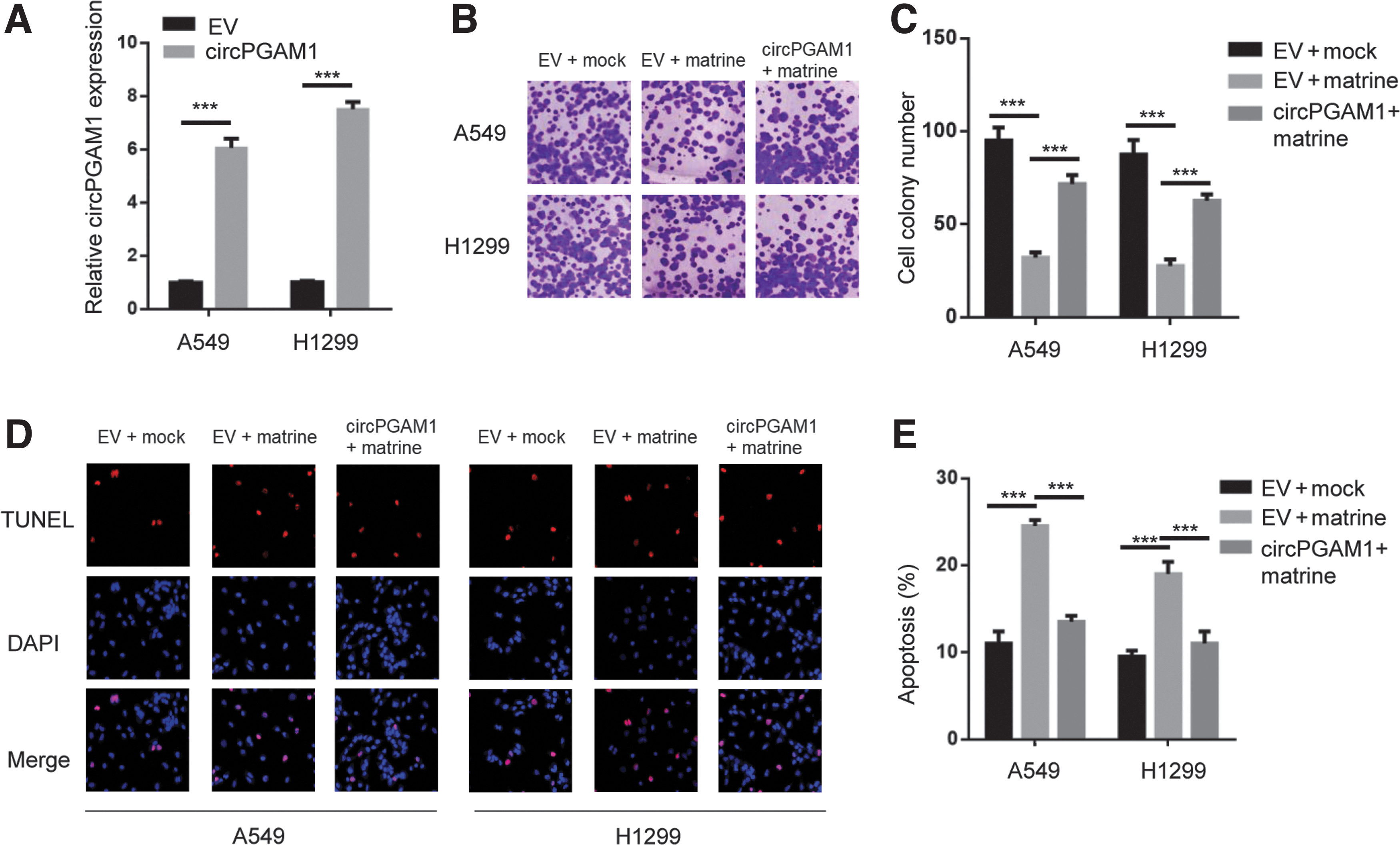
Overexpression of circ-PGAM1 increases the resistance of nonsmall cell lung cancer cells to matrine.
As determined by the colony formation assay, matrine treatment significantly decreased the number of colonies formed by both H1299 and A549 cells, while circ-PGAM1 overexpression significantly increased the colony number compared with matrine treatment alone (p < 0.0001 for both A549 and H1299 [EV+mock vs. EV+matrine]; and p < 0.0001 for both A549 and H1299 [EV+matrine vs. circ-PGAM1+matrine]) (Fig. 1B, C).
Similarly, matrine treatment alone enhanced the apoptosis of both A549 and H1299 cells, which was reversed by circ-PGAM1 overexpression (p < 0.0001 for both A549 and H1299 [EV+mock vs. EV+matrine]; and p < 0.0001 for both A549 and H1299 [EV+matrine vs. circ-PGAM1+matrine]) (Fig. 1D, E). In conclusion, circ-PGAM1 promoted the chemoresistance of NSCLC cells to matrine.
miR-326 inhibition reversed the decreased chemoresistance caused by circ-PGAM1 knockdown
Based on the starBase online prediction program, miR-326 was identified as a possible target of circ-PGAM1 (Fig. 2A). miR-326 overexpression substantially inhibited circ-PGAM1 expression (p < 0.0001 [NC mimic vs. miR-326 mimic]), while miR-326 inhibition upregulated circ-PGAM1 expression (p < 0.0001 [NC inhibitor vs. miR-326 inhibitor]) in NSCLC cells (Fig. 2B).

miR-326 is important for attenuating chemoresistance caused by circ-PGAM1 knockdown.
circ-PGAM1 knockdown significantly suppressed the colony formation ability of A549 cells treated with matrine (p < 0.0001 [si-NC vs. si-circ-PGAM1]), which was partially rescued by transfection of the miR-326 inhibitor (p < 0.0001 [si-circ-PGAM1 vs. si-circ-PGAM1+miR-326 inhibitor]) (Fig. 2C, D).
Moreover, circ-PGAM1 knockdown contributed to the increased apoptosis of A549 cells treated with matrine (p < 0.0001 [si-NC vs. si-circ-PGAM1]), which was reversed by transfection of the miR-326 inhibitor (p < 0.0001 [si-circ-PGAM1 vs. si-circ-PGAM1+miR-326 inhibitor]) (Fig. 2E, F). Overall, data suggested that circ-PGAM1 mediated chemoresistance of NSCLC cells by regulating miR-326.
CXCR5 was targeted by miR-326 in NSCLC cells
Next, CXCR5 was identified as a downstream target for miR-326 according to TargetScan prediction (Fig. 3A). RT-qPCR results showed that the miR-326 mimic significantly suppressed CXCR5 expression (p < 0.0001 [NC vs. miR-326]), whereas its level was elevated by CXCR5 overexpression compared with the miR-326 mimic alone (p < 0.0001 [miR-326 vs. miR-326+CXCR5]) (Fig. 3B).
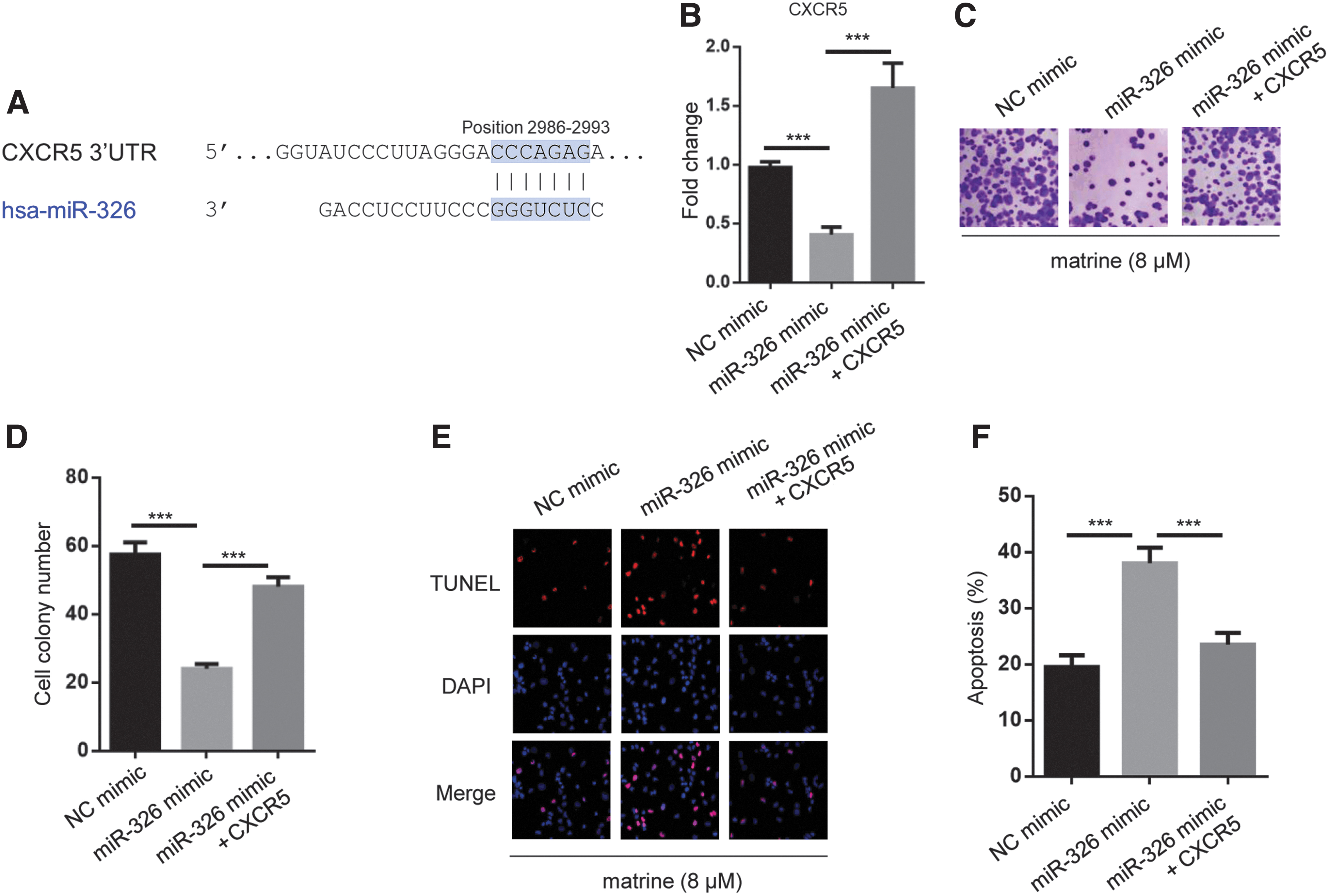
CXCR5 is a crucial miR-326 downstream effector in nonsmall cell lung cancer cells.
Transfection of the miR-326 mimic significantly decreased the colony number of A549 cells (p < 0.0001 [NC vs. miR-326]), while CXCR5 stimulated cell proliferation under matrine treatment (p < 0.0001 [miR-326 vs. miR-326+CXCR5]) (Fig. 3C, D). Furthermore, miR-326 overexpression increased apoptosis in A549 cells treated with matrine (p < 0.0001 [NC vs. miR-326]), which was reversed by CXCR5 overexpression (p < 0.0001 [miR-326 vs. miR-326+CXCR5]) (Fig. 3E, F).
These data indicate the crucial role of CXCR5 in chemoresistance of NSCLC cells.
circ-PGAM1 was involved in clinical lung tumor progression
To examine the role of circ-PGAM1 in lung cancer, the authors first measured the circ-PGAM1 level in NSCLC cells and normal BEAS-2B cells. In comparison with BEAS-2B cells, the circ-PGAM1 level was significantly upregulated in H1299 and A549 cells (p < 0.0001 [BEAS-2B vs. A549]; and p < 0.0001 [BEAS-2B vs. H1299]) (Fig. 4A).

circ-PGAM1 is involved in clinical lung tumor progression.
The authors also analyzed TCGA dataset of lung adenocarcinoma and found that circ-PGAM1 was upregulated in tumor samples (p = 0.0017 < 0.01) (Fig. 4B). More importantly, lung cancer patients with high circ-PGAM1 expression had poor overall survival than patients with low circ-PGAM1 expression (p = 0.018 < 0.05) (Fig. 4C).
Overall, the results suggested that circ-PGAM1 was closely associated with lung cancer progression.
Discussion
In the present study, the authors found that circ-PGAM1 was upregulated in NSCLC cell lines. The treatment with matrine significantly suppressed the proliferation potential and induced apoptosis of NSCLC cells, which was demonstrated to be reversed after circ-PGAM1 overexpression, while the knockdown of circ-PGAM1 enhanced the antitumor effects of matrine on NSCLC proliferation and apoptosis. Moreover, the authors found that circ-PGAM1 facilitated the matrine resistance of NSCLC cells by regulating the miR-326/CXCR5 axis.
Surgery, chemotherapy, and radiotherapy are common treatment options for NSCLC patients. 21 However, the resistance of NSCLC cells to chemotherapeutic drugs limits their treatment efficacy in the clinic. 22,23 Matrine has been recognized as an effective therapy for NSCLC. 24 In this study, the authors observed that matrine treatment led to significant inhibition of NSCLC colony formation and significantly enhanced the apoptosis of NSCLC cells. circ-PGAM1 is reported to enhance the drug resistance of laryngocarcinoma cells to cisplatin. 17
In the current study, the authors explored the effect of circ-PGAM1 overexpression or silencing on matrine-treated NSCLC cells. They found that overexpression of circ-PGAM1 reversed the matrine treatment-induced inhibition on proliferation of NSCLC cells as well as elevation in NSCLC cell apoptosis, which was consistent with previous studies.
MicroRNAs (miRNAs) are small noncoding RNA transcripts (∼22 nucleotides) that inhibit target gene expression by binding to the 3′-untranslated region of target mRNAs. 25 They are involved in multiple biological processes, including tumor proliferation, invasion, and chemoresistance. 26,27 miR-326 has been reported as a promising biomarker in cancer, 28,29 and some studies have reported that miR-326 is downregulated in NSCLC tissues and cells and suppresses NSCLC development and enhances drug sensitivity. 30,31
In this study, the authors found that miR-326 interacted with circ-PGAM1 and its overexpression significantly inhibited cell proliferation and promoted cell apoptosis in NSCLC. The rescue assays revealed that inhibition of miR-326 reversed the enhanced antitumor effect of circ-PGAM1 silencing on proliferation and apoptosis of matrine-treated NSCLC cells.
CXCR5 is directly targeted by miR-326. It is one of the membranes of the CXC chemokines, 8–10 kDa proteins that are critically involved in tumor cell growth and survival and metastasis during cancer progression. 32 Previous studies have indicated that CXCR5 levels are upregulated and correlated with migration and metastasis of NSCLC, and CXCR5 is suggested to be an independent prognostic factor for survival in lung cancer patients. 33,34
In the current study, the authors found that CXCR5 expression was negatively regulated by miR-326 in NSCLC cells and CXCR5 overexpression reversed the anticancer effects induced by miR-326 upregulation on matrine-treated NSCLC cells.
In conclusion, circ-PGAM1 is upregulated in NSCLC cells and its overexpression enhances the matrine resistance of NSCLC cells by inhibiting cell proliferation and promoting apoptosis through regulation of the miR-326/CXCR5 axis. The findings of this study may provide an insight into matrine resistance in NSCLC.
Footnotes
Authors' Contributions
G.Z. designed the research, gave key advice, integrated data, prepared figures, and wrote the manuscript. C.D. carried out all the experiments. G.Z. and C.D. performed the statistical analysis. L.Y. provided essential assistance. All authors reviewed the final manuscript.
Disclosure Statement
The authors declare that there are no conflicts of interest.
Funding Information
This work was supported by grants from the Ningbo Medical and Health Brand Discipline.