




Abstract
Background:
Selective internal radiation therapy (SIRT) using a suitable β−-emitting radionuclide is a promising treatment modality for unresectable liver carcinoma. Yttrium-90 (90Y) [T 1/2 = 64.2 h, E β(max) = 2.28 MeV, no detectable γ-photon] is the most preferred radioisotope for SIRT owing to its favorable decay characteristics.
Objective:
The present study describes indigenous development and evaluation of intrinsically radiolabeled [90Y]yttria alumino silicate ([90Y]YAS) glass microsphere, a formulation biosimilar to “TheraSphere” (commercially available, U.S. FDA-approved formulation), for SIRT of unresectable liver carcinoma in human patients.
Methods:
YAS glass microspheres of composition 40Y2O3-20Al2O3-40SiO2 (w/w) and diameter ranging between 20 and 36 μm were synthesized with almost 100% conversion efficiency and >99% sphericity. Intrinsically labeled [90Y]YAS glass microspheres were produced by thermal neutron irradiation of cold YAS glass microspheres in a research reactor. Subsequent to in vitro evaluations and in vivo studies in healthy Wistar rats, customized doses of [90Y]YAS glass microspheres were administered in human patients.
Results:
[90Y]YAS glass microspheres were produced with 137.7 ± 8.6 MBq/mg YAS glass (∼6800 Bq per microsphere) specific activity and 99.94% ± 0.02% radionuclidic purity at the end of irradiation. The formulation exhibited excellent in vitro stability in human serum and showed >97% retention in the liver up to 7 d post-administration when biodistribution studies were carried out in healthy Wistar rats. Yttrium-90 positron emission tomography scans recorded at different time points post-administration of customized dose of [90Y]YAS glass microspheres in human patients showed near-quantitative retention of the formulation in the injected lobe.
Conclusions:
The study confirmed the suitability of indigenously prepared [90Y]YAS glass microspheres for clinical use in the treatment of unresectable hepatocellular carcinoma.
Introduction
Primary as well as metastatic liver malignancies have emerged as serious heath challenge and, currently, one of the most prevalent causes of cancer-related deaths worldwide. 1 –4 Among the different types of liver malignancies, hepatocellular carcinoma is the most prevalent and accounts for around 90% of liver cancer cases globally. 2,4,5 Selective internal radiation therapy (SIRT) using a suitable β−-emitting radionuclide is one of the most promising treatment modalities of unresectable liver carcinoma. 6 –11 Intrinsically [90Y]Y-labeled glass microsphere formulation is the most widely used radiotherapeutic agent for SIRT. 6,10,11
Yttrium-90 (90Y) is a pure β−-emitter with a physical half-life of 64.2 h and decays to stable 90Zr by near exclusive β−-particle emission with maximum and average energy of 2.28 MeV and 937 keV, respectively. 10,11 The particulate emission from 90Y has mean tissue penetration of 2.5 mm and a maximum of 11 mm, 11 thereby effective in delivering cytotoxic dose to a large tumor mass. The [90Y]Yttria glass microsphere formulation that is most extensively used in SIRT across the globe is sourced from a commercial manufacturer in the name of TheraSphere®. 11 It is a radiochemical formulation consisting of millions of nonbiodegradable glass microspheres, having diameter in the range of 20–35 μm, in sterile physiological saline, and in which 90Y is an integral constituent of the glass. 12
For SIRT, [90Y]Yttria glass microspheres are administered via intra-arterial route through hepatic artery. Malignant liver tumors are generally highly vascular and receive the majority of their blood supply from the hepatic artery (80%–100%), compared with liver parenchyma, which receives its blood supply primarily from the portal vein. Therefore, the intra-arterial injection of [90Y]Yttria glass microspheres would primarily deliver ionizing radiation dose to the tumor in local or regional manner, whereas the dose to liver parenchyma would be considerably lower as hepatic artery provides only ∼25% of total hepatic blood flow. 13,14 Once administered in the hepatic artery, the microspheres preferentially lodge in the vasculature of the malignant hepatic cells and deliver cytotoxic doses of ionizing radiation from 90Y, normally around 50–1000 Gy in the treated liver tumor depending on size with median of ∼200 Gy. 15
One of the major constraints in the broader utility of [90Y]Yttria glass microsphere in the treatment of liver cancer is the prohibitively high cost of the dose of commercially available formulation for individual patient care. In India, the cost of treatment using ready-to-use formulation of TheraSphere imported from commercial manufacturer is $10,000–12,000, depending on the dose size. Taking it into consideration, it was felt pertinent to develop a new [90Y]Yttria glass microsphere formulation, which will be biosimilar to TheraSphere and can be made available at an affordable cost (within $1000 for each dose).
In this direction, yttria alumino silicate (YAS) glass microspheres having 20Al2O3-40SiO2-40Y2O3 (w/w) chemical composition and particle size in the range of 20–36 μm have been synthesized following the procedure developed indigenously and characterized. Intrinsically 90Y-labeled [90Y]YAS glass microspheres were produced by thermal neutron irradiation of cold microspheres at a suitable thermal neutron flux in a research reactor. In the present study, the authors report in detail the systematic approach following which intrinsically radiolabeled [90Y]YAS glass microsphere formulation, suitable for human clinical applications, was developed and evaluated as a biosimilar formulation to TheraSphere.
Experimental
Materials and equipment
Yttrium oxide, alumina, and silica used for the preparation of YAS glass were of spectroscopic grade and procured from Merck, GmbH. All chemicals and reagents used were of analytical grade. Medical grade sterile saline and water for injection were used. High purity irradiation grade quartz tubes were used for encapsulation of YAS glass microspheres for irradiation.
Powder X-ray diffractometer (XRD; Bruker D8 Discover Instrument) with collimated CuKα radiation source was performed to confirm the glassy nature of the prepared glass and glass microspheres. Scanning electron microscope (SEM) images of the glass microspheres were acquired using SEM model: Stereoscan S-240 (Cambridge, United Kingdom). Chemical analysis was carried out by energy dispersive X-ray fluorescence (EDXRF) technique (EDXRF spectrometer EX 3600M; Xenemetrix, Israel), having Rh-anode X-ray tube and in-built acquisition and analysis software. Radioactivity of [90Y]Y-YAS glass microspheres produced was measured using a precalibrated isotope dose calibrator (Curiementor 3; PTW-Freiburg, Germany).
Radionuclidic purity of [90Y]YAS glass microsphere formulation was ascertained by γ-ray spectrometry using a HPGe detector (Canberra Eurisys, France) coupled to a PC-based 4K channel analyzer (MCA). A 152Eu reference source, obtained from Amersham, Inc., was used for energy and efficiency calibration of the HPGe detector. All the nuclear data used were taken from Table of Isotopes. 16 All other radioactivity measurements were carried out using a well-type NaI(Tl) scintillation counter (Mucha, Raytest, Germany), unless mentioned otherwise.
Synthesis of YAS glass microspheres
Glass preparation
Yttrium alumino silicate glass having composition 40Y2O3-20Al2O3-40SiO2 (wt%) was prepared by melt-quench process. High purity chemicals were used to ensure that chemical impurities which can be activated under neutron irradiation are avoided in raw material. Each batch of 100 g charge was prepared by weighing calculated amounts of initial constituents in the form of oxides. The batch was mixed thoroughly and heated at 110°C overnight to remove any moisture present. The mixture was melted in a Pt-Rh crucible in electrically heated R-L furnace at around 1550°C–1650°C and held for sufficient time to obtain a clear melt free from any air bubbles.
The melt was stirred and held for sufficient time to obtain a clear melt free from any air bubbles. The melt was removed from the furnace and quenched by pressing in between two metal plates to obtain small pieces of cracked glasses. The glassy nature of the prepared material was confirmed by XRD. Furthermore, the glass frits were slowly ground and sieved through 20 and 36 μm sieves to collect the feed particles in between 20 and 36 μm size range. The crushing and sieving processes were carried out repeatedly to collect sufficient amount of the feed particle of required sizes for spheroidization. At final stage, the feed particles are cleaned using air jet to remove any dust particle present with the feed particles.
Flame spheroidization
The glass feed particles are converted into glass microspheres by introducing them into oxy-hydrogen (O2-H2) flame. Before exposure to flame, glass particles were heated to remove moisture and agglomeration. The glass particles are directed into the flame through a feeder vibrated manually. The flame was conditioned by passing H2:O2 at a ratio of 2:1. The glass particles were exposed to the flame for a short time for melting and allowed to spheroidize due to surface tension followed by rapid cooling. The flame is directed into a quartz tube/container that collects the glass microspheres after being expelled from the flame. The schematic of flame spheroidization process is shown in Figure 1.
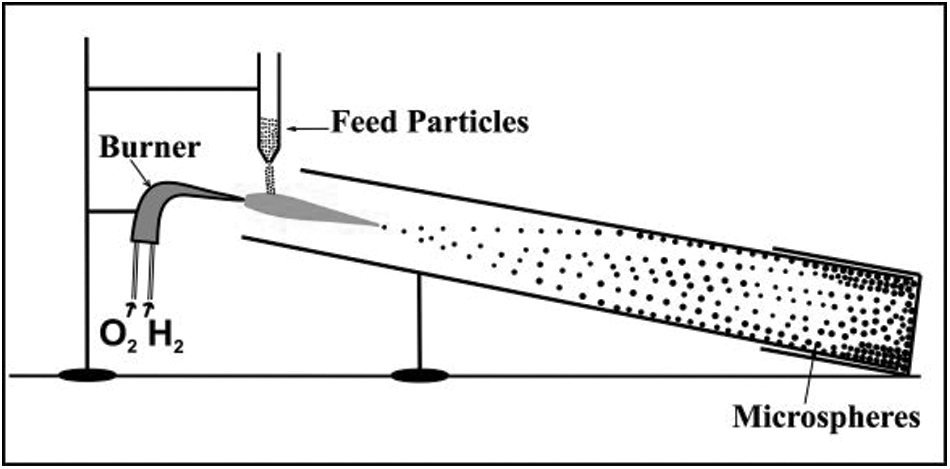
Schematic diagram of flame spheroidization process for synthesis of YAS glass microspheres. YAS, yttria alumino silicate.
Post-synthesis treatment
After the spheroidization of glass particles, the glass microspheres were sorted by sieving to obtain the particles of desired size range of 20–36 μm. The separated glass microspheres of 20–36 μm size range were further screened to remove the particles with air bubbles and other defects. Glass microspheres with microbubbles were screened by sedimentation technique using heavy liquids of suitable density. After the removal of defective particles, the glass microspheres were subsequently cleaned with acetone, dried, and finally heated in a furnace to remove any organic impurities.
Physicochemical characterization
YAS glass microspheres prepared were observed under SEM to check for sphericity, size, and visible defects. XRD and small-angle X-ray spectra (SAXS) were recorded before and after neutron irradiation to observe the glassy nature of the microspheres and evaluate the surface changes of the glass microsphere after irradiation. Analysis of chemical composition of various batches of YAS glass microspheres was carried out using EDXRF and inductively coupled plasma optical emission spectroscopy (ICP-OES) techniques.
Formulation of [90Y]YAS glass microspheres
Irradiation
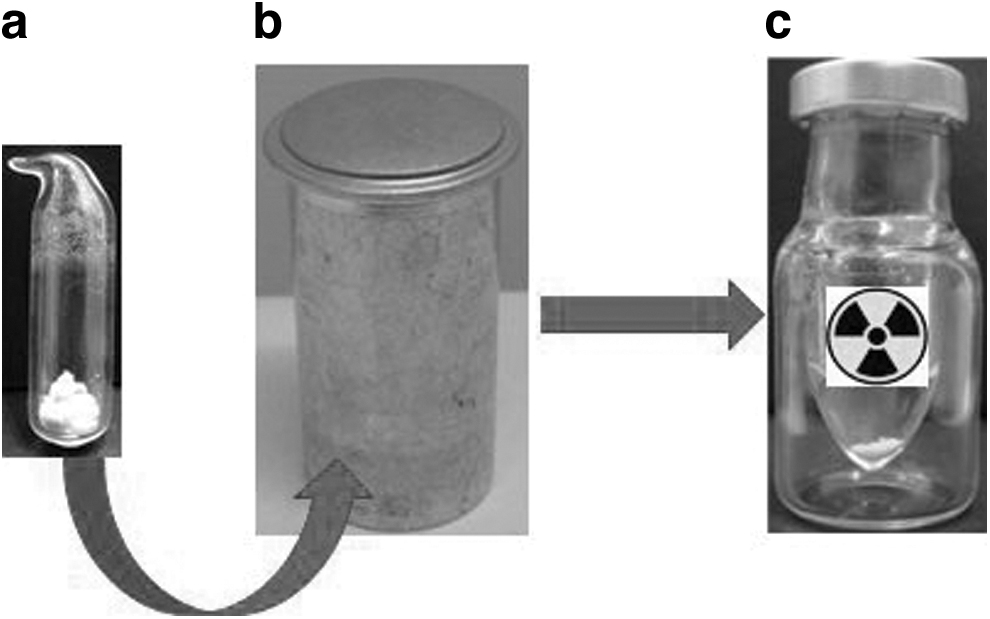
Depending on dose requirement, 20–60 mg of YAS glass microspheres were taken in a quartz ampoule [5 mm (ϕ) × 12 mm (l)], and the ampoule was flame sealed (Fig. 2a). The sealed quartz ampoule containing the glass microspheres was irradiated at a thermal neutron flux of ∼1.4 × 10¹⁴ n·cm−2·s−1 for 7 d, after placing inside a cold-pressure-weld type cylindrical 1S aluminum container of dimension 22 mm and length 44 mm (Fig. 2b).
Dose formulation
The irradiated glass microspheres contained in sealed quartz ampoules were allowed to cool for 24 h after the end of irradiation, and the ampoules were retrieved from containers after cutting open the Al irradiation container by remote operation inside a 50 mm lead-shielded chamber. Subsequent handling of irradiated microspheres was carried out in a leak-tight glove box of the dimension 1.8 × 1.8 × 0.9 m3 equipped with neoprene gloves and other associated accessories. The accessories include remotely operated pipette, vortex mixer, standard glass vial station, semi-automatic glass vial sealing unit, and so on. High efficiency particulate air filters were provided in the exhaust line, and aseptic environment was maintained inside the glove box.
The quartz ampoule was broken carefully inside the glove box, and the irradiated glass microspheres were transferred into a sterile tapered-bottom quartz container, as shown in Figure 2c. The glass microspheres were washed twice using 1 mL of sterile physiological saline in each occasion by remote operation. Finally, 0.6 mL of sterile physiological saline was added to the [90Y]YAS glass microspheres, sealed, and autoclaved (20 min at ∼121°C and 15 psi pressure).
Quality control of [90Y]YAS glass microspheres
[90Y]YAS glass microsphere formulation prepared was subjected to the following quality control tests.
Activity assay
The radioactivity content of [90Y]YAS glass microsphere formulation was measured by a precalibrated isotope dose calibrator. The 90Y activity was recorded in gigabecquerel from the measurement.
Specific activity
The specific activity of the formulation was calculated as 90Y activity (GBq) produced per milligram of YAS irradiated for dose formulation.
Radionuclidic purity
The radionuclidic purity was determined by recording γ-ray spectra of an appropriate aliquot withdrawn from [90Y]YAS glass microsphere formulation using an HPGe detector coupled to a 4 K MCA system. A 152Eu reference source (Amersham, Inc.) was used for both energy and efficiency calibration of the detector. All the nuclear data used were taken from Table of Isotopes. 16 Gamma ray spectra of aliquots of [90Y]YAS glass microsphere formulation were recorded for 1 h at regular time intervals. Aliquots were preserved for more than 10 half-lives of 90Y, and spectra were recorded for 24 h to determine the activity of long-lived radionuclide impurities produced.
Radiochemical purity
The radiochemical purity of [90Y]YAS glass microsphere formulation was determined in the following way. The radioactive glass microspheres in 0.6 mL physiological saline were allowed to settle completely by incubating for ∼30 min. Subsequently, an aliquot (typically, 0.1 mL) was withdrawn from the supernatant and 90Y activity of the aliquot was measured. The percent radiochemical purity was determined from the activity data using the following equation:
where A s and A t are the background corrected 90Y activities associated with 0.1 mL of supernatant withdrawn and total activity of the [90Y]YAS dose formulation, respectively.
Sterility
Sterility of the [90Y]YAS glass microsphere formulation was tested by the direct inoculation method following the approved Indian Pharmacopeia (IP) procedure. The test was carried out in “Fluid Thioglycolate Medium” and “Soybean–Casein Digest Medium” as per IP. The sterility of the formulation is confirmed by incubating the test solution with a portion of the media at the specified incubation temperature (as per IP) for 14 d. No growth of microorganisms confirmed sterility of the formulation.
Apyrogenicity
Apyrogenicity of [90Y]YAS glass microsphere formulation was tested by gel clot-bacterial endotoxin test (BET) assay method as per approved IP procedure, described previously. 17 The endpoint-turbidimetric assay, which is based on the quantitative relationship between the concentration of endotoxins and the turbidity (measured by absorbance or transmission) of the reaction mixture at the end of an incubation period, is used to determine endotoxin concentration.
In vitro stability assay
In vitro stabilities of [90Y]YAS glass microsphere formulation with regard to release of 90Y radioactivity was studied both in physiological saline and in human serum. Aliquot [90Y]YAS glass microsphere formulation was withdrawn, diluted to 2.0 mL by the addition of physiological saline, and stored at 37°C up to 7 d. The percentage of 90Y activity leached out into normal saline from the formulation at different time intervals post-preparation was determined following the same procedure described for the determination of radiochemical purity of the formulation. From this, the percent radioactivity remained associated with YAS glass microspheres as function of time post-preparation, which ascertains the in vitro stability of the formulations in normal saline, was determined.
To determine in vitro stability in human serum, aliquot of the formulation was withdrawn and mixed with 1.0 mL of freshly isolated human serum and mixed thoroughly. The mixtures were stored at 37°C up to 7 d. The percent radioactivity remained associated with YAS glass microsphere as function of time post-preparation was determined as in the previous case.
Furthermore, it was pertinent to study the effect of radioactivity on the shape, size, and morphology of [90Y]YAS glass microspheres upon its storage in vitro. These parameters could influence the biological properties of [90Y]YAS glass microspheres produced by neutron irradiation of cold particles. For this, a portion of [90Y]YAS glass microsphere formulation prepared was stored at room temperature for 30 d for 90Y radioactivity to decay (>10 half-lives of 90Y), and subsequently, SAXS and SEM of the sample were recorded.
Biodistribution studies
Biodistribution studies of [90Y]YAS glass microsphere formulation were carried out in a group of healthy male Wistar rats each weighing 200–250 g. Each animal was anaesthetized using a combination dose of xylazine hydrochloride and ketamine hydrochloride. Anaesthetized animals were prepared for aseptic laparotomy, and subsequently, the hepatic artery is exposed surgically. Appropriately diluted aliquots of freshly prepared [90Y]YAS glass microsphere formulation (0.1 mL, ∼5 MBq radioactivity) were injected through the portal vein of each animal. The total counts corresponding to the activity of [90Y]YAS glass microsphere aliquot taken in the syringe in a flat-type NaI(Tl) scintillation counter were recorded just before injection, and the counts in empty syringe were subtracted to obtain total counts injected in each animal (typically 400,000–500,000/30 s).
Abdominal organs were placed in situ, and surgical wound was stitched immediately. After the completion of the surgical procedures, the animals were kept under observation until they completely recovered from the anesthetized conditions. To obtain the biodistribution pattern of the injected preparation, randomly selected group of four animals each were sacrificed at 3, 24, 72, and 144 h post-injection (p.i.) by CO2 asphyxiation. The tissue and the organs were excised, washed with physiological saline, and dried, and the activity associated with each organ and tissue was measured in terms of counts in the same NaI(Tl) scintillation counter. For determination of activity in the blood, sample was withdrawn using syringe and counted directly. The uptake of [90Y]YAS glass microsphere in different organs and tissue is calculated from these data and expressed as percent injected activity (dose, %ID) per organ.
The total uptake in the blood, skeleton, and muscles was determined by considering that the respective organ/tissue constitute 7%, 10%, and 40% of the total body weight of the animals, respectively. 18,19 While calculating the total skeletal uptake in the animals, tibia is considered as the representative of the skeleton. For comparative evaluation, biodistribution pattern of TheraSphere (Boston Scientific) was also obtained at 3 h post-administration of the formulation in another set of healthy Wistar rats following exactly the same protocol as described above. All the animal experiments are carried out in compliance with the relevant national laws for conducting animal experimentations in India with prior approval of Institutional Animal Ethics Committee of Bhabha Atomic Research Centre.
Human clinical study
Preliminary human clinical investigation of [90Y]YAS glass microsphere formulation was carried out in a male patient (56 years) with right lobe hepatocellular carcinoma. Triphasic computed tomography (CT) of the thorax, abdomen, and pelvis was performed (on PET/CT Gemini TF 64; Philips Medical System, Best, the Netherlands) before the TARE procedure, which revealed segment VII live lesion in the patient. Dedicated 3D contouring software (EBW; Philips Medical System) was used to estimate tumor and liver volumes from CT. Tumor and liver mass, required to calculate the activity [90Y]YAS glass microspheres to be administered, was determined by considering the density of the liver to be 1.07 g/mL. 20
Activity or dose of [90Y]YAS glass microspheres required for the therapy was calculated as per the protocol reported earlier 21 and was found to be 3.4 GBq for the patient selected for TARE. Customized dose of 3.4 GBq of [90Y]YAS glass microsphere formulation was prepared and administered through right hepatic artery with superselective approach. Positron emission tomography (PET)/CT images were recorded at 24 h post-administration to ascertain the localization of the glass particles. The human clinical studies reported herein were carried out after getting regulatory clearance from the institution ethical committee of Tata Memorial Centre, Mumbai, India, and with informed written consent from the patients concerned.
Results
Synthesis and characterization of YAS glass microspheres
YAS glass microspheres were synthesized using flame spheroidization process with conversion efficiency of almost 100% and >99% sphericity. SEM images of the glass microspheres (Fig. 3a) confirmed the high degree of sphericity and uniformity of the microspheres prepared and absence of any visible defects. The absence of any characteristic peaks in the XRD pattern of synthesized glass microspheres (Fig. 3b) confirmed typical glassy nature of the material. Chemical composition of YAS glass microspheres synthesized in different batches was analyzed by a combination of EDXRF and ICP-OES techniques, and the results are summarized in Table 1. The data showed that chemical composition remained unchanged after synthesis of glass microsphere using high temperature process. A representative EDXRF spectrum YAS glass microsphere is shown in Figure 3c. Particle size distribution analysis of glass microspheres carried out using laser diffraction particle size analyzer (Fig. 3d) showed that more than 90% of particles were within the range of 20–36 μm.
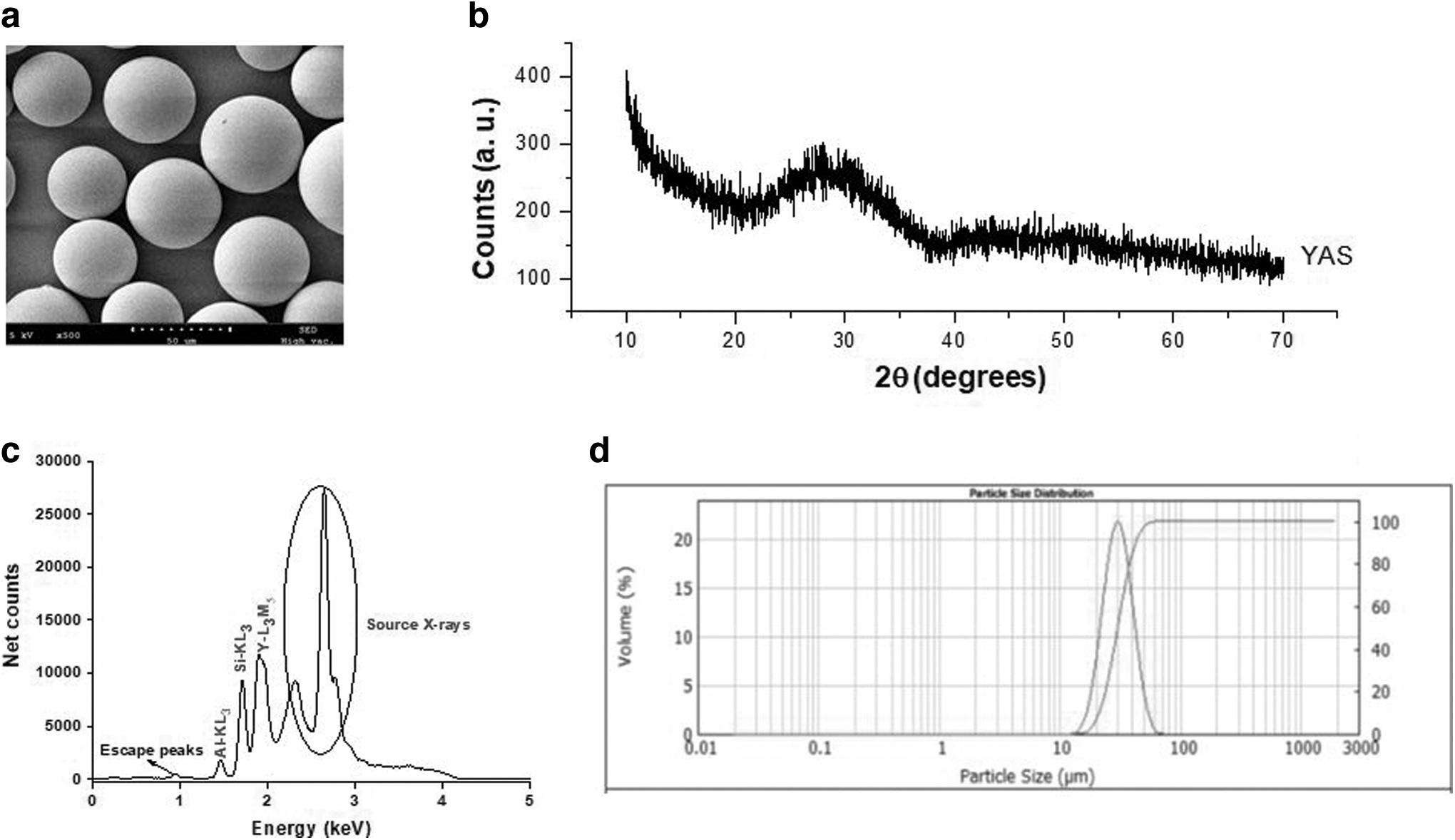
Characterization of YAS glass microspheres:
Compositional Analysis of Yttria Alumino Silicate Glass Microspheres
Formulation and quality control of [90Y]YAS glass microspheres
Intrinsically [90Y]Y-labeled glass microsphere formulation was produced in six different batches by thermal neutron irradiation of 20–60 mg of YAS glass microspheres in a research reactor. During this process, 90Y is produced by 89Y(n,γ)90Y route [thermal neutron capture cross section of 89Y (σ = 1.28 b)]. Since natural yttrium is mononuclidic (100% in 89Y), the radioisotope other than 90Y that is expected to form on neutron irradiation of yttrium would be 90mY, which decays to 90Y by isomeric transition with a short half-life of ∼3.2 h and emission of γ-photons. However, due to its short half-life, it almost completely decays in the time required for dose formulation and transportation for its clinical use, and hence not taken into consideration.
The data on batch yield, specific activity, and radionuclidic impurity analysis are given in Table 2, which shows that [90Y]YAS glass microspheres were produced with a specific activity of 137.7 ± 8.6 MBq/mg of microspheres, which corresponds to ∼6800 Bq of 90Y radioactivity per microsphere. Radionuclidic purity of the formulations was >99.9%, desirable for human clinical applications. The production of radionuclidic impurities specified in Table 2 was due to neutron activation of chemical impurities present in the constituents YAS glass.
Yield, Specific Activity, and Radionuclidic Purity Data of Six Batches of [90Y]Yttria Alumino Silicate Glass Microspheres at the End of Irradiation
Decay properties of radionuclidic impurities are as follows:
Sc: T 1/2 = 83.83 d, E β(max) = 357 keV, E γ = 889 keV (99.9%).
Cr: T 1/2 = 27.7 d, no β, E γ = 320 keV (9.83%).
Fe: T 1/2 = 44.5 d, E β(max) = 1.57 MeV, E γ = 1.29 MeV (43.2%).
Zn: T 1/2 = 244.1 d, E β(max) = 324 keV, E γ = 1.11 MeV (50.8%).
Nb: T 1/2 = 34.97 d, E β(max) = 924 keV, E γ = 766 keV (99.8%).
Cs: T 1/2 = 2.06 y, E β(max) = 658 keV, E γ = 605 keV (97.6%), 796 keV (85.4%).
Hf: T 1/2 = 42 d, E β(max) = 407 keV, E γ = 482 keV (82.9%).
YAS, yttria alumino silicate.
Radiochemical purity of all the six batches of [90Y]YAS glass microsphere formulations determined by following the procedure was found to be >99.0%. Sterility and BET revealed that all the batches of [90Y]YAS glass microsphere formulations were sterile and with <175 EU bacterial endotoxin content. The results of all the quality control tests are summarized in Table 3.
Results of Quality Control Tests of [90Y]Yttria Alumino Silicate Glass Microspheres Produced
BET, bacterial endotoxin test.
In vitro stability assay
[90Y]YAS glass microspheres exhibited excellent in vitro stability with regard to the release of 90Y activity from the formulation when stored at 37°C in physiological saline and in human serum. Leaching of 90Y activity from the radiolabeled microspheres was found to be negligible (<0.2%) even after it was stored for 7 d in both the media.
Figure 4a shows the SAXS profiles of YAS glass microspheres (black) and [90Y]YAS glass microsphere recorded 30 d (>10 half-lives of 90Y) after formulation of the radiolabeled product allowing 90Y activity to decay almost completely (red). It is evident that there is almost no change on the surface of the glass microspheres after neutron irradiation to produce 90Y-labeled formulation. Similarly, SEM image of decayed [90Y]YAS glass microsphere (Fig. 4b) showed very uniform and spherical monodispersed glass microsphere, which indicated that both the size and shape of the [90Y]YAS glass microspheres remained almost intact on its storage up to 30 d.

SAXS profile
Biodistribution studies
Biodistribution pattern of [90Y]YAS glass microspheres expressed as the percentage of injected activity (dose) at different time points after intra-articular administration of the formulation in healthy Wistar rats is summarized in Table 4. The study revealed excellent retention of administered microparticles in the liver (97.62 ± 0.68%ID at 24 h and 94.23 ± 0.57%ID at 144 h p.i.). The uptake in any other major organ/tissue, particularly, the lungs, gastro intestinal tract, and spleen, that might have resulted due to leakage of the radioactive microspheres from the liver, was found to be insignificant. Almost no accumulation of activity in the skeleton up to 144 h post-administration indicated that there was no leaching of 90Y activity from the microspheres lodged in the liver. Furthermore, a comparison of biodistribution patterns of [90Y]YAS glass microspheres with commercially available TheraSphere in healthy Wistar rats at 3 h post-administration through portal vein, as shown in Figure 5, revealed near-identical pattern of the developed formulation with TheraSphere. Overall, the biodistribution pattern revealed all the favorable characteristics of the developed formulation desirable for human clinical use.
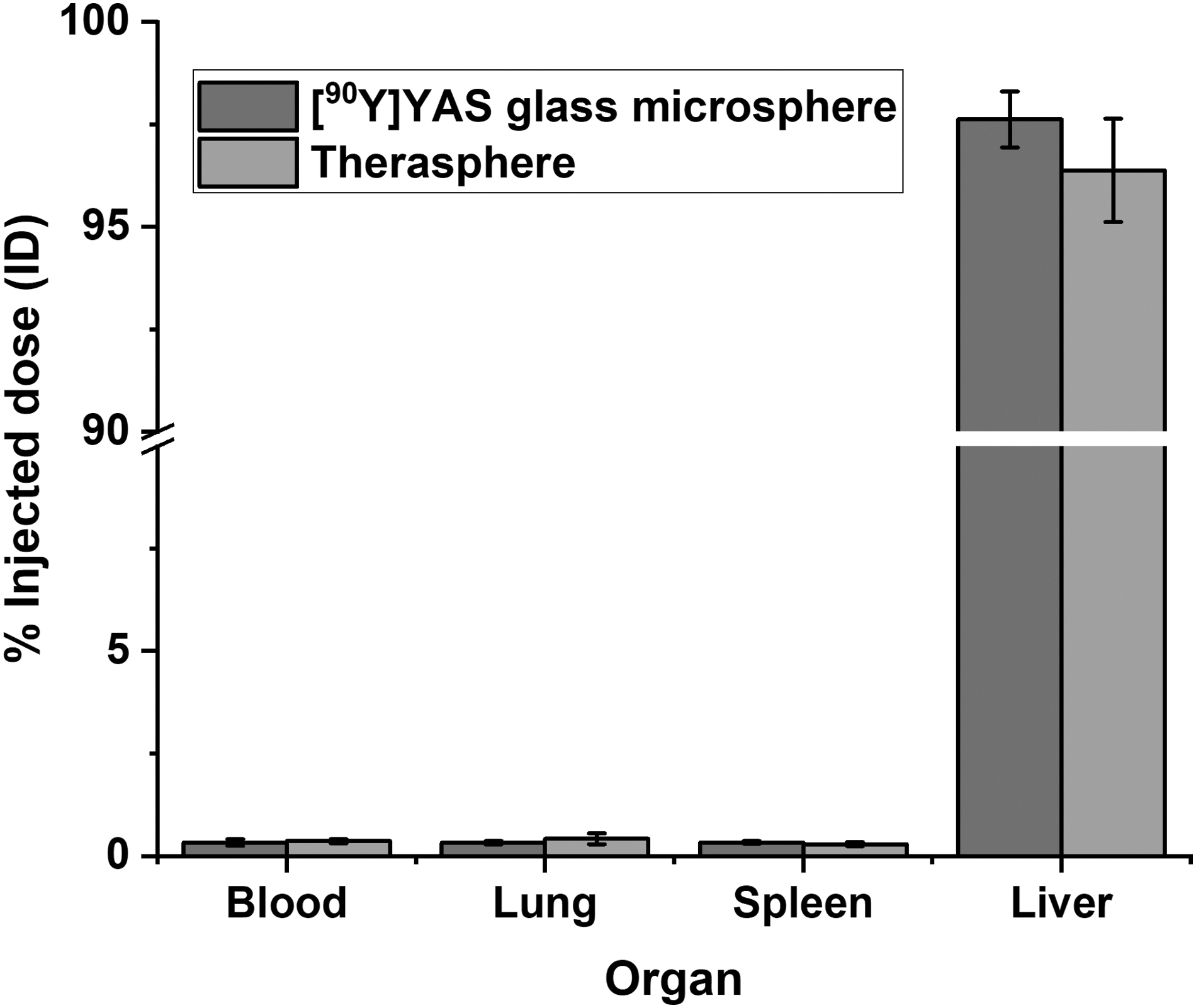
Comparison of biodistribution patterns of [90Y]YAS glass microspheres with commercially available TheraSphere® in healthy Wistar rats at 3 h post-administration through portal vein. YAS, yttria alumino silicate.
Biodistribution Pattern of [90Y]Yttria Alumino Silicate Glass Microspheres in Healthy Wistar Rats
Data are presented as mean ± standard deviation. At each time point, three animals were taken.
GIT, gastro intestinal tract; %ID, %injected dose.
Human clinical study
Figure 6a shows representative post-therapy PET/CT image of a 56-year male patient with right lobe hepatocellular carcinoma 24 h after the administration of 3.4 GBq of [90Y]YAS glass microspheres, whereas Figure 6b and c represents transaxial CT and transaxial PET/CT of the liver of the same patient. Target-specific localization and near-complete retention of the formulation in the cancerous site are quite evident from these images. Furthermore, preliminary investigation revealed that the administration of 3.4 GBq therapeutic dose of the developed [90Y]YAS glass microsphere formulation injected into the patient was well tolerated by the patient, as no adverse side-effect of the therapeutic procedure was reported.

Post-therapy PET/CT image of a 56-year male patient with right lobe hepatocellular carcinoma 24 h after administration of 3.4 GBq of [90Y]YAS glass microspheres showing
Discussion
Intrahepatic administration of customized doses of [90Y]Y-glass microsphere is one of the most effective therapeutic modalities for patients with inoperable liver malignancies. 6 –10 The radioactive glass microspheres are guided to the artery that supplies blood to the liver using a catheter inserted through an incision in the groin. The nonbiodegradable glass microspheres lodge in the hepatic arterioles (branches of the artery) and embolize the blood vessels feeding the tumor. These lodged microspheres exert a radiotherapeutic effect by β−-particles emitting from 90Y, which destroys the local malignant tissue with little damage to the surrounding normal tissue. The primary objective of the present investigation was in-house development of a robust methodology for preparation of therapeutic doses of [90Y]Yttrium glass microsphere ([90Y]YAS glass microsphere) biosimilar to the commercially available product (TheraSphere), which will ensure its wider availability to a larger population of patients at an affordable cost. This was achievable in India due to the availability of a research reactor with medium thermal neutron flux.
European Association of Nuclear Medicine procedure guideline for the treatment of liver cancer specifies the use of [90Y]Yttrium glass microspheres (TheraSphere) that consists of insoluble glass microparticles in which 90Y is an integral constituent of the glass. 22 The diameter of glass microspheres (specific gravity 3.7 g/dL) ranges from 20 to 35 μm with mean sphere diameter 25 μm. Each of these microspheres contain >2500 Bq of 90Y radioactivity at calibration time. 12 Yttrium alumino silicate glass particles with chemical composition 20Al2O3-40SiO2-40Y2O3 (w/w) were synthesized by melt-quench technique and converted to glass microspheres by flame spheroidization. The chemical composition of the microspheres was same as that of TheraSphere.
Particles with diameter within the range of 20–36 μm were segregated to produce [90Y]YAS glass microsphere formulation. Considering the mean diameter of the glass particles to be 30 μm and specific gravity 3.7 g/dL (reported for TheraSphere), each milligram of the material synthesized will have ∼20,000 microspheres. On irradiation at a thermal neutron flux of ∼1.4 × 10¹⁴ n·cm−2·s−1 for 7 d in a research reactor, cold YAS glass microsphere was converted to [90Y]YAS glass microsphere with specific activity of 137.7 ± 8.6 MBq/mg at the end of irradiation. This roughly translates to ∼6800 Bq of 90Y activity associated with each microsphere at the end of irradiation. Taking into consideration 24 h of decay loss of activity from the end of irradiation to human clinical application at hospital, each glass microsphere will carry ∼4000 Bq 90Y activity at the time of its clinical utilization.
This value is higher compared with that mentioned in commercial TheraSphere specification. 12 Higher specific activity or activity per unit microsphere means that fewer particles need to be administered to achieve the desired dose. As a result, the microparticles will be less embolic with reduced concern of vascular stasis. Overall, a comparison of technical specifications of [90Y]YAS glass microsphere formulation prepared vis-a-vis TheraSphere is given in Table 5, which shows that the in-house-developed formulation compares well with the commercially available TheraSphere in terms of chemical composition, particle size range, radioactivity content, purity, and so on. Recently, Pham et al. have reported the synthesis and preclinical evaluation of [90Y]Y-glass microspheres of 18–30 μm diameter following the similar melt-quench process of glass formulation, although the specific activity of the formulation was reported to be significantly lower (∼23 MBq/mg). 23
Technical Specifications of Developed [90Y]Yttria Alumino Silicate Glass Microsphere Formulation Vis-a-Vis TheraSphere Confirming the Biosimilarity
RC, radiochemical; RN, radionuclidic; YAS, yttria alumino silicate.
Conclusions
Formulation of ready-to-use therapeutic doses of [90Y]YAS glass microsphere suitable for human clinical use in the treatment of unresectable liver cancer has been achieved. YAS glass microspheres of composition 40Y2O3-20Al2O3-40SiO2 (w/w) and diameter ranging between 20 and 36 μm were prepared by flame spheroidization process. [90Y]YAS glass microspheres with adequate radionuclidic and radiochemical purity for human clinical use were produced by thermal neutron irradiation of YAS glass microspheres. Leaching of 90Y from the microspheres was negligible (<0.2%) both in physiological saline and in human serum. In vivo evaluation in healthy Wistar rats showed near-complete retention of [90Y]YAS glass microspheres in the liver of the test animals when administered through portal vein. Preliminary human clinical evaluation of the formulation in a patient with right lobe hepatocellular carcinoma also showed retention of ∼98% of the administered activity of [90Y]YAS glass microspheres in the injected lobe by post-therapy 90Y-PET scans.
Footnotes
Acknowledgments
The authors from Bhabha Atomic Research Centre are grateful to the Department of Atomic Energy, Government of India, for the financial support. The valuable service of the staff members of the animal house facility of Bhabha Atomic Research Centre in carrying out animal biodistribution studies is also acknowledged.
Authors' Contributions
K.V.V.: Data curation, formal analysis, writing—original draft. A.R.: Data curation, formal analysis. A.D.: Data curation, formal analysis. R.C.: Data curation, formal analysis, writing—review and editing. H.D.S., S.K.: Data curation, formal analysis. A.J.: Data curation, formal analysis. A.P.: Data curation, formal analysis. V.R.: Formal analysis, supervision. M.G.: Conceptualization, data curation, formal analysis, writing—review and editing. S.C.: Conceptualization, data curation, formal analysis, writing—original draft, review and editing, supervision.
Disclosure Statement
The authors declare that they have no known competing financial interests or personal relationships that could have appeared to influence the work reported in this article.
Funding Information
The work is funded by Department of Atomic Energy, Government of India.