




Abstract
Abstract
Small molecule inhibitors of the mitogen-activated protein kinase kinase (MEK) and glycogen synthesis kinase 3 (Gsk3) have been essential in the establishment and maintenance of embryonic stem cells (ESCs) from rats and from nonpermissive mouse strains. However, conflicting results have been reported regarding their efficacy in the establishment and maintenance of pluripotent stem cells from other species. Here, we investigated the effects of PD0325091 (PD; a MEK inhibitor) and CHIR99021 (CH; a Gsk3β inhibitor) on the reprogramming of porcine fetal fibroblasts to induced pluripotent stem cells (piPSCs). Primary cultures treated with the two inhibitors (2i) showed a reduced number of alkaline phosphatase–positive colonies and a lower percentage of OCT4-expressing cells compared with the cultures grown with basic medium, which was supplemented with murine leukemia inhibitory factor (LIF). Moreover, the piPS-like cell lines established under 2i conditions expressed significantly lower levels of pluripotency markers, including OCT4, SOX2, REX1, UTF1, STELLA, TDH, and CHD1, compared with the controls. To test the short-term effects of the small molecule inhibitors, piPS-like cells that had been established in basic culture medium were cultured for five passages in medium supplemented with 2i or PD or CH individually. In accordance with the first experiment, expression levels of most pluripotency genes declined in cultures treated with inhibitors, although the response to each inhibitory molecule varied for the different genes. Results of this study concur with previous reports and cast doubts on the effectiveness of CH and PD in the reprogramming of porcine somatic cells to pluripotency.
Introduction
S
Small molecule inhibitors have also been used in culture of human pluripotent stem cells, albeit with conflicting results. Whereas some authors have reported that CHIR99021 facilitates human somatic cell reprogramming to induced pluripotent stem cells (iPSCs) (Li et al., 2009) and enhances the establishment of ESCs from poor-quality human embryos (Taei et al., 2013), other studies suggest that the Wnt pathway promotes differentiation, and not self-renewal, in human pluripotent cells (Davidson et al., 2012; Lian et al., 2012).
Inhibitors of MEK and Gsk3β have been also used for derivation and maintenance of porcine pluripotent-like cells. After transfer of porcine ES-like cells derived from blastocyst inner cell mass (ICM) from conventional medium into medium supplemented with CHIR99021 and PD184352, colony morphology changed from flat to compact, while at the same time cell proliferation increased (Haraguchi et al., 2012). Porcine (p) iPSCs cultured in the presence of CHIR99021 and PD0325901 (2i) displayed characteristics typical of naïve-state pluripotent stem cells, such as the compact colony morphology, and self-renewal was dependent on leukemia inhibitory factor (LIF) (Telugu et al., 2010). Moreover, porcine iPSCs cultured under these conditions expressed the naïve stem cell markers STELLA and REX1 (Rodrigues et al., 2012). However, conflicting results have been reported regarding the expression levels of pluripotency-related genes by piPSCs. The OCT4 mRNA level in cells with naïve-like phenotype (treated with 2i) was less than 10% compared with that of primed-like cells (Telugu et al., 2010), whereas others reported that, under their experimental conditions, the expression levels of OCT4 were higher in the naïve-like cells than in their primed counterparts (Rodrigues et al., 2012). In a recent report, the number of alkaline phosphatase (AP)-positive piPS-like colonies was lower in cultures treated with 2i compared with cultures maintained in the absence of these inhibitors (Gao et al., 2013). The correct expression profile of pluripotency-related genes is thought to be critical for the derivation and maintenance of pluripotent cells. Here, we embarked on a study to unravel the usefulness of the 2i for the derivation of porcine pluripotent cells. We used PD0325901 and CHIR99021 in the reprogramming of porcine fetal fibroblasts (pFFs) into piPS-like cells and evaluated the effects of these inhibitors on the induction of endogenous pluripotency genes in primary cultures as well as in several established cell lines.
Materials and Methods
Establishment of piPS-like cells
pFFs that carry the OCT4-EGFP reporter (Nowak-Imialek et al., 2011) were transfected with Sleeping Beauty transposon plasmids containing the cDNA sequences for porcine OCT4, SOX2, C-MYC, KLF4 (SB-CAG-pOSMK-ires-Tomato), as well as porcine NANOG and human LIN28 (SB-Ef1a-pNANOG-ires-hLIN28), together with a plasmid coding for the Sleeping Beauty transposase (SBx100). The expression vectors and the transfection procedure were described earlier (Petkov et al., 2013). After transfection, the cells were cultured in T75 culture flasks for 3 days in pFF medium consisting of Dulbecco's modified Eagle medium (DMEM) supplemented with 0.1 mM β-mercaptoethanol, 1×nonessential amino acids (NEAA), 1×penicillin-streptomycin, 2 mM
For analysis of gene expression, piPS-like cell colonies established with or without inhibitors were collected at passage 7 by incubation with PBS for 15 min, and detached from the feeder by gentle pipetting. After pelleting, the cells were lysed in TRI Reagent solution (Ambion), and total RNA was extracted according to the manufacturer's protocol.
To determine the gene expression in piPS-like cells that had been established without small molecule inhibitors and had subsequently been cultured under the 2i conditions, three cell lines derived in basic iPSC medium were split for five passages with the same medium (BM), or supplemented with 2i, or solely with 1 μM PD0325901 (PD) or 3 μM CHIR99021 (CH). At the end of the experiment, total RNA was extracted as described above.
Reverse transcription and relative quantitative real-time PCR
Purified total RNA was reverse transcribed to cDNA using MuLV Reverse Transcriptase (Applied Biosystems). Real-time PCR was performed with Power SYBR Green Master Mix (Applied Biosystems) on an ABI 7500 Fast System, according to the manufacturer's instructions. The primer sequences for amplification of the endogenous porcine OCT4, SOX2, NANOG, C-MYC, KLF4, REX1, CHD1, and TDH have been reported recently (Petkov et al., 2013). The primer sequences for amplification of UTF1 were adopted from Kuijk et al. (2008), the primers for STELLA were taken from Rodrigues et al. (2012), and the MHC1 primer sequences were the same as reported by Fujishiro et al. (2013). The data were analyzed using GeneX software (bioMCC) using glyceraldehyde 3-phosphate dehydrogenase (GAPDH) as a reference gene. Relative expressions were determined by normalization to the sample with lowest expression (lowest expression=1) and are presented as mean±standard error of the mean (SEM). Significant differences (where p≤0.01) were determined by Student's t-test performed by the same program.
Results
Effects of 2i in primary cultures and piPS-like cell lines
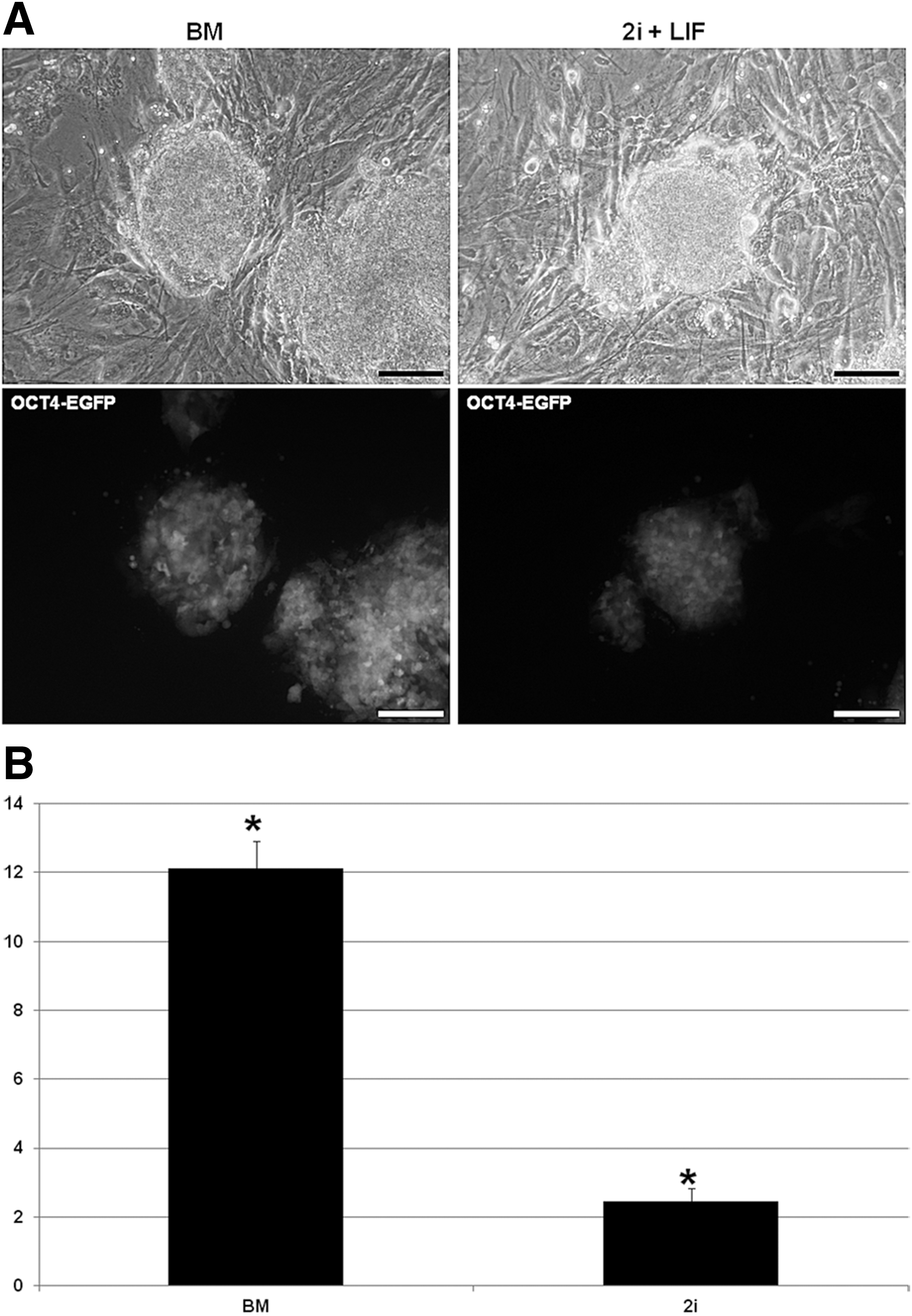
To determine the effects of 2i conditions on the conversion of OCT4-EGFP reporter pFFs to iPS-like cells and on the activation of AP and OCT4, a total of six experimental replicates were performed in which the cells transfected with reprogramming transcription factors were cultured for approximately 2 weeks with or without these compounds. The morphology of the appearing OCT4-EGFP–positive piPS-like colonies was similar in both treatments (Fig. 1A); however, the percentage of OCT4-EGFP–positive cells was significantly higher in cultures that were not treated with 2i (12.1%±0.81 vs. 2.44%±0.4; p<0.01) (Fig. 1B). The number of AP-positive colonies was 3.7-fold higher in the nontreated cultures compared with 2i-treated cells (p<0.01).
(
After manual picking of the OCT4-EGFP–positive colonies and propagating them on MEF feeders, we found that under 2i conditions it was nearly impossible to establish cell lines that maintained expression of the OCT4-EGFP reporter. As a result, most cells cultured under 2i conditions lost enhanced green fluorescent protein (EGFP) fluorescence, whereas the colonies maintained in BM were more compact and predominantly EGFP-positive (Fig. 2). The relative expression levels of endogenous pluripotency genes in piPS-like cell lines established with or without 2i are shown in Figure 3. The expression of OCT4, SOX2, REX1, UTF1, STELLA, and TDH was lower in the cells derived with 2i compared to basic iPSC medium (p≤0.01). The expression levels of other genes, such as CHD1, C-MYC, and KLF4, were not significantly affected (0.01≤p≤0.04). The expression level of MHC1, which is downregulated in naïve mouse iPSCs, was at a similarly low level in both groups [cycle threshold (Ct) values from real-time PCR were larger than 35 at an amplification efficiency over 90%].

Porcine iPS-like colonies established in BM or in 2i conditions (P7). The colonies established in 2i medium show reduced OCT4-EGFP fluorescence and presence of some large epithelial-like cells. Scale bars, 50 μm.

Relative expression of pluripotency-related genes in piPS-like colonies established in BM or in 2i conditions (P7). Columns with different superscripts have p<0.01.
Effects of PD0325901 and CHIR99021 on pluripotency gene expression in cultures transferred from basic medium to medium supplemented with small molecule inhibitors
Three previously established piPS-like cell lines were cultured for five passages (P11–P15) on feeders in basic iPSC medium, alone or supplemented with 2i, or PD or CH individually. Although there were no significant differences in colony morphology between the treatment groups, the expression of the OCT4-EGFP reporter visibly faded in the 2i group (Fig. S1) (Supplementary Data are available at www.liebertpub.com/cell/) Results from the gene expression analysis by real-time qPCR are summarized in Figure 4. Almost all of the examined genes (8 out of 10) showed significantly reduced expression in at least one of the groups treated with the inhibitor(s) compared with BM. This category includes OCT4 and SOX2 (2i<BM; both p≤0.01), UTF1 and STELLA (2i and CH<BM; all p≤0.01), REX1 and TDH (2i, CH, and PD<BM; all p≤0.01), and NANOG and CHD1 (CH<BM; both p≤0.01). The relative expression of C-MYC and KLF4 did not differ significantly among the four experimental groups (all p>0.05).
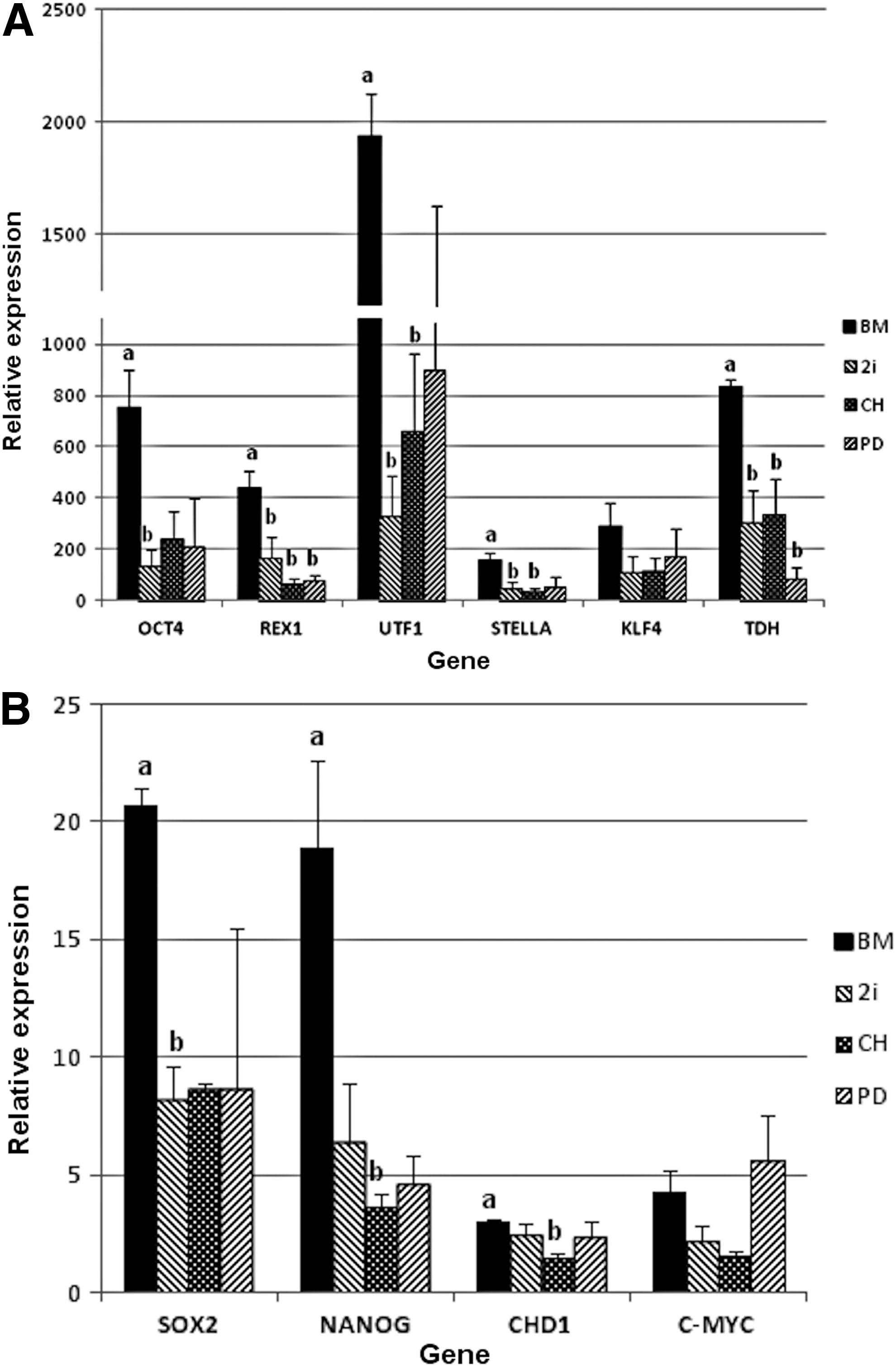
Relative expressions of pluripotency-related genes in piPS-like colonies established in BM and later switched to 2i conditions (P11–P15). (
Discussion
Induction of endogenous pluripotency gene expression is an essential part of the epigenetic reprogramming process of somatic cells to iPSCs. Small molecules have been shown to be critical for the derivation of rat pluripotent stem cells and may have beneficial effects in other species as well (Li et al., 2008). Here, we measured the activation of pluripotency markers in pFFs during their conversion into iPS-like cells with a focus on the role of 2i in this context. By monitoring AP expression in primary cultures, we found that under 2i conditions, there were significantly fewer AP-positive colonies compared with culture medium that was supplemented only with LIF (BM), which is in agreement with recent findings by other researchers (Gao et al., 2013). Moreover, primary cultures treated with 2i contained a significantly lower number of OCT4-EGFP–positive cells. These results suggest that the small molecule inhibitors used in this study may impair the reprogramming process, although the mechanism of such a process remains unknown. After picking the OCT4-EGFP–positive colonies, it was not possible to maintain the cell lines under 2i conditions without loss of the OCT4 reporter fluorescence in most cells. Furthermore, results from the real-time qPCR analysis revealed that these cell lines had significantly lower endogenous OCT4, SOX2, CHD1, REX1, UTF1, STELLA, and TDH expression levels compared with the group established in BM. In a similar experiment, Gao and co-workers (2013) found that iPS-like cells established under 2i conditions had two- to three-fold lower expression of OCT4, NANOG, and TERT.
Because most of the reports published to date deal with iPSCs that have been established in cell culture medium without CHIR99021 and PD0325901 and only later switched to 2i conditions (Rodrigues et al., 2012; Telugu et al., 2010), we set up similar experiments in which we chose three OCT4-EGFP–positive iPS-like lines established in basic culture medium, and propagated them for five passages in the presence of 2i-, CH-, or PD-supplemented basic medium. The results from qRT-PCR showed that the endogenous OCT4 expression levels declined significantly in cells cultured with 2i, a finding that generally agrees with results reported by Telugu et al. (2010). Interestingly, the differences between BM and CH or PD groups were not statistically significant, indicating that both inhibitors may work together to reduce OCT4 expression, or each of them alone may need a longer time period to accomplish this effect. Most of the other genes examined were significantly downregulated under 2i and/or CH conditions compared with BM, suggesting a negative effect of CH on the expression of these genes.
Our results regarding the relative OCT4, NANOG, STELLA, and REX1 expression levels contradict findings by Rodrigues et al. (2012), who reported that these transcription factors were significantly upregulated in piPS-like cells cultured with PD0325901, CHIR99021, and PD173074 (3i). The reason for this discrepancy is currently unclear, but it may be due to multiple differences in the experimental setups. One obvious difference is the fact that the Rodriguez et al. (2012) used PD173074 [an fibroblast growth factor (FGF) and vascular endothelial growth factor (VEGF) inhibitor] in addition to the other two inhibitors. However, there are many other differences in our cell culture protocols, such as the background of the pFF populations used for reprogramming and the fact that we selected the piPS-like colonies based on OCT4-EGFP reporter expression instead of morphology. Furthermore, our piPSC culture medium was based on FBS and KSR instead of N2B27 supplements, and the expression vector platforms were different between the two studies (Sleeping Beauty transposons with CAG promoters vs. lentiviral vectors with tetO promoters). More experiments will be necessary in the future to adequately address this issue.
The results of our experiments bring into question the effectiveness of using 2i in the establishment and maintenance of piPSCs. Even though piPSCs treated with these inhibitors have been reported to possess some characteristics of naïve pluripotent cells, such as morphology and some gene expression changes, it remains unclear whether these cells are capable of contributing to chimeras similar to mouse naïve ESCs and iPSCs. On the other hand, the only piPSCs with evidence for germ line chimerism have been established without the use of small molecule inhibitors and have not been shown to possess “naïve” characteristics (West et al., 2010), suggesting that the pig might differ from the mouse in terms of pluripotent pathways. Last, no porcine ESCs with proven pluripotency have been reported to date in culture medium supplemented with the 2i similar to the ones used in this study. Interestingly, preimplantation embryos maintained under similar conditions have failed to proliferate in culture (Rodrigues et al., 2012), indicating that these particular small molecule inhibitors do not provide optimal culture conditions for establishment of true porcine ESCs. Nevertheless, it should be noted that more research is needed in this specific area.
In conclusion, we established and maintained piPS-like cells in medium supplemented with CHIR99021 and PD0325901 and showed that these inhibitors cause significant downregulation of the expression levels of master pluripotency genes, casting serious doubt on the effectiveness of these inhibitors in the reprogramming of porcine somatic cells to pluripotency.
Footnotes
Acknowledgments
We thank Dr. Zoltan Ivics (Paul Ehrlich Institute, Langen, Germany) for providing the Sleeping Beauty transposon vector system, which we used as a basis for our reprogramming vectors. This study was supported by a grant by the German Research Foundation Ni256/ 32-1.
Author Disclosure Statement
The authors declare that there are no existing conflicts of interest.
References
Supplementary Material
Please find the following supplemental material available below.
For Open Access articles published under a Creative Commons License, all supplemental material carries the same license as the article it is associated with.
For non-Open Access articles published, all supplemental material carries a non-exclusive license, and permission requests for re-use of supplemental material or any part of supplemental material shall be sent directly to the copyright owner as specified in the copyright notice associated with the article.
