




Abstract
Abstract
Cloned calves produced by somatic cell nuclear transfer frequently suffer alveolar collapse as newborns. To study the underlying pathophysiological mechanisms responsible for this phenomenon, the expression profiles of numerous genes involved in lung development need to be investigated. Quantitative real-time PCR is commonly adopted in gene expression analysis. However, selection of an appropriate reference gene for normalization is critical for obtaining reliable and accurate results. Seven housekeeping genes—β-glucuronidase (GUSB), phosphoglycerate kinase 1 (PGK1), β-2-microglobolin (B2M), peptidylprolyl isomerase A (PPIA), glyceraldehyde-3-phosphate dehydrogenase (GAPDH), TATA-box binding protein (TBP), and 5.8S ribosomal RNA (5.8S rRNA)—were selected and evaluated as candidates. Their gene expression levels in the collapsed lungs of deceased neonate cloned calves and normal lung derived from normal calves were assessed. The ranking of gene expression stability was estimated by the geNorm, NormFinder, and BestKeeper programs. 5.8S rRNA and PPIA were determined to be the most stable reference genes by geNorm and BestKeeper, whereas the combination of GAPDH and TBP was suggested as reference genes by NormFinder. Taking these results into account, we conclude that 5.8S rRNA and PPIA could be the most reliable reference genes for studying the genes involved in alveolar collapse. Moreover, 5.8S rRNA could be represented as a uniform reference gene in similar cases.
Introduction
S
There have been several approaches for investigating mechanisms of alveoli collapse in neonatal cloned cattle, most of which focus on imprinted genes and the methylation status of certain transcription factors (Lin et al., 2008). However, the underlying pathophysiological mechanisms that account for this condition are yet to be elucidated. Numerous genes are involved in lung development, thus identification of the genes responsible for lung collapse in newborn cattle and evaluation of gene expression profiles of target genes in collapsed lung tissues are prerequisites.
Real-time quantitative PCR (qPCR) is a powerful tool for monitoring changes in gene expression and for understanding biological and molecular mechanisms due to its sensitivity, accuracy, specificity, and broad quantification range. To acquire accurate and meaningful gene expression quantification, the magnitude of expression normalized to a reference gene as an internal control is required. The reference gene is often referred to as a housekeeping gene (HKG), which should be expressed constitutively at relative constant levels under either different experimental conditions or different disease processes. However, commonly used HKGs cannot be universal under all experimental conditions; indeed, previous studies have shown that some HKGs can vary considerably either in different cell types or under different disease processes (Bustin, 2000; Suzuki et al., 2000; Thellin et al., 1999; Vandesompele et al., 2002; Warrington et al., 2000). Therefore, it is crucial to seek stably expressed HKGs through a systematic study to interpret the qPCR data more effectively.
Few articles in the literature could be found concerning alveolar collapse in cloned cattle; therefore, comparison data of suitable HKGs expressed stably in collapsed lung tissue for quantification is limited. The aim of this study was to identify candidate reference genes for qPCR in the collapsed lung tissue of cloned cattle. The expression levels of seven commonly used HKGs—β-glucuronidase (GUSB), phosphoglycerate kinase 1 (PGK1), β-2-microglobolin (B2M), peptidylprolyl isomerase A (PPIA), glyceraldehyde-3-phosphate dehydrogenase (GAPDH), TATA-box binding protein (TBP), and 5.8S ribosomal RNA (5.8S rRNA)—were assessed in the collapsed lung tissues of cloned cattle and normal lungs of age-matched normal cattle, and the comparison data were analyzed through three different statistical methods.
Materials and Methods
Animals
Collapsed lung tissues from four neonatal cloned cattle that died of respiratory failure and normal lung tissues from four age-matched normal cattle were collected for this study. All procedures were performed at the Institute of Animal Sciences, Chinese Academy of Agricultural Sciences (Beijing, China) and were in accordance with the Guiding Principles for the Care and Use of Laboratory Animals.
Tissue collection
Both the neonatal cloned calves died of respiratory failure within 2 days of age and were dissected immediately after death. Normal calves within 2 days of age were killed as control samples. Lung tissue samples of all calves were immediately collected and frozen in liquid nitrogen or soaked in 4% paraformaldehyde (PFA) for later analysis. The samples for histopathological study were gathered from more than five sites within each lung tissue sample to make sure they represented the entirety.
Necropsy and histopathological study
Tissues were autopsied by veterinarians from the Chinese Academy of Agricultural Sciences. Histopathological diagnosis was performed in the animal pathogenesis lab in the College of Veterinary Medicine at China Agricultural University.
RNA extraction, DNase treatment, and cDNA synthesis
Total RNA was extracted from lung tissues using the RNeasy Mini Kit (Qiagen, Hilden, Germany) according to the manufacturer's protocol with DNase treatment during purification of RNA. RNA concentration and purity were determined by measuring the absorbance at A260 and A280 using a NanoDrop ND-1000 Spectrophotometer (NanoDrop Technologies Inc., USA). RNA integrity was checked by electrophoresis of 500 ng of RNA on 0.8% agarose ethidium bromide–stained gels. A mean ratio of A260/A280 ≈2.0 is generally accepted as pure RNA.
cDNA was synthesized using the QuantiTect Reverse Transcription Kit (Qiagen, Hilden, Germany). Briefly, 2 μg of total RNA was used to produce first-strand cDNA with an oligo(dT) primer and random primers.
Primer design and real-time quantitative PCR
Oligonucleotide primer pairs were generated by Primer Express 3.0 (Applied Biosystems, Foster City, CA, USA) according to the published bovine sequences in GenBank and synthesized by the Beijing Invitrogen Company (Beijing, China). The primer efficiency was tested through a serial dilution curves with the equation: PCR efficiency = (10[−1/slope] − 1) · 100.
qPCR amplification was performed using the 7500 Fast Real-time PCR system (Applied Biosystems, Foster City, CA, USA) following the manufacturer's instructions and with SYBR Green Real-Time PCR with ROX correction. Briefly, 1 μL of 1:10 diluted cDNA, 1 μL of primer pairs (10 pmol/μL for each primer), 7.5 μL of 2× Power SYBR Green Real-Time PCR Master Mix (Applied Biosystems, Foster City), and 5.5 μL of double-distilled water was added to a final reaction volume to 15 μL. The holding conditions for qPCR were as follows: Elimination of carryover contamination by uracil N-glycosylase (UNG) at 50°C for 2 min and activation of Taq polymerase and template denaturation at 95°C for 10 min. The cycling conditions included template denaturation at 95°C for 15 sec and annealing and elongation at 60°C and 72°C for 1 min, respectively. To ensure a single product for each reaction, melt curve analysis was added after thermocycling ranging from 60°C to 95°C by temperature increases of 0.5°C per cycle. All assays were performed in triplicate with no template control (NTC).
Statistical analysis
The expression stability of HKGs was calculated by geNorm (http://medgen.ugent.be/∼jvdesomp/genorm/index.php), NormFinder (http://moma.dk/normfinder-software), and BestKeeper software (http://www.gene-quantification.de/bestkeeper.html) packages.
Result
Alveolar collapse
The collapsed lung tissues from deceased neonatal cloned cattle were dissected, and pathological sections were analyzed between cloned cattle and age-matched normal controls. The lung tissue from cloned cattle showed a series pathogenic symptoms compared to normal calves (Fig. 1), such as atelectasis, broader alveolar septum, mesenchymocyte hyperplasia, inflamed effusion in the alveolar space, generation of hyaline membrane, transformation to interstitial pneumonia, and lymphocyte and neutrophil infiltration as a focus. These phenotypes indicated that lung tissue derived from deceased neonatal cloned calves was severely collapsed compared to normal lung tissues.

Atelectasis of neonatal died cloned calf showed by histopathological analysis. (
HKG selection and primer identification
For the purpose of finding suitable endogenous control genes for qPCR data normalization in collapsed lung tissue of SCNT-derived cattle, seven commonly used HGKs (B2M, GAPDH, GUSB, PPIA, PGK, TBP, and rRNA 5.8S) belonging to different functional classes were chosen that could significantly reduce the chance that the genes might be co-regulated (Vandesompele et al., 2002) (Table 1). All of the primers selected showing the single peak of the dissociation curve and each single PCR product were verified by sequencing, which indicated good specificity of primers. The primer efficiencies ranged from 99.214% to 101.802% with a correlation coefficient (R2) varying from 0.992 to 0.999 (Table 2).
Levels of candidate reference genes mRNA
The cycle threshold (Ct) values were plotted directly to characterize the expression profiles of the HKGs (Fig. 2). The median expression level of raw Ct values spanned from 13.39 cycles for B2M to 24.48 cycles for GAPDH (Supplementary Table S1). By t-test, all the reference genes observed did not significantly differentially express between collapsed lungs and normal lungs. The corresponding p values ranged from 0.094 for B2M to 0.922 for PGK (Supplementary Table S2; Supplementary Data are available at www.liebertpub.com/cell/).
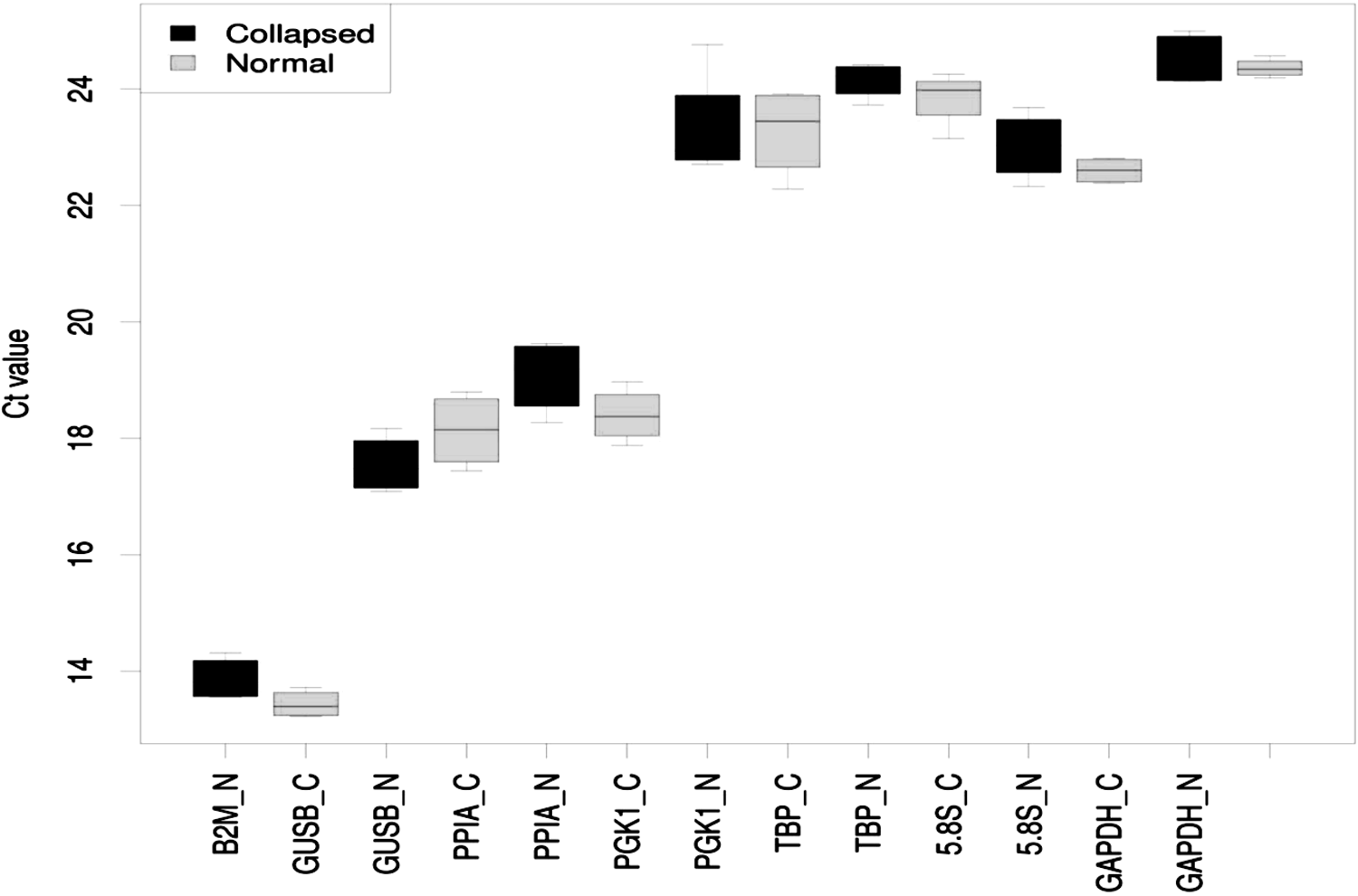
Expression levels of candidate reference genes in collapsed lungs of cloned calves and normal lungs of healthy calves. Raw Ct values of each gene from qPCR are given by boxplot. Data from collapsed lung and normal lung are plotted in black and gray, respectively. Boxes indicate the upper and lower quartiles with medians, and the error bars represent the 90th and 10th percentiles.
Expression stability within HKGs
To identify the least variable HKGs between collapsed lungs from cloned cattle and normal lungs from age-matched normal cattle, three Excel-based programs were used—geNorm, NormFinder and BestKeeper.
geNorm analysis
The principle of geNorm is that two ideally internal control genes should main a constant ratio between the genes in all samples (Vandesompele et al., 2002). The geNorm applet provides the average pairwise variation of a certain HKGs with all other tested HKGs as the expression stability value (M). The lower M value reflects the higher stability of gene expression. The M values of all tested HKGs were below the default limit of 1.5, showing the high expression stability of tested HKGs in our samples. The ranking M values of tested HKGs were as follows: GUSB > PGK > B2M > TBP > GAPDH > PPIA and 5.8S rRNA (Fig. 3). This order indicates that PPIA and 5.8S rRNA could be determined as the most two stable HKGs between the two sets of samples.
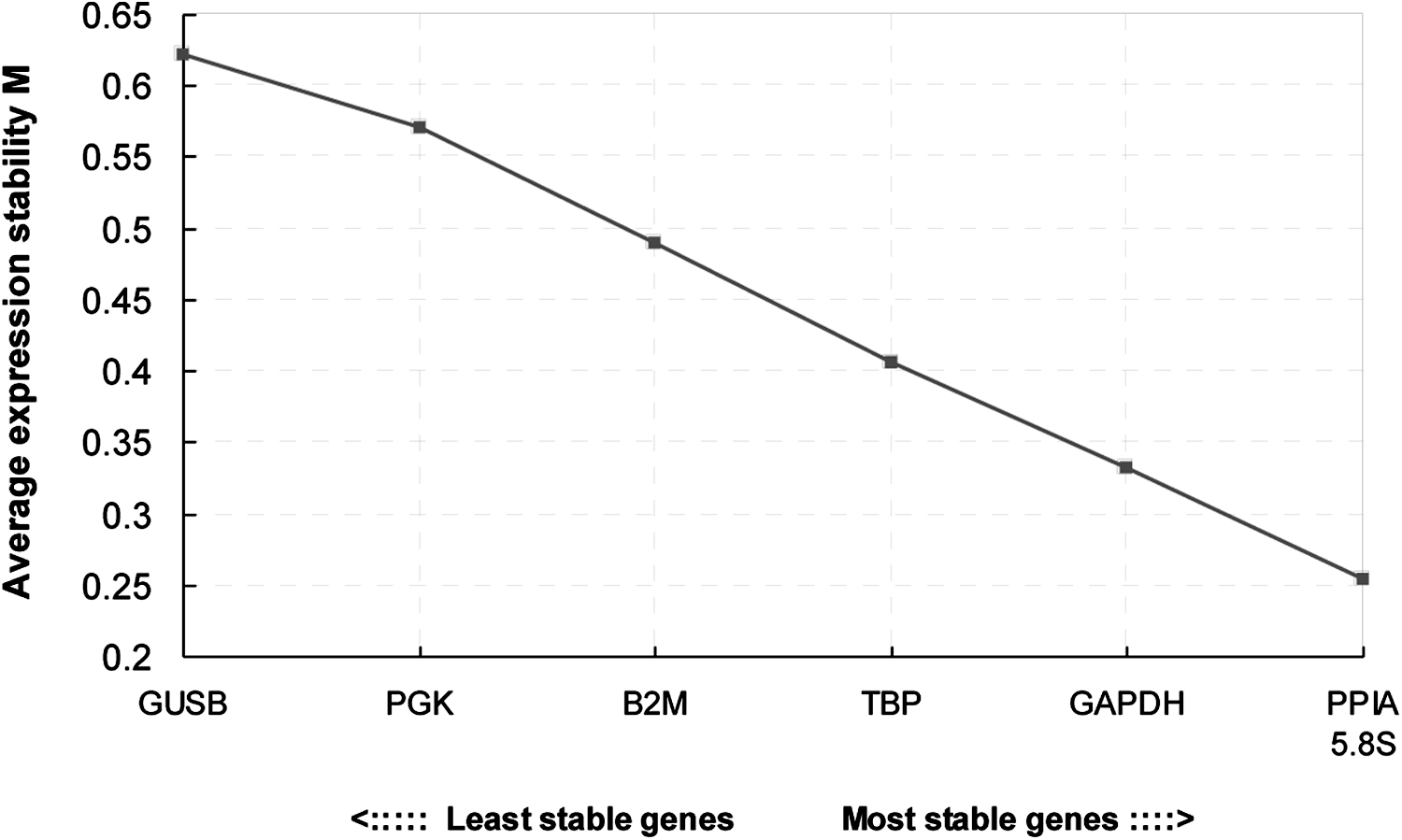
geNorm analysis of average expression stability of the M value. The M value was identified as the average pairwise variation of a certain reference gene with all other reference genes; thus, a lower M value reflects a more stable gene. geNorm analysis showed that the most stable genes were PPIA and 5.8S rRNA and the least stable gene was GUSB, comparing gene expression between collapsed lung and normal lung.
The optimal number of HKGs for normalization was revealed by geNorm software for accurate normalization of qPCR data. The average pairwise variation V n /Vn+1 was calculated for two sequential normalization factors with the cutoff threshold of V n /Vn+1 = 0.15, below which the inclusion of an additional control gene (n + 1) would be not required (Vandesompele et al., 2002). In our assay groups, the pairwise variation V2/V3 was 0.119, indicating that there is no need to include a third reference gene for normalization. As recommended by geNorm, PPIA and 5.8S rRNA would be the most reliable reference genes for normalization (Fig. 4).
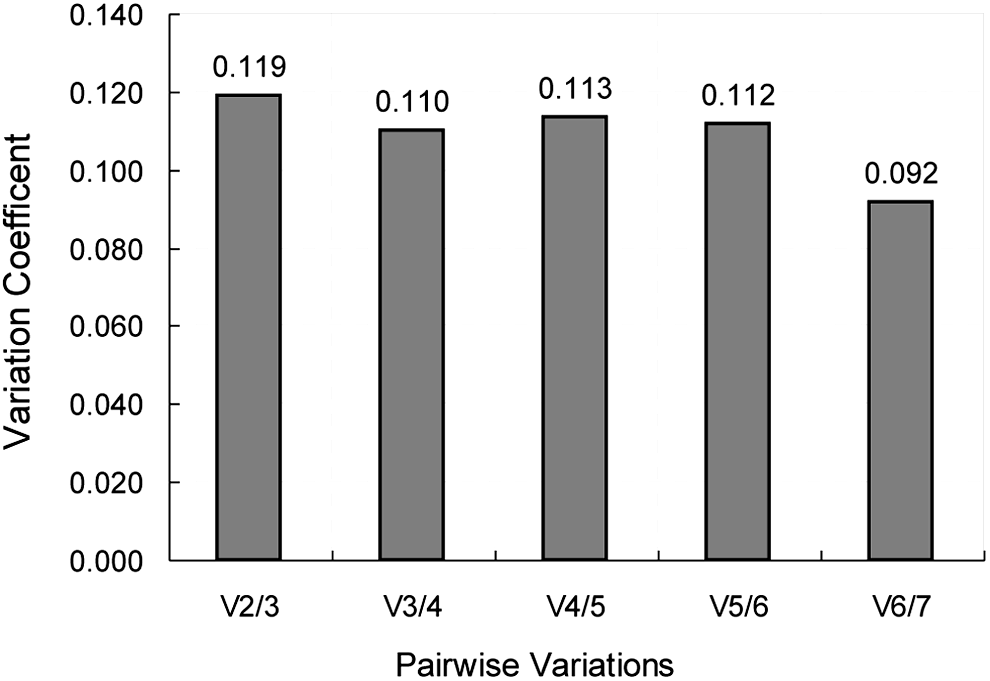
Optimal number of HKGs for data normalization in qPCR by geNorm. The optimal number of HKGs was inferred by normalization factors (NF) of n and n + 1 genes (Vn/n+1), in which the NF calculation was based on the geometric mean of multiple control genes given by geNorm software. When Vn/n+1 is below 1.5, then the additional n + 1 gene is not necessarily needed. Our data showed that V2/3 was smaller than 0.15, suggesting that two reference genes should be adequately suitable for gene expression in our case.
NormFinder analysis
NormFinder is a Microsoft Excel-based program designed to estimate the HKGs expression stability by calculating the expression variation both within groups and between groups. It is more suitable for studies containing different disease groups. The candidate HKGs with less expression variation infer lower stability values, therefore indicating more stablility for normalization. In collapsed lungs and normal lungs, GAPDH showed the lowest stability value of 0.122 followed by 5.8S rRNA and TBP, which were both 0.15 (Fig. 5). The best combination of two genes as candidate references was GAPDH and TBP (stability value = 0.098) (Table 3).

Ranking of HKGs through gene expression stability calculated by NormFinder software. NormFinder evaluated the reference gene for qPCR normalization through gene expression stability; a gene with a lower stability value was more stable for normalization. The ranking order and corresponding stability value given by NormFinder is shown along the x axis, from which GAPDH and TBP were determined to be the best combination of reference genes for normalization.
CV, coefficient of variance (CV = SD/mean × 100%); SD, standard deviation.
BestKeeper analysis
BestKeeper, Excel-based software, ranks the candidate stabilities by a pairwise correlation analysis with all of the HKGs pairs. The geometric average of the “best” HKGs was calculated by raw Ct values from qPCR. The seven candidate genes were correlated in a pairwise manner with each other and with the BestKeeper index, which is a combined parameter computed from all the candidates. Consequently, the result demonstrated that the HKGs stability order generated from BestKeeper was: PPIA > 5.8S rRNA > PGK > TBP > GAPDH >GUSB > B2M (Table 4)
HKGs, housekeeping genes.
Discussion
Lung collapse is one of dominant causes of death in neonatal SCNT cattle. The measurement of transcript abundance with real-time qPCR is a sensitive and effective method for providing evidence for interpreting the underlying pathophysiological mechanisms of this condition. A stably expressed reference gene is vital for the normalization of gene expression data from qPCR, because an inappropriate reference gene could lead to inaccurate calculation of gene expression and incorrect interpretation of data. It is of great importance to validate internal control/reference genes for normalization prior to gene expression studies (Thellin et al., 1999). This study systematically analyzed stability of reference genes for normalization of qPCR data in collapsed lung tissues of newborn cloned cattle with respiratory failure to provide validated reference genes in similar cases. The data analysis for selecting the most stable HKG was performed by three Microsoft Excel-based programs—geNorm, NormFinder, BestKeeper. These programs were applied widely for reference gene selection (Bae et al., 2015; Mariot et al., 2015; Park et al., 2015; Velada et al., 2014).
The geNorm applet uses the pairwise variation analysis method to estimate the best combination of two reference genes based on the geometric mean expression levels. The principle is that two ideal putative reference genes should display constant expression ratios in all samples whether in different cell types or different disease types. BestKeeper software employs the same pairwise idea as geNorm, but BestKeeper adopts a measure of the linear correlation called the Pearson correlation coefficient to characterize the pairwise correlation between genes across samples (Pfaffl et al., 2004). The pairwise analysis idea neglects the co-regulation of reference genes in analyzed samples, which would cause sampling errors. Therefore, an integrated parameter named the BestKeeper index was developed, and genes were correlated pairwise with each other and then with the BestKeeper index to revise the co-regulation effect.
The NormFinder software uses a model-based variance estimation approach to provide a more precise method to seek internal control genes suitable for normalization of qPCR data by calculating the expression variation both between groups and in groups (Andersen et al., 2004). In our data, the coefficient of variance of each gene less than 0.05 confirmed the minor variance of intragroup and intergroup computed by NormFinder. The model-based approach supplied by NormFinder is less affected by gene co-regulation and could make up for the deficiency of pairwise method as genes co-regulation.
Many studies revealed that HKG expression could be variable and prone to directional shifts induced by experimental conditions, consequently resulting in inaccurate normalization (Dheda et al., 2004; Kumar et al., 2012). There was an influx of reference gene selection studies in lung diseases and development (Bouhaddioui et al., 2014; Ishii et al., 2006; Jiang et al., 2009; Krasnov et al., 2011; Kriegova et al., 2008; Mehta et al., 2015; Pinhu et al., 2008; Saviozzi et al., 2006; Yin et al., 2010) that indicated that the reference genes would not be constantly stably expressed in treatment group and control group, or within different developmental stages of the lung. For instance, five HKGs (TUBA1A, ACTB, GAPDH, 18S rRNA, and HIST4H4) were assessed in which TUBA1A was proposed as an appropriate reference gene for gene expression analysis during mouse lung development (Mehta et al., 2015). Ten HKGs (ABL1, ACTB, B2M, GAPDH, GNB2L1, HPRT1, PBGD, RPL21, TBP, and TUBB) were evaluated in alveolar macrophages derived from patients suffering from chronic obstructive pulmonary disease, and GNB2L1, HPRT1, and RPL32 were inferred to be valid HKGs (Ishii et al., 2006).
The reference gene stability of embryos with different culture conditions of in vitro production was still of significant interest. For example, GAPDH, HMBS, and EEF1A2 were shown to be the best combination of reference genes for normalizing gene expression data between bovine blastocysts produced by in vitro fertilization (IVF), intracytoplasmic sperm injection (ICSI), and SCNT. Both the culture conditions of embryos and embryo production method gave rise to the unstable expression patterns of reference genes (Luchsinger et al., 2014). Coincidentally, RPS15, RPS18, and GAPDH were considered to be suitable for normalization of real-time PCR data from buffalo oocytes/IVF embryos (Kumar et al., 2012).
According to the ranking of tested HKG expression stability, we suggest that 5.8S rRNA and PPIA could be applied as reference genes for gene expression analysis in bovine collapsed lung as well as respiratory diseases resulting from similar processes. Ultimately, we presented 5.8S rRNA as the uniform reference gene (Table 5). 5.8S rRNA is a well-documented HKG and is the most conserved and most widely used reference gene. Raw expression data of 5.8S rRNA between collapsed lung and normal lung did not exhibit great differences; indeed, all three software programs suggested that 5.8S rRNA was the most stable gene among all of the candidate references gene we tested.
Atelectasis is a phenotype resulting from pulmonary surfactant deficiency. In humans, several genes have been found to be associated with lung collapse (Bullard and Nogee, 2007; Cameron et al., 2005; Dunbar et al., 2000; Klein et al., 1998; Nogee et al., 2000; Thomas et al., 2002). However, to investigate the mechanism explaining atelectasis in neonatal cloned cattle and the impact of nuclear transfer leading to lung collapse requires more gene expression data; on the other hand, this could provide comparative data to enrich more evidence for human respiratory disease research. Therefore, the combination of PPIA and 5.8S rRNA could be recommended as a valuable source for gene expression normalization in pulmonary surfactant–related research.
Footnotes
Acknowledgments
This work was supported by the National Natural Science Foundation of China (31301977), Chinese Academy of Agricultural Sciences Foundation (2011cj-1), and the Agricultural Science and Technology Innovation Program (ASTIP-IAS06). We also thank Prof. Jifeng Zhang, Dr. Jinming Huang, Dr. Changfa Wang, and Dr. Hongjun Yang from the Dairy Cattle Research Center, Shandong Academy of Agricultural Sciences for providing some samples of cloned cattle.
Author Disclosure Statement
The authors declare that no conflicting financial interests exist.
References
Supplementary Material
Please find the following supplemental material available below.
For Open Access articles published under a Creative Commons License, all supplemental material carries the same license as the article it is associated with.
For non-Open Access articles published, all supplemental material carries a non-exclusive license, and permission requests for re-use of supplemental material or any part of supplemental material shall be sent directly to the copyright owner as specified in the copyright notice associated with the article.
