




Abstract
Abstract
As man's best friend, dogs have an important position in human society. Ten years ago, we reported the first cloned dog, and his birth has raised various scientific issues, such as those related to health, reproduction, and life span. He has developed without any unique health issues. In this article, we summarize and present perspectives on canine cloning.
Introduction
O
After publishing the scientific report on the first cloned dog, canine cloning research has been carried out to improve and verify SCNT parameters. For example, studies on oocyte collection, donor cell synchronization, cloned embryo activation protocols, and recipient conditions have improved the success rate of cloned offspring (Jang et al., 2010). Furthermore, to develop biomedical models for diseases, transgenic dogs expressing the red fluorescent protein (RFP) protein (Hong et al., 2009) and conditional gene-expressing transgenic dogs have been generated via viral gene delivery methods (Kim et al., 2011).
Many people have raised health issues regarding cloned offspring, including cloned dogs, because several cloned offspring have died or suffered from sudden death or abnormalities. An initial study monitoring body growth and bone formation did not show any difference between cloned and wild-type dogs. The reproductive function of cloned dogs has been studied as well. With Snuppy, sperm was fertilized with in vivo oocytes from cloned female dogs, and fertilized embryos were implanted and delivered as normal puppies (Park et al., 2009). The puppies have developed without any health issues. Analysis of hormones and follicles in the first cloned females did not show any differences from wild-type dogs (Hong et al., 2010). Recently, Kim et al. (2013) analyzed the genomic stability of cloned and normal dogs using next-generation sequencing. In their analysis, cloned dogs had more genomic similarities, such as copy-number variation (CNV) and structural variation (SV). Telomere length was not changed in the nuclear donor dog.
The average life span of the Afghan hound as a large breed is 10–12 years. According to a personal communication with the dog owner, the original nuclear donor dog (named “Tai”) used for Snuppy died at age 11 due to cancer. Snuppy is 10 years old, indicating that he has grown up and lived to a normal age for a wild-type Afghan hound. Because he is very old, we think that he will be exposed to various age-dependent degenerative diseases, such as cancer, as had occurred in the nuclear donor dog. We will continue to monitor his health. The cloned female dogs (of the same breed) have also developed without any health issues to date and are now 9 years old.
Since the birth of the first cloned dog, various dog cloning studies have been performed, and they show three future directions for the scientific field. The first is elite dog production for human society. For this, theoretical knowledge is based on the genetic transmission of elite performance, although it remains controversial. However, one scientific study indicated that cloned elite dogs showed better performance than wild-type dogs, and their behavioral tests have been verified (Choi et al., 2014). Thus, scientific evidence for transmitting the perceptual or behavioral competence of nuclear donor dogs into cloned offspring should be investigated via further canine SCNT cloning research.
Second, dog cloning can be used in endangered breeds of Canis. Cloned wolves and coyotes have been produced in the same family (Canis). A cloned Sapsaree, a Korean monument breed, was born through SCNT (Jang et al., 2009). Thus, as the need for specific endangered canine breeds increases, SCNT could be the best choice for propagating such breeds. For both the first and second applications, somatic cells from skin biopsy tissues of specific dogs should be isolated and maintained through in vitro culture.
Last, biomedical studies using canine models and recent publications on transgenic dogs (Hong et al., 2009; Kim et al., 2011) help us to generate various types of genetically modified dogs for specific diseases. Additionally, recent genome editing technologies [zinc finger nuclease, transcription activator-like effector nucleases (TALEN), and CRISPR-Cas9] have been introduced in large animals, such as cattle, pigs, and monkeys. The same approach can be used for dogs. If we understand the exact genetic mutation for a specific disease in dogs, dogs with relevant mutations can be generated to study genetic diseases using genome editing technologies. These genetic canine models will provide very powerful research approaches for dog/human genetic diseases in the future.
As mentioned above, the first cloned dog, “Snuppy,” has had a normal life over the past 10 years and remains in good health (Fig. 1). We hope that this report contributes additional supportive data on canine SCNT as a valuable technology in light of reports published early in its history and provides further support for the normality and viability of animals produced by SCNT.
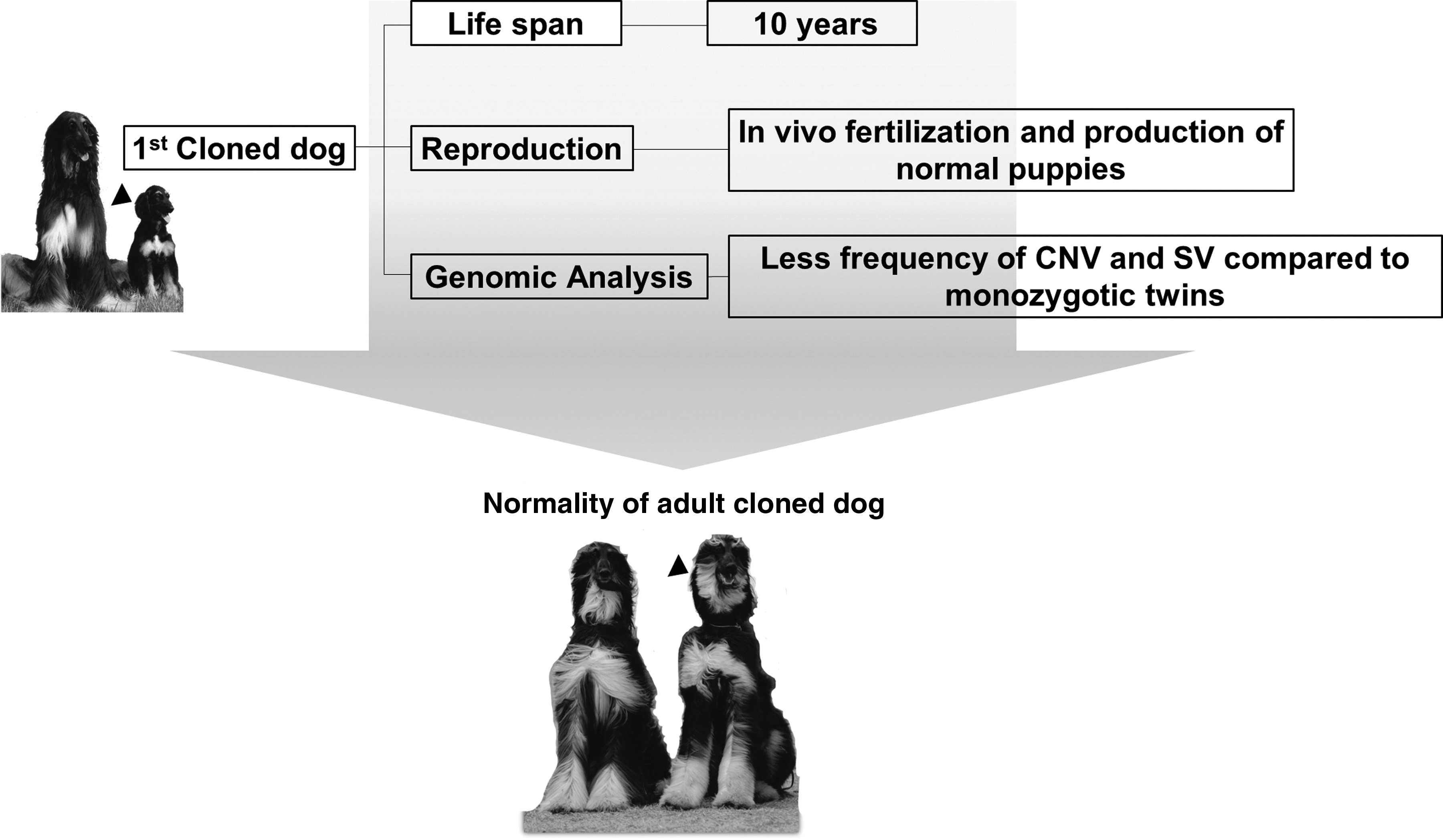
Overview of first cloned dog to date. Black arrow indicates cloned puppy, “Snuppy.”
Footnotes
Acknowledgment
This study was financially supported by the BK21 PLUS Program for Creative Veterinary Science Research, RDA (#PJ0109282015), and Korea IPET (#311062-04-3-SB010).
Author Disclosure Statement
The authors declare they have no competing financial interests.