




Abstract
Single-cell transcriptomics and in situ imaging of murine pancreas upon partial reprogramming in vivo reveal transcriptional dynamics upon Oct4, Sox2, Klf4, and cMyc (OSKM) induction. Interestingly, transcriptomic signatures of partial reprogramming observed in pancreas are shared by several tissues upon OSKM induction as well as during in vitro reprogramming of fibroblasts, pointing to the existence of conserved pathways critical for early reprogramming, regeneration, and rejuvenation.
The reversal of adult somatic cell identity to an embryonic fate in vitro by overexpression of four pluripotency-related transcription factors (i.e., Oct4, Sox2, Klf4, and cMyc, a.k.a. OSKM) by Yamanaka revolutionized biology >15 years ago. Since then, many studies have investigated the molecular underpinnings of cellular plasticity underlying this dramatic cell fate change, uncovering metabolic, epigenetic, transcriptomic, and proteomic players crucial for this process.
Later, in vivo reprogramming was shown to be feasible through induction of OSKM expression at the global-organismal level (Abad et al, 2013; Ohnishi et al, 2014). Although with some differences, these studies proved that induction of cellular plasticity and pluripotency were achievable in living organisms but came at a high cost as it led to widespread appearance of tumors and loss of tissue function.
Although very informative, previous experiments based on bulk analysis of cell populations did not get a clear view of the cellular trajectories followed during somatic cell reprogramming, key to fully understand the rewiring of the somatic to embryonic circuits. It was not until recently that several studies in the mouse and human models started exploring the cellular trajectories followed during OSKM-induced somatic cell reprogramming using single-cell multiomic technologies [(Liu et al, 2020; Schiebinger et al, 2019) among others].
Unexpectedly, in vitro somatic cell reprogramming driven by OSKM overexpression led to discovery of cells of diverse developmental trajectories, including extraembryonic (endodermal and trophectodermal), neural, and mesodermal, which arose before or in parallel with the expected pluripotent fate. Nevertheless, although some of these cellular identities had also been shown to arise upon in vivo reprogramming (Abad et al, 2013), similar studies at the single-cell level in mouse models were missing.
Two months ago, a study by Chondronasiou and colleagues addressed for the first time the dynamics of cellular reprogramming by OSKM in vivo (Chondronasiou et al, 2022). Using the pancreas as a model because of its high reprogramming efficiency, they characterized the cell identities arising during the early phase of reprogramming (i.e., 7 days of doxycycline-induced OSKM expression at the systemic level) through single-cell transcriptomic studies. Chondronasiou et al showed a heterogeneous response to OSKM induction between cells within the same organ, being acinar cells the more prone to remodeling in the pancreas.
Through an elegant combination of scRNA-seq and in situ RNA and protein visualization in the reprogrammed tissue, they characterized intermediate cell fates arising after 7 days of OSKM induction. Among them, they identified several subpopulations of acinar cells that, while displaying transcriptional changes, retained normal histology. In addition, they identified an intermediate reprogramming heterogeneous population of cells that displayed transcriptional signatures not normally found in the pancreas, including partially sharing transcriptomes with K-RAS-driven acinar mataplasia or pluripotent marker expression (i.e., Oct4).
Interestingly, they defined a gene signature characteristic of intermediate reprogramming in the pancreas that could be also observed in other partially reprogrammed tissues (i.e., stomach and colon), as well as in vitro during mouse embryonic fibroblasts (MEFs) reprogramming. Intriguingly, the expression of these intermediate reprogramming markers was transient during MEF reprogramming, and Chondronasiou et al showed that the silencing of several of these markers (i.e., Ly6a and Krt14) was indeed a prerequisite for proper pluripotency acquisition.
Partial reprogramming is a sword of double edge, depending on the OSKM regimen applied in vivo, as it can lead to malignant transformation, but also to cellular rejuvenation (Singh and Zhakupova, 2022). Diversity of treatment (e.g., doxycycline dose, pulse length, and time of induction), OSKM transgene location and copy number, and differences in mouse models (i.e., progeric or wild type) or tissues analyzed make the results from the different available studies difficult to compare.
Although one thing is clear: partial reprogramming represents a very powerful platform to study mechanisms underlying cellular plasticity and rejuvenation, future studies will be needed at the single-cell level to provide with a comprehensive roadmap of molecular determinants leading to the choice of the different cellular trajectories initiated by OSKM induction: rejuvenation, pluripotency acquisition, or malignant transformation (Fig. 1).
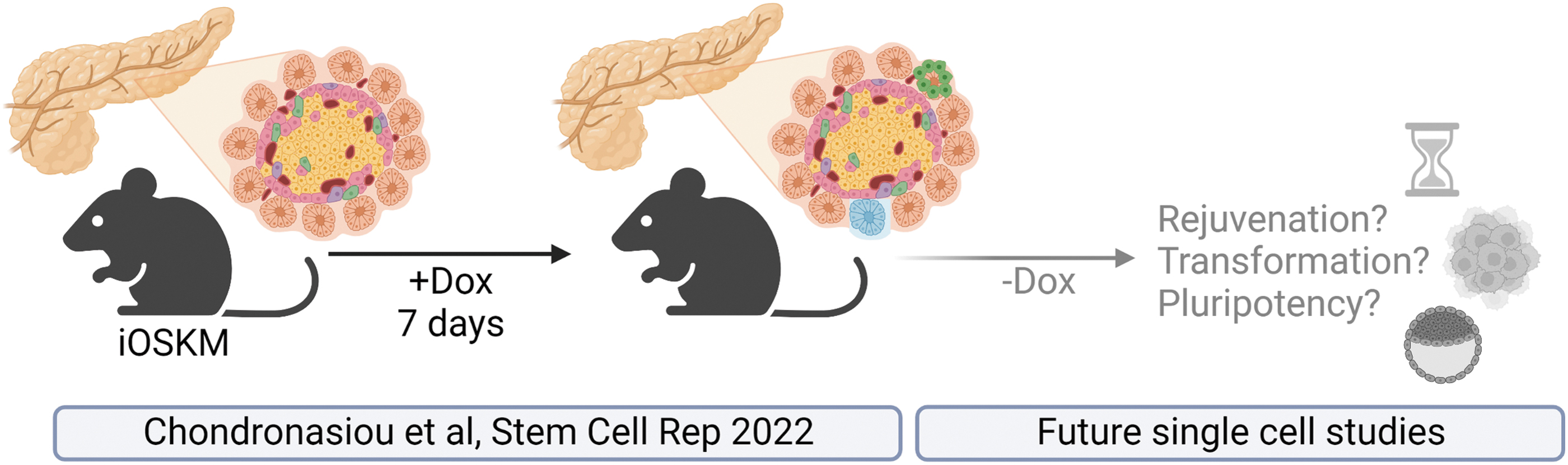
Chondronasiou shows that partial reprogramming in vivo by overexpressing OSKM in mice promotes cellular plasticity in the pancreas, generating a transcriptomic and phenotypic diversity of acinar cells. Transcriptional signatures arising upon transient reprogramming are partially observed in other tissues of the same mice and in MEF in vitro reprogramming. Future studies will determine which subtype of intermediate-preprogrammed acinar cells will be rejuvenated, give rise to transformed cells, or result in pluripotency induction. MEFs, mouse embryonic fibroblasts.
Footnotes
Author's Contribution
D.G. wrote and edited the article.
Author Disclosure Statement
The author declares there are no conflicting financial interests.
Funding Information
D.G. is a Ramón y Cajal researcher by the Spanish Agencia Estatal de Investigación, cofunded by the FEDER Program of the EU (RYC2019-027305-I). Research in the Guallar laboratory is funded by grants of the Spanish Agencia Estatal de Investigación, cofunded by the FEDER Program of the EU (RTI2018-096708-J-I00) and the Xunta de Galicia Consellería de Cultura, Educación, Formación Profesional e Universidades (ED431F 2022/11).