




Abstract
Creating hematopoietic stem cells (HSCs) capable of multilineage engraft while possessing the ability to self-renew stands as a pivotal achievement within the field of regenerative medicine. However, achieving the generation of these cells without transgene expression or teratoma formation has not been fully accomplished. In a recent publication featured in Cell Stem Cell, Piau et al. document the production of functional HSCs derived from human-induced pluripotent stem cells (hiPSCs). They achieved this through a one-step differentiation protocol that notably does not require any transgene expression. hiPSCs-derived HSCs can engraft and self-renew upon serial transplantation and they are able to reconstitute lymphoid, myeloid, and erythroid compartments. This study presents a promising system to further study human HSC ontogeny, and it might represent a crucial step to obtain HSCs.
Hematopoietic stem cells (HSCs) sit on the apex of the hematopoietic hierarchy, and they give rise to the entire blood during the whole life of the organism (Zhang et al., 2018). Because of their regenerative potential, transplantation of HSCs is the current gold standard of treatment for many hematological diseases. Nevertheless, the full success of this therapy highly depends on finding a human leukocyte antigen (HLA)-compatible donor and, although haploidentical donor transplantation is commonly used, some ethnic groups have limitations to find HLA compatibility (Dehn et al., 2008). Thus, alternative sources of HSCs would increase the HLA repertoire and it would minimize the probability of graft-versus-host disease.
Generating HSCs in vitro from different cell types is one of the milestones that has been highly pursued in the field of regenerative medicine. Different studies have reported the generation of bona-fide HSCs from different cell sources and different methods [reviewed in Bigas et al. (2022)]. Reprogramming of endothelial cells or lymphoid precursors by the expression of transcription factors has generated HSC-like cells with multilineage in vivo repopulating and serial transplantation capabilities (Lis et al., 2017; Riddell et al., 2014). HSCs have also been obtained from pluripotent stem cells by the combination of directed differentiation with the forced expression of HSC-specific transcription factors (Sugimura et al., 2017).
The ability of pluripotent stem cells to generate functional HSCs without transgenes has been demonstrated by the formation of teratomas containing low frequencies but functional HSCs (Amabile et al., 2013; McDonald et al., 2020; Suzuki et al., 2013). However, the use of either HSC-specific transcription factors, many of them proto-oncogenes, or teratomas for HSC specification limits the applicability of these strategies in the clinical setting.
In a recent study published in Cell Stem Cell, Piau et al. (2023) report the generation of transplantable HSCs derived from five different lines of human-induced pluripotent stem cells (hiPSCs) in a transgene-free and embryoid body (EB)-based differentiation. Authors apply a machine learning-based algorithm to identify proper combinations and concentrations of mesodermal (precursor of, among others, the HSC fate) and hematopoietic cytokines that differentiate hiPSCs toward the HSC fate.
In a one-step protocol, hiPSCs are aggregated to form EBs over a 17-day period, consistently supplemented with a uniform cocktail of cytokines throughout the entire process. Day 17 EBs contain a population of hematopoietic progenitors that, upon transplantation of whole EBs into NSG mice, can engraft into primary recipients and demonstrate self-renewal capabilities across secondary and even tertiary transplants (Fig. 1).
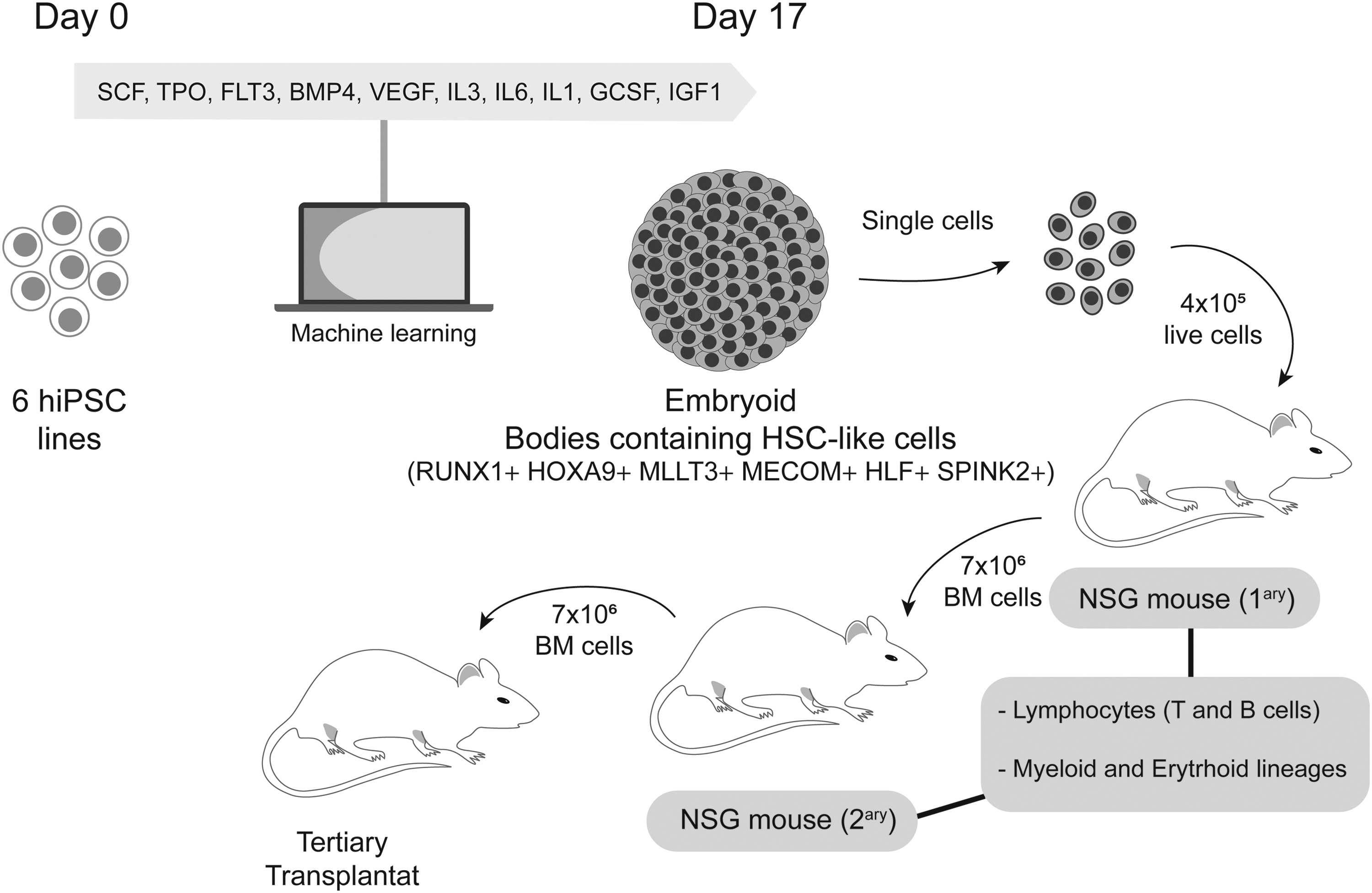
Generation of HSCs by in vitro differentiation of hiPSCs without transgene expression. Machine learning-based approach identifies a cocktail of cytokines that allows to differentiate hiPSCs toward HSC fate taking advantage of embryoid bodies differentiation. More in detail, six different lines of hiPSCs were differentiated for 17 days using embryoid bodies-based differentiation. Day 17 EBs contain a small population of cells that display human HSC-like signature (RUNX1⁺ HOXA9⁺ MLLT3⁺ MECOM⁺ HLF⁺ SPINK2⁺). Day 17 EBs were disaggregated and 4 × 10⁵ BM cells were transplanted into immunocompromised (NSG) mouse. For secondary and tertiary transplantation experiments, 7 × 10⁶ BM cells were transplanted into recipient mice. BM, bone marrow; EB, embryoid body; hiPSCs, human-induced pluripotent stem cells; HSC, hematopoietic stem cell.
Authors described that hiPSCs-derived HSCs (hiPSCs-HSCs) contribute to the lymphocyte (T and B cells), myeloid (monocytes), and erythroid lineages in bone marrow (BM) and peripheral blood of transplanted mice. hiPSCs-HSCs-derived T cells also repopulate the thymus of recipient animals, acquiring CD4 and CD8 markers and, when stimulated, can efficiently be amplified. Further characterization demonstrated the presence of definitive erythropoiesis among transplanted cells, since they express higher levels of adult and fetal globins.
Interestingly, hiPSCs-HSCs self-renew upon serial transplantation, maintaining similar multilineage output in secondary recipients, and they can even repopulate BM under tertiary transplantation. Authors also quantify the number of HSCs within day 17 EBs, determining that 1 out of 15,700 cells could repopulate.
To identify the population of HSCs generated from hiPSCs, Piau et al. characterized EBs at different time points by single cell RNA sequencing, which lead to the identification of a cluster of HSC-like cells that express the human HSC gene signature RUNX1⁺ HOXA9⁺ MLLT3⁺ MECOM⁺ HLF⁺ SPINK2⁺ described by Calvanese et al. (2022). Additional comparison of the HSC-like cluster suggests that hiPSCs-HSCs may resemble early stages of human embryonic HSCs, confirming the suitability of the system to study human HSC ontogeny.
Although this study represents a significant advancement in the field of hematopoiesis, several unresolved questions remain. Among these is the apparent absence of specific myeloid blood cell types subsequent to the transplantation of hiPSCs-HSCs. It remains uncertain whether this absence is due to limitations in technical detection, as suggested by the authors, or whether it is a result of the generation of a biased HSC population, requiring further investigation. Furthermore, the study lacks a clear definition of the engraftable cell phenotype, as the authors transplant the entire population of cells undergoing differentiation without specifying the characteristics necessary for successful engraftment.
Another important question that remains is the reason why this differentiation protocol succeeds in generating HSCs over previous studies that used a similar approach. One potential explanation could lie in the preservation of the three-dimensional structure of the embryo body along the entire differentiation process. This preservation may facilitate crucial cell-to-cell communication signaling, known to be vital for HSC generation.
Alternatively, the success could be attributed to the utilization of a specific plasma that supplements the differentiation medium. This plasma might provide essential growth factors necessary for HSC specification. Further analysis in the composition of this plasma could offer insights into the signaling pathways that are provided to the differentiating cells. Finally, the reproducibility of the protocol across multiple laboratories emerges as a crucial factor determining the true impact of this breakthrough discovery in regenerative or therapeutic applications.
Footnotes
Acknowledgments
We thank all members of Bigas laboratory for helpful discussions.
Authors' Contributions
L.G.P. contributed to conceptualization, final report, formal analysis, article writing, and final review. A.B. was involved in conceptualization, article writing, and final review.
Author Disclosure Statement
The authors declare that no conflicting financial interests exist.
Funding Information
This study was funded by grants from PID2019-104695RB-I00 and PDC2021-120817-I00 from Agencia Estatal de Investigación (AEI) to A.B. L.G.P. is a recipient of 2021 FI_B2 00188, AGAUR, Generalitat de Cataluña.