




Abstract
Cellular senescence is a state in which cells enter cell cycle arrest. However, senescent cells have the ability to secrete signaling molecules such as chemokines, cytokines, and growth factors. This secretory activity is an important feature of senescent cells, since the secreted factors impact the surrounding cellular microenvironment. Indeed, senescent cells and their secretome play a crucial role during limb development. However, whether the process of limb regeneration also relies on senescent cells remains unclear. Creation of a novel targeted depletion strategy that can eliminate senescent cells in the regenerating limb has now demonstrated an important role for senescent cells in limb regeneration. This role is linked to senescent cell-derived Wnt signaling. These findings reveal a previously unknown role for senescent cells during limb regeneration through Wnt signaling.
Senescent cells are often associated with cell stress. A hallmark of senescent cells is cell cycle arrest and, therefore, lack of proliferation. Though senescent cells do not contribute to processes through self-division, they can play important roles as signaling meditators (Acosta et al., 2013). For example, senescent cells influence patterning during limb development through their senescence-associated secretory phenotype (SASP) (Storer et al., 2013). The SASP is a combination of inflammatory cytokines, growth factors, and other molecules (Muñoz-Espín and Serrano, 2014). Given their important role in limb development, this raised the question of whether senescent cells contribute to limb regeneration (Yu et al., 2023).
Only salamanders regenerate limbs as adults. Limb loss in salamanders leads to wound healing, followed by the formation of a blastema (McCusker et al., 2015). The blastema is an accumulation of progenitor cells arising through dedifferentiation and/or recruitment of tissue-resident stem cells (Sandoval-Guzman et al., 2014). Although proliferation of progenitor cells plays a role in regeneration, there may be other cells that do not proliferate and serve other roles in the blastema niche (Walters et al., 2023). Senescent cells satisfy this requirement given their lack of proliferation and role as signaling mediators. Technologies that specifically target senescent cells are required to explore their role in the blastema.
Dr. Maximina Yun's research team reasoned that senescent cells could be specifically targeted given their unique features (i.e., high β-galactosidase) (Yu et al., 2023). They developed a nanoparticle-mediated depletion strategy, consisting of a galactose shell loaded with doxorubicin. Doxorubicin toxicity was specific to senescent cells because their β-galactosidase activity degrades the galactose shell releasing doxorubicin and resulting in senescent cell depletion. Using this technology, the researchers eliminated senescent cells in the regenerating salamander limb, which decreased cell cycle entry. This indicated that senescent cells are contributing to the pro-proliferative microenvironment (Yu et al., 2023).
Yu et al. reasoned that the SASP could influence the blastema microenvironment. The nanoparticles were adapted to fluorescently label senescent cells. After labeling in vivo, single-cell RNA sequencing of senescent versus nonsenescent blastema cells was performed. This revealed Wnt7b and Wnt8b as potential secreted senescent cell-derived factors involved in regeneration. The importance of senescent cell-derived Wnt signaling was confirmed by pharmacological Wnt signaling activation, which rescued delayed regeneration in animals depleted of senescent cells (Fig. 1).
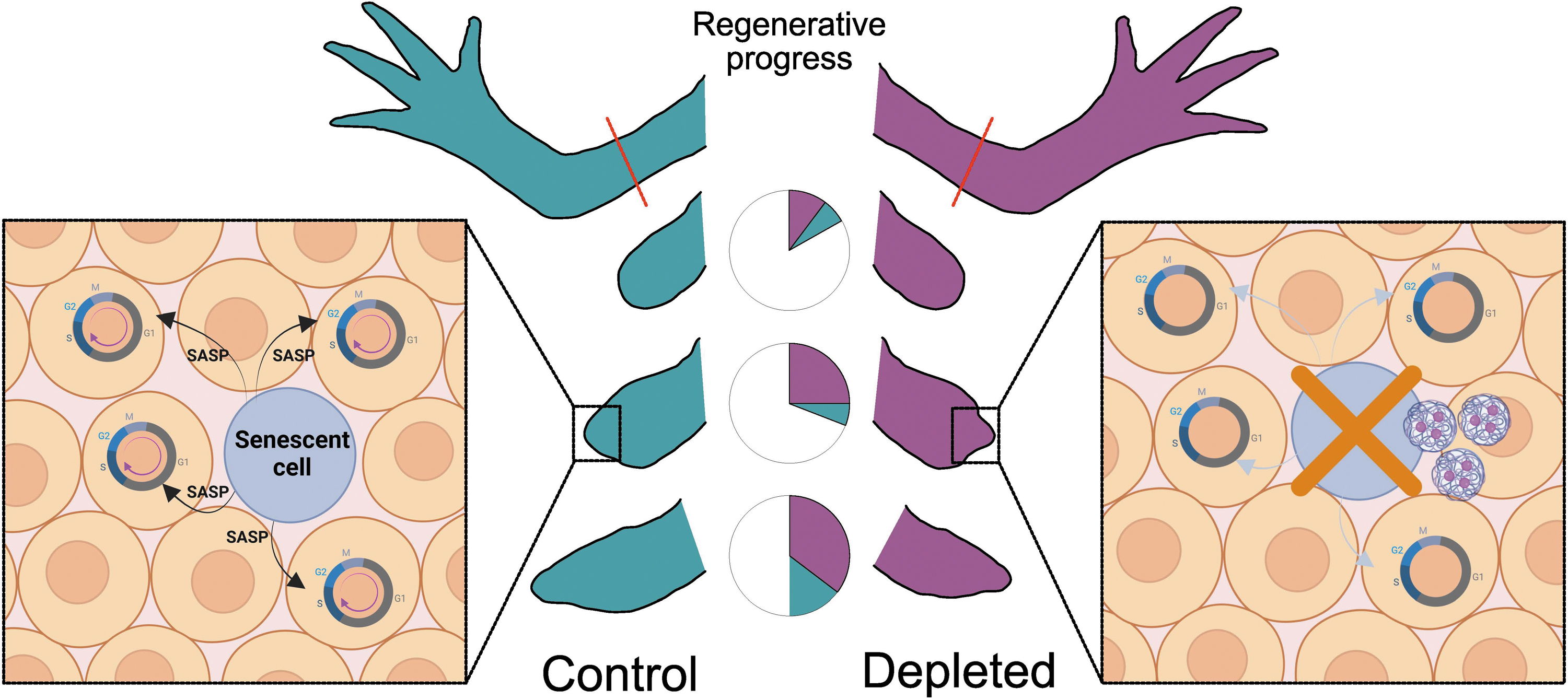
The impact of senescent cells on limb regeneration. The control (left) showing senescent cells and the (SASP) during limb regeneration. The insets of a blastema show the induction of the cell cycle entry through the SASP. The senescent cells depleted conditions achieved through β-galactosidase-coated nanoparticle-mediated depletion (right) demonstrate delayed limb regeneration in comparison with the vehicle controlled animals. This delayed regeneration is illustrated by the pie charts; Control and Depleted sectors illustrate different progress during regeneration. Insets of this figure were generated with Biorender.com. SASP, senescence-associated secretory phenotype. Color figure is available online.
These findings elucidated the important signaling role of senescent cells secreted SASP, specifically Wnt signaling molecules, in the blastema niche during regeneration (Yu et al., 2023). Wnt signaling is especially interesting in this context since it contributes to limb patterning during both regeneration and development (Lovely et al., 2022). It is conceivable that senescent cell-derived Wnt signaling contributes to patterning and represents another shared mechanism between limb development and regeneration.
Implicating senescent cells in regeneration opens more questions about their role, including why and how blastema cells enter senescence and whether senescence serves as a quality control mechanism. This study provides rationale for future investigation of senescent cells in regeneration and moves us closer to understanding limb regeneration.
Footnotes
Authors' Contributions
Writing—original draft was carried out by M.J.O. and writing—review and editing was by M.J.O. and N.D.L.
Author Disclosure Statement
The authors declare they have no conflicting financial interests.