




Abstract
The interplay between aging and immune system deterioration presents a formidable challenge to human health, especially in the context of a globally aging population. Aging is associated with a decline in the body’s ability to combat infections and an increased risk of various diseases, underlining the importance of rejuvenating the immune system as a strategy for promoting healthier aging. In issue 628 of Nature (2024), Ross et al. present a compelling study that introduces a novel strategy for rejuvenating the aged immune system (Ross et al., 2024). By using antibodies to selectively eliminate “aberrant” hematopoietic stem cells (HSCs), this research opens new avenues for addressing age-related immune deterioration.
Given that aging significantly increases the risk of numerous diseases, the global growth of the aging population (Lutz et al., 2008) poses an escalating challenge to our health care systems. A key aspect of promoting healthier aging lies in enhancing the body’s capacity to combat infections.
Hematopoietic stem cells (HSCs) are vital for lifelong blood cell generation. With aging, many HSCs increasingly favor myeloid differentiation (Wahlestedt and Bryder, 2017), associating with heightened inflammation, compromised adaptive immunity, and a greater risk of myeloproliferative diseases (Fig. 1a). Ross et al. introduce a novel therapeutic approach using antibodies to target and eliminate such myeloid-biased HSCs. Unlike the broad and somewhat indiscriminate approach of drug-based senolytics (Kirkland and Tchkonia, 2020), the method employs a precision-targeted strategy. It utilizes distinctive cell surface markers to identify and selectively eliminate myeloid-biased HSCs. Simultaneously, it aims to preserve those HSCs with a pronounced capacity for differentiation into lymphoid lineages (Fig. 1b). Remarkably, the hematopoietic system of aged mice treated with the antibody-mediated therapy presented several youthful features, including elevated numbers of naive adaptive immune cells, attenuated inflammation, dramatically enhanced virus-specific T cell production postvaccination and improved viral defense capabilities (Fig. 1c).
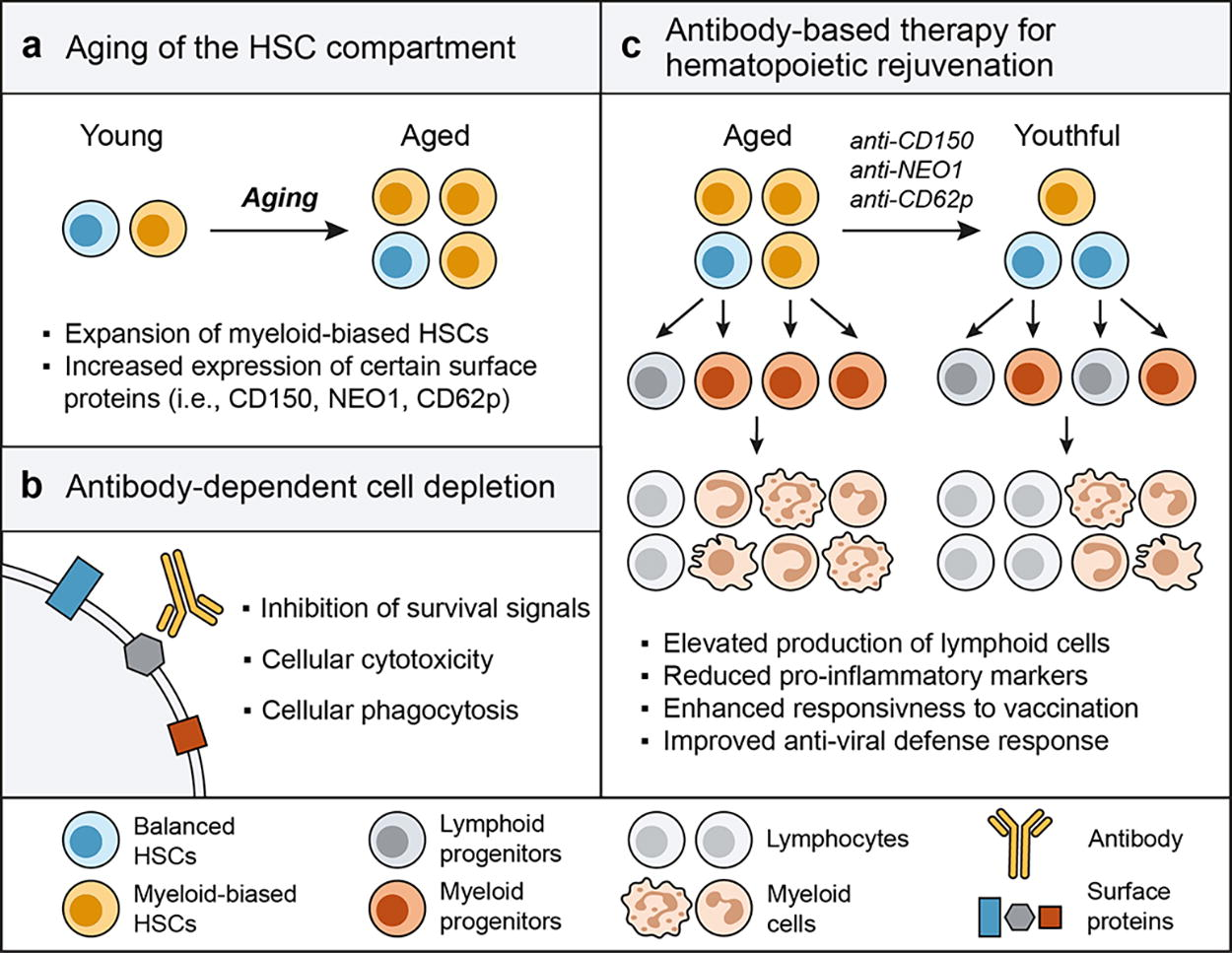
Antibody-based HSC depletion revitalizes the aging immune system.
In agreement with recent work from our own group (Konturek-Ciesla et al., 2023), the study by Ross et al. underscores the importance of leveraging relatively unaffected HSCs to counteract age-related decline, thereby focusing on the intrinsic changes that associate with the aging HSC compartment (Rossi et al., 2005). While this perspective echoes research indicating limited rejuvenation of HSCs through approaches such as caloric restriction, parabiosis, and exercise (Ho et al., 2021), it challenges another emerging view that systemic and reversible effects contributed by nonhematopoietic components would be the principal driver of HSC aging (Ma et al., 2022, Pálovics et al., 2022). However, when attempting to reinstate more efficient lymphopoiesis, it is critical not to completely overlook systemic effects. A prime example is that of thymic atrophy, which serve to directly constrain T cell development with age (Palmer, 2013).
Translating research on aging HSC biology into human therapies necessitates a careful balance between immune rejuvenation and minimizing associated risks. One concern is that the strategy by Ross et al., which employs co-blocking antibodies against c-KIT and CD47 to enhance depletion efficiency, may inadvertently also eliminate some “youthful” HSCs, possibly leading to unintended clonal dominance. That said, observations that young mice depleted of the majority of their HSCs can maintain healthy hematopoiesis counter perhaps this concern (Schoedel et al., 2016). Another potential issue arises from the consequences of enhancing the generation of naive lymphocytes in the elderly. While beneficial for immunity, it remains unknown whether such enhancements might increase the incidence of acute lymphoid leukemias, which typically originate from aberrations in the immature and naive lymphoid components. Given the known deterioration of DNA repair mechanisms with aging—a hallmark of the aging process (López-Otín et al., 2013)—the strategies proposed by Ross et al. to enhance lymphopoiesis in the elderly could inadvertently increase the risk of or hasten malignant transformations. Finally, while the study builds on well-founded targets from previous studies in mice, its effectiveness in humans merits further exploration.
These concerns aside, Ross et al.’s approach to selectively deplete myeloid-biased HSCs represents a significant conceptual advance towards restoring immunity in the elderly. Overall, Ross et al.’s study not only opens new pathways for immune system rejuvenation in the elderly but also lays the groundwork for transformative treatments aimed at significantly enhancing the health span and quality of life for older populations.
Footnotes
Authors’ Contributions
D.B. wrote the article. A.K.-C. made the figure.
Author Disclosure Statement
The authors declare no conflicting financial interests.
Funding Information
D.B.’s research is supported by grants from the Swedish Research Council, Cancerfonden and the Swedish Pediatric Leukemia Foundation.