




Abstract
Tumors evade immune detection by downregulating antigen presentation and hindering immune responses. Type 1 conventional dendritic cells (cDC1s) are vital in stimulating cytotoxic T cells against tumors. Ascic et al. are now demonstrating the in situ ability of PU.1, IRF8, and BATF3 (PIB) transcription factors to directly reprogram a plethora of tumors bypassing the suppressive effects of the tumor microenvironment, and leading to overall tumor regression while eliciting a systemic immune response that can protect from secondary tumor induction.
Recent progress in understanding how host immune cells interact with cancer cells has elevated immunotherapy to the forefront of cancer treatment strategies (Yadav and Delamarre, 2016). Cancer cells often develop mechanisms to evade immune detection mainly by downregulating antigen presentation and major histocompatibility complex molecules, thus preventing immune cells from recognizing and eliminating them. In this context, type 1 conventional dendritic cells (cDC1s), known for their ability to present antigens, induce cytotoxic T cell responses and secrete pro-inflammatory cytokines that target neoplastic cells that are considered pivotal in initiating and modulating immune responses against cancer. These properties make cDC1 cells a highly promising target for personalized immunotherapies.
The Pereira group recently identified a unique combination of transcription factors (TFs)—PU.1, IRF8, and BATF3 (PIB)—with the intrinsic ability to reprogram cells toward a cDC1-like phenotype (Rosa et al., 2018). In a series of studies, they demonstrated that the combinatorial expression of these three TFs consistently reprogrammed primary somatic fibroblasts grown in 2D cultures, as well as various mouse and human cancer cell lines, into antigen-presenting cells (APCs) with transcriptomic, phenotypic, and functional properties of cDC1 cells (Ferreira et al., 2023; Rosa et al., 2018, 2022; Zimmermannova et al., 2023). The diverse range of reprogrammable cell types suggests that PIB factors can universally activate a minimal gene regulatory network essential for establishing and maintaining the cDC1 phenotype.
An important question centers on how to translate the in vitro findings of cDC1 reprogramming, especially in the context of tumor cells (tumor-APCs), into viable immunotherapies. The study by Ascic et al. (2024) represents significant progress by providing compelling evidence that reprogramming tumor cells into a functional cDC1 phenotype in vivo can overcome the immunosuppressive tumor microenvironment and elicit a robust and sustained immune response characterized by tumor regression and the establishment of long-term systemic immunity (Fig. 1). The authors evaluated the immunogenic potential of reprogrammed melanoma cells in a heterologous mouse model carrying melanoma and lung-adenocarcinoma (LC) tumors at distinct sites. By reprogramming melanoma cells into a single primary tumor site and assessing their impact on distal melanoma and adenocarcinoma tumors, they observed a significant reduction in tumor growth at both the primary injection site and distal melanoma tumors, though not in the LC tumors. These findings highlight systemic and antigen-specific antitumor activity, attributed to the expansion and activation of cytotoxic T cell clones in melanoma tumor sites and peripheral blood. It will be intriguing to investigate whether tumor-APCs migrate from primary to secondary tumor sites and examine their median survival following reprogramming completion. The systemic effects observed are most likely mediated indirectly through lymphocyte-driven responses.
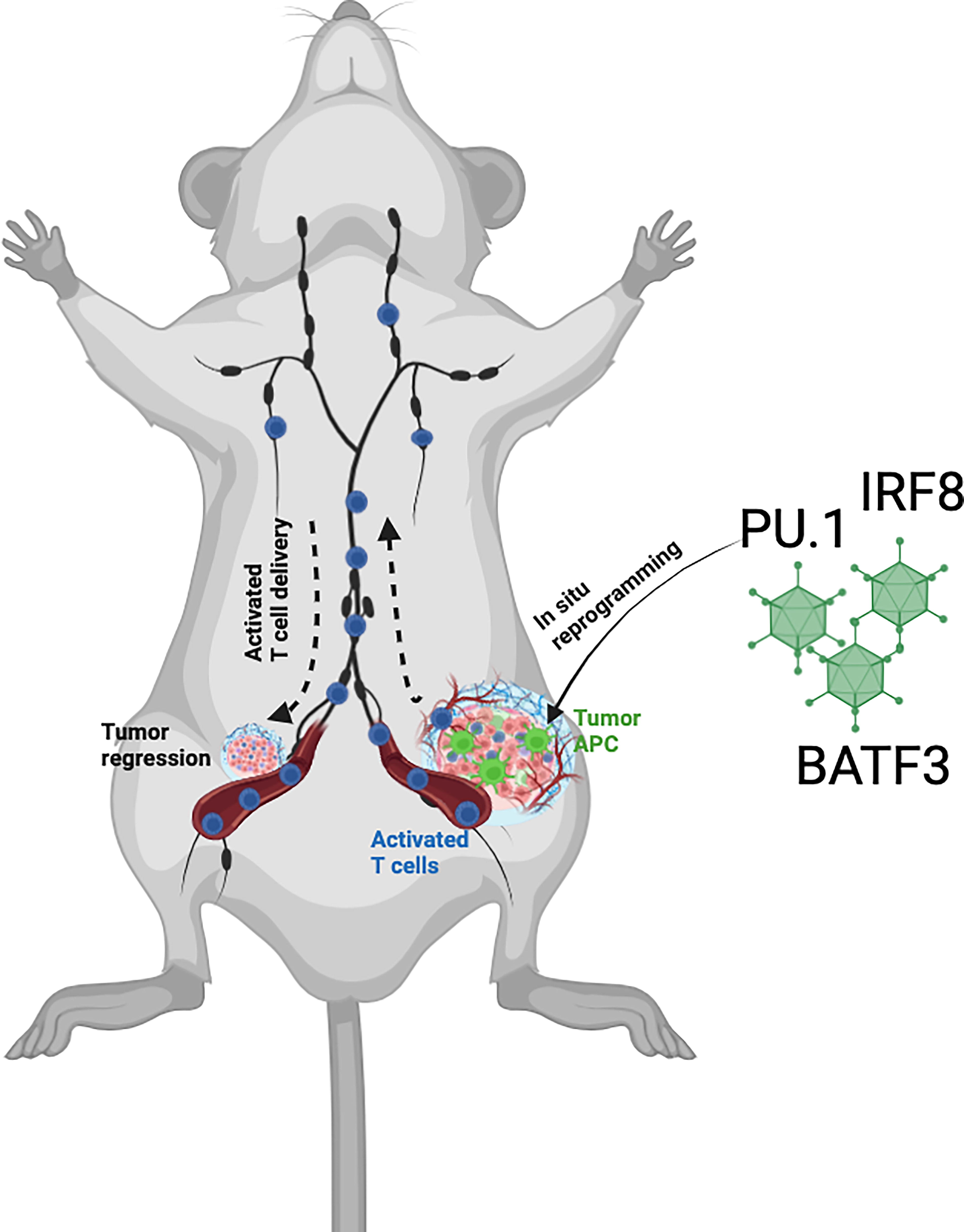
In situ tumor reprogramming by adenovirus-delivered PIB leads to induction of systemic effects at secondary tumor sites via prolonged and sustained T cell-mediated immunity. PIB: PU.1, IRF8, and BATF3 transcription factors.
A key feature of immunotherapy is its capacity to induce long-term immunological memory. Notably, mice that exhibited significant tumor regression following cDC1 reprogramming became resistant to subsequent tumor challenges, underscoring the establishment of a durable immune memory. It is conceivable that multiple rounds of reprogramming could be used to target metastatic tumors that acquire neo-antigens as a result of new mutations or epigenetic changes that lead to metastatic tumor evolution. Combining tumor-APCs with immune checkpoint blockade was tested and shown to have synergistic effects, leading to increased survival rates and complete remission in a higher percentage of treated animals compared to monotherapy. These findings establish in vivo reprogramming as a novel and promising modality for cancer immunotherapy.
In situ reprogramming involves the direct delivery of PIB transcription factors into the tumor microenvironment, targeting and reprograming heterogeneous cell populations. In solid tumors, effective delivery within the three-dimensional (3D) tumor structure is essential, as reprogramming factors will encounter both proliferating and nonproliferating cells, hypoxic conditions, and variable concentrations of nutrients and signaling molecules. Through comparative testing of various PIB delivery methods, the authors stratified nonintegrative adenoviral (Ad) delivery over lentiviral (LV) and adeno-associated viral vector transduction. Adenoviral delivery demonstrated superior spheroid penetration, achieved higher reprogramming conversion rates, and generated functional cDC1 cells that could persist in the tumor microenvironment over extended periods. The in situ PIB delivery not only reprogrammed tumor cells but also delayed tumor growth and induced regression. These outcomes were associated with polyclonal CD4 expansion and the recruitment of cytotoxic CD8 T cells. A strong correlation between the number of reprogramming events and tumor growth delay, as well as survival rates, indicated that transduction efficiency is a critical parameter for therapeutic efficacy. Thus, PIB Ad vectors emerged as the preferred platform for cancer gene therapy, offering a rapid and efficient approach for in situ generation of tumor-APCs. It is important to note that PIB delivery may not be precise enough to target only tumor cells. As a result, there could be off-target effects or the production of partially reprogrammed cells, which might disrupt overall immune balance. Further evaluation is needed to address these concerns.
Future mechanistic studies are needed to identify factors that either enhance or inhibit the fidelity of the reprogramming process, both in vitro and in vivo. Reprogramming efficiency has been shown to vary based on the tissue of origin (Zimmermannova et al., 2023), suggesting the presence of cell-type-specific barriers. Elucidating how PIB factors override distinct cell identities is of considerable interest and could inform additional reprogramming paradigms. A key mechanistic question pertains to whether PIB factors function independently yet additively to directly activate the cDC1 program, or if co-operative interactions between these TFs and other stage-specific factors are required for step-wise reprogramming and cDC1 activation. Identifying and overcoming such barriers is expected to enhance the fidelity of the reprogramming process, thereby increasing the number of transduced tumor cells and improving patient response rates.
In conclusion, this study provides compelling evidence that in situ cDC1 reprogramming represents a novel and effective cancer immunotherapy modality. The ability to reprogram tumor cells directly within the Tumor Microenvironment (TME) offers several advantages over traditional approaches, including the potential for more precise and durable antitumor immunity.
Footnotes
Author’s Contributions
C.C. wrote the article and generated the figure.
Author Disclosure Statement
No conflicting financial interest.
Funding Information
C.C. was supported by NIH/NHLBI R01HL170286.