




Abstract
Abstract
Background:
Improving nutrition and physical activity behaviors associated with childhood obesity are significant national public health goals. Energy Balance for Kids with Play (EB4K with Play), developed through a partnership between the Academy of Nutrition and Dietetics Foundation and Playworks, is a multi-component school-based intervention designed to address youth's nutrition and physical activity behaviors. This article describes the EB4K with Play intervention and evaluation study and presents the baseline data.
Methods:
The evaluation is a 2-year cluster-randomized design targeting third- to fifth-grade students enrolled in a low-income, urban school district in northern California. Six schools were recruited to participate. Four were randomized to the intervention group and two into a control group. Baseline student-level data pertaining to nutrition, physical activity, fitness, and BMI were collected in the fall of 2011. The EB4K with Play program, which includes direct-to-student nutrition and physical activity interventions, a school wellness component, and parent/community partner outreach components, began immediately after baseline data collection.
Results:
An ethnically diverse sample of students (n=844) was recruited to participate in the study. Baseline data showed a higher percent of eligibility for free and reduced-price school lunch and higher rates of obesity/overweight than the California state averages. Fitness levels and levels of moderate-to-vigorous physical activity were comparable to state averages.
Conclusions:
End-point data will be collected after 2 years of the intervention. The findings from this study should help guide future efforts to design effective intervention programs to support the prevention of pediatric obesity.
Introduction
Childhood obesity is a significant public health issue that affects 17% (12.5 million) of all children and adolescents in the United States, with the highest risk among low-income and minority populations.1–4 Childhood obesity leads to the development of debilitating and costly chronic diseases and is currently estimated to be responsible for $14.2 billion in direct annual medical costs.5,6
The Institute of Medicine's recent report, “Accelerating progress in obesity prevention: Solving the weight of the nation,” calls for a systems-based approach, highlighting schools as a critical venue in which to address childhood obesity. 2 Two recent reviews present the mixed results of school-based obesity prevention interventions and draw the following four conclusions.6,7 First, interventions addressing both nutrition and physical activity appear to have the greatest impact. Second, both educational and environmental aspects of nutrition and physical activity behaviors must be addressed. Third, whereas home involvement components have had meager results to date, engaging parents and communities in intervention efforts is thought to be a critical requirement for effecting change.2,8 Finally, for interventions to have lasting effects, they must have sufficient dose and be sustainable.
Two national nonprofit organizations, the Academy of Nutrition and Dietetics Foundation (ANDF) and Playworks, collaborated to develop a school-based intervention that incorporated best practices identified by previous research.6,7 ANDF is devoted to advancing public health and nutrition utilizing the expertise of Registered Dietitians (RD), and Playworks organizes safe and healthy play for students throughout the school day in high-risk schools. The program, Energy Balance for Kids with Play (EB4K with Play), provides one nutrition coach and one recess coach to a school to promote and support nutrition and physical-activity–related education, environmental changes, and engagement of parents and communities in healthy behaviors. ANDF previously piloted an RD nutrition coach (RD coach) working with physical education teachers and school administrators in low-income schools in Kansas City, Missouri. The pilot program demonstrated increased nutrition knowledge and vegetable consumption in the intervention students, compared to the controls; physical activity, fitness, and weight status were not assessed (Gerstein DE, Ross M, Crawford PB, UC Berkeley, unpublished data, 2008–09). Playworks has trained recess coaches to create safe physical activity opportunities for students attending low-income schools by organizing their play yards for over 15 years. Research has shown that Playworks recess coaches significantly increase opportunities for safe physical activity through the school day. 9
The current study was designed to test the impact of EB4K with Play on students' nutrition and physical activity knowledge and behaviors, fitness, and BMI z-score over a 2-year period beginning in the fall of 2011. This article describes the study design, intervention, and baseline characteristics of the study participants.
Methods
Study Design
This is a 2-year cluster-randomized study targeting students enrolled in a low-income, urban school district in northern California who were in the third through fifth grades in the fall of 2011. The study protocol was approved by the Committee for the Protection of Human Subjects at the University of California, Berkeley. Written parental consent and child assent were obtained for each student participating in the study.
School Selection
Six elementary schools (K–6) were recruited to participate in the study based on the following eligibility criteria: ≥50% of students eligible for free or reduced-price lunch; average of at least 60 students per grade; and no exposure to Playworks in the past 5 years. Four of these schools were randomized to the intervention group and two to a control group at the end of the 2010–2011 academic year. Before the start of the study, observational school-level data were collected from the six schools. It was discovered at that time that one of the schools assigned to the intervention group had a recess coach previously trained by Playworks; therefore, this school was dropped from the study. The assistant superintendent of the school district identified another school that met the study eligibility criteria to participate as an intervention school. Between September and October 2011, all third-, fourth-, and fifth-grade students from the six participating schools were recruited by fliers sent home to parents/guardians (Fig. 1).
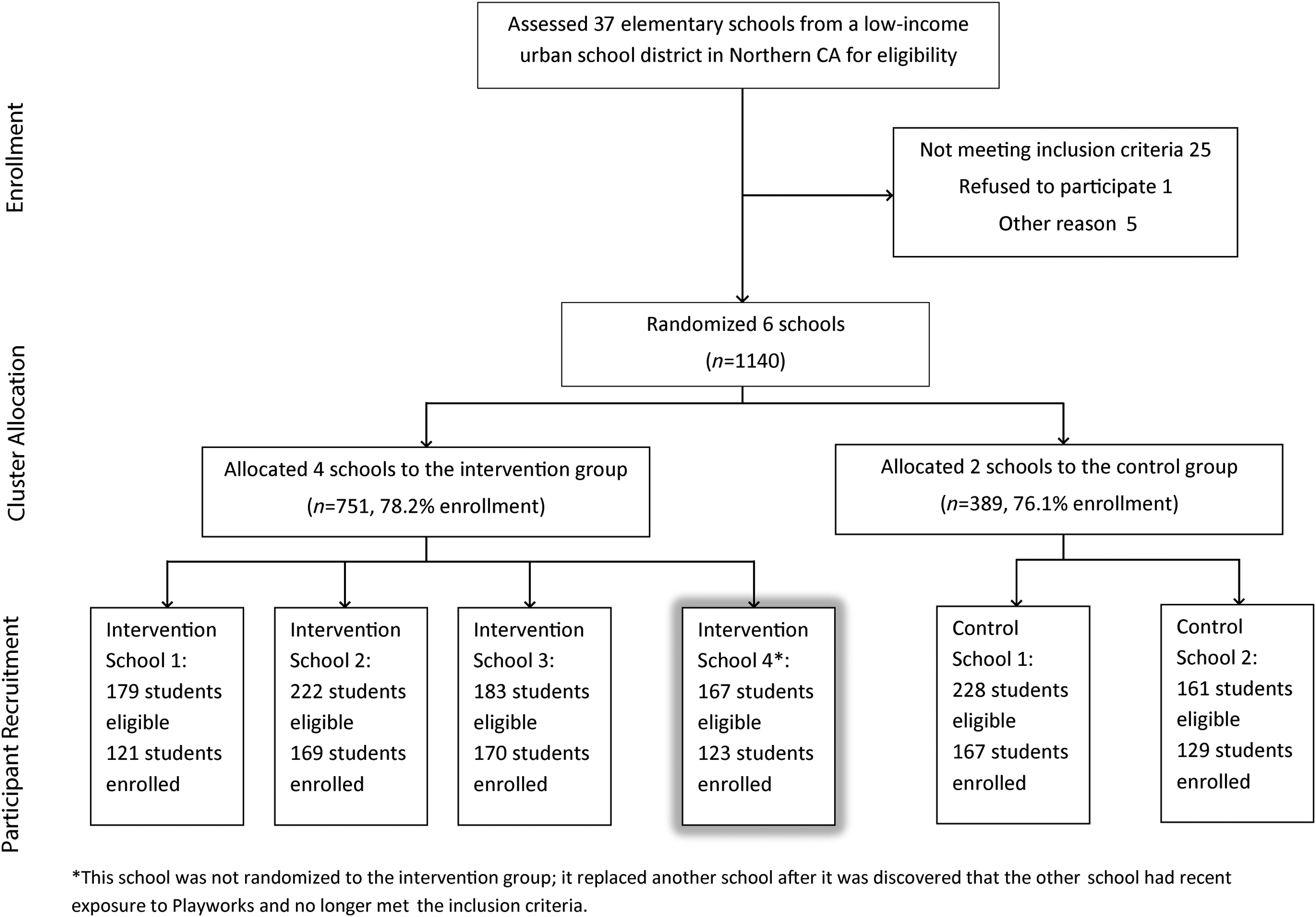
The Energy Balance for Kids with Play (EB4K with Play) study recruitment and randomization flow chart.
Sampling Methods
The primary short-term outcomes, fruit and vegetable consumption behaviors and moderate-to-vigorous physical activity (MVPA) minutes during the school day, were used for the sample-size calculations. Calculations assumed two-group t-tests (two-sided alpha=0.05) comparing change from baseline to postintervention (2 years) between groups and accounted for the cluster design effect. Based upon standard deviations and intracluster correlations (rho=0.03) from the previous pilot study of the RD coach (Gerstein DE, Ross M, Crawford PB, UC Berkeley, unpublished data, 2008–09), a sample of 200 students in each of the six study schools was expected to provide power exceeding 80% to detect differences between groups in changes from baseline of 0.28 fruit and 0.49 vegetable servings. Power calculations for physical activity, based on previous studies in similar populations,10,11 suggested the study would have 80% power to detect a difference between groups in change in MVPA of 10.5 minutes, with at least 63 fourth- and fifth-grade students per school.
Study Variables, Measures, and Data Collection
The study will compare the change over time between intervention and control groups in the following primary dependent variables: nutrition knowledge; dietary intake; minutes of MVPA during the school day; fitness; and BMI z-score. Data collection was planned for baseline (fall of 2011), mid-point (spring of 2012), and end point in the second year of the intervention (fall of 2012 for MVPA and spring of 2013 for other measures). The following baseline data were collected in the fall of 2011:
1. Demographic data: All participating students completed a student questionnaire that collected demographic information, including age, gender, and race/ethnicity. 2. Nutrition knowledge data: Responses to six nutrition knowledge questions, which were tailored to the curriculum content and previously used in the pilot evaluation study, were combined to create a nutrition knowledge score. 3. Dietary intake data: Students' self-reported breakfast, milk, sweetened beverage, snack, and restaurant food consumption was assessed with questions adapted from the School Physical Activity and Nutrition questionnaire and the Child Food Consumption Questionnaire.12,13 Students' self-reported estimates of their screen time the day before assessment were also collected using a survey question similar to that used in Robinson's 1992 randomized controlled trial on reducing children's television (TV) viewing, which had high test-retest reliability.
14
In addition, researchers collected and analyzed digital images of students' lunch trays pre- and postmeal consumption to assess 1 day of students' school lunch fruit and vegetable consumption. A trained coding team assessed the portions of fruits and vegetables, excluding French fries, remaining on the trays after the students ate. Codes are based on a standardized nine-point scale, adapted from the Comstock scale.
15
The inverse of the portion left was taken to represent the portion of the fruit or vegetable that the students consumed. The intent is to assess consumption at the various data collection periods when the same fruit and vegetable is offered. Research has shown this to be a highly accurate method of measuring actual consumption of school cafeteria meals.
16
4. Physical activity data: Participating fourth- and fifth-grade students (this assessment did not include third graders because of limited equipment) wore Actigraph GT1M and GT3X accelerometers (AG; Actigraph, LLC, Pensacola, FL), programmed for 15-second periods, for 5 consecutive school days in order to measure minutes of physical activity during the school day. Research has demonstrated the comparability of these units when used in the uniaxial mode.
17
The minutes students engaged in activity during the school day were categorized as MVPA or sedentary activity based on Evenson's cut points.
18
Research staff were at the school the first few days of data collection to encourage students to wear the accelerometers. In addition, teachers wore accelerometers to model the behavior. 5. Fitness data: Researchers administered and recorded times for a 1-mile run test for fourth- and fifth-grade students (these data were not collected from third-grade students), which has been validated against maximal treadmill testing as a measure of cardiorespiratory fitness in youth.
19
6. Anthropometric data: Standing height (in centimeters) and weight (in kilograms) measures were obtained from all participating students using National Health and Nutrition Examination Survey anthropometry standardized protocols.
20
These measurements were used to calculate BMI. BMI z-scores were calculated using the 2000 CDC Growth Charts for the United States.
21
7. Fruit and vegetable attitude data: The student questionnaire included six attitudinal questions pertaining to fruit and vegetables adapted from the Wilson and colleagues child nutrition questionnaire.
22
8. Program fidelity data: Throughout the 2-year intervention, the interventionists will track all programming in logs that are kept at each of the schools. These logs will be collected each semester and assessed for program fidelity and dose.
Statistical Analysis
Linear models were used to compare the continuous values between the intervention and control groups at baseline. Chi-square tests compared differences in proportions. A significance level of p≤0.05 was used for all statistical tests. All analyses were performed using SAS software (version 9.3; SAS Institute, Inc, Cary, NC).
Intervention
The EB4K with Play program has nine components targeting direct-to-student nutrition and physical activity interventions, school-wellness, and parent/community partner outreach. Figure 2 shows the nine components: nutrition education; individualized nutrition and physical activity goal setting/coaching; community visibility and engagement; energy balance team; teacher engagement/coaching; organized play during in-school and before-school recess; class game time; other opportunities for physical activity during and after school; and junior coach program. Each component focuses on desired intermediate outcomes (changes in dietary intake behaviors, minutes of MVPA during the school day, and nutrition knowledge and attitudes) as well as school-level changes that may lead to changes in fitness and promote healthier body weights. The theoretical basis of the intervention was a concept developed by an ANDF-appointed team of nutrition and physical activity experts and is based on social cognitive theory. 23

The Energy Balance for Kids with Play (EB4K with Play) logic model illustrating the nine components of the program, which focus on intermediate outcomes that lead to a shift in energy balance and the ultimate outcomes.
Each school has its own RD coach and Playworks recess coach. RD coaches follow the ANDF curriculum leader guide for grades 3–5 (unpublished) to deliver classroom lessons, lead physically active games during physical education time, implement cafeteria promotions, facilitate school wellness environment and policy changes with school wellness councils (energy balance teams), plan parent outreach activities, and collaborate with the recess coach. The recess coach organizes and teaches safe, inclusive games before and during school and conflict resolution strategies, encourages children to participate in games, generates community and family involvement by recruiting and supporting volunteers, and organizes a leadership program, called the junior coach program.
Nutrition and recess coach training
Before the start of the intervention, nutrition and recess coaches completed trainings specific to their respective disciplines. The RDs participated in four, 1-hour webinars, followed by 2-day in-person training with the Playworks coaches. The webinars included an in-depth overview of the curriculum lessons and physical activity games as well as topics specific to being successful in a school environment, such as ages and stages of child development, school funding, school meal patterns and requirements, the HealthierUS School Challenge (HUSSC), 24 leading school wellness environmental changes, effective communication with students, staff, and administrators, and cultural competency and sensitivity. The in-person training provided opportunities for practicing lessons and physical activity games, organizing group play and effective transitioning of students from activity to learning readiness, integrating physical activity into classrooms, delivering nutrition and physical activity messages during recess, training students to be healthy role models, and working with parents/guardians. Additional ongoing trainings by webinars, teleconferences, and in-person meetings are provided on a bimonthly basis throughout the intervention.
Head nutrition coach and recess program manager
A head nutrition coach and a recess program manager provide on-site management to all of the participating EB4K with Play program schools as well as oversight and training for the nutrition and recess coaches. They work with the school principals to ensure that the program components fit within the school schedules and they conduct trainings for teachers and coaches. The head nutrition coach also works closely with the district nutrition services director to establish community partnerships, identify modifications necessary to meet the USDA's HUSSC criteria, and submit each school's HUSSC award applications. 24 The recess program manager serves as a liaison between Playworks and school principals/district officials, provides trainings for teachers and junior coaches (students chosen to play a peer leadership role), schedules and supervises Playworks interscholastic league events, establishes community partnerships, and assists the head nutrition coach with formal observations of the coaches and with providing ongoing support for effective group management and rapport building strategies.
Nutrition education
The RD coach delivers 12 weeks of grade-specific nutrition education to the third-, fourth-, and fifth-grade students using interactive teaching strategies (e.g., games, worksheets, food preparation and tastings, small group activities, and a “mini-power up” physical activity led with the assistance of a student). Lesson topics include: MyPlate 25 ; food labels; beverages; eating on the go; and lessons targeting each meal of the day and healthy snacks. Though topics change weekly, energy balance concepts, fruit and vegetable consumption, and the concept of choosing nutrient-dense foods, called “Power Pick Foods,” are promoted daily throughout the program. Each lesson is matched to Health Education Content Standards for California Public Schools, Kindergarten through Grade Twelve adopted by the California State Board of Education. 26 The EB4K with Play curriculum presented in the classroom is reinforced during physical education class with short, active games developed specifically for each curriculum topic. Program materials are available in English and Spanish.
Cafeteria promotions
The RD coach leads cafeteria promotions with posters and banners promoting Power Pick foods and energy balance messages. RD coaches take pictures of students eating fruits and vegetables to display on a “Power Pick Champions” banner in the cafeteria. Healthy fruit and vegetable tastings are conducted, and take-home recipe cards are provided. The cafeteria staff provide Power Pick and EB4K with Play t-shirts and encourage and praise students for making healthy selections.
Nutrition and physical activity coaching
During physical education class, the RD coach meets with groups of 4–6 students for 2–5 minutes of active coaching. Students set goals for eating and activity and strategize how to make healthy choices in- and outside of school. The coaching sessions are designed to personalize the EB4K with Play curriculum for students in order to promote the adoption of the healthy behaviors. 27
Class game time
At least twice a month, the recess coach leads class game time (CGT); students and the classroom teacher participate in physical activity games during this time. CGT provides the classroom teacher with an opportunity to learn relevant games and observe techniques used by the Playworks recess coach to organize students for active play, prevent disruptive behavior, manage student conflict in the play yard, and easily transition students back to the classroom for learning readiness.
Recess: Before and during school
The recess coach provides safe, active play opportunities during recess. Designated game areas are organized in the play yard. Students are taught how to play games in a safe, respectful manner that minimizes conflicts and includes all students in physical activities. A 45-minute before-school recess is offered at the EB4K with Play schools, led by the recess coach, which children are encouraged to attend.
Junior coach program
The recess coach leads a junior coach program, creating opportunities for student leadership. The recess coach and classroom teachers select junior coaches from among students with a complete junior coach application. Junior coaches assist in leading CGT games, Power-Ups, recess games, cafeteria promotions, and act as role models for their peers.
Teacher engagement
A 30-minute to 1-hour initial teacher training introduces the program, its goals and activities, and expectations for teacher involvement. Power-Ups, a classroom challenge to promote physical activity breaks in the classroom at least once per day, are introduced to teachers during the training. Minutes of classroom physical activity are tracked by teachers and students using a classroom poster over a 4-week period; prizes are awarded to classrooms with the most minutes of physical activity.
Recreational sports leagues
The recess coach leads four recreational sports leagues for students in the intervention schools each school year, providing an opportunity for students to participate in a variety of sports in a friendly, safe, and supervised setting, outside of school time, at no cost. The aim of each of these sports leagues is to involve at least 15 students from each school who have not previously played this sport and give families a chance to watch their students play by hosting these events in the evening.
Community visibility and engagement
A strong effort is made to raise awareness of the EB4K with Play program among community stakeholders and parents through monthly newsletters in English and Spanish, school-specific events, and educational materials for students to share with parents. At least two school/parent events each year include EB4K with Play program messages and materials (e.g., a booth, handouts, and tasting activities at back-to-school night; a hydration station with water bottles and handouts at recreational sports league games). In addition to informing stakeholders about the EB4K with Play program, the head nutrition coach will seek collaborations with local organizations through complementary programs and services, such as the University Cooperative Extension, Dairy Council, local health departments, local parks and recreation departments, local food banks, and farm programs.
Energy balance team
The RD coach works with the school principal to recruit school staff and teachers to participate in an energy balance team (EB Team) at each school. The EB Team assesses their school's current wellness environment and creates an action plan to achieve the bronze level of the USDA's HUSSC awards. 24
Results
Seventy-seven percent of eligible students provided written parental consent and student assent to participate in the study: 242 third-grade students; 325 fourth-grade students; and 312 fifth-grade students. The sample size varied for each assessment tool as a result of missing or incomplete baseline data. Students' demographic data are reported in Table 1. The study sample was ethnically diverse and comparable in ethnicity to the full student body of the participating schools. The participating schools had higher percentages of students participating in the free and reduced-price lunch program (64–100%) than the state of California (56.7%) as a whole. 28 Students' anthropometric, fitness, physical activity, and dietary data collected at baseline are presented in Table 2. The sample size for the digital images of lunch trays was smaller as a result of missing pre- or postmeal photos, missing ID labels in images, student absences on day of assessment, and students throwing lunches away before the postmeal photograph was taken. Though overweight (BMI ≥85th percentile for sex and age) and obesity (BMI ≥95th percentile) prevalence were higher than national and state data, 29 students' fitness levels based on the 1-mile run times and their level of MVPA during the school day were similar to other reports of California and national students.10,11 With respect to nutrition, baseline observations of lunchtime dietary intake demonstrated fruit and vegetable consumption that was lower than most national school meal studies have found and was also below the MyPlate recommendations for fruit and vegetable intake.30–33
Student Demographic Data from the Energy Balance for Kids with Play (EB4K with Play) Evaluation Study Collected at Baseline (Fall 2011)
p value based on chi-square or Fisher's exact tests.
Characteristics of Students Participating in Energy Balance for Kids with Play (EB4K with Play) Evaluation Study Collected at Baseline (Fall of 2011)
Fitness and accelerometer data were collected from fourth- and fifth-grade students (not third-grade students).
These data are based on students' self-reported behaviors.
SD, standard deviation.
There were significant differences noted at baseline between intervention and control groups' observed fruit and vegetable intake at lunchtime derived from analysis of digital lunchtime photographs. The observed fruit intake of students in the intervention group was greater than that of the control group; the intervention group's mean observed vegetable intake was less than that of the control group. There was also a significantly higher percentage of students who reported watching more than two hours of TV programs and movies, an indicator of sedentary activity, in the control group. All other baseline data were similar across the study groups.
Discussion
This study has a number of strengths, including leveraging two national organizations to deliver the intervention, and the collection of rigorous, highly reliable dietary, physical activity, fitness, and anthropometric data. However, because this is an integrated multi-component intervention, the impact of individual program components will not be detectable. Other study limitations include the potential introduction of bias from replacing a school in the intervention group after randomization, as well as the potential challenges of collecting self-reported data from children. It should be noted that the scope of this study does not extend to addressing the schools' ability to obtain future funding for the EB4K with Play program. This is a costly intervention. If it proves to be successful, the next step will be to explore how to best disseminate this model on a larger, cost-effective scale.
Students' BMI changes after 2 academic years will be measured; however, the sample size and short duration of the study may make it unlikely to detect significant differences between the intervention and control groups. Whereas other school-based obesity prevention intervention research that assessed adiposity has concluded with mixed results, 8 this intervention was uniquely designed to incorporate the lessons learned from previous interventions' successes and challenges.6,7 EB4K with Play focuses on improving both nutrition and physical activity behaviors by addressing both the educational and environmental aspects of the behaviors. The intervention was also designed to engage parents and community members in order to create home and community environments that support these behavior changes. Finally, the intervention was designed to have a high program dose and with sustainable program components for a lasting effect.
Conclusions
The study, which concluded in May 2013, will identify the impact of EB4K with Play, a school-based multi-component intervention designed to deliver an integrated energy balance program to third-, fourth-, and fifth-grade students in a low-income urban community over 2 years. The EB4K with Play program embodies the collective wisdom of two national nonprofit organizations with respect to the nature and dose of program components that will support nutrition and activity behavior changes conducive to long-term BMI changes. The results of this intervention will guide future efforts to combine a variety of program components and link school and community in the design of effective intervention programs to support the prevention of pediatric obesity.
Footnotes
Acknowledgments
This program was funded through a grant from the Healthy Weight Commitment Foundation. The Academy of Nutrition and Dietetics Foundation funded the evaluation study. The authors acknowledge the RD Nutrition Coaches: Sandra Brown, Anca Cunningham, Elena Huey, Susie Liles, Ruth Schrager, Karaliese Brown, Jill West, and Lisa Medrow; the Playworks Recess Coaches: Peter Best, Laura Kocourek, Paul Pasternak, and Grace Reinhalter; and the Playworks staff: Alison Towney and Jackie Hemann. The authors also acknowledge the Atkins Center for Weight and Health staff: Christina Becker, Ginny Gildengorin, Lauren Goldstein, and Sheila Stern, who assisted with editing this article.
Author Disclosure Statement
This program was funded by the Healthy Weight Commitment Foundation, which is a coalition of 230 primarily food and beverage organizations. This Foundation did not have any involvement or influence in the development or implementation of the program or evaluation. The Academy of Nutrition and Dietetics Foundation funded the evaluation study and had no involvement in the data collection or analyses.