




Abstract
Abstract
Despite public health concerns and the many recognized benefits of physical activity (PA), levels of participation among youth remain below national recommendations. To this end, a variety of strategies for promoting physical activity for youth have been advocated, including multi-faceted, school-based approaches. One that continues to be identified as having great potential is a comprehensive school physical activity program (CSPAP). The aim of this article is to introduce a conceptual framework for school-based PA promotion that serves to stimulate, guide, and organize related research and practice. The CSPAP conceptual framework is a proposed framework, informed by existing science, recommendations, and a social ecological perspective with individual PA behavior as the epicenter. Discussed in turn are the four proposed interactive levels of influence (i.e., components, facilitators, leaders, and culture) and several integral elements proposed to operate at each level. The article concludes with a presentation of the utility of the framework for research and practice.
Introduction
Given the great concern regarding the physical activity (PA) levels of youth and the known benefits PA has on cognition, schools have been identified as logical sites for promoting PA for a few reasons.1,2 First, the majority of youth attend schools for approximately 6–7 hours per day, thus providing access to the targeted audience in a formal setting. 3 Also, most schools have many of the facilities, equipment, and staffing needed for effective PA promotion that may not be available in the home or community environments. 4 However, schools can also be limiting because of the lack of time offered for activities that do not contribute to academic requirements. 5 Consequently, multi-faceted, cost-effective, and noninvasive approaches to school-based PA promotion are recommended.6,7 The aim of this article is to introduce a conceptual framework for school-based PA promotion that serves to stimulate, guide, and organize related research and practice. The guiding definition of school PA promotion used throughout this article and in the accompanying framework is opportunities in and around the school setting that purposefully endorse physical movement and its associated health and fitness benefits.
Comprehensive School Physical Activity Program Conceptual Framework
A comprehensive school physical activity program (CSPAP) is a systematic, five-component approach by which schools and school districts optimally use all school-based PA opportunities available to develop educated individuals with the knowledge, skills, and confidence to participate in daily PA and sustain a physically active lifestyle. 8 The underlying notion is that the recommended 60 minutes of PA each day may be accumulated through the coordinated synergy of multi-component CSPAP implementation.9,10 The CSPAP concept emerged in 2008 from a rich history of proposed comprehensive school-based approaches to health and wellness11,12 and, in a few short years, has become a widely advocated PA-focused model for building healthier generations of youth through schools.8,10 The CSPAP model is endorsed throughout the 2013 Institute of Medicine report on school-based PA, where it is termed a whole-of-school physical activity program, 2 and is central to the newest national initiative to boost movement in schools—First Lady Michelle Obama's Let's Move! Active Schools (LMAS) campaign. 13
The construction of a conceptual framework provides both a rational and visual representation of the flow from theory to practice. Such illustrations depict the organizational structure and relationships among variables that mediate and moderate the desirable outcome. Informed by the existing science and recommendations outlined in this article, as well as the recommended application of the social ecological systems and theoretical constructs14,15 to address childhood obesity and youth PA issues (e.g., previous reports16–19 ), we propose, in Figure 1, a multi-layered conceptualization for promoting PA through schools (entitled CSPAP conceptual framework).
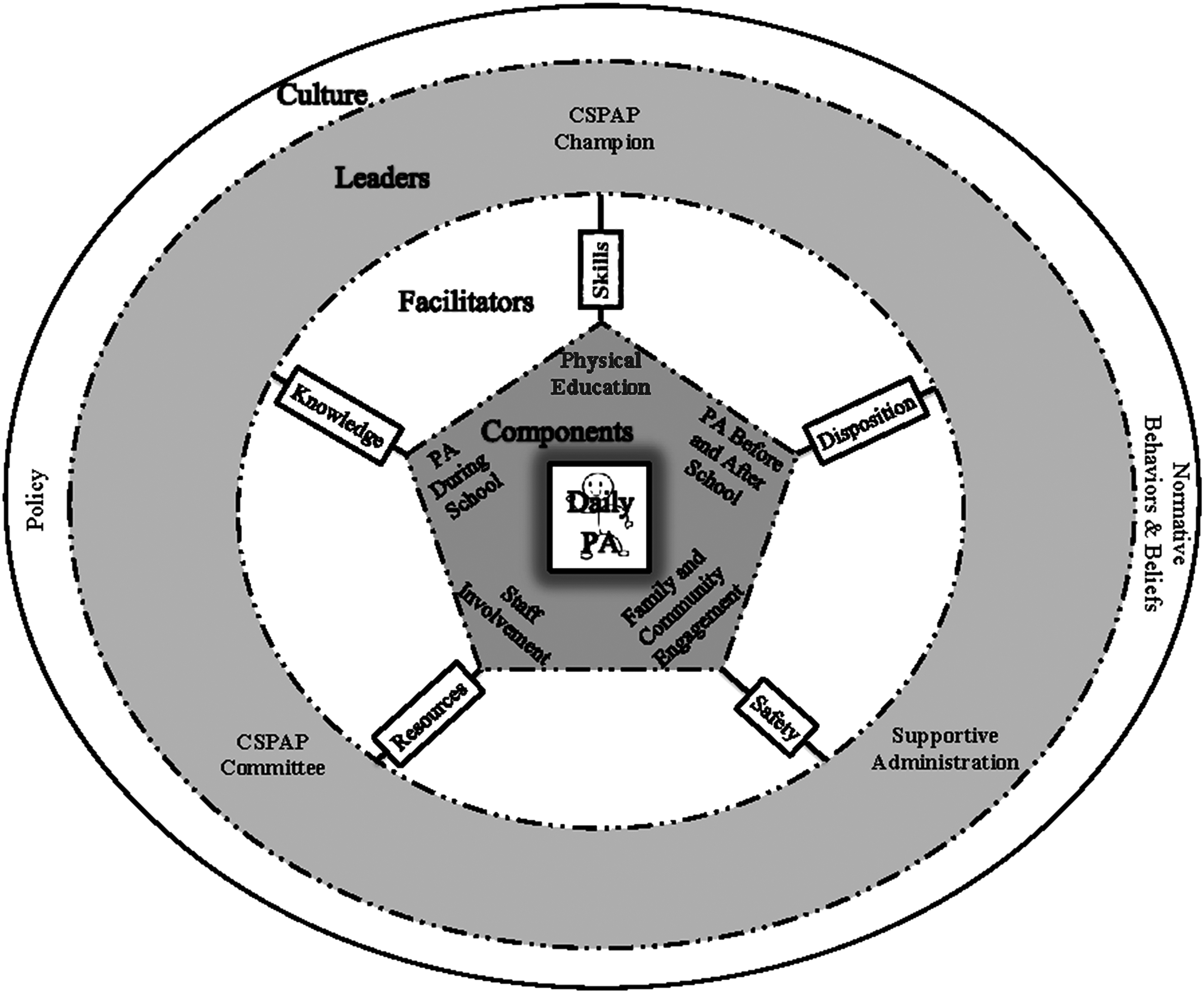
Conceptual framework for CSPAP research and practice based on a social ecological perspective. Dotted lines represent the bidirectional influence of levels. Facilitator level resources relate to personnel, financial, political, time, space, access, built environment, and transportation support, and safety relates to physical, social, and emotional well-being. CSPAP, comprehensive school physical activity program; PA, physical activity.
Application of a social ecological perspective in the CSPAP conceptual framework allows interventionists to design school PA promotion programs that acknowledge the interconnectedness between an individual and his or her environment. The rationale for applying a social ecological perspective to school PA programming is simple: Every school-aged child is surrounded by multiple levels of overlapping influences on their school PA behavior. The CSPAP conceptual framework presented in Figure 1 proposes four interactive levels of influence (i.e., components, facilitators, leaders, and culture) and several integral elements operating at each level. Using social ecological terminology, the four levels reflect micro-, meso-, exo-, and macrosystems of influence on the overall goal and epicenter of the CSPAP conceptual framework—daily PA behavior. The basic premise behind the CSPAP conceptual framework is that elements from each level of influence must function in synergy for effective, sustainable CSPAP implementation. The remainder of this article will provide an empirical-based rationale for the elements proposed at each level, with the intent that the CSPAP conceptual framework be used to stimulate, guide, and organize research and practical application in school-based PA promotion.
Epicenter: Daily Physical Activity Behavior
Consistent with a main goal of school PA promotion from CSPAP implementation at the individual level, and thus a key unit of measurement, is the engagement in the recommended amount of PA behavior each day.8,10 Clearly, the individual PA behavior of great interest and importance from CSPAP implementation to date has been that of youth, 8 but it is also recommended that the PA behavior of adult populations surrounding schools (e.g., administrators, teachers, school health professionals, parents, and CSPAP-engaged community members) would also be a valuable element of change from the comprehensive promotion of an active, healthy school setting.9,20,21 The CSPAP framework recognizes that school PA promotion would ideally influence the daily school PA behaviors of both youth and adults.
Micro Level: Comprehensive School Physical Activity Program Components
At the microsystem level of influence are the immediate surroundings, in the form of five school entities and social networks known as components, where PA opportunities can be structured and promoted in and around the school setting. Depicted in Figure 1, these five components encompass the current CSPAP model that was created to guide the practical application of a CSPAP and delineate the specific points of interventions for schools to foster PA opportunities. 8 The intent of a CSPAP is not that all five components be targeted at once, but rather to target the components that are most logically and contextually tailored (i.e., high-priority need with highest probability for success) for increasing the PA levels of students, staff, and parents associated within the specific school context. Similar multi-component approaches have been applied with some success in addressing the health and educational needs of various school-aged youth.1,22–27 and a compendium of the most up-to-date research pertaining to each CSPAP component in particular is overviewed elsewhere. 21
Meso Level: Comprehensive School Physical Activity Program Facilitators
Consistent with social ecological perspective, the influential elements at the mesosystem level in the CSPAP conceptual framework serve to mediate the relationship between the micro- and exosystem layers (see Fig. 1). Three of the CSPAP facilitators, knowledge (i.e., understanding), skills (i.e., competencies), and dispositions (i.e., attitudes, values, self-efficacy beliefs), reflect the same guiding outcomes/standards for school physical education (PE) programs 28 and PE teacher education programs. 29 Unfortunately, many of these three facilitators are often lacking among school personnel who seek to become the primary provider of school PA opportunities for children 30 and therefore are embedded learning goals of CSPAP guides and training programs.10,31
The fourth and fifth facilitators, resources (i.e., operating personnel, financial and political support, time and space allocation, access to equipment and facilities, physical/built environmental structures, transportation considerations, and so on) and safety (i.e., physical, social, and emotional) are practical necessities underlying the establishment and healthy functioning of comprehensive school programming and classroom climates.32,33 Both have been further compartmentalized into multiple dimensions in complementary school health models, 34 but given the concurrent functioning of many dimensions (e.g., transportation requirements to off-campus facilities) and the reality that full integration of each dimension is contextually dependent, we attempt to clarify these complexities by classifying each dimension into two higher-order terms of resources and safety. The challenge is that many schools are already limited in the availability of most kinds of resources that are often reliant on the built environment surrounding schools, and therefore school personnel must be creative or even learn new strategies to secure adequate resources and use alternative methods for promoting school PA.31,35 Children's safety, encompassing social and emotional aspects beyond physical, has been identified as one major barrier among the early attempts by CSPAP-trained teachers to initiate a CSPAP implementation. 36
These facilitators are not mutually exclusive and can be combined to help schools and school personnel navigate and carry out the components of a CSPAP. For example, a school principal, with the encouragement of the CSPAP committee, may provide the necessary resources (e.g., registration expenses or paid leave) for a PE teacher to attend a professional development workshops to develop an in-depth understanding of the CSPAP model, competencies in how to plan, communicate, and market CSPAP events, and a greater appreciation for the value of CSPAP and confidence in how to foster healthful living in school children. 31 Indeed, the inclusion of all five facilitators is most advantageous for actualizing school PA promotion through the CSPAP components.
Exo Level: Comprehensive School Physical Activity Program Leaders
Applying the social ecological perspective, the exosystem level is comprised of three leaders of the larger school community, in the form of individuals and groups, who can directly and indirectly influence the promotion of school PA through CSPAP implementation. Together, they represent the foundational triad of CSPAP leadership who are strongly united and engaged around the goal of school PA promotion. The first influential leader is someone to spearhead CSPAP efforts and serve as the school's primary coordinator and contact for PA promotion. Many titles have been proffered for this position (e.g., director of physical activity [DPA], 31 physical activity leader [PAL], 37 school health coordinator,23,24 and activity program champion 38 ), but, for ease of communication, we use CSPAP champion in the CSPAP conceptual framework. The most logical person to take on this role in schools is the PE teacher. 39 PE teachers are uniquely positioned as the professional in schools with expertise in PA promotion and access to the necessary resources and facilities to make PA programming happen, a belief endorsed by both school administrators and classroom teachers. 40
However, because of the relative infancy of the CSPAP model, very few physical educators are prepared to take on the role of a CSPAP champion. Thus, physical educators, both in-service through in-service professional development workshops 31 or preservice through teacher education programs, 41 must be trained with the skills, knowledge, and disposition to assume CSPAP champion duties and maximize the impact of a CSPAP. Further, not all schools have a physical educator or even require PE as part of the school curriculum. 42 To avoid having unqualified individuals with little-to-no PA-related background or education leading school PA efforts, professional development programs are now available to train capable individuals for the roles and responsibilities of a CSPAP champion, such as the DPA certification program 31 and the PAL training that is part of the LMAS campaign. 43 Because these training programs are in their infancy (i.e., DPA was unveiled in spring 2012 and PAL was rolled out in fall 2013), research is warranted to define the effective duties and effect of a trained CSPAP champion. Based on the evidence demonstrated from similar in-person training interventions on successfully changing the health-promoting knowledge, skills, and behaviors of school personnel and youth, the potential for such training efforts to positively influence CSPAP implementation is promising.24,38,44
The second influential leader at the exosystem level is a supportive administration. Supportive administration, whether it be school based (e.g., principal) or district based (e.g., superintendent, curriculum administrator, school health advisory council member, and/or PE coordinator/supervisor), is critical to the creation, implementation, and maintenance of successful PA or health-promoting programming at schools.26,45–47 In fact, identifying and garnering a supportive school administrator is a recommended prerequisite for implementing a targeted CSPAP component31,48 and, therefore to no surprise, has been reported as the first step in the CSPAP action plans by more than half of the PE teachers seeking CSPAP champion training to date. 49 For these reasons, school administration is included in the CSPAP conceptual framework as a necessary leader for schoolwide PA promotion.
Support from school administration can come in many different forms. For example, an administrator could provide (1) emotional support by encouraging a PE teacher to become a certified DPA and praising all students and faculty who are promoting schoolwide PA, (2) instrumental support by supplying the specific resources (see meso-level CSPAP facilitators) and training opportunities (i.e., staff development days, guest presentations to faculty, or sample PA breaks offered during faculty meetings) to make CSPAP programming happen, and (3) informational support by providing tips and feedback regarding the vision and progress of CSPAP efforts. Although research has yet to determine which kind or amount of support is most beneficial to the promotion of school PA, research has confirmed that administrators generally consider the creation of healthier school communities as important, but express concerns regarding budget, lack of time during the school day, and competing priorities on classroom education and student achievement as potential barriers to increasing PA opportunities in schools.50,51 Some suggestions on how to overcome these barriers when seeking administrative support are to present a simplified coordinated plan of existing structures and services within the school system that strikes a balance between local data and valued student and organizational outcomes. 52
Finally, a CSPAP committee, comprised of, and sanctioned by, supportive administration, along with a multi-disciplinary team of school and local personnel with a vested interest in PA promotion (i.e., CSPAP champion, classroom teachers, school nurse, parents, community members, and students), is the third influential unit of the CSPAP leadership triad. Stemming from early school wellness legislation (i.e., Child Nutrition and WIC Reauthorization Act of 2004 53 ) and the recommended health team/advisory council approach for implementing coordinated school health policies and programs,45,54 the CSPAP committee should collectively represent each of the CSPAP components (see micro level) and serve as the advisory “think tank” for CSPAP programming. 47 The CSPAP committee would be commissioned as a subcommittee of any preexisting school health or wellness teams/advisory councils that operate at the school site or district level. 10
Chaired by the CSPAP champion, the CSPAP committee assists the CSPAP champion with as many of the following duties as possible: convening regular team meetings; building awareness and support for school PA promotion; generating and organizing implementation strategies; securing resources and coordinating fund-raising activities; and monitoring and evaluating program activities. Given the far-reaching influence of its members, the most important charge for this committee is to guide and facilitate collaborations and forging partnerships between the PA promotion efforts at school and targeted stakeholders and decision makers in and around the school—administration, staff, parents, and community members. 55 Scheduling and time challenges can make the participatory operations of a CSPAP committee difficult, but if evidence from the formation of similar school-based committees with similar responsibilities is a guide, their existence in schools (along with a coordinator such as the CSPAP champion) can facilitate the institution of sustainable PA-promoting practices and policies.23,24,38,55,56
Macro Level: Comprehensive School Physical Activity Program Culture
A school culture that embraces and endorses school-based PA opportunities for youth is the fourth and outermost level of influence in the CSPAP conceptual framework. Consistent with the bidirectional relations inherent in social ecological systems,14,15 a PA-promoting school culture can be the result of, or antecedent to, the presence of CSPAP components. In this framework, school culture is operationalized first as policy interventions that have the potential to influence PA opportunities at schools. Policies aimed at improving youth PA can exist at multiple levels of legislation (i.e., national, state, district, and school) and stages of development (i.e., agenda, formulation, adoption, implementation, monitoring, and evaluation), 16 which often translate into considerable variation in the degree of implementation in schools,57–59 the awareness of their existence by teachers and administrators,50,60 and their production of intended effects on increasing PA in schools.23,24,61 One possible way to increase public engagement and awareness, and, quite possibly, even facilitate policy implementation and strength, is to establish a transparent oversight process whereby CSPAP committees regularly assess and post online the school-level PA policies using results from available tools such as the School Physical Activity Policy Assessment.56,62
The second operational element of school culture in this framework is the normative behaviors and beliefs shared by the entire CSPAP community that convey general expectations, social values, and messages of appropriateness in favor of school PA promotion. Some potentially powerful vehicles for conveying CSPAP norms are the media portrayal of PA surrounding school (e.g., CSPAP activities featured on local and school news outlets), the visibility of physically active individuals in public within the community, and the number and popularity of services and practices dedicated to school PA promotion within and outside the school. According to theory of planned behavior, individuals' intention to be physically active is predicated by the degree to which they perceive cultural norms that encourage or signal an expectation for PA behavior. 63 The predictive utility of perceived social norms on both physical activity intention and behaviors has been supported with both children and adults.64–66
Utility of the Framework
In review, the primary aim of this conceptual framework is to stimulate, guide, and organize research and practice related to CSPAP. From a research perspective, the framework can be used by researchers to examine the interrelationships between and among the four levels and their utility, either from a top-down (e.g., CSPAP leaders from a coalition to accomplish the CSPAP facilitators) or bottom-up approach (e.g., CSPAP components shape the contextually specific CSPAP facilitators), for school PA promotion. Though no studies have examined the effect of implementing all five CSPAP components, from our perspective the intent of CSPAP-based research should not be to exclusively examine the effectiveness of implementing all components simultaneously, but to determine the individual contributions of each CSPAP component to the daily PA behaviors surrounding schools. To us, each CSPAP component has its own needs and essential ingredients for sustained engagement that should be captured with research. Further, there has yet to be research conducted regarding the most effective implementation strategies for each CSPAP component by the CSPAP champion spearheading these efforts. Longitudinal and experimental research studies are warranted for any of these future endeavors.
From a practical standpoint, the framework can be used by practitioners as a comprehensive list of the many influential levels and elements that should be considered when promoting PA in schools. The framework can also be used to foreshadow the potential collaborative efforts needed to deliver CSPAP activities. For example, how can the CSPAP committee leverage resources to implement a CSPAP component that addresses the PA levels of staff (e.g., staff wellness programs)? In this sense, the CSPAP conceptual framework could be seen as a wheel in which daily PA behavior is the axis, the components are the hub, the facilitators are spokes of sorts, the leaders are the rim, and the culture is the tire. Thus, when all levels act in synergy, the wheel moves as do individuals in and around schools at a meaningful and recommended amount each day. This same wheel analogy could be used to drive research questions as well.
Conclusion
Using the growing evidence supporting the five CSPAP components as a backdrop, the conceptual framework proposed in this article was created to stimulate, guide, and organize research and practical application in school-based PA promotion. As illustrated in Figure 1, the CSPAP components, facilitators, leaders, and culture are presented as four levels of influence that must interact in unison for school-wide PA promotion to exist. For instance, from an inner-outer directional influence, efforts to increase daily PA behaviors in schools at the epicenter are implemented by two of the CSPAP components in the first level, as a result of the utilization of a facilitator in the second level, that was acquired by a leader in the third level, and, ultimately, generates a cultural shift, through changes in school policy and social norms in the outermost level, that favor PA promotion. Or, conversely, from an outer-inner directional influence, an element of school culture could foster any leader to utilize any facilitator to affect any component that promotes regular PA behaviors surrounding schools. This framework is timely and warranted because it considers both the multi-level and the interrelational effects on PA behaviors in schools from a social ecological perspective while advancing the CSPAP model being endorsed by governing bodies2,8 and current national initiatives (e.g., LMAS). Future research and practice will help solidify and extend the influential levels and inherent elements proposed in this framework for promoting PA through schools.
Footnotes
Author Disclosure Statement
No competing financial interests exist.