




Abstract
Abstract
Background:
Sports, such as youth baseball (YB), are popular outlets for increasing activity, yet there has been no investigation of food environments surrounding them. The aim of this study was to observe the types of foods available and consumed by players and spectators at YB events.
Methods:
This was an observational assessment, by environmental scan, of foods consumed by players and family members at a YB field in northwest North Carolina.
Results:
Participants included boys from six YB teams (n=51) between 8 and 11 years of age and families. A total of 12 YB games were observed. Most team snacks (72%) consisted of high-calorie food items, including French fries, candy, and cookies; most beverages (53%) consumed by players were sugar sweetened. We observed 313 spectators and players, who consumed a total of 249 foods and 276 beverages. Most food and beverage items (89%) were purchased from the concession stand, of which 73% were considered less-healthy options.
Conclusions:
High-calorie snacks and sugar-sweetened beverages dominate the YB environment. Despite the benefits of participating in sports, families of children participating in sports leagues may be increasing their risk for poor nutritional habits as a result of increased exposure to unhealthy foods and disruption of meal times.
Introduction
Pediatric obesity (≥95th percentile BMI for age and gender) affects over one third of US children. 1 Experts have suggested that prevention and treatment efforts target behaviors that contribute to chronic high energy intake and low energy expenditure. 2 Sports are recommended as a way to augment children's physical activity and thereby increase energy expenditure. 3 Surveys from the National Council of Youth Sports indicate that more than 44 million US children participated in an organized sport in 2008, 4 a 25% increase since 1997. The prevalence of overweight and obesity among youth sports participants is similar to national averages, 5 and one study has indicated that nearly half of obese children (48%) participated in organized sports. 6 Until recently, little research regarding pediatric obesity has focused on sports settings or their influence on health behaviors.7,8
Sports participation does not guarantee children are meeting activity recommendations, 9 and food environments surrounding sports may promote snacking and consumption of high-calorie convenience foods.7,8 A review of 19 studies comparing child sports participants by weight, diet, and physical activity levels 8 found that youth sports participants were, overall, more likely to consume both healthy (e.g., fruits, vegetables, and milk) and unhealthy (fast food and sugar-sweetened beverages [SSBs]) foods, as well as having greater overall calorie intake, compared to nonsports participants. This research raises the question of whether sports participation may influence caloric intake, either directly (access to high-calorie foods during sporting events) or indirectly (i.e., the influence of sport participation on family routines, meal times, and meal quality). If children do not achieve daily recommendations for activity through sporting programs, and consume more calories than they expend from being involved in sports, their participation in sports may inadvertently reinforce obesigenic behaviors, rather than prevent them.
Youth sporting environments have not been well studied, and, to our knowledge, no previous studies have discerned whether children who play sports, and their families who attend sporting events, increase their risk for overweight or obesity as a result of unhealthy food behaviors associated with sports participation. Parents have noticed the lack of healthy food options at sporting events, 7 yet a systematic review found limited investigation of food environments at sporting events. 10 As a first step in exploring this question, we conducted an environmental scan to investigate the foods consumed in a youth baseball (YB) division in North Carolina. The aims of this study were to catalog food options found at the YB ballpark, identify existing YB policies potentially related to nutrition behaviors at games and practices, and observe the food and beverage choices of individuals at the ballpark.
Methods
This was an environmental scan study employing observational techniques to assess the foods consumed in a YB division in North Carolina. Environmental scans are easily adapted to meet diverse research needs 11 and have been useful in assessing public health and community activities. 12 Because no identifying information was collected from participants, consent for participation was waived, but parents, coaches, and players were informed of the study, and the governing board approved of the study. This study was approved by the Wake Forest Baptist Medical Center Institutional Review Board (IRB no.: 00016549; Winston-Salem, NC).
Setting and Participants
All observations were conducted at a YB field in a small town in northwest North Carolina. The “minor league” division of this baseball organization was chosen because of the large number of children participating, which includes boys between 8 and 11 years of age, and six total teams. Observations of food consumption were conducted during YB games, including all players and attendees. Observations were not conducted during YB practices, because concession stands were closed, ballpark attendance was lower, and practices were often held simultaneously in different locations.
Observations
Two study staff members observed food consumption by individuals attending each YB game, focusing on concession stand purchases, team snacks, and food brought by spectators. The built environment and facilities for eating and purchasing food were also noted (i.e., picnic areas and vending machines). Twelve games were observed at random throughout the 6-week YB season; each team from the division was observed twice, once during a weeknight game and once during a weekend game. To ensure reliability, two staff members recorded observations for the same group of spectators at each game.
All study staff were trained to collect and record observational data on standardized behavior-observation forms developed for this study. To prevent loss of data, observations were “open-ended” rather than categorical and were coded after the completion of data collection. When recording behaviors, observers performed a scan sample of all individuals in attendance at each observed game, following a one-zero time recoding method. 13 This method required observers to assess the entire group in attendance at regular periodic sampling intervals, observing the behavior of each individual at the scanning instant, with multiple reobservations of each individual over time. Observers recorded, in as much detail as possible without intrusion, the approximate age (child or adult) and gender of individuals observed. Data were captured regarding the type of food consumed by each person (i.e., snack or beverage; concession item or brought to park), as well as a specific description of the food or beverage item consumed (i.e., fast food, hamburger, or diet soda). Team snacks for players, customarily provided by parents after games, were observed by this same method. Food and beverage items that could not be classified unobtrusively (i.e., unlabeled beverages and opaque cups) were described in general terms (i.e., sandwich or beverage).
Policies and Scheduling
Policies pertaining to food or drinks were obtained to establish whether any existing YB guidelines would potentially influence observations in this study. Practice and game schedules were obtained in an effort to estimate individual exposure of children and families to the environment of YB. Policies governing food and beverages were determined through discussion with YB board members and coaches. Copies of policies and schedules were obtained, and practice and game schedules were assessed to determine the times and locations of events.
Statistical Analysis
Final records of all observations were coded and categorized as discrete variables by food or beverage type and analyzed using descriptive statistics. Food observations were further classified as healthy or unhealthy through categorization approaches used in the Nutrition Environment Measures Survey (NEMS), which use conservative observational criteria to classify foods without having specific nutritional information.14,15 NEMS measures were not utilized because of the unique YB environment, staff had not been trained in its use, and general observations of the foods consumed were the aims of this observational study. Items were classified as unhealthy if they were suspected to carry little nutritional value or a high content of sugar and/or saturated fat. Previous studies specified unhealthy snacks to include items such as chocolate bars, potato chips, cakes, and pastries.16,17 Healthy snacks were lower-fat items with less sugar, higher fiber, and/or fewer calories, such as whole grains, fruits, vegetables, nuts, seeds, and low-fat dairy products.16,17
Results
Fifty-one children participated across six teams: Most were Caucasian (98%) and 8–11 years of age (10±0.9). Overall, food/beverage observations were obtained for 179 adults and 83 children who attend YB games, as well as 51 YB players (N=313). Observations collected by staff members at each game were compared for accuracy and were consistent across 97% of observations. Discrepant observations were removed.
Observations of Players and Team Snacks
A total of 102 snacks and 82 beverages were observed and recorded during 12 games. Most (72%) team snacks provided by parents after or during games were French fries, chips, crackers, popcorn, candy, or cookies; healthier items included granola bars and peanuts (Fig. 1). Beverages offered with team snacks included water (31.7%), diet soda (32.9%), sugar-sweetened sports drinks (26.8%), or regular sodas (8.5%). Most beverages (53%) consumed in the dugout during games were sugar sweetened (milk shakes, regular sodas, or sports drinks); 41% were water, sugar-free drinks, or diet sodas; and 6% were unable to be classified (opaque container or tea that could not be determined as sweetened or unsweetened).
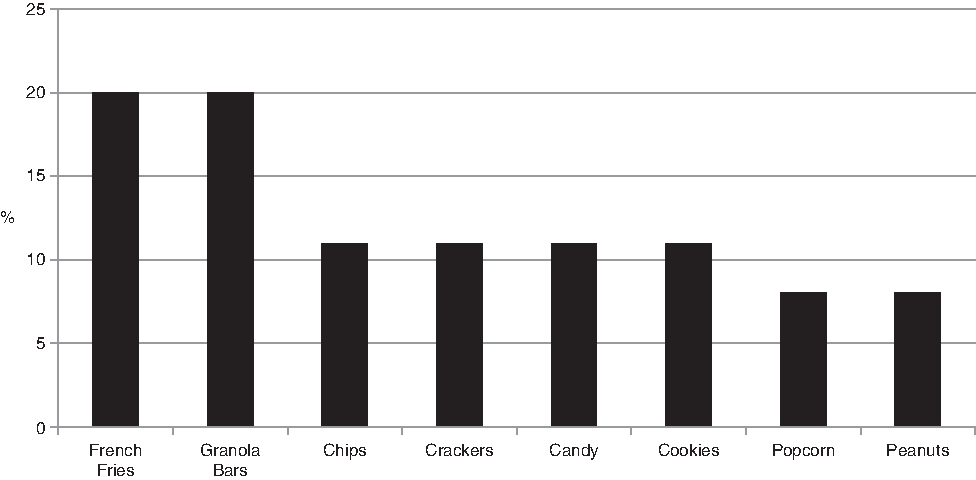
Foods offered as team snacks, proportion of total (n=102).
Observations of Spectators
A total of 313 adults, children (nonplayers), and YB players were observed, and a total of 249 foods and 276 beverages were recorded. Six percent of foods consumed by spectators were fast food items purchased outside of the YB field, 5% were prepared meals brought from home, and all others were purchased from the concession stand (89%; Fig. 2). Of these, 73% were less-healthy options, including French fries, potato chips, popcorn, candy, cookies, or ice cream; 23% were healthier options, such as fruit, vegetables, peanuts, or granola bars; and 4% were sandwiches and were unable to be sufficiently classified as healthy or unhealthy. Of beverages consumed by spectators, regular soda was consumed most frequently, followed by water, sports drinks, and diet soda (Fig. 3).
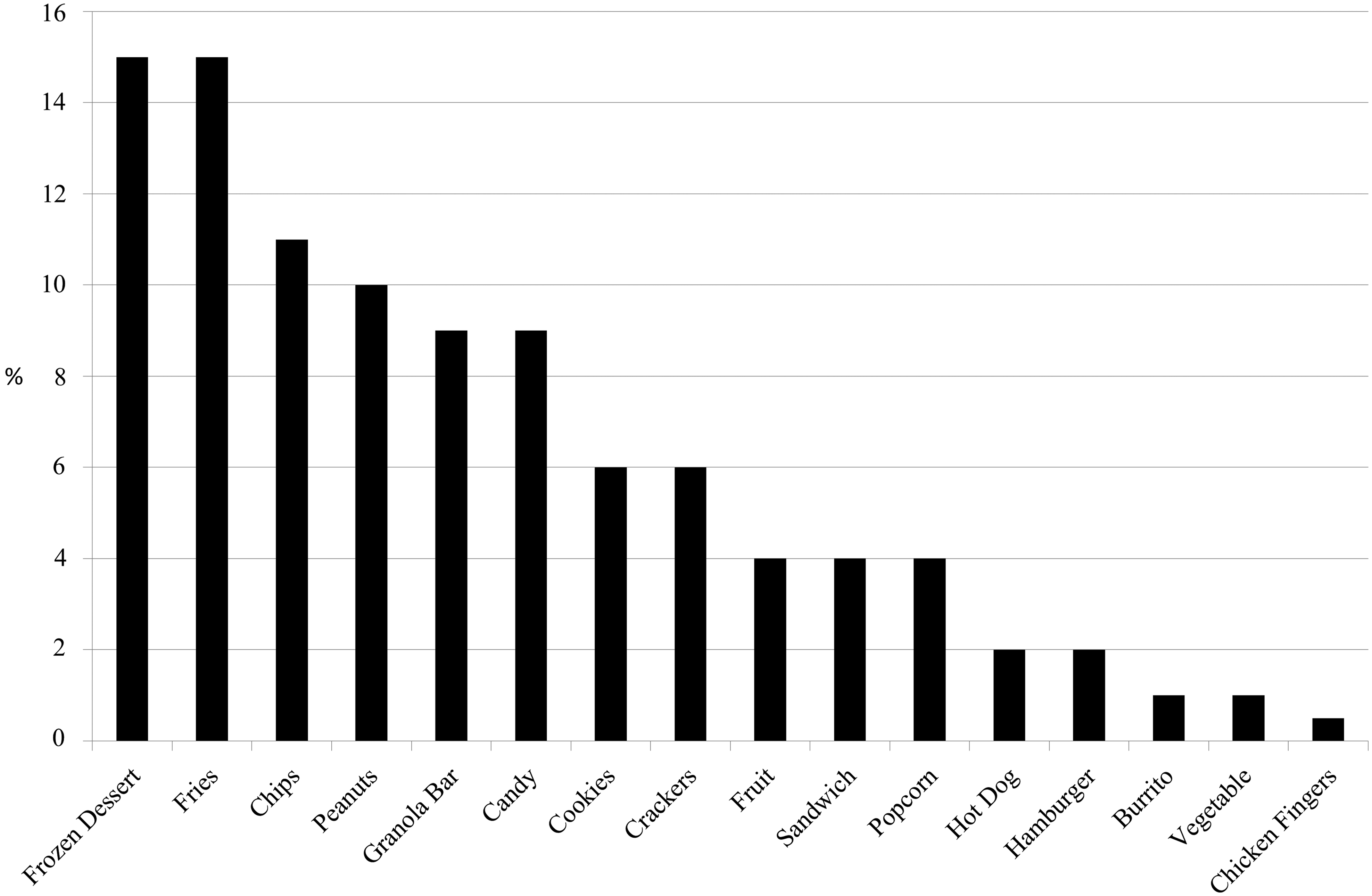
Foods consumed from concession stand, proportion of total (n=249).
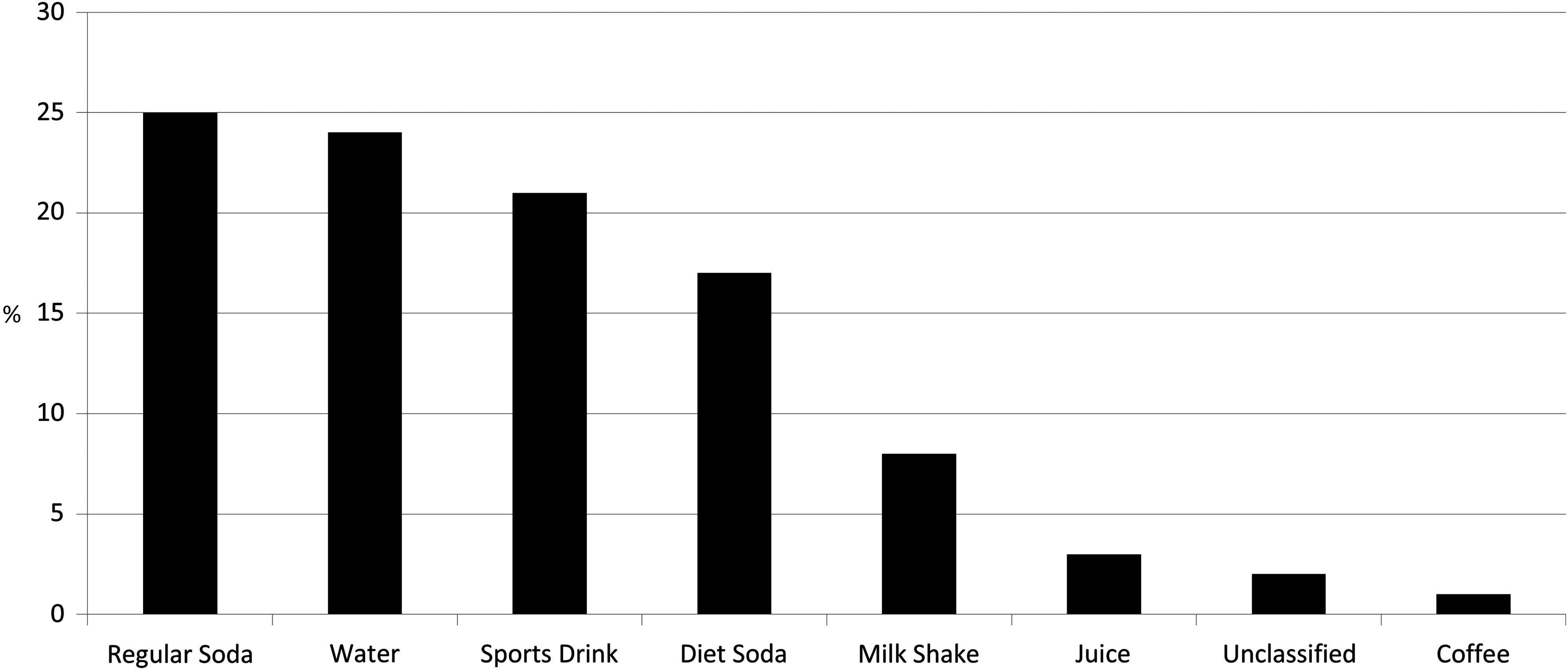
Beverages consumed by spectators, proportion of total (n=276).
Youth Baseball: Schedule, Policies, Concession Stand, and Facilities
The YB season lasts 6 weeks, with 69 total YB events (games and practices): 18 weekday games; 15 weekend games; and 36 weekday practices. Each team participated in one weekday practice, one weekday game, and one weekend game. Each team had two evening events per week (one game and one practice) between 5:00 and 7:00
Items available for purchase at the ballpark concession stand were predominantly unhealthy (fried foods, hot dogs, hamburgers, chips, candy, and ice cream). Healthier alternatives included a grilled chicken sandwich, vegetables (such as salads), and bottled water. Six picnic tables were located adjacent to the concession stand; no other amenities were provided (microwave, refrigerators, and so on). One water fountain was located by the concession stand.
Discussion
Participating in sports should be beneficial to health, yet may negatively influence child and family nutrition through food options available at sport venues and the effect on meal times. Observational assessments indicated that the foods consumed at a YB field are composed predominantly of high-calorie snacks and beverages, and most foods consumed by both parents and children were considered unhealthy snack items. Based on these observations, the YB ballpark could be considered an obesigenic environment, despite the focus on physical activity and sport participation.
SSBs are a significant source of calories 18 and are associated with excess weight gain.19–21 Sugar-sweetened sports drinks have been inappropriately marketed as a healthy alternative to soda 22 and beneficial to physical performance. 23 Such beverages are generally unnecessary for the average child participating in sports 24 and may negate the benefits of exercise. 23 Given that participants in YB have variable amounts of active time 25 and consumption of unhealthy snacks and beverages are frequently observed, children may leave the ball field having consumed more calories than they expended. This is a difficult problem to address, given evening game and practice schedules, which may perpetuate the need for convenient food options from fast food restaurants, concession stands, and ready-to-eat snacks. Exposure to environments and schedules described in this study may be chronic, because many children participate in at least two sports teams every year, 4 and indulgences at concession stands could become habitual.
Increasing focus on the foods available and associated with sporting events is important, because families may be placing more emphasis on physical activity than on healthy eating. 26 As found in this YB field, there were no policies pertaining to food and beverages. Olstad and colleagues conducted a series of mixed-methods studies evaluating the adoption of healthy food guidelines in public recreation facilities in Canada, finding difficulties in implementation and acceptance.27–30 With the frequency and timing of games and practices, ensuring a healthy environment at sporting events will support the well-being of players and families. Engaging families, coaches, and stakeholders will be an important step in establishing policies to improve the food environment of youth sports.
A limitation of this study was the ability to accurately document all foods consumed at the ballpark without being intrusive. Because of the nature of scan-sampling techniques, there is an inherent bias toward recording more recognizable behaviors, because less-conspicuous behaviors are unlikely to be noticed. The exact number of calories consumed or expended by each player or spectator was not determined in this study. Despite training of study staff and application of general guidelines of healthy and unhealthy foods, misclassification of food items may have occurred because brand names and nutritional information were unable to be obtained. Because this study was qualitative, the process is subject to observer bias. To prevent bias as much as possible, multiple observers collaborated to ensure validity of observational records, and data were collected in as standardized a manner as possible. Because of the exploratory nature of qualitative research, the relatively few participants, and the observation of only one sports league, it is difficult to extrapolate findings to other leagues or extend conclusions to broader populations. There are unique aspects to baseball that may not be applicable to other sports settings, such as being outside and having an associated culture of food (i.e., hot dogs and peanuts). However, there are many sports settings with similar environments to YB with concession stands, outside venues, and evening games and practices. Data are also limited to just one YB division without a comparison group and may not reflect nutritional behaviors in other youth sport communities (i.e., football, soccer, or swimming), other age groups, or larger leagues. Even so, novel findings have emerged from these results.
Conclusion
Although YB likely provides children with an opportunity to increase their physical activity, the YB environment may inadvertently contribute to unhealthy dietary habits of children and families. Being a prime avenue for children's physical activity, more attention to the food environments surrounding organized sports should add to the already positive health benefits of sport participation. Additional research determining the overall effect of sports on children's caloric balance may reveal the overall benefit of organized sports on children's health and weight, as well as identify key leverage points for change (e.g., parent behaviors, concession stands, peer influence, and practice/game schedules). Establishing policies regarding foods available at sporting events is a promising public health step, because it appears few have established policies. 31 Because 52% of outdoor sports facilities are community owned and operated, 4 engaging parents and sports leagues to conduct family-based interventions may be feasible ways to improve activity and nutrition behaviors at the community level.
Footnotes
Acknowledgments
Research was supported, in part, through the Eunice Kennedy Shriver National Institute of Child Health and Human Development/National Institutes of Health Mentored Patient-Oriented Research Career Development Award (K23 HD061597) and the Kate B. Reynolds Charitable Trust (grant no.: 2009-098). The authors thank Karen Klein (Research Support Core, Wake Forest School of Medicine, Winston-Salem, NC) for providing helpful revisions of the manuscript and Camila Pulgar for assistance in the conduct of the study.
Author Disclosure Statement
Dr. Skelton has been a consultant for the Nestlé Corporation, though they were not involved in any aspect of this research. Ms. Irby and Dr. Drury-Brown have no competing financial interests.