




Abstract
Abstract
Background:
The aim of this longitudinal study was to examine the link between perceived authoritative parenting behaviors and sugary drink consumption among children from low-income families who do or do not have televisions (TVs) in their bedrooms.
Methods:
Middle school students (N = 480) completed a baseline survey in sixth grade and a follow-up survey in seventh grade. The students were recruited from 12 schools in a low-income, predominantly black (33%) and Latino (48%), urban school district. The survey assessed the children's perception of their parents' controlling and nurturing behaviors, the presence of a TV in their bedrooms, and their level of sugary drink consumption on the previous school day. Children's report of specific controlling and nurturing parental behaviors were used to create an “authoritative parenting” score. Regression analyses were used to test the main and interactive effects of authoritative parenting behaviors and having a TV in the bedroom with sugary drink consumption in seventh grade, controlling for age, race/ethnicity, gender, BMI, and sugary drink consumption in sixth grade.
Results:
A significant interaction emerged: The authoritative parenting score predicted lower levels of sugary drink consumption in seventh grade, but this relationship was moderated by whether or not there was a TV in the child's bedroom.
Conclusion:
A TV in the child's bedroom may weaken the positive influence of authoritative parenting behaviors on limiting sugary drink consumption among middle school children from low-income families. Stronger initiatives are recommended to educate parents and help them refrain from placing TVs in their children's bedrooms.
Introduction
Sugary drinks are beverages sweetened with caloric sweeteners (e.g., sugar or high-fructose corn syrup), such as soft drinks, sports drinks, fruit drinks, and sweetened teas and coffees. These beverages have been the biggest single source of added sugar for children ages 2–11 and adolescents ages 12–17. 1 There is a substantial body of research documenting how sugary drinks contribute to childhood obesity, as well as increased risk of a range of metabolic and cardiovascular diseases.2–5 A major public health concern is that sugary drink consumption is significantly higher among children living in low-socioeconomic-status (SES) households6,7 and has increased more rapidly among black and Hispanic youth relative to their white peers,8,9 making it a likely contributor to health disparities.
Public policy efforts to reduce youth sugary drink consumption have targeted multiple levels of the socioecological model, including such varied strategies as proposed taxes, 10 restrictions in government buildings, 11 restrictions in schools, 12 exclusion from federal food programs, 13 removal from restaurant children's meals, 14 and calls for bans on marketing sugary drinks to children and teens.15,16 Though it is critical to continue reducing the availability and marketing of sugary drinks to youth, the home environment also deserves attention. Recent studies have found that most sugary drink consumption occurs at home and the primary source of sugary drinks is the grocery store,17,18 suggesting that parents have a significant role to play in limiting their children's consumption of these beverages.
Parents also determine whether or not there is a television (TV) in a child's bedroom. This decision appears to differ by race, ethnicity, and SES of the family, with higher likelihood of a bedroom TV among children from low-income families, as well as black and Hispanic families. 19 There are several reasons why a bedroom TV is not recommended. One study of children from low-income families found that those with a bedroom TV watch 4.6 more hours of TV per week than those without. 20 There is also a substantial body of research documenting that a TV in a child's bedroom is a predictor (alone or in combination with other measures of TV and other screen time) of childhood obesity, poor diet, and sugary drink consumption specifically.20–25 There is evidence that watching commercial TV exposes children to significant amounts of unhealthy food and beverage marketing, which, in turn, increases the likelihood of consuming of unhealthy products. 19 Experimental research has found that children eat more unhealthy snacks while watching TV that contains food commercials than TV with nonfood commercials.26,27 In 2013, beverage companies spent $690 million on TV ads for sugary drinks, compared to only $53 million to advertise water. 28 This may be why TV exposure and beverage consumption examined in a large national sample of over 11,000 high school students found that students with the highest overall media exposure (which included a TV in the bedroom) drank significantly more sugary drinks and less water than students with low media exposure. 25
Parents clearly have a critical role to play in determining the food environment of the home. The study of food-related parenting behaviors is a growing field, and research is needed to help parents navigate the challenges of promoting a healthy diet for their children.29–35 Because much of the research on food parenting refers to specific behaviors, such as restricting a child's access to unhealthy foods or pressuring a child to eat, Hughes and colleagues suggest that future research examine food parenting practices within the context of the overall parenting style. 30 Parenting style is traditionally used to describe how high or low parents are on two dimensions: demandingness/control and responsiveness/nurturance. The style generally considered ideal is “authoritative,” which is characterized by high levels of control combined with high levels of nurturance. In one study designed to test the role of perceived parenting style and practices on adolescent sugary drink consumption, Van der Horst and colleagues measured specific parenting practices relevant to sugary drinks, as well as perceived parent involvement and strictness. 36 The researchers found that children whose parents who set more sugary drink limits drank fewer sugary drinks, and this effect was strongest for adolescents who perceived their parents as moderately strict and highly involved. These findings suggest that parents' food-specific behaviors and more general style of parenting may be important predictors of children's sugary drink consumption.
Finally, it is important to consider that parenting occurs within the context of the socioecological system. Kremers and colleagues suggest that researchers examine the “system conditions” under which restrictive rules have impact. 35 They note a few examples of environmental conditions that may influence the effectiveness of restrictive parenting rules, such as proximity to fast food restaurants and availability of snacks in the home, and urge researchers to consider others and test for the moderating influence of these factors. The present study considers a TV in a child's bedroom as an environmental condition that may interfere with the otherwise positive influence of parental behaviors that reflect “nurturance” and “control” on children's sugary drink consumption.
The aim of the present article is to examine how children's perceptions of parenting behaviors and exposure to TV in their bedrooms in sixth grade predict reported sugary drink consumption in seventh grade, using a longitudinal cohort of a racially and ethnically diverse sample of inner city middle school children. Middle school is a pivotal age when children are developing independent dietary habits. 37 We create a new short measure for use with young adolescents. The measure captures their perception of parental nurturance and controlling behaviors, using both food-specific and general questions. We examine the relationship between high control and high nurturance parenting behaviors and level of sugary drink consumption and test whether having a TV in the bedroom moderates this relationship. We also test whether the children who report high levels of controlling parenting behaviors are less likely to have TVs in their bedrooms. We hypothesize that authoritative parenting behaviors predict lower sugary drink consumption, but a TV in the bedroom weakens this relationship.
Methods
Study Sample and Procedure
This study was part of a longitudinal study aimed at evaluating the implementation of school wellness policies and the impact of these policies on obesity and obesogenic behaviors among middle school students. Data were collected in fall of 2012 (sixth grade) and 2013 (seventh grade) across 12 K–8 schools that were randomly selected out of all 28 K–8 schools in an urban New England school district enrolling approximately 20,000 students. The majority of students in this district are black (46.1%) or Hispanic (37.3%) and 78% are eligible for free or reduced-priced lunch. 38 No sugary drinks are available in the buildings in this school district owing to a state law mandating that all beverages for sale on campus are limited to water, 100% juice, and milk. 38
All students in sixth grade during the fall of 2012 (N = 687) were invited to complete a 30-minute health and behavior questionnaire that covered dietary and physical activity behaviors as well as physical and mental health. Follow-up questionnaires were collected in fall 2013 when students were in seventh grade. Questionnaires were completed online (Surveymonkey.com, LLC; Palo Alto, CA) in the computer classrooms at each school as questions were read aloud by a trained research assistant to accommodate varying reading levels. Parental consent and child assent were obtained from all study participants. Yale University's Institutional Review Board and the local school district approved all procedures.
The sixth-grade survey was completed by 626 students, representing a 91% response rate (7% opted out and 2% were absent from school on data collection days). In seventh grade, 498 students (80% of the baseline sample) completed the survey. The reasons why 20% did not complete the seventh-grade survey were a combination opting out, absenteeism on data collection days, and moving away. An additional 23 students with missing (item nonresponse) data were excluded from this study, so the final sample size included 475 students. Compared to the analytic sample, excluded respondents were more likely to be black (46% vs. 34%) and less likely to be Latino/a (33% vs. 48%). No other significant differences were observed.
Measures
Sugary drink consumption
Sugary drink consumption was assessed at both time points using the question, “Thinking about everything you drank yesterday, how many sodas or other sugar-sweetened beverages (such as sports drinks, flavored drinks, or sweetened coffee drinks) did you have? Do not include 100% fruit juice.” Response options included units from “0” to “6” servings and “7 or more.” This question was adapted from beverage items of the School-Based Nutrition Monitoring (SBNM) Questionnaire. 39 The SBNM Questionnaire asks school children about dietary behaviors “yesterday.” Psychometric analyses using the measure found that students were able to answer the dietary intake questions reliably over time, and their answers were consistent with the gold-standard method of a 24-hour recall multiple-pass interview by a trained researcher. 39 As is customary in school-based dietary research, 40 data were only collected on days following a school day in order to ensure that the dietary behaviors reflected school-day patterns. To reduce subject burden, we combined separate “soda” and “other sugar-sweetened beverages” items into one question. To reduce the likelihood of a ceiling effect, we expanded response choices from “0” to “3 or more” to “0” to “7 or more.” Responses of “7 or more” were recoded as “7.” This was done for n = 23 in sixth grade and n = 24 in seventh grade. Sugary drink consumption measured in grade 7 was the outcome variable, and models were adjusted for sugary drink consumption measured in grade 6.
Parenting scale
A sixth-grade parenting scale was created for the present study with items that assessed the students' perception of their parents (or other adults who take care of them) on the dimensions of control and nurturance. The internal consistency of the parenting style dimensions was assessed using Cronbach's alpha (α), with α ≥ 0.60 considered acceptable. 41 The Control subscale (α = 0.64) was measured with five items asking: How often do your parents or other grownups: (1) check on whether you've completed your homework; (2) limit how much time you spend watching TV; (3) limit how much time you spend on the computer for fun; (4) limit how much you go out with friends on school nights; and (5) limit how many sweets or other unhealthy foods you are allowed to eat. Responses were on a scale of 1 to 4, ranging from “never” to “often.” The wording for questions 1, 2, and 4 was taken from the National Educational Longitudinal Study. 42 Question 3 was added as a second component of limiting screen time. Question 5 was created to assess the child's perception of restriction, a key construct in the child feeding literature. Nurturance (α = 0.60) was measured with four items asking: How often do your parents or other grownups: (5) listen to you when you have something to say; (6) give you fruits and vegetables to eat; (7) encourage you to be more physically active; and (8) spend time doing things you both like to do. Items 5 and 8 were designed to assess general aspects of parental involvement of talking and spending time together, which are in the Nurturance section of Steinberg's 1991 measure of parenting styles. 43 Questions 6 and 7 were written to capture parental involvement by encouraging specific healthy behaviors.
Within each parenting style dimension, a mean of the items was calculated to create composite scores. Scores were prorated for students completing three Nurturance items (N = 7) and three (N = 1) or four (N = 12) Control items. The subscale scores were summed to create an overall authoritative parenting score (α = 0.71), ranging from 2 to 8, with higher scores indicating greater perceptions of authoritative parenting. Lower scores indicate lower perceptions of authoritative parenting owing to low nurturance, low control, or both.
Television in the bedroom
Whether or not a student had a TV in the bedroom was assessed at baseline by a single yes/no item developed for the present study, “Do you personally have a TV
Demographics
Birthdate, gender, and race/ethnicity were drawn from the school district database. Age was calculated as an integer representing time in years between date of birth and grade 6 data collection.
Statistical Analysis
Means and standard deviations for continuous variables and frequencies and percentages for categorical variables were calculated to describe sample characteristics. For descriptive purposes, bivariate associations of follow-up sugary drink consumption with baseline independent variables were tested using a negative binomial regression model, given that our sugary drink outcome was an overdispersed (variance >> mean) count variable. 44 A multivariate negative binomial regression model was used to test the association of sugary drink consumption in seventh grade with the main and interactive effects of parenting and having a TV in the bedroom, controlling for age, race, gender, and sixth-grade sugary drink consumption. The parenting score was centered about the grand mean to make interpretation of the interaction term more meaningful. All independent variables were measured in grade 6.
Negative binomial regression models predict expected counts on a log scale. To make interpretation more meaningful, regression coefficients were exponentiated to calculate incident rate ratios (IRRs). For continuous variables, IRRs represent the percent change [(IRR–1)*100] for every unit increase in the independent variable. An IRR for a categorical variable indicates the incidence rate relative to the reference group. For example, an IRR 0f 0.7 for a continuous variable indicates a 30% decrease in the incident rate per unit increase in the independent variable, and an IRR of 0.7 for a categorical variable indicates an incident rate that is 0.7 times the reference group. To account for the school-clustered sampling design, students' 2012 school (N = 12) was included as a fixed effect in the bi- and multivariate regression models. 45 Two-way interactions of demographic variables with parenting score and having a TV in the bedroom were tested to see whether the relationship of sugary drink consumption with these two independent variables differed by age, race, or gender. None were significant so models were presented without these interaction terms. All analyses were conducted using SAS software (v9.3; SAS Institute Inc., Cary, NC), and statistical significance was set at α <0.05.
Results
Sample characteristics are presented in Table 1. Mean sugary drink consumption by gender and race/ethnicity in sixth and seventh grade is presented in Figure 1. For the overall sample, just under two sugary drinks were consumed the day before in both sixth and seventh grade; however, black girls in seventh grade reported the highest level of consumption of nearly three drinks the previous day. Bivariate results suggest that greater sugary drink consumption in seventh grade was associated with higher sixth-grade consumption (p < 0.001) and having a TV in the bedroom at baseline (p = 0.002). Seventh-grade consumption decreased as sixth-grade authoritative parenting scores increased (p = 0.028). No significant difference in seventh-grade sugary drink consumption was found by age (p = 0.790), sex (p = 0.215), or BMI (p = 0.840). Latino/a and white students drank fewer sugary drinks in seventh grade, compared to black students (p = 0.018 and p < 0.001, respectively). There were 3 students whose reported race did not fall into one of the three main racial/ethnic groups represented in this study. These students were most similar to black students in terms of seventh-grade sugary drink consumption, so they were combined with black students for the multivariate analysis. Results from models run without these 3 students were consistent with models presented.
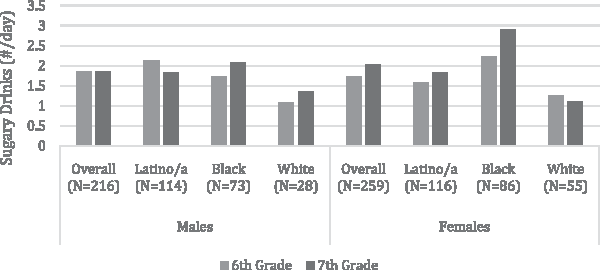
Mean sugary drink consumption by gender, race/ethnicity, and time.
Baseline Sample Characteristics (N = 475)
TV, television.
The relationship between parenting and having a TV in the bedroom was tested using independent sample t-tests with the sixth-grade sample. Children who had TVs in their bedrooms reported similar perceptions of overall parental authoritative behaviors as children without TVs in their bedrooms (t(616) = 0.46; p = 0.64). This similarity between the groups was consistent for the subscale measures of control (t(618) = 0.49; p = 0.64) and nurturance (t(618) = 0.34; p = 0.73).
Results from the multivariate negative binomial model are shown in Table 2. For these data, the count of sugary drinks per day in seventh grade decreased by 22% (β = –0.25; IRR = 0.78; p = 0.004) for each unit increase in the parenting scale for students without a TV in their bedroom, adjusting for sixth-grade consumption and holding all other variables constant. The interaction term (β = 0.21; IRR = 1.23; p = 0.032) shows that the decrease seventh-grade sugary drink count associated with parenting was attenuated to 4% [exp(–0.25 + 0.21)] among students with a TV in the bedroom, holding all other variables constant. Figure 2 depicts this interaction, plotting the fitted values of the actual count of sugary drink per day as a function of parenting score, at parenting score values ranging from 4.96 to 7.96, representing all values within 1.5 units of the mean. Among students without a TV in their bedroom, sugary drink consumption decreased as parenting scores increased, but a buffering effect of parenting on sugary drink consumption was not observed for students reporting a TV in the bedroom.
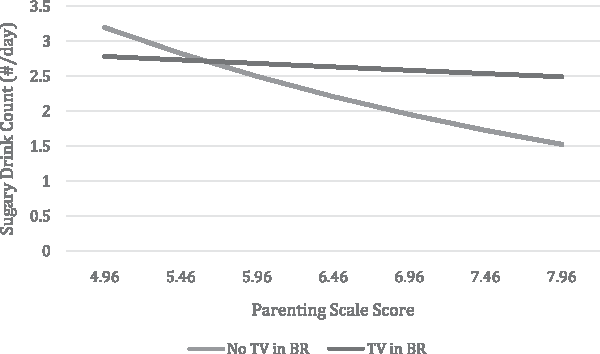
Fitted negative binomial regression models predicting count of sugary drinks/day in seventh grade by TV in the bedroom (N = 475). Model depicts expected sugary drink counts for a black male at the mean for baseline age, BMI percentile, and sugary drink consumption. TV, television; BR, bedroom.
Coefficients and Standard Errors from Unadjusted and Adjusted Negative Binomial Regression Models Predicting Log Count of Sugary Drinks/Day in Seventh Grade (N = 475)
In both models, student's sixth-grade school was included as a fixed effect to account for school-clustered sampling design.
TV, television.
Results also suggest that, holding all other variables constant, the expected count of sugary drinks/day for female students was 1.17 times that of male students (p = 0.061), and it increased by 19% for every unit increase in baseline sugary drink consumption (p < 0.001). The expected count of sugary drinks/day for white and Latino/a students was 0.64 (p = 0.002) and 0.77 (p = 0.008) times the count for black students, respectively, and sugary drink consumption did not differ significantly between Latino/a and white students or by baseline age and BMI percentile, holding all other variables constant.
Discussion
The high level of sugary drink consumption documented in this study is consistent with other studies from low-income, racially and ethnically diverse communities. 6 In sixth grade, children in this sample reported drinking an average of nearly two sugary drinks during the previous school day. If one drink is equivalent to eight ounces of soda, this rate of consumption translates to over 11 teaspoons of sugar in 1 day from beverages. Though sugary drink consumption in the entire sample dipped slightly by seventh grade, black girls consistently reported the highest sugary drinks consumption and the largest increase over the year. This suggests that work must be done in this community to reach out to these girls in particular to better understand why their beverage patterns are so different than their Latina, white, and male peers.
The finding that there was not a significant relationship between the control subscale of the parenting scale and the likelihood of having a TV in the bedroom was surprising, given that one might argue that parents who set limit on TV time, computer time, and sweets would be less likely to permit a TV in the bedroom. This finding, however, may reflect the social norms of this community, given that 84% of the children had a bedroom TV by sixth grade. As discussed by Patrick and colleagues, it is important to consider parenting styles within the context of social norms, and understand that parents may choose to pick their battles for limit setting. 33 In this sample, parents who prioritize checking their children's homework and limiting how much they go out on school nights (two items from our measure) may not necessarily see keeping a TV out of their child's bedroom as essential.
As hypothesized, students who reported higher levels of authoritative parenting at home also reported lower rates of sugary drink consumption. This finding is consistent with the results of other studies that have found that authoritative parenting is consistent with a healthier diet. 36 Our regression model revealed a significant interaction between authoritative parenting and TV in the bedroom, suggesting that the power of parenting to limit sugary drink consumption may be undermined by a child's exposure to the environmental influences created by a bedroom TV. This finding contributes to our understanding about how parenting interacts with other elements of a child's environment and may be used to educate parents about the possible unintended consequences of allowing a TV in their child's bedroom. Future research could test whether this finding would persuade otherwise authoritative parents that keeping the TV out of their children's bedroom is a priority.
The mechanism through which a TV in the bedroom interferes with parenting deserves further study. One hypothesis is that exposure to food marketing is the driving factor, which is consistent with research documenting “pester power.”46,47 Supporting this theory, an experimental study with young children found that parental messages about making healthy choices had only a small moderating influence on the relationship between exposure to advertising and food choices. 48 There is also evidence that parents believe that food marketing influences their children's food choices, 49 and even though they know sugary drinks are not healthy, they buy them because their children request them. 50 This may be yet another example of parents picking their battles, and future research could test messages designed to help parents understand the importance and benefits of protecting their children from food marketing. Previous research has also found that parental and child TV viewing are correlated, 51 suggesting that children exposed to high levels of advertising live with parents also exposed to high levels, which, in turn, may increase the likelihood of parents purchasing heavily marketed products, such as soft drinks. Finally, another possible mechanism explaining the link between having the TV in the bedroom and increased sugary drink consumption may be that children with TVs in their bedrooms are getting less sleep and are therefore more likely to turn to sugary drinks with caffeine during the day. Qualitative research with youth about why youth choose to drink sugary drinks could be used to further investigate this potential causal pathway.
The American Academy of Pediatrics has a policy statement recommending that at each well-child visit, pediatric healthcare providers ask about and provide appropriate counseling on the amount of media children consume and having a TV in the bedroom. 52 Research is needed to assess how health professionals can convey this message most effectively. Instead of simply providing advice, it may be important to understand how the TV came to be in the child's bedroom in the first place. A qualitative study of why parents allow a TV in the child's bedroom identified that though some parents identified the benefits (e.g., occupying the child, reducing arguments about what to watch in the household), others simply had not thought about it. 53 Education and increased awareness may change the behavior of parents who had not focused on the issue, but more convincing messages and alternatives need to be provided to parents who feel there are benefits. One idea would be to create a “TV buyback” program, where families are given cash or alternative forms of entertainment for the child (e.g., board and card games that can be played alone, books, or audiobooks) in exchange for old TVs. This program could be implemented by health centers or stores that sell TVs, given that a common scenario for placing a TV in the child's bedroom is because the family has purchased a new TV.
This study has several limitations. All primary variables of interest were measured by self-report and are therefore subject to bias inherent in this method. Although our response rates were good for this type of research, we did find that black students had higher rates of missing data than Latino students, suggesting that the findings specific to black children should be interpreted with caution. Our outcome variable (how many sugary drinks per day) does not provide a measure of the number of ounces consumed or differentiate among the types of sugar drinks consumed (e.g., soda vs. sports drinks or sugar-sweetened fruit drinks). Further, sugary drink consumption for only 1 day was collected at each time point.
This study had a limited measure of parenting. Though the measure had acceptable internal reliability for the purpose of capturing a select number of behaviors consistent with the constructs of control, nurturance, and authoritative parenting, further measure development is needed to understand how parent's behaviors and styles interact. Specifically, it would be useful to have a comprehensive assessment that includes both parenting limit setting for sugary drinks, different types of food, exposure to TV and other screens, as well as established measures of all four parenting styles (authoritative, authoritarian, permissive, and neglectful), as suggested by Baranowski and colleagues.29,30 In addition, the present study also only assessed the child's perceptions of parenting, which may be different than the parent's perceptions or the impressions an outside observer might have. Finally, our sample was predominately black and Hispanic students from low-income families in an urban school district with a very high prevalence of overweight and obesity, so the findings may not be generalizable beyond these parameters.
Footnotes
Acknowledgments
This study was funded by the National Institute of Child and Human Development (R01 HD070740; J.I. and M.S., MPI), The Patrick and Catherine Weldon Donaghue Foundation Medical Research Foundation (West Hartford, CT), and the Rudd Foundation.
Author Disclosure Statement
No competing financial interests exist.