




Abstract
Abstract
Background:
In 2014, USDA established nutrition standards for snack foods sold in schools. Many manufacturers reformulated products to meet these Smart Snacks standards, but continue to advertise unhealthy versions of the same brands. Furthermore, Smart Snack packaging often looks similar to less nutritious versions sold outside of schools (look-alike products). This practice may confuse consumers about the nutritional quality of Smart Snacks and raise concerns about schools selling them.
Methods:
An online experiment with 659 students (13–17 years) and 859 parents (children ages 10–13) was performed. Participants randomly viewed information about snacks sold at a hypothetical school, including (1) look-alike Smart Snacks; (2) existing store versions of the same brands; (3) repackaged Smart Snacks (highlighting differences versus unhealthy versions); or (4) consistent brands (i.e., Smart Snack versions also sold in stores). They then rated the individual snacks offered and the school selling them.
Results:
As hypothesized, students and parents rated look-alike and store versions similarly in taste, healthfulness, and purchase intent, while considering repackaged Smart Snacks as healthier, but less tasty. Most participants also inaccurately believed they had seen look-alike products for sale in stores. Furthermore, they rated schools offering look-alike Smart Snacks and store versions as less concerned about students' health and well-being than schools in the other two conditions.
Conclusions:
The nutritional quality of snacks sold in schools has improved, but many Smart Snacks are virtually indistinguishable from less nutritious versions widely sold outside of schools. This practice likely benefits the brands, but may not improve children's overall diet and undermines schools' ability to teach good nutrition.
Background
Companies spend millions marketing foods and beverages in schools, exceeded only by television advertising and premiums in marketing expenditures aimed at children and adolescents. 1 Unfortunately, in-school marketing promotes primarily nutrient-poor products, including sugary drinks, fast food, snack foods, and candy. Sales of branded products represent one of the most common forms of food marketing in schools. 2 One-half of middle schools and 70% of high schools have exclusive vending contracts that allow companies to sell branded beverages to students, and 25% of middle schools sell branded food items. Even in elementary schools, 44% of students can purchase competitive foods (i.e., products sold in school outside of the school meal program), including potato chips, candy, and cookies. 3 Benefits to companies selling branded products in schools include increased sales, brand recognition and loyalty, implied school endorsement of products, and positive brand associations from perceptions that companies support schools.2,4–6
In 2013, the USDA established nutrition standards for competitive foods and beverages sold in schools and designated products that meet these standards as Smart Snacks. 7 Smart Snacks went into effect in September 2014 and significantly improved the nutritional quality of foods and beverages in schools, prohibiting sales of regular soda, candy, high-fat chips, and other nutrient-poor products on school grounds during the school day. In response, some snack food manufacturers reformulated their existing products to meet Smart Snacks nutrition standards. 6 For example, a reduced-fat Smart Snack version of Cheetos contains less fat and sodium and no saturated fat and is packaged in a smaller serving size than the traditional version of Cheetos sold in stores. Similarly, whole-grain Pop-Tarts sold as Smart Snacks in schools contain more fiber and protein and less fat and sodium than versions of Pop-Tarts sold in stores. However, many brands that offer Smart Snacks for sale in schools continue to advertise and sell their less nutritious products to young people outside of schools. Of note, Tostitos, Pop-Tarts, Lay's Potato Chips, Cheetos, and Doritos were the most advertised snack brands to teens in 2014 6 and all these brands offer nutritionally improved versions as Smart Snacks for sale in schools. Furthermore, packaging for the Smart Snack versions of these products looks similar to the less nutritious advertised versions that are available in stores.6,8
This common practice of selling Smart Snack versions of less nutritious brands of snack foods in schools raises public health concerns. Selling these nutritionally improved products provides companies the opportunity to market their brands to youth in schools. Offering reformulated Smart Snack products in packaging that looks similar to less nutritious versions of the same brand—especially when these products are widely advertised to youth and readily available outside of schools—may be especially problematic. Consumer behavior research suggests that look-alike products increase consumer confusion.9,10 Therefore, sales of look-alike Smart Snacks in schools could also lead students and parents to infer that the same brands offered on store shelves meet school nutrition standards. Finally, offering versions of typically less nutritious brands of snacks in schools, even if they meet Smart Snacks nutrition standards, could counteract schools' efforts to teach students about good nutrition and health and/or lead parents to question schools' commitment to their students' health and well-being.
This study is the first to examine how selling look-alike Smart Snacks in schools affects attitudes about the brands and perceptions of schools selling these products. We hypothesized that offering look-alike Smart Snack versions of typically less nutritious snack brands in schools will (1) increase students' positive attitudes toward intent to purchase and perceived healthfulness of the brands; (2) confuse parents and students about the differences between Smart Snacks and less nutritious versions available in stores; and (3) cause parents and students to believe that the school is less concerned about students' health and well-being. We also hypothesized that packaging that clearly differentiates Smart Snacks from versions sold outside of schools will reduce these effects.
Methods
Using an online experimental design with four conditions, we compared hypothetical schools that offered (1) look-alike Smart Snacks (i.e., brands currently sold in schools that also offer less nutritious versions for sale outside of schools in similar-looking packages); (2) repackaged Smart Snacks (i.e., the same look-alike Smart Snacks in alternative packaging designed to look clearly different from the less nutritious versions for sale in stores); or (3) store versions (i.e., the less nutritious versions sold in stores) of the same look-alike Smart Snack brands and a school that offered only (4) consistent brands (i.e., brands that offer Smart Snack products with the same nutritional composition for sale both inside and outside of schools). Participants included students aged 13 to 17 years (online recruitment of children under age 13 is restricted by online privacy regulations). We also recruited parents of children 10- to 13-years-old. Parents of older youth were not included as they tend to be less involved in their children's purchasing decisions and thus would be less able to answer questions about their children's attitudes about snacks. The University's Institutional Review Board Human Subject Committee determined the study with both samples to be exempt.
Participants
Researchers recruited participants through Survey Sampling International (SSI), a market research company with a representative panel of US adults (ages 18+) who have consented to participate in online surveys. SSI recruits its panelists by placing banner advertisements on websites, social networks, and other online communities, as well as through text messaging. For quality control, members periodically receive rewards, but no compensation for individual surveys. To recruit parents for this study, SSI randomly sent invitations to qualified panelists who indicated consent if they chose to participate. To recruit students, SSI sent invitations with a brief description of the study to a random selection of panelists with a child aged 13 to 17 years who had previously indicated their child could answer surveys. The parent provided the survey to the child who also indicated consent at the beginning of the survey.
Participants were randomly assigned to one of four experimental conditions and screened for parents, with a child in grades 4 through 9, and students aged 13 to 17 years, in grades 7 through 12, attending a school that sold snacks or beverages outside of the school meal program. Parents with more than one qualified child answered questions about the child with the most recent birthday.
Survey Design
Researchers developed versions of the student and parent surveys for each of four conditions (i.e., the types of snacks sold in a hypothetical school). Surveys were administered using Qualtrics online survey software. After screening, participants examined a page with images of 12 snacks explaining that one school (student survey) or one middle school (parent survey) was considering offering these products for sale to students. The 12 snacks included five snacks that differed by condition (see Fig. 1) and seven additional snacks (these snacks all met Smart Snacks standards, including products sold in and outside of schools, and did not differ by condition) selected from an online school resource listing products that meet Smart Snacks standards.8,11 Twelve products were presented to resemble the selection of different products that would be available in a school vending machine or store, but only five products that varied by condition were included in the analyses. Look-alike Smart Snacks and consistent brand conditions included images from the Smart Snacks website, while the store versions' condition used images from brand websites depicting products sold in stores. A designer created new packages for the repackaged Smart Snack condition, including the same product information as actual Smart Snacks with modified colors and greater emphasis on nutritional improvements (compared with the less nutritious versions available in stores).
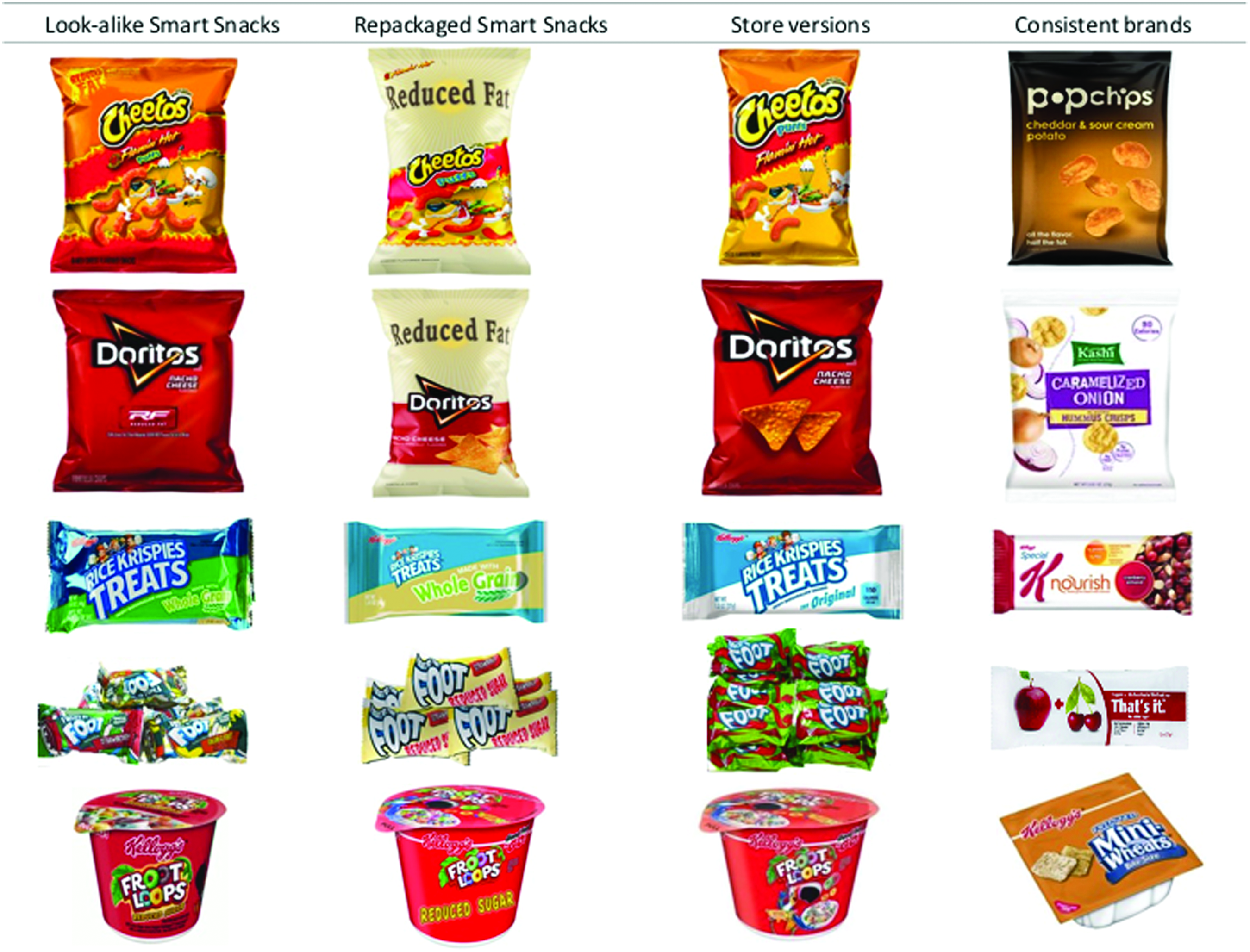
Snack packages presented in the four experimental conditions. (Color image is available online at www.liebertpub.com/chi.)
After examining the snacks, participants indicated their agreement with statements about a school offering these 12 products for sale to students. They then rated the five individual snacks of interest on expected taste (parents indicated how much they thought their children would like it). Parents indicated if they thought their child would buy these snacks and if they would give their child money to buy them. Students indicated if the product was currently for sale in their school, if they had purchased it previously, or their intent to purchase. Students and parents also indicated whether they had seen the products for sale outside of schools, and then rated the healthfulness of individual products. Students in the look-alike Smart Snacks, store versions, and consistent brand conditions also rated the healthfulness of look-alike and store versions of the same brands presented together. Finally, participants answered demographic questions about themselves and parents answered questions about their children.
Using Amazon Mechanical Turk (MTurk), parents of children aged 10 to 13 years (n = 196) piloted a preliminary version of the parent survey, giving feedback on unclear or difficult-to-answer questions. Cognitive testing of the student survey used a convenience sample of adolescents aged 13 to 17 years (n = 15).
Statistical Analysis
Analysis of Variance (ANOVA) with Bonferroni post hoc corrections assessed differences in responses by experimental condition for students and parents. Within-subjects t-tests evaluated significant differences in students' side-by-side ratings of look-alike Smart Snacks versus store versions of the same brands (for the five brands that varied by condition).
Results
In total, 859 parents participated in the survey, and 724 students (aged 13–17 years) agreed to participate. After excluding students who did not attend a school selling snacks outside of school meals (n = 65, 10%), 659 students participated in the full survey. Both samples were diverse in race/ethnicity and education (Table 1).
Participant Characteristics
Attitudes About the Snacks
As predicted, mean attitudes about the healthfulness of the five snacks evaluated differed significantly by condition (Table 2). Both parents and students rated snacks in the consistent brand condition as significantly healthier than snacks in the three less nutritious brand conditions. They also rated repackaged Smart Snacks as healthier than both store and look-alike versions of the same snack brands. In addition, parents, but not students, rated look-alike snacks as significantly healthier than store versions of snack brands.
Attitudes Toward the Snacks (Aggregate for Five Snacks Evaluated)
Superscript lowercase letter indicates significantly higher than other condition (indicated by letter) at p < 0.05.
Number of products previously purchased at school, only includes products that students indicated were available in their school.
Mean purchase intent, only includes products that students indicated were not available in their schools.
Parents' and students' expected taste ratings also differed by condition, as did parents' beliefs that their child would buy the snacks and students' purchase intent. Parents indicated that their children would like the taste and would buy consistent snack brands significantly less than snacks in the three less nutritious brand conditions. Students also believed that they would like the taste of consistent snack brands less than less nutritious brands (for snacks that were not available at their schools) and that they would like repackaged Smart Snacks significantly less than either look-alike or store versions of the same snack brands. Students were more likely to have purchased the store versions than the consistent snack brands (for snacks available in their schools). Notably, neither parents nor students expected the taste of look-alike and store versions to differ significantly, and students did not report significant differences in previous purchases of look-alike, repackaged, or store versions of less nutritious snack brands.
When examining students' attitudes about individual snack brands, some interesting findings were noted. Although students rated consistent snack brands lower in expected taste overall compared with all versions of the less nutritious brands, average expected taste ratings for these brands were generally positive, ranging from 4.66 (of 9) to 6.80, which were comparable with ratings for repackaged versions of less nutritious brands. Furthermore, as noted, students rated the store versions of less nutritious brands as less healthy than the repackaged Smart Snacks and the consistent brands, but they did not rate these nutritionally poor snack foods as unhealthy overall. Rather, they rated them neutral in healthfulness (i.e., ∼5 [neither healthy nor unhealthy] on a 9-point scale) (M = 4.37–5.48).
Consumer Confusion
As noted, parents and students tended to rate the look-alike and store versions of less nutritious snack brands as similar in healthfulness, whereas they tended to view the repackaged Smart Snacks that emphasized improved nutrition as healthier. Similar taste ratings for look-alike and store versions of less nutritious snack brands also indicate that students and parents viewed them similarly. However, when asked to compare healthfulness of store and look-alike versions of the same product directly, students did recognize that look-alike products were healthier (M = 5.10 and 4.73, respectively), t(441) = 10.76, p < 0.001.
Examination of where students and parents believed they had seen different versions of less nutritious snack brands indicated further potential for consumer confusion (Table 3). Although parents and students were significantly less likely to indicate that they had seen repackaged versions of the less nutritious snack brands in school or in stores, they believed they had seen approximately two of the products for sale (notably, researchers had created these packages, they were not sold anywhere). In addition, both parents and students believed they had seen on average four look-alike versions of less nutritious brands in stores, although these products are not generally available outside schools. Students also believed that store versions of three less nutritious brands on average were still available for sale in their schools.
Perceived Product Availability Outside and Inside Schools (Number of Products [of Five Possible] that Participants Indicate They Have Seen for Sale Inside or Outside of School)
Superscript lowercase letter indicates significantly higher than other condition (indicated by letter) at p < 0.05.
Indicates potential misidentification (i.e., products are not generally available in schools and/or outside of schools).
Attitudes About Schools
Finally, as predicted, the snacks offered for sale in a school affected students' and parents' attitudes about the school (Table 4). Both parents and students rated schools that offered consistent snack brands as significantly more concerned about students' health and well-being compared with schools that offered look-alike and store versions of less nutritious snack brands. Parents also rated schools that offered repackaged snacks as more concerned about students' health and well-being. In contrast, parents and students rated schools that offered store versions of less nutritious brands as more interested in providing snacks that students prefer compared with schools offering either repackaged versions of the brands or only consistent brands. Students also rated schools that offered less nutritious brands higher on providing snacks with wide appeal, while parents, but not students, rated them as more interested in making money from snacks, compared with schools offering only consistent brands.
Attitudes About the School That Sells These Products (Agreement, 1–7)
Superscript lowercase letter indicates significantly higher than other condition (indicated by letter) at p < 0.05.
Discussion
As predicted, offering nutritionally improved versions of snack brands in packaging that looks similar to less nutritious versions widely available in stores (look-alike Smart Snacks) may confuse students and parents. Unless placed side-by-side, students could not distinguish look-alike Smart Snacks currently sold in schools from the less nutritious versions sold in stores. Both parents and students believed that look-alike Smart Snacks were less healthy than the same snacks repackaged to emphasize nutritional improvements. In addition, parents and students believed that they had seen four of five of the look-alike Smart Snacks in stores, although they are not generally available outside of schools. Similarly, students thought that they could purchase the majority of store versions of the brands (that do not meet Smart Snacks standards) in schools.
These results demonstrate that packaging Smart Snacks to look similar to less nutritious versions of the same brands may benefit the brands. Students thought they would like the taste of look-alike Smart Snacks as much as they liked the store versions of these brands, whereas they expected to like the taste of the same snacks in different packaging less. As expected taste is a strong predictor of purchase intent and actual liking,12,13 companies likely maximize their sales in schools when students perceive Smart Snacks to be similar to or the same as products sold outside of schools. It also likely increases sales outside of schools as selling brands in schools allows them to market to a large segment of youth and implies school endorsement of their brands.4,5,8 In this case, consumer confusion could be an effective marketing strategy.
However, these results also indicate that selling look-alike Smart Snacks in schools may not serve the best interests of students or schools. Students did not believe that even the less nutritious versions of the snacks sold in stores were unhealthy (rating them neutral to somewhat healthy), and look-alike Smart Snacks in schools may worsen this misperception. Furthermore, students did not dislike the consistently nutritious brands examined (rating them neutral to like somewhat), indicating they would likely purchase these products if they were the only options available in schools. Finally, both parents and students believed that schools offering look-alike Smart Snacks were less concerned about students' health and well-being than schools offering clearly more nutritious snacks (i.e., repackaged Smart Snacks or consistent brands). Notably, these significant differences occurred when just 5 of 12 snacks offered were look-alike Smart Snacks or less nutritious store versions of the brands. When students and parents believe that schools are more interested in offering snacks that students prefer than in students' health and well-being, it likely hurts schools' credibility when teaching nutrition and good health and may interfere with efforts to promote good nutrition in school meals.
These findings also suggest potential improvements to the Smart Snacks standards. The USDA could establish regulations to allow brands to sell products as Smart Snacks in schools only if they do not also advertise and/or sell less nutritious versions of their brands to young people outside of schools. Alternatively, USDA could require that brands package their Smart Snack versions in a way that clearly distinguishes them from the less nutritious versions sold outside of schools. Individual school districts could also establish similar provisions in their local school wellness policies. School food service providers could also work with companies that offer snack foods consisting of fruits, vegetables, and nuts to offer their products as Smart Snacks in schools. Public health advocates also have suggested that selling look-alike products in schools is a form of marketing for the brands and may not comply with new USDA rules requiring that school wellness policies permit only foods and beverages that meet Smart Snacks standards to be marketed on school campuses during the school day. 14
This study does have limitations. Exposure to the brands in this study occurred online and it is possible that participants would have responded differently if given the opportunity to hold and examine the packages. In addition, previous consumption of brands may have affected students' and parents' responses. However, random assignment of participants to conditions was used to control for any individual differences that might have affected responses. Finally, the use of an online survey panel does not provide a representative sample of the entire population. Panel members must have internet access in their homes and they tend to be more educated and have higher incomes than the general population. However, the education level is associated with greater use and understanding of nutrition information 15 and thus maybe this sample may have noticed and/or placed more importance on nutritional differences compared with a less educated population. Although school food advocates have noted that look-alike Smart Snacks are confusing to students and parents, 16 follow-up research conducted in a retail and/or school setting with a more diverse sample could further confirm these findings.
Conclusion
The implementation of Smart Snacks nutrition standards has improved the nutritional quality of snack foods sold to young people in schools. However, rather than the array of fruits, nuts, low-fat dairy, and whole-grain products envisioned by many school food advocates when the standards were introduced, many of the products now commonly sold in school vending machines and stores are almost indistinguishable from the less nutritious products widely marketed and sold to young people outside of schools. It is unclear how encouraging youth to consume somewhat more nutritious versions of chips, fruit snacks, and sweets in schools—especially when they think these products are the same ones they buy at the corner store—will lead to better diet and long-term health. Selling look-alike Smart Snacks in schools benefits the brands that offer these products, but schools, parents, and public health advocates must also consider whether this practice benefits the students who purchase them.
Footnotes
Acknowledgments
The authors are grateful to Whitney Hubbard for designing product images; Katherine Rich for her assistance with the literature review; Xun Li, PhD, for data assistance; and Sally Mancini, MPH, for assistance with manuscript preparation.
Funding Source
Michael & Susan Dell Foundation.
Author Disclosure Statement
No competing financial interests exist.