




Abstract
Abstract
Background:
School-based body mass index screenings (SBMIS) have been controversial. We aimed to determine if parents would indicate improved utility with SBMIS when the report included parent education and whether parental intent to modify obesity risk factors would vary with report type or child weight.
Methods:
A cluster-controlled trial was conducted with 31 elementary schools randomized to distribute a standard SBMIS report or the standard report plus education (SBMIS+). A random subsample of parents completed a mailed survey (731 SBMIS, 738 SBMIS+). Using a two-stage cluster sampling design, logistic regression models with school-level random effect were used to assess differences between conditions and by weight category.
Results:
Parents in the SBMIS+ condition vs. the standard condition were more likely to indicate that the report provided useful information (not significant) and an intent to help their child get enough sleep (p < 0.001). Parents of children who were overweight or obese were less likely than parents of children who were not to indicate that the report provided useful information about their child's weight status (p < 0.001) or access to resources (p < 0.05). However, these parents were more likely to plan a visit to healthcare provider (p < 0.001) and to intend to limit sugar-sweetened beverages (p < 0.05).
Conclusions:
Parental education can enhance the utility of the SBMIS report and parental intention to modify at least one obesity risk factor. SBMIS reports prompted parents of children with overweight and obesity to seek clinical care and limit sugar-sweetened drinks.
Background
Dramatic increases in the prevalence of childhood overweight and obesity have been well documented and well publicized.1,2 Prevalence estimates indicate that over 17% of American youth are obese, but very few parents identify their own children as having an elevated weight status. 3 As few as 2% of parents with overweight children and 17% of parents with obese children describe their children as overweight. 4
Policy approaches have been recommended, such as school-based body mass index screening (SBMIS), for the purpose of providing parents with annual assessments of their child's weight status with an explanation of the results, recommended follow-up actions, and education on healthy eating and active living.5,6 As of 2012, 21 states or about one-third of school districts implemented SBMIS, yet a third of these schools did not require parent notification and only one-quarter had a policy regarding referrals. 7 Although the CDC does not make a recommendation for or against SBMIS, they recommend parent notification, education, and the provision of resources as part of a list of 10 safeguards to optimize program impact on healthy weight. 6
SBMIS reports have not been consistently associated with improvements in parent awareness or accurate perceptions of child weight, motivation, or behavior change, although the mixed outcomes could be explained by a lack of attention to parent notification and education.8–10 In general, parent objections to SBMIS are rare when CDC safeguards are followed, but problems have been documented when schools do not follow the established CDC safeguards.8,9,11–13 A commonly stated parent concern is about their child's reaction and fear that reports could contribute to bullying, disordered eating, and adverse health outcomes, but there is little evidence demonstrating these associations.9,14 Studies suggest that parents want transparency from the school about the SBMIS program, that is, knowledge about why the screenings occur, how children will be measured, and how parents will be notified.11,13 In addition, parents request that resources and education accompany the SBMIS report regarding actionable suggestions to help their child and their families reduce health risks associated with obesity, that is, eat healthier, reduce sedentary activities, and live more physically active lifestyles.15,16 Importantly, health literacy among parents should be considered with easy-to-understand visuals and straight-forward messaging.11,15
To advance research in this area, our aim was to determine whether SBMIS reports enhanced with education that included an online link for parents to self-assess and learn about strategies to reduce the risk of childhood obesity would be associated with an improved utility by parents. Consistent with principles of adult learning, we hypothesized that parents who received the enhanced SBMIS report would report greater utility than those who received the standard SBMIS report because self-assessment and feedback information were immediately available to facilitate learning. 17 The health belief model informed our second hypothesis that SBMIS would be most useful for parents who perceive their children to be overweight or obese and at health risk. 18 Such a situation could be constructed as a problem to solve, leading parents to self-direct their learning about the actions they could take such as encouraging healthy behaviors, creating supportive home environments, or seeking clinical care.17,19
Methods
Participant Selection
This sample included parents from elementary schools across the state of Pennsylvania as part of study evaluating the impact of school-based BMI screening. Of 3238 public elementary schools, a convenience sample of 163 schools who had a preexisting relationship with the lead author were recruited and 31 schools (19% response rate) agreed to participate. Schools were classified as either rural or urban, then stratified within these groups by enrollment and socioeconomic status (percentage of students eligible for the National School Lunch Program), and then block randomized to a condition.
Instruments and Procedure
Standardized screening of student BMI is state mandated in Pennsylvania and coordinated through trained school nurses who collect BMI information and then share results with parents through standardized printed reports or secure online portals (Commonwealth of Pennsylvania, Height and Weight Measurements, 28 Pennsylvania Code §23.21, 2004). Public schools use a state-standardized report to inform parents of screening. Elements of the report include the following: child's height, weight, and BMI for age and sex percentile, CDC guidance about how to interpret BMI percentiles as a screening and not diagnostic measure, possible scenarios in which BMI may be misleading (e.g., athletes), health risks associated with excess weight, and advisement to follow up with a primary care provider for comprehensive growth assessment. State policy guidance recommends that schools mail reports directly to parents following prescreening parent education delivered, for example, at “back to school” night.
In addition to the standard SBMIS report, schools randomized to SBMIS+ condition received a modified SBMIS report with guidance and links to enable access to the online Family Nutrition and Physical Activity (FNPA) screening tool designed to assess parenting practices, home environmental factors, and child behaviors associated with a child's risk of becoming obese.20,21 A supplemental information sheet accompanied the SBMIS+ report with colorful, easy-to-read information and instructions (sixth grade reading level) to encourage parents to complete the online screening tool to potentially help reduce a child's risk of developing obesity (Fig. 1). The online FNPA tool provided parents with a composite score (and risk meter) as well as item-by-item responses with behaviorally anchored education aimed at improving parenting practices, home environment factors, and child behaviors to prevent obesity. Parent educational content was mapped to topics on the Kids Eat Right (Academy of Nutrition and Dietetics Foundation) website or parents could directly download these educational materials, in English or Spanish, which contained healthy recipes, tips for getting children more physically active, nutrition guidelines, and information regarding nutrition and health myths. All schools offered free internet access to parents, before and after school hours.
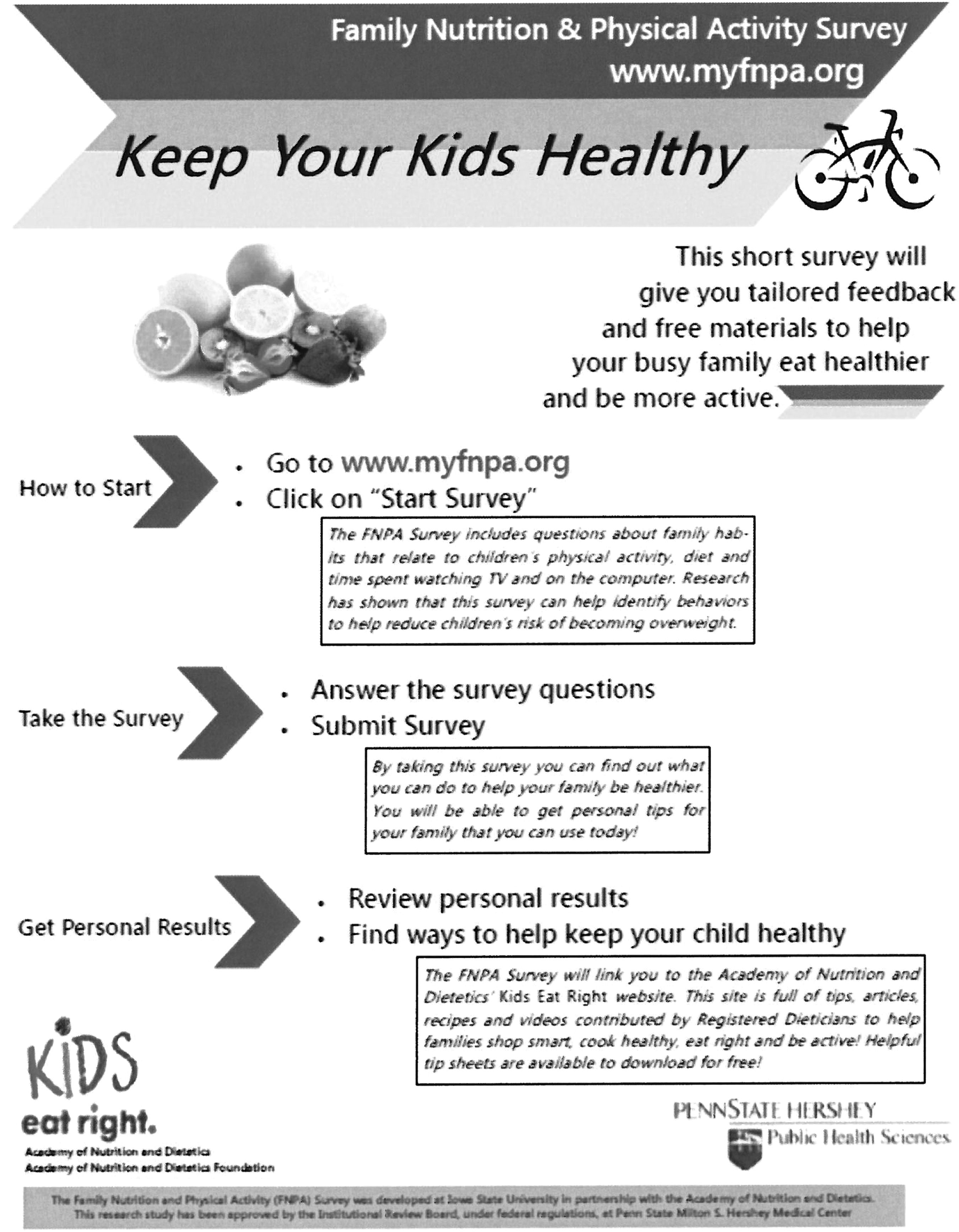
Information sheet included with the enhanced SBMIS+ report. FNPA, Family Nutrition and Physical Activity; SBMIS, school-based body mass index screening.
Following dissemination of the SBMIS or SBMIS+ report, paper and pencil surveys were mailed within 4–6 weeks to parents of first, third, and fifth grade students in the participating school districts. Data from 2 years of surveys (2012 and 2013) were combined into one data set, but cases were excluded in the second year if the parent indicated completing the survey in the prior year.
Five survey items (assessed with a simple Yes or No) were used to assess Perceived Utility. Items adapted from earlier work 22 captured parent's perception of whether the report “provide(d) useful information about (their) child's weight status,” helped parents “to better understand (their) child's weight status,” “provide(d) information on how to reduce (their) child's risk of becoming overweight,” “provide(d) information or access to resources aimed at promoting healthy lifestyles,” and whether the report “prompt(ed) parents to visit a health care provider or registered dietician about (their) child's weight status.”
Five additional survey items assessed parent intention to change specific health behaviors consistent with the FNPA, since receiving the report. These behaviors included the following: “limit(ing) the use of sugar-sweetened drinks,” “offer(ing) fruits and vegetables at meals/snacks,” “limit(ing) screen time (TV, video games, iPod/iPad),” “help(ing) child get enough physical activity,” and “help(ing) child get enough sleep.” Items were answered with a four-point Likert scale where 1 = “I am not planning to do this,” 2 = “I might try to do this,” 3 = “I am planning to do this,” and 4 = “I am already doing this.” Parents also provided child birth date, height, and weight, as reported on the SBMIS report, and this objectively measured information was used by the study team to calculate age- and sex-specific BMI percentiles and classify children by weight category.
Data Analysis
Based on the stratified two-stage sampling design, a series of logistic regression models with random school effect, fixed treatment effect (SBMIS or SBMIS+), and fixed weight group effect (overweight or not) were used to assess the intent to treat differences between parent utility perceptions of SBMIS and SBMIS+ reports. The study team was unable to confirm that the SBMIS+ parents actually read the enhanced report, used the FNPA tool, or read the educational materials. Responses to Perceived Utility questions were coded “1 = Yes” and “0 = No.” To detect an intention to treatment effect, response categories for the Behavior Change questions were collapsed to combine “I might try to do this” and “I am planning to do this” into one behavior change category where the behavior had not yet been changed (“1”), and the relative prevalence of these responses to “I am not planning to do this,” where there was no intent or plan to change behavior (“0”), was compared between the two treatment groups. Parents who reported that they were already performing the healthy behavior were excluded from regression models. Since parents in the same school may respond more similarly than parents in different schools, school effects were entered into the model as a random effect. Logistic regression models also examined potential differences in responses between parents of children who were categorized as underweight or normal weight (“NW,” BMI for age and sex percentile <85%) and parents of overweight children (“OW,” BMI for age and sex percentile ≥85%), regardless of treatment group. Analyses were performed using SAS Enterprise Guide 6.1 (SAS Institute, Cary, NC) and R Studio (RStudio: Integrated Development for R. RStudio, Inc., Boston, MA). The alpha level was set at 0.05 to detect significant differences.
Results
Parent surveys were returned by 1745 parents over two school years out of an estimated 6356 surveys distributed to produce a 27% response rate. All participating schools had respondent parents. There were 1469 surveys from unique parents with the number of respondents split nearly even between groups (SBMIS: n = 731; SBMIS+: n = 738). Respondent parents were nearly all females, white/Caucasian, aged 30–49 years, and college educated (Table 1). Slightly over half of the students were female and ∼30% were overweight or obese, based on objectively school-measured height, weight, and calculated BMI for age and sex percentiles. The student sample (6.5% non-white, 5.8% Hispanic) was representative of study school populations (6.6% non-white, 5.5% Hispanic), but less diverse state population estimates (21.5% non-white, 9% Hispanic). In terms of socioeconomic status, 37.4% of students enrolled in study schools were eligible for the Free or Reduced Price National School Lunch Program, slightly less than the state average (42.9%) in the 2011–2012 school year.
Characteristics of Study Participants by School-Based Body Mass Index Screening Report Condition
One parent did not provide age information and two parents did not provide education information.
GED, general educational development; SBMIS, school-based body mass index screening.
Proportion comparisons showed that parents in the SBMIS+ condition, compared to parents in the standard condition, were significantly more likely to state that they already implemented four of five behavioral and home environmental strategies associated with reducing childhood obesity risk (all p < 0.001) (Table 2). In general, parents did not indicate differences related to the utility of the SBMIS report by standard vs. enhanced report group. Parents in the SBMIS+ group were more likely than those in the SBMIS group to indicate that the enhanced report provided information on how to reduce the risk of a child becoming overweight, but the difference was not statistically significant and the effect size was small (p = 0.07; odds ratio [OR] 1.53; Cohen's d 0.67) (Table 3). 23
Parents by Study Condition Already Practicing Health Behavior or Home Environment Strategy to Reduce Childhood Obesity Risk
Parent Perceptions of School-Based Body Mass Index Screening Report Utility by Study Condition and Child Weight Category
Parents receiving the standard SBMIS report were the reference group.
Parents of children without overweight or obesity were the reference group.
p < 0.05.
p < 0.001.
OR, odds ratio.
Child weight status was associated with parent perception of the utility of the SBMIS report (Table 3). These analyses included all children, regardless of treatment group. Parents of children who were overweight or obese were statistically less likely to indicate that the SBMIS report provided useful information about or helped them to understand their child's weight status (both p < 0.001) and less likely to indicate that the report provided information or access to resources aimed at promoting healthy lifestyles (p < 0.05), but effect sizes were minimal (all OR <1.0). However, these parents were more likely to indicate that the SBMIS report prompted a visit to a healthcare provider or registered dietician to discuss their child's weight status (p < 0.001) with small effect size (OR 1.90; Cohen's d 0.51).
There were some differences by treatment group and child weight regarding future plans for behavior change. When parents practicing obesity-protective measures were removed from the analysis, parents in the SBMIS+ group were statistically more likely to indicate an intention to help their child get enough sleep (p < 0.001) with a medium effect size (OR 13.78; Cohen's d 1.68) (Table 4). Parents of children with overweight or obesity were statistically more likely to indicate plans to limit the use of sugar-sweetened drinks since receiving the SBMIS (p < 0.01) with small effect size (OR 2.67; Cohen's d 0.44).
Parent Intention to Adopt Behaviors After School-Based Body Mass Index Screening Report by Study Condition and Child Weight Category (Parents Already Practicing Behaviors were Excluded from Analysis)
Parents receiving the standard SBMIS report were the reference group.
Parents of children without overweight or obesity were the reference group.
p < 0.01.
p < 0.001.
Discussion
The results demonstrate the feasibility of enhancing SBMIS reports with parent education, the ability to sustain an educational intervention over multiple school years, and important differences in parent perception of utility by child weight status. Despite randomization of schools, parents in the SBMIS+ condition were more likely to practice obesoprotective behavior and home environmental strategies, perhaps because such schools excelled in health promotion. When these parents were excluded from analyses, SBMIS reports with educational enhancements resulted in greater parent intent to modify at least one childhood obesity risk factor (ensuring that their child gets enough sleep). Aside from the experimental groups, the correlations between child weight status and report utility, and planned actions were observed. Parents of children with overweight and obesity were more likely to indicate intent to limit the use of sugar-sweetened beverages. These parents reported limited utility overall with the SBMIS report but, importantly, were more likely to involve a physician or registered dietitian to discuss their child's weight status. These findings result from a rigorous, pragmatic study design in a state that has implemented school-based BMI screening and surveillance for more than a decade and thereby contributes to an understanding of the efficacy of SBMIS reporting on parent intent to change behavior and seek clinical care.
Fourteen states notify parents with SBMIS reports, reaching an estimated 28% of 50 million public school students annually, thus offering great potential to improve parental awareness and acknowledgement of a health risk screening and knowledge about healthy lifestyles and local resources.7,24 Controversy in the United States regarding SBMIS reports seems to rest with the concern that parents may implement counter-productive strategies such as restricting child food intake as observed in earlier, nonrandomized trials.16,25 Thus far, empirical evidence has not supported popular concerns with SBMIS reports and teasing, appetite suppressants, or self-esteem.9,26
State by state, little is known about the content of SBMIS reports, specifically the quality of the parent educational approaches, other than providing parent notification consisting of basic, objective information: student's height, weight, and BMI for age and sex percentile. 24 Pennsylvania's standard SBMIS report includes parent notification and general guidance to discuss concerns about weight and growth with the child's healthcare provider. Our findings suggest that for parents of children who are overweight or obese, this guidance is adequate to prompt parents to seek professional care. Florida is more direct with this guidance as their SBMIS report includes recommendations by weight category (e.g., medical assessment or no action needed), however, parents of children with overweight or obesity were not more likely than those with normal weight children to seek professional care. 25 Oregon's SBMIS report includes diet and lifestyle suggestions and useful websites, but qualitative research suggests that the report did not prompt parents to seek healthcare provider involvement or change behaviors. 11
A unique advantage of our enhanced SBMIS+ approach is the incorporation of the evidence-based online FNPA tool (www.myfnpa.org) designed to provide actionable information to assist parents in evaluating practices and home environments that could be targeted to help reduce their child's risk of obesity. 20 Longitudinal analyses have supported the predictive utility for identifying children who are at risk of becoming obese 21 and other studies have demonstrated associations with parenting style, 27 as well as effective links to provider counseling, 28 and clinical outcomes. 29 In this study, we observed that parents found greater utility in the SBMIS reports when provided with access to the FNPA assessment and the associated feedback, and educational links. Although the difference between groups was not significant and the effect was small, this was a positive signal in a low-dose educational intervention evaluated with a rigorous study design.
Our low-dose educational intervention utilized an existing policy and practice of SBMIS reports to get the FNPA link to parents at a time when assessing behavioral and home environmental risk for developing childhood obesity would be meaningful. This pragmatic approach to distributing parenting education leveraged existing evidence-informed and tested tools; minimized school staff burden; and necessitated only a single supplemental page of supplemental information. Participating schools confirmed that parent communication through the internet was commonly used and had wide reach. Regardless, lower socioeconomic status and rural residency may represent barriers to internet-delivered interventions despite recent gains. Home internet access among populations with lower incomes increased from 64% to 72% during this study period and rural access was estimated at 70%.30,31 Our approach to supplement SBMIS with parent education is similar to that used by Arkansas, which distributes an SBMIS report with specific steps that families can take to reduce risk and suggestions to involve healthcare providers for further assistance. 26 Our SBMIS+ approach is distinct in using an evidence-informed, web-based tool to provide a risk score to inform parent risk assessment and personalized education regarding behavioral strategies.
Limitations
Self-reported data limit our ability to verify that parents took their child to the healthcare provider. In addition, the nested study design prohibited the opportunity to examine interaction effects such as SBMIS report with child weight category on dependent variables of interest. Rural schools and those with lower income populations may need to adapt the online component of the intervention to reach parents. Last, the population studied was primary white, non-Hispanic, which limits the generalizability of the findings to diverse populations.
Conclusion
SBMIS+ parents reported higher recognition of educational resources and an intent to change at least one behavior associated with obesity risk. Use of evidence-informed, online educational tools such as the FNPA may offer promise for improving the utility of SBMIS for parents and their children. Parents of children with overweight and obesity were more likely to report limited utility with the SBMIS, but indicated plans to follow up with a healthcare provider and change at least one behavior associated with obesity risk, thus informing the utility of the policy overall.
Footnotes
Acknowledgments
All phases of this study were supported by an NIH grant (5R21HD067803). The authors thank the staff of the Social and Behavioral Research Services group at Iowa State University (Ames, IA) for their assistance in design, collection, and compilation of survey measures.
Human Subjects Approval Statement
This project was reviewed by the Human Subjects Protection Office, Penn State Hershey College of Medicine and approved as IRB# 34388.
Author Disclosure Statement
No competing financial interests exist.