




Abstract
Abstract
Background:
The aim of the present study was to undertake a systematic review exploring the relationship between childhood obesity and fecal microorganisms, to answer the following question: “Are Firmicutes and Bacteroidetes a significant risk indicator/factor for obesity in children?” The main search terms were “child” and “obesity” together with “gut microbiota” (PubMed: 2005–2017). The minimal requirements for inclusion were the evaluation of gut microbiota composition and BMI in children between 0 and 13 years of age.
Methods:
Assessed articles were carefully classified according to a predetermined criterion, and the Preferred Reporting Items for Systematic Reviews and Meta-Analyses (PRISMA) were considered. Seven articles were critically appraised and used as a basis for conclusions.
Results:
Three studies showed a positive association between Bacteroides fragilis and obesity. In addition, a high value of evidence indicated that a decrease in the Bacteroidetes phylum and in Bacteroides/Prevotella groups was related to high BMI. For the Firmicutes phylum, one high-quality study highlighted that it was positively correlated with weight gain. With regard to Firmicutes species, Clostridium leptum, Eubacterium hallii, and Lactobacillus spp. indicated adipose tissue storage, while Clostridium difficile and the Staphylococcus genus were correlated with low BMI. Despite the fact that only one study did not perform real-time polymerase chain reaction to quantify the microorganisms, its results corroborated those of the studies that did.
Conclusions:
Changes in Firmicutes and Bacteroidetes phyla/species levels might in fact be significant indicators/factors for childhood obesity. However, given the small number of articles appraising these entire phyla and the heterogeneity among the species assessed, further well-designed studies are required to improve the knowledge.
Background
On the global scale, obesity is considered the major nutritional burden in both developed and developing countries. Today, more than ever before, it has become clear that obese children are prone to become obese adults, with higher chances of developing severe comorbidities, such as dyslipidemia, metabolic syndromes, cardiovascular diseases, and type 2 diabetes.1,2
The scientific literature emphasizes that childhood obesity is a multifactorial disease that can be linked to suboptimal macronutrient composition in the diet, together with insufficient physical activity. 1 Genetic, endocrine, and psychosocial factors can also contribute to excessive weight gain in children. Furthermore, recent clinical investigations have pointed to significant differences occurring in the composition of the gut microbiota in obese and nonobese children.2–4
The gut microbiota includes a wide range of bacteria, with a gene pool much more abundant than that from the host. The physiologic functions attributed to the gut microbiota extend to extraintestinal tissues and suggest connections with excessive weight gain. 5 While some microbes in the gastrointestinal tract may be capable of promoting energy storage, others could promote leanness.2–4 The intestinal tract is sterile at birth, and bacterial colonization occurs according to the type of delivery (vaginal birth or cesarean section), feeding practices (breastfeeding or formula-feeding),3,4 and hygiene habits, such as brushing the teeth after meals, for example. The gut microbiota does not reach full maturity until the age of 4 years, and it undergoes modifications over time, mainly due to environmental factors such as antibiotic therapy, dietary practices, and surgical procedures, for example. 6
Obesity may be related to variations in the relative abundance of the two predominant microbial phyla in the gut: Firmicutes and Bacteroidetes. Animal studies with gut microbiota transplantation found that the microbiota of genetically obese leptin-deficient mice had a greater relative abundance of Firmicutes compared with the microbiota of lean, control mice. In addition, when germ-free mice were colonized with the microbiota from an obese donor, they presented an increase in body fat, despite having a similar food intake. 7 This result is further supported by clinical data suggesting an association between weight loss and changes in gut microbial composition 8 ; obese patients—who had significantly fewer Bacteroidetes and more Firmicutes compared with lean controls—when subjected to the same diet, displayed an increase in the relative abundance of Bacteroidetes, which positively correlated with weight loss, but not with the dietary caloric content. 8
Interestingly, different mechanisms have been proposed to explain the relationship between the gut microbiota composition and the development of obesity. The first mechanism relates to the role of gut microbes in extracting energy from nondigestible polysaccharides, providing an extra source of calories to the host. The second refers to the ability of the gut bacteria to modulate the lipopolysaccharide (LPS) levels in the blood, triggering the onset of a moderate systemic chronic inflammation, predisposing to obesity and diabetes. The third mechanism relies on the fact that the gut microbiota can regulate host genes associated with energy storage and consumption.9,10
Regarding the microbial component in obesity pathophysiology, the extent to which children's gut microbes change their relative abundance to support a modified environment is still unclear. In the same way, the extent to which gut microbes might play a causal role in the development of childhood obesity should also be elucidated. The development of well-designed investigations has been extremely important for evidence-based practices, engaging critical science with a clinical performance of excellence. Therefore, systematic methods to assess and summarize data are playing a pivotal role in the scientific literature. Thus, the purpose of the present study was to undertake a systematic review to explore the relationship between childhood obesity and the fecal composition regarding Firmicutes and Bacteroidetes phyla.
Methods
Question Addressed by Present Review
“Are Firmicutes and Bacteroidetes in the gut microbiota a significant risk indicator/factor for obesity in children?”
Literature Search
A comprehensive literature search was performed in the PubMed database in September of 2017, consisting of all publications from January 2005 to September 2017. A manual search was also performed based on references from articles found. The Preferred Reporting Items for Systematic Reviews and Meta-Analyses (PRISMA) protocol was followed.
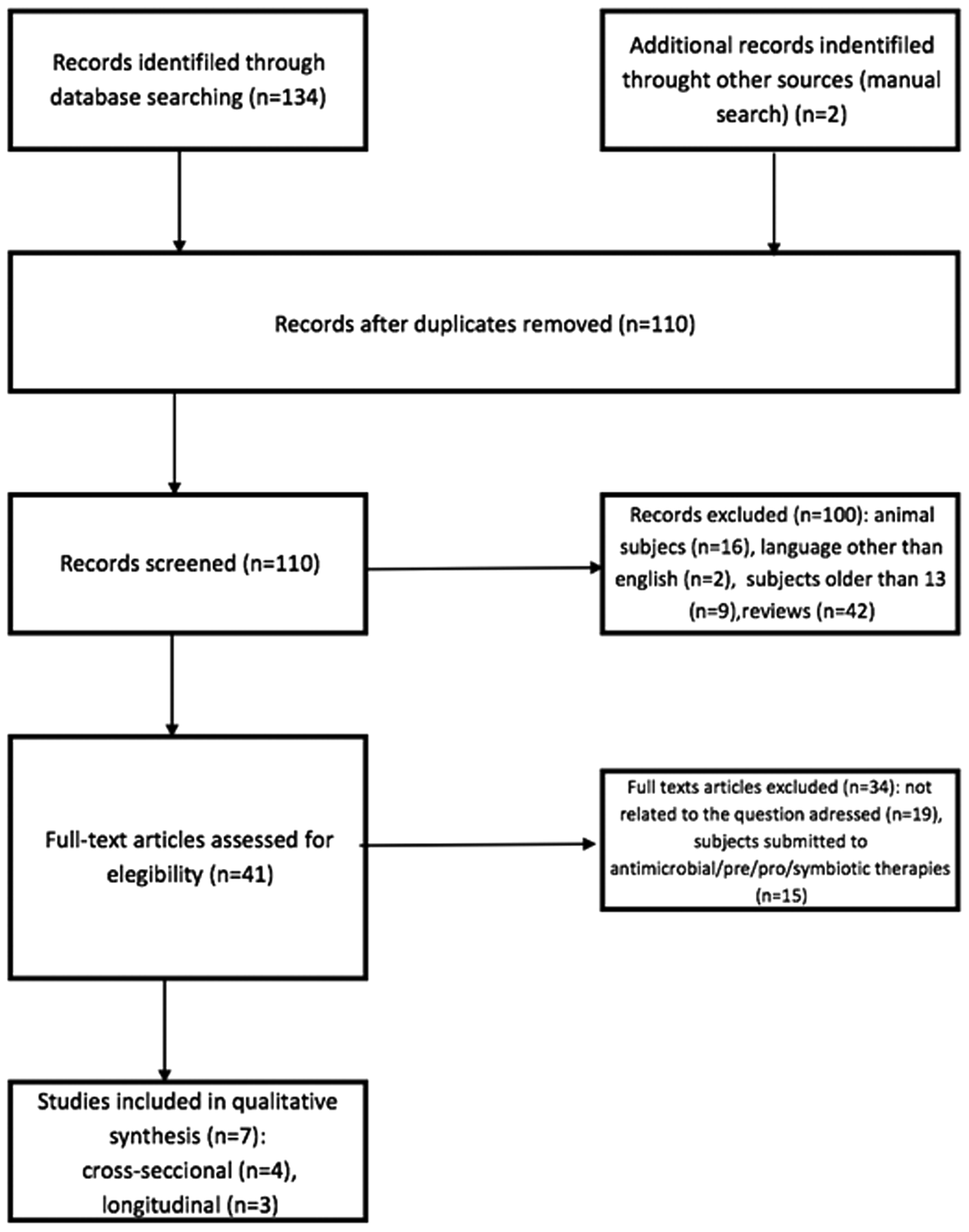
Based on the aim of the present systematic review, the following search descriptors were used: “obesity,” “gut microbiota/microbiome” or “gastrointestinal tract microbiota/microbiome,” and “child.” In total, 110 records were originally identified, without duplicates. Filters were then used to include only articles with human subjects (not older than 13 years) and those written in the English language, resulting in 83 articles. Further analysis excluded 42 articles based on the summary, since they referred to literature reviews (Fig. 1). Forty-one full-text articles were then assessed to certify that all eligibility criteria were available. Two examiners selected relevant records independently (C.M.S.P.I and T.M.P.), and seven articles were considered of interest for answering the main question addressed in this systematic review and were included for further analysis (Fig. 1).
Inclusion and Exclusion Criteria
Studies were included only if they assessed obesity according to BMI and if they explored the interrelations with the gut/gastrointestinal tract microbiota in children.
BMI is defined as weight in kilograms divided by height in meters squared (kg/m2) and is a measure largely used to characterize obesity on a global scale. For adults, the World Health Organization (WHO) defines overweight as a BMI of 25 kg/m2 or greater and obesity as a BMI of 30 kg/m2 or greater. 11 This definition does not apply for children, because it does not take into account the physiological BMI changes throughout childhood. Thus, the WHO classifies as overweight young children whose BMI is between the 97th and 99th percentiles of the WHO Child Growth Standards Curve, or between weight-for-height scores (z-score) +2 and z-score +3, regarding gender and age in months. In addition, obesity was confirmed when the percentile was higher than 99.9 on the WHO Child Growth Standards Curve, or the z-score was higher than +3. Conversely, children older than 5 years, with BMI between the 85th and 97th percentiles on the WHO Child Growth Standards Curve, are classified as overweight, and as obese when the percentile is higher than the 97th or the z-score is higher than +2. 11 The z-score better represents nutritional status because it is based on the number of standard deviations; the observed value lies from the median reference value of a population, in terms of a Gaussian distribution chart. Thus, a z-score of 0 is equivalent to the 50th percentile value (median) and a z-score of +2, for example, is almost equivalent to the 98th percentile. 12
The search was limited to clinical and observational cross-sectional or longitudinal studies in children and comprised relevant records that addressed the relationship between obesity and gut microbiota.
The following articles were excluded from the present appraisal: reviews, those involving animal subjects, those in languages other than English, those with subjects >13 years of age, those involving children with any syndrome or disorder, those with individuals subjected to antimicrobial/probiotic/prebiotic/symbiotic therapy, letters, and short communications.
Evaluation of Scientific Articles and Levels of Evidence
Articles that met all the inclusion criteria were subjected to critical appraisal by two researchers (C.M.S.P.I. and T.M.P.). Even after the evaluation criteria were standardized, any disagreement between the reviewers was solved by a discussion between them, until a consensus could be reached.
Each selected article was given a score from A to C, according to a predetermined criterion (Table 1). Articles addressing all issues described in grade A—such as full descriptions of eligibility criteria and sample selection, stratification of children regarding age/sex/social group/lifestyle, valid methodology for BMI assessment, bias taken into account, and adequate statistical analysis applied—were rated as having a high value of evidence. Conversely, when the eligibility criteria and sample selection were not fully described, stratification was not performed in detail, and confounders were not included in the Discussion section, articles having moderate value as evidence were scored as B. Finally, when eligibility criteria methods for obesity diagnosis and sample selection were poorly described or bias was not reported, a score of C was given, referring to a poor level of evidence.
Criteria for Grading Assessed Scientific Articles
Results
Of the 110 articles yielded in the literature search, 7 (4 cross-sectional and 3 longitudinal studies) met all of the inclusion criteria and were therefore included and critically appraised (Fig. 1).
The studies by Bergström et al., 3 Scheepers et al., 4 Xu et al., 13 and Borgo et al. 14 were rated “A” because they described in full the inclusion and exclusion criteria, as well as the sampling strategy (Table 2), including a good number of participants. In cases of populations belonging to large cohorts, if the original reference with the full study design description was cited, methods of sample selection were considered to be completely described. Moreover, the studied groups were equally distributed according to age and sex, and the presence of bias or confounders was explored in the Discussion section. It is important to highlight the longitudinal design of the studies by Bergström et al. 3 and Scheepers et al., 4 which usually results in a higher level of evidence, since the causal factors and confounders are not investigated at the same time. It is also of note that Scheepers et al. 4 provided a full description of missing data. Despite adopting a follow-up design, the study by Vael et al. 15 did not mention the presence of bias, even considering that the anthropometric measures were obtained by questionnaire, and performed a less sensitive technique for enumerating microorganisms (cultivation in selective media) compared with studies that used molecular biology analysis [real-time polymerase chain reaction (PCR)]. Therefore, such studies could not be ranked as possessing high levels of evidence (A) according to the criteria adopted (Table 1).
Results of Scientific Articles Appraised
CS, cross-sectional; L, longitudinal; PCR, polymerase chain reaction.
The articles by Karlsson et al. 16 and Ignacio et al. 2 were rated as grade “B,” since the inclusion/exclusion criteria, sample selection, and presence of bias were not fully described (Table 2).
None of the articles selected was classified as having a poor value of evidence, that is, grade C (Table 2).
The seven included articles were used as a basis for conclusions in this systematic review, in terms of the significant results. It is important to highlight that the great majority of the studies appraised (six of seven) used the same analysis approach: real-time PCR to quantify the microorganisms, with specific primers for the bacterial 16S ribosomal RNA (rRNA) gene. Even though only one article used a less sensitive method, cultivation in selective media instead of real-time PCR, the results corroborated those found by the molecular biology technique. In this way, an association between the increase in certain microbes belonging to Firmicutes (Clostridium leptum, Eubacterium hallii, and Lactobactobacillus spp.) and obesity/overweight was found in the studies by Bergström et al. 3 (grade A) and Ignacio et al. 2 (grade B). Conversely, the studies by Scheepers et al. 4 (grade A) and Vael et al. 15 (grade B) reported low levels of bacteria belonging to Firmicutes (Clostridium difficile and the genus Staphylococcus) relative to weight gain. When the entire phylum was taken into account, Firmicutes showed a positive and significant association with BMI 3 (Table 2).
High levels of Bacteroides fragilis, belonging to the Bacteroidetes phylum, were found in overweight/obese children compared with normal-weight children2,4,15 (Table 2). In addition, a decrease in Bacteroidetes, regarding the entire phylum, and a decrease in the Bacteroides/Prevotella groups were significantly associated with higher BMI in two grade A articles13,14 (Table 2).
Finally, species/families belonging to other phyla, such as Methanobrevibacter smithii, Akkermansia muciniphyla, Desulfovibrionaceae, and Bifidobacteriaceae, were also related to low BMI, according to the investigations by Bergström et al. 3 (grade A), Borgo et al. 14 (grade A), Karlsson et al., 16 and Ignacio et al. 2 (grade B); and the relationship between the levels of Enterobacteriaceae and BMI showed contradictory results3,16 (Table 2).
Discussion
To the best of our knowledge, the present review is the first to systematically explore and critically assess the published scientific articles concerning the relationship between bacteria from Firmicutes/Bacteroidetes phyla and weight gain in the pediatric population. The better understanding of this issue revealed that these two phyla might in fact be significant risk factors/indicators for childhood obesity/overweight, indicating the missing information that should be assessed in further well-designed studies.
Thousands of bacteria belonging to the Firmicutes phylum may be involved in the relationship between gut microbiota diversity and weight gain. Based on the findings from the four articles with the highest level of evidence (grade A),3,4,13,14 the increases in the species C. leptum and E. hallii, together with decreases in Faecalibacterium prausnitzii and C. difficile, were associated with obesity/overweight in infants and preschool-/school-aged children. C. leptum is an important carbohydrate-fermenting bacterium belonging to Clostridial cluster IV, a group of bacteria which also includes certain species of the Eubacterium genus. 17 Together with other intestinal microorganisms, they are able to ferment unabsorbed sugar/fibers from the diet, producing short-chain fatty acids that might act as an energy source for the human host 3 and may also play a role in gut epithelial function. 18 Despite producing short-chain fatty acids—significant amounts of butyrate—F. prausnitzii has been suggested to exert anti-inflammatory effects in the gastrointestinal tract.17,19 Therefore, their decrease in the gut microbiota of overweight children may be associated with the biological process of obesity. In addition, C. difficile is a pathogenic bacterium related to infectious diarrhea that can be asymptomatically carried in the first years of life. According to the findings of Scheepers et al. 4 (grade A—Table 2), children who were colonized by C. difficile at 1 month postpartum had a lower BMI at about 8.5 years of age. Nevertheless, according to the authors, these results should be interpreted with caution, since this finding was observed only in the group of children with conventional lifestyles and diets (after potential bias adjustment) compared with those children from “alternative” mothers recruited through certain channels, such as organic shops, anthroposophic clinics, and Steiner schools.
According to the studies rated as providing a moderate level of evidence (grade B—Table 2),2,14 Lactobacillus spp. (LB) were related to higher BMI, while members of the Staphylococcus genus were linked to lower BMI. Lactobacilli are gram-positive, acidogenic, and aciduric bacteria, being recognized as beneficial microbes in the human gut microbiota, and whose levels are strongly influenced by dietary habits. The effect of LB on weight gain is supposed to be species-dependent. In the meta-analysis conducted by Million et al., 20 it was shown that Lactobacillus acidophilus and Lactobacillus fermentum are candidates for increasing energy efficiency in humans, being related to weight gain. The increment in weight was dependent on the host, but the differences observed were of great relevance in clinical practice. 20 In line with this finding, attention should be drawn to the potential effects of the consumption of LB-containing foods, such as L. acidophilus, which are present in “acidophilus milk” and freeze-dried products, for example. Nevertheless, further studies are needed to clarify the role of Lactobacillus spp. in the human energy harvest and weight regulation, especially in young children. As stated above, members of the Staphylococcus genus were linked to low BMI. 15 This genus refers to pathogenic gram-positive bacteria, usually colonizing the skin surface and the gut. Staphylococcus spp. are facultative bacteria not able to supply extra energy by complex carbohydrate fermentation and are commonly suppressed when competing with a broad range of obligate anaerobes. In fact, the presence of Staphylococcus spp. in 1-year-old Swedish infants pointed to the slow acquisition of a more complex microbiota. 21
All the microorganisms mentioned in the two paragraphs above are from the Firmicutes phylum, and their influence on obesity was clear. The contradictory findings may be explained by the different species involved in each investigation, hindering direct comparisons. Remarkably, when the Firmicutes phylum was considered as a whole, one study with a high level of evidence 3 revealed a positive and significant association with BMI (Table 2), suggesting a reliable/solid conclusion in this regard. Bergström et al. 3 described the establishment of microbial patterns during the first 3 years of life and identified correlations among these patterns and dietary habits, as well as physiological parameters, focusing particularly on weight gain. It was found that significant changes in the gut microbiota occurred in children from 9 to 18 months of age, particularly when breastfeeding stopped and complementary feeding was introduced, at which time bacterial replacement was induced.
The Bacteroidetes phylum is composed basically of gram-negative bacteria, in contrast to the gram-positive Firmicutes microorganisms. Three studies rated as having a high/moderate value of evidence (A/B) showed a positive correlation or association between B. fragilis and obesity in children2,4,15 (Table 2). Belonging to the Bacteroidetes phylum, B. fragilis is a bacillary bacterium, anaerobic, immobile, encapsulated, and nonsporulating. It is also part of the commensal microbiota of the human gut colon. However, outside of the gut, it can cause infection. The study by Vael et al. 15 investigated the relationship between the gut microbes and BMI in the first 3 years of life, showing that high concentrations of B. fragilis at the age of 3 weeks were closely associated with higher BMI during the first 3 years of life. Despite the fact that agar enumeration (a less sensitive methodology) was performed in the research by Vael et al., 15 their findings are in accordance with those of another study rated as “A,” 4 which used real-time PCR, as did all the other articles appraised in the present systematic review (Table 2). The investigation by Scheepers et al. 4 was one of the most recent articles found in our review and showed an association between B. fragilis in early years of life (1 month post partum) and subsequent weight gain during childhood (children up to 10 years of age). The study by Ignacio et al. 2 (grade B) also corroborated these results, indicating differences in the gut microbial ecosystem of obese compared with nonobese children. Furthermore, they revealed a significant association between the numbers of B. fragilis bacteria and weight gain. LPS are present in the outer membrane of gram-negatives, such as B. fragilis, and these LPS may display a role as inflammatory stimuli, which could be linked to the development of obesity. 16 It is important to highlight that this information needs further investigation, because although B. fragilis LPS use the same receptors and coreceptors used by classic Enterobacterial LPS (Toll-like receptors 4/MD2/CD14), B. fragilis LPS is about 1000-fold lower in terms of potency. 22
In addition, high levels of evidence indicated the lower abundance of members of the Bacteroides/Prevotella group (gram-negative bacteria, belonging to the Bacteroidetes phylum) in obese subjects 14 (Table 2). Since Bacteroides/Prevotella genera have been associated with gut inflammation, particularly mediated by proinflammatory Th17 cytokines,23,24 the investigation of specific species would certainly clarify this apparent contradiction. Furthermore, when the entire Bacteroidetes phylum was investigated, strong evidence 13 (Table 2) highlighted a significant reduction in their levels and, consequently, in the Bacteroidetes/Firmicutes ratio when obese children were compared with eutrophic children. These authors explored the correlation between the gut microbiota and obesity in Kazakh's school children from 7 to 13 years old, analyzing fecal samples, and their results agree with those reported by Ley et al., 25 in which a decrease in Bacteroidetes was associated with obesity. Still, the investigation by Xu et al. 13 found no significant changes in Firmicutes numbers in the stool samples of Kazakh children. This study was the only one to investigate Firmicutes and Bacteroidetes phyla as a whole, without consideration of only certain species.
Even though species/families belonging to other phyla were noted in the appraised articles, revealing that M. smithii, A. muciniphyla, Enterobacteriaceae, Desulfovibrionaceae, and Bifidobacteriaceae were related to low BMI, the focus of the present systematic review was on microorganisms belonging to the phyla Bacteroidetes and Firmicutes.
While our review has supplied useful information about the gut microbiota and obesity in the pediatric population, its limitations should be pointed out. By far, the majority of high-quality research available in PubMed involved research with adolescents/adults/animal and antimicrobial pre/pro/symbiotic therapies or reviews, and only seven well-designed clinical studies could be critically assessed. Despite the fact that our qualitative analysis (based on scores A, B, or C) worked well, pooling methods such as meta-analysis were not performed because of the significant heterogeneity among the species involved in the appraised investigations, particularly with respect to the lack of an entire phyla evaluation (Bacteroidetes/Firmicutes), precluding this kind of analysis. Given these limitations, and to obtain consistent agreement within the studies appraised in future systematic reviews, one should consider investigating the entire Bacteroidetes and Firmicutes phyla and not only particular species. Likewise, different species of bacteria show biochemical diversity and distinctive pathogenic potential.
Greater knowledge of the gut microbiota composition might contribute to the prevention of weight gain or facilitate weight loss in the human population. This might be a useful strategy to avoid, prevent, or control weight gain in children and, consequently, in adults. Regarding a long-term approach, the implementation of effective preventive measures clearly has a significant economic impact in terms of the reduction of costs to the public health system.
Although it is difficult to control all confounders in clinical studies, they accurately reflect what occurs in real life. Thus, clinical investigations with significant sample sizes can report the reality of the problem, excluding the artificially controlled conditions of experimental designs. Thus, future studies should continue to investigate the microbial ecosystem and its impact on health during childhood and later in life.
Conclusions
In conclusion, changes in Firmicutes and Bacteroidetes phyla/species levels might in fact be significant indicators/factors for childhood obesity. However, given the critical number of articles appraising these entire phyla and the significant heterogeneity among the species involved in the assessed investigations, caution is required in extrapolating this assumption.
Footnotes
Acknowledgments
We thank FAPESP (2015/24600-2) and CNPq (409475/2016-5) for the financial support received.
Author Disclosure Statement
No competing financial interests exist.