




Abstract
Abstract
Background:
Catch-up sleep and low physical activity on weekends have been commonly documented. Preliminary evidence on Chinese children, however, has shown a variety of weekly physical activity patterns. This study examined the prospective associations between weekend catch-up patterns of sleep and physical activity and obesity over a 2-year period in Chinese children.
Methods:
Prospective data from 599 children in the Understand Children's Activity and Nutrition (UCAN) cohort study were analyzed. Weekly patterns of obesogenic behaviors (physical activity and sleep duration) were assessed annually over a 2-year period. Moderate-to-vigorous physical activity (MVPA) and sedentary time were determined by ActiGraph accelerometry. Data on sleep durations and sociodemographic factors were obtained from parental-reported questionnaires. Weekend catch-up sleep and MVPA patterns were calculated and examined in relation to childhood obesity after controlling for sociodemographic variables and sedentary time.
Results:
Every additional hour of average weekly sleep duration was associated with a 16% decrease in the odds of obesity (OR: 0.841, 95%CI: 0.709 − 0.999). After adjustment of average sleep duration, weekend sleep catch-up categories showed no association with obesity risk. Over a 2-year period, half of the children demonstrated weekend catch-up MVPA. Weekend catch-up MVPA for less than 20 minutes (OR: 0.473, 95%CI: 0.258 − 0.867) or more than 20 minutes (OR: 0.505, 95%CI: 0.257 − 0.993) were both related to lower risk of obesity.
Conclusions:
Weekend catch-up sleep did not ameliorate the risk of childhood obesity, whereas weekend catch-up MVPA did reduce that risk. More research is needed to explore the factors contributing to these obesogenic behavior patterns.
Background
In the past two decades, the prevalence of childhood obesity has increased by 40% to 50% in Hong Kong, with greater increases seen in boys and in children younger than 8 years old. 1 Compelling evidence has indicated that obesogenic behaviors, including physical activity, sedentary behavior, dietary intake, and sleep, are related to obesity risk in children and youth.2,3 General guidelines pertaining to physical activity and sleep duration have been developed for children and adolescents. These guidelines have suggested that to achieve good health, youth should accumulate 60 minutes or more of moderate-to-vigorous intensity physical activity (MVPA) on a daily basis. 4 Sleep duration between 9 and 11 hours is considered adequate for school-aged children and adolescents. 5
Despite these evidence-based guidelines, a considerable proportion of children worldwide do not meet the recommendations for physical activity and sleep duration. Furthermore, children are commonly found to demonstrate less favorable obesogenic behaviors (lower physical activity level and later bed/wake times) in less-structured environments, such as weekends.5,6 It is coined the “structured day hypothesis” (SDH), which posits that children are largely free from restrictive, compulsory daily routines on weekends and summer days, and thus they have more autonomy in their behaviors than on structured school days. 2
The “activitystat” theory, however, provides different points of view explaining within-day and day-to-day variations in physical activity. 7 This theory suggests a homoeostatic mechanism in regulating within-person physical activity, that is, any increase in physical activity in one domain will be compensated by reducing physical activity at another time point. 8 Research findings of physical activity compensation have been inconsistent to date. For Hong Kong children and youth, currently available evidence showed higher levels of physical activity on weekends than on weekdays, which is contrary to the SDH.9,10 It remains unexplored whether weekend physical activity compensation exists or not for Chinese youth population.
Unlike the patterns of physical activity, weekend catch-up sleep and weekly shift in sleep–wake times has been found prevalent among children and adolescents worldwide, including Hong Kong. Using parent-reported data, Wing et al. found that Hong Kong children 5–15 years of age slept ∼54 more minutes per night on weekends than on weekdays. 11 Such shift, particularly in youth, is believed to be physiologically driven as depicted in the social jetlag theory, measured as the difference in sleep midpoints between school days and free days. 12
Due to school obligation, students have to shift their sleep times that leads to increasing sleep debt during school days and compensate for it on weekends. 12 Social jetlag was found to be related to adiposity in children having sufficient weekly sleep duration. 13 However, lower risk of overweight and obesity has been reported for children who got insufficient sleep during weekdays and had weekend catch-up sleep in Hong Kong 11 and Korea. 14 The relationships of sleep parameters with childhood obesity are likely to be complex and warrants further investigation.
Despite the abovementioned evidence on weekend catch-up behaviors and obesity, no studies have examined multiple obesogenic behaviors together. If certain weekend catch-up patterns exist, interventions to combat childhood obesity might be tailored to different time segments and to specific types of catch-up behaviors. Therefore, the purposes of this study were (1) to determine children's weekend catch-up patterns of sleep and physical activity over a 2-year period, and (2) to examine the associations between weekend catch-up sleep duration, physical activity, and obesity in Chinese children.
Methods
Participants
Data were drawn from the Understanding Children's Activity and Nutrition (UCAN) cohort study, which was conducted annually during the 2009–2010 to 2011–2012 school years. Details of this study's design have been reported elsewhere.10,15 Briefly, 1,666 children in grades 1 to 3 from 24 schools in Hong Kong were recruited in 2009 (T1), and 90% of them were retained for a 1-year (T2) follow-up, with 76% of them participating in a 2-year follow-up (T3) survey. The parents of a subsample of the participants agreed to let their children wear ActiGraph accelerometers (Pensacola, FL) to record their activity patterns. The measurements were all performed at similar times of the year, to minimize seasonal variations at each time point. Trained research staff measured the children's body weights and heights, distributed the initialized accelerometers, and gave parental questionnaires to the children during school visits. The staff requested that the questionnaires be returned to the contact teachers within 1–2 weeks. Ethics approval was obtained from the Survey and Behavioral Research Ethics Committee of the university. Written informed consent was sought from the parents.
Physical Activity
Upon recruitment (at T1), accelerometer data were collected for 44% of those children whose parents had agreed to let their children wear the monitors (n = 448). This data collection could not be more inclusive due to the limited number of accelerometers available at the beginning of the study. At T2 and T3, the accelerometer data were collected for all of the children whose parents allowed them to wear the devices (n = 874 for T2, and n = 706 for T3). The children were instructed to wear their accelerometers at the hip level using an elasticized belt for 8 consecutive days during their waking hours and nonwater-based activities. These data were recorded in 1-minute episodes. Nonwear time was defined as a period of at least 60 consecutive minutes with zero counts. 16 A minimum of 10 hours of recording per day was considered a valid reading. 17 The accelerometer data were downloaded using ActiLife 6, and analyzed using MeterPlus software (Santech, Inc., V.4.3, www.meterplussoftware.com). Based on the age-specific cutoff counts, the MVPA was defined as ≥4 METs. 18 Sedentary time was determined as <100 counts per minute. 19 Four MVPA parameters were generated: weekday MVPA, weekend MVPA, weekend catch-up (weekend MVPA − weekday MVPA), and average MVPA, which was calculated as (weekday MVPA * 5 + weekend MVPA * 2)/7. Weekend catch-up MVPA was then categorized into three groups: no catch-up (≤0), <20 minutes, and ≥20 minutes. This cutoff point was selected because 20 minutes reflected the upper quartile of the weekend MVPA catch-up.
Sleep
To determine the children's average sleep duration, their parents responded to a single survey question: “How much sleep does your child usually get at night?” The answers were specific hours and minutes, such as 8 hours and 30 minutes. Sleep durations were separately recorded for weekdays and weekends, and average sleep duration was calculated as (weekday sleep * 5 + weekend sleep *2)/7. Weekend catch-up sleep was calculated in hours, as (weekend sleep duration–weekday sleep duration), and then categorized into four groups: no catch-up (≤0), <1 hour, 1–2 hours, and ≥2 hours. The four categories were used because the latter two groups occupied the first and second largest proportions of weekend sleep catch-up.
Anthropometric Measurements
Body weights were measured with the minimum clothing possible on an electronic scale (TANITA Body Fat Monitor, Model TBF-531A; Tanita Corporation of America, Inc.). Body heights (standing without shoes) were measured using a portable stadiometer (Seca, Model 214, Hamburg, Germany). The body mass index (BMI) for each child was calculated by dividing weight (kg) by height squared (m 2 ). Obesity was defined based on the International Obesity TaskForce reference for children. 20
Covariates
Demographic information, including the responding parents' ages, both parents' educational attainment, number of siblings, self-reported body weight and height for the responding parents (for calculating the parents' BMIs), and the children's dates of birth and sex, were collected from the parental questionnaires. Maternal educational attainment was regarded as an indicator of socioeconomic status because previous research has shown a stronger association of maternal education with children's health behaviors than paternal education. 21 It was classified based on local statistics. 22
Statistical Analyses
The distributions of weekend catch-up sleep and physical activity categories were determined for all children who provided valid data at the three assessment time points. The analytic sample consisted of those children who provided valid accelerometer data for at least one assessment wave, and whose parents reported sleep durations and the other covariates. General linear models were implemented to test the associations between the weekend catch-up categories, involving sleep duration and MVPA, and demographic variables. Two types of generalized estimating equations (GEEs) were used to examine the associations between sleep patterns, MVPA, and the risk of obesity. Model 1 tested the sleep and MVPA parameters independently in terms of their associations with obesity. The combined contributions of sleep and MVPA parameters to the risk of obesity were tested in Model 2. All of the models were adjusted for each child's sex, age, assessment time point, parents' BMI, maternal educational attainment, number of siblings, children's sedentary time, the accelerometer wear time, and school clustering. The interactions between sleep duration/MVPA and weekend catch-up categories were also tested. The analyses were performed using SPSS version 24. Statistical significance was set at p < 0.05.
Results
A total of 599 children (54% boys) provided valid accelerometer data for at least one assessment time point, and their parents responded to all of the questions. The children who provided valid accelerometer data had similar general characteristics to those who did not. On average, 11% of the boys and 5% of the girls were classified as having obesity. Weekend catch-up was more prevalent for sleep than for MVPA (Fig. 1). The proportion of children showing a pattern of weekend catch-up sleep was ∼64% across the three time points for boys. However, this proportion increased from 68% to 75.8%, from T1 to T3 for girls. Most of the children had 1–2 hours of weekend catch-up sleep. Over a 2-year period, the proportions of children who showed catch-up MVPA on weekends were relatively stable for boys, but the proportions declined from 58.1% to 47.4% among girls. Children having more than 2 hours of weekend catch-up sleep had the lowest average sleep durations over the whole week (Table 1). Weekend catch-up of 20 minutes or more MVPA was associated with higher average MVPA (60 minutes/day). Children with no weekend catch-up or with catch-up of less than 20 minutes of MVPA had similar amounts of average MVPA for each week (Table 2). Older children were more likely to have weekend catch-up sleep of more than 2 hours, but they were less likely to catch up in their physical activity on weekends. Children with weekend catch-up sleep of less than 1 hour had more educated parents, and a higher parental BMI was associated with more hours of weekend catch-up sleep.
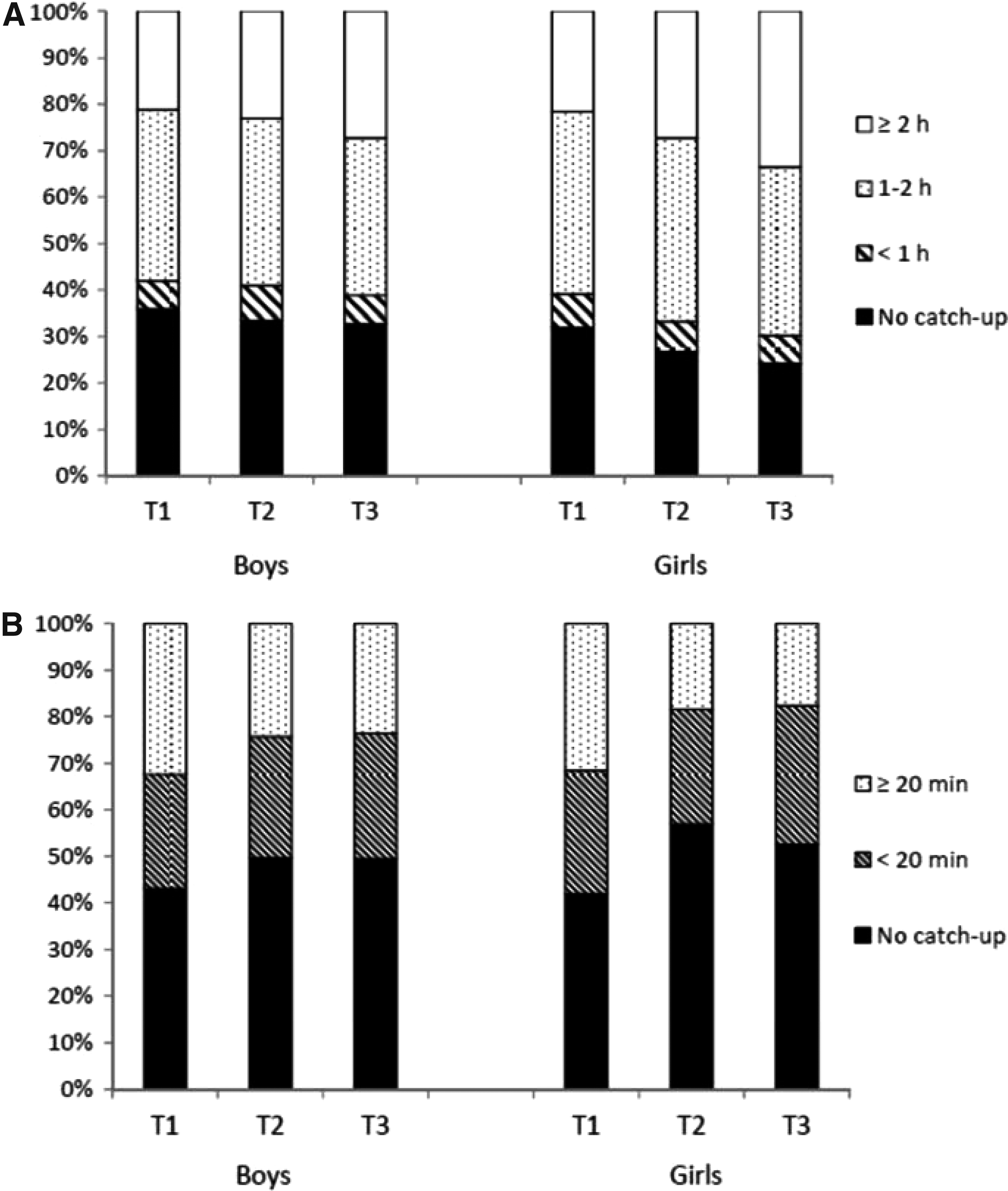
Distribution of
Participants' Characteristics by Weekend Catch-Up Sleep Patterns
General linear models adjusted for sex and time points. Data are presented as mean and 95% confidence interval.
p < 0.05, compared with all the other groups.
p < 0.05, compared with no catch-up and catch-up ≥2 hours.
Significant difference in any of two categories.
Participants' Characteristics by Weekend Catch-Up Physical Activity Patterns
General linear models adjusted for sex and time points. Data are presented as mean and 95% confidence interval.
p < 0.05, compared with all the other groups.
Significant difference in any of two categories.
MVPA, moderate-to-vigorous physical activity.
The associations between sleep, MVPA, and obesity risk are shown in Table 3. Every additional hour of average sleep duration over each week was associated with a 16% decrease in the likelihood of obesity (OR: 0.841, 95%CI: 0.709 − 0.999). The weekend sleep catch-up categories were not associated with obesity risk after adjustment of average weekly sleep duration. No interactions were found between average sleep duration and weekend sleep catch-up. However, weekend MVPA catch-up times of less than 20 minutes (OR: 0.473, 95%CI: 0.258 − 0.867) or ≥20 minutes (OR: 0.505, 95%CI: 0.257 − 0.993) were related to lower risk of obesity. Interactions between the average MVPA and weekend catch-up MVPA categories were observed. As a result, the associations of average MVPA and obesity risk were presented for the three categories separately. More average MVPA minutes led to a further reduction in obesity risk for no weekend catch-up group (OR: 0.989, 95%CI: 0.980 − 0.999), but not for the other two groups.
The Associations of Sleep and Physical Activity with Odds for Obesity
Model 1: univariate associations of sleep and physical activity with obesity.
Model 2: combined contributions of sleep and physical activity to the odds of obesity.
All the models are adjusted for sex, child age, measurement time point, maternal education attainment, parental BMI, number of siblings, sedentary time, accelerometer wear time, and school clustering. Interactions between sleep duration/MVPA minutes and weekend catch-up categories are tested and presented only if significant interactions are found. Average sleep duration is calculated as (weekday sleep duration * 5 + weekend sleep duration * 2)/7; average MVPA is calculated as (weekday MVPA * 5 + weekend MVPA * 2)/7.
The significant results are shown in bold.
OR, odds ratio; CI, confidence interval; MVPA, moderate-to-vigorous physical activity.
Discussion
This study examined the patterns of weekend catch-up sleep and physical activity over a 2-year period and investigated the effects of weekend catch-up patterns on obesity risk among Chinese children. The key finding was that weekend catch-up physical activity was apparent for approximately half of the children, and such activity was associated with a lower risk for obesity. These differences in obesity risk could have been mainly attributable to differences in the averages of MVPA time for each week. In addition, this study confirmed the results of previous research, which showed that children tend to sleep longer on weekends than on weekdays.11,14 However, no matter whether such weekend catch-up existed, the average sleep duration over each week appeared to be the most important factor influencing the risk of obesity.
Although the general guidelines recommend regular healthy lifestyles on a daily basis, noticeable differences have been observed between weekdays and weekends in terms of physical activity levels and sleep durations among children and youth. 6 More unfavorable behaviors on weekends, that is, less physical activity, more sedentary time, and later bed/wake-up times as hypothesized by the SDH, 2 were not fully supported by the findings of this study. Over a 2-year period, approximately half of the children showed catch-up MVPA on weekends. In general, these results were consistent with those of other local studies, which showed that a considerable proportion of children and adolescents spent more time in physical activity during weekends or holidays than on school days.9,10 Interestingly, children who accumulated more minutes of MVPA on school days demonstrated the lowest MVPA on weekends, whereas, those who were less physically active on school days had higher levels of MVPA. Such findings seem to be consistent with the concept of “activitystat”, which posits that increased physical activity in one time point will be compensated for by reducing physical activity in another time point, and vice versa. 23 However, the existence of the “activitystat” is still debatable; some studies supported this hypothesis,8,24 whereas the others did not. 25 More importantly, it is unknown when compensation occurs, for example, within the same day, over days, or over a longer period of time. Nevertheless, through such “compensation” on weekends, children in the current study could often achieve the recommended amounts of MVPA for each week, and these children had a lower risk for obesity. Even with the similar amounts of average MVPA for each week, children with weekend catch-up of less than 20 minutes of MVPA had reduced obesity risk than those children without catch-up.
Currently, the optimal combination of frequency and duration of physical activity has not been clearly determined although the general guidelines recommend MVPA on a daily basis for children and youth. 26 The emerging evidence on adults delivers an encouraging message: compressing the recommended amounts of physical activity into 1 or 2 days of the week seems to be sufficient for reducing mortality.27–29 Janssen et al. tested a similar concept with children and youth. 30 They found that infrequently active children (participating in ≥60 min/day MVPA on 1–4 days of the week) had similar cardiometabolic risk factors to those of frequently active children (participating in ≥60 min/day MVPA ≥5 days of the week). However, these results may have resulted from higher levels of MVPA in the more frequently active group. 30 That study made no comparisons between inactive and infrequently active groups. 30 Still, as the currently available evidence clearly shows that some physical activity is better than none, flexible activity patterns may be easier to fit into busy schedules, and this could offer an intermediate way to increase physical activity levels.
This study confirmed a reverse relationship between sleep duration and childhood obesity, as demonstrated in a systematic review. 31 Comparisons with previous studies also showed similar patterns of accumulating weekday sleep debt on weekends in children and youth. 32 However, the finding that weekend catch-up sleep was not associated with lower risk of obesity differed from that of previous studies on Asian children and adolescents.11,14,33 This discrepancy may be attributable to differences in age group and the sample's sleep duration (sufficient or not), in the means of measuring sleep duration, in the ways of defining weekend catch-up/compensation, and in the statistical methods applied. It is important to note, however, that this study adjusted for average sleep duration, which was not done in previous studies. In this study's sample, weekend catch-up sleep did not mean longer average sleep duration on a weekly basis. Instead, the over-catch-up group, that is, those having at least 2 more hours of sleep on weekends than on weekdays, 32 had the lowest average sleep duration. Nevertheless, reasonable amounts of catch-up sleep on weekends (less than 2 hours) appeared to be helpful for achieving marginally normal sleep duration for each week (∼9 hours per day). The definite impact of weekend oversleep on obesity risk has not been fully understood and might be influenced by multiple factors such as age, sleep duration, and sleep timing. The discrepancy between biological and social timing, that is, social jetlag, has been suggested to be a factor contributing to obesity in a large-scale epidemiological study among adolescents and adults. 34 The only study conducted in children to date had similar findings, however, the study sample had generally sufficient sleep (≥9 hours per day) and had similar sleep durations on school days and weekends. 13 In addition, unstable weekday–weekend sleep patterns may have other unfavorable consequences. For example, Biggs et al. documented that weekday–weekend sleep variations of over 2 hours led to an increased risk of behavioral difficulties in children 5–10 years of age. 35 Another study conducted on adolescents in Hong Kong showed that sleep debt of more than 2 hours on weekends was associated with lower academic performance. 36 Collectively, these findings suggest that it may be inappropriate to recommend oversleep on weekends as a long-term solution to the unhealthy consequences caused by inadequate sleep. Still, within a short period, catch-up sleep on weekends may serve as a buffer to sleep deprivation on weekdays, and such extra sleep may attenuate the detrimental effects of metabolic alterations. 14
This study identified several sociodemographic factors that contribute to the weekend catch-up patterns. Children with less-educated parents and higher parental BMI should be the target groups for interventions regarding obesogenic behaviors. Furthermore, such interventions should be implemented in early childhood, as children tend to demonstrate less favorable behavior patterns (oversleep and less catch-up MVPA on weekends) as they grow older during primary school. The reasons why some Chinese children may accumulate more MVPA on weekends than on weekdays are worth investigating further. In Chinese culture, children's need for adequate sleep and physical activity may not be their parents' priority. 37 Children generally have a variety of extracurricular activities (including some academic-related activities) to perform during weekend days and many of these activities are selected by their parents. As a result, Chinese children may not enjoy the degree of autonomy posited in SDH theory. The impact of this cultural aspect on obesogenic behaviors might be complex and difficult to determine. Nevertheless, it remains clear that regular sufficient sleep and adequate participation in physical activity should be a priority for all those concerned with children's health. The recent efforts to develop an integrated approach within each 24-hour timeframe might present a solution to the problem of obesogenic behaviors. 38
The strengths of this study include its longitudinal design and its simultaneous examination of both weekend catch-up sleep and physical activity patterns. Nevertheless, interpretations of the findings are subject to several limitations. First, the children's sleep duration was reported by their parents using a single item and has not been validated. Although this kind of reporting is a commonly used method in population studies, self-reported sleep duration may be subject to overestimation. In addition, sleep quality and bedtimes were not assessed in this study, although they have been suggested to be associated with childhood obesity. Future research should use more comprehensive measures of sleep parameters or an objective measure of sleep duration, such as accelerometry. Second, for children who provided less than 7 days of accelerometer data, it was assumed that 4–6 days of data were indicative of the child's weekly pattern. Third, this study focused on compensatory behavior changes between school days and weekends for both physical activity and sleep. To test the “activitystat” theory pertaining to physical activity, different timeframes should be explored. Finally, future studies should control for children's diet as it is also an obesogenic behavior.
Conclusions
In conclusion, weekend catch-up sleep and extra weekend physical activity were found prevalent among Chinese children in surveys conducted over a 2-year period. The findings suggested that having weekend catch-up sleep did not ameliorate the risk of childhood obesity, but weekend catch-up MVPA did reduce that risk. These findings confirmed that adequate sleep durations and regular sleep patterns should be promoted for Chinese children and youth. Given the current evidence that “some is better than none,” catch-up physical activity on weekends may offer a promising strategy for increasing the levels of physical activity among young people. More research is needed to explore the factors contributing to obesogenic behavior patterns.
Footnotes
Acknowledgments
The UCAN study was supported by the General Research Fund (GRF) from the Research Grants Council (RGC) of the Government of the Hong Kong Special Administrative Region, China (GRF#451308). The authors are grateful to all the children and their parents who participated in this study, along with the school teachers and student helpers who assisted in the UCAN project.
Author Disclosure Statement
No competing financial interests exist.