




Abstract
Abstract
Background:
Childhood obesity (CO) has become a true epidemic and a subject of increasing publications. The aim of this study was to assess if the number of publications in that field increases over time in proportion to the epidemic, and also according to socioeconomic factors.
Methods:
A PubMed search was carried out to extract articles related to CO published between 1945 and 2017. Data were downloaded from PubMed and processed through a dedicated parser. Socioeconomic data were collected from international organizations.
Results:
Overall, 36,554 articles were retrieved among 3329 journals, one-third of them being concentrated in 44 journals. The annual growth rate of publications on CO was on average 11.6% per year between 1990 and 2016, whereas the growth rate of articles on pediatrics or of the total articles indexed in MEDLINE was 2.6% and 4.4%, respectively. The most productive countries were the United States (37.80%), the United Kingdom (6.24%), and Italy (4.56%). There was a significant relationship between publications on CO in a country and prevalence of CO in that country (p = 0.002) and between evolution of the number of publications and evolution of the Human Development Index (p = 0.01). Following exponential growth, CO publications reached a plateau in 2013, whereas publications targeted on obesity in infants continue to increase.
Conclusions:
Research on CO has risen markedly in the last two decades, with a higher growth rate than biomedical research overall, as a result of the worldwide obesity epidemic and also due to specific socioeconomic factors.
Introduction
Obesity is one of the fastest growing and most serious public health challenges facing the world in the 21st century. In 2008, an estimated 1.46 billion adults worldwide had BMI of 25 kg/m 2 or greater, of these 205 million men and 297 million women were obese. 1 Furthermore, in 2010, overweight and obesity were estimated to cause 3.4 million deaths, 3.9% of years of life lost, and 3.8% of disability-adjusted life-years worldwide. 2 Despite increased social awareness and numerous preventive public health interventions, children are not spared and childhood obesity (CO) is also nowadays a major global issue. Recent epidemiology estimates indicate that 16.9% (95% CI, 14.9–19.2) of 2–19-year olds were obese in the United States. 3 European-based pediatric cohorts also reached alarming rates and several low- and middle-income developing countries worldwide have reported rapidly rising rates of CO, despite persisting high levels of undernutrition. 4 We are therefore dealing with a true epidemic, with potentially devastating consequences, particularly considering the health care-related burden of pediatric-onset obesity being carried along into adult life.4,5
Bibliometry is to scientific articles what epidemiology is to patients. 6 Using the metadata of scientific publications (authors, references, keywords, etc.), it allows measurement of the “output” of institutions and countries, description of historical development, and mapping of new fields of development in medicine. Such approaches have been conducted in many fields, such as ophthalmology, acupuncture, physical medicine and rehabilitation, pediatrics, or dermatology.7–11 The aim of this study was to test the hypothesis that the number of publications in the field of CO increases over time in proportion to the CO epidemic, and that socioeconomic factors have an impact on the level of publication. We also aimed at identifying publications trends, as well as the predominant actors (journals, countries) involved in the field of CO.
Methods
Bibliographic Search
The search for articles to be included in this study was carried out in March 2018, using the MEDLINE database (URL: https://www.ncbi.nlm.nih.gov/pubmed). MEDLINE was chosen because it is widely used in medicine, it has a good coverage for high-quality studies, and every reference in MEDLINE is indexed using MeSH thesaurus.12,13
We first used the MeSH term “Obesity,” introduced in MEDLINE in 1965, with a restriction on age (0–18 years), and we analyzed the MeSH terms used to index the 35,266 articles identified by the search. The MeSH term “pediatric obesity,” introduced in MEDLINE in 2014, was highly prevalent and we added it to the search. This allowed us to identify 1328 articles indexed with this term but missed by the MeSH term “obesity.”
Therefore, the final search string was (“pediatric obesity”[Majr] OR (“obesity”[Majr] AND (“infant” [MH] OR “child” [MH] OR “adolescent” [MH] OR “infant, newborn” [MH] OR “child, preschool” [MH]))) AND (“1945/01/01”[PDAT]: “2017/12/31”[PDAT]).
The use of the publication date type [PDAT] allows restricting a search to journal citations that have either print or electronic publication dates and that have been published in a specific period of time.
Data were downloaded from PubMed in Extensible Markup Language (XML) and were processed through a dedicated parser. The parser was developed by our team in Java. It extracts and transforms original PubMed XML to custom Java objects containing relevant information for our study. The following metadata, extracted from PubMed, were integrated into a dedicated database: journal, Major MeSH terms, first author's affiliation, publication type, language and year of publication. PubMed was also searched for all the articles published in the same period of time, to make comparisons in the trends of publications, using the following search string: “1945/01/01”[PDAT]: “2017/12/31”[PDAT]. The search for pediatric publications was performed by searching PubMed for all publications 1 year at a time and then applying the age filter (“Child: 0–18 years”) to restrict results.
According to Bradford's law, the population of journals may be divided into three groups, after ranking by decreasing order of productivity: a small group of core journals that contains one-third of articles, the nucleus of periodicals particularly devoted to the given subject, a larger group of journals that accounts for another third and a much larger group of journals that picks up the last third. 14 Therefore, we divided the journals in those three groups, to identify the most important journals in the field of CO. The 2017 Impact Factor of each journal was recovered from the Thomson Reuters (ISI) Web of Knowledge database.
The country in which the work was performed is not available in PubMed. This information was therefore extracted from the first author's affiliation. A specific algorithm in several steps was developed as follows: (1) from e-mail address, country code top-level domain based on ISO 3166–1 (e.g., it refers to Italy) and (2) from each address field, a comparison was performed with a dedicated geographical database enriched by the Google map API (geocode).
Due to the high number of missing data concerning the first authors' affiliation in PubMed before the 90s, and to the delay between entry of articles into the PubMed database and time-to-indexing with MeSH terms, which can be up to 1 year, 15 we restricted the analysis on countries to the period 1990–2017.
Country ranks for scientific publication were adjusted for population size (number of articles published divided by population size) and gross domestic product (GDP) per capita (number of articles published divided by GDP per capita). The evolution of publications on CO per country was compared with the evolution of the Human Development Index (HDI) for these countries, over the period 1990–2015. The HDI is a summary measure of average achievement in key dimensions of human development: a long and healthy life, being knowledgeable, and have a decent standard of living. The HDI is the geometric mean of normalized indices for each of the three dimensions. The health dimension is assessed by life expectancy at birth and the education dimension is measured by mean of years of schooling for adults, ages 25 years and older, and expected years of schooling for children of school entering age. The standard of living dimension is measured by gross national income (GNI) per capita. The HDI uses the logarithm of income to reflect the diminishing importance of income with increasing GNI. The scores for the three HDI dimension indices are then aggregated into a composite index using geometric mean.
For the most productive countries in term of publications on CO, we compared the evolution of the number of publications on CO between 1990 and 2015 with the evolution of the HDI during the same period.
The data on population size, GDP per capita, and HDI were computed from the World Population Review (http://worldpopulationreview.com), the World Bank (https://data.worldbank.org/indicator), and the United Nations Development Programme (http://hdr.undp.org/en/content/human-development-index-hdi), respectively.
Country ranks for scientific publications were also adjusted for their overall contribution to research, to assess the weight of work on CO among their scientific production, using an activity index (AI), developed by Schubert and Braun in 1986 and used in previous studies.16,17 This AI evaluates the relative research efforts a country devoted to a given subfield. Briefly, we computed the AI indicator as follows: [(number of publications of the country on CO/overall number of publications on CO in PubMed)/(number of publications of the country in PubMed/overall number of publications in PubMed)]. The total numbers of publications per country were assessed with the same method as for the number of publications on CO per country (extraction of the first author's affiliation with the dedicated parser).
The prevalence of CO was computed from the systematic analysis for the Global Burden of Disease Study 2013 published in 2014. 2
All statistical analyses were conducted with the STATA software program, version 9.0 (StataCorp LP, College Station, TX). We used linear regression to study the relationship between number of publications on CO and AI, country size of population, and gross domestic per capita. A p-value of <0.05 was considered significant.
Results
A total of 36,554 articles were retrieved from PubMed among 3329 different journals over the period from January 1, 1945, to December 31, 2017. The number of articles per year increased from 1 article in 1945 to 3178 in 2016. The annual number of publications remained low until the mid-90s and then steadily increased. Therefore, most of the articles on CO were published between 1990 and 2017 (n = 31 971; 87.5%) (Fig. 1).

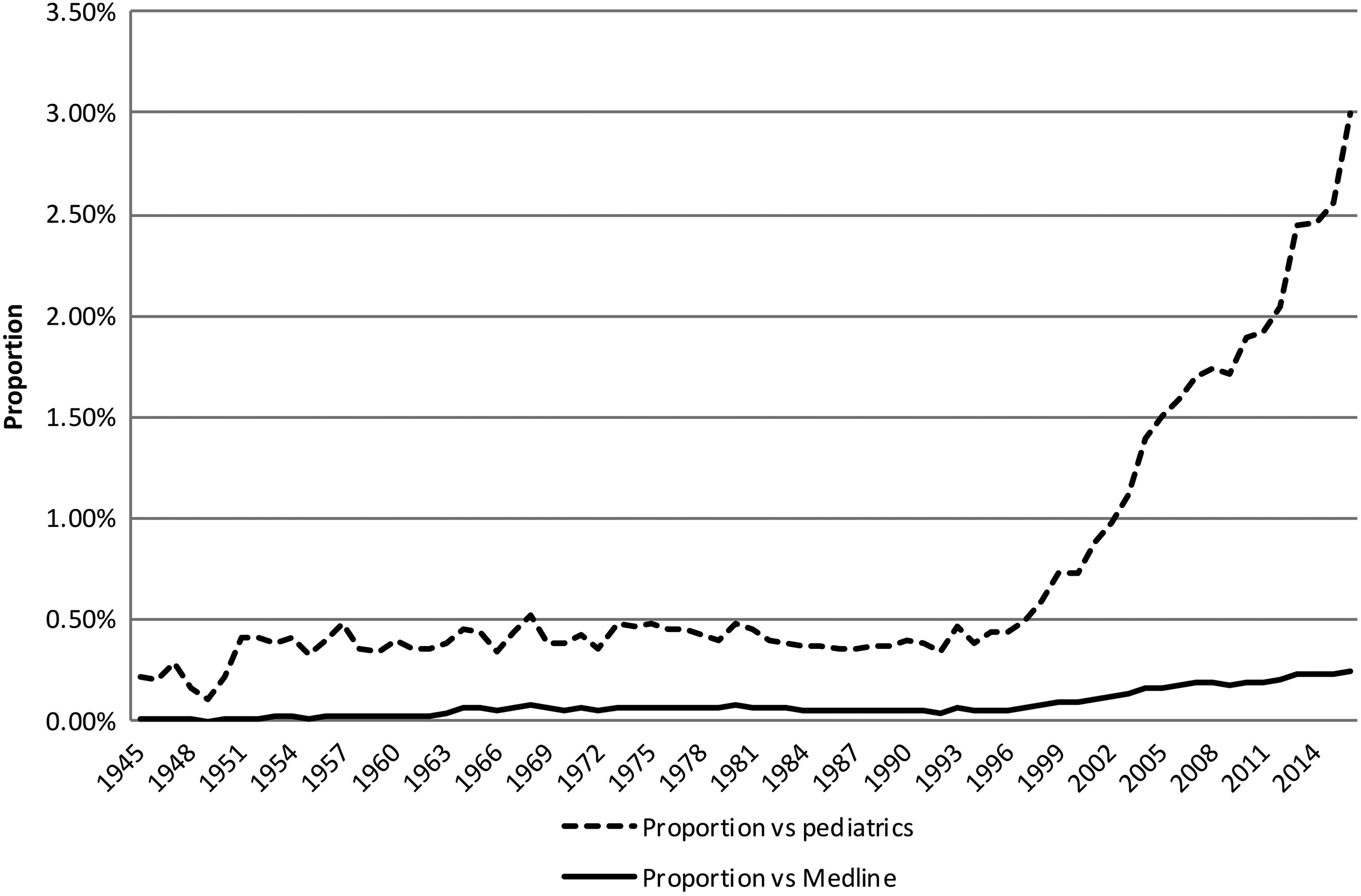
The annual growth rate of publications on CO was on average 11.6% per year between 1990 and 2016, whereas the growth rate of articles on pediatrics or of the total articles indexed in MEDLINE was 2.6% and 4.4%, respectively.
When compared with the annual growth rate of the total articles indexed in MEDLINE, we observed that the rate of publications on CO followed the overall rate of MEDLINE, and of publications on pediatrics, until the late 90s, when the proportion of articles on CO increased exponentially (Fig. 2). In 1990, studies on CO represented 0.053% of all the articles in PubMed, but 0.252% in 2016. Moreover, in 1990, the studies on CO represented 0.40% of all the articles on pediatrics in PubMed, but 3.00% in 2016.
Journals
Publications were retrieved from 3329 journals spanning 32 languages. According to Bradford's law, we divided the journals into three categories. The first category, that is, the most important journals in the field of CO, included 44 journals (1.32%) that had published one-third (n = 12,252) of the total number of articles identified between 1945 and 2017 (Table 1). Twenty of these journals were specialized in nutrition or obesity, and 13 in pediatrics, some in both.
Core Journals (i.e., Most Interesting Journals) that Published One-Third of the Total Number of Articles on Childhood Obesity, Proportion of Articles Published on Childhood Obesity Relative to the Total Number of Articles Published by the Journal for the Period 1945–2017, and 2017 Impact Factor of Journals
Number of articles on CO published by the journal in that period.
Proportion of articles published on CO relative to the total number of articles published by the journal for the period.
Impact factor 2017 not available.
CO, childhood obesity.
Language
Although the articles were published in 32 different languages, 87.60% of the articles (n = 32,026) were published in English, 1.97% (n = 720) in German, and 1.91% (n = 699) in Spanish. In PubMed overall, the proportions were 82.3%, 3.2%, and 1.2%, respectively.
Countries from Which Publications Originated
Our retrieved articles represented publications originating from 131 countries between 1945 and 2017, but the affiliation was not available for 22% of them, mostly for the older articles. Therefore, over the period ranging from 1990 to 2017, we were able to identify the country of origin for 88.19% of the articles. Among the 18 countries that contributed to more than 1% of the total number of publications, the top three contributors of CO-related publications were the United States (37.80%), the United Kingdom (6.24%), and Italy (4.56%) (Table 2). There was a significant relationship between the number of publications on CO in a country and the prevalence of CO in that country (p = 0.002).
Scientific Production on Childhood Obesity per Country, According to Their Population, Their GDP per Capita, Their Scientific Production Overall, and the Prevalence of Childhood Obesity
The countries presented in the table are those contributing to more than 1% of the total amount of publication.
Number of articles published on CO by the country between 1990 and 2017.
The GNP per capita is in thousands of US dollars.
AI: [(number of publications of the country on CO/overall number of publications on CO in PubMed)/(number of publications of the country in PubMed/overall number of publications in PubMed)].
AI, activity index.
For these 18 countries, the increase in the number of publications on CO between 1990 and 2015 was significantly related to the evolution of the HDI on the same period (p = 0.01) (Fig. 3).

To assess the weight of research of CO in each country, we compared the contribution of each country in terms of publications of CO with their contribution to articles in PubMed in the same period of time (AI) (Table 2). With regard to their level of publication, 14 countries gave a higher than average importance to CO than to other fields. Mexico, Brazil, Australia, and Turkey gave at least twice more importance to CO than to other fields, on average. Conversely, Japan, China, France, and Germany gave to CO less importance than to other medical subjects. There was a significant relationship between the prevalence of CO in a country and its level of research on CO, assessed by the AI (p = 0.036).
When adjusted to the size of the population, Denmark, Australia, and Sweden took the lead in terms of scientific production, and when adjusted to GDP per capita, the ranking changed to place the United States, China, and Brazil in the top 3, respectively (Table 2). However, there was no relationhip between the number of publications on CO from a country and the size of its population (p = 0.54) or its GDP per capita (p = 0.17).
Ages
Overall, 62% of the articles were concerned with obesity among the 6–12-year-old children and 65% were concerned with obesity in adolescents, that is, between 13 and 18 years; many articles dealing simultaneously with several age groups (figure 1).
A total of 12% and 21% of the articles were concerning infants (0–23 months) and preschool children (2–5 years), respectively. While publications on CO in adolescents and 6–12-year-old children started to rise in the 60s, publications on CO in infants and preschool children remained low until the late 90s, before increasing, although at a lower rate than publications concerning older children. Following exponential growth, CO publications reached a plateau in 2013, whereas publications targeted on obesity in infants continue to increase.
Publication Types
Randomized clinical trials and clinical trials represented 4.82% (n = 1762) and 3.53% (n = 1290) of the 36,554 articles retrieved from PubMed, respectively. Less than 10% of articles were reviews (n = 3307, 9.05%) and 0.80% were meta-analysis (n = 292). There were only 84 guidelines published on CO over the period (0.23% of the total number of articles published).
Discussion
Within the database of PubMed, more than 36,000 entries correspond to CO, corresponding to 0.12% of the total entries. However, the proportion has increased significantly from around 0.02% in the 60s and 0.05% in the 90s to 0.25% in 2016. Moreover, the topic CO accounted in 2016 for 3.00% of the articles published on pediatrics and indexed in PubMed.
The studies on CO were scattered in a high number of different journals, most of them being nonspecifically pediatric journals and originating from a large number of countries. Although there was a relationship between the prevalence of CO in a country and the number of publications on CO originating from that country, there was no relationship between the number of publications per country and the number of inhabitants or the GDP per capita. Some countries concentrated their efforts on CO compared with other fields of research.
Limitations
As with other publication analyses, some limitations are unavoidable. Exclusion of articles that were most recently published and not yet indexed by the National Library of Medicine (NLM), or from journals not indexed in PubMed, makes it impossible to trace all sources and to have an overview of the total number of publications worldwide.
In addition, although MEDLINE is the most authoritative international biomedical literature database, the number of medical journals from various countries is still limited.18,19 Other databases are also available for bibliometric studies, such as Web of Science, Scopus, Embase, PsycNET, and CINAHL. Nevertheless, we demonstrated in a previous study that most, if not all, of the good quality literature published was indexed in MEDLINE. 13
Another limitation is that we relied on MEDLINE MeSH terms. Articles included in MEDLINE are manually indexed. This manual assignment of indexing terms and document qualifiers to each citation in the database is one of the key determinants of the system's performance because these terms, when accurately applied, ensure straightforward retrieval of articles of a specific type. 20 Yet, as for any human activity, indexation errors in PubMed are possible and have been previously observed. 20 This could have led to both false-positive and false-negative hits in our study. We limited our search to two keywords (obesity, restricted on age groups, and pediatric obesity) because they were the most relevant to the scope of our study. Doing that, we may have missed some articles dealing with CO but not indexed with these keywords. However, the large amount of literature analyzed gave us a large enough overview of the trends of publication, to draw reliable conclusions.
Using the first author affiliation to assess the country of origin may induce a bias for studies involving international collaborations. However, the country of the first author is usually the country where most of the study took part. Furthermore, PubMed only reports affiliation information of the first author of articles published before 2014 (www.ncbi.nlm.nih.gov/books/NBK3827/#pubmedhelp.Affiliation_AD). This is why this method has been used in many studies on publication trends and in bibliometric studies.7,8,17,21–24 The prevalence of CO has been the subject of many different publications, from different countries. However, the methodologies used, as well as the populations investigated, varied from one study to another, making it difficult to compare the results. We therefore decided to rely on the most recent study comparing the prevalence of CO worldwide. 2 If the estimates may be less precise than the ones obtained from specific studies, they were at least comparable.
Trends
The growth in the number of publications on CO showed an exponential increase since the mid-90s. This increase was more important than the annual growth rate of the total articles indexed in MEDLINE. This is in line with the fact that research output in global obesity research roughly doubled each 5 years, with almost 80% of the publications and authors from the second decade (2003–2012). 25
The references were published in 3329 different journals, with 44 journals contributing one-third of CO literature. Obesity or pediatric journals captured only a small proportion of the literature on CO, which was also observed in 2010 on clinical obesity care. 26 The two journals contributing most were Obesity and the International Journal of Obesity. However, the first 20 journals contributed only 23% of CO literature, which is similar to the findings of Vioque et al. on obesity research overall. 27 Therefore, those wishing to keep up in this field will need to develop more inclusive strategies than reading these specialty journals.
North America and Europe were the most productive world areas with 42.43% and 37.52% of the literature, respectively. The great increase of publications on obesity during the period 1990–2017 was particularly evident in the last decade of the period, which is in line with the worldwide obesity epidemic. 28 There was a significant relationship between the number of publications on CO in a country and the prevalence of CO in that country. However, many countries with a high prevalence of CO did contribute very little to research.
The increase in the number of publications on CO between 1990 and 2015 was highly related to the increase in the HDI in the same period, especially for developing countries. This is probably related to the relationship between the number of publications on CO in a country and the prevalence of CO in that country, on the one hand, and between the prevalence of CO in a country and socioeconomic status (SES), on the other hand. In 1989, a landmark study demonstrated a strong inverse relationship between SES and obesity among women in developed societies, but no relationship for men and children in developed societies. 29 Conversely, the authors found a strong direct relationship between SES and obesity among men, women, and children in developing societies. This trend has been confirmed by more recent studies.30,31 By contrast, obesity in children appears to be predominantly a problem of the rich in low- and middle-income countries, 30 whereas a US study has observed that low income was highly associated with overweight/obese status in children and that low SES played a more significant role in the US CO epidemic than race/ethnicity. 32
Publications on CO seemed to reach a plateau since 2013, which is to be compared with the fact that there was no significant change from 2003–2004 through 2011–2012 in high weight for recumbent length among infants and toddlers or obesity in 2–19-year olds in the United States. 3 There was even a significant decrease in obesity among 2–5-year-old children during the same period (from 13.9% to 8.4%). If the decrease in publications in 2017 and 2016 may be attributed to the indexation delay of PubMed, 15 this is hardly the case for the plateau observed between 2013 and 2015.
However, publications targeted on infant obesity continue to increase. The relationships between infant and obesity have long been neglected in terms of research, apart from the impact of in utero exposure to mother's obesity or gestational diabetes mellitus.33,34 Nevertheless, recent evidence suggests that rapid weight gain, especially fat mass gain, in earlier infancy predisposes to mid-childhood overweight/obesity. 35 Furthermore, with the development of the concept of developmental origins of health and disease, increasing evidence suggests that infancy could be a critical period during which nutrition would have a programming effect for later health. 5
Publication type
It is possible that we missed some systematic reviews since this term is only a subheading (subheadings are qualifiers used to describe the specific aspects of the MeSH heading that are pertinent to the article) and not a publication type, and is therefore hard to identify. 20 However, although we observed an increase in the number of randomized controlled trials (RCTs), meta-analyses, and systematic review from the early 90s, it remains low and the gold standards in terms of evidence-based medicine are not frequent enough. We can hope that the increase in publication of clinical trials and RCTs will increase significantly over time the number of meta-analyses published.
Research on CO has grown markedly in the last two decades, with a higher growth rate than biomedical research overall. This reflects the growing epidemic of CO, and the emerging topic of infant obesity. The United States, a country with a very high prevalence of obesity, leads scientific production on CO research. Several countries from the north of Europe, with a not very high prevalence of CO, are in proportion very active in terms of research on that topic. Efforts should be made to help developing countries with the highest prevalence of obesity such as in Latin America, Polynesia, or most African countries, to come to terms with this problem.
Footnotes
Author Disclosure Statement
No competing financial interests exist.