




Abstract
Abstract
Background:
Future integration of genomics into weight management may target children with overweight given prospects for prevention. Meanwhile, parents learn about weight-related genomics primarily through the media, and little is known about parental reactions to complex genomic and environmental causes underlying children's obesity risk.
Methods:
Three hundred twenty-four parents with overweight who have a child 3–13 years of age were recruited through Amazon Mechanical Turk. Parents were randomized to read an article highlighting one of three causes of obesity risk: genetics only, family environment only, gene–family environment interactions (G × FE), or read a control article.
Results:
Parents who perceived their child to be overweight exhibited increased risk perception and guilt over parents of lean children overall, but exhibited decreased worry in response to the G × FE message. Furthermore, parents of children with overweight who received the G × FE message did not exhibit heightened risk perception or guilt, reported that the message was less relevant, and that they paid less attention to it.
Conclusions:
Multifactorial causal information about children's obesity risk elicits unintended consequences among parents whose children are most at-risk for obesity in adulthood. As these messages are most accurate, it is crucial to investigate effective ways to communicate the holistic nature of obesity risk to parents.
Introduction
The integration of genomics into obesity prevention is envisioned for the future. 1 Using predictive genomic information related to weight is most important for children at high risk for obesity, among whom there is time to prevent weight gain. 2 However, the effects of communicating the complex risk factors underlying children's obesity risk on parents' psychological responses are unknown. Despite this, parents are already learning about weight-related genomics and health with respect to themselves and their children through the media.3–5 In this article, we examine parental response to genomic messages related to children's obesity risk to inform future communication efforts in this area.
In considering individuals' reactions to weight and obesity-related genetics and genomics, researchers have long focused on simplistic single gene models, and some have concluded that the provision of genetic risk information for obesity is ineffective for triggering self-oriented behavior change. 6 Few have assessed the influence of holistic descriptions of genomic factors in obesity, including gene–environment interaction concepts, especially in domains outside of self-oriented behaviors.7,8 Evidence suggests that gene–environment interaction concepts result in risk perceptions that exceed the levels for each element individually 9 ; for example, conceptualizing interaction as “adding fuel to the fire.” 10
Notably, the majority of the literature assessing the influence of genomic risk information on behavior change refers to the self. The current article asks how these processes occur when parents apply health information to understand their child's risk. There is evidence that the provision of genomic information may be more successful in changing health behaviors aimed at children. 11 We explore the influence of genomic risk information on two primary parental responses; risk perception and guilt. Risk perception has been theoretically and empirically identified as an important driver of behavior change, both for the self,12,13 and for one's child.14,15
Evidence also suggests that increases in perceived risk of health threats accompanying genomic information provision are not always sufficient to change parents' behavior, whereas increases in parental guilt may be a more likely pathway.11,16 Guilt is conceptually intertwined with the motivation to engage in compensatory behavior to repair perceived wrongdoing. 17 Parents frequently feel guilty about passing down risk-conferring genes to their children,16,18,19 and about children's weight, particularly when children are perceived to be overweight. 20 This relationship is not always straightforward. Certainly guilt is an aversive experience for parents, and there is evidence that it may also be associated with impaired self-control. 21 Despite this complexity, guilt can be an active player in behavior change processes, and it remains important to explore potential aversive and beneficial effects. We investigate perceived obesity risk and guilt as they are the primary psychological variables that media are likely to evoke, and that may be less prone to socially desirable responses than motivation or intention variables.
Parental reactions to genomic information about obesity risk are likely to differ based on perceived child weight. Parents who acknowledge their child is overweight should exhibit greater involvement in risk messages, as overweight or obesity in young life are primary risk factors for adulthood obesity. 22 Accordingly, parents of children with overweight are expected to have stronger risk perception and guilt responses to information addressing genomic and behavioral determinants of children's obesity risk.23,24
In this study, we examine the psychological consequences (in terms of risk perception and guilt) of parental exposure to genomics-oriented media reports about obesity risk among children. We consider three ways to communicate the causes of obesity: (i) “genetics alone” cause with a holistic focus on genetic factors (rather than a single gene variant), (ii) “family environment alone” cause, or (iii) “gene–family environment interaction (G × FE)” cause, where genetics and the environment, in this case, the family environment, interact. Notably, the genetics and family environment conditions lie on the extreme ends of parental agency, with the genetics condition representing a causal route over which parents have no control and the family environment condition representing a causal route over which parents have control. The G × FE condition lies somewhere in between and contains elements of both.
Second, we assess the influence of parental perceptions of their child's current weight on their responses to causes of children's obesity risk. We approached these aims with three hypotheses.
Parents will exhibit heightened risk perception and guilt for their child's obesity risk when exposed to a G × FE risk message, over and above a genetic-alone, a family environment-alone, or a control message, as it presents two routes through which parents confer risk to their child.
ii. Parents who perceive their child to be overweight will have heightened risk perception and guilt for their child's obesity risk regardless of the causal information type presented.
iii. Child weight status will moderate the effects of obesity causal information type, such that the heightened influence of the G × FE message on risk perception and guilt will be magnified for parents who perceive their child to be overweight.
Methods
Participants
We recruited 324 self-identified biological parents with overweight who had children between 3 and 13 years of age through Amazon Mechanical Turk (mTurk). mTurk has been validated as a data collection tool for research that produces high-quality data mirroring findings from United States nationally representative samples.25,26 Following data quality assessment, our final sample consisted of 273 parents (see Supplementary Material S1 for mTurk sampling and data quality details).
Design and Procedures
We examined the effects of messages about three causal pathways for children's obesity risk on parental outcomes with a four-arm design: (i) genetics alone, (ii) family environment alone, and (iii) gene–family environment interaction (G × FE). A fourth article on deep sea exploration served as a control. Participants responded to a screening survey that determined their eligibility to participate in the study. Eligible participants were randomized to read one online newspaper-style article and complete outcome measures. This study was ruled exempt by the Office of Human Subjects Research Protection at the National Institutes of Health.
Stimulus Material
All experimental articles had a base story that referenced a child who a obese parent with obesity, matched to participant gender (i.e., mother/father). The genetics-alone condition emphasized that weight-related genes in mothers/fathers can be passed down to children. The family environment-alone article emphasized that the family environment established by mothers/fathers creates weight-related habits and behaviors that are passed down to children. Finally, the G × FE interaction condition focused on how children's response to the family environment created by mothers/fathers depends upon the genes they inherit from mothers/fathers (see Supplementary Materials S2a, S2b, S2c, S2d for articles).
Measures
Outcome measures were assessed in reference to an “index child,” a 3–13-year-old biological child of the parent participant. Measures assessed parents' risk perceptions 13 and guilt (Table 1). We also measured causal attributions to genetics and attributions to family environment as primary causes of children's obesity risk. 27 Finally, we assessed perceived relevance of the article to self and family, 28 and perceived attention to the article. 29
Measures
Data Analysis
We conducted analysis of covariances for each outcome variable, controlling for parent and child gender and parents' own perceived weight (“overweight” vs. “very overweight”). Significant interactions between causal information type and perceived child weight were followed by simple effects analyses. We assessed moderation effects on perceived attention and message relevance both with and without the control condition because the control topic (ocean exploration) was understandably rated as less relevant to participants and their families. Interaction coefficients were statistically significant in both analyses. Thus, we report outcomes from models, including the control condition.
Results
Demographics of parents and their index child did not differ significantly by experimental condition (Table 2).
Demographics by Condition
Parent weight is dichotomized as “very overweight” versus “overweight.”
Cells represent means (and standard deviations).
Child weight is dichotomized as “overweight” or “very overweight” versus “about right” or “underweight.”
Effects of Causal Information on Outcome Variables (Hypothesis 1)
Counter to hypothesis, there were no main effects of causal information on risk perception or guilt (Table 3).
Main Effects and Interaction of Message Type and Perceived Child Weight on Outcome Variables, F Test Values for Main Effects and Interactions, and Effect Sizes
p < 0.05, **p < 0.01.
Effects of Perceived Child Weight on Outcome Variables (Hypothesis 2)
There were main effects of perceived child weight on risk perception such that parents of children with overweight (PCO) perceived more absolute [F(1,262) = 43.84, p < 0.0001, ηp2 = 0.14] and relative [F(1,262) = 45.63, p < 0.0001, ηp2 = 0.15] risk, had higher perceptions of vulnerability [F(1,262) = 14.16, p < 0.0001, ηp2 = 0.051], and higher worry [F(1,262) = 22.53, p < 0.0001, ηp2 = 0.079] (Table 3). There was no main effect of perceived child weight on guilt related to passing down genetic risk. However, there were effects for overall guilt [F(1,262) = 9.14, p = 0.003, ηp2 = 0.034] and family environment-related guilt [F(1,262) = 12.96, p < 0.0001, ηp2 = 0.047], such that PCO felt more guilt compared with parents of children who are lean (PCL) (Fig. 1; Table 4). These main effects, however, were qualified by the interaction effects uncovered for Hypothesis 3.
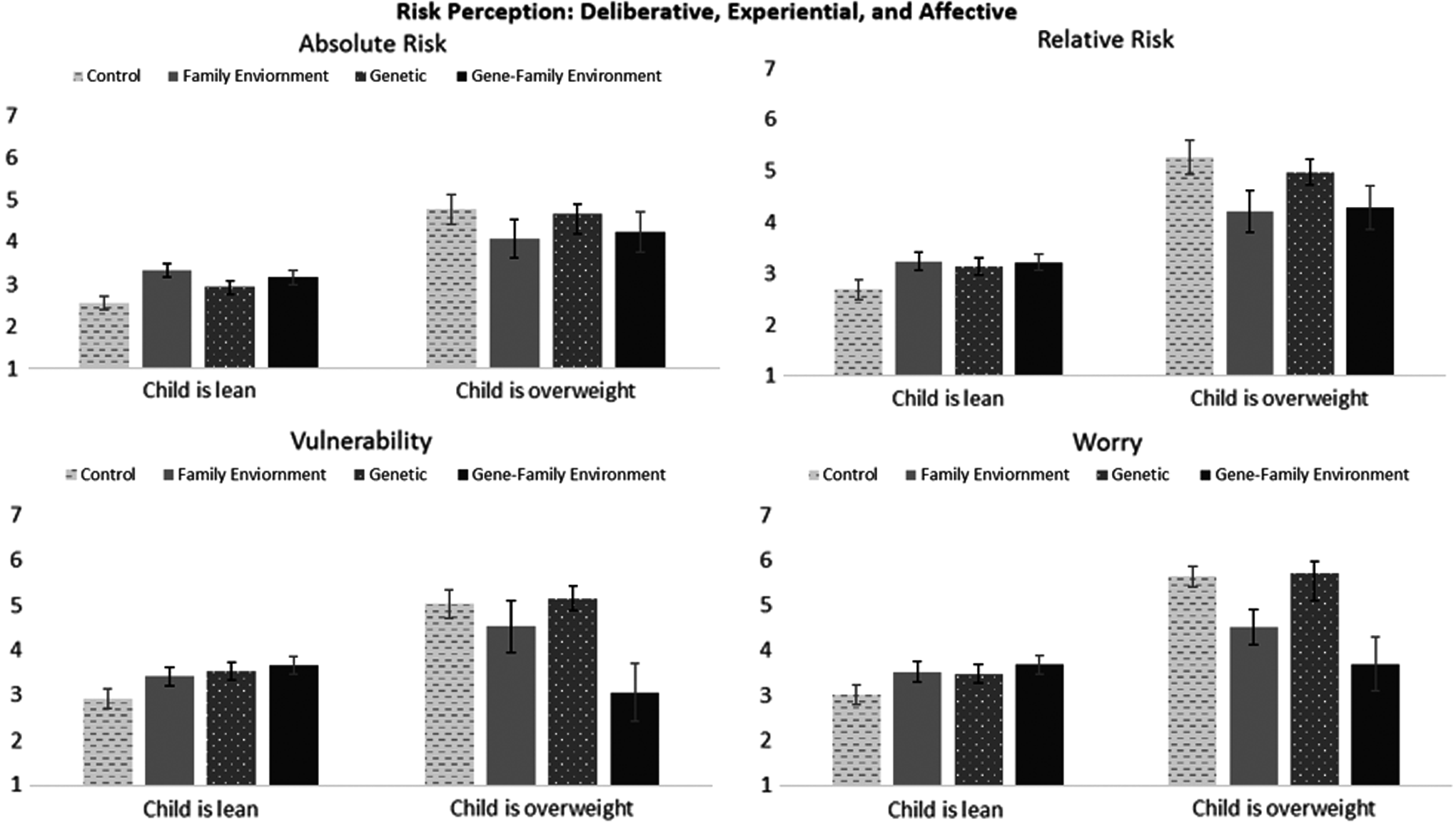
Estimated Marginal Mean (Standard Deviations) and Simple Effects by Message Condition and Child Perceived Weight
Lean versus overweight column shows simple effects of child's perceived weight within each message condition. Superscripts show simple main effects of message type within each perceived child weight. Different letters indicate statistically different values, whereas same superscript letters reflect nonsignificant differences by message condition.
G, gene; FE, family environment.
Moderation Effects of Parental Response to Causal Information by Perceived Child Weight (Hypothesis 3)
Risk perception
There were significant interactions for all types of risk perception (Table 3). Simple effects revealed that for PCL, the family environment message resulted in significant increases in absolute and relative risk perception, and worry over a control message (all p < 0.05; Table 4). Additionally, the G × FE message resulted in significantly increased risk perception over control (all p < 0.05). For PCO, none of the articles resulted in higher perceived risk compared with control. The G × FE message resulted in perceived vulnerability and worry that were significantly lower than control (all p < 0.05; Fig. 1; Table 4 for simple effects tests and means). For worry, the family environment condition was also lower than control (p < 0.05).
Comparisons between PCL and PCO within each message group revealed that PCO who received either the control or genetic message reported significantly heightened risk perceptions, perceived vulnerability and worry about raising a child who develops obesity as an adult. Furthermore, PCO who received the G × FE information exhibited risk perception that was higher than PCL, but that was lower in magnitude than the control and genetic-only messages for PCO.
Guilt
There were significant interactions for all three types of parental guilt (Table 3). Among PCL, those who received the family environment message reported higher levels of overall guilt (p = 0.022), and those who received the G × FE message reported higher levels of genetic guilt (p = 0.047). PCO did not report differential guilt depending upon message.
Simple effects within message type show that PCO who received either control or genetic only information expressed higher levels of overall guilt than PCL. Furthermore, PCO who received genetic-only information felt more guilt about passing down genetic predisposition for obesity to their children than PCL. Finally, PCO who received either control or genetic-only information felt more guilt about their family environment as a risk factor for childhood obesity versus PCL who received similar messages.
Relevance and Attention
There was a significant main effect of article type on perceived self-relevance [F(3,262) = 35.13, p < 0.0001, ηp2 = 0.29], such that all articles were rated as more self-relevant than the control. This main effect was qualified by a significant causal information-by-child weight interaction for self-relevance [F(3,262) = 2.82, p = 0.040, ηp2 = 0.031]. For both PCL and PCO, all causal articles were rated as more relevant than control (all ps < 0.05). For PCO only, the G × FE article was rated less relevant than the genetic article (p = 0.01; Fig. 1; Table 4). Simple effects for PCO versus PCL within message type show that PCO who received the genetics-only message reported that the article was more self-relevant. Conversely, PCO who received the G × FE message rated it as less self-relevant than PCL who received the same article. There was a significant main effect of article type on perceived family relevance of the article [F(3,262) = 35.63, p < 0.0001, ηp2 = 0.29], such that all articles were rated as more family relevant than the control. This main effect was qualified by an interaction [F(3,262) = 2.64, p = 0.05, ηp2 = 0.029], where among PCO, the G × FE message was rated less family relevant than the genetic message, but there were no differences in message ratings among PCL.
There was a main effect of child weight status on attention [F(1,262) = 10.51, p = 0.001, ηp2 = 0.039], such that PCO reported paying less attention than PCL. There was also a main effect of message [F(3,262) = 3.49, p = 0.016, ηp2 = 0.038], such that parents who received the G × FE message reported paying less attention than parents who received the genetic and family environment messages (p = 0.037 and p = 0.002, respectively). These main effects were qualified by a significant interaction [F(3,262) = 4.31, p = 0.005, ηp2 = 0.047]. There were no differences in reported attention by article type among PCL. PCO reported paying less attention while reading the G × FE message than the genetic or family environment message (all ps < 0.05).
Causal Attributions
There was a significant interaction between message type and child weight status on genetic causal attributions [F(3,262) = 2.72, p = 0.045, ηp2 = 0.030]. There was no significant simple effect of message type among PCL. For PCO, those who received the family environment and G × FE messages had lower genetic attributions than the control and genetic conditions (all ps < 0.05). For family environment attributions, there was a main effect of message type [F(3,262) = 2.74, p = 0.043, ηp2 = 0.031]. Simple effects revealed that parents in the G × FE group made lower family environment attributions than the control and the genetic groups. There was also a significant message type by child weight interaction [F(3,262) = 4.69, p = 0.003, ηp2 = 0.051]. Whereas PCL did not differ in attributions by message, PCO who received a G × FE message had lower family environment attributions than the control and genetic conditions (all ps < 0.05; see Fig. 1; Table 4). Furthermore, compared with PCL, PCO who received the genetic message had higher family environment attributions, whereas those who received the G × FE message had lower family environment attributions.
Discussion
This work demonstrates that messages about the multifactorial nature of children's risk for obesity could be associated with unintended consequences for parents whose children are most at-risk. The potentially negative outcomes of communicating the complex, multifaceted risk factors contributing to children's obesity risk have not been identified before. It is crucial to investigate effective ways to communicate the holistic nature of obesity risk to parents to spur health-promoting behavior, rather than counterproductive defensive reactions.
At first glance, data relevant to hypothesis 1 appear in line with reports that genetic risk information is ineffective for changing health behavior. 6 We found no effects of risk message type on the psychological antecedents to behavior change, perceived risk, and guilt. This finding stands in contrast to the McBride et al. study that found weight-related genomic information provided to parents affected child feeding outcomes. 11
McBride et al. 11 also demonstrated, however, that the influence of genomic information on behavior change was not equal for all parents. Thus, it is possible that relevant moderators that explain when and why certain parents feel guilty following genomic risk messages are disguising such effects. Indeed, we found that parental response to risk information was influenced by their perception of the child's weight. By considering the moderating effect of perceived child weight, we uncovered important patterns in parental risk perceptions for raising a child who becomes obese and feelings of guilt in response to causal obesity risk information. Children with overweight or obesity in childhood are at an increased risk for adult obesity, 22 a point that is often communicated in medical settings and public health campaigns. While many parents do not correctly recognize their children to be overweight, 30 those who do, typically exhibit more concern about their child's weight and health. 31 Similarly, we found that parents who identified their child as overweight or obese reported higher levels of obesity risk perception and guilt.
Considering, then, the reactions of parents who have overweight children, we found that those who received G × FE information demonstrated responses consistent with defensive processing of health messaging. This included equal or decreased risk perception and guilt when compared with parents of lean (and thus lower risk) children. Reduced endorsement of genetic and family environment causal pathways for obesity risk and low perceived relevance of the message for parents of at-risk children further support this interpretation. Perhaps, most telling is that parents receiving the G × FE message who have an overweight child reported paying less attention to the article than parents of lean children and those of children with overweight who received any other risk message. In other words, parents of at-risk children appeared to avoid and discount information suggestive of health threats to their child, consistent with literature showing that defensive processing is likely when health information is threatening.32,33
Furthermore, defensive responding is likely when health information presents a risk that is perceived to be controllable. 34 Compared with the genetic-only message, the G × FE message presents environmental risk factors that could be modified by parents. Finally, the G × FE message highlights parents' responsibility for their child's risk on two dimensions (passing down genes and shaping the family environment). Thus, although the G × FE message presents a controllable risk, the perceived level of effort needed to circumvent obesity may feel more difficult to muster.
We show a similar, but less consistent, pattern of disengagement among parents who received the family environment-only message. While the family environment message also represents a controllable risk, it may be more familiar, whereas the G × FE message is novel and thus potentially more threatening. 35 Noteworthy is that the family environment may not be equally controllable for all parents. It is worth investigating in future work whether low-income parents may feel less able to make changes to the family environment, and whether this may also be associated with defensiveness.
At the outset, we made hypotheses about main effects of message type and perceived child weight. The hypothesis that parents who have a child with overweight would have heightened risk perception, and guilt was largely supported. However, hypothesized main effects of the causal risk information were unsupported because the moderation effect of child weight was crucial in shaping parental responses to causal information. Indeed, although main effects of genetic or genomic information on behavior-related variables are often null, there can be moderating factors such that some subgroups (e.g., those with more responsibility for passing down risk; individuals in a given emotional state) have more acute reactions to the information.11,36
Strengths and Limitations
The study involved an internet sample reading a fictitious news story. mTurk samples have been shown to be valid and reliable when adequate data quality steps are taken. Thus, findings are likely as generalizable as a laboratory sample to the real-world parental responses to mass media reporting about child obesity risk.26,37 By creating the news articles, we were able to manipulate causal risk information and achieve consistency across experimental conditions. The primary outcomes in the current study were the proximal psychological variables mostly likely affected by media-oriented information. Future work should examine how these proximal variables influence health behavior. Consistent with childhood obesity prevalence, there were more parents who had lean children than parents who had children with overweight in the sample. Future efforts should oversample parents of children at higher weights. Another limitation is that the sample was primarily White and female, thereby limiting generalizability. Parenting and health research rarely includes fathers, 38 and as such, our inclusion of fathers is a strength. However, more research is needed with minority populations as perceived weight status can vary among racial and ethnic groups and may influence results.
Conclusion
Development of genomic approaches for weight management and obesity prevention will likely require explanation of complex, multifaceted messages to parents and families. That these messages are becoming increasingly prevalent in media contexts presents an opportunity to evaluate their influence. This study showed that multifactorial causal messages cause parents of children with overweight to disengage from risk-relevant information. This suggests a need to identify messaging approaches for conveying complex information that reflects accurate risk information but does not elicit defensiveness among parents. Such research can improve health communication efforts to parents around genomic information presented through the media, public health channels, and eventually in clinical settings. This would better equip parents to understand the risk factors facing children, especially high-risk children, and support parental behavior change to improve individual and public health.
Footnotes
Acknowledgments
The authors would like to thank Dr. Jennifer Kowalewski, associate professor of multimedia journalism at Georgia Southern University, and Ms. Sheldon Gardner, journalist, for reviewing the articles used in this research for adherence to journalistic practices. They also thank Ms. Rachel Cohen for assistance with creation of experimental stimuli. This research was supported by the Intramural Research Program of the National Human Genome Research Institute. The effort of Sherine El-Toukhy was supported by the Division of Intramural Research of the National Institute on Minority Health and Health Disparities, National Institutes of Health.
Author Disclosure Statement
No competing financial interests exist.
Supplementary Material
Supplementary Materials S1 and S2a, S2b, S2c, 
References
Supplementary Material
Please find the following supplemental material available below.
For Open Access articles published under a Creative Commons License, all supplemental material carries the same license as the article it is associated with.
For non-Open Access articles published, all supplemental material carries a non-exclusive license, and permission requests for re-use of supplemental material or any part of supplemental material shall be sent directly to the copyright owner as specified in the copyright notice associated with the article.
