




Abstract
Abstract
Background:
Excessive body weight is a lifestyle issue, which is commonly found in children in many countries worldwide, and has enormous medical implications. This study aimed to determine the effect of overweight and obesity on the shape of the spine in children.
Materials and Methods:
A total of 910 children 10–12 years of age participated in this study. Their height, weight, and fat tissue content were measured. Their BMI was calculated, and their body weight status was categorized. The shape of the spinal curvature was assessed using an ultrasound Zebris Pointer system. The following parameters were used for the assessment: the shape of the thoracic kyphosis and lumbar lordosis, the sagittal trunk inclination, and alignment of the spine in the frontal plane.
Results:
An overweight or obesity was found in 23.7% of participants. The thoracic kyphosis was similar in children with a normal and an excessive weight. The BMI and body fat correlated statistically significantly with the shape of lumbar lordosis as well as with the tilt of the long axis of the body. The results revealed that overweight or obesity did not have any effect on the lateral bending of the spine.
Conclusions:
Excessive body weight was found to increase the risk for developing the lumbar hyperlordosis and cause posterior axial tilt. Therefore, overweight and obese children should participate in gymnastic classes that can help correct faulty posture. Special attention should be paid to correct the position of the lower part of the trunk.
Introduction
Excessive body weight is recognized as one of the most serious public health concerns not only in highly developed countries but also in countries with a low national income, where paradoxically malnourishment often prevails. According to the Global Burden of Disease Study, in 2015, excessive body weight was recorded in 2.2 billion children and adults worldwide, that is, in 30% of the global population. Since 1980, the prevalence of obesity has doubled in more than 70 countries, and it has still been on the increase. 1 The problem concerns people of different ages. Unfortunately, obesity has become more common among children and adolescents.
Most analyses relating to the pediatric obesity have emphasized the correlation between a high BMI and the prevalence of cardiovascular diseases and diabetes type 2. There are considerably fewer researches devoted to studying the effect of excessive body weight on the shaping of the locomotor system in its developmental stages.2–7 Faulty posture is commonly observed in children and adolescents; however, lack of movement and unhealthy eating habits, as well as a sedentary lifestyle, have been enumerated as its causes. 8 Some authors have pointed out the correlation between excessive body weight and poor posture, but they have mainly emphasized that excessive weight increases the risk for developing valgus knees and flat feet. 5 Numerous studies have demonstrated relationship between excessive body weight and the spinal pain in children and teens.6,7 This type of pain might be associated with faulty body posture. Thus, the correlation between overweight and obesity and the trunk inclination in children seems to be worthy of investigation.
This study aimed to compare the shape of the spine in the 10–12-year-old children with a normal and an excessive body weight and determine whether overweight and obesity have an impact on the level of thoracic kyphosis, lumbar lordosis, sagittal trunk inclination, and lateral bending of the spine.
Materials and Methods
In the study, children 10–12 years of age participated from 7 randomly selected schools from the pool of 24 local public primary schools. For randomization, tables of random numbers were used. For inclusion in the study, the children were required to participate voluntarily, obtain a written informed consent from their parents, and have no disability. As many as 85% of students from the selected schools and their parents responded positively to the invitation for participation in the study. Nine children were excluded from the study due to Legg–Calvé–Perthes disease (one boy), osteogenesis imperfecta (one boy), scoliosis treated with corset brace (one girl), disability caused by meningomyelocele (one boy), or due to locomotor apparatus injury (fracture or sprain) experienced in the last year before the study (five children). Information on the health status of the children was obtained from their parents. All children regularly participated in physical education classes at school (4 h/week).
Finally, a total of 910 children, 456 boys and 454 girls, including 299 10-year-olds, 323 11-year-olds, and 288 12-year-olds, were enrolled in the study. Before conducting the study, approval from the Bioethics Committee at the District Medical Association was obtained (approval number 2/0177).
The body build of the participants was assessed. Their height was measured within 0.1 cm following a standard procedure using a calibrated anthropometer (ZPH Alumet No. 010208). Body weight was measured within 0.1 kg, using an electronic scale (Tanita Body Composition Analyzer bf-350), which was also used for calculating the percentage body fat content. For taking these measurements, the participants were undressed to their underwear and asked to stand barefoot. Tanita Analyzer to determine body fat constant utilizes the evaluation of the resistance met by weak, safe electric current flowing through tissues relative to the body height, age, and gender. Usability of this method for examining children has been confirmed by McCarthy et al. 8 The measurement was performed during morning hours, and the children consumed breakfast before the examination. The amount of liquids consumed was not controlled. Based on the data collated, BMI was calculated, and the body weight status was categorized as normal or excessive according to the standards developed by Cole and Bellizzi. 9
An ultrasound system, which consisted of a measurement sensor, pointer with two transmitters, reference marker placed at the level of the pelvis of the examined person, and a computer with the WinSpine software installed (Zebris APGMS Pointer) was used to assess the spinal alignment. The assessment of body posture was conducted with the participants in a habitual standing position, barefoot, and with a bare torso. The examination was always carried out by the same physiotherapist experienced in the use of the device. The measurement consisted in marking selected points on the body of the examined person with a marker: acromial processes of the shoulder blades; anterior, superior, and posterior superior iliac spines; apices of iliac wings; point between Th12 and L1; and a three-time marking of the course of the spinous processes from C7 to the sacrum. Based on these data a report explaining a three-dimensional trunk inclination was created. The following parameters were considered for the assessment: the shape of the thoracic kyphosis and lumbar lordosis, the sagittal trunk inclination expressed by the vertical tilt of the long axis of the body (sagittal trunk inclination), and alignment of the spine in the frontal plane (lateral bending of the spine, which might imply scoliosis). The obtained results were compared with the standards provided by the manufacturer. 10
Authors of the study are aware that an X-ray examination would be more detailed, yet due to the ionizing radiation exposure, this type of examination is not recommended as a screening test of body posture in children. 11 The Zebris Pointer system had been selected due to its lack of invasiveness, mobility, and good assessment of the reliability of the obtained results confirmed by other researchers.12,13
Statistical analysis of the collated data was carried out using Statistika v10. Contingency tables, basic descriptive statistics, Shapiro–Wilk test (for the assessment of normal distribution of variables), F test (for the assessment of homogeneity of variance), t test for independent samples, Mann–Whitney U test, and Spearman's rank correlation (for measurement of dependence between variables) were used for the analysis. The level of significance was accepted at α = 0.05.
Results
The boys and girls included in the study did not differ with respect to their age (p = 0.32), height (p = 0.72), or weight (p = 0.66). BMI was also similar in both the groups (p = 0.76) (Table 1). The fat tissue content was significantly greater in girls (p < 0.001), with the difference between boys and girls being 4.11%. The angle of thoracic kyphosis was significantly greater in boys (p < 0.001; a difference of 2.64°), and that of lumbar lordosis was greater in girls (p = 0.02; a difference of 1.36°). The sagittal trunk inclination was similar in both the groups (p = 0.92), while the alignment of the spine in the frontal plane revealed a significantly greater tendency toward lateral bendings in boys (p = 0.007).
Diversification of Variables under Research in Boys and Girls
Statistically significant differences.
SD, standard deviation.
Out of a total of 910 participants, normal body weight was found in 694 children (76.3%), whereas overweight or obesity was found in 216 (23.7%) participants [including 95 (21%) girls and 121 (26.5%) boys]. Participants with an excessive body weight had a significantly greater height (a difference of 5 cm), a greater weight (a difference of 17.64 kg), and a greater BMI (a difference of 6.52 kg/m 2 ) compared with those with a normal weight (Table 2). The body fat content in overweight and obese children was greater by 11.76% compared with children with normal weight. The shape of the thoracic kyphosis was similar in participants with a normal and an excessive body weight (p = 0.81), but the angle of lumbar lordosis was greater in those with an excessive body weight (p = 0.002). The sagittal trunk inclination also differed between both the groups (p < 0.001). The results showed that excessive body weight did not have any impact on the prevalence of the lateral bending of the spine (p = 0.91).
Diversification of Variables under Research in Children with a Normal and Excessive Body Weight
Statistically significant differences.
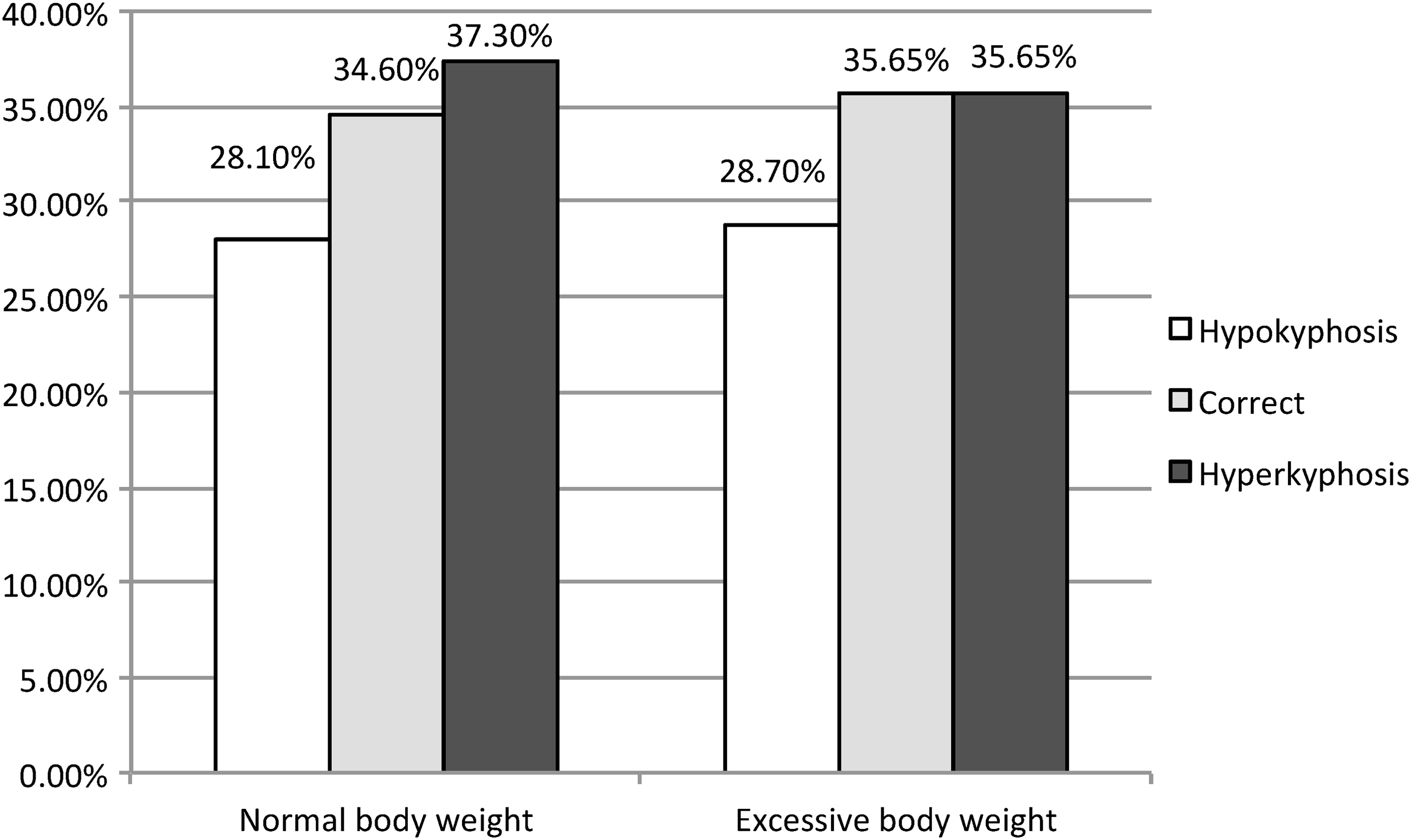
Among the 694 children with a normal body weight, the thoracic hyperkyphosis was the most common (n = 259, 37.3%), correct thoracic kyphosis was slightly less common (n = 240, 34.6%), and thoracic hypokyphosis was the least common (n = 195, 28.1%) (Fig. 1). Among the 216 children with an excessive body weight, the proportion of those with thoracic hyperkyphosis and correct thoracic kyphosis was found to be same (n = 77 for each condition, 28.7%), whereas thoracic hypokyphosis was found out in 62 (28.7%) children.
Correct lumbar lordosis was observed in 169 (24.4%) children with normal body weight and in 44 (20.4%) children with excessive body weight (Fig. 2). Lumbar hyperlordosis was more common in children with an excessive body weight (n = 116, 53.7%) than in those with a normal body weight (n = 304, 43.8%), whereas lumbar hypolordosis was more common in children with a normal body weight (n = 221, 31.8%) than in those with an excessive body weight or obesity (n = 56, 25.9%).

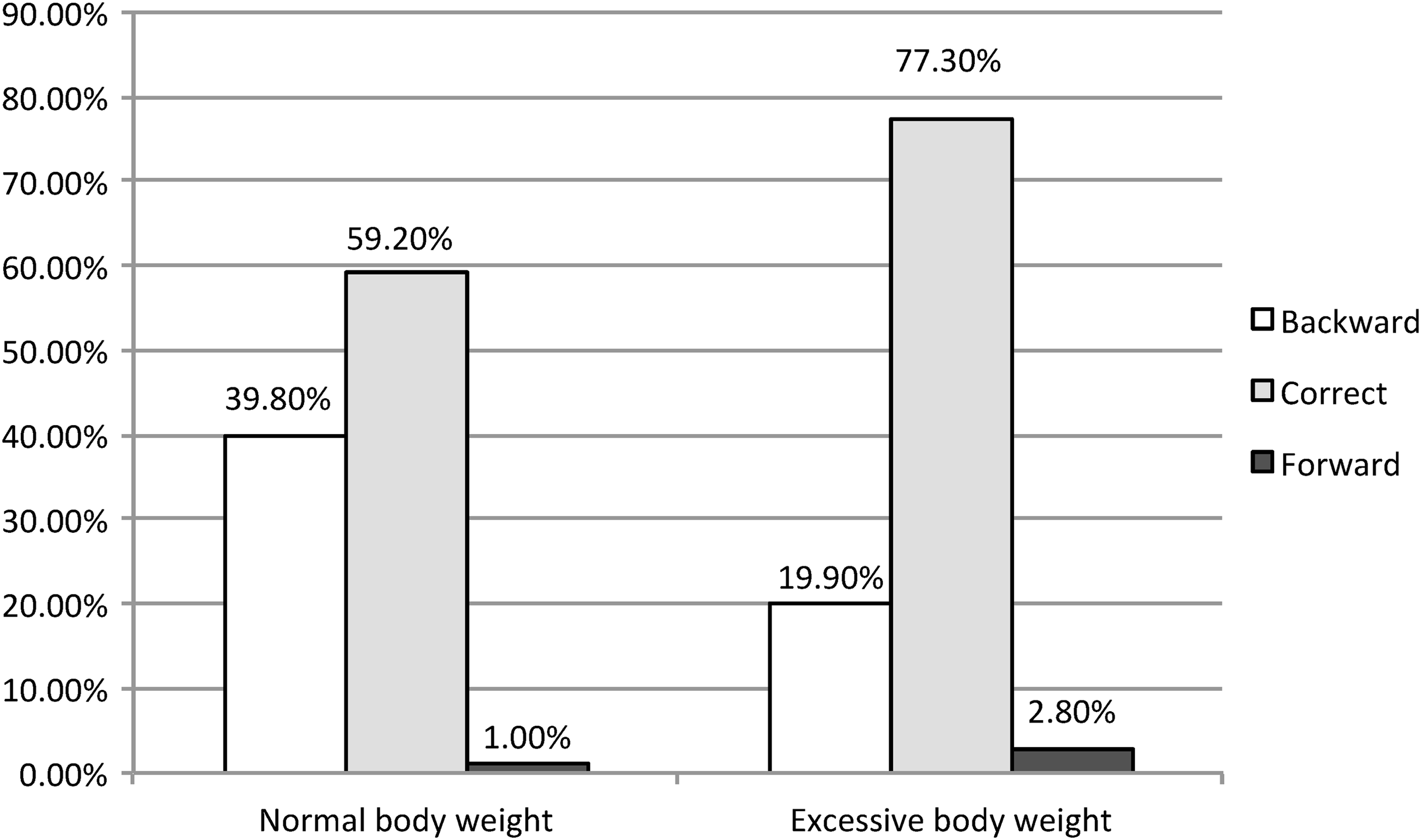
Correct sagittal trunk inclination was more common in participants with an excessive body weight (n = 167, 77.3%) than in those with a normal body weight (n = 411, 59.2%) (Fig. 3). Excessive backward tilt was more common in participants with a normal body weight (n = 276, 39.8%) as compared with children with an overweight or obesity (n = 43, 19.9%). Excessive forward tilt was the least common in both the groups; it was observed only in seven children (1%) with a normal body weight and in six children (2.8%) with an excessive body weight.
Correct spine alignment in the frontal plane was observed in almost 70% of participants in both the groups (in 483 children with a normal body weight and in 151 children with an excessive body weight) (Fig. 4). Of the remaining children with a normal body weight, 51 (7.4%) showed lateral bending of the spine toward the right side and 160 (23%) toward the left side, whereas among children with an excessive body weight, 13 (6%) showed lateral bending of the spine toward the right side, and 13 (6%) toward the left.

The analysis of correlations between the variables revealed a significant association between BMI and body fat content and between the angle of the lumbar lordosis and sagittal trunk inclination (Table 3). A greater BMI and a greater body fat content were associated with a lumbar hyperlordosis and a greater backward tilt.
Correlations between Variables
Statistically significant correlations.
Discussion
Faulty body posture is one of the most frequent health-related problems in children and adolescents.2,14,15 It usually does not hinder their functioning in any way, and therefore tends to be ignored. However, with time, posture gets worse and becomes a cause of pain. Taking into account the magnitude of this problem, it seems to be unusually important to determine the factors causing different types of faulty postures and factors worsening them. Understanding the effect of overweight and obesity on the musculoskeletal system in its developmental stage will facilitate forecasting changes in body posture and in elaborating intervention programs.
Most often, the problem is complex, and the development of poor posture is related to many components. However, identification and elimination of at least one risk factor may increase the chance of developing interventions with a greater effectiveness and therapeutic actions.
According to some researches, a bad somatic build and most importantly excessive body weight may have an adverse effect on the body posture.2,4,14–19 The results of the present research confirmed that body weight is a factor that determines the alignment of the trunk. In the study, it was observed that both BMI and body fat content affected the shape of the lumbar lordosis. A correlation between excessive body weight and the shape of the lumbar lordosis was also observed by other authors.18,19 An excessive anterior curvature of the lower part of the spine may potentially affect the alignment of the pelvis in the sagittal plane and may lead to changes within the hip joint. It also increases the risk of lower back pain.
Similar to the research of Górniak et al., 19 in the present study, it was found that the shape of the thoracic kyphosis was similar in children with a normal and an excessive body weight, whereas the studies of Grabara and Pstrągowska 18 and Wyszyńska et al., 16 showed that in children with excessive body weight there was tendency toward flattening of thoracic kyphosis in its lower part. A correlation between body weight and the shape of the spine in the sagittal plane was seen not only in children but also in adults. 20 A research conducted on students in southern Africa also showed an increased risk of lumbar hyperlordosis with the increase of BMI. 21
In the present research, a significant difference of the sagittal trunk inclination was observed between children with normal and excessive body weight. Children with overweight and obesity had normal sagittal trunk inclination more frequently, whereas children with normal body weight had a tendency to lean the body backward. However, no correlation was found between BMI and body fat content and the lateral bending of the spine in the present study. This lack of correlation was also confirmed by the results of a research conducted on Brazilian children 5–8 years of age. 4 However, the research of Wyszyńska et al. showed a greater asymmetry in the alignment of the shoulder girdle in the frontal plane in children with excessive body fat. 16
The mechanisms which would explain the posture disorders and other changes in the locomotory apparatus resulting from excessive body weight should be explained. For instance, the correlation between obesity and low back pain has been documented, but it has not been explained. 22 It appears that changes in the spine biomechanics associated with the distribution of the adipose tissue may be the cause for this phenomenon. Within the presented study it was determined that girls and boys did not differ in the BMI value, yet the adipose tissue content was higher in girls. Moreover, lumbar hyperlordosis was more frequently observed in girls. However, as presented by the study of Arfai et al., boys and girls with similar BMI do not differ in the amount of visceral adipose tissue, but subcutaneous adipose tissue. 23 This issue requires further testing.
It seems to be justified to emphasize all types of risks associated with poor nutrition and excessive body weight, also those related to the shape of the spine. In addition, taking into account the increased prevalence of faulty posture in children and adolescents, it seems to be indispensable to identify in detail all the associated risk factors which will allow the therapists to properly implement therapeutic interventions.
Children with excessive body weight should be enrolled in corrective gymnastic intervention programs. Special attention should be paid to correct the position of the lower part of the trunk. Moreover, the correlations between excessive body weight other than the trunk inclination traits selected in the present study should be studied.
Conclusions
The present study found that excessive body weight significantly affected the shape of the spine in children increasing the risk for developing lumbar hyperlordosis. Normal sagittal trunk inclination was more frequently observed in children with excessive body weight. Excessive backward body inclination was frequently observed in children with normal body weight. Overweight and obesity do not increase the risk of lateral bending of the spine.
Footnotes
Author Disclosure Statement
No competing financial interests exist.