




Abstract
Abstract
Background:
Youth with severe obesity are vulnerable to body dissatisfaction. Extracurricular activity (ECA) involvement has been linked to positive social interactions and body image in community samples; however, these links remain to be tested in clinical samples of youth with severe obesity. The present study explored ECA involvement [both physical and nonphysical activities (PAs)] in a clinical sample of youth with obesity to determine whether ECA involvement was related to body image (appearance and weight esteem) and social life (i.e., social experiences with peers).
Methods:
Participants were 209 adolescents (Mean age = 15.05; 50.2% female) who completed a baseline assessment at a tertiary care weight management program.
Results:
Of the participants, 70.3% of youth reported participating in PAs, and 56.5% reported participating in non-PAs. As hypothesized, weight esteem and social life were higher in those who participated in PA vs. those who did not. Mediation analyses revealed that social life positively mediated the relationship between PA participation and weight esteem.
Conclusions:
Social life may be a mechanism by which PA participation is positively related to weight esteem in youth with severe obesity. Findings could inform weight management programs for youth with obesity who are at risk for social inclusion and body dissatisfaction.
Introduction
At present, pediatric obesity affects approximately one in seven Canadian children, 1 with severe obesity representing the fastest-growing subcategory of childhood obesity.2,3 In addition to health complications, youth with severe obesity are at risk for poor mental health outcomes and reduced quality of life compared to their average weight peers. 4 Of particular concern are the high rates of body dissatisfaction observed in this population. The increasing societal stigma associated with obesity, coupled with unrealistic and unattainable beauty standards put forth by the Western media make youth with obesity vulnerable to increased feelings of shame, guilt, and body dissatisfaction compared with their average weight peers.5–8 As body dissatisfaction has been linked cross-sectionally and prospectively to a wide range of negative physical and mental health outcomes such as poor academic achievement, substance abuse, depressive symptoms, diminished quality of life, avoidance of physical activity (PA), weight gain, and disordered eating,9–15 identifying factors that could foster positive body image in youth with severe obesity is paramount.
One experience that has been widely studied by developmental researchers in relationship to positive youth development and body image is participation in extracurricular activities (ECAs). ECAs are developmental activities held outside of school hours that include a wide range of both PAs (e.g., sports teams) and non-PAs (e.g., art, music, clubs, volunteering). ECAs contribute to positive youth development by allowing youth to interact with peers, learn new skills, and develop a sense of initiative and autonomy.16–18 Although the psychosocial benefits of ECA participation in average weight youth (i.e., academic success, self-worth, self-esteem, resilience, lower levels of depression) have been well established,19–23 less is known about how ECAs may be related to body image in youth living with obesity.
Past research on extracurricular PA participation and body image has shown mixed findings. In addition, as research has primarily focused on community samples of average-weight youth, it is unclear how these results may generalize to youth with severe obesity. Some studies have identified links between PA and positive body image, physical satisfaction and less disordered eating,24–26 whereas other studies have shown sport participation to be associated with higher body image concerns in female adolescents.27,28 Studies in samples of youth with overweight and obesity have observed links between exercise, positive self-perceptions, 29 and increased health-related quality of life (including physical and social domains), 30 however, these findings are based on randomized controlled trials which limit generalizability.31,32 Despite potential links between PA and mental health outcomes, no studies have examined whether extracurricular PA participation is related to body image in youth with severe obesity.
To date, few studies have examined the relationship between non-PA participation and body image in adolescents, and existing research (conducted in community samples of mainly average weight youth) has shown mixed findings. One community study found participation in non-PA to be negatively associated with weight satisfaction. 25 Other longitudinal research has identified links between non-PA participation and self-esteem, where participation in community activities such as volunteering, community service, and religious groups was associated with higher self-esteem up to 8 years later. 19 As the development of self-esteem plays a large role in adolescent body image, 33 it is possible that non-PAs may be related to positive body image as well. Despite these findings, links between non-PA ECAs have yet to be tested in clinical samples of adolescents with severe obesity.
In addition to self-esteem and body image, ECA participation has also been linked to positive social interactions. Past research suggests that participation in ECAs allow youth to establish and maintain positive social support networks with peers and adults by belonging to a club, group, or team. Social support and positive social interactions during adolescence are positively associated with self-worth, self-efficacy, positive affect, emotional support, and positive body image.16,34 As youth with obesity are at risk for social exclusion and discrimination by peers and adults, 5 positive social interactions and a sense of belongingness gained through participation in ECAs may be beneficial to their self-perceptions and contribute to the development of positive body image. 35 Thus, positive social interactions may be a mechanism by which youth experience positive body image through participation in ECAs.
Present Study
Studies on ECA participation, positive social interactions, and body image during adolescence have largely focused on community samples of average weight youth. As such, it is unclear whether the same pattern of findings would be observed in clinical samples of youth with severe obesity. As the development and maintenance of positive body image for youth with obesity has important implications for both mental and physical health,9,36 it is important to explore these relationships. Thus, the purposes of the present study were to (1) explore the prevalence of extracurricular PA and non-PA participation in youth with severe obesity attending a tertiary care weight management program and (2) examine the relationships among ECA participation (PA and non-PA), positive social interactions, and body image (measured by appearance and weight esteem). It was predicted that participation in PAs would be positively related to both appearance and weight esteem, and that the presence of positive peer interactions would mediate this relationship. More specifically, the relationship between extracurricular PA participation and appearance/weight esteem may be explained by positive social interactions.
Methods
Participants
Participants were 209 youth between the ages of 12 and 17.93 [Mage = 15.05 years, standard deviation (SD) = 1.67 years; 50.2% female] who completed a baseline assessment at a tertiary care weight management program for youth with severe pediatric obesity between November 2010 and April 2017. Participants were referred to the tertiary care weight management program if they met the following criteria: were between the ages of 5 and 17 (the present study only examined youth between 12 and 17.93), and had severe obesity which was characterized as a BMI greater than 99th percentile for age and sex defined by the World Health Organization, 37 or a BMI >95th percentile with an associated medical comorbidity or chronic illness impacted by obesity (e.g., Dyslipidemia, Obstructive Sleep Apnea).37,38
Procedure
After consent was obtained by youth and their guardians to have their data used for research purposes, parents and youth who arrived for their baseline assessment independently completed a packet of questionnaires, including those pertaining to demographics, appearance/weight esteem, and social life. After completing these questionnaires, parents and youth met with an exercise specialist who conducted an open-ended interview about the youth's involvement in ECAs, which included questions about the number of activities the youth was currently involved in, and the type of activity (i.e., PA vs. non-PA). The weight management program follows the Canadian Clinical Practice Guidelines for the Prevention and Management of Obesity. 39 Permission to analyze secondary data was obtained from the hospital Research Ethics Board and University Research Ethics Board.
Measures
Appearance and weight esteem
The Body Esteem Scale for Adolescents and Adults (BESAA) 40 is a 23-item measure that was used to assess appearance and weight esteem. Two subscales of the BESAA were used: Appearance Esteem, which encompasses general feelings about appearance (10 items, e.g., “I like what I see when I look in the mirror”) and Weight Esteem, which examines satisfaction with weight (8 items, e.g., “I am satisfied with my weight”). Participants rated how often they agreed with the following statements on a five-point Likert scale from 0 (never) to 4 (always). Subscale scores were obtained by taking the mean score across items of each subscale, with higher scores indicating more positive body esteem on a particular subscale. In the present study, the appearance esteem and weight esteem subscales demonstrated good reliability (α = 0.91 and 0.84, respectively).
Social life
The Social Life subscale of the Impact of Weight on Quality of Life for Kids 41 was used to assess adolescents' social experiences within their peer group, and their ability to establish friendships as a result of their weight. This subscale comprised six items that are rated on a five-point Likert scale from 1 (Always True) to 5 (Never True) with higher scores indicating better social life. Examples of items include “Because of my weight people tease me or make fun of me” and “Because of my weight I have trouble making or keeping friends.” Scores were obtained by taking the mean score across all items, with higher scores indicating better social life. In the present study, the social life subscale demonstrated good reliability (α = 0.88).
Extracurricular activities
ECA involvement was assessed through an open-ended interview with an exercise specialist. This information was then coded into two categories: PAs (which included both structured and unstructured PAs such as sports teams, exercising at the gym, walking to school, and walking the dog) and non-PAs (also including both structured and nonstructured activities such as choir, band, student council, reading, and practicing an instrument). These categories were chosen based on past research suggesting PA and non-PA may differ in their relationships to body image. 25 The number of PAs and non-PAs were summed to obtain a total score, and were then dichotomized (0 = no activities, 1 = at least one activity) to examine the difference between those who participated in at least one activity vs. those who did not participate in any activities.
Statistical Analyses
Two independent sample t-tests were conducted to examine differences in weight esteem, appearance esteem and social life between those who participated vs. did not participate in PAs and non-PAs. Mediation analyses were conducted to determine whether social life explained the relationship between ECA participation and appearance/weight esteem (controlling for age and gender). To do this, the PROCESS macro for SPSS was used to test each pathway, as well as the total, direct, and indirect effects using bias-corrected confidence intervals (CIs) calculated using 5000 bootstrapped samples.
Results
Descriptive Statistics
Descriptive statistics for all activity and outcome variables can be found in Table 1. Results showed that 70.3% of the sample reported participating in PAs, 56.5% reported participating in non-PAs, and 13.4% did not participate in any activities. The number of PAs youth reported presently participating in ranged from 0 to 8 activities [mean (M) = 1.52, SD = 1.56], whereas the number of non-PAs ranged from 0 to 7 (M = 1.16, SD = 1.49). When examining participation rates by gender, 63.8% of girls participated in PAs compared with 76.9% of boys. Furthermore, 68.6% of girls reported participating in non-PAs compared with 44.2% of boys. Finally, 11.4% of girls did not participate in any activities compared with 15.4% of boys.
Descriptive Statistics Reported as Mean (Standard Deviation) for Continuous Variables and n (%) for Categorical Variables (n = 209)
PA, physical activity; BMI, body mass index.
Independent samples t-tests revealed that those who participated in PA reported significantly higher weight esteem (but not appearance esteem) and social life compared with those who did not (M = 2.44, SD = 0.75 vs. M = 2.04, SD = 0.81 for weight esteem, and M = 85.13, SD = 15.37 vs. M = 76.25, SD = 25.77 for social life; Table 2). Those who participated in non-PA did not differ on appearance esteem, weight esteem, or social life compared with those who did not participate (all ps > 0.17; Table 2).
Independent Sample t-Tests Testing Differences between Those Who Participated and Did Not Participate in Physical Activity and Non-Physical Activity
CI, confidence interval; M, mean; SD, standard deviation.
PA Participation on Weight Esteem through Social Life
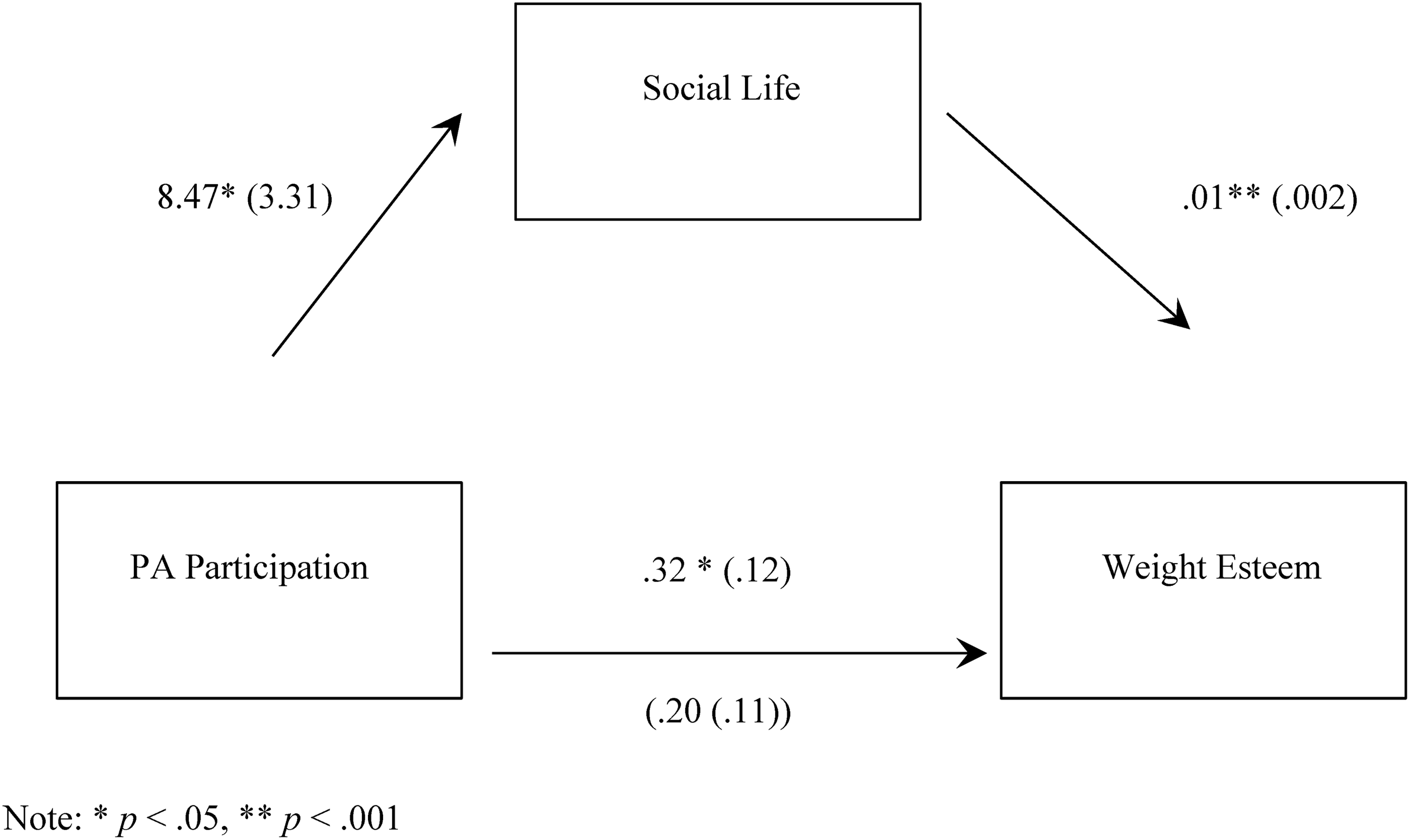
As results of the independent samples t-tests revealed that those who participated in PA reported higher weight esteem and social life compared to those who did not, mediation analyses were conducted to further examine whether the relationship between PA participation and weight esteem may be explained by social life. Tests of individual pathways revealed that PA participation positively predicted weight esteem (Fig. 1). PA participation also positively predicted social life, which in turn, positively predicted weight esteem (Fig. 1). With social life in the model, the direct effect between PA participation and weight esteem was reduced and was no longer significant [b = 0.20, standard error (SE) = 0.11, p = .07; Fig. 1]. Tests of the indirect effect of PA participation on weight esteem through social life using bias-corrected CIs calculated using 5000 bootstrapped samples were significant and were estimated at b = 0.11, SE = 0.05, 95% CI [0.02–0.24] (Table 3). Thus, social life significantly mediated the relationship between PA participation and weight esteem.
Indirect Effect of Physical Activity Participation on Weight Esteem through Social Life
Results based on presented with bias-corrected 95% CIs from 5000 bootstrap samples. Covariates included gender and age, n = 157.
p < 0.05.
SE, standard error.
Discussion
Childhood obesity is heavily stigmatized in western society, which makes youth with obesity vulnerable to social exclusion as well as feelings of appearance-related guilt, shame, and body dissatisfaction. 5 As body image during adolescence plays a key role in identity development and has important implications for mental and physical health,36,42 it is important to examine factors related to the development of positive body image in youth with severe obesity. The present study found that 70.3% of youth reported participating in extracurricular PAs, whereas 56.5% reported participating in non-PAs. In support of our hypothesis, results showed that those who participated in PAs reported higher social life and weight esteem (but not appearance esteem) compared to those who did not participate. In contrast, those who did and did not participate in non-PAs reported similar appearance esteem, weight esteem and social life. Finally, mediation analyses revealed that social life mediated the relationship between PA participation and weight esteem, where PA participation was positively related to social life, which was in turn, positively related to weight esteem.
Results of the present study showed that social life explained the relationship between PA participation and weight esteem. That is, youth who reported engaging in PA reported greater social life (i.e., positive social experiences within peer groups and greater ability to make friends as a result of their weight), which was in turn, associated with higher weight esteem. This finding is in line with research on average weight youth that has identified links between ECA participation and social support, as well as PA participation and positive body image.16,25 It is also in line with research that has shown greater social engagement to be associated with body satisfaction in a community sample of adolescents with obesity. 34 This finding adds to the current literature on PA participation and body image in adolescents with obesity by suggesting participation in PA allows youth to experience positive social interactions with peers, which in turn, may contribute to the development of positive weight esteem. As youth with obesity often experience weight-based discrimination, 5 positive social experiences may allow youth to view their bodies in a more positive light when they have a peer group that values them. Thus, social life may be a mechanism by which youth with obesity confer positive weight esteem by participating in extracurricular PA.
The present study found that PA participation was positively related to weight esteem, whereas non-PA was unrelated to both appearance and weight esteem. This finding may be due to the fact that PA participation is more closely related to body experiences than non-PA. For instance, some researchers argue that PA can be empowering to adolescents (especially girls) as it provides a means for them to learn their physical capabilities and enhance their body image. 26 Moreover, it may also be a way for adolescents to resist internalizing thin-ideal media by focusing on what their bodies can do instead of how it looks. 43 In contrast, non-PAs (e.g., clubs, art, music) may not provide the same opportunities for positive body-related experiences as PAs. As youth with obesity experience appearance-related stigma and report more body dissatisfaction than average weight youth, 5 the benefits of PA may be especially important in reducing weight preoccupation and self-consciousness in these youth.
The present study found that 70.3% of youth reported participating in at least one extracurricular PA, whereas 56.5% reported participating in at least one non-PA. Furthermore, more boys than girls reported participating in PA (76.9% vs. 63.8%), whereas more girls than boys reported participating in non-PA (68.6% vs. 44.2%). As this study is the first to examine ECA participation in a clinical sample of youth with obesity, more research is needed to examine whether other clinical samples of youth seeking treatment for severe obesity report similar rates of ECA participation. As many studies differ in their definitions of ECAs (e.g., whether to combine PA and non-PA, whether to include both structured and unstructured activities), and the majority of studies on ECA participation in community samples do not present participation rates by weight status, it is difficult to draw comparisons about participation rates across clinical vs. community samples of youth with obesity. In light of these limitations, more research on ECA participation in youth with obesity is needed.
The present study adds to the literature on the importance of fostering positive weight and body acceptance in youth living with obesity. 44 Longitudinal research has demonstrated that positive body image is associated with mental and physical health outcomes in youth with higher weights and obesity, where positive body image was associated with attenuated weight gain and disordered eating behaviors over a period of 5–11 years.9,36,45,46 Treatment-seeking youth with overweight and obesity often report barriers to participating in PA such as fearing body-related judgment from others, fear of being weight-teased, or lack of skills/knowledge of how to do PA.47,48 As such, weight management programs could teach skills to help youth feel comfortable with PA (i.e., motor skills) and encourage youth to participate in one extracurricular PA where they feel safe (e.g., no weight teasing) with the goal of bolstering social relationships and improving body satisfaction by allowing youth to focus on what their body can do instead of how it looks.
Limitations and Future Directions
Although the present study had multiple strengths, some limitations should be noted. The present study used a cross-sectional design, which does not allow for causal or directional inferences. As such, it may be the case that the relationship between PA participation and weight esteem could be bidirectional, such that greater PA participation is associated with higher weight esteem and higher weight esteem results in greater participation in PA. It is also possible that participants' existing weight and appearance esteem, or prior experience with participating in PA affected the type of activity they self-selected to participate in, or whether they participated at all. For instance, youth with poor weight esteem and/or negative past experiences with PA (e.g., teased by peers, poor motor skills) may avoid PA or instead choose to participate in other non-PAs. Thus, future studies should consider these factors and use longitudinal designs and test bidirectional relationships to see whether the same pattern of results emerges over the span of a year, multiple years, or even into adulthood.
Another limitation of the present study is that the sample was comprised youth from one tertiary care weight management program, and included only participants older than the age of 12 due to the developmental appropriateness of the measures used. As such, the results of the present study may not generalize to youth with severe obesity living in other regions, youth younger than the age of 12, or adults. Furthermore, results relied on self-report measures, which may result in overreporting ECA participation and social life, and underreporting body dissatisfaction. The use of a clinical interview allowed for an in-depth look into the number and type of ECAs youth participated in, however, not all dimensions of ECA involvement were captured. Although developmental researchers have yet to agree on a particular way to best capture dimensions of ECA involvement, 49 future studies should use questionnaires that examine duration/consistency, engagement, and compare group vs. individual activities to further explore how ECAs are related to social life and body image. Finally, screen-based activities (i.e., video games and social media) were not included in this study as past research has demonstrated negative relationships between screen time and mental health outcomes in youth with obesity. 50 Future studies should examine the impact of screen-based activities on body image and social life. Strengths of the present study included a large clinical sample of youth with severe obesity, comprised of an equal representation of males and females.
Conclusion
This study was the first to explore ECA participation in a clinical sample of youth with severe obesity attending a tertiary care weight management program, and examine whether PA and non-PA participation was related to body image and social life. Most notably, the present study identified social life (i.e., positive social experiences within peer groups) as a mechanism by which PA participation is positively related to weight esteem in youth with severe obesity. In light of the noted limitations, the present study yielded valuable findings that could help inform weight management programs for youth with severe obesity who are at risk for social exclusion and body dissatisfaction. Our results suggest that clinicians in weight management programs should encourage PA participation as a way to increase social networks and support among their peers, and ultimately positively influence body image. As such, this study highlights the importance of PA participation in relationship to positive social experiences and body image in a high-risk population of youth with obesity.
Footnotes
Author Disclosure Statement
No competing financial interests exist.