




Abstract
Background:
Media use is a known contributor to childhood obesity, but encouraging reductions in screen use only partially eliminates media influence. We tested a family-centered, media literacy-oriented intervention to empower parents and children 9–14 years to skillfully use media to reduce marketing influences, enhance nutrition knowledge, improve the selection of foods in the home environment, and improve fruit and vegetable consumption.
Methods:
A community-based, 6-U program included separate parent and youth (ages 9–14 years) sessions, each of which was followed by a session together in which skills from the individual sessions were reinforced. A pretest to posttest field test with control groups (N = 189, parent–child dyads) tested the intervention's efficacy.
Results:
Standardized mean differences from the multiple analysis of covariance tests showed that the intervention group demonstrated improvements on parents' use of nutrition labels (0.29), the ratio of healthy to unhealthy food in the home environment (0.25), youth's fruit (0.30) and vegetable (0.25) consumption, parent and youth media literacy skills, and family communication dynamics about food. The largest effects found were for negative parental mediation (0.48) and parents' report of child-initiated discussion (0.47). Consistent but weaker results were revealed for Latinx families.
Conclusions:
This family-centered approach helped family members practice using media together to make better nutrition decisions without depending on the ability of parents to limit media use. It successfully addressed the often-negative impact of the media on behaviors that increase obesity risk while also cultivating the potential for media to provide useful information that can lead to behaviors that decrease obesity risk.
Introduction
Many scholars assert that the current obesity pandemic is directly related to aggressive food marketing.1–4 Exposure to food marketing messages associates with children's consumption of branded, higher calorie, low-nutrient foods, with fewer fruits and vegetables, with effects on body weight beyond screen time and displacement of physical activity.5–8 Food industry self-regulation of marketing to youth has been ineffective 9 and inadequate. 10
Reducing food marketing's impact requires more than limiting media use, but most childhood obesity interventions targeting media have focused on reducing children's screen time. 1 These can produce significant—although small—reductions in screen time, 11 but many parents consider this approach impractical or unacceptable. 12 Moreover, screen use reductions only partially eliminate media influence because food marketing is ubiquitous inside and outside of the home from the Internet, school, signs and displays, print media, and food packaging.
Media literacy represents a more comprehensive approach because it helps children develop defenses against potentially harmful food marketing and develop skills to make healthier food choices. 1 Media literacy is the ability to access, analyze, evaluate, and create media in a variety of forms. 13 Rigorously designed media literacy programs cultivate skills for recognizing, evaluating, and responding to persuasive messages 14 and are endorsed by the American Academy of Pediatrics to positively influence youth health behaviors. 15 Applied to obesity prevention, media literacy should reduce the negative impact of marketing that promotes the consumption of obesogenic foods. Several media literacy-focused nutrition programs have shown promising results for improving nutrition skills and behaviors for obesity prevention.16–18
We developed and tested FoodMania! Kids & Food in a Marketing-Driven World, 19 the first media literacy-based, nutrition program developed for parents and their children to attend together. While some of the most effective prevention programs targeting youth outcomes include significant parent involvement,20,21 including for nutrition interventions generally, 22 parental communication about food marketing specifically can influence a child's ability to resist its measurable effects. 23 Facilitating critical thinking of media content is called negative mediation.
Parental communication also can help youth use credible information to guide food selections. 24 Thus, a program developing media literacy skills for children and parents, encouraging parent–child communication about marketing and building parental skills that promote critical discussion of messages, should be more powerful in reducing the impact of food marketing messages and promoting healthier food choices than a program focused on children or parents separately.
FoodMania! targets youth ages 9–14 years, a window of opportunity for developing media literacy and nutrition skills. 25 Children of this age begin to make independent food choices 26 while continuing to use persuasion to influence family food purchases.23,24 Their ability to understand persuasive approaches increases substantially between 8 and 12 years of age. 25 Their understanding of persuasive motive increases dramatically around age 10 years, and at about age 12 years they can apply higher order reasoning toward advertising and marketing. 25 This age therefore is useful for promoting critical thinking and critical inquiry about food marketing and use of nutrition labels.
Program design leveraged a theoretical model that has guided successful substance abuse prevention and sexual health education strategies for middle- and high-school students, both in and after school, and across diverse communities.27–29 The message interpretation process (MIP) model provides a theory of change and a basis for measuring mediating variables that may affect nutrition behaviors. 19 Based on the Social Cognitive Theory and Dual-Processing Theory, it posits that individuals make both logical comparisons and emotionally evaluative judgments about the content and source of media messages.29,30 These inform expectations about the rewards for engaging in behavior portrayed in the messages, influencing whether message receivers follow through with relevant behaviors. 29 MIP-based media literacy interventions have enhanced logical, rational decision-making skills, while reducing the impact of the emotional component in messages.27–29 Curriculum elements therefore included deconstructing messages to discover appealing but misleading content, and how advertisements target specific audiences such as youth. We hypothesized that improving parent–child media literacy and nutrition skills would result in parents purchasing less high-fat, high-sugar, high-calorie foods, and more fruits and vegetables, and in youth consuming healthier foods. Controlling for pretest scores, we expected that FoodMania! parent and child participants would show improved media literacy and nutrition skills leading to an improved ratio of healthy-to-less-healthy foods in the home and subsequent increases in youth consumption of fruits and vegetables. Figure 1 illustrates the theoretical model tested. Because it is important to verify the applicability of interventions across diverse communities and cultures, we also tested whether differential program effects existed for a Latinx subsample, as a first step in determining the need for cultural adaptation of the intervention.
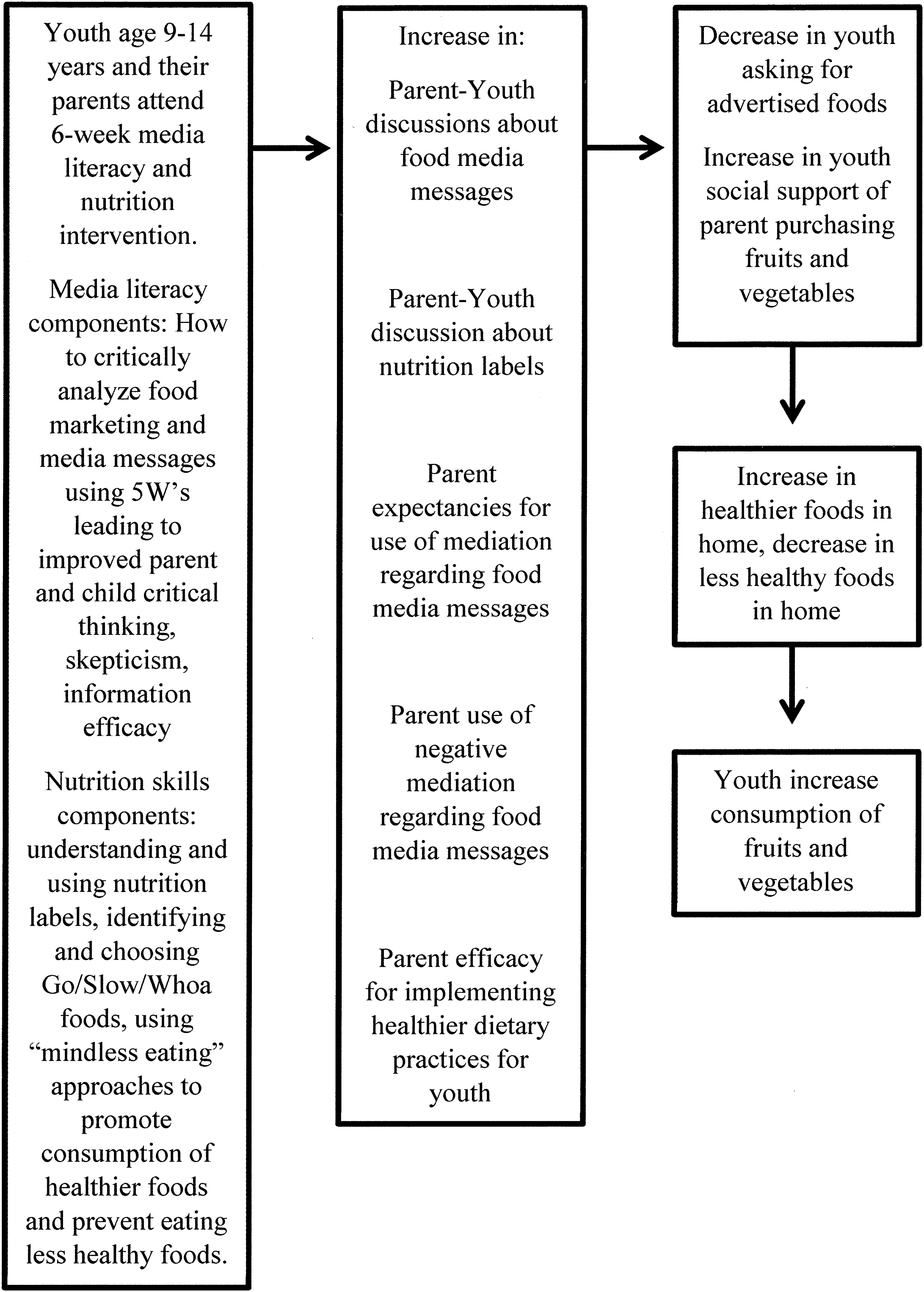
Nutrition media literacy intervention model. Notes: The intervention promotes parent–youth discussion about food media messages and nutrition labels, and improves parental beliefs about these discussions and confidence in making positive dietary changes in the home. This, combined with increased youth support for healthier purchases, improves the home food environment leading to increased consumption of fruits and vegetables by youth.
Methods
FoodMania! was developed by media literacy scholars and Extension educators using iterative focus groups and curriculum workshops. 31 A pilot test of the initial curriculum (N = 59 families) and focus groups with parents, youth, and educators informed curriculum and evaluation measure refinement. The intervention session format was modeled after the Strengthening Families Program for Parents and Youth 10–14, an evidence-based, prevention program for preadolescent children and their parents or caregivers.32–35 See Table 1 for more information on the 6-U FoodMania! curriculum units, lessons, and activities.
FoodMania! Curriculum, Lessons, and Activities
NFL, nutrition facts label.
The parents' nutrition-specific components of the intervention focused on age-appropriate strategies effective for influencing child food consumption,33–37 including use of and discussion of nutrition labels with children, increasing availability and accessibility of healthier foods, youth self-monitoring of fruit and vegetable intake the Go/Slow/Whoa model for food choices, practice facilitating youth's critical thinking, and child-initiated discussion about food marketing and nutritional content of foods.
Sample and Procedure
Families (N = 189 dyads) from three urban and two rural counties in Washington State participated through Extension programs. Treatment and control group families had sociocultural backgrounds typical for their respective 4-H and Supplemental Nutrition Assistance Program Education (SNAP-Ed) audiences (Table 2). Initially, participants self-selected into either the intervention or control group. Intervention groups filled up first and intentional efforts were made to find comparable controls. Data were collected no more than 2 weeks before the first session and at the final session for the intervention group, or after 6 weeks for the control group. Attrition rates pretest to posttest were 16.93% for parents and 17.46% for youth. Missing data rates were 1.06% and 2.12% for parents and youth, respectively. The research was approved by the principal investigator's institutional review board for the use of human subjects (No. 15012).
Demographic Information
Total N = 189; Intervention Group n = 105; Control Group = 84. Age was measured in years. Parent Education Level was measured with a scale that ranged from 1 (Grade School) to 8 (Graduate Degree). Family Eats Dinner Together and Family Watches TV during Dinner were measured using a 5-point Likert-type scale with 1 = Strongly Disagree and 5 = Strongly Agree. Parents Use Internet with Children was measured using a 5-point Likert type scale with 1 = Less than Once a Week and 5 = More than 5 times a Week. Parents could select more than one Race/Ethnicity.
SNAP, Supplemental Nutrition Assistance Program.
Extension educators were responsible for on-site execution (i.e., recruitment, implementation, and administration of evaluation surveys) of the program. They attended a 2-day training for program implementation and evaluation protocol/administration. Pencil-and-paper evaluation surveys were completed in person separately by parents and youth. For youth, each question was read aloud with an accompanying PowerPoint slide displaying the item and responses. Implementation logs and checklists completed immediately after each session tracked program fidelity. The research team conducted periodic in-person fidelity checks.
Description of Measures
Table 3 lists measure descriptions, reliabilities, and descriptive statistics. Nutrition items were selected from the National Collaborative on Childhood Obesity Research Measures Registry that aligned with the curriculum. 38 Measures were selected with reliability and predictive validity demonstrated in previously published articles, use in community-based nutrition programs, and sensitivity to change demonstrated during pilot testing.39–47
Study Measures with Reliabilities, Descriptive Statistics, and Item Description
Parent report variables were measured using a 5-point Likert-type scale with 1 = Never and 5 = Very Often, except those designated with 1, which used a 5-point Likert-type scale with 1 = Strongly Disagree and 5 = Strongly Agree. Youth report variables were measured using a 4-point Likert-type scale with 1 = NO! and 4 = YES!, except those designated with 2, which used a scale of 0 = none and 5 = 5 or more times. 3 Indicates a single-item measure. 4 Indicates a 3-item measure. 5 Indicates a 4-item measure. 6 Indicates a 5-item measure. 7 Indicates if the measure is from the MIP model.
M, mean; N/A, not applicable; SD, standard deviation.
Analysis
Separate multiple analysis of covariance (MANCOVA) models were built to examine parent outcomes and youth outcomes. Analysis was performed in MPLUS 8.3. 48 Posttest measures served as dependent outcomes controlling for pretest levels. Intervention condition vs. control group served as the fixed factor. Covariates included dichotomous measures of participation in SNAP as well as white or nonwhite race/ethnicity. Youth outcomes included controlling for age.
Latinx Subsample
Identifying differential program effects is the first step in determining the need for cultural adaptation of an intervention. 49 Thus, 23 dyads who identified as Latinx were examined for continuity of treatment effects compared with the non-Latinx sample. Bayesian estimation was used, due to the small sample of 23 (14 intervention; 9 control). 50 We chose to compare four constructs and three outcome measures, all, but one, of which were modeled in an initial test of the theoretical model based on Wave 1 results. 51 Each construct and outcome were estimated as an analysis of variance (ANOVA) with the intervention and control indicator as the fixed factor. Posterior predictive p-values (PPP) were used to examine model fit for the Bayesian results. 50
Results
Implementation logs were submitted by educators for 75% of the lessons (121 out of 160) and indicated 90% program fidelity for key topics and activities. Initial testing showed no significant differences on any variables by county, indicating strong program fidelity across sites. Testing of key constructs revealed intraclass correlations mostly <3%, with design effects <2% for most constructs. This indicated no need to account for nesting in the analysis. 52
MANCOVA Results
Model fit for the parent and youth MANCOVAs was (1) parent: χ 2 (2048) = 4387.6, p < 0.001, CFI = 0.71, Root Mean Square Error of Approximation (RMSEA) = 0.09, and (2) youth: χ 2 (105) = 234.35, p < 0.001, Comparative Fit Index (CFI) = 0.83, RMSEA = 0.09. In addition, variance explained for the parent outcomes averaged 45% (range: 17%–80%) and for youth averaged 28% (range: 22%–37%). Moderate fit of the MANCOVAs indicates the need for additional examination of outcomes within the context of a process. Tables 4 and 5 report the standardized results of the parent and youth MANCOVAs. For each one of our parent outcomes (Table 4), the intervention showed significant increases (p < 0.05) in the intervention group at posttest compared with the control group, controlling for pretest levels. Standardized effect sizes ranged from 0.232 (Social Support for Fruit) to 0.482 (Parental Negative Mediation) standard deviations of change compared with the control group. The control variable indicating participation in the SNAP program was significant (p < 0.05) for Parental Negative Mediation, Social Support for Fruit, and Social Support for Vegetables. The white/nonwhite race control was significant (p < 0.05) for Parental Negative Mediation, Parent Efficacy, and Use of Food Nutrition Labels.
Parent-Reported Outcome, Multiple Analysis of Covariance Standardized Results
Condition was used as a predictor and was coded as 0 = Control and 1 = Intervention. Participation in SNAP was used as a predictor and was coded as 0 = No and 1 = Yes. Parent participant identification as white or non-white (WNW) was used as a predictor and was coded as 0 = Non-White and 1 = White. Standardized effect size is represented by the Estimate column.
SE, standard error; WNW, white or nonwhite.
Youth-Reported Outcome, Multiple Analysis of Covariance Standardized Results
N = 109. Condition was used as a predictor and was coded as 0 = Control and 1 = Intervention. Youth age ranged from 9–14 years old. Standardized effect size is represented by the Estimate column.
Significant youth outcomes (Table 5, p < 0.05) included Child-Initiated Discussion, Talking with Parent about Food Nutrition Labels and reports of Fruit and Vegetables eaten Yesterday. The youth report of asking their parents about buying advertised foods was not significant at the 0.05 level. SNAP and white/nonwhite demographic indicators were nonsignificant for youth outcomes. Only youth age presented a significant effect on child-initiated discussion.
Latinx Subgroup
PPP for the Bayesian ANOVAs indicated that the model-predicted values tended to underestimate the observed data for the Latinx subsample (Table 6). This model underestimation was reflected in the subsample effect sizes we obtained, which were generally close to, but smaller than, those obtained with the non-Latinx sample. Bayesian analysis with the subsample showed intervention differences (p < 0.05) on three of the tested constructs. The significant Latinx effect sizes were all parent-reported outcomes, including Child-Initiated Discussion, Negative Mediation, and Expectancies for Mediation. While all effect sizes for the Latinx intervention subsample were in the hypothesized positive direction (indicating positive intervention effects), four of the six Latinx effect sizes were smaller than those found in the full sample.
Latinx Group Effects Compared with Non-Latinx Group
Standardized ANOVA effect sizes are reported in the Estimate columns for each group. (Y) indicates a Youth-reported measure while (P) indicates Parent report.
p < .05; **p < .01; ***p < .001.
Discussion
This study addressed food marketing as a contributor to childhood obesity aside from “screen time,” for example, television viewing and computer usage. Obesity prevention approaches that encourage reductions in screen use only partially eliminate the influence of media messages on youth and their parents.
This study tested an intervention using media literacy-based nutrition education to empower parents and children to critically analyze food media messages and enhance their nutrition skills and behaviors. It is the first community-based program to help children and parents build skills together to resist food marketing messages rather than just restricting media. Parents started to use more negative mediation; both youth and parents reported increases in child-initiated discussion about food messages in the media and communication about food nutrition labels. The intervention group demonstrated improvements on youth support of parents purchasing fruits and vegetables, the ratio of healthier-to-less-healthy foods in the home and the final intended outcome of youth consumption of fruits and vegetables.
Variables representing family communication as a catalyst for change demonstrated the largest effect sizes, specifically Negative Parental Mediation (0.48) and parents' report of Child-Initiated Discussion (0.47). These effects exceeded the standardized mean effect size of −0.32 to −0.41 found in meta-analyses for media literacy interventions on risky health behaviors.15,54,55 This confirmed the value of facilitating critical thinking and discussion of food marketing. With specific reference to behavioral outcomes, effect sizes for parents' Use of Nutrition Labels (0.29) and the Ratio of Healthy to Unhealthy Food in the Home Environment (0.25), along with the behavioral outcomes in this study for youth's fruit (0.30) and vegetable (0.25) consumption, also met or exceeded mean effect size for behavioral outcomes in previous media literacy interventions (0.10–0.23). Long-term effects not measured in this study should be included. Follow-up effect sizes from media literacy interventions tend to be maintained from immediate posttest.54,55 Finally, while no significant direct effect was found for youth's reported requests for advertised foods in this analysis, tests of the theoretical model 51 demonstrated effects on this outcome stemming from media literacy's effects on parent–child interactions. The moderate model fit of the MANCOVAs reinforces the value of testing a theory-based process model 53 as a complement to reporting mean differences.
Program success was facilitated by a partnership with university Extension professionals as the outreach mechanism of the land-grant university. 56 Extension professionals' experience delivering and evaluating SNAP-Ed programs in their local communities provided insight into reasonable and feasible practices regarding data collection. They focused on keeping respondent and administration burden low to encourage program participation, to secure high levels of retention, and to get the highest response rates possible from participants. The evaluation framework has high external validity for supporting replication and dissemination of the program. Despite the strengths of this partnership, educators' participation in both implementation and evaluation could introduce bias to the research process, including self-selection of participants into the intervention group. More participants desired an intervention group than could be accommodated, facilitating assignments of participants with similar characteristics to the control group for a delayed treatment design, but this nonrandom procedure is an important study limitation. State project team members conducted site visits during evaluation sessions to ensure impartiality, although we could not monitor 100% of the sessions, also verifying fidelity of program content by visiting each site to observe delivery of at least 1 U.
A unique aspect of this intervention strategy was that it recognized that reducing screen time is an insufficient defense against powerful food marketing influences. Eliminating exposure to all food advertising is impractical, and reducing screen time is challenging for some families. Placing limits on screen time may result in rebellion from youth who have an affinity for all types of media.57,58
Another strength was its focus on skills practice, not simply information transmission, in an interactive, family-centered context. Other information-based interventions with a similar age group (9–12 years old) sometimes have backfired because they unintentionally increase attention to problematic information due to a lack of skills practice or parental reinforcement.57,58 This intervention therefore addressed the potentially negative impact of the media on behaviors that increase obesity risk while also cultivating the potential for media to provide opportunities for parent–child discussions that can lead to behaviors that decrease obesity risk.
The results suggest the need to develop a more culturally responsive version of the curriculum that provides better access and relevance for Latinx families. Although the intervention demonstrated effectiveness across a variety of demographic groups, weaker results existed for the Latinx population. Given that Latinos represent 25% and 40% of the total population in two of the counties, we would expect to see higher participation rates and it would be useful to investigate if a language barrier limited Latinx participation, along with other logistical factors such as location or timing. Latinx youth ages 2–19 years are 48% more likely than their non-Latinx white peers to suffer obesity, 59 and marketers target Spanish-speaking Latinx communities specifically. 60 It is problematic that federal obesity-prevention program guidelines lack culturally responsive recommendations, 61 and obesity-prevention programs often lack distinctive Latinx community values, information sources, and worldviews about food and nutrition. 62 The FoodMania materials, designed to be of universal relevance, may have lacked the specific cultural relevance necessary to achieve maximum impact with this subgroup. 62
Although this study lacked 24-hour dietary recalls and BMI as outcome measures, BMI would not have been expected to change significantly in only 6 weeks, and long-term follow-up often is challenging to implement in community-based settings. Future tests could use BMI as a moderator variable affecting the effectiveness of the curriculum, given that overweight and obese children are more susceptible to consuming high-calorie foods presented in food advertisements. 63
Future research could incorporate longer term follow-up and refinements to the theoretically informed strategies that achieved results. Once marketing strategies have been unmasked and media literacy skills have been developed, they might remain, just as other cognitive skills do. It also is likely that continued practice and reinforcement will better preserve and extend the results. Because the curriculum design utilized child–parent interactions to facilitate learning and addressed the role of the home environment in fostering healthier eating, effects are likely to mature to the extent family members continue to discuss media, nutrition labels, and food choices together. In this light, it seems especially significant that one of the largest effects was revealed for Child-Initiated Discussion. This suggests that the program strategies can help youth with the essential task of preparing to make their own decisions about food selection and consumption.
Conclusions
This study has tested a fundamentally different approach to youth obesity prevention compared with previous strategies reliant on parents' limiting screen use and on youth and parents receiving nutrition education separately. This test of a family-centered, media literacy-based obesity prevention intervention produced improvements in family skills for using media effectively and increases in youth's consumption of fruits and vegetables. The family-centered approach helps family members practice using media together to make better nutrition decisions and does not depend on the ability of parents to limit media use, which likely is limited given youth's marketing-saturated environment outside the home. By leveraging strong social dynamics between parents and children, families can cohesively use the media to make better nutrition decisions through the development of mutually reinforcing health strategies, resulting in decreased risk for obesity.
Footnotes
Acknowledgments
The authors thank the Extension educators and staff who assisted with this project, along with all of the contributing authors of the curriculum tested in this study.
Funding Information
This material is based on work that was supported by the National Institute of Food and Agriculture, US Department of Agriculture, under award number 2012-68001-19618. Any opinions, findings, conclusions, or recommendations expressed in this publication are those of the authors and do not necessarily reflect the view of the US Department of Agriculture.
Author Disclosure Statement
No competing financial interests exist. The authors have no financial relationships relevant to this article. No author has received support for this work that could have influenced its outcome.