




Abstract
Background:
Childhood obesity interventions are particularly effective during the preschool age, but little is known about parents' long-term perceptions of weight management. This study explores how parents perceive the influence of interpersonal relationships on their children's eating and physical activity 4 years after participating in a randomized controlled trial. Bronfenbrenner's ecological systems theory frames this study, with the child's environment conceptualized as interlocking microsystems that affect weight management.
Methods:
Interviews were conducted with 33 parents (85% mothers, 48% with university degree) of 33 children [mean age 9.3 (standard deviation 0.7), 46% girls] from Stockholm, Sweden. Interviews were analyzed using thematic analysis, focusing on parents' perceptions of interpersonal relationships: family, relatives, other children, preschool/school staff, and health care practitioners.
Results:
Two main themes were developed: (1) Discouragement, with the subthemes Conflicting rules and Social comparison, and (2) Support and understanding, with the subthemes Teamwork and Shared responsibility and continuity of care. Parents perceived children's weight management as a continuous orchestration of different influences across social spheres. Years after obesity treatment, parents struggled to maintain the child's healthy routines outside the home. However, when siblings, grandparents, teachers, and friends' parents acted supportively, routines were easier to maintain.
Conclusions:
The findings suggest that each microsystem in a child's environment has important influence on weight management, such that, as children grow older, children's lifestyles cannot be managed by parents alone. To facilitate weight management, more people in the child's environment should be involved early in the treatment process, and continued professional support should be offered to parents.
Introduction
Parents' support of their children in weight management has a positive impact on children's weight status. 1 However, in supporting their children, parents need to cope with others' perceptions of children's bodies, eating, and lifestyle changes.2,3 Thus, parents' efforts are influenced by friends, relatives, and other people in the child's vicinity. Particularly influential are grandparents. 2 According to a systematic review, 2 parents feel that grandparents impede their efforts to maintain a healthy lifestyle for their children, and perceive that grandparents struggle to understand or accept new food habits. 2
Likewise, a US-based study 4 has shown that grandparents' definitions of healthy eating differ from parents' perceptions, with grandparents providing sugary and processed treats to bond with young children and affirm the grandparental role, as part of a “balanced” approach to feeding/eating. For example, grandmothers report serving sugar-sweetened beverages to children on festive occasions, while acknowledging that these beverages are not considered healthy. 5
Alongside the family environment, the school environment has an increasingly important effect on children's everyday eating and activities as children become older. School-based preventative interventions have shown positive effects in improving child weight status, particularly in younger schoolchildren and when the measures taken are long term and involve parents.6,7 However, a recent Australian study has shown parents prefer that pediatricians provide advice on lifestyle changes, and have less confidence in school-based weight monitoring and management. 8
This suggests that parental experiences of school-based interventions may be more complex than weight-based outcomes can measure. One possible reason could be communication gaps between parents and school-based health care professionals. Pocock et al. found that parents often perceive information and advice provided by health care professionals as contradictory, and that communication with clinicians may lead parents to feel guilty about their child's overweight. 2
In interviews exploring the experiences of parents of preschoolers who participated in the More and Less (ML) childhood obesity treatment study, we found that social settings and interpersonal relationships were key to how parents handled emotional and social challenges related to their child's weight status. 9 Parents also mentioned difficulties in finding the right support and coping with the social stigma attached to obesity. They reflected on their experiences from the parent program and found that practical techniques around limit setting, stress management, encouragement, and dealing with power struggles were useful tools. In addition, parents emphasized the importance of sharing their experiences with other parents in the group. These results showed that parents of children with obesity experience both social and emotional challenges, and that group treatment can help parents cope with these challenges in the immediate term. 9
In this study, we explore the continued impact of social and emotional challenges that parents revealed after completing the ML program. 9 Using Bronfenbrenner's ecological systems theory, we focus on the inner layer of a child's ecology.10,11 This layer—the microsystem—includes the people closest to the child (parents, siblings, and the extended family, alongside friends, classmates, and teachers), whose influence on a child's development occurs on a direct and daily basis. The study is the first of its kind as no previous research has examined parents' long-term experiences following a childhood obesity program.
Our analysis focuses on how parents perceive the effect of interpersonal relationships on their children's ongoing weight management. Because obesity is a chronic condition whose continuous treatment is essential, 12 this analysis sheds important light on the struggles that parents experience when trying to manage their children's weights.
Materials and Methods
The Population
ML is a randomized controlled trial conducted between 2012 and 2016 in Stockholm Region, Sweden.13,14 In total, 177 children 4–6 years of age, diagnosed with obesity according to international guidelines, 15 participated with their parents. Half of the participating families was randomized to standard treatment in an outpatient pediatric unit, where both children and parents attended appointments focused on healthy food choices and a physically active lifestyle. The families were offered at least four individual visits with a pediatrician, pediatric nurse, dietician, and/or physiotherapist.
The other half was randomized to parent-only group treatment, with weekly sessions focusing on evidence-based parenting practices and lifestyle advice in relation to obesity-related behaviors such as food and beverages, sedentary behaviors, physical activity, and stress. After completing the parent program, participants were randomly allocated to booster calls or not. All participating children were measured four times in 1 year and parents filled out questionnaires regarding family background. ML was approved by the Regional Ethical Board in Stockholm (ID: 2011/1329-31/4) with amendment (ID: 2016/80-32).
Four years after families completed ML, we conducted semistructured telephone interviews with parents, focusing on their perceptions of the treatment they had received since the study began. The interview guide was developed by a group of researchers with expertise in parenting and childhood obesity. The interviews were conducted by a pediatric nurse (MSc in Nursing), lasting on average 45 minutes (28–70 minutes). Families recruited during the first 2 years of the study were invited to participate. Of 67 families, 33 agreed to participate: 17 from standard treatment and 16 from the parent-only group treatment.
Twenty-eight mothers and five fathers were interviewed (Table 1 with population characteristics at the 4-year follow-up). Eighteen families declined, 14 could not be reached, and 2 had moved abroad. In this analysis, we do not aim to compare parental experiences between treatment groups, but rather understand how parents experienced their child's ongoing weight management years after starting childhood obesity treatment.
Descriptive Statistics of the Parents and Their Children at the 4-Year Follow-Up
Foreign background: parent and grandparents born outside Sweden or parent born in Sweden and both grandparents born outside Sweden.
Parents classified with normal weight, overweight, or obesity according to the BMI criteria by the World Health Organization.
SD, standard deviation.
Analysis
Interviews were analyzed by two co-authors (T.J. and E.G.) under supervision of the first author, using thematic analysis. 16 Texts were first condensed and divided into meaning bearing units. This became the starting point for the initial coding. After further analysis, each condensed text unit resulted in one or several codes that carried across text units with similar content. Subsequently, all codes were compiled and discussed jointly. A thematic map was drawn, and different categories and themes were developed.
Results
Two themes and four subthemes were developed as illustrated in Figure 1. Participants are presented as father/mother followed by interview order codes (e.g., 19).
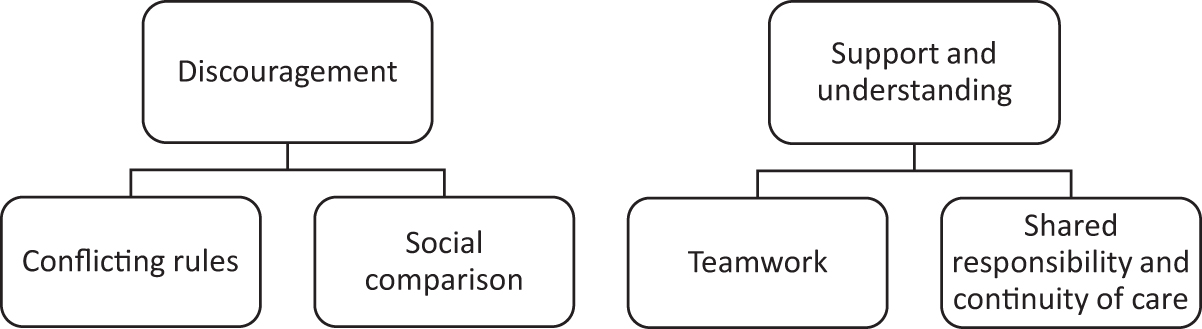
Main themes and subthemes.
Discouragement
The first theme was divided into two subthemes, Conflicting rules and Social comparison, capturing the main sources of discouragement.
Conflicting rules
Parents reported facing challenges when their children's daily routines were disrupted due to conflicting rules. In the company of other adults, eating routines were questioned, blurred, or forgotten. For example, parents described conflicting emotions about their children being invited to parties, where worries about lack of control competed with the need to encourage social belonging.
As one mother described, “(…) when we go to parties for instance, it affects, because, partly that you cannot run after your child to see what they eat and partly because the children get affected by what the others get, (…) It's accessible, it's on the tables like, just grab as much as you can” (M27). However, despite losing control over the child's eating, parents did not want to “take away the fun of going to parties or festivities and such” (M19).
Parents also described weekends and holidays together with family and friends as disruptive to everyday routines. Some parents said their children's new, healthier eating habits were negatively affected when they stayed with their grandparents for a longer period, leading to weight gain:
…but being on holiday [with the grandparents], he gains weight, it's not just one, two kilos, but he gains five, six kilos after a short time. (…) Yes, so I don't know what to do, I just get angry and I talk to them, I tell them, but they still don't understand so I just… I have fought to death and then after a short time, everything is ruined (M26).
Parents perceived grandparents as having a major impact on everyday routines, saying they held different views on what healthy eating meant and struggled to accept the parents' requests not to give the children sweets.
Conflicts between parents were also perceived as an obstacle to maintaining healthy habits. Several parents said they felt discouraged by their partner when attempting to regulate the child's eating. One father explained, “Then my words lose or have no effect. (…). If we sit at home and eat and I say ‘[child], now that's enough’ and the mother says, ‘let him eat a little more, he didn't eat much.’ Like this.” (F14). When parents separated, this sometimes led to clashes in lifestyles and food rules. One mother said it was important “to make sure that both family households have roughly the same thinking”:
You must be able to have separate rules, but at the same time it's not good if one week you can eat out or do things like that and the other week it's strict, then it becomes like a yoyo effect. … (M7).
According to many parents, the transition from preschool to school was a major change that affected children's food intake. While preschool staff helped children during mealtime, at school, children had lunch together with classmates, with no staff guidance on healthier choices. One mother described how the lack of individualized attention and food intake regulation at school affected her child's eating: “(…) and then he started school where he had to take food himself, he took two, three times without any adult noticing it at school. And he did that every day. So, then he gained a lot of weight again” (M5).
Social comparison
Parents repeatedly said their children compared themselves to their peers, with great impact on the children's lives, their wellbeing, and their choice of food and activities. The older the children became, parents said, the more they compared themselves to their friends, with school meals being an important setting for comparison. One mother described how her son's eating was influenced by peers: “[…] he gets a little, not bullied maybe, but the other children notice that he's bigger than all normal weight children, so they tease him, so he doesn't want to be teased and therefore eats less [food in the school canteen] …” (M11).
Parents said their children's physical activities were affected by social comparison. One father reported his son wanted to quit football after being teased, while one mother said her son was “very active and all, but when he practices football… he cannot run as fast or the same amount of time as the slim boys. So, he chooses to be a goalkeeper” (M11).
Some parents said that sibling relationships influenced weight management. When children compared themselves to their siblings, parents worried that this could affect their wellbeing and self-esteem. For example, one father noted: “sometimes her little sister says… ‘I don't want to be fat like [child]’ and it feels bad” (F16). A main area of comparison surrounded food and eating, particularly where the child had a sibling with normal weight, who could eat more freely. A father explained: “Sometimes he gets sad and feels that it's unfair that he cannot eat as much as his brother and not eat as much sweets as his friends and not be able to have a snack so frequently” (F17).
Support and Understanding
Parents described positive experiences where others supported and worked alongside them to manage their children's weights. The theme is divided into two subthemes, Teamwork and Shared responsibility, where the parents describe how different people in their surroundings contributed to managing the child's weight.
Teamwork
Several parents said their families worked together as a team to maintain a healthier lifestyle. For example, one mother said that “I got the other parent involved in this [weight management]. It's the teamwork that has been the most rewarding thing” (M7). Parents emphasized the importance of involving the whole family and engaging the child's siblings. Teamwork also enabled separated parents to maintain the child's healthy eating habits. One mother described how she and her ex-partner enacted similar rules around meals and weekend treats: “Yes and now we live apart, but the fact that we have the same rules around meals, Saturday sweets, cosy Friday, that you talk to each other, it's probably super important” (M19).
In addition to the nuclear family, other people in the child's vicinity provided support. One mother explained that her parents “did understand and dad said ‘okay, we do see that he's gaining weight too and that's not so good for health and that’” (M26). This, she said, was an important step in managing her child's weight. Another father said that his parents had grown increasingly supportive of the child's weight management: “… with my parents, there has actually been a big difference, it has.
They got it, they're doing it, they make sugar-free apple puree… [the children] get a few goodies…” (F23) Some parents spoke about involving the child's friends' parents. As this father explained, “… it's probably easier for other parents, because… I think, for them, there are no [difficult] feelings involved … it's just like someone sends a child to me and they say you cannot give him sugar because he's diabetic. Then I do not question it” (F17).
Some parents said their child's school was an indirect part of their ‘team,’ through providing children with healthy eating and body image messages that were consistent with the messages parents provided at home. These parents cited school-based communication as facilitating children's coherent understandings of their bodies and reinforcing a healthy weight management approach. One mother said, “we focus on feeling good and not the weight itself or how you look, … and I actually think that works quite well. They talk a lot about it at school too, … to talk about your body feeling good even when you're 80” (M18).
Shared responsibility and continuity of care
Within the family, shared views of the child's health and shared responsibilities for maintaining a healthy lifestyle made weight management much easier for both parents and children. Some parents said the child's siblings shared responsibility for their brother's or sister's new eating and physical activity habits. For example, in one family, a sibling helped his brother during school lunches. Some parents also mentioned grandparents as supportive of the child's new lifestyle, for example, by offering fruit as an alternative to sweets.
When schools were involved in the child's weight management, parents felt reassured: “… now there‘s not much snacking and such in school … but I can also think that it's very nice, that they know about [the child's weight management] and that they have it in mind as well” (M30). However, school-based support had to be delivered sensitively without drawing undue attention to the child. For example, one mother, who asked her child's teacher to watch over his portions, said the teacher took a gentle approach: “she sort of gives him a sign that ‘now it's good’” (M30).
In another example, a mother described how her daughters' teacher made sure that all children took “one good portion” so that her daughters “would feel that it was not just them who didn't go and get more food” (M1).
Parents described being able to collaborate with health care professionals as an essential part of weight management. In clinical encounters, parents said they followed instructions from health care professionals together with the child, as they were positioned in one “team.” One mother said this allowed her to convey to her child that she was working with him instead of against him: “And then I changed the role from the one who needed to decide how much he would eat, to the one who… who, it was someone else who decided how much he would eat” (M29).
Importantly, while health care encounters allowed parents to share responsibility for their child's weight management with a clinician, they also provided much-needed continuity of care. Parents felt that good clinical care contributed to feeling supported and encouraged to maintain changes. A successful meeting with a health care professional could increase motivation and trust:
“The school nurse measures [the weight and height], at least once every six months instead of once a year. And then she calls and talks to me and says how it is and that. I have actually experienced that she's very supportive, she strengthens both me and [child]. She seems like a very good person. And it has probably to do with her attitude towards it. She doesn't shame but she is very motivating and lowers the demands; ‘Do the best you can’ and that, so I get strength instead of someone telling me what to do” (M21).
Discussion
This study is the first to explore parents' perceptions of how interpersonal relations affect children's weight management 4 years after starting obesity treatment. Interpersonal relationships within the family, with friends, at school, and in health care settings emerged as pivotal to parents' discussions of their children's ongoing weight management. When parents' efforts were discouraged or challenged by others, either within or outside the family, parents perceived this as negatively influencing the family's lifestyle and the child's weight. By contrast, family members,’ teachers,’ friends,’ and health care professionals' support and encouragement facilitated ongoing weight management.
While early childhood obesity treatment had provided the participating parents with skills and tools for continued weight management, as their children grew older, practicing these skills became increasingly challenging, both within and outside the home. According to Bronfenbrenner's ecological system model, the relationship with one's parents is by far the most important for a young child; however, when the child grows up, other relationships within their microsystem grow in importance.10,11 Notably, the international literature demonstrates that grandparental care is associated with childhood obesity risk, 17 and our findings suggest a possible reason for this association.
Within the family environment, parents identified siblings and grandparents as potentially disruptive of rules and routines: parents had to negotiate siblings' conflicting food needs, as well as grandparents' persistent provision of treats and lack of compliance with food and exercise rules. The latter aligned with findings from the United States, showing that grandparents use treats to bond and create positive memories with grandchildren, regardless of weight status.4,5
Outside the home, parents were concerned about their inability to control children's eating at school or at friends' houses, and about how peer comparison and teasing influenced their children's eating and body image. This aligned with a Dutch study that found older children undergoing obesity treatment and their parents cited lack of peer support—ranging from dietary rule-breaking to bullying—as a key barrier to treatment success. 18
To navigate weight management successfully as children transitioned from early to middle childhood, parents relied on multiple people within and beyond the family. When parents were interviewed immediately after completing treatment, they described feelings of exclusion, stigma, loneliness, and being misunderstood by people around them 9 ; however, 4 years after the trial, parents emphasized the value of inviting others to support their child's weight management.
Citing examples of siblings and grandparents encouraging a child's physical activity and healthy eating, teachers attending sensitively to children's food intake, and health care professionals communicating openly, but nonjudgmentally, parents expressed the distinct roles played by every member of the child's growing network. These findings convey the importance of including wider social networks in research on the long-term influence of interpersonal relationships on children's weight management. 19
In line with arguments from international scholars,20,21 our findings highlight teachers' roles in offering support and counteracting stigma, and further underscore the importance of collaborative relationships between health care professionals and families. In addition, the findings suggest that obesity treatment and prevention programs should be designed to provide parents with strategies to involve key people in a child's life, such as grandparents, older siblings, teachers, and friends.
This study has some limitations. We were not able to interview all families who participated in the study, and caution should be exercised in generalizing the findings to other populations. Second, while fathers are an important part of pediatric obesity treatment and prevention, 22 and although food responsibilities are a central part of contemporary Swedish fatherhood, 23 most participants were mothers. However, the fathers who participated were deeply involved in their children's eating, a gender-cultural aspect that may affect the transferability of the results beyond Sweden. In addition, parental concerns with the school meal, which is fundamental to the Swedish school system, 24 may not be transferable to other countries.
Conclusions
Parents who took part in early childhood obesity treatment found it difficult to maintain their now-older child's weight management without substantial teamwork across social circles, including home, the extended family, school, friendship groups, and health care settings. The findings suggest that childhood obesity prevention and treatment programs should consider grandparents, teachers, and other adults important in the child's life and provide specific tools to include them in the child's weight management. In addition, childhood obesity treatment should be followed by structured, long-term support, so that positive outcomes are maintained as children develop.
Footnotes
Authors' Contributions
P.N. conceived the idea of this study in collaboration with A.E. and K.N. K.N. designed and led the data collection. P.N. led the analysis. A.E., H.R.R., and N.N. made critical contributions to data interpretation. K.E. led the writing of the article. E.G. and T.J. conducted the initial data analysis and drafted the article under the supervision of P.N. and K.E. All authors contributed to reviewing and approving the final article.
Acknowledgments
The authors thank all participating families for their invaluable contribution to this study. We also thank Sofia Ljung, Jonna Nyman, Louise Lindberg, Mahnoush Etminan Malek, Kathryn Lewis Chamberlain, Jan Ejderhamn, Philip A. Fisher, Patricia Chamberlain, and Claude Marcus who were involved in the study design or in data collection within the More and Less Study. Additional thanks go to Christine Persson Osowski and Maria Somaraki who contributed to the development of the interview guide for the longitudinal assessment.
Funding Information
This work was supported by Foundation Frimurare Barnhuset in Stockholm and Center for Medical Innovation (CIMED) funding (SLL20190383).
Author Disclosure Statement
No competing financial interests exist.