




Abstract
Background:
Coronavirus disease 2019 (COVID-19)-necessitated lockdowns and school closures have limited social interactions among adolescents, which result in unhealthy behaviors. This study compared the multilevel factors associated with obesity among adolescents in South Korea before and during the pandemic.
Method:
We applied the social-ecological model and analyzed the 2019 and 2020 Korea Youth Risk Behavior Web-based Survey (KYRBS), including middle and high school students. We considered factors at the individual, family, and community levels in the logistic regression. Age and gender-adjusted obesity (body mass index ≥ the 95th percentile) was the dependent variable.
Result:
The prevalence of obesity slightly increased from 11.31% before the pandemic to 12.48% during it; the odds of obesity were 1.12 times (95% confidence interval [CI] = 1.08–1.16) as high during the pandemic compared to before it. Several individual factors (e.g., age, gender, fast-food consumption) and perceived family economic status were commonly associated with obesity before and during the COVID-19 pandemic. Physical activity and city type were related to obesity only before the pandemic. Downgraded economic status owing to COVID-19 was adversely related to obesity during the pandemic.
Conclusion:
Inclusive multilevel support is needed to combat obesity in adolescence during the pandemic and those economically impacted require additional support.
Introduction
Lockdowns and school closures during the coronavirus disease 2019 (COVID-19) pandemic have interrupted the daily routines and restricted the social interaction and school life of adolescents, which results in their unhealthy lifestyle behaviors (e.g., limited physical activity [PA], increased screen time, and delayed bedtime) that are reported as a cause of the increased prevalence of obesity in Europe,1–3 the United States, 4 and China. 5 Given that the pandemic has limited social interaction, accounting for changes in adolescents' weight status before and during the pandemic is required. Furthermore, although adolescents show resilience and the ability to cope during the pandemic,6,7 they are relatively incapable of coping with disasters or stress compared with adults and are generally passive to the impacts of crises and consequent social changes.8,9 Thus, the pandemic, which may have exacerbated adolescents' health risks and accompanied by negative changes in their environment, has become a critical public health agenda.
In South Korea (hereinafter Korea), despite an initially less strict distancing policy than the United States or Europe, schools moved to an online modality. This change inevitably caused the reduction in adolescents' PA levels.10,11 Furthermore, the pandemic has caused a decrease in Korea's GDP growth rate and the loss of approximately 460,000 jobs. 12 This study investigates not only individual factors but also the social and environmental aspects associated with the prevalence of obesity among Korean adolescents before and during the COVID-19 pandemic. Particularly, we examine the association between changes in economic conditions caused by the pandemic and the prevalence of obesity among Korean adolescents by applying the social–ecological model (SEM).
Conceptual Framework: SEM
SEM has been used to explain health behavior and develop health promotion interventions, encompassing factors at the individual, relationship, community, and societal levels (Fig. 1, left).13–15 With the proposed SEM of layers influencing weight status, obesity is not just a matter of individual lifestyle but is also influenced by the overall social, economic, and environmental context.16–19
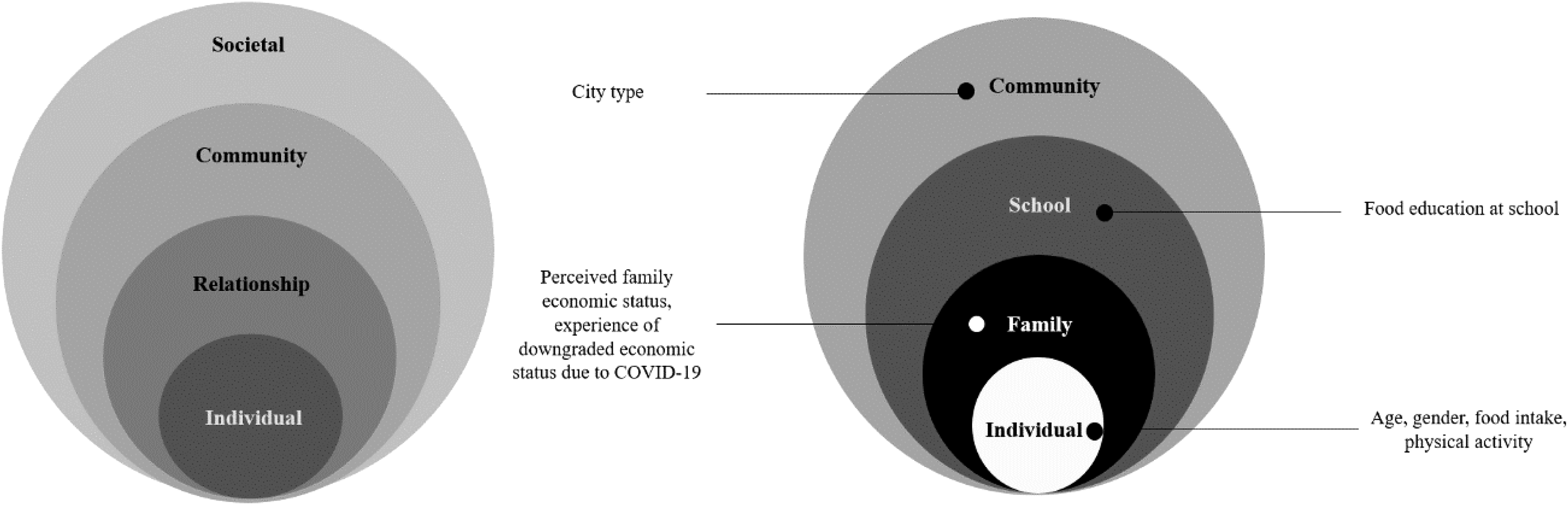
The SEM suggested by CDC and the adapted SEM. SEM, social–ecological model.
At the individual level, food intake and PA are significant factors associated with obesity. 9 Family-level factors (e.g., socioeconomic status [SES])17,18 and social environment factors such as social networks 19 also affect obesity in children and adolescents. We applied the adapted SEM with the individual (age, gender, food intake, and PA), family (perceived familial SES and experience of downgraded SES owing to COVID-19), school (food education at school), and community (city type) levels (Fig. 1, right).
Methods
Data Sources
We analyzed the 2019 and 2020 Korea Youth Risk Behavior Web-based Survey (KYRBS). The KYRBS provides nationally representative cross-sectional data on various health statuses and behaviors among adolescents in middle and high schools, aged 12–18 years. 20 The KYRBS included 400 middle and 400 high schools from 17 provinces. There were sample allocations based on province and school characteristics (general vs. specific; coed or not).
The data comprised 14%–15% of middle and high schools and about 2% of all middle and high school students. The 2019 KYRBS was conducted between June and July and the 2020 KYRBS between August and November. The response rates were 95.3% in 2019 and 94.9% in 2020. We excluded cases with missing values for height and weight, thus resulting in a total sample of 55,749 for 2019 and 53,534 for 2020.
Ethical Approval
This study was reviewed and received an exemption determination from the institutional review board of the university to which the corresponding author is affiliated (No.: 2021-09-029).
Measures
The dependent variable was obesity, defined as age- and gender-based BMI percentile 21 based on self-reported weight and height ≥the 95th percentile.
We used multilevel factors as independent variables. First, individual-level factors were age, gender, weekly fast food intake frequency, and PA (days of moderate exercise per week). Second, family-level factors were perceived familial SES (1 = high; 5 = low) and downgraded SES owing to COVID-19 (1 = totally agree, 4 = totally disagree). Third, the school-level factor was whether the participants received food education at school (no vs. yes). Finally, the community-level factor was the city type (small- and mid-sized cities vs. big cities).
Analytic Strategy
We used a chi-squared test to see whether the odds of being obese differed before and after the COVID-19 pandemic. Logistic regression was used to examine factors associated with obesity. We used STATA 17, and the significance level was set at p < 0.05.
Results
The proportion of adolescents with obesity slightly increased from 11.31% before COVID-19 to 12.48% during the pandemic (Table 1). The odds of obesity from an unadjusted model were 1.12 times (95% confidence interval [CI] = 1.08–1.16) as high during the pandemic compared with before it (χ 2 = 35.374; degree of freedom = 1; p < 0.05).
Characteristics of Survey Participants, n (%)
Before and during the pandemic, the participants were 15 years old on average with a standard deviation of 1.77 (before) and 1.75 (during); about half of them were girls, received food education at school, and lived in a metropolitan city. Although fast food consumption between the two periods was very similar, the mean hours of moderate exercise decreased from 2.02 to 1.9 hours. During the pandemic, approximately 5.74% strongly agreed and about a quarter (24.64%) somewhat agreed that they experienced downgraded SES.
Several factors were associated with obesity both before and during the pandemic (Table 2). For example, for both periods, at the individual level, the likelihood of obesity among older and male adolescents was higher than among younger and female adolescents. The possibility of obesity in groups consuming fast food several times a week or daily was lower than among those who did not consume fast food. However, moderate exercise, negatively associated with obesity before the pandemic, was not significant during the pandemic.
Logistic Regression Predicting Factors Associated With Adolescent Obesity
Odds ratios, 95% confidence intervals in parentheses.
p < 0.001; **p < 0.01; *p < 0.05.
At the family level, the likelihood of obesity among adolescents who perceived familial SES as mid-low and low was higher than among those who perceived it as high both before and during the pandemic. In addition, during the pandemic, adolescents who perceived downgraded SES showed higher ORs than those who did not. Specifically, the likelihood of obesity among those who somewhat agreed (OR = 1.12; 95% CI = 1.13–1.31) and totally agreed that their familial SES had been downgraded (OR = 1.22; 95% CI = 1.09–1.37) was higher than of those who totally disagreed.
School-level factor was not significantly related to the likelihood of obesity for both periods. At the community level, the likelihood of obesity among adolescents who lived in metropolitan areas was lower than that among those who lived in small and medium cities only before the pandemic. However, the impact of the city type was not significant anymore during the COVID-19 pandemic.
Discussion
We found that the likelihood of obesity among adolescents was higher during the pandemic than before it. The SEM also demonstrated that lower level factors (i.e., individual and family level) were more critical than higher level factors (i.e., school and community level) with regard to obesity among Korean adolescents before and during the pandemic. These results are consistent with those of previous studies that applied SEM to investigate obesity in Korean children and adolescents.22,23
Focusing on the differences in correlates of the prevalence of obesity before and during COVID-19, moderate PA was associated with a lower risk of obesity only prepandemic. Although Korea did not implement a robust social distancing policy during the pandemic, there were cases wherein school gym classes were limited, or private sport facilities were restricted. 24 Considering that the amount of PA at home in Korea is low,25,26 such restrictions at school can be considered the cause of the decline in PA and the reason that its predictive power was not significant during the pandemic. Thus, despite the slight difference in PA time before and during the pandemic, it is possible that PA may inevitably be limited. Therefore, it is necessary to provide more opportunities for physical education even in remote classes and support exercise in their homes.
Similar to previous studies,17,27 the likelihood of obesity among students who perceived their familial SES as low was higher than that in their counterparts. In addition, perceived downgraded SES owing to COVID-19 was negatively related to obesity during the pandemic, which contributed to the limited literature on obesity and the COVID-19 pandemic. At the family level, more policies are needed to support adolescents from low-income families or those experiencing a deep economic downturn directly resulting from COVID-19.
In Korea, the exclusion of public education was minimized by rapidly shifting to online classes without closing schools completely during the pandemic, but this transition was not easy for PA. 24 Given the negative impact of COVID-19 on school-based obesity intervention 28 and that PA in Korea is mainly centered on public education activities,24,25 it is essential to support vulnerable groups that cannot afford to participate in obesity interventions through private activities.
Although the data analyzed in this study include a representative sample of Korean adolescents every year, there is a limitation in that they do not reveal causality. Owing to the constraints of secondary data, this study could not examine parental and community characteristics related to obesity among adolescents, although family and community factors had a stronger relationship with childhood obesity than did individual factors in the United States. 14 Future research should comprehensively address the various multilevel factors that influence obesity among adolescents according to the duration of COVID-19.
Footnotes
Authors' Contributions
Conceptualization of the study was done by S.H.J. and H.H. Data curation was carried out by S.H.J. Formal analysis was taken care by S.H.J. Methodology of the study was taken care by S.H.J. and H.H. Project administration was done by H.H. Visualization was taken care by S.H.J. Writing—original draft—was done by S.H.J. and H.H. Writing—review and editing—was done by S.H.J. and H.H. All authors were involved in writing the article and approved the submitted version.
Funding Information
No funding was received for this article.
Author Disclosure Statement
No competing financial interests exist.