




Abstract
Background:
Evidence regarding the impact of parenting style on health and other outcomes is inconsistent and limited by measurement quality and type. This study will examine associations between parenting style and children's objectively assessed activity patterns, body composition, fitness, diet, health, and academic achievement.
Methods:
Two hundred fifty-five children (mean age: 9.4 years) from Adelaide, Australia, were included. Parenting style (items from Child Rearing Questionnaire and National Longitudinal Survey of Children and Youth to assess Authoritative, Authoritarian, Permissive, Disengaged parenting), diet, and health were proxy-reported by parents. Body composition, fitness, and 24 hour activity patterns were objectively measured, and children reported screen-time. Academic achievement was measured using standardized tests in reading and mathematics. Mixed models were used to regress parenting style against activity patterns, body composition, fitness, diet, health, and academic achievement, adjusted for age, sex, socioeconomic position, and pubertal stage.
Results:
Children with Disengaged parents had poorer activity patterns: less moderate to vigorous physical activity (standard mean difference [SMD] relative to grand mean = −0.23), light physical activity (SMD = −0.13) and sleep (SMD = −0.18), more sitting (SMD = 0.45), later bedtime (SMD = 0.18), lower overall energy expenditure (SMD = −0.23), and poorer overall self-reported health (SMD = −0.30). Children with Permissive parents had generally better activity patterns (SMD = 0.25–0.32). Children with Authoritative parents were more likely to meet dietary guidelines for fruit intake (SMD = 0.12). There were no associations for Authoritarian parenting style or for academic achievement, body composition, or fitness.
Conclusions:
Disengaged parenting was detrimental, while Permissive parenting was beneficial for activity patterns. As parenting styles may be malleable, future interventions may target Permissive parenting to improve children's activity patterns.
Trial registration: Australia New Zealand Clinical Trials Registry, identifier ACTRN12618002008202. Retrospectively registered on 14 December 2018.
Introduction
Nature vs. nurture is a millennial debate spanning the fields of biology, psychology, and philosophy. In recent decades, attention has increasingly turned to the role of parenting style in influencing children's outcomes. Parenting style, refers to the emotional environment in which parent–child interactions occur, 1 and may be malleable. 2 Thus, if a particular parenting style is associated with favorable outcomes, future interventions may target parenting styles as a strategy for improving child outcomes. Parenting style is generally considered in four categories based on parents' warmth and control 3 : Authoritative (high warmth-high control); Authoritarian (low warmth-high control); Permissive (high warmth-low control); and Disengaged (low warmth-low control).
Several reviews and meta-analyses have shown that authoritative parenting is generally associated with favorable outcomes for adiposity (g = −0.12), diet (g = 0.14) and academic achievement (r = 0.17), compared to at least one other parenting style (i.e., permissive, disengaged, or authoritarian) among children aged <18 years.4–8 However, previous studies share several limitations. For example, studies examining parenting style and diet have used less accurate dietary assessment methods (e.g., Food frequency Questionnaires rather than 24-hour recalls), and often consider only a single component of dietary intake (e.g., fruit/vegetables, junk food) rather than considering diet more broadly, 9 and few have included adolescents. 4 Furthermore, studies examining parenting styles and academic achievement have mostly assessed general achievement (e.g., grade point average [GPA]) rather than specific key academic skills (e.g., reading and writing), 7 which may be of interest to parents and teachers. 10
Fewer studies have considered associations between parenting styles and activity patterns (physical activity, sedentary behavior, and sleep) or fitness. 11 A meta-analysis 8 indicated no significant association between parenting style and physical activity. However, most included studies (82%) used self-reported measures of physical activity. The use of objective measures of physical activity and sedentary behavior may help to increase understanding of associations between parenting style and activity patterns. To our knowledge, few (n = 5) studies have examined associations between parenting style and objectively assessed physical activity,12–16 and of those studies, only one objectively assessed sedentary behavior. 16
In addition, the majority of those studies were conducted in the United Kingdom 13 or United States,12,14,16 with only one conducted in Australia. 15 Sample sizes ranged from 99 to 792 with children aged between 6 and 11 years.12–14,16 One study included only adolescent girls (mean age 14.5 years). 15 Those studies generally indicated that parenting style was not associated with physical activity14–16 or sedentary behavior, 16 although two studies suggested that permissive parenting was associated with higher physical activity.12,13
To our knowledge, only one study has assessed associations between parenting style and fitness 17 and two have assessed associations with self-reported sleep.18,19 Authoritative parenting style for boys and an Authoritarian parenting style for girls were associated with higher aerobic fitness among 331 Taiwanese children, aged between 7 and 8 years. 17 There were no associations for muscular fitness. 17 Authoritative parenting was associated with less self-reported sleep disturbance among 329 Brazilian children (mean age = 10.25 years) 18 and Permissive parenting was positively associated with child sleep problems among 232 Australian, United Kingdom, United States, and Chinese children aged 3 to 5 years. 19 No previous study has assessed sleep objectively.
Discrepancies in previous studies' findings may be addressed by studying the relationships between parenting style and children's outcomes in a dataset that includes comprehensive, objective, and high-quality measurement approaches. This study will expand on the current literature by including the following: (1) a broad range of foods when assessing diet, including fruits; vegetables, and legumes; dairy; meat; grains and discretionary foods; (2) an objective measure of 24-hour activity patterns, fitness and adiposity; and (3) a standardized test of academic skills, to examine associations between parenting style and body composition, activity patterns, fitness, diet, health, and academic achievement among Australian primary school children.
Methods
Study Design and Recruitment
Participants were drawn from the Life on Holidays cohort study, the full methods for which have been previously published. 20 In brief, participants were Grade 4 students from 24 (21% uptake) schools in greater Adelaide, randomly selected in socioeconomic status strata. Children were recruited in two waves (Wave 1: 2019 and Wave 2: 2020; 43% participation rate). Baseline data were used for this study. Ethical approval was obtained from University of South Australia Human Research Ethics Committee (200980), the South Australian Department of Education and Child Development (2008-0055), and the Adelaide Catholic Education Centre (201820). Written informed parent consent and child assent were obtained. A post hoc power analysis suggested that based on the current sample size and an α of 0.05, the study had 93% power to detect an effect size of d = 0.5, and 76% power to detect an effect size of d = 0.4.
Independent Variable
Parenting style
Parenting style was measured using six items from the Child Rearing Questionnaire, 21 which captured parents' warmth and affection toward their child (e.g., “How often do you express affection by hugging, kissing and holding this child?”). Five items from the National Longitudinal Survey of Children and Youth 22 were used to determine the frequency with which parents set clear expectations and limits on their child's behavior (e.g., “When you give this child an instruction or make a request to do something, how often do you make sure that he/she does it?”). Items were averaged to obtain a mean score for each parenting dimension. Scores on each parenting dimension were then dichotomized and combined to obtain four parenting styles (authoritative, authoritarian, permissive, and disengaged).
As there are no standard cut-points for these scales, scores were dichotomized at the least positive tertile. 23 This is an accepted method of assessing parenting styles9,24 and each parenting dimension has demonstrated acceptable reliability and internal consistency in the same sample (r = 0.73–0.83). 23
Dependent Variables
Body composition
Percentage body fat and body mass were obtained using InBody 270 Bioelectrical Impedance Analysis (BIA) scales (Seoul, Korea). Height was measured using a Seca 213 stadiometer (Hamburg, Germany). BMI z-scores were calculated according to the World Health Organization Child Growth Standards. 25 Waist circumference was measured using a steel Lufkin W606PM anthropometric tape, 26 with waist to height ratio calculated. The InBody BIA provides a valid (correlation coefficient [CC] = 0.69–0.95) estimate of body fat when compared to dual-energy X-ray absorptiometry and hydrostatic weighing. InBody BIA also shows almost perfect reproducibility (CC = 0.99). 27 BMI and waist circumference demonstrate excellent intra- and inter-rater reliability (>0.96 and >0.99, respectively).28,29
Twenty-four-hour activity patterns
Seven-day, 24-hour wrist-worn GENEActiv accelerometers were used to determine time in sleep, sedentary behavior, light- [light physical activity (LPA)] and moderate to vigorous physical activity (MVPA). The minimum amount of data for inclusion in analyses was 4 days (at least 3 weekdays and 1 weekend day) with ≥10 hours of wear time. Phillips's cut-points were applied to determine daily sedentary time, LPA and MVPA, 30 and Van Hees et al 31 algorithm used to derive sleep characteristics. Sleep variability was defined as the standard deviation of sleep durations. Average count per minute was used as a proxy for daily energy expenditure. When compared to other accelerometers, the GENEActiv has excellent convergent validity (r = 0.98), 32 and has good test-retest reliability (intraclass correlation coefficient [ICC] = 0.67–0.87). 33
Screen time was captured using the interviewer-administered Multimedia Activity Recall for Children and Adults (MARCA), a computerized 24 hours recall. 34 Children recalled every activity (e.g., sports, reading, household chores) they did on the previous 2 days, using a segmented-day format with a resolution of 5 minutes or more. Screen time was the average number of minutes per day children reported watching television, playing video games, or using a computer. The MARCA has excellent test-rest reliability (ICC = 0.88–1.00), 35 and good validity when compared against accelerometry (r = 0.4), 35 pedometry (r = 0.44), 36 and doubly-labeled water (r = 0.7). 37
Fitness
Cardiorespiratory fitness was determined as maximal oxygen uptake [
Diet
Dietary intake was assessed using the Automated Self-Administered 24-hour Dietary Assessment Tool (ASA24), Australian version, 2016, 44 an online tool which collects food and beverage intake over the previous 24 hours using a seven-pass method. 45 Parents either completed the 24-hour recall of their child's diet, online or by phone interview. 20 The ASA24 tool has been shown to accurately estimate energy intake to within 0.52 kcal (confidence interval [95% CI] −236 to 237) and support accurate reporting of 80% of items consumed, 46 and has been used in previous studies of a similar age group.47,48
The Australian Health Survey Discretionary Food List was applied to the food level data to identify discretionary choices 49 and calculate servings. 50 The Australian Health Survey Australian Dietary Guidelines database was then applied to determine servings of the five food groups: grain or cereal foods; vegetables and legumes/beans; fruit; dairy and/or alternatives; and lean meats, poultry, fish, eggs, tofu, nuts/seeds, and legumes/beans. 51 Servings of the five food groups and discretionary foods were then compared to the recommended average daily number of servings according to age group and sex, 52 and classified as meeting/not meeting guidelines for each of the five food groups.
General health
General health was proxy-reported by parents using the 5-point Likert item “Would you say your child's health in general is…?” poor (score = 1) to excellent (score = 5).
Academic achievement
Academic achievement was assessed using the Progressive Achievement Tests in Reading Comprehension (PAT-R) and Mathematics (PAT-M).53,54 Both PAT-R and PAT-M are timed, standardized tests, administered annually within Australian schools. PAT-R (r = 0.65–0.78) and PAT-M (r = 0.65–0.87) correlate well with subject grades for English and mathematics, respectively. 55
Covariates
Child age, sex (male/female), highest parental education level [proxy for socioeconomic position (SEP)], and pubertal stage were proxy-reported by parents. Highest level of education was categorized as: low SEP = Grade 12 or less; Mid SEP = TAFE (technical and further education) or equivalent certificate or diploma; high SEP = Bachelor's degree or postgraduate qualification. The Pubertal Development Scale was used to assess stage of pubertal development, classified into three levels: prepubertal, early puberty and mid-pubertal+. 56
Analyses
All analyses were conducted in R. 57 Mixed models with maximum likelihood estimators were used to regress parenting style category against obesity, dietary, and time-use outcomes using the lme4 58 and lmerTest packages. 59 Three different types of models were used, depending on the type of outcome variable. For continuous outcome variables, linear mixed-effect models assuming a Gaussian distribution of residual errors were used. For compositional outcomes (time-use composition of sleep, sedentary time, LPA, and MVPA), the composition was first expressed as a set of three isometric log ratios (using the Compositions package), 60 before using a long linear mixed model format for multivariate outcomes. 61
For binary outcomes (meeting or not meeting dietary guidelines), generalized mixed models assuming a binomial distribution of residual errors were used. All models were adjusted for age, sex, pubertal stage, and SEP category. Effect sizes were calculated for each parenting style for each outcome relative to the grand mean. Participants with missing data were excluded.
Results
Three hundred and eighty one participants were recruited, however 23 did not commence baseline assessments (n = 1 moved school; n = 1 ineligible; n = 21 unknown reason), thus the final sample size was 358 children. Seventy-eight percent (281/358) of participants had parenting style data. Of these, 5 were missing puberty data and a further 21 did not have SEP data, resulting in an analytical sample of n = 255 with complete exposure, covariate, and outcome data. Participant characteristics are described in Table 1. Participants were aged between 8 and 10 years (mean age = 9.4 years). Most participants were classified as having a parent with an Authoritative parenting style (47%), while fewer had a parent with Authoritarian (20%), Permissive (17%), or Disengaged (16%) parenting styles. Parenting style groups were not significantly different regarding child age, sex, SEP, or pubertal status.
Descriptive Statistics of Analytical Sample and Parenting Style Categories (Mean, SD Unless Otherwise Indicated)
Activity data use compositional means (compositional mean is calculated as the geometric means of each activity, linearly adjusted to collectively sum to 1440 min).
LPA, light physical activity; MVPA, moderate to vigorous physical activity; SEP, socioeconomic position; TDEI, total daily energy intake; zBMI, BMI z-score.
Table 2 shows the adjusted means and CIs for each parenting style for each outcome, and Table 3 shows the contrasts across parenting style categories. Figure 1 shows the effect sizes (relative to the grand mean). In general, children with Disengaged parents had less favorable activity patterns—less MVPA (standard mean difference [SMD] relative to grand mean = −0.23), less LPA (SMD = −0.13), more sitting (SMD = 0.45), less sleep (SMD = −0.18), later bedtime (SMD = 0.18), lower overall energy expenditure (SMD = −0.23), and poorer overall self-reported health (SMD = −0.30). Children with Permissive parents, on the contrary, had better activity patterns - more MVPA (SMD relative to grand mean = −0.25), more LPA (SMD = 0.27), and higher overall energy expenditure (SMD = 0.32).
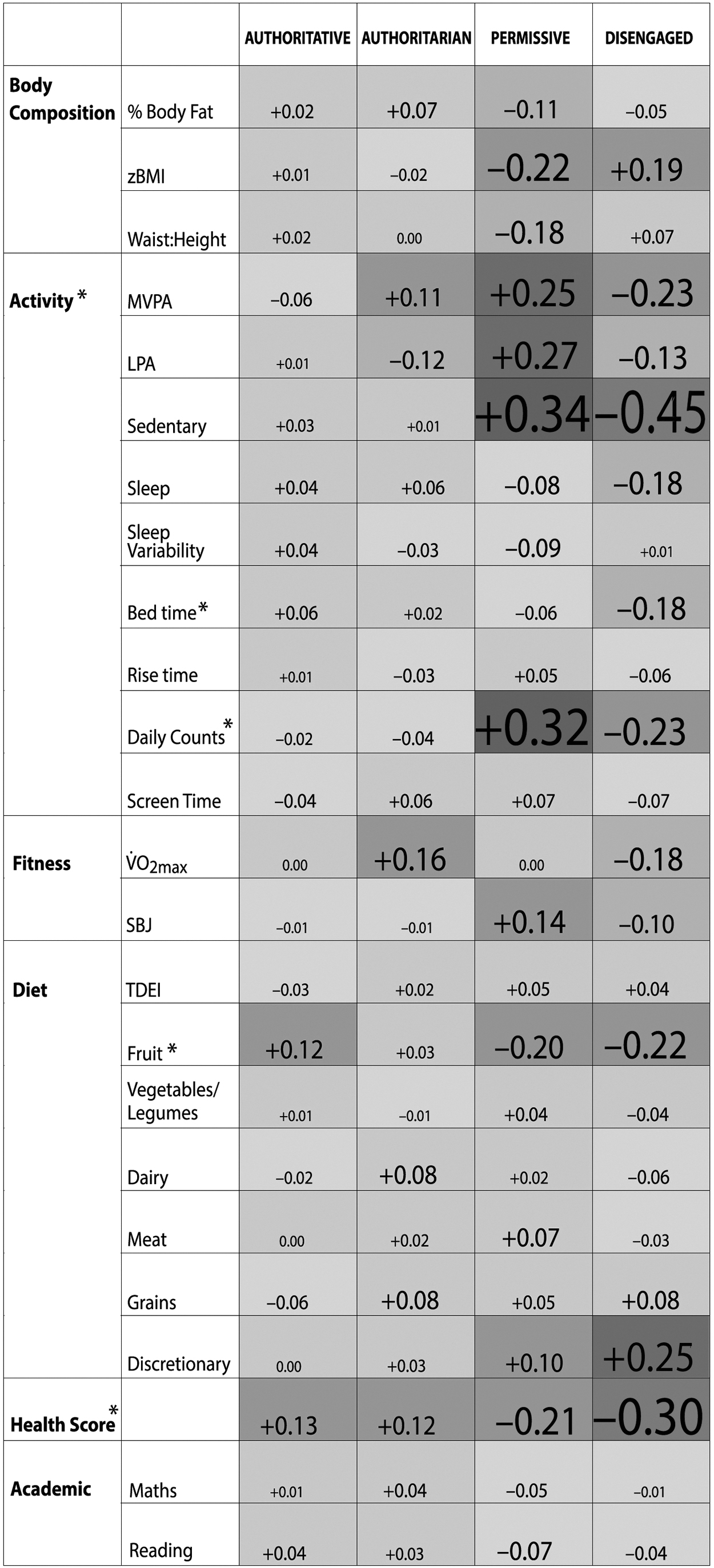
Effect sizes (standardized mean differences relative to the grand mean) for parenting styles for each outcome. The sign of the effect sizes has been adjusted so that positive effect sizes always represent better outcomes. The size of the font and depth of the color indicates the absolute magnitude of the effect size. Significant omnibus F-values are indicated by asterisks. LPA, light physical activity; MVPA, moderate to vigorous physical activity; SBJ, standing broad jump; TDEI, total daily energy intake; zBMI, BMI z-score.
Adjusted Means for Parenting Categories
Adjusted means averaged over age and over the levels of sex, socioeconomic status, and puberty.
Bold text denotes statistical significance at p < 0.05.
Additional adjustment for total waking wear time of accelerometer. Random intercepts for nested sampling at class, school, and wave level.
Additional adjustment for month of test. Random intercepts for nested sampling at class, school, and wave level.
CI, confidence interval.
Contrasts Across Parenting Style Categories
Bold text denotes statistical significance p < 0.05.
All models adjusted for age, sex, pubertal stage, and SEP category.
For compositional variables, 95% CIs were derived from bootstrap resampling and p-values were derived from these CIs following Altman DG 2011 (https://doi.org/10.1136/bmj.d2304). 66
Additional adjustment for total waking wear time of accelerometer. Random intercepts for nested sampling at class, school, and wave level.
Children with Authoritative parents were more likely to meet the dietary guidelines for fruit consumption (SMD = 0.12) when compared to children with Disengaged or Permissive parents. There were very few differences between parenting style groups and body composition, fitness, or academic achievement.
Discussion
Key Findings
This study was the first to examine associations between parenting style, body composition, fitness, and activity patterns using 24-hour accelerometry. In general, children with Permissive parents had better activity patterns (i.e., more MVPA and LPA, and higher overall energy expenditure). Conversely, children with Disengaged parents had worse activity patterns.
Literature has generally demonstrated inconsistent results regarding associations between parenting style and activity patterns. We found that children with Disengaged parents engaged in less MVPA (up to 20 min/days, SMD = −0.23), more sedentary behavior (up to 60 min/days, effect size [ES] 0.45), and had poorer overall health (difference up to 0.43 U, SMD = −0.30). On the contrary, children with Permissive parents had the most favorable activity patterns, demonstrated by higher daily MVPA and LPA and higher energy expenditure (SMD = 0.25–0.32). Others have also demonstrated that children with Permissive parents engaged in more MVPA12,13 and children with Uninvolved (i.e., Disengaged) parents engaged in less MVPA. 12 Permissive parenting styles are characterized by low control and high warmth.
Thus, it is plausible that children with Permissive parents may be allowed to engage in more free play, and the parents engage in more play with their children and hence accrue more physical activity. Although Disengaged parenting is also characterized by low control, it is also characterized by low warmth. Thus, it may be the combination of low control and high warmth that results in children accruing more physical activity. Others have suggested no relationship between parenting style and objectively assessed physical activity or sedentary behavior.14–16 Each of those previous studies used a different parenting style measure and sample characteristics differed between studies, making it challenging to draw confident conclusions about the relationship between parenting style and activity behaviors. It is also possible that other parental behaviors beyond parenting style, not assessed here, contribute to activity patterns, such as parental modeling of activity behaviors and parental encouragement.
In contrast to previous literature demonstrating Authoritative parenting was associated with healthier BMI, 8 our study found no differences between groups in terms of body composition. Previous studies have observed stronger associations for children aged <10 years (g = −0.16), compared with adolescents (g = −0.04), 8 possibly due to a shift of reference group from parents to peers as children become adolescents. Our sample included adolescents, providing a possible explanation for divergent results. Alternatively, it may be that parenting style has less of an impact on body composition compared with other behaviors. 4
We found that children with Disengaged parents were generally less likely to meet the dietary guidelines for fruit intake, while children of Authoritative parents were more likely to meet the dietary guidelines for fruit when compared to children with Disengaged or Permissive parents. Given the sizeable and consistent body of evidence supporting an association between Authoritative parenting and healthier dietary patterns in children,4,8,9 it was surprising that our study found no significant relationships between this parenting style and other dietary outcomes, such as vegetable and discretionary food and beverage intake.
Regardless, our findings are consistent with those of a recent review by Kiefner-Burmeister and Hinman, 4 which reported that authoritative parenting was associated with healthier eating in 9 of the 15 included studies. Methodological differences in the approaches used to measure parenting styles, dietary assessment methods (e.g., food frequency questionnaires or individual questionnaire items, rather than dietary recalls), and dietary outcome type (e.g., fruit and vegetable intake or snack intake only, or the use of an overall diet quality score) may explain differences in our findings compared to previous studies.
Strengths and Limitations
Our study examined all aspects of energy balance (dietary intake, daily activity patterns, including MVPA, LPA, sedentary behavior, and sleep), BMI, and parenting style. In addition, we used high-quality measurement tools, including 7-day, 24-hour accelerometry, and objective fitness tests with well-established reliability and validity and a standardized test of academic achievement. Our study used a very high-quality dietary assessment tool—a seven-pass recall. 44 Our representative sampling frame, recruited through randomly selected schools was a further strength. Although we had a representative sampling frame, recruited through randomly selected schools in high, medium, and low SEP strata, our sample was relatively highly educated, with 47% of parents having completed a university degree (compared to ∼40% for 30–44-year old Australians based on population data). 62 Thus, our findings may not be generalizable to families with less-educated parents.
In addition, dietary data were only collected for 1 day and were reported by parents, who may not be aware what food their child consumes when not under parental supervision. Social desirability bias may have also influenced responses to dietary intake. In addition, we did not include a parenting measure for both parents, which would have allowed for sex-specific parenting style associations to be explored. Some have suggested that mothers and fathers reported significantly different parenting practices (control, limit setting, monitoring, discipline, and reinforcement), and associations between parenting practices, adiposity, and related behaviors differed between mothers and fathers. 6 A further limitation included the potential for unmeasured confounding (e.g., number of siblings, parental working status, family dynamics). Finally, it is unclear whether findings can be generalized to other regions and age ranges.
Conclusion
Permissive parenting was associated with favorable activity patterns, while Disengaged parenting was associated with unfavorable activity patterns. The combination of high physical activity, high sleep, and low sedentary behavior is associated with a range of short- and long-term health benefits. 63 However, globally few (10% of children and 3% of adolescents) meet all three recommendations for physical activity, sleep, and sedentary behavior. 64 Thus, interventions promoting Permissive parenting, may improve children's activity patterns and associated health benefits. However, different parenting styles are associated with different outcomes. For example, an Authoritative parenting style is often associated with favorable outcomes for adiposity, diet, and academic achievement.4–8 Thus the parenting style for one outcome may not be the parenting style for another outcome.
Somewhat encouragingly, our results suggested that parenting style is not associated with many unmodifiable factors, such as socioeconomic status (SES), parental age, occupational classification, and family structure. Parenting style is sure to be influenced by a complex interaction between genetics, personality, parents' own childhood experiences, social, economic, and cultural factors, among other things. 65 Alternative study designs may help to shed light on the relationship between parenting style and lifestyle behaviors of children. Longitudinal studies, which follow children as they are adopted into families with differing parenting styles, and intervention studies with long follow-up periods would be illuminating.
Footnotes
Impact Statement
Research on associations between parenting style, obesity, and related behaviors is inconsistent and limited by measurement quality. We found Permissive parenting was beneficial, while Disengaged parenting was detrimental to children's objectively assessed activity patterns. Parenting style may be malleable; future interventions may target Permissive parenting to improve children's activity patterns. There were no associations for Authoritarian parenting style.
Authors' Contributions
T.O.: conceptualization, methodology, and writing—review and editing; C.Maher: conceptualization, methodology, and writing—review and editing; A.W.: writing—original draft, project administration, data acquisition, and data curation; F.F.: software, physical activity data analysis, and writing—review and editing; D.D.: writing—review and editing and formal analyses; CMauch: analysis of dietary data and writing—review and editing; G.R.T.: analysis of fitness data and writing—review and editing; T.F.—data curation and writing—review and editing. All authors approved the final article as submitted and agree to be accountable for all aspects of the work.
Funding Information
This project is funded by NHMRC project grant APP1143379 (2018–2022). Carol Maher is supported by a Medical Research Future Fund Investigator Grant GNT1193862 (2021–2025). D.D. is supported by a NHMRC (APP1162166) and Heart Foundation (APP102084) Early Career Fellowship (2019–2022), and by the Centre of Research Excellence in Driving Global Investment in Adolescent Health funded by NHMRC (APP1171981). The funding bodies played no role in the design, collection, analysis, and interpretation of data or in writing the article.
Author Disclosure Statement
No competing financial interests exist.