




Abstract


Angelina Jolie's self-disclosure of the BRCA1 gene mutation that led her to undergo a double mastectomy helped normalize the concept of genetic testing and counseling more than a year ago. Clinical practitioners agree that more patients are aware of genetic testing and counseling because of what has been called the “Angelina effect.”
Yet counselors are still grappling with numerous challenges to their roles that include ever-increasing amounts of data, addressing patient awareness of available services, matching patients with the best tests, and helping ensure that insurance pays for them.
Perhaps the most basic challenge: Genetic counsel for patients is as specific as their genes. And genetic knowledge has only in recent years unfolded to the degree that sound interpretation is even possible.
“The problem is that we're still on the road to being able to give a comprehensive view of what it is that we can tell somebody in a snapshot just based on their genome,” Elissa Levin, MS, CGC, head of genomics and integrative health innovations at Icahn School of Medicine at Mount Sinai, told Clinical OMICs.
“I really see the genome as a baseline background that we will essentially tap into at multiple different touch points throughout our life cycle. One of the challenges is, how do we do that?” added Levin, who is also assistant professor of genetics and genomic sciences at the Icahn Institute for Genomics and Multiscale Biology at Mount Sinai.
“How do we make the genome accessible across different practices, across different health systems, across different providers who also may not have knowledge about how to interpret genomic information or multivariate information?”
Do-it-yourself genetic testing firms pose a challenge to counselors by encouraging individuals to interpret their own data. Yet many DIY companies also offer access to counselors. 23andMe, for example, refers users to Informed Medical Decisions Inc. and its website, Informed DNA, as well as to the National Society of Genetic Counselors (NSGC). The company no longer offers health reports that provided interpretations about common genetic variants, after the FDA in November ordered 23andMe to stop selling its Saliva Collection Kit and Personal Genome Service.
Balancing Two Roles
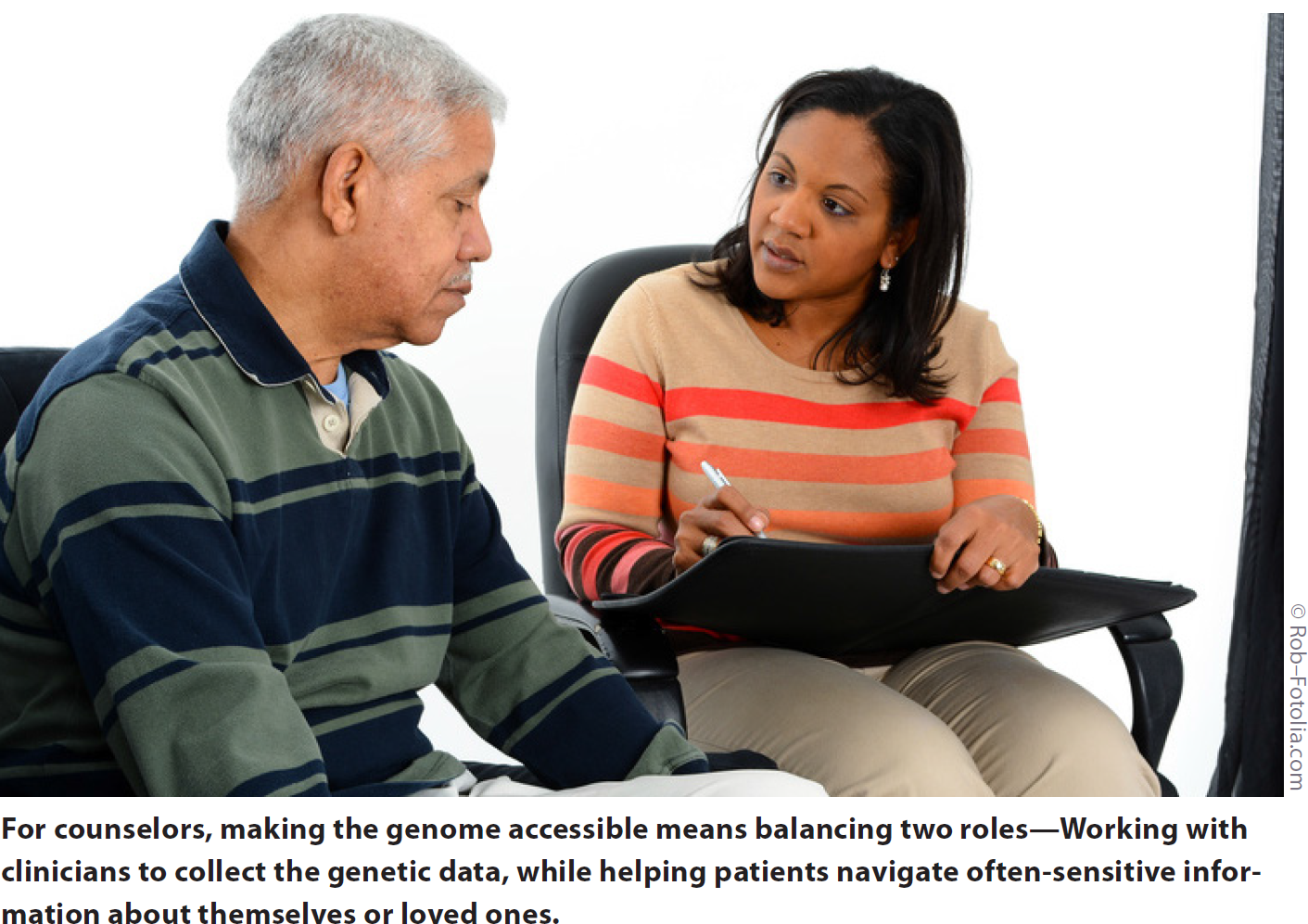
For counselors, Levin said, making the genome accessible means balancing two roles—working with clinicians to collect the genetic data, while helping patients navigate often-sensitive information about themselves or loved ones. That balance starts with training that focuses both on fundamental understanding of genetics and genomics, and on psychology.
“Interestingly, when you begin to apply those in a patient context, very often I find myself using some of the same skills, framed in a much more medical lexicon, if you will. It's the same process with many of the physicians, especially physicians who may be less familiar with genetic testing,” Levin said.
Counselors can be very helpful to physicians, she said, by helping them understand how genetic data will impact somebody's decision-making, with full understanding of the benefits, risks, and limitations of testing.
“We really find ourselves navigating many of the same subjects, but taking different tactics in working with both patient and provider. Fundamentally, it is an art. And I think one of the most important things for a counselor is really being comfortable talking about what can be very uncomfortable or challenging topics,” Levin added.
© Rob–Fotolia.com
Among those topics is insurance. Jennifer Hoskovec, MS, CGC, director, prenatal genetic counseling services at The University of Texas Medical School at Houston, told Clinical OMICs that counselors work with patients to secure coverage. That can mean helping provide medical documentation and a letter of medical necessity in conjunction with a physician.
“The first thing a genetic counselor can do is make sure that the right person is having the right test at the right time,” said Hoskovec, who is also president of the 3,000-member NSGC. “That in and of itself is going to be a more appropriate use of a test, so from an insurance perspective, there will hopefully have less of a risk of not being covered.”
Lack of time is another challenge faced by genetic counselors, she added. Many patients don't get pre-test counseling for a variety of reasons, resulting in more minutes being spent post-test explaining the outcome.
“When no pretest counseling is done, the post-test counseling can be significantly increased in terms of time, because there is a lot of preparation: What was this test for? What types of info is it aimed at? Here are your results. What may it mean for you or your family members? What does it not mean? What are the next steps? It could be very, very involved and time consuming,” Hoskovec said.
Shrinking Face Time
While 75% of genetic counselors told NSGC in its 2014 Professional Status Survey they spend 30 to 75 minutes with patients, Hoskovec says that has begun to change: “With reimbursement from insurance and genetic counselors having to justify their time in clinic, there sometimes is pressure about how much time you're spending face-to-face with a particular patient.”
“With the sheer volume of information that needs to be covered from some of these broad-based tests, that will remain the case, while in the world of healthcare, there's more pressure to spend maybe a little bit less time face-to-face and be more efficient with your time in clinic. That's a challenge,” Hoskovec said.
Counselors are responding, she added, by making more use of phone or telemedicine sessions, as well as sending patients educational videos and using face-to-face more for follow-ups.
Hoskovec and the 1,700-member American College for Medical Genetics and Genomics (ACMG) note that the counselors have traditionally functioned within larger teams involving families, physicians, lab professionals, nutritionists, social workers, and others.
“Throughout their history, genetic counselors have taken on the role of care coordinator. In a sense, the rest of medicine is just catching with this model—known to be interdisciplinary, patient- and family-centered care,” ACMG Medical Director David Flannery, M.D., FACMG, FAAP, and Judith Benkendorf, MS, CGC, special assistant to the executive director, told Clinical OMICs.
In a policy statement last year, ACMG suggested that responsibility for providing comprehensive pre- and post-test counseling to patients should rest with genetic test-ordering clinicians, who it said should alert patients to the possibility that clinical sequencing may generate incidental findings requiring further evaluation. Most U.S. states give doctors responsibility for lab tests, though a few license genetic counselors to order testing independently.
ACMG says the Angelina effect has raised awareness of the importance of genetic counseling while underscoring another challenge to counselors: Genetic testing is not appropriate or relevant for everyone. Breast cancer is multifactoral; the BRCA genes are only responsible for a small percentage of cases. And counselors have long faced uncertainty and unexpected findings, from non-paternity to the non-inherited, never seen-before chromosome translocations in prenatal diagnoses involving advanced maternal age.
“Each of these situations requires counseling and communication skills. These same skills are now being applied in more complex situations as a result of genomic testing Dr. Flannery and Benkendorf said. “Now, when whole exome sequencing is used to arrive at a diagnosis for a symptomatic patient, there is a possibility that the patient will be found to have changes in other genes that could have serious health consequences.
“Pretest genetic counseling is critical to prepare patients for all possible consequences and related implications so that they make an informed decision, best suited to their goals and needs. Likewise, post-test genetic counseling is equally as important,” the ACMG officials added.