




Abstract

Bringing molecular testing to the clinic is now easier than in past years, thanks to deeper knowledge about the genome and gene variants, increased automation and efficiency, user-friendlier technology, and improved methods to monitor quality.
Incorporating these and other basics into a successful molecular diagnostics (MDx) lab requires clinicians to address opportunities and challenges much as in creating any other lab. In many cases, that means managers must develop business plans that show administrators how their MDx lab intends to succeed clinically and financially. There's a lot of competition: More than 600 medical laboratories nationwide, plus another 200 independent labs, carry out molecular diagnostics tests.
Linnea M. Baudhuin, Ph.D., DABMG, a clinical molecular geneticist at Mayo Clinic, told Clinical OMICs that those business plans will need to address which sub-market or sub-markets the lab will serve: infectious disease, hematology/oncology, molecular genetics, or pharmacology and pharmacogenomics (PGx)?
Labs must also plan out their testing menus both when it comes to inherited disorders, with a focus on finding variants that may require next-generation sequencing to be carried out; as well as PGx testing, focused on looking for benign variants associated with altered response to medication.
While there is a large and growing list of candidates for PGx testing, Dr. Baudhuin said labs should be aware that many PGx tests—including many focused on inherited disorders tests—will need to be laboratory developed tests (LDTs) and therefore, which will require labs to expend resources for test development and validation.
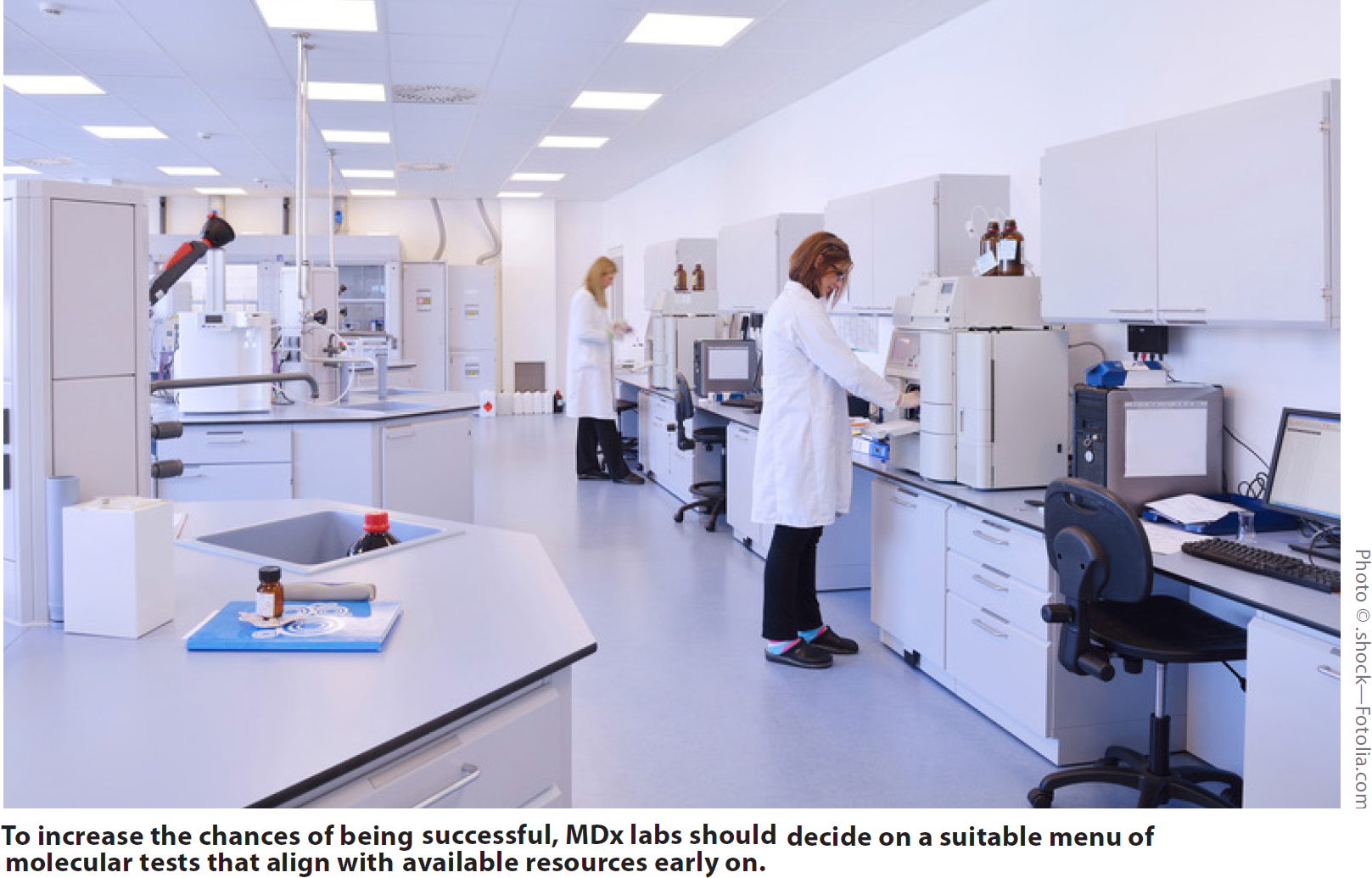
Photo © .shock—Fotolia.com
Dr. Baudhuin said MDx labs can enhance their chances of clinical success if they:
Decide on a suitable menu of molecular tests that align with available development, verification, and implementation resources
Identify quality assurance and quality control (QA/QC) issues and guidelines tailored to MDx
Understand regulatory compliance requirements specific to molecular testing
Anticipate and troubleshoot challenges likely to arise after implementation, with an eye to emulating best practices, just as any other type of lab would do, and
Develop strategies for maximizing reimbursement for molecular assays
“Clinical laboratories will need to take into consideration many factors, including market, local patient and physician needs, potential volume, and methodology when deciding upon their testing menu,” said Dr. Baudhuin, who is co-director of Cardiovascular Laboratory Medicine at Mayo, as well as co-director of the Clinic's Personalized Genomics Laboratory and Clinical Genome Sequencing Laboratory.
Dr. Baudhuin was among speakers who discussed the challenges of integrating molecular diagnostics at “Bringing Molecular Testing into the Clinical Lab,” a course presented May 29–30 by the American Association for Clinical Chemistry (AACC). The course was designed to offer practical advice and tools from lab leaders and colleagues about the challenges of implementing molecular testing in the clinical lab, and how they can be best overcome.
A Matter of Logistics
One set of challenges, Dr. Baudhuin said, involves the logistics of the laboratory. A startup lab might consist of two to three techs, several PCR-based assays, within 500 to 1,000 square feet of dedicated space. A more established lab, however, may need five or more techs and a broader testing menu and at least 1,000 to 1,500 square feet.
Within the labs, there should at minimum be separate pre- and post-PCR areas, a unidirectional workflow, and physically separate labs for reagent prep, specimen receipt and prep, PCR setup and amplification, and amplified DNA product analysis.
Start-up laboratories should go for the low-complexity, heavy-hitter tests first—such as infectious disease tests that are FDA-approved and/or involve closed-system platforms— and streamline their methodologies to limit the number of platforms they use. Laboratories can branch out to expand their menu and methodologies as they become more established and experienced, Dr. Baudhuin said.
“Laboratories need to be careful in that they don't take on testing methodologies that are more complex than they are prepared for, or that they don't include tests for disorders for which they are not staffed to provide qualified clinical and technological review,” Dr. Baudhuin added.
They also need to learn perhaps the most important how-to for any lab— how to use limited resources wisely.
“That is an issue I think all of the molecular labs are dealing with, because there are more and more tests being requested—for example, genetic tests and tumor profiling tests,” said John Greg Howe, Ph.D., director of the Molecular Diagnostics Laboratory and an associate professor at Yale University School of Medicine. Dr. Howe's lab performs testing in hematopathology, genetics, and pharmacogenetics.
Send-Out vs. In-House
One answer to limited resources is choosing which tests should be carried out in-house, and which can be sent-out to an external lab. Just as it takes more money to eat out vs. dining in, send-outs are costlier than in-house tests.
How much more depends on the test, with labs having to balance disparities between external “reference” lab costs, in-house costs of carrying out the same tests—and what Medicare expects to pay for it, Andrea Ferreira-Gonzalez, Ph.D., director of the Molecular Diagnostics Lab, chair of the Division of Molecular Diagnostics and professor of pathology at Virginia Commonwealth University, explained during another presentation within the AACC course.
“One of the problems that I've seen is that there are lots of tests being sent out, but each of them is a low-volume test,” Dr. Howe said. “The question is, how do you deal with that? Generally, you try to bring in the tests that are the highest volume.”
That's easier said than done, she added: “The problem is, I don't think any one lab can do all these tests. It really depends on the ability of the lab to set up the tests, and then to sign them out. Some of these tests can be quite specific in that some knowledge of what the gene is that is involved, or the genes, and the particular diseases.”
Sometimes, one of the limiting factors is the actual expertise to sign out tests for further study once the MDx lab finds a mutation. Another factor is the ability to do the testing in a matter that is efficient and cost effective—a task complicated by the fact many labs compete with other labs employing more technically-skilled people.
The skill sets of a lab will sway decisions on in-house vs. send-out tests. While that is less evident in sequencing, where technologies are the same despite differences in genes being sequenced, according to Dr. Howe, “then you run up against the problem of signing them out properly, with having expertise in a particular disease area that these tests are being used for.”
“There are many potential obstacles to bringing PGx tests in house, including the need for clinical and technical expertise in the laboratory, potential for low uptake (i.e. volume), need for rapid turn-around, and issues with test reimbursement,” Dr. Howe added.
Since there are multiple platforms that can be considered for PGx testing, labs also need technical expertise for proper evaluation to determine which platforms are most suitable for each individual laboratory. The technical expertise is also needed for development and validation of the PGx tests that need to be CLIA-validated laboratory developed tests, since the FDA has approved only a few MDx tests.
That is expected to change over the next decade as the march of molecular diagnostics into the clinic continues. While projections vary depending on the source, the size of the MDx market is expected to rise during this decade, driven by expanded use of tests and expected increases in cancer and infectious disease. The market is projected to grow from its 2013 level—$4.476 billion (Grand View Research) or $5.5 billion (Kalorama Information)—to $8.02 billion by 2020 (Grand View), or an even rosier $8.7 billion by 2019 (Transparency Market Research).